Published on : 07 Oct 2026
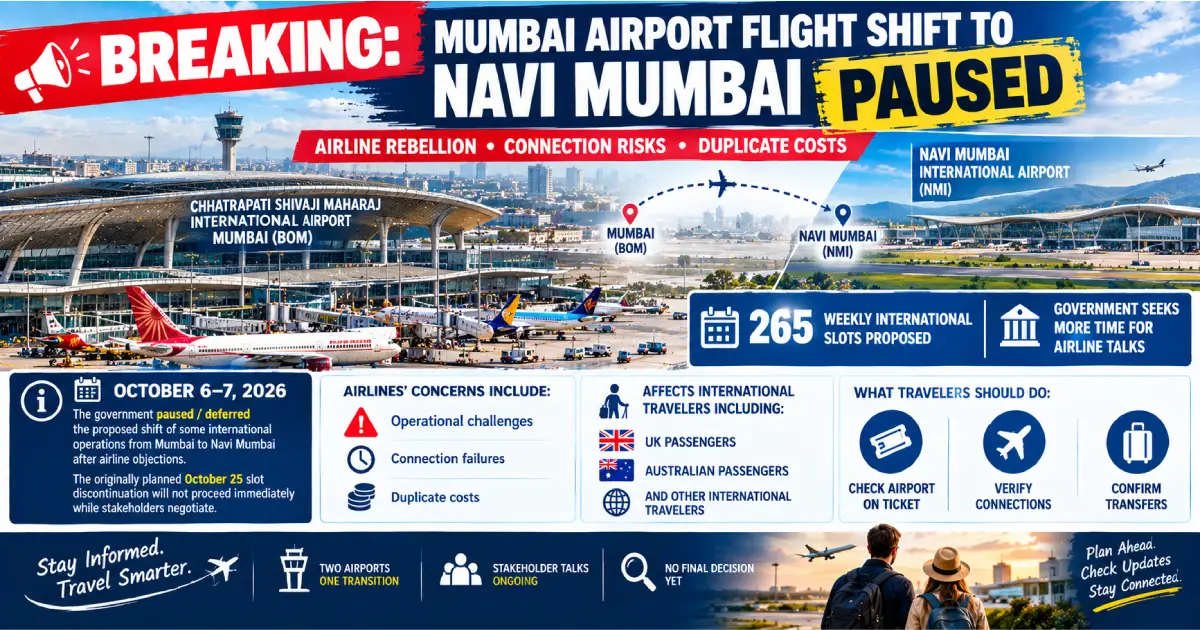
Breaking: A planned transfer of flights from Mumbai’s Chhatrapati Shivaji Maharaj International Airport (BOM) to the newly constructed Navi Mumbai International Airport (NMIA) has been paused after a coordinated rebellion by airline operators at a stakeholder meeting in Delhi on Tuesday October 6, 2026. The Navi Mumbai airport flight shift has been paused as airlines raise disruption concerns following the meeting, attended by airline operations heads, Adani Airport Holdings, the Airports Authority of India, the Federation of Indian Airlines, and domestic airline operators. Mumbai International Airport had informed airlines that some Terminal 2 slots would be temporarily discontinued from October 25 to support the proposed transition. The airlines’ response was unambiguous and unified: the plan as structured would create unacceptable operational chaos.
For UK passengers — who use Mumbai as the primary gateway to India and as a connecting hub for flights onward to South Asia — and for Australian passengers — for whom Mumbai sits on the direct routing between Australia and Europe via the Gulf and Indian subcontinent — this story is not abstract aviation policy. It is a direct threat to the reliable operation of the routes they fly. The potential for connection failures between a major international airport and a secondary facility 35–40 kilometres away, on roads in one of the world’s most congested cities, would make Mumbai one of the most difficult connecting hubs in Asia for international travellers. The pause gives airlines the breathing room to demand a workable transition plan — but the October 25 slot discontinuation at Terminal 2 was already days away when the meeting happened. Here is everything you need to know.
Published: October 7, 2026 — Wednesday What Happened: Flight shift from Mumbai BOM to Navi Mumbai NMIA paused after airline opposition Meeting Date: Tuesday October 6, 2026 — stakeholder meeting, Delhi Attendees: Airline operations heads | Adani Airport Holdings | Airports Authority of India | Federation of Indian Airlines | Domestic airline operators What Was Proposed: Some Mumbai Terminal 2 slots discontinued from October 25 to support Navi Mumbai transition Why Airlines Objected:
The October 6 Delhi stakeholder meeting was called to advance the transition planning for shifting some flight operations from Mumbai’s existing Chhatrapati Shivaji Maharaj International Airport (BOM) to the new Navi Mumbai International Airport — a project backed by Adani Airport Holdings, which operates both facilities. The specific proposal on the table was the discontinuation of some Terminal 2 slots at BOM from October 25, 2026 — effectively the first concrete step toward migrating flight operations to the new airport.
The airlines did not simply raise concerns. They raised enough concerns to halt the process entirely. The meeting’s outcome — the pause — reflects the severity and unanimity of the objections. When an industry federation, domestic operators, and international carriers all align against a transition plan at a stakeholder meeting, airport operators and regulators cannot proceed without addressing the underlying issues.
The Federation of Indian Airlines — representing IndiGo, Air India, SpiceJet, Akasa Air, and other domestic carriers — was among the bodies present. International carrier operations heads also attended. The breadth of representation means this was not one airline’s complaint. It was a sector-wide rejection of the transition timeline and structure as proposed.
The most fundamental operational objection raised by airlines is the physical distance between Mumbai BOM and Navi Mumbai NMIA — approximately 35 to 40 kilometres. On paper, this does not sound dramatic. In Mumbai traffic reality, it is potentially catastrophic for connecting passengers.
Mumbai is among the most congested cities in the world by road traffic density. The journey between the two airports — on roads that traverse multiple suburban districts, cross the Thane Creek, and are subject to monsoon flooding, peak-hour gridlock, and unpredictable traffic events — takes anywhere from 60 minutes in off-peak conditions to 3 hours or more during peak periods. There is no direct rail link between BOM and NMIA. The proposed Navi Mumbai Metro connection is not yet operational.
For a passenger on an international arrival at BOM who needs to connect to a domestic departure at NMIA, or vice versa, the minimum connection time would need to be at least 3–4 hours to have a reasonable probability of success. This effectively destroys the viability of same-day international-to-domestic connections through Mumbai — one of the most important connection flows at India’s second-busiest airport.
For international transit passengers — flying, for example, from London to Mumbai on British Airways and then onward to Colombo or Bangalore — the split-airport scenario creates connections that would require either extreme minimum connection times or rebooking of the entire itinerary.
Splitting international flights between two airports around 35 to 40 kilometres apart could make domestic-to-international and international-to-international transfers more difficult, while requiring airlines to duplicate ground staff, engineering teams, spare-part inventories and crew logistics.
This cost dimension is why airlines of every size and type — from IndiGo on the domestic side to British Airways on the international side — have aligned in opposition. Operating from two airports in the same city is not simply twice the cost of one airport. It is significantly more complex:
Ground staff duplication: Every airline that operates at both BOM and NMIA needs check-in staff, gate agents, ramp agents, and customer service personnel at both locations. For a carrier like Air India that operates extensive international and domestic services, this represents a significant headcount increase.
Engineering teams: Aircraft maintenance line stations must be established at both airports. Technicians, tools, and spare parts cannot be easily shared across 35–40 kilometres of Mumbai traffic.
Spare-part inventories: Aviation regulations require minimum on-site spare parts for aircraft types operating at a given airport. A carrier operating Boeing 737s at both BOM and NMIA needs to maintain two separate minimum parts inventories — doubling the capital tied up in spares.
Crew logistics: Pilots and cabin crew positioning between two airports — for early morning reporting, overnight layovers, or standby duties — requires either multiple crew hotels near both airports or expensive transfer arrangements. For a 24-hour operation, this adds complexity and cost that ultimately feeds into ticket prices.
One issue that received less attention in initial coverage but is critically important for passengers is the IATA code problem. Mumbai’s existing airport operates under the code BOM. Navi Mumbai will operate under a separate code — NMIA. When passengers book tickets, they book to and from specific airport codes. A passenger who books a connection through “Mumbai” may find that their inbound flight arrives at BOM and their outbound flight departs from NMIA — without any clear indication in the booking that a 35–40 km inter-airport transfer is required.
This is exactly the situation that created chaos at London-area airports (Heathrow/Gatwick/Stansted/Luton/Southend) for decades — where passengers booking “London” connections discovered too late that their two flights operated from airports 50+ km apart. Mumbai’s split would replicate this problem in one of Asia’s most congested cities.
Mumbai is the UK’s primary gateway to India by volume — second only to Delhi for India-UK traffic but the dominant hub for passengers travelling to Maharashtra, Gujarat, Goa, and the business travel market connecting London to India’s commercial capital.
British Airways operates London Heathrow → Mumbai (BOM) as one of its most important long-haul routes — multiple daily frequencies, operated by Boeing 787 Dreamliners. BA passengers connecting through Mumbai to domestic Indian destinations (Goa, Pune, Hyderabad, Chennai) use Mumbai as their hub. A split-airport scenario would break many of these connections.
Virgin Atlantic operates London Heathrow → Mumbai services. Same connection concerns apply.
Air India operates extensive London Heathrow → Mumbai and London Heathrow → Delhi services, with Mumbai as a major hub. Air India, as India’s flag carrier, was among the operators present at or represented at the October 6 meeting.
What the pause means for UK passengers with upcoming Mumbai bookings:
✅ October 25 Terminal 2 slot discontinuation: now paused — your BOM-operated flight should continue operating from BOM for now ✅ No confirmed date for any future transition — monitor thiaairways.com / airlines’ websites ✅ No action required today — the pause means the status quo continues for now ⚠️ Monitor your booking — if any airline reroutes your flight from BOM to NMIA in future, you have a right to a full refund or free rebooking under UK261
Mumbai is the key connection point for Australian passengers travelling to South Asian destinations — India, Sri Lanka, Nepal, Bangladesh, Pakistan — that are not directly served from Australian cities. Qantas and Virgin Australia do not operate direct Australia–India services beyond Delhi and a limited number of direct routes. Most Australian passengers reaching Mumbai do so via Dubai (Emirates, Qantas codeshare), Doha (Qatar Airways), Singapore (Singapore Airlines, Qantas), or Kuala Lumpur (Malaysia Airlines, AirAsia).
For Australian passengers arriving at Mumbai BOM from Dubai or Singapore and connecting onward to domestic India, a split-airport situation would be even more severe than for UK passengers — because Australian passengers typically arrive on international carriers that would need to know in advance which Mumbai airport they are using, and book their domestic connections accordingly.
What the pause means for Australian passengers: ✅ Current BOM operations unchanged — pause protects your existing booking ✅ Qatar Airways, Emirates, Singapore Airlines services to Mumbai BOM continue as scheduled ⚠️ If you have India travel planned for late October or November 2026: monitor airline announcements for any transition updates
| Metric | Value |
|---|---|
| Mumbai BOM annual passengers | ~55 million |
| Mumbai BOM rank in India | 2nd busiest (after Delhi) |
| Mumbai BOM rank globally | Top 30 by international traffic |
| Distance BOM → Navi Mumbai NMIA | ~35–40 km by road |
| Estimated road transfer time (peak) | 90 minutes to 3+ hours |
| Current rail connection between airports | None |
| Airport operator | Adani Airport Holdings |
| Key UK carriers at BOM | British Airways, Virgin Atlantic, Air India |
| Key Australian connection carriers | Emirates, Qatar Airways, Singapore Airlines, Air India |
| Terminal 2 slot discontinuation proposed | October 25, 2026 — NOW PAUSED |
Navi Mumbai International Airport — also referred to as NMIA or Navi Mumbai Greenfield Airport — is a major new aviation infrastructure project being developed by Adani Airport Holdings on reclaimed land in Navi Mumbai, on the eastern side of Thane Creek from Mumbai city. The airport has been under construction for several years and is designed to provide relief capacity for Mumbai BOM, which has been operating beyond its comfortable capacity for years and has very limited room for physical expansion on its existing site.
NMIA is intended to be a world-class facility capable of handling significant passenger volumes once fully operational. In the long term, the case for a second Mumbai airport is strong — the city is India’s commercial capital, handles enormous domestic and international traffic, and BOM’s physical constraints mean it cannot grow to meet India’s rapidly expanding aviation market.
The problem is not whether Navi Mumbai airport should exist. It is whether the transition from BOM to NMIA can be managed without creating the connection chaos, booking confusion, and cost duplication that airlines raised at the October 6 meeting. The pause is not a cancellation of the project — it is a recognition that the October 25 timeline was not achievable without addressing these concerns first.
The pause does not specify a new transition date. Airlines have effectively forced Adani Airport Holdings and the Airports Authority of India back to the planning stage to develop a transition framework that addresses:
Until these issues are resolved and a new agreed timeline is published, Mumbai BOM continues to operate normally. The October 25 Terminal 2 slot discontinuation is paused.
Under UK261 (for UK passengers) and under general contract law for all passengers: if an airline significantly changes your departure or arrival airport after booking — including moving your flight from BOM to NMIA — you have the right to:
✅ Full cash refund — if the airport change is significant (35–40 km constitutes a significant change) ✅ Free rebooking on the next available service from your original airport (BOM) ❌ You are not required to accept a flight from a different airport without compensation
The exact phrase: “My booking was for a flight operating from Mumbai BOM. The change to Navi Mumbai NMIA constitutes a significant departure airport change. Under [UK261/my booking terms], I am requesting a full cash refund or free rebooking from BOM.”
The pause means your existing Mumbai BOM booking is not affected today. No action is required from passengers for October or November travel. Monitor:
| Resource | Contact / Link |
|---|---|
| British Airways Mumbai | ba.com |
| Virgin Atlantic | virginatlantic.com |
| Air India UK | airindia.com |
| Air India Australia | airindia.com |
| Emirates (via Dubai to BOM) | emirates.com |
| Qatar Airways (via Doha to BOM) | qatarairways.com |
| Singapore Airlines (via SIN to BOM) | singaporeair.com |
| Mumbai Airport BOM Live | csia.in |
| FCDO India Travel Advice | gov.uk/foreign-travel-advice/india |
| Smartraveller India | smartraveller.gov.au/destinations/asia/india |
| UK CAA UK261 Passengers | caa.co.uk/passengers |
The planned shift of some Mumbai flight operations to Navi Mumbai International Airport has been paused after a unified airline rebellion at a Delhi stakeholder meeting on October 6, 2026. Airlines raised three fundamental objections: the 35–40 km road distance between airports makes domestic-to-international connections unviable in Mumbai’s traffic conditions; operating from two airports simultaneously requires duplicating ground staff, engineering teams, spare parts, and crew logistics at enormous cost; and the booking system complexity of two separate IATA-coded Mumbai airports risks passenger confusion and missed connections.
The October 25 Terminal 2 slot discontinuation at BOM — which would have been the first concrete step in the transition — is now paused with no confirmed new date. For UK passengers flying British Airways, Virgin Atlantic, or Air India to Mumbai, and for Australian passengers connecting through Mumbai via Emirates, Qatar, or Singapore Airlines, this pause means your BOM operations continue as scheduled. No immediate action is required.
Watch this story. When Adani Airport Holdings and the AAI publish a revised transition plan addressing the airlines’ concerns, a new October 25-style deadline will emerge — and at that point, passengers with Mumbai bookings will need to verify which airport their specific flights operate from.
For More Resources:
Related Articles:
Posted By : Vinay
This article is provided for general informational purposes only and is based on information available at the time of publication. Travel advisories, airline schedules, airport operations, visa requirements, government regulations, and other travel-related information are subject to change without prior notice. While Travel Tourister makes reasonable efforts to verify information using official announcements, government publications, airline and airport communications, and other reliable sources, we cannot guarantee that all information remains complete, accurate, or up to date at all times. Readers should independently verify any information that may affect their travel plans with the relevant airline, airport authority, government agency, embassy, or other official source before making travel, financial, or other decisions. Travel Tourister shall not be liable for any direct or indirect loss, inconvenience, or damages arising from the use of or reliance on the information contained in this article. Nothing in this publication constitutes legal, immigration, financial, or professional travel advice. If you believe any information in this article is inaccurate or outdated, please contact our editorial team. We review all credible correction requests promptly and update our content whenever appropriate.
Lastest News
2nd Floor, 39, Above Kirti Club, DLF Industrial Area, Kirti Nagar, New Delhi, Delhi 110015



Travel Tourister is a leading Travel portal where we introduce travellers to trusted travel agents to make their journey hasselfree, memorable And happy. Travel Tourister is a platform where travellers get Tour packages ,Hotel packages deals through trusted travel companies And hoteliers who are working with us across the world. We always try to find new and more travel agents and hoteliers from every nook and corners across the world so that you could compare the deals with different travel agents and hoteliers and book your tour or hotel with the one you have chosen according to your taste and budget.
Copyright © Travel Tourister, India. All Rights Reserved

 Call
Call Enquiry