Published on : 10 Oct 2026
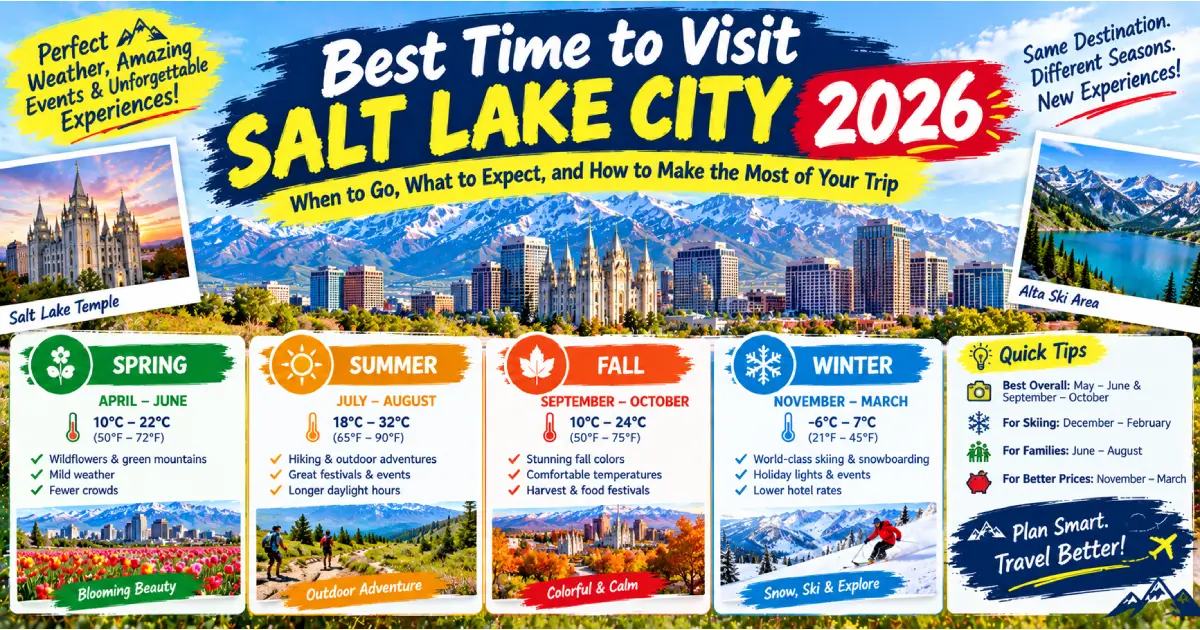
Salt Lake City is one of the most genuinely year-round destinations in the American West — a city that offers dramatically different and equally compelling experiences depending on when you arrive. In winter, the Greatest Snow on Earth falls on ski resorts within 45 minutes of downtown, making SLC one of the world’s great ski gateway cities. In spring, the Wasatch foothills erupt in wildflowers while the city itself comes alive with outdoor dining, farmers markets, and the first hiking trails of the season. Summer brings dry, sunny days ideal for canyon exploration, while autumn delivers golden aspen groves and the kind of crisp, clear air that makes every mountain view feel sharper and more vivid.
Understanding when to visit Salt Lake City depends entirely on why you’re coming. Skiers and snowboarders should plan for January through March, when snowpack is deepest and the resorts at Alta, Snowbird, Park City, and Deer Valley are operating at peak capacity. But for non-skiers, the calculus is different: late May through early June offers wildflower season and moderate temperatures before the summer heat arrives; September and October deliver the most perfect overall conditions, with warm days, cool nights, and the extraordinary gold of autumn aspens on every canyon wall. The shoulder seasons reward visitors with fewer crowds, better hotel rates, and the kind of uncrowded outdoor access that’s impossible in peak ski season.
Salt Lake City sits at 4,226 feet elevation — higher than Denver — which moderates summer temperatures compared to cities at lower elevations. July and August can bring afternoon temperatures into the 90s°F, but the low humidity means heat feels manageable, evenings cool quickly, and canyon drives provide immediate relief. The city receives 2,500+ hours of sunshine annually, making rain a rarity that mostly appears as brief afternoon thunderstorms in summer. Understanding the rhythm of the seasons here will help you make the most of whatever time you have.
| Season | Months | Avg Temp | Crowds | Best For |
|---|---|---|---|---|
| Winter | Dec–Mar | 25–40°F | High (ski) | Skiing, snowshoeing, winter festivals |
| Spring | Apr–May | 45–65°F | Low | Wildflowers, hiking, fewer crowds |
| Summer | Jun–Aug | 65–95°F | Moderate | Canyon hikes, Great Salt Lake, outdoor events |
| Fall | Sep–Nov | 40–70°F | Low–Moderate | Aspens, hiking, best overall conditions |
Best Overall Months: September and October Best for Skiing: January and February Avoid (if possible): Mid-July to mid-August (peak heat, highest hotel prices)
Peak ski season — the best powder on the continent
January is the pinnacle of ski season in Salt Lake City. The Wasatch Range typically receives its heaviest snowfall between late December and early February, and the resorts east of the city — Alta, Snowbird, Brighton, Solitude — are operating at full capacity with maximum terrain open. The phrase “Greatest Snow on Earth” is not hyperbole: Utah’s legendary light, dry powder (averaging 500 inches at Alta annually) is world-famous, and January powder days can dump 18–24 inches overnight.
Downtown SLC in January is cold but manageable — temperatures average 25–40°F, with occasional lows below 20°F. The city infrastructure handles winter well, and the Wasatch mountains to the east create dramatic backdrops on clear days. Hotel rates in Salt Lake City peak in January; book 3–4 months ahead for ski season weekends. The Sundance Film Festival (Park City, 40 miles away) runs the final two weeks of January and can complicate accommodation availability.
Average High/Low: 37°F / 20°F Precipitation: 1.3 inches (mostly snow at elevation) Crowds: Very high (ski resorts), moderate (city attractions) Events: Sundance Film Festival (Park City, late January)
Deep winter, excellent skiing, coldest temperatures
February is statistically the coldest month in Salt Lake City and also among the best for skiing. Snowpack is typically at its peak, the resorts are fully open, and weekday skiing offers resort access without the weekend crowds that define January. Temperatures in the city range from 22–42°F, with wind chill making it feel colder; the mountains are correspondingly colder, so proper layering is essential.
The city itself is quiet in February — museum visits, world-class dining, and the vibrant indoor food and drink scene make for a satisfying city experience alongside the skiing. The Jazz play at home during February; catching an NBA game at the Delta Center is an excellent evening activity. Presidents Day weekend (third weekend of February) is the busiest ski weekend of the year — avoid it or book many months in advance.
Average High/Low: 42°F / 25°F Precipitation: 1.1 inches Crowds: High (resorts), moderate-low (city) Events: NBA Jazz home games; Presidents Day ski weekend
Late ski season meets early spring in the city
March is a transitional month that rewards visitors with excellent late-season skiing AND the first hints of spring in the city. The snowpack remains excellent at higher elevations — Alta and Snowbird often have their best conditions of the year in March when settled snowpack provides a consistent base under new snowfall — while the valley begins to warm. By late March, temperatures in the city reach the 50s°F on sunny days.
Alta typically closes in late April, Snowbird even later (sometimes into June), making March a viable ski month with increasingly pleasant weather in between runs. The ski season shoulder (mid-March onward) also brings better hotel rates and shorter lift lines as the hardcore January crowd thins out. Utah’s cherry blossoms begin to emerge in late March in sheltered city neighborhoods.
Average High/Low: 52°F / 30°F Precipitation: 1.6 inches Crowds: Declining (resorts), low (city) Events: St. Patrick’s Day events; early wildflower activity in sheltered spots
Spring arrives — wildflowers, lower prices, perfect hiking weather
April is one of the best-kept secrets in Salt Lake City travel. Ski season is winding down (higher resorts still open), temperatures are climbing toward 60°F in the city, and the Wasatch foothills begin their spectacular spring bloom. Red Butte Garden opens for the season in earnest with early bulbs and flowering trees. City Creek Canyon — an urban trail literally minutes from Temple Square — becomes a morning birding haven as migrants move through.
Accommodation rates drop significantly from ski season peaks, and the city’s restaurants and attractions are far less crowded. The weather in April can be unpredictable — expect some rain and cool periods — but the sunny days are glorious. This is the last chance to ski (Snowbird sometimes operates into late April) while also enjoying spring in the valley.
Average High/Low: 60°F / 37°F Precipitation: 2.1 inches (highest of the year) Crowds: Low Events: Spring wildflower season begins; Jazz playoff push
The wildflower peak — one of the best months to visit
May is arguably the single best month to visit Salt Lake City if you’re not coming to ski. Temperatures are warm but not hot (65–75°F most days), the mountains are dramatically green, and wildflower season reaches its peak in the foothills and lower canyons. Donut Falls in Big Cottonwood Canyon is at its most spectacular in May, fed by snowmelt, and the trail to it is fully open. Red Butte Garden’s tulips and early perennials are extraordinary.
The city’s outdoor culture fully wakes up in May: the Farmers Market at Pioneer Park opens its season, outdoor restaurant patios fill up, and the cycling and running trails around the city are crowded with locals enjoying the perfect conditions. Hotel rates remain low, crowds at attractions are manageable, and the combination of warm days and cool nights is ideal for exploring. May is also when the Jordan River Parkway — a flat, paved multi-use trail — becomes the evening exercise artery of the city.
Average High/Low: 72°F / 47°F Precipitation: 1.7 inches Crowds: Low–Moderate Events: Farmers Market opens (mid-May); SLC Marathon (early May); Red Butte Garden concerts season begins
Summer begins — long days, canyon access, outdoor events
June marks the beginning of Salt Lake City’s outdoor summer season in earnest. Temperatures in the city reach the upper 70s to mid-80s°F, ski resorts close (Snowbird is the last to shut), and the focus shifts entirely to summer recreation. The Wasatch canyons — Big Cottonwood, Little Cottonwood, Millcreek, City Creek — offer hiking and mountain biking at their most accessible, with trails typically snow-free from late June onward at most elevations.
The Great Salt Lake’s summer season begins in June; Antelope Island State Park is at its most accessible and the brine shrimp population attracts enormous flocks of migratory birds. Red Butte Garden’s summer concert series begins in June and draws major national acts to its outdoor amphitheater — one of the best concert venues in the Mountain West. Summer days are long (sunset after 9pm in late June), maximizing exploration time. The heat is manageable compared to desert cities like Phoenix or Las Vegas.
Average High/Low: 85°F / 57°F Precipitation: 0.8 inches Crowds: Moderate Events: Red Butte Garden concerts (through September); Twilight Concert Series begins; Utah Pride Festival (early June)
Peak summer — hot afternoons, afternoon thunderstorms, high prices
July is the hottest month in Salt Lake City, with average highs reaching 93°F and heat indices occasionally pushing into triple digits. The low humidity keeps it more comfortable than coastal cities at the same temperature, but afternoon heat between noon and 5pm is genuinely intense. Plan outdoor activities for early morning or evening; canyon drives and higher-elevation hikes (above 8,000 feet) provide relief.
The city is busy in July with summer tourism — Park City and Sundance resort areas draw visitors, and major outdoor events fill the calendar. The Pioneer Day holiday on July 24th is Utah’s biggest annual celebration, marking the arrival of Mormon settlers in 1847; the parade in Salt Lake City is one of the largest in the western United States and an interesting cultural event for visitors. Afternoon thunderstorms — brief, intense, usually finished within an hour — are common in July and August.
Average High/Low: 93°F / 65°F Precipitation: 0.7 inches Crowds: High Events: Pioneer Day (July 24) — parade, fireworks, citywide celebration
Still hot — best for Bonneville Salt Flats Speed Week
August mirrors July in temperature and crowds, with slightly increasing afternoon thunderstorm frequency. The primary reason to specifically target August is Speed Week on the Bonneville Salt Flats (mid-August), when land speed records are attempted on the ancient lake bed 100 miles west of the city. It’s one of the most extraordinary spectacles in American motorsports culture and draws enthusiasts from around the world.
The Great Salt Lake’s water levels drop to their summer minimum in August, exposing large salt flats on Antelope Island and concentrating the brine shrimp population. Park City’s Mountain Resort runs its summer activities — mountain biking, gondola rides, outdoor events — through August. Red Butte Garden concerts continue. If you’re visiting in August, prioritize early morning or evening activities and use the midday heat for museum visits, gallery time, and long lunches.
Average High/Low: 90°F / 63°F Precipitation: 0.8 inches Crowds: High Events: Bonneville Speed Week (mid-August); Park City summer activities
The best overall month — aspens, cool temps, outdoor perfection
September is the best month to visit Salt Lake City — a claim supported by nearly every metric that matters to travelers. Temperatures drop into the ideal range (mid-60s to low 80s°F during the day, 45–55°F at night), crowds thin dramatically after Labor Day, hotel rates fall from summer peaks, and the Wasatch mountains begin their spectacular autumn transformation. By mid-September, the aspen groves above 8,000 feet are turning gold — a color so vivid and so extensive that it defines the Mountain West autumn.
The American Fork Canyon and Big Cottonwood Canyon are the classic destinations for fall foliage in September, with peak color typically running from mid-September through the first week of October depending on elevation. The canyon drives require no hiking — the road itself offers extraordinary views. Red Butte Garden concerts run through September. The cooler nights make dining on outdoor patios delightful. September is the month when everything in Salt Lake City works: weather, crowds, prices, and scenery are all optimal simultaneously.
Average High/Low: 77°F / 52°F Precipitation: 1.0 inches Crowds: Low–Moderate Events: Fall foliage begins (mid-September); Red Butte Garden concerts (final month); Utah State Fair (early September)
Peak fall foliage — the most photogenic month
October rivals September as the best month to visit Salt Lake City, with autumn foliage reaching its absolute peak in the first two weeks of the month. The aspen groves at mid-elevation (7,000–9,000 feet) glow gold, orange, and yellow against dark pine and spruce, creating some of the most dramatic mountain scenery in North America. Park City is spectacular, Big Cottonwood Canyon is extraordinary, and even the drive along I-15 south offers panoramic views of the flame-colored Wasatch.
Temperatures in October remain very comfortable — high 60s to low 70s°F in early October, dropping toward the high 50s by the end of the month. The first snow typically dusts the highest peaks in mid-October, adding a brilliant contrast to the fall color. Halloween is celebrated enthusiastically throughout the city. Ski resorts begin snowmaking in late October in preparation for opening season in early November; by the end of October, the anticipation of ski season adds an electric quality to the mountain towns.
Average High/Low: 65°F / 41°F Precipitation: 1.3 inches Crowds: Moderate (foliage season draws visitors) Events: Fall foliage peak (first two weeks); Halloween events; ski resorts begin preparation
Early ski season — Thanksgiving, first powder, holiday lights
November is a transitional month that rewards visitors willing to accept some uncertainty. The higher resorts — Alta and Snowbird — typically open by Thanksgiving week, sometimes earlier in a strong snow year, and early season skiing with fresh snowpack and minimal crowds is a genuine treat. Temperatures in the city drop sharply in November, with average highs falling from the 60s in early November to the low 40s by month’s end.
Thanksgiving week is a popular time to visit for families combining a ski trip with the holiday. The Temple Square winter light display — one of the largest in the region, with 500,000+ lights on the trees and buildings of Temple Square — begins Thanksgiving week and runs through New Year’s. It’s free, open nightly, and genuinely spectacular. Crowds at the light display are largest on Thanksgiving weekend; weeknights offer a more contemplative experience.
Average High/Low: 46°F / 28°F Precipitation: 1.3 inches Crowds: Low (city), building (resorts by Thanksgiving) Events: Temple Square winter lights begin (Thanksgiving week); early ski season openings
Christmas magic — ski season opens, Temple Square lights, holiday events
December is one of Salt Lake City’s most atmospheric months for visitors who embrace winter. All major ski resorts are open by mid-December, and the Christmas holiday period — December 20 through New Year’s Day — is among the most festive times in the Mountain West. Temple Square’s winter lights draw hundreds of thousands of visitors; the display of 500,000+ lights on 200 trees, combined with the temple’s dramatic architecture, creates one of the most visually striking holiday settings in the United States.
Hotels and resorts fill quickly for the Christmas-New Year’s week; book 4–6 months ahead. Temperatures are cold (25–35°F in the city), but the Mountain West Christmas aesthetic — snow on the peaks, festive lighting, roaring fireplaces in mountain lodges — is genuinely compelling. The New Year’s Eve First Night celebration in downtown Salt Lake City is family-friendly, alcohol-free (in keeping with Utah’s culture), and draws large crowds.
Average High/Low: 36°F / 22°F Precipitation: 1.3 inches Crowds: High (holiday period) Events: Temple Square lights (through New Year’s); ski season in full operation; First Night SLC (New Year’s Eve)
| Month | Avg High | Avg Low | Rain/Snow | Sunshine Days |
|---|---|---|---|---|
| January | 37°F | 20°F | 1.3 in | 16 |
| February | 42°F | 25°F | 1.1 in | 18 |
| March | 52°F | 30°F | 1.6 in | 20 |
| April | 60°F | 37°F | 2.1 in | 21 |
| May | 72°F | 47°F | 1.7 in | 25 |
| June | 85°F | 57°F | 0.8 in | 28 |
| July | 93°F | 65°F | 0.7 in | 29 |
| August | 90°F | 63°F | 0.8 in | 28 |
| September | 77°F | 52°F | 1.0 in | 26 |
| October | 65°F | 41°F | 1.3 in | 24 |
| November | 46°F | 28°F | 1.3 in | 19 |
| December | 36°F | 22°F | 1.3 in | 15 |
Temperatures in °F. SLC elevation: 4,226 ft. Data represents Salt Lake City valley conditions; mountain resorts 20–45 min away are 10–25°F colder with significantly higher snowfall.
| Event | Date | Location |
|---|---|---|
| Sundance Film Festival | January 22 – February 1 | Park City / SLC |
| SLC Marathon | May 2 | Downtown SLC |
| Utah Pride Festival | June 5–7 | Washington Square Park |
| Pioneer Day Parade | July 24 | Main Street, SLC |
| Bonneville Speed Week | August 10–16 | Bonneville Salt Flats |
| Utah State Fair | September 4–13 | State Fairpark |
| Red Butte Garden Concert Series | June–September | Red Butte Garden |
| Twilight Concert Series | July–August | Gallivan Center |
| Fall Foliage Peak | September 15 – October 10 | Wasatch Canyons |
| Temple Square Winter Lights | November 25 – January 1 | Temple Square |
| First Night SLC | December 31 | Downtown SLC |
| Resort | Typical Opening | Typical Closing | Best Month | Lift Ticket (approx.) |
|---|---|---|---|---|
| Alta | Mid-November | Late April | January–February | $100–$130/day |
| Snowbird | Thanksgiving | Late May–June | January–March | $100–$140/day |
| Brighton | Mid-November | Mid-April | February–March | $85–$110/day |
| Solitude | Late November | Mid-April | January–February | $85–$110/day |
| Park City Mountain | Mid-November | Mid-April | January–February | $110–$150/day |
| Deer Valley | Mid-December | Mid-April | January–February | $130–$175/day |
All six resorts are within 45 minutes of downtown SLC. Ikon Pass covers Alta, Snowbird, Brighton, Solitude, and Park City. Epic Pass covers Park City.
Skiers and snowboarders: January–February for deepest powder; March for settled snowpack and improving weather; late November/early December for uncrowded early season.
Families with children: March (spring break) or June–August for summer canyon activities; December for holiday lights and ski season.
Hikers and outdoor enthusiasts: May–June for wildflowers; September–October for fall foliage and ideal temperatures; avoid July–August midday heat.
Culture and food travelers: September–October for best restaurant experience (cooler weather, comfortable dining); May for low crowds and full cultural calendar.
Budget travelers: April–May and September–October offer the best combination of good conditions and lower prices (avoid peak ski season and summer high season).
Photography: October for peak aspen foliage; January for dramatic mountain snow scenes; May for wildflowers.
Posted By : Vinay
Latest Article
2nd Floor, 39, Above Kirti Club, DLF Industrial Area, Kirti Nagar, New Delhi, Delhi 110015



Travel Tourister is a leading Travel portal where we introduce travellers to trusted travel agents to make their journey hasselfree, memorable And happy. Travel Tourister is a platform where travellers get Tour packages ,Hotel packages deals through trusted travel companies And hoteliers who are working with us across the world. We always try to find new and more travel agents and hoteliers from every nook and corners across the world so that you could compare the deals with different travel agents and hoteliers and book your tour or hotel with the one you have chosen according to your taste and budget.
Copyright © Travel Tourister, India. All Rights Reserved

 Call
Call Enquiry