Canada Travel Guide 2026: Everything You Need to Know
Published on : 09 Oct 2026
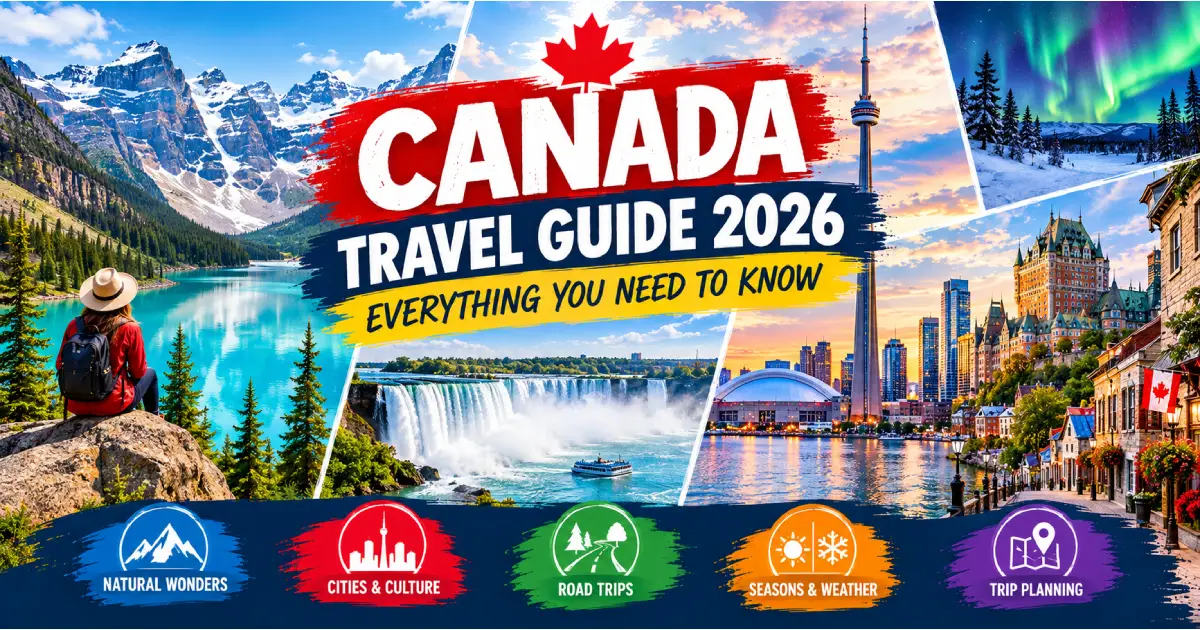
Canada Travel Guide 2026 — Best Time to Visit, Entry Rules, Costs, Top Cities, National Parks, Itineraries, and Insider Tips for First-Time Visitors
By Travel Tourister | Updated October 2026
This Canada travel guide is built for travelers planning a first (or fifth) trip to the world’s second-largest country by area — a nation of ten provinces and three territories stretching across six time zones, from the Atlantic fishing villages of Newfoundland to the glacier-fed lakes of the Canadian Rockies and the Pacific rainforests of Vancouver Island, with the longest coastline on Earth, more than 40 national parks, and roughly 41 million residents concentrated overwhelmingly (about three-quarters) within a few hours’ drive of the United States border. Canada rewards visitors who understand its central planning challenge before booking anything: the country is enormous, the distances between headline destinations are measured in flight hours rather than driving hours, and the version of Canada a traveler actually experiences — cosmopolitan and bilingual in Toronto, Montreal and Quebec City, mountain-and-lake wilderness in Banff and Jasper, maritime and lobster-boat in Nova Scotia — depends almost entirely on which two or three regions are combined into a single trip.
What distinguishes Canada from other tier-one travel destinations is the combination of scale and accessibility. The headline attractions (Niagara Falls, Banff and Lake Louise, the walled streets of Old Quebec, Stanley Park, the Cabot Trail) are all served by good roads, reliable domestic flights, and mature tourism operators, meaning first-time visitors can reach extraordinary landscapes without expedition-level planning, while repeat visitors can push further into Newfoundland’s iceberg coast, the Yukon’s aurora skies, or Churchill’s polar bear season. Add safe, walkable, multicultural cities, a food scene that runs from Montreal smoked meat to Pacific salmon to Atlantic lobster, and a genuinely welcoming local culture, and Canada becomes one of the easiest long-haul trips to enjoy and one of the hardest to fit into a single visit.
This Canada travel guide covers everything needed to plan a 2026 trip — quick facts, the best time to visit, entry requirements (including the eTA), how to get around, the 10 destinations that anchor most itineraries, realistic costs in Canadian dollars, food to try, three sample itineraries, practical tips, and answers to the most common questions from first-time visitors.
For complete guides, see our Best Time to Visit Canada 2026, Best Places to Visit in Canada, Things to Do in Canada, and Canada Trip Cost guides.
Quick Overview: Canada Travel Guide at a Glance
Topic
Quick Facts
Capital / Largest City
Ottawa / Toronto
Population
Approximately 41 million
Official Languages
English and French (French dominant in Quebec)
Currency
Canadian dollar (CAD) — prices shown before tax in most shops
Time Zones
Six (Pacific, Mountain, Central, Eastern, Atlantic, Newfoundland)
Best Time to Visit
June–September (Rockies, coast, festivals); late September–mid October (fall color); December–March (skiing, aurora, winter festivals)
Entry Rules
US citizens: valid passport. Most other visa-exempt visitors flying in: eTA (CAD $7). Others: visitor visa
Electricity
120V, 60 Hz, Type A and B plugs
Driving
Right-hand traffic; distances and speed limits in kilometers
Tipping
15–20% in restaurants and for taxis; not included in the bill
Emergency Number
911
Top 10 Canada Destinations Compared
#
Destination
Province
Best For
Ideal Stay
Best Season
1
Toronto
Ontario
Skyline, museums, food
2–3 days
Jun–Sep
2
Niagara Falls
Ontario
Waterfalls, wineries
1 day
May–Oct
3
Montreal
Quebec
Food, festivals, nightlife
2–3 days
May–Oct
4
Quebec City
Quebec
History, European charm
2 days
Year-round
5
Ottawa
Ontario
Parliament, canal, museums
1–2 days
May–Sep, Feb
6
Vancouver
British Columbia
Mountains, ocean, city life
2–3 days
Jun–Sep
7
Victoria and Vancouver Island
British Columbia
Gardens, whales, surf
2–4 days
May–Oct
8
Banff and Lake Louise
Alberta
Lakes, hiking, wildlife
3–4 days
Jun–Sep
9
Jasper and Icefields Parkway
Alberta
Glaciers, dark skies, scenic drive
2–3 days
Jun–Sep
10
Nova Scotia and Cabot Trail
Nova Scotia
Lighthouses, lobster, coastal drives
4–6 days
Jun–Oct
🗓️ Best Time to Visit Canada
The best time to visit Canada depends on which version of the country you want — summer delivers the Rockies, the coasts, and the festival calendar, fall delivers some of the most dramatic foliage in the world, winter delivers skiing and aurora, and spring delivers the lowest prices at the cost of closed mountain trails.
Summer (June–August): Peak season for good reason — long daylight hours, accessible mountain roads, warm lakes, and festivals including the Montreal International Jazz Festival (late June to early July) and the Calgary Stampede (early July). Expect the highest hotel prices of the year in Banff, Vancouver, and Quebec City. Wildfire smoke can affect air quality in British Columbia and Alberta in July and August, so build flexibility into mountain itineraries.
Fall (September–October): Many experienced travelers consider this the best window. Ontario and Quebec foliage typically peaks from late September to mid October, golden larch trees turn the Banff backcountry in late September, and crowds and prices drop after Labor Day. Churchill, Manitoba, runs its polar bear season in October and November.
Winter (December–March): Whistler, Banff, and Quebec’s Laurentians offer world-class skiing, while Quebec City hosts its Winter Carnival and Ottawa’s Rideau Canal Skateway opens as ice conditions allow. The Yukon and Northwest Territories (Yellowknife) are among the best places on Earth to see the northern lights, with the season running roughly from late August through April.
Spring (April–May): Shoulder season brings lower prices, Ottawa’s tulip festival in May, and Vancouver’s cherry blossoms in spring, but many Rockies trails, lakes, and some roads remain snow-covered or closed until June.
Insider tips: If you can only choose one month for a classic Rockies-plus-cities trip, early-to-mid September offers summer-like access with noticeably smaller crowds and cheaper rooms. For a deeper month-by-month breakdown, see our Best Time to Visit Canada guide.
🛂 Canada Entry Requirements: Passport, eTA, and Visas
Entry rules depend on your nationality and how you arrive, and they change, so always confirm on the official Government of Canada (IRCC) website before booking. In general: US citizens need a valid passport to fly in but do not need an eTA or visa; citizens of most visa-exempt countries — including the United Kingdom and Australia — need an Electronic Travel Authorization (eTA) when flying into Canada, which costs CAD $7, is applied for online in minutes, and is typically valid for up to five years or until the passport expires. Travelers entering by land or sea from the United States generally do not need an eTA, but still need proper identification and any required documents.
Citizens of countries that are not visa-exempt (including India) normally need a visitor visa, although some travelers who have held a Canadian visitor visa in the past ten years or hold a valid US non-immigrant visa may qualify to apply for an eTA instead — eligibility rules are specific, so check the IRCC tool rather than relying on third-party summaries.
Insider tips: Apply for your eTA only through the official canada.ca website — look-alike sites charge extra fees. Check your passport’s validity before you book, and carry travel medical insurance: visitors are not covered by provincial public health systems, and emergency treatment can be expensive.
✈️ How to Get to and Around Canada
Flying in: The four main international gateways are Toronto Pearson (YYZ), Vancouver (YVR), Montréal–Trudeau (YUL), and Calgary (YYC), with Air Canada, WestJet, and major international carriers serving all four. Toronto and Montreal suit eastern itineraries, while Vancouver and Calgary suit Rockies and Pacific itineraries — and booking an open-jaw ticket (arrive in one city, depart from another) avoids expensive backtracking across the country.
Domestic flights: Canada’s distances make flying the sensible choice between regions: Toronto to Vancouver takes about five hours, and Vancouver to Calgary about 90 minutes. Book early for summer, and check baggage fees on budget fares.
Trains: VIA Rail runs the Quebec City–Montreal–Ottawa–Toronto corridor comfortably (Toronto to Montreal takes roughly five hours), while the Rocky Mountaineer offers luxury daylight rail journeys between Vancouver and the Rockies.
Driving: Renting a car is the best way to experience the Rockies, Nova Scotia, and Vancouver Island. Key distances: Calgary to Banff about 130 km (1.5 hours); Toronto to Niagara Falls about 130 km (1.5 hours); Montreal to Quebec City about 255 km (under 3 hours); Vancouver to Whistler about 120 km (2 hours); Vancouver to Banff about 850 km (9–10 hours). Winter tires are legally required in Quebec from December 1 to March 15 and on designated British Columbia highways from October 1 to April 30.
Insider tips: Do not try to see Toronto, Banff, and Halifax in one week — each leg costs half a day of travel. Pick two regions per trip and travel slowly.
🍁 Top 10 Places to Visit in Canada
1. Toronto — Canada’s Largest and Most Multicultural City
Best For: Skyline, museums, food | Ideal Stay: 2–3 days | Getting There: Toronto Pearson (YYZ) | Best Time: June–September
Toronto is Canada’s largest city and one of the most multicultural cities on Earth, with a skyline anchored by the 553-meter CN Tower (home of the EdgeWalk, a hands-free walk around the tower’s outer rim), a lakefront that doubles as a summer playground via the ferry to the Toronto Islands, and neighborhoods that function as separate food destinations — Kensington Market, Chinatown, Little Italy, Greektown, and the historic Distillery District. The Royal Ontario Museum, the Art Gallery of Ontario, and the sprawling St. Lawrence Market make rainy-day planning easy, and Toronto’s position makes it the natural launch point for Niagara Falls, Ottawa, and Montreal.
Insider tips: The UP Express train connects Pearson Airport to Union Station in about 25 minutes, avoiding highway traffic. The best free skyline photo is from the Toronto Islands ferry or Centre Island’s waterfront. Buy CN Tower tickets online in advance for summer weekends.
2. Niagara Falls — Horseshoe Falls Up Close
Best For: Waterfalls, wine | Ideal Stay: 1 day (or overnight) | Distance from Toronto: ~130 km | Best Time: May–October
Niagara Falls consists of three waterfalls — Horseshoe Falls (mostly on the Canadian side), American Falls, and Bridal Veil Falls — and the Canadian side offers the superior panoramic view as well as the closest experiences: the boat tour that sails into the mist at the base of Horseshoe Falls, Journey Behind the Falls (tunnels beneath the falls), and the illuminations that light the cascade every night. Combine the falls with Niagara-on-the-Lake, a small Victorian-style town surrounded by wineries famous for icewine, for a full day trip from Toronto.
Insider tips: Visit on a weekday morning to avoid peak crowds, and book the boat tour online in summer. If you drive in from the United States, allow extra time for border crossing queues on holiday weekends.
3. Montreal — Europe in North America
Best For: Food, festivals, nightlife | Ideal Stay: 2–3 days | Language: French dominant, English widely spoken | Best Time: May–October
Montreal is Canada’s French-speaking cultural capital and one of its best food cities — a place where wood-fired Montreal bagels (St-Viateur and Fairmount are the classic rivals), smoked meat sandwiches at Schwartz’s, poutine, and a serious restaurant and bar scene sit alongside the cobblestones of Old Montreal, the soaring interior of Notre-Dame Basilica, and views from Mount Royal, the green hill that gives the city its name. Summer festivals (jazz, comedy, and fireworks among them) fill the calendar, while the underground city keeps winter manageable.
Insider tips: Greeting shop staff with a friendly bonjour-hi is appreciated and usually switches the conversation to whichever language suits you. Jean-Talon Market is the best place to taste Quebec produce, cheese, and maple products in one visit.
4. Quebec City — North America’s Walled City
Best For: History, romance, winter festivals | Ideal Stay: 2 days | Distance from Montreal: ~255 km | Best Time: Year-round
Old Quebec, a UNESCO World Heritage district since 1985, is the only fortified city north of Mexico, and walking its stone ramparts, the narrow Petit Champlain shopping street, and the boardwalk beneath the turreted Château Frontenac feels closer to Normandy than to North America. Nearby, Montmorency Falls drops 83 meters — higher than Niagara — and is a short drive from downtown. In winter, the Quebec Winter Carnival and the Hôtel de Glace (Ice Hotel) turn the city into a fairy-tale snowscape.
Insider tips: Stay inside the walls or in Petit Champlain so you can explore on foot at dawn and after the day-trippers leave. Allow time for a funicular ride between the Upper and Lower Town to save your legs on the steepest streets.
5. Ottawa — The Capital
Best For: Museums, Parliament, canal | Ideal Stay: 1–2 days | Between: Toronto and Montreal | Best Time: May–September, February
Canada’s capital is compact, clean, and culturally rich: Parliament Hill with its Gothic Revival Centre Block, the UNESCO-listed Rideau Canal (a boating route in summer and one of the world’s longest natural-ice skating rinks in winter when conditions allow), the lively ByWard Market, and a strong lineup of national museums including the National Gallery of Canada. The Canadian Tulip Festival fills the city with color each May.
Insider tips: Ottawa fits neatly as a one-night stop between Toronto and Montreal. Check Parliament Hill tour availability, as parts of the Centre Block have been under long-term renovation.
6. Vancouver — Mountains, Ocean, and City in One
Best For: Outdoors, food, scenery | Ideal Stay: 2–3 days | Getting There: Vancouver (YVR) | Best Time: June–September
Vancouver is one of the few major cities in the world where you can ski, kayak, and enjoy a fine-dining dinner in the same day. Stanley Park and its roughly nine-kilometer seawall form the city’s green heart, Granville Island offers a lively public market and artisan shops, Gastown preserves the city’s Victorian roots (including the steam clock), and the North Shore delivers the Capilano Suspension Bridge and Grouse Mountain within 30 minutes of downtown. The Sea to Sky Highway leads onward to Squamish and Whistler.
Insider tips: Rent a bike for the seawall, and use the SeaBus to cross to North Vancouver cheaply. Lynn Canyon Park has a free suspension bridge if you want to skip Capilano’s ticket price. Hotel rates peak sharply in July and August, and Vancouver is a major Alaska cruise departure port.
7. Victoria and Vancouver Island — Gardens, Whales, and Surf
Best For: Gardens, wildlife, relaxed pace | Ideal Stay: 2–4 days | Getting There: BC Ferries (about 90 minutes) or seaplane | Best Time: May–October
Victoria, British Columbia’s capital, is a harbor city of flower baskets, heritage architecture, afternoon tea at the Fairmont Empress, the Royal BC Museum, and the nearby Butchart Gardens — a century-old floral showpiece built in a former limestone quarry. Beyond the city, whale-watching tours (orca sightings are most reliable from late spring through early fall), the old-growth giants of Cathedral Grove, and the surf town of Tofino in Pacific Rim National Park Reserve make Vancouver Island a rewarding multi-day side trip.
Insider tips: Reserve BC Ferries vehicle space in advance in summer. Harbour Air seaplanes connect downtown Vancouver and Victoria’s Inner Harbour in roughly 35 minutes for travelers without a car.
8. Banff and Lake Louise — The Heart of the Canadian Rockies
Best For: Hiking, lakes, wildlife | Ideal Stay: 3–4 days | Distance from Calgary: ~130 km | Best Time: June–September
Banff National Park, established in 1885 as Canada’s first national park, delivers the postcard Rockies: the town of Banff at about 1,383 meters elevation with the Banff Gondola, Bow Falls and the Banff Upper Hot Springs; Lake Minnewanka and Johnston Canyon nearby; and the glacier-fed, turquoise waters of Lake Louise and Moraine Lake an hour away. The vivid color of these lakes comes from fine glacial rock flour suspended in the water, and it is at its most intense in July and August after the ice melts.
Moraine Lake Road is closed to personal vehicles, so visitors reach the lake by Parks Canada shuttle, commercial tour, or public transit — a rule that matters more than any other when planning a Banff trip, because shuttle seats and parking at Lake Louise sell out far in advance in summer.
Insider tips: A Parks Canada entry pass is required (a daily pass is roughly CAD $11 per adult, with an annual Discovery Pass available — verify current prices on the Parks Canada site). Carry bear spray if hiking, and keep at least 100 meters from bears and wolves and 30 meters from elk. Book accommodation six months or more ahead for July and August.
9. Jasper and the Icefields Parkway — Glaciers and Dark Skies
Best For: Scenic drives, glaciers, stargazing | Ideal Stay: 2–3 days | Route: Highway 93, 232 km from Lake Louise | Best Time: June–September
The Icefields Parkway, a 232-kilometer mountain highway linking Lake Louise and Jasper, is regularly named among the most scenic drives in the world, passing Peyto Lake, the Columbia Icefield and Athabasca Glacier, and a succession of waterfalls and viewpoints. Jasper National Park is quieter and wilder than Banff, with Maligne Lake, abundant elk and bighorn sheep, and one of the largest accessible dark-sky preserves on Earth, which makes autumn stargazing outstanding.
Insider tips: Fuel up in Lake Louise or Saskatchewan River Crossing, because services along the parkway are limited. A 2024 wildfire damaged parts of the Jasper townsite, so check current conditions, closures, and accommodation availability before booking.
10. Nova Scotia and Atlantic Canada — Lighthouses, Lobster, and the Cabot Trail
Best For: Coastal drives, seafood, small-town culture | Ideal Stay: 4–6 days | Getting There: Halifax (YHZ) | Best Time: June–October
Nova Scotia compresses the Atlantic coast into a self-drive paradise: Halifax’s waterfront and Citadel Hill, the postcard lighthouse at Peggy’s Cove about 45 minutes away, the UNESCO-listed colorful waterfront of Lunenburg, and the 298-kilometer Cabot Trail loop around Cape Breton Highlands National Park, where mountains plunge into the Atlantic. Nearby, the Bay of Fundy has some of the highest tides in the world, with a difference of up to about 16 meters between low and high tide. Prince Edward Island (Anne of Green Gables country, red-sand beaches, and the 12.9-kilometer Confederation Bridge) and Newfoundland (Gros Morne National Park, Signal Hill, and spring iceberg season) are natural extensions for longer trips.
Insider tips: Many drivers prefer to run the Cabot Trail counterclockwise to have the ocean on the outside lane for better views. Book lobster dinners and Cape Breton accommodations early for July and August.
Beyond the Classics — Northern and Adventure Canada
For repeat visitors, the Yukon and Northwest Territories offer northern lights viewing from late August through April, Churchill, Manitoba, offers polar bears in October–November and beluga whales in July–August, the Okanagan Valley in British Columbia blends lakes and wineries, and Whistler delivers world-class skiing in winter and mountain biking in summer.
💰 How Much Does a Trip to Canada Cost?
Canada is not a budget destination, but it is more affordable than most travelers expect outside peak Rockies and big-city summer weeks. The following per-person daily estimates in Canadian dollars are planning guides, not quotes, and exclude international flights.
Cost Category
Budget
Mid-Range
Luxury
Accommodation (per room per night)
CAD $100–$170
CAD $180–$320
CAD $400+
Food (per person per day)
CAD $50–$80
CAD $90–$150
CAD $200+
Transport and activities (per day)
CAD $30–$70
CAD $80–$160
CAD $200+
Estimated Daily Total (per person)
CAD $150–$250
CAD $300–$450
CAD $600+
Insider tips: Menu and shelf prices exclude sales tax — federal GST is 5%, and provinces add their own (Ontario’s HST is 13%, Quebec adds QST, British Columbia adds PST, and Alberta has no provincial sales tax). Tipping 15–20% is standard in restaurants. Banff, Lake Louise, Whistler, and Vancouver have the highest summer room rates in the country, while Montreal, Ottawa, and Halifax are generally better value. See our Canada Trip Cost guide for detailed budgets.
🍽️ Canadian Food and Drink to Try
Canadian cuisine is regional and multicultural. Must-try dishes include poutine (fries, cheese curds, and gravy, born in Quebec), Montreal-style bagels and smoked meat, butter tarts and Nanaimo bars (the classic Canadian sweets), maple syrup and maple taffy, Pacific salmon and sushi in Vancouver, Alberta beef in Calgary and Banff, and Atlantic lobster rolls and seafood chowder in Nova Scotia and Prince Edward Island. Ontario and British Columbia produce excellent wine, and Niagara icewine is a world-famous dessert wine. For restaurant picks, see our Best Restaurants in Canada guide.
Spend two nights in Toronto, take a day trip to Niagara Falls, then travel to Montreal by train (about five hours) for two nights, and finish with two nights in Quebec City. This route has the best mix of culture, food, and history with minimal driving.
7 Days: Rockies and Pacific Coast (Vancouver, Banff, Lake Louise)
Spend two nights in Vancouver, fly to Calgary, then drive to Banff for three nights and add one night at Lake Louise or along the Icefields Parkway. This is the classic mountain-and-lake trip, best between June and September. See our Canada 7-Day Itinerary.
14 Days: Coast-to-Coast Highlights
Combine Toronto, Niagara, Montreal, and Quebec City (seven days), fly west to Calgary, spend four days in Banff and Jasper, and finish with three days in Vancouver and Victoria. See our Canada 14-Day Itinerary.
🧳 Practical Canada Travel Tips
Wildlife safety: Stay at least 100 meters from bears and wolves and 30 meters from elk, moose, and other large animals; never feed wildlife; and carry bear spray on backcountry trails.
Weather: Pack layers year-round — mountain weather can change within hours, and even July nights in the Rockies can approach freezing at altitude.
Insects: Mosquitoes and black flies are common in forested areas from May through July; bring repellent.
Money and phones: Cards and contactless payments are accepted nearly everywhere. Check roaming costs, or buy a Canadian eSIM or SIM, since mobile data is more expensive than in many countries.
Language: English works everywhere outside rural Quebec, but a few French greetings are appreciated in Montreal and Quebec City.
Alcohol and cannabis: The legal drinking age is 18 or 19 depending on the province, and cannabis is legal under provincial rules — but never carry it across the border.
Safety: Canada is generally safe for visitors; use normal city precautions and lock vehicles at trailheads, where break-ins can occur.
❓ Canada Travel Guide FAQs
Do I need a visa to visit Canada? It depends on your nationality. US citizens need a passport only; visa-exempt visitors from countries such as the UK and Australia need an eTA when flying; citizens of many other countries need a visitor visa. Always confirm on the IRCC website.
What is the best month to visit Canada? July and August are best for the Rockies and coasts, while September offers a strong balance of good weather, fall color, and fewer crowds. For skiing and northern lights, visit between December and March.
How many days do I need in Canada? Seven days works for one region (eastern cities or the Rockies); 10–14 days lets you combine two regions.
Is Canada expensive to visit? It is moderately expensive, especially in Banff, Whistler, and Vancouver in summer. Mid-range travelers should plan roughly CAD $300–$450 per person per day, excluding flights.
Is Canada safe for tourists? Yes — it consistently ranks among the safest countries for travelers. Wildlife and weather pose greater risks than crime in most regions.
About Travel TouristerTravel Tourister’s destination specialists have mapped Canada from the CN Tower and Niagara’s mist to Old Quebec’s ramparts, Banff’s turquoise lakes, the Icefields Parkway, Vancouver’s seawall, and Nova Scotia’s Cabot Trail — to deliver the most practical and honest Canada travel guide for every type of 2026 visitor.
Posted By : Vinay
As a lead contributor for Travel Tourister, Vinay is dedicated to serving our Tier 1 audience (US, UK, Canada, Australia). His mission is to deliver precise, fact-checked news and actionable, data-driven articles that empower readers to make informed decisions, minimize travel risks, and maximize their adventure without compromising safety or budget.
Travel Tourister is a leading Travel portal where we introduce travellers to trusted travel agents to make their journey hasselfree, memorable And happy. Travel Tourister is a platform where travellers get Tour packages ,Hotel packages deals through trusted travel companies And hoteliers who are working with us across the world. We always try to find new and more travel agents and hoteliers from every nook and corners across the world so that you could compare the deals with different travel agents and hoteliers and book your tour or hotel with the one you have chosen according to your taste and budget.




 Call
Call Enquiry