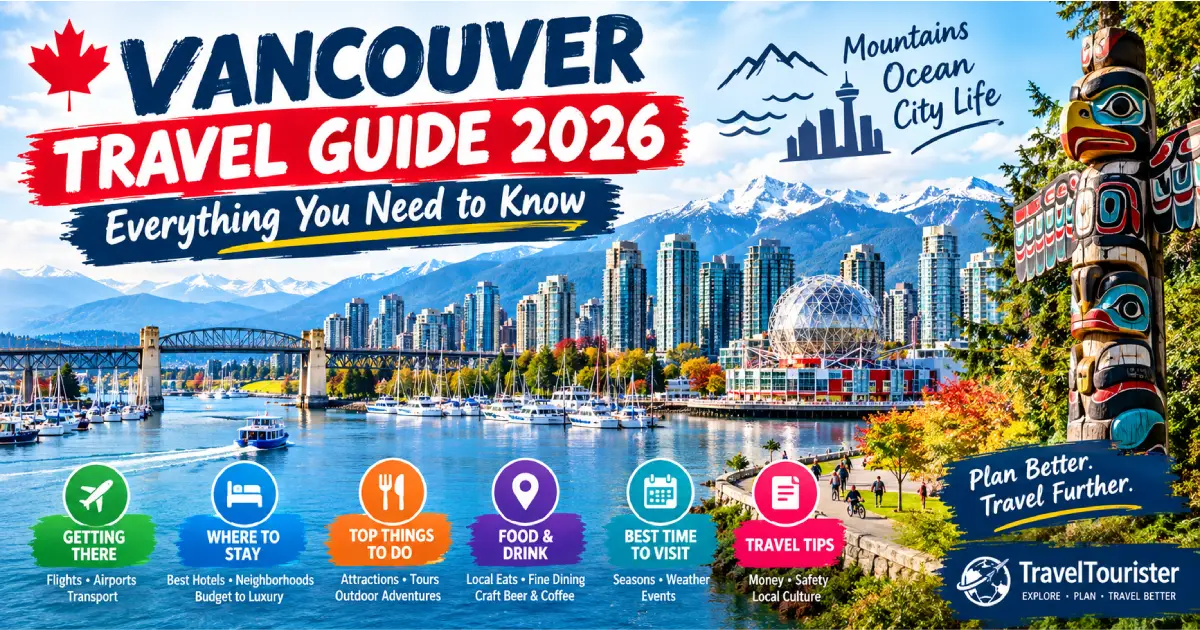
Vancouver Travel Guide 2026: Everything You Need to Know
Published on : 14 Oct 2026
Vancouver Travel Guide 2026 — Best Time to Visit, Top Attractions, Neighborhoods, Transit, Where to Stay, Costs in CAD, Food, Day Trips, and Insider Tips for First-Time Visitors
By Travel Tourister | Updated October 2026
This Vancouver travel guide is built for visitors planning a first (or fifth) trip to Canada’s Pacific gateway — a city of about 700,000 people (roughly 2.7 million across Metro Vancouver) squeezed between the Pacific Ocean, Burrard Inlet, and the snow-capped Coast Mountains, where you can walk a seawall around a 400-hectare rainforest park in the morning, ride a gondola above the treeline after lunch, and eat sushi or dim sum that rivals what you would find in Asia by dinner. Vancouver sits on the traditional, unceded territories of the Musqueam, Squamish, and Tsleil-Waututh Nations, and Indigenous art, culture, and guided experiences are an increasingly important part of how visitors experience the region, from totem poles in Stanley Park to the Museum of Anthropology and Indigenous-led walking tours.
What makes Vancouver easy for visitors is how compact its highlights are and how well they connect. The Canada Line SkyTrain takes about 25 minutes from the airport to downtown, the SeaBus ferry crosses Burrard Inlet to the North Shore in about 12 minutes, small False Creek ferries link Granville Island to downtown, and the Stanley Park Seawall, Gastown, Chinatown, and Granville Island are all reachable on foot or by bike. Nature is just as close: the North Shore mountains (Grouse Mountain, Capilano, and Lynn Canyon) are 30 minutes from downtown, Squamish and the Sea to Sky Highway begin an hour away, Whistler is about two hours north, and BC Ferries sails to Victoria and Vancouver Island from terminals on the edge of the city.
This Vancouver travel guide covers everything needed to plan a 2026 trip — quick facts, the best time to visit, how to get from the airport and around the city (with current TransLink fares), the 15 best attractions, a neighborhood guide, where to stay, food, day trips, realistic costs in Canadian dollars, itineraries, safety and practical tips, and answers to the most common questions from first-time visitors. Prices, schedules, and opening hours change, so verify current information before you book.
For complete guides, see our Canada Travel Guide 2026, Best Time to Visit Canada, Canada 7 Day Itinerary, and Canada Trip Cost guides.
Quick Overview: Vancouver Travel Guide at a Glance
Topic
Quick Facts
Province
British Columbia, on Canada’s Pacific coast
Population
About 700,000 (city); roughly 2.7 million (Metro Vancouver)
Language
English (widely multilingual city)
Currency
Canadian dollar (CAD); 5% GST is added at checkout, plus provincial taxes on some items
Time Zone
Pacific Time
Airport
Vancouver International Airport (YVR), about 25 minutes from downtown by Canada Line SkyTrain
Airport to Downtown
Canada Line to Waterfront Station; a CAD 6.50 YVR AddFare applies to trips that start at the airport (since July 1, 2026)
Local Transit
TransLink one-zone adult fare CAD 3.50 with cash or tap-to-pay (CAD 2.85 with Compass stored value) since July 1, 2026; verify current fares
Best Time to Visit
June–September (driest and sunniest); late March–April for cherry blossoms; December–March for nearby skiing
Ideal Stay
3–4 days (plus 1–2 days for Victoria, Whistler, or other day trips)
Tipping
15–20% in restaurants and bars; not included in the bill
Emergency Number
911
Vancouver at a Glance: Top Highlights by Interest
If You Love…
Don’t Miss
Outdoors in the city
Stanley Park Seawall, English Bay, Kitsilano Beach, Queen Elizabeth Park
Granville Island Public Market, Richmond dim sum, Chinatown, Michelin-recognized restaurants
Culture and history
Museum of Anthropology, Gastown, Dr. Sun Yat-Sen Classical Chinese Garden
Families
Science World, Stanley Park, Capilano Suspension Bridge, beaches
Neighborhood wandering
Granville Island, Gastown, Main Street, Commercial Drive, Steveston
Day trips
Victoria and Butchart Gardens, Whistler, Squamish, Bowen Island
🗓️ Best Time to Visit Vancouver
The best time to visit Vancouver is June to September, when the weather is driest, the days are long, and every attraction, ferry, and hiking trail is open. July and August are the sunniest months, while late March and April bring cherry blossoms and May and October offer quieter streets with a higher chance of rain.
Seawall, beaches, long days, festivals, day trips, driest weather
Highest prices, crowds, occasional wildfire smoke
Fall (Sep–Oct)
Highs about 14–19°C (57–66°F)
Fall color, fewer crowds, good hiking in September
Rain returns by October; shorter days
Winter (Nov–Feb)
Highs about 5–9°C (41–48°F)
Skiing and snowshoeing nearby, cozy restaurants, lowest hotel rates
Frequent rain and grey skies; short days
Insider tips: Vancouver’s wettest months are November to March, so pack a good rain jacket and plan indoor options such as the Museum of Anthropology, Science World, and Granville Island Public Market. In summer, book hotels and popular tours well ahead, and check air-quality updates in case of wildfire smoke from the interior. For a nationwide view, see our Best Time to Visit Canada guide.
✈️ How to Get to Vancouver and Around the City
Getting there: Most international visitors fly into Vancouver International Airport (YVR), a major gateway to the Pacific with direct flights from North America, Asia, Europe, and Oceania. Amtrak Cascades and buses connect Vancouver with Seattle (about four hours; verify current service), and BC Ferries serves Vancouver Island and the Gulf Islands from the Tsawwassen and Horseshoe Bay terminals.
From YVR to downtown: The Canada Line SkyTrain takes about 25 minutes from YVR to Waterfront Station in downtown Vancouver. Note that trips starting at YVR, Sea Island Centre, or Templeton stations carry a YVR AddFare, which rose from CAD 5 to CAD 6.50 on July 1, 2026, on top of the regular fare; the charge applies to trips that start at the airport, not to trips to it. A taxi or rideshare is more expensive and slower in rush-hour traffic.
Getting around: TransLink runs the SkyTrain, buses, and SeaBus, and fares rose by an average of about 5 percent on July 1, 2026. A one-zone adult fare is now CAD 3.50 with cash or tap-to-pay and CAD 2.85 with Compass Card stored value, a two-zone fare is roughly CAD 5.10 (CAD 4.20 with Compass), and buses are always a one-zone fare. After 6:30 PM on weekdays and all day on weekends and holidays, SkyTrain and SeaBus cost only the one-zone fare. A transfer within 90 minutes is included, and a DayPass (about CAD 12; verify) pays off after about five rides. You can tap a contactless credit or debit card or mobile wallet at the gates, so you do not need to buy a Compass Card for a short stay.
Other ways to move: The SeaBus crosses to Lonsdale Quay on the North Shore in about 12 minutes, the Aquabus and False Creek Ferries link Granville Island with downtown and Yaletown, and bike share and bike paths cover the Seawall and much of the city. The downtown core is very walkable.
Insider tips: Tap on and off every time, avoid driving downtown because parking is expensive, and use the SeaBus for a cheap harbor cruise with skyline views. Fares change, so confirm current prices on the TransLink and YVR websites.
🌲 Top 15 Things to See and Do in Vancouver
1. Stanley Park and the Seawall — A Rainforest in the City
Cost: Free (bike rentals and attractions extra) | Best Time: May–September | Time Needed: Half day
Stanley Park covers roughly 400 hectares of forest, beaches, and gardens at the edge of downtown, and its Seawall wraps around the park for about nine kilometers, with views of the harbor, Lions Gate Bridge, and the North Shore mountains. Highlights include the totem poles at Brockton Point, Prospect Point lookout, Third Beach for sunset, and shaded forest trails.
Insider tips: Rent a bike and ride the one-way bike path in the direction shown, start in the morning to avoid crowds, and carry water and a rain jacket.
2. Granville Island — Market, Studios, and Waterfront
Cost: Free to enter; food and shopping extra | Best Time: Weekday mornings | Time Needed: 2–3 hours
Granville Island is a former industrial peninsula turned arts and food hub, home to the Granville Island Public Market with seafood, bakeries, produce, and prepared foods, plus artist studios, breweries, a kids’ market, and waterfront dining. Small ferries from downtown and the Seawall make arriving part of the fun.
Insider tips: Visit on a weekday morning to avoid crowds, bring a reusable bag, and graze at several stalls instead of sitting for a single meal.
3. Capilano Suspension Bridge Park
Cost: Roughly CAD 70–80 (verify) | Best Time: Morning or late afternoon | Time Needed: 2–3 hours
The Capilano Suspension Bridge stretches roughly 140 meters across a river gorge about 70 meters above the water, and the park adds Treetops Adventure (a series of walkways among Douglas firs) and the Cliffwalk, a cantilevered path along a granite cliff. It is one of Vancouver’s most popular attractions.
Insider tips: Book timed tickets online, arrive early to avoid queues, and consider Lynn Canyon Park for a free alternative.
4. Grouse Mountain — Skyride and City Views
Cost: Skyride roughly CAD 70–85 (verify) | Best Time: Clear days and sunset | Time Needed: Half day
Grouse Mountain is a year-round mountain playground about 30 minutes from downtown, reached by the Skyride gondola. It offers panoramic views over Vancouver, a wildlife refuge with grizzly bears, hiking, and in winter, skiing, snowshoeing, and ice skating. The Grouse Grind, a steep trail of about 2.9 kilometers with roughly 850 meters of climb, is a local fitness challenge.
Insider tips: Check the weather, since low cloud can block the view, and avoid the Grouse Grind unless you are fit and prepared.
5. Gastown — Cobblestones and the Steam Clock
Cost: Free to wander | Best Time: Daytime and evenings | Time Needed: 1–2 hours
Gastown is Vancouver’s historic district, with Victorian brick buildings, cobbled streets, independent shops, galleries, restaurants, and the famous steam clock. It sits next to Waterfront Station and is easy to combine with Chinatown.
Insider tips: Visit in the late afternoon for the best light and dining, and keep an eye on nearby streets after dark.
6. Chinatown and Dr. Sun Yat-Sen Classical Chinese Garden
Cost: Garden admission roughly CAD 14–16 (verify) | Best Time: Weekdays | Time Needed: 2–3 hours
Vancouver’s Chinatown is one of the oldest in North America, with traditional shops, bakeries, restaurants, and murals, and the Dr. Sun Yat-Sen Classical Chinese Garden is a tranquil Ming Dynasty-style garden built by artisans from China.
Insider tips: Combine the garden with lunch in Chinatown, and visit on a weekday morning for a quieter experience.
7. Museum of Anthropology at UBC
Cost: Roughly CAD 20–25 (verify) | Best Time: Rainy days | Time Needed: 2–3 hours
The Museum of Anthropology at the University of British Columbia is renowned for its collection of Northwest Coast Indigenous art, including monumental totem poles and Bill Reid’s sculpture The Raven and the First Men. It is among the best places in Canada to learn about the region’s First Nations cultures.
Insider tips: Take a bus from downtown and combine it with a walk on nearby Spanish Banks or Wreck Beach.
8. Science World and False Creek
Cost: Roughly CAD 30–40 (verify) | Best Time: Any day, especially rainy ones | Time Needed: 2–4 hours
Science World, in the silver geodesic dome beside False Creek, is a hands-on science museum that families love, and the surrounding False Creek seawall offers waterfront walks and views.
Insider tips: Combine it with a walk or ferry ride along False Creek to Yaletown and Granville Island.
9. English Bay, Kitsilano, and Jericho Beaches
Cost: Free | Best Time: June–September | Time Needed: Half day
Vancouver has a string of sandy city beaches, including English Bay and Sunset Beach in the West End, Kitsilano Beach with its outdoor pool and views, and Jericho Beach for calmer paddleboarding. Sunset at English Bay is a local ritual.
Insider tips: Arrive early on hot weekends, and bring layers since evening sea breezes can be cool.
10. Queen Elizabeth Park and the Bloedel Conservatory
Cost: Park free; conservatory admission roughly CAD 8–12 (verify) | Best Time: Spring and summer | Time Needed: 1–2 hours
Queen Elizabeth Park sits on Vancouver’s highest point and offers city and mountain views, quarry gardens, and the Bloedel Conservatory with tropical plants and birds. It is a good spot for photography and a quiet picnic.
Insider tips: Visit in spring for blossoms and in clear weather for the best views.
11. Lynn Canyon Park — The Free Suspension Bridge
Cost: Free | Best Time: May–October | Time Needed: 2–3 hours
Lynn Canyon Park in North Vancouver offers a free suspension bridge about 50 meters above Lynn Creek, forest trails, swimming holes such as the 30 Foot Pool, and an ecology center. It is a quieter, cheaper alternative to Capilano, and the two are close enough to compare.
Insider tips: Wear sturdy shoes, stay on marked trails and away from cliff edges, and never swim in unsafe conditions or after heavy rain.
12. Steveston Village — A Historic Fishing Village
Cost: Free to wander | Best Time: Weekdays and spring (spot prawn season) | Time Needed: Half day
Steveston, at the southwestern edge of Richmond, is a historic fishing village with a working harbor, Fisherman’s Wharf, waterfront cafes, and the Gulf of Georgia Cannery National Historic Site. In late spring, boats sell fresh spot prawns directly from the dock.
Insider tips: Combine Steveston with a Richmond dim sum lunch, and reach it by Canada Line plus a short bus ride (verify current routes).
13. Sea to Sky Gondola and Shannon Falls
Cost: Gondola roughly CAD 70–80 (verify) | Best Time: May–October | Time Needed: Half day
About an hour north of Vancouver in Squamish, the Sea to Sky Gondola climbs to a summit lodge with views over Howe Sound, suspension-bridge walks, and trails. Nearby Shannon Falls, about 335 meters tall, is one of British Columbia’s highest waterfalls and is a short walk from the highway.
Insider tips: Start early to avoid traffic, check road and weather conditions before heading out, and combine it with a drive to Whistler for a full day.
14. Victoria and Butchart Gardens — A Day Trip by Ferry or Seaplane
Cost: Ferry roughly CAD 100–150 each way for a car and two passengers (verify); Butchart Gardens roughly CAD 35–40+ | Best Time: May–October | Time Needed: 1–2 days
Victoria, British Columbia’s capital, sits on Vancouver Island and is reached by BC Ferries from Tsawwassen (about 1.5 hours across) or by seaplane from downtown Vancouver (roughly 35 minutes). Highlights include the Inner Harbour, afternoon tea at the Fairmont Empress, the Royal BC Museum, and the Butchart Gardens.
Insider tips: Reserve vehicle space on BC Ferries in summer, or leave the car behind and use a bus, ferry, or seaplane. It works best as an overnight rather than a rushed day trip.
15. Whistler — A Day Trip on the Sea to Sky Highway
Cost: Gondolas and activities vary (verify) | Best Time: December–April (ski) and July–September | Time Needed: 1–2 days
Whistler, about two hours north, is one of North America’s largest ski resorts and a year-round mountain village, with the Peak 2 Peak Gondola linking two mountains, hiking and mountain biking in summer, and a pedestrian village with restaurants and shops. The Sea to Sky Highway drive, along Howe Sound past Shannon Falls and Squamish, is a highlight in itself.
Insider tips: Consider staying overnight to avoid a long day in traffic, and check winter road conditions and tire requirements before you drive. Many visitors take a bus from Vancouver.
🗺️ Vancouver Neighborhood Guide
Neighborhood
Vibe
Best For
Good Base?
Downtown and Coal Harbour
Skyline, harbor, major hotels
Waterfront, shopping, first-timers
Yes, best for first-timers
Gastown
Historic, cobbled, trendy
Dining, boutiques, nightlife
Yes, atmospheric
Yaletown
Converted warehouses, patios
Restaurants and False Creek walks
Yes, upscale
West End and English Bay
Beachside, residential
Sunsets, Stanley Park access
Yes, relaxed
Kitsilano and Granville Island
Beaches, market, local shops
Beach days and food
Yes, local flavor
Mount Pleasant and Main Street
Breweries, cafes, design shops
Dining and nightlife
Yes for value
Chinatown
Historic, multicultural
Food and the Chinese Garden
Day visit
Commercial Drive
Bohemian, cafes, international food
Casual eats and nightlife
Yes for a local feel
North Shore (North and West Vancouver)
Mountains and trails
Grouse, Capilano, Lynn Canyon
Day trips or nature stays
Richmond and Steveston
Asian dining, fishing village
Dim sum and seafood
Day visit or airport stays
🏨 Where to Stay in Vancouver
For first-time visitors, the best base is Downtown, Coal Harbour, or the West End, close to the Seawall, Gastown, transit, and the waterfront. Yaletown suits couples who want restaurants and patios, Kitsilano and Mount Pleasant suit travelers who want a local feel and better value, and the North Shore suits nature-focused stays.
Level
Typical Nightly Rate (Per Room, Summer)
Notes
Hostel dorm bed
CAD 40–80
Downtown and Gastown
Budget
CAD 130–200
Budget hotels and small guesthouses
Mid-Range
CAD 250–400
Three- and four-star hotels downtown
Luxury
CAD 500+
Five-star hotels and waterfront properties
Rates are highest in July and August and lowest from November to March. Hotel stays in the City of Vancouver carry 8 percent provincial sales tax, a 3 percent Municipal and Regional District Tax, a temporary 2.5 percent Major Events tax through January 2030, and 5 percent GST on the total, which comes to roughly 20 percent on top of the quoted rate (verify with your hotel).
Insider tips: Book early for summer and for cruise-ship weekends (Vancouver is a major Alaska cruise port), stay near a SkyTrain or SeaBus station, and compare North Vancouver or Burnaby for better value.
🍽️ Where to Eat in Vancouver
Vancouver is one of the best food cities in Canada, with Pacific seafood, Japanese precision, and some of the best Chinese cooking outside Asia. The Michelin Guide Vancouver 2026 selection lists 72 restaurants, and starred restaurants include Burdock & Co, Published on Main, Masayoshi, Okeya Kyujiro, and Sushi Hyun. Canada’s 100 Best 2026 ranked AnnaLena twelfth, Kissa Tanto fifteenth, Published on Main twentieth, and Burdock & Co thirty-third.
Must-try bites: Pacific salmon, fresh spot prawns (late spring), sushi and ramen, dim sum in Richmond and Chinatown, Japadog hot dogs, and Nanaimo bars.
Food neighborhoods: Granville Island Public Market, Chinatown, Richmond’s dim sum and night markets (seasonal), Main Street and Commercial Drive for casual eats and craft beer, and Gastown and Yaletown for dining.
Tax note: In British Columbia, restaurant food carries 5 percent GST and no provincial sales tax, while alcohol is taxed at 10 percent PST (verify), and 15 to 20 percent tipping is standard.
About 1.5-hour ferry, or about 35-minute seaplane, plus local travel
Inner Harbour, gardens, afternoon tea
Bowen Island
About 20-minute ferry from Horseshoe Bay
Beaches, hikes, village shops
Fort Langley
About 1 hour
Historic fort and village
Deep Cove
About 30 minutes
Kayaking, hiking, and bakeries
Harrison Hot Springs
About 1.5–2 hours
Lake, hot springs, relaxation
Seattle, Washington
About 3 hours by car (plus border crossing)
Space Needle, Pike Place Market
Insider tips: Check ferry reservations and road conditions before you go, and consider tours or public transit for Whistler and Squamish to avoid driving. See our Canada 7 Day Itinerary guide for how Vancouver fits into a longer trip.
💰 How Much Does a Trip to Vancouver Cost?
The table below shows estimated costs per person per day in Canadian dollars, assuming two travelers sharing a room in summer and excluding international flights and hotel taxes.
Cost Category
Budget
Mid-Range
Luxury
Accommodation (per room per night)
CAD 130–200
CAD 250–400
CAD 500+
Food (per person per day)
CAD 50–80
CAD 90–150
CAD 200+
Local transit (per day)
CAD 10–15
CAD 15–40
CAD 60+
Attractions (per day)
CAD 20–40
CAD 60–120
CAD 200+
Estimated Daily Total (Per Person)
CAD 150–240
CAD 300–480
CAD 700+
A three-day trip therefore costs roughly CAD 450 to 720 per person on a budget, CAD 900 to 1,440 mid-range, and CAD 2,100 or more for luxury, before flights and hotel taxes, with prices lower in the off-season.
Insider tips: Menu and shelf prices exclude taxes, restaurant tips of 15 to 20 percent are standard, tap-to-pay transit and the evening and weekend one-zone fare keep transit costs low, and many top experiences (the Seawall, beaches, Gastown, and Lynn Canyon) are free. For a national view, see our Canada Trip Cost guide.
🧳 Sample Vancouver Itinerary
Day
Morning
Afternoon
Evening
Day 1: Stanley Park and Downtown
Stanley Park Seawall by bike or on foot
English Bay and Gastown
Dinner in Gastown or Yaletown; sunset at English Bay
Day 2: Markets, Culture, and Mountains
Granville Island Public Market
Capilano Suspension Bridge or Lynn Canyon, or the Museum of Anthropology
Grouse Mountain at sunset or Chinatown dinner
Day 3: Day Trip
Sea to Sky Highway to Squamish or a ferry to Victoria
Sea to Sky Gondola and Shannon Falls, or Butchart Gardens
Vancouver is generally safe for visitors; use normal city precautions, be aware that parts of the Downtown Eastside around East Hastings and Main have visible street disorder and are best avoided at night, and never leave valuables in a parked car, especially at trailheads
Weather
Mild but wet from November to March; pack a good rain jacket and layers year-round
Hiking Safety
North Shore trails can be steep and weather changes quickly; carry water, layers, and a map, and stay on marked trails
Wildlife
Coyotes live in Stanley Park and other green spaces; never feed or approach wildlife
Tipping and Taxes
5% GST on most purchases; 15–20% tips in restaurants, bars, and taxis
Alcohol and Cannabis
The legal age for both in British Columbia is 19
Payments
Cards and contactless payments accepted almost everywhere; tap-to-pay works on TransLink
Wildfire Smoke
Possible in July–August; check air-quality updates and keep a flexible day
Respect for Indigenous Places
Vancouver is on the unceded territories of the Musqueam, Squamish, and Tsleil-Waututh Nations; consider booking Indigenous-led tours and visiting the Museum of Anthropology
Insurance
Medical insurance is essential because provincial health plans do not cover visitors
Emergency
Call 911 for police, fire, or ambulance
Frequently Asked Questions: Vancouver Travel Guide
How many days do I need in Vancouver?
Three to four days is ideal for the main sights, neighborhoods, and food, and an extra day or two lets you add Victoria, Whistler, or Squamish.
Is Vancouver worth visiting?
Yes. Vancouver combines a rainforest park, mountains, beaches, outstanding food, and easy access to Victoria and Whistler, making it one of Canada’s best first-trip destinations and a perfect start or finish to a Rockies trip.
What is the best time to visit Vancouver?
June to September offers the driest, sunniest weather and the best access to attractions, while late March and April bring cherry blossoms and winter offers lower prices and nearby skiing. Expect rain from November to March.
Is Vancouver expensive?
Vancouver is moderately expensive, especially for hotels in July and August, but free experiences such as the Seawall, beaches, and Lynn Canyon, plus affordable transit, help keep costs manageable.
Is Vancouver safe for tourists?
Vancouver is generally safe, but visitors should take normal city precautions, avoid the Downtown Eastside at night, and keep valuables out of parked cars.
Where should I stay in Vancouver?
First-timers should stay Downtown, Coal Harbour, or the West End for easy access to attractions and transit. Yaletown suits couples, and Kitsilano and Mount Pleasant suit travelers who want a local feel.
How do I get from Vancouver Airport to downtown?
The Canada Line SkyTrain takes about 25 minutes to Waterfront Station. Trips starting at the airport carry a CAD 6.50 YVR AddFare on top of the regular fare, so budget roughly CAD 10 to 12 per adult one way (verify current fares).
Can I visit Victoria or Whistler as a day trip from Vancouver?
Yes, but both work better as overnight trips. Victoria is a ferry or seaplane ride away, and Whistler is about two hours by road, so consider staying at least one night.
Final Verdict: Vancouver Travel Guide
Vancouver is one of the easiest and most rewarding cities in Canada for first-time visitors: compact enough to cover the highlights in three or four days, close enough to mountains, ocean, and wine-and-food neighborhoods to feel like several trips in one, and perfectly placed as a gateway to Victoria, Whistler, and the Canadian Rockies.
For most travelers, the best plan is to stay Downtown, Coal Harbour, or the West End, spend one day on Stanley Park and the beaches, one day on Granville Island, Gastown, Chinatown, and a museum, and one day on the North Shore mountains or a day trip, and book one or two destination dinners well ahead. Travel in June to September for the best weather, use SkyTrain and SeaBus to keep transit simple, pack for rain whenever you go, and plan Vancouver as the start or finish of a longer Canadian adventure.
About Travel TouristerTravel Tourister’s destination specialists have explored Vancouver from the Stanley Park Seawall and Granville Island to Gastown, Chinatown, the North Shore mountains, and the Sea to Sky Highway — to deliver the most practical and honest Vancouver travel guide for every type of 2026 traveler.Want help planning your Vancouver trip? Our specialists can help you choose the right season and hotel area, book top restaurants and attractions early, add Victoria, Whistler, or the Rockies, and build a realistic budget before you commit to non-refundable bookings.
Posted By : Vinay
As a lead contributor for Travel Tourister, Vinay is dedicated to serving our Tier 1 audience (US, UK, Canada, Australia). His mission is to deliver precise, fact-checked news and actionable, data-driven articles that empower readers to make informed decisions, minimize travel risks, and maximize their adventure without compromising safety or budget.
Travel Tourister is a leading Travel portal where we introduce travellers to trusted travel agents to make their journey hasselfree, memorable And happy. Travel Tourister is a platform where travellers get Tour packages ,Hotel packages deals through trusted travel companies And hoteliers who are working with us across the world. We always try to find new and more travel agents and hoteliers from every nook and corners across the world so that you could compare the deals with different travel agents and hoteliers and book your tour or hotel with the one you have chosen according to your taste and budget.




 Call
Call Enquiry