Published on : 17 Oct 2026
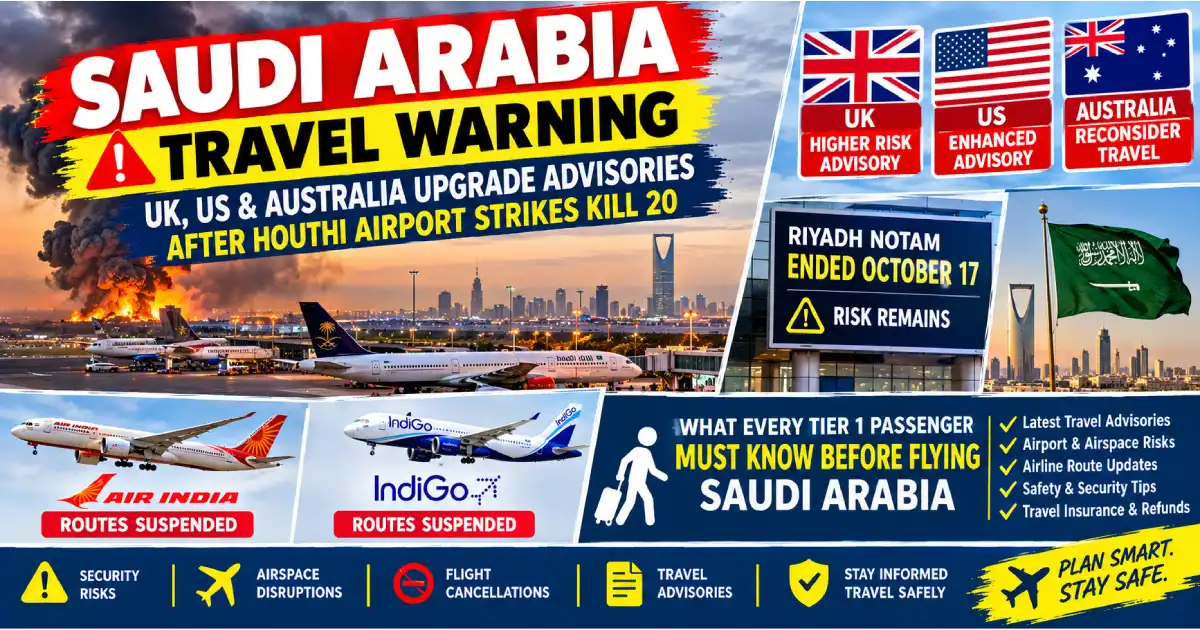
The governments of the United Kingdom, United States, Australia, and New Zealand have all upgraded their official travel warnings for Saudi Arabia following a series of Houthi ballistic missile and drone strikes on Saudi airports around October 10–12, 2026 that killed at least 20 people and wounded more than 300 — the deadliest attack on Saudi civilian infrastructure in more than a decade. King Khalid International Airport in Riyadh (RUH), the country’s primary international hub, was directly targeted. Jeddah’s King Abdulaziz International Airport (JED), Saudi Arabia’s second-largest airport and the gateway for Hajj and Umrah pilgrims, was also struck. CCTV footage from King Khalid Airport showed hundreds of travellers caught in the blast zones that tore through the terminal facilities. A Notice to Airmen (NOTAM) formally closing or restricting Riyadh airport operations has now ended as of October 17 — but the threat that generated it has not. The Houthis have explicitly declared they will continue targeting Saudi Arabia’s infrastructure, airports, and energy facilities. Airlines are resuming services cautiously, but governments are telling their citizens the risk picture has fundamentally changed.
Saudi Arabia is home to one of the world’s largest expatriate communities — approximately 13 million foreign nationals including substantial Indian, Pakistani, Filipino, Egyptian, and Western populations. UK, US, Australian, and Canadian citizens live and work across Riyadh, Jeddah, the Eastern Province, and other cities. The Saudi airports that were struck are not transit curiosities — they are lifelines. Every Western expat flying home for Christmas, every British businessperson travelling to Riyadh for a conference, every Australian or American connecting through Jeddah for South Asian travel, and every pilgrim family planning an Umrah visit is directly affected by the upgraded government advisories now in force. Here is everything that is confirmed, exactly what the government advice says, and what every affected passenger must do.
Published: October 2026 Attack Dates: Approximately October 10–12, 2026 Attacker: Houthis (Ansar Allah) — Yemen — Iran-aligned armed group Weapons: Ballistic missiles + drones — multiple strikes Airports Directly Targeted: King Khalid International Airport, Riyadh (RUH) + King Abdulaziz International Airport, Jeddah (JED) Casualties: At least 20 killed | 300+ wounded — deadliest Saudi airport attack in a decade Riyadh Airport NOTAM: Ended October 17, 2026 — flights resuming Government Advisory Upgrades:
The Houthi attacks on Saudi airports around October 10–12 represent a significant escalation in the Yemen conflict’s reach into Saudi civilian infrastructure. The attacks struck King Khalid International Airport in Riyadh — the country’s primary international hub processing millions of passengers annually — and King Abdulaziz International Airport in Jeddah, Saudi Arabia’s second-busiest airport and the world’s primary gateway for Islamic pilgrimage to Mecca and Medina.
CCTV vision from King Khalid Airport showed hundreds of travellers caught in the blasts that tore through the travel hub. The attack killed at least 20 people — including foreign nationals — and wounded more than 300, making it the deadliest strike on Saudi civilian infrastructure in more than a decade. A Pakistani national was among those killed, with 11 injured in a separate incident, reflecting the disproportionate impact on the large South Asian expatriate community that transits through and lives near these airports.
The US Mission in Saudi Arabia issued an immediate warning to American citizens, advising caution when using airports in the Kingdom, urging them to exercise additional care, and noting that US government employees must obtain special authorisation to use airports in Saudi Arabia and face additional travel restrictions in certain areas. The warning was extraordinary in its specificity — not a generic travel advisory, but a targeted warning about airport-specific risk during travel.
The Houthis — formally known as Ansar Allah, an Iran-aligned armed movement that controls much of northern Yemen — have threatened airports, energy facilities and shipping routes, seeking to disrupt economic activity and increase pressure on Riyadh. The targeting of airports is not incidental to the conflict. It is deliberate strategic pressure: by making Saudi Arabia’s primary international aviation hubs unsafe, the Houthis aim to damage Saudi Arabia’s tourism industry, its oil sector’s ability to attract foreign workers and investors, and its ambition to establish Riyadh as a major global aviation hub through projects like the new King Salman International Airport.
The Houthis have explicitly declared they will continue these attacks. This declaration — combined with their demonstrated capability to reach Riyadh’s main airport with ballistic missiles — is what has driven governments to upgrade their travel advisories rather than issue temporary cautions that might be downgraded once airport operations resume.
The Notice to Airmen (NOTAM) formally closing or restricting King Khalid International Airport showed the airport would remain shut until 2100 GMT on October 17. That NOTAM has now ended. Airlines are resuming services to Riyadh on a cautious, monitored basis. But a NOTAM ending is not the same as a risk ending.
The physical damage from the strikes is being assessed and repaired. Insurance conditions for aircraft operating into Riyadh are under review — war risk insurance premiums for Saudi Arabia-bound flights have increased significantly, which affects airline operating costs and their willingness to operate services. Some carriers have opted to maintain suspensions beyond the NOTAM expiry because their internal safety and insurance assessments have not been resolved, even after the airport officially reopened.
Status today: Operating but with reduced airline services | Multiple carriers still suspended | War risk insurance premiums elevated | Security measures enhanced
Jeddah’s King Abdulaziz International Airport was also directly targeted in the October 10–12 attacks. Jeddah is particularly significant because it serves as the world’s primary gateway for Islamic pilgrimage — millions of Hajj and Umrah pilgrims travel through JED annually, predominantly from the UK, US, Australia, Pakistan, Indonesia, Egypt, and other Muslim-majority countries. The targeting of Jeddah airport carries religious and political dimensions that extend far beyond its operational role.
Jeddah’s operational status has been separately managed from Riyadh’s — the airport has resumed some services, but with the same caveats about war risk insurance, airline suspensions, and the ongoing threat environment.
Cancellations across all Saudi airports reached 46.4% according to aviation analytics firm Cirium at the peak of disruption. The following carrier-specific suspensions are confirmed:
| Carrier | Suspension Details | Status |
|---|---|---|
| Lufthansa Group | All flights to Riyadh cancelled until October 16 | Resuming cautiously |
| Air France-KLM | Riyadh suspended until end of October | Still suspended |
| Gulf Air | All flights to/from Riyadh cancelled until October 17 | Resuming |
| Etihad Airways | Abu Dhabi–Riyadh cancelled until October 19 | Resuming |
| Emirates | Multiple Saudi services cancelled October 12–13 | Monitoring |
| flydubai | Dubai–Dammam FZ883/869/863/867 cancelled October 12–13 | Monitoring |
| Air Arabia | Multiple Sharjah–Saudi routes cancelled | Monitoring |
| Air India | Saudi routes — extended suspension | Still suspended |
| IndiGo | Saudi routes — extended suspension | Still suspended |
| Delta Air Lines | Atlanta–Riyadh launch DELAYED to March 2027 | October 23 launch cancelled |
| Saudia | Disruptions — home carrier operating with modifications | Monitoring |
| flynas | Disruptions confirmed | Monitoring |
| Riyadh Air | Disruptions confirmed | Monitoring |
The UK Foreign, Commonwealth and Development Office has updated its Saudi Arabia travel advice in the wake of the airport attacks. The FCDO’s current position advises British nationals to exercise heightened caution in Saudi Arabia, with specific additional warnings about the risk of attacks on airports and transport infrastructure. The FCDO advises against all but essential travel to certain border areas and regions with elevated attack risk. For Riyadh and Jeddah — the two cities with directly targeted airports — the FCDO emphasises monitoring the local situation, following the advice of local authorities, and having contingency plans in place.
Practical implications for UK nationals:
Check live: gov.uk/foreign-travel-advice/saudi-arabia
The US State Department has issued a Level 3 advisory for Saudi Arabia: Reconsider Travel. This is the second-highest level in the four-tier US advisory system — below Level 4 (Do Not Travel) but significantly above the previous assessment. The specific advisory notes:
The US government employee restriction on airport use is particularly significant — it signals the official US assessment that Saudi airports carry a specific elevated risk that warrants formal authorisation protocols, not just generic caution.
Check live: travel.state.gov — search Saudi Arabia
The Australian Government’s Smartraveller advisory for Saudi Arabia has been upgraded. The advisory states:
The specific mention of transit is critical for Australian passengers who route through Riyadh or Jeddah to reach South Asian destinations. Smartraveller’s advice to avoid non-essential transit through Level 3 countries means that using Riyadh as a connecting airport — even without spending time in Saudi Arabia — is now subject to a formal advisory caution.
Check live: smartraveller.gov.au/destinations/middle-east/saudi-arabia
New Zealand’s Ministry of Foreign Affairs and Trade has also issued an upgraded advisory for Saudi Arabia in response to the airport attacks. New Zealand nationals in Saudi Arabia should monitor the MFAT’s SafeTravel website for current guidance.
Check live: safetravel.govt.nz
Saudi Arabia is home to approximately 13 million foreign nationals — one of the world’s largest expatriate communities relative to its citizen population. The composition of this community means the airport attacks and upgraded travel advisories have a global reach that extends far beyond the Tier 1 Western audience:
Indian nationals: The largest single expatriate group in Saudi Arabia — approximately 2.5 million people. Air India and IndiGo have both extended their Saudi route suspensions, directly stranding or limiting the travel options for millions of Indian workers, their families, and anyone sending remittances through their travel.
Pakistani nationals: A Pakistani national was among the killed in the attacks, and 11 were wounded — reflecting the substantial Pakistani workforce in Saudi Arabia. Pakistan International Airlines (PIA) operations to Saudi Arabia are under review.
Filipino nationals: Approximately 1 million Filipino workers in Saudi Arabia — among the most remittance-dependent bilateral relationships in the world.
UK nationals: Significant business, diplomatic, and expat community — particularly in Riyadh, Jeddah, and the Eastern Province. British Aerospace, BAE Systems, financial services, healthcare, and education all have major Saudi operations.
US nationals: Major defence contractor workforce, diplomatic community, oil sector workers (particularly in the Eastern Province Aramco operations), and business travellers.
Australian nationals: Defence, mining, infrastructure, and education sector presence, plus a substantial diaspora transit market.
A significant number of UK, US, and Australian passengers who never intend to visit Saudi Arabia nonetheless find themselves transiting through Riyadh or Jeddah as intermediate stops on journeys to South Asian destinations. Pakistan (Karachi, Lahore, Islamabad), India (Mumbai, Delhi, Chennai), Bangladesh (Dhaka), and Sri Lanka (Colombo) are all reachable via direct or transit services through Saudi airports.
For these passengers — who may have booked connecting itineraries through RUH or JED to take advantage of competitive fares or convenient schedules — the Australian Smartraveller advice is particularly relevant. Avoid non-essential transit through countries rated at Level 3. A transit passenger spending 90 minutes in Riyadh airport to connect to a Lahore flight is, by Australian advisory standards, in a Level 3 environment for the duration of that transit.
Passengers with upcoming transit itineraries through Saudi airports should contact their airlines today to request rebooking via an alternative hub — Doha (Qatar Airways), Dubai (Emirates), Abu Dhabi (Etihad), or Istanbul (Turkish Airlines) — that is not subject to Level 3 advisories.
EU261 (for flights departing EU countries): The Houthi missile attacks on Saudi airports constitute an extraordinary circumstance — a military conflict event entirely beyond any airline’s control. EU261 cash compensation of €250–€600 does not apply. However:
✅ Full cash refund — unconditional for any cancelled flight ✅ Free rebooking — on next available service to Saudi Arabia when safe to travel ✅ Meals, hotel, transport — if stranded at the departure airport when cancellation is announced
UK261 (for flights departing UK airports): Same extraordinary circumstances framework — no cash compensation for military conflict cancellations:
✅ Full cash refund — unconditional ✅ Free rebooking — British Airways, Virgin, Saudia must rebook UK passengers
DOT (US passengers): DOT April 2024 Automatic Refund Rule — unconditional for cancelled flights regardless of cause:
✅ Full cash refund to original payment method — mandatory ✅ No travel vouchers without your consent — demand cash
Standard policies: Most standard travel insurance policies include a “government advice” clause that suspends coverage for destinations where the traveller’s government has issued an “advise against all but essential travel” or Level 3+ advisory. If you travel to Saudi Arabia against your government’s current advisory:
❌ Your travel insurance is likely void for that destination ❌ Medical evacuation coverage is likely suspended ❌ Trip cancellation coverage does not pay out if you voluntarily travel against advice
If you must travel for essential business or compassionate reasons: Contact your insurer before departure. Some specialist providers (Campbell Irvine, Battleface, Garuda) provide coverage for elevated-risk destinations with explicit government advisory exceptions.
Step 1: Check your government’s current advisory — gov.uk (UK), travel.state.gov (US), smartraveller.gov.au (Australia), safetravel.govt.nz (NZ). The specific language of the advisory determines your insurance position.
Step 2: Check your airline’s cancellation and rebooking policy. If your airline has proactively suspended Saudi routes, you are entitled to a full cash refund or free rebooking with no change fee.
Step 3: Contact your travel insurer today. Confirm whether your policy covers Saudi Arabia under the current advisory level. Get the answer in writing.
Step 4: If you choose to postpone, request rebooking to a later date when the security situation has stabilised. Airlines that have issued waivers for Saudi routes are typically permitting free rebooking up to 12 months forward.
Step 1: Register with your embassy or consulate immediately:
Step 2: Identify your nearest airport and check its operational status before travelling to it. Fly.faa.gov shows US FAA restrictions. NOTAM.net shows international NOTAMs including Saudi airports.
Step 3: Have a contingency plan for departing via an alternative airport if your primary departure point is targeted or closed.
Step 4: Monitor Saudi Civil Aviation Authority (GACA) announcements directly: gaca.gov.sa
Contact your airline immediately to request rebooking via an alternative hub. You are not obligated to transit through a government-advisory-designated risk zone if your original routing can be replicated via Doha, Dubai, Abu Dhabi, or Istanbul.
Alternative routing options:
| Resource | Contact / Link |
|---|---|
| UK FCDO Saudi Arabia | gov.uk/foreign-travel-advice/saudi-arabia |
| US State Dept Saudi Arabia | travel.state.gov/content/travel/en/traveladvisories/traveladvisories/saudi-arabia-travel-advisory.html |
| Australian Smartraveller | smartraveller.gov.au/destinations/middle-east/saudi-arabia |
| NZ SafeTravel | safetravel.govt.nz |
| British Embassy Riyadh | +966 11 488 0077 |
| US Embassy Riyadh | +966 11 488 3800 |
| Australian Embassy Riyadh | +966 11 250 7000 |
| Saudia Customer Service | saudia.com |
| Air India Saudi routes | airindia.com |
| Qatar Airways (alternative) | qatarairways.com |
| Emirates (alternative) | emirates.com |
| NOTAM Database | notam.net |
| Saudi GACA | gaca.gov.sa |
The Houthi ballistic missile and drone attacks on Saudi Arabia’s airports around October 10–12, 2026 killed at least 20 people, wounded 300+, drove Saudi-wide flight cancellations to 46.4% at their peak, and have prompted the UK, US, Australia, and New Zealand to upgrade their official travel advisories for Saudi Arabia. Riyadh’s King Khalid International Airport NOTAM ended October 17 — flights are resuming — but the Houthis have explicitly declared they will continue targeting Saudi infrastructure. Air France-KLM has suspended Riyadh through end of October. Delta has delayed its Atlanta–Riyadh launch to March 2027. Air India and IndiGo have extended Saudi route suspensions. The US government now requires special authorisation for its employees to use Saudi airports.
The 13 million expatriates in Saudi Arabia — including hundreds of thousands of UK, US, Australian, and Western nationals — face a materially changed risk environment for their travel to, from, and through the Kingdom.
The five things every affected passenger must do right now:
For More Resources:
Related Articles:
Posted By : Vinay
This article is provided for general informational purposes only and is based on information available at the time of publication. Travel advisories, airline schedules, airport operations, visa requirements, government regulations, and other travel-related information are subject to change without prior notice. While Travel Tourister makes reasonable efforts to verify information using official announcements, government publications, airline and airport communications, and other reliable sources, we cannot guarantee that all information remains complete, accurate, or up to date at all times. Readers should independently verify any information that may affect their travel plans with the relevant airline, airport authority, government agency, embassy, or other official source before making travel, financial, or other decisions. Travel Tourister shall not be liable for any direct or indirect loss, inconvenience, or damages arising from the use of or reliance on the information contained in this article. Nothing in this publication constitutes legal, immigration, financial, or professional travel advice. If you believe any information in this article is inaccurate or outdated, please contact our editorial team. We review all credible correction requests promptly and update our content whenever appropriate.
Lastest News
2nd Floor, 39, Above Kirti Club, DLF Industrial Area, Kirti Nagar, New Delhi, Delhi 110015



Travel Tourister is a leading Travel portal where we introduce travellers to trusted travel agents to make their journey hasselfree, memorable And happy. Travel Tourister is a platform where travellers get Tour packages ,Hotel packages deals through trusted travel companies And hoteliers who are working with us across the world. We always try to find new and more travel agents and hoteliers from every nook and corners across the world so that you could compare the deals with different travel agents and hoteliers and book your tour or hotel with the one you have chosen according to your taste and budget.
Copyright © Travel Tourister, India. All Rights Reserved

 Call
Call Enquiry