Published on : 24 Oct 2026
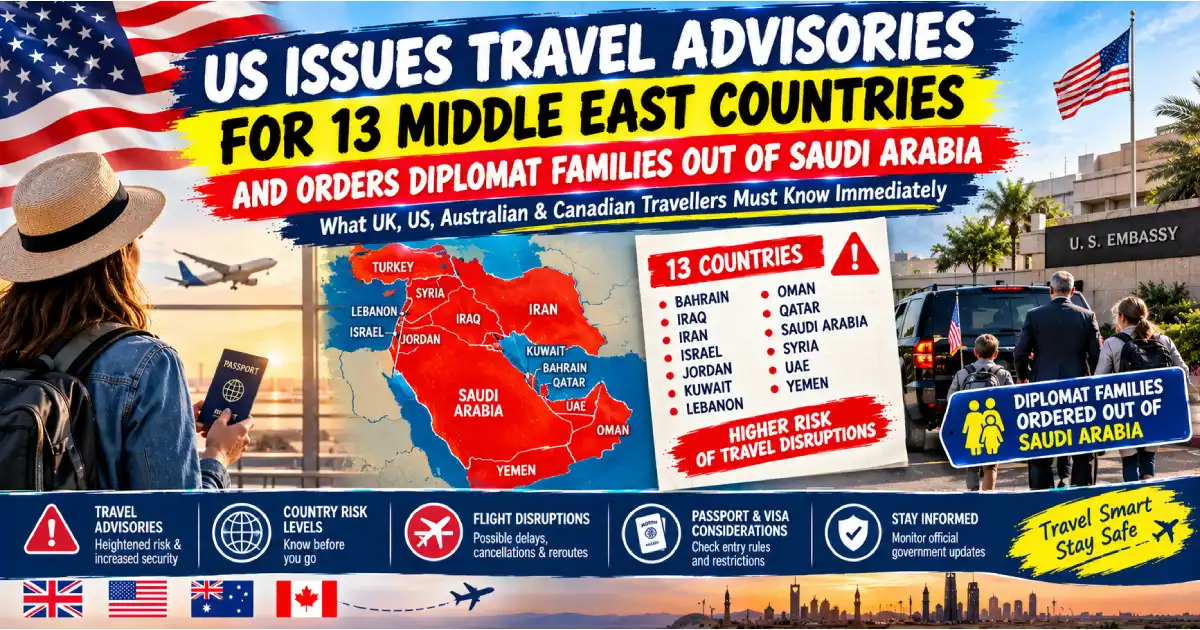
🚨 THE US HAS ORDERED NON-EMERGENCY GOVERNMENT STAFF AND THEIR FAMILIES TO LEAVE SAUDI ARABIA. THIS IS THE HIGHEST-SEVERITY OFFICIAL SIGNAL THE US GOVERNMENT ISSUES BEFORE RECOMMENDING CIVILIANS DO THE SAME. IF YOU HAVE TRAVEL PLANNED TO OR THROUGH THE MIDDLE EAST, READ THIS NOW.
The United States State Department has issued travel advisories covering 13 Middle East countries simultaneously — Saudi Arabia, Bahrain, Iran, Iraq, Jordan, Lebanon, Kuwait, Oman, the United Arab Emirates, Qatar, Syria, Yemen, and Israel — all citing elevated terrorism risk in the wake of sustained Houthi ballistic missile and drone attacks on Saudi airports that have killed and injured hundreds of people over the past three weeks. The advisory cascade is the broadest single-day Middle East travel warning issuance by the US government in years, and it accompanies a formal Ordered Departure — the directive commanding non-emergency US government employees and their family members to leave Saudi Arabia immediately. An Ordered Departure is not a suggestion. It is a binding government order, and its issuance for Saudi Arabia signals that the US government’s intelligence assessment of the risk to American citizens in the country has crossed a formal threshold.
Saudi Arabia sits at Level 3 — Reconsider Travel on the four-tier US advisory scale. The Yemen border areas sit at Level 4 — Do Not Travel — the US government’s highest warning level, reserved for destinations it considers so dangerous that no American should travel there under any circumstances. The UK Foreign, Commonwealth and Development Office, Australia’s Smartraveller, and Canada’s travel advisory system have all issued updated Middle East warnings aligned with the changed security picture. Even the UAE — which has remained the most operationally stable Gulf hub throughout the 2026 conflict period — now has a formal US advisory, though Dubai remains open and the Gulf News confirmed October 24 that 36 weekly Dubai–Europe routes are returning as airlines cautiously restore services.
At the same time, the situation on the ground at Saudi airports is not uniformly closed. Riyadh’s King Khalid International Airport NOTAM ended October 17 and airlines are resuming cautiously. Dammam’s King Fahd International Airport has partially resumed — but a drone attack on Dammam killed two people and injured eight, confirmed by the Saudi Civil Aviation Authority. Najran and Jazan airports have also been struck in recent weeks. The Houthis have stated explicitly that they will continue targeting Saudi aviation infrastructure. The US State Department warns that Houthi attacks have the potential to escalate rapidly. This is the most important travel risk story of October 2026. Here is everything confirmed and exactly what every affected passenger must do.
Published: October 24, 2026 — Saturday US Action: Ordered Departure — non-emergency US government staff + families ordered to leave Saudi Arabia US Advisory Level — Saudi Arabia: Level 3 — Reconsider Travel (out of 4) US Advisory Level — Yemen border areas: Level 4 — Do Not Travel (highest) 13 Countries with Active US Travel Advisories (October 24, 2026): Saudi Arabia | Bahrain | Iran | Iraq | Jordan | Lebanon | Kuwait | Oman | UAE | Qatar | Syria | Yemen | Israel Attack Summary — Recent Weeks:
The US State Department’s travel warning system has four levels — Level 1 (Exercise Normal Precautions) through Level 4 (Do Not Travel). Parallel to this public-facing advisory system, the State Department has an internal mechanism for protecting its own personnel: the Ordered Departure. An Ordered Departure is a formal directive from the US Secretary of State ordering non-emergency US government employees and their dependants to immediately leave a country. It is distinct from an Authorised Departure (which permits — but does not require — voluntary departure) and is a step below a full Embassy closure.
The significance of an Ordered Departure for civilian travellers is profound. The US government does not order its own personnel out of a country and simultaneously tell civilians the situation is fine. Historically, Ordered Departures have consistently preceded significant deteriorations in security conditions. They represent the State Department’s formal institutional judgment that the risk to American personnel — who have security briefings, protection details, and evacuation contingency plans that ordinary citizens do not — has exceeded an acceptable threshold.
The Ordered Departure for Saudi Arabia issued October 24 covers non-emergency staff and their family members at the US Embassy in Riyadh and US Consulates in Jeddah and Dhahran. Emergency staff — typically security, consular emergency services, and senior diplomatic personnel — remain in post. But the families and the non-essential workforce are leaving.
For UK, Australian, and Canadian travellers, the Ordered Departure is the clearest single signal that the security situation in Saudi Arabia has crossed a line that governments consider significant. Your government’s advice may use different language — “advise against all but essential travel” (FCDO), “reconsider your need to travel” (Smartraveller) — but the underlying intelligence assessment driving all of these advisories is the same picture that prompted the US Ordered Departure.
The primary focus of today’s advisory action. Saudi Arabia has sustained multiple Houthi ballistic missile and drone attacks on its civilian aviation infrastructure over the past three weeks. The confirmed strikes:
UK FCDO current advice: Advise against all but essential travel to Saudi Arabia. Australia Smartraveller: Reconsider your need to travel. Canada: Avoid non-essential travel.
For travellers with Saudi Arabia bookings: Contact your airline today. Verify that your specific flight is operating. Check whether your travel insurance is valid — most standard policies are void for destinations under “advise against all but essential travel” advisory status.
For travellers who must travel: Register with your embassy or consulate immediately.
The UAE — and specifically Dubai — has been the most stable Gulf aviation hub throughout the 2026 conflict period. Despite today’s US advisory covering the UAE, Dubai International Airport is operational and 36 weekly Dubai–Europe routes are returning according to Gulf News (October 24, 2026). Emirates is operating at approximately 70–75% capacity. Etihad is operating from Abu Dhabi.
The UAE advisory is precautionary — the State Department has included it in the 13-country issuance as part of a comprehensive regional risk assessment, not because of specific imminent threats to UAE soil. However:
⚠️ The risk of regional escalation is real. If the conflict between Houthi forces and the Saudi-led coalition escalates significantly, UAE airspace could be affected rapidly. The advisory’s language — “have the potential to escalate rapidly” — is specifically relevant to the UAE as the second Gulf hub most exposed to regional escalation scenarios.
For passengers transiting through Dubai (DXB): Continue to monitor emirates.com for flight status. The airport is open. But have contingency plans in case of rapid closure.
For passengers transiting through Abu Dhabi (AUH): Same guidance — Etihad is operating, AUH is open. Monitor etihad.com.
Kuwait International Airport (KWI) has been the subject of drone strike reports in recent days. Kuwait has historically been a secondary Gulf hub for passengers routing from South Asia to Europe and North America. The reports of drone activity at Kuwait International are a significant escalation of the geographic scope of Houthi targeting.
Before any travel involving Kuwait International: Verify current airport status directly with your airline. Do not assume that because Kuwait International was operational yesterday, it is operational today.
Kuwait Airways: kuwaitairways.com | +965 2243 3555 Jazeera Airways: jazeeraairways.com
Qatar and its Hamad International Airport in Doha have remained the most operationally reliable Gulf hub throughout the 2026 conflict period. Qatar has not been directly targeted in the Houthi attack campaign, and Doha’s geographic position — on Qatar’s northeastern coastline — places it furthest from the conflict zone. The US advisory for Qatar is precautionary and general — there is no specific threat to Qatar or Doha.
For passengers routing through Doha on Qatar Airways: Doha remains the recommended Gulf hub for UK, Australian, and Canadian passengers who need to transit the Middle East while minimising risk exposure.
Jordan (Amman) received an upgraded advisory today as part of the 13-country issuance. Amman Queen Alia International Airport has not been directly attacked and continues to operate normally. However, Jordan’s geographic position — sharing borders with Israel, Syria, and Iraq, all of which have their own elevated advisories — makes it part of the broader regional risk assessment.
Lebanon was already at Level 4 — Do Not Travel before today’s issuance. The Lebanese aviation situation — with Beirut Rafic Hariri International Airport operating intermittently and under significant conflict-adjacent risk — has not changed materially today. The October 24 advisory reconfirms existing advice.
Bahrain and Oman have not been directly targeted by Houthi attacks to the extent of Saudi Arabia. Their inclusion in the 13-country advisory reflects the State Department’s assessment that the conflict’s potential to expand geographically in the Gulf has increased. Bahrain International Airport (BAH) and Muscat International Airport (MCT) continue to operate normally.
Syria, Iran, Iraq, and Yemen were already at the highest advisory levels before October 24. Today’s issuance reconfirms and updates these existing warnings:
The most immediately actionable consequence of today’s advisory upgrades for most UK, Australian, and Canadian travellers is the status of their travel insurance. Standard travel insurance policies — including most comprehensive annual multi-trip policies — contain a “government advice” clause that reads approximately:
“We will not pay claims arising from travel to a destination where your government has advised against all but essential travel or against all travel.”
This clause is triggered by today’s advisory status for Saudi Arabia (UK FCDO: “advise against all but essential travel”). If you travel to Saudi Arabia against this advice:
❌ Your travel insurance is void for medical expenses in Saudi Arabia ❌ Your travel insurance is void for emergency evacuation ❌ Your travel insurance is void for trip cancellation claims related to Saudi Arabia ❌ Your travel insurance is void for baggage loss, flight cancellation, or any other covered event in Saudi Arabia
This is not a technicality. It is a material reality that means any medical emergency, security incident, or travel disruption that occurs during travel to a government-advised-against destination leaves you personally responsible for all costs — which can run to hundreds of thousands of dollars for a medical evacuation in a conflict-adjacent environment.
If you must travel to Saudi Arabia, the Gulf, or other advisory-affected Middle East destinations for essential business or compassionate reasons, specialist high-risk travel insurers exist:
Contact your specialist insurer before departure — not after an incident occurs. Get the coverage confirmation in writing.
| Carrier | Route | Suspension |
|---|---|---|
| Air France-KLM | Paris/Amsterdam → Riyadh | Suspended through end of October |
| Lufthansa Group | Frankfurt/Munich/Zurich → Riyadh | Partial suspension — check per flight |
| Air India | Multiple India → Saudi routes | Extended suspension |
| IndiGo | Multiple India → Saudi routes | Extended suspension |
| Delta Air Lines | Atlanta → Riyadh | Delayed to March 2027 |
| Carrier | Status |
|---|---|
| Etihad Airways | Riyadh resumed October 19 — monitor etihad.com |
| Emirates | Saudi services resuming — check per flight |
| Gulf Air | Riyadh resumed October 17 |
| Saudia | Home carrier — operating with modifications |
| Turkish Airlines | Saudi services under review |
Gulf News confirmed October 24 that 36 weekly Dubai–Europe routes are returning as airlines cautiously restore Dubai services. This is the most positive aviation development in today’s broader picture. Airlines resuming or expanding Dubai services:
Step 1 — Check your government’s live advisory:
Step 2 — Contact your airline today: If your airline has not proactively cancelled your flight, check whether it is operating. Some airlines are flying to Riyadh — others are not. Your specific airline’s status is what matters, not the airport’s general status.
Step 3 — Contact your travel insurer: Ask specifically: “Is my policy valid for travel to Saudi Arabia under the current UK FCDO/Smartraveller/State Dept advisory?” Get the answer in writing.
Step 4 — If you want a refund: Under UK261 (for flights departing UK), EU261, and the US DOT Automatic Refund Rule, if your airline cancels your flight you are entitled to a full cash refund. If your airline continues to operate the flight but you choose not to travel due to the advisory, you are generally in standard fare-rules territory — refundability depends on your ticket type.
Step 5 — If you must travel: Register with your embassy before departure. Download your government’s emergency alert app. Have an emergency cash reserve. Do not rely solely on digital payments in a conflict-adjacent environment.
The most common scenario for UK, Australian, and Canadian passengers: routing through Dubai (DXB), Doha (DOH), or Abu Dhabi (AUH) on a connecting journey to Asia, Africa, or elsewhere.
Dubai transit (DXB): Currently assessed as acceptable — 36 weekly Europe routes returning. Monitor your airline. Have a contingency routing via Doha if Dubai closes unexpectedly.
Doha transit (DOH): Safest Gulf transit option currently — Qatar has not been directly targeted. Qatar Airways is operating. Recommended over Dubai for risk-sensitive passengers.
Abu Dhabi transit (AUH): Etihad is operating. AUH not directly targeted. Acceptable with monitoring.
Riyadh/Dammam transit: Do not plan transit through Saudi airports unless absolutely essential and with full knowledge of the current risk picture.
Beirut transit: Do not transit. Level 4 advisory.
Iraq/Iran/Syria/Yemen: Do not travel or transit. Level 4 advisories.
Your policy’s “government advice” exclusion clause is typically in the general exclusions section. Read it now. Key questions:
If the answer to any of these is uncertain, call your insurer today — not after you have already boarded.
UK261 (flights departing UK airports):
EU261 (flights departing EU airports):
DOT April 2024 Automatic Refund Rule (flights departing US airports):
The exact phrase at any airline counter: “My flight [number] to [destination] has been cancelled. Under [UK261/EU261/DOT April 2024 Rule], I am requesting a full cash refund to my original payment method. I do not accept a travel voucher.”
If your airline is still operating the flight but you choose not to travel: Standard fare rules apply. If you purchased a refundable ticket, claim your refund. If you purchased a non-refundable ticket, contact your travel insurer for trip cancellation coverage — noting the government advisory status may affect your claim eligibility (see above).
| Resource | Contact / Link |
|---|---|
| UK FCDO Saudi Arabia | gov.uk/foreign-travel-advice/saudi-arabia |
| UK FCDO UAE | gov.uk/foreign-travel-advice/united-arab-emirates |
| UK FCDO Kuwait | gov.uk/foreign-travel-advice/kuwait |
| UK FCDO Jordan | gov.uk/foreign-travel-advice/jordan |
| US State Dept Travel | travel.state.gov |
| Australia Smartraveller Saudi | smartraveller.gov.au/destinations/middle-east/saudi-arabia |
| Australia Smartraveller UAE | smartraveller.gov.au/destinations/middle-east/united-arab-emirates |
| Canada Travel Advisories | travel.gc.ca |
| NZ SafeTravel | safetravel.govt.nz |
| British Embassy Riyadh | +966 11 488 0077 |
| US Embassy Riyadh | Emergency line — sa.usembassy.gov |
| Australian Embassy Riyadh | +966 11 250 7000 |
| Canadian Embassy Riyadh | +966 11 488 2288 |
| Qatar Airways (safest Gulf transit) | qatarairways.com |
| Emirates | emirates.com |
| Etihad | etihad.com |
| Campbell Irvine (specialist insurance) | campbellirvine.com |
| Battleface (high-risk insurance) | battleface.com |
| Saudi GACA (airport status) | gaca.gov.sa |
| UK CAA UK261 Claims | caa.co.uk/passengers |
| DOT Consumer Protection | airconsumer.dot.gov |
Friday October 24, 2026 is the most significant single-day travel advisory action taken by the US government for the Middle East in years. The State Department has issued formal travel advisories covering 13 countries simultaneously — Saudi Arabia, Bahrain, Iran, Iraq, Jordan, Lebanon, Kuwait, Oman, UAE, Qatar, Syria, Yemen, and Israel — all citing elevated terrorism risk driven by the sustained Houthi campaign of ballistic missile and drone attacks on Saudi civilian aviation infrastructure. Saudi Arabia sits at Level 3 (Reconsider Travel) with a formal Ordered Departure of non-emergency US government staff and families. Dammam airport has been struck with 2 killed and 8 injured. Najran and Jazan airports have been hit. Kuwait International Airport has reported drone strike activity. The Houthis have explicitly stated they will continue. The US State Department warns the attacks have the potential to escalate rapidly.
The UAE — including Dubai and Abu Dhabi — has received a precautionary advisory but remains operational, with 36 weekly Dubai–Europe routes returning as of October 24. Qatar’s Doha is the current safest Gulf transit hub. Saudi airports are partially operational but under direct ongoing threat.
The seven actions every traveller with Middle East plans must take immediately:
For More Resources:
Related Articles:
Posted By : Vinay
This article is provided for general informational purposes only and is based on information available at the time of publication. Travel advisories, airline schedules, airport operations, visa requirements, government regulations, and other travel-related information are subject to change without prior notice. While Travel Tourister makes reasonable efforts to verify information using official announcements, government publications, airline and airport communications, and other reliable sources, we cannot guarantee that all information remains complete, accurate, or up to date at all times. Readers should independently verify any information that may affect their travel plans with the relevant airline, airport authority, government agency, embassy, or other official source before making travel, financial, or other decisions. Travel Tourister shall not be liable for any direct or indirect loss, inconvenience, or damages arising from the use of or reliance on the information contained in this article. Nothing in this publication constitutes legal, immigration, financial, or professional travel advice. If you believe any information in this article is inaccurate or outdated, please contact our editorial team. We review all credible correction requests promptly and update our content whenever appropriate.
Lastest News
2nd Floor, 39, Above Kirti Club, DLF Industrial Area, Kirti Nagar, New Delhi, Delhi 110015



Travel Tourister is a leading Travel portal where we introduce travellers to trusted travel agents to make their journey hasselfree, memorable And happy. Travel Tourister is a platform where travellers get Tour packages ,Hotel packages deals through trusted travel companies And hoteliers who are working with us across the world. We always try to find new and more travel agents and hoteliers from every nook and corners across the world so that you could compare the deals with different travel agents and hoteliers and book your tour or hotel with the one you have chosen according to your taste and budget.
Copyright © Travel Tourister, India. All Rights Reserved

 Call
 Enquiry