By Travel Tourister | Updated October 2026
Maharashtra sits on top of one of India’s great trekking landscapes and most people driving through it on the expressway have no idea. The Western Ghats — the Sahyadri range — runs the full length of the state, a spine of basalt plateaus, sheer cliff faces, ancient fort ruins, and dense deciduous forest that stretches from the Nashik highlands in the north to the Kolhapur hills in the south. Within a three-hour radius of Mumbai and four hours of Pune, there are more legitimate weekend trekking options than most adventure travellers manage in a year of planning.
What makes Maharashtra’s trekking landscape genuinely distinctive is the layering. Almost every significant trek here leads to a Maratha fort — some intact, some in atmospheric ruin — that carries real historical weight from the campaigns of Chhatrapati Shivaji Maharaj. You are not just reaching a summit for the view. You are standing on a fortification that controlled a trade route, repelled a Mughal siege, or served as a capital of the Maratha Empire. That context changes the experience of every approach, every climb, and every panorama.
This guide covers the best weekend treks in Maharashtra across every difficulty level — from beginner-friendly one-day climbs to multi-day Sahyadri ridge routes that demand preparation and physical conditioning. Each entry includes distance, elevation gain, difficulty, best season, base village, and practical planning information so you can build a realistic weekend itinerary rather than discovering logistics on the trailhead.
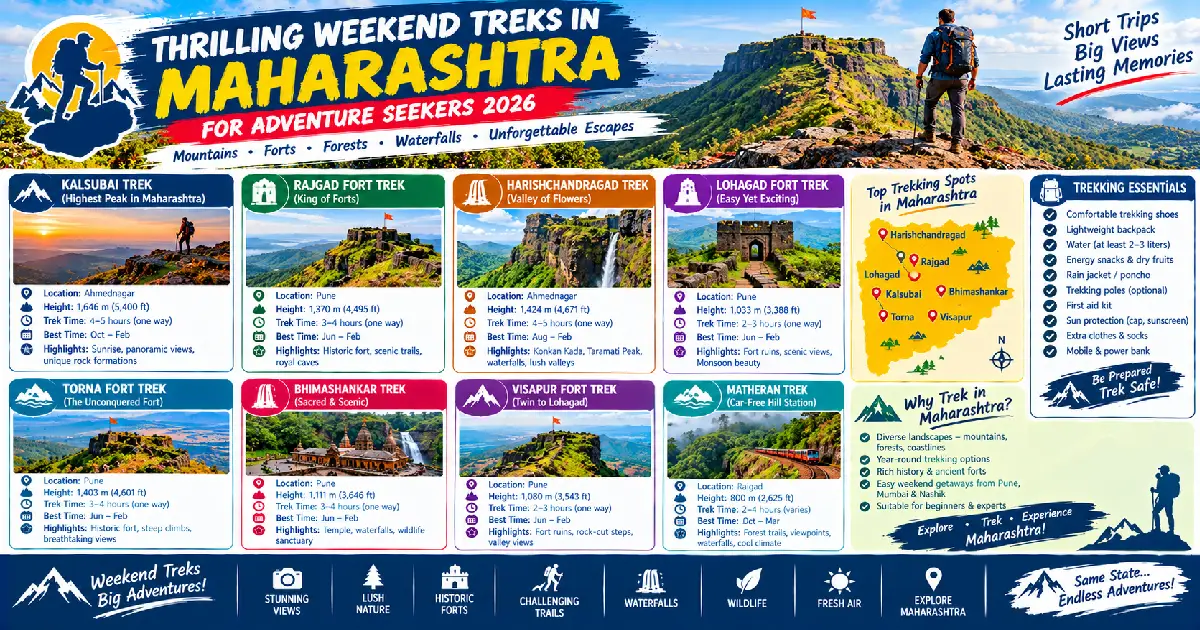
| Trek | Difficulty | Distance (RT) | Elevation | Duration | Base Village | Distance from Mumbai | Best Season |
|---|---|---|---|---|---|---|---|
| Harishchandragad | Moderate–Hard | 20–25 km | 1,424 m | 2 days | Khireshwar / Pachnai | ~165 km | Oct–Feb |
| Rajgad Fort | Moderate | 12–14 km | 1,376 m | 1–2 days | Gunjavne | ~200 km | Oct–Mar |
| Kalsubai Peak | Easy–Moderate | 8–10 km | 1,646 m | 1 day | Bari | ~165 km | Oct–Feb |
| Bhimashankar | Easy–Moderate | 12–14 km | 1,000 m | 1–2 days | Khandas | ~200 km | Oct–Mar |
| Torna Fort | Moderate | 6–8 km | 1,403 m | 1 day | Velhe | ~60 km Pune | Oct–Mar |
| Alang-Madan-Kulang (AMK) | Very Hard | 25–30 km | 1,600+ m | 2–3 days | Ambivli | ~180 km | Nov–Feb |
| Ratangad | Moderate | 10–12 km | 1,297 m | 1 day | Ratanwadi | ~180 km | Oct–Feb |
| Visapur Fort | Easy | 6 km | 1,084 m | 1 day | Malavli | ~105 km | Oct–Mar |
| Naneghat | Easy–Moderate | 6 km | 750 m | 1 day | Tokawade | ~125 km | Oct–Mar |
| Sandhan Valley | Moderate | 6 km valley | 700 m descent | 1–2 days | Samrad | ~165 km | Oct–Feb |
Harishchandragad is the trek that experienced Maharashtra trekkers return to repeatedly and the one that most people who have done it recommend first to anyone asking where to start. At 1,424 metres, it is not the highest peak in the Sahyadri, but the combination of the Koknaspur pinnacle, the Kedareshwar Cave temple with its ancient Shiva linga surrounded by a water moat, and the Konkan Kada — a sheer concave cliff that drops vertically to the Konkan plain far below — makes it one of the most visually and spiritually powerful mountain experiences in western India.
The approach from Khireshwar village takes you through dense forest and past a seasonal waterfall before the trail steepens significantly in the final section toward the plateau. The approach from Pachnai is slightly shorter and more direct. Most trekkers choose a two-day format — camping on the plateau or staying in the cave temple on night one, exploring Konkan Kada and the summit area on day two before descending. A one-day dash is physically possible for very fit trekkers but leaves almost no time for the plateau exploration that defines the experience.
For those wanting to trek with an organised group that handles route logistics, permits, and safety, Trekpanda’s Harishchandragad batch offers guided departures with experienced leaders, base camp coordination, and transportation from Mumbai and Pune — removing the multi-leg coordination that makes self-organised Harishchandragad trips more complex than they appear on paper.
| Detail | Information |
|---|---|
| Altitude | 1,424 m (4,672 ft) |
| Trek Distance | 20–25 km round trip (Khireshwar route) |
| Elevation Gain | ~900 m from base village |
| Difficulty | Moderate to Hard |
| Duration | 2 days (recommended); 1 day possible for fit trekkers |
| Base Villages | Khireshwar (most common); Pachnai; Sadhale Ghat |
| Nearest Town | Akole (Ahmednagar district) |
| Distance from Mumbai | ~165 km (4–5 hrs by road) |
| Distance from Pune | ~135 km (3.5–4 hrs by road) |
| Best Season | October to February |
| Permits Required | Forest entry fee at Khireshwar (nominal) |
| Camping | Permitted on plateau; cave shelter at Kedareshwar |
| Water Source | Available at base; limited on upper plateau — carry 3L minimum |
| Key Highlights | Koknaspur pinnacle, Konkan Kada cliff, Kedareshwar Cave temple |
| Day | Route | Distance | Highlights |
|---|---|---|---|
| Day 1 Morning | Khireshwar → forest trail → upper plateau | 8–10 km; 5–6 hrs | Dense Sahyadri forest; seasonal waterfall; gradual then steep ascent |
| Day 1 Afternoon | Plateau exploration; Kedareshwar Cave | 2–3 km on plateau | Ancient cave temple; Shiva linga in water moat; fort ruins |
| Day 1 Evening | Camp on plateau or cave shelter | — | Sunset over Konkan plain; night sky at 1,400 m |
| Day 2 Morning | Konkan Kada viewpoint; Koknaspur approach | 4–5 km | Sheer concave cliff; vast Konkan plain view; sunrise |
| Day 2 Afternoon | Descent via same or alternate route | 8–10 km; 4–5 hrs | Reverse trail; return to Khireshwar |
Kalsubai at 1,646 metres is the highest peak in Maharashtra and the most accessible serious summit in the Sahyadri. The trek from Bari village follows a direct ridge line that includes iron chains and handrails fixed into the rock face in the steeper sections — technical enough to feel like a real climb, assisted enough to be accessible to well-prepared beginners attempting their first significant ascent. A small temple to the goddess Kalsubai sits at the summit.
| Detail | Information |
|---|---|
| Altitude | 1,646 m — highest peak in Maharashtra |
| Trek Distance | 8–10 km round trip |
| Elevation Gain | ~700 m from Bari village |
| Difficulty | Easy to Moderate (iron chains assist steeper sections) |
| Duration | 1 day; 5–6 hrs return |
| Base Village | Bari (Akola taluka, Ahmednagar district) |
| Distance from Mumbai | ~165 km (4–4.5 hrs) |
| Distance from Pune | ~115 km (2.5–3 hrs) |
| Best Season | October to February |
| Highlights | Highest Maharashtra summit; iron chain sections; summit temple; panoramic Sahyadri views |
| Crowds | High on weekends (Oct–Dec) — start before 6 AM |
Rajgad was the capital of the Maratha Empire under Chhatrapati Shivaji Maharaj for 26 years — longer than any other fort — and its sprawling plateau, multiple sub-forts (machis), water tanks, and structural remains make it far more interesting to explore than a single summit peak. The approach from Gunjavne village takes approximately 3–4 hours to reach the Pali Darwaja entrance. Most serious Rajgad visits require two days to cover the full circuit.
| Detail | Information |
|---|---|
| Altitude | 1,376 m |
| Trek Distance | 12–14 km round trip |
| Elevation Gain | ~900 m |
| Difficulty | Moderate |
| Duration | 1 day (partial); 2 days (full fort exploration) |
| Base Village | Gunjavne |
| Distance from Pune | ~55 km (1.5–2 hrs) |
| Distance from Mumbai | ~200 km (4.5–5 hrs) |
| Best Season | October to March |
| Highlights | Maratha Empire capital; three machis (sub-forts); ancient water tanks; sweeping Western Ghats views |
| Accommodation | Basic stay available on the fort; camping permitted |
Torna (also called Prachandagad) holds the distinction of being the first fort captured by the teenage Shivaji Maharaj in 1646, marking the beginning of the Maratha Empire. At 1,403 metres, it is a serious climb from Velhe village but a single-day objective. The approach trail through dense forest and rocky terrain is well-marked. The fort top offers a commanding 360-degree view of the surrounding Sahyadri ridgelines.
| Detail | Information |
|---|---|
| Altitude | 1,403 m |
| Trek Distance | 6–8 km round trip |
| Elevation Gain | ~800 m |
| Difficulty | Moderate |
| Duration | 1 day; 5–7 hrs return |
| Base Village | Velhe |
| Distance from Pune | ~60 km (1.5 hrs) |
| Distance from Mumbai | ~190 km (4–4.5 hrs) |
| Best Season | October to March |
| Highlights | First Maratha fort; historical significance; summit temple; panoramic ridge views |
Bhimashankar combines a forest trek through a designated wildlife sanctuary with a visit to one of the 12 Jyotirlinga shrines of Lord Shiva — making it simultaneously a serious nature walk and a pilgrimage destination. The Shidi Ghat route from Khandas village is the more adventurous approach, with near-vertical sections using iron rungs fixed into the rock. The sanctuary is home to the Giant Indian Squirrel (Shekru) — Maharashtra’s state animal — and birdlife is abundant year-round.
| Detail | Information |
|---|---|
| Altitude | ~1,000 m |
| Trek Distance | 12–14 km round trip (Shidi Ghat route) |
| Elevation Gain | ~600 m |
| Difficulty | Easy to Moderate; Shidi Ghat route is Moderate–Hard |
| Duration | 1–2 days |
| Base Village | Khandas (Shidi Ghat route) |
| Distance from Mumbai | ~200 km (4–5 hrs) |
| Distance from Pune | ~110 km (2.5 hrs) |
| Best Season | October to March; post-monsoon forest is spectacular |
| Highlights | Bhimashankar Jyotirlinga temple; wildlife sanctuary; Giant Indian Squirrel sightings; dense forest |
AMK is the benchmark hard trek in Maharashtra — a multi-day traverse of three adjacent fortress peaks in the Kalsubai range that involves technical rock climbing sections, chimney climbs requiring a rope and guide, and sustained physical effort that separates it clearly from every other weekend objective on this list. The AMK traverse is not suitable for beginners, first-time trekkers, or anyone without prior multi-day Sahyadri experience. With the right preparation and a certified guide, it is extraordinary.
| Detail | Information |
|---|---|
| Altitude | Alang: 1,593 m; Madan: 1,577 m; Kulang: 1,459 m |
| Trek Distance | 25–30 km full traverse |
| Elevation Gain | 1,600+ m cumulative across all three peaks |
| Difficulty | Very Hard — rope sections; chimney climbs |
| Duration | 2–3 days |
| Base Village | Ambivli |
| Distance from Mumbai | ~180 km |
| Best Season | November to February only |
| Guide Required | Yes — mandatory; technical sections require rope assistance |
| Highlights | Three fortress peaks; highest technical difficulty in Maharashtra weekend trekking; remote and uncrowded |
| Prerequisite | Prior Sahyadri experience of at least 5 moderate treks |
Ratangad at 1,297 metres is famous for the Nedhe — a naturally formed arch or “eye” in the basalt rock near the summit — that frames the sky and surrounding ridges in a composition that photographs extraordinarily well. The approach from Ratanwadi village passes through forest and along a ridgeline with continuous views. It is an ideal single-day objective for trekkers who have done Kalsubai and want the next step up in terms of trail quality and visual drama.
| Detail | Information |
|---|---|
| Altitude | 1,297 m |
| Trek Distance | 10–12 km round trip |
| Elevation Gain | ~700 m |
| Difficulty | Moderate |
| Duration | 1 day; 5–6 hrs return |
| Base Village | Ratanwadi |
| Distance from Mumbai | ~180 km (4–4.5 hrs) |
| Distance from Pune | ~120 km (3 hrs) |
| Best Season | October to February |
| Highlights | The Nedhe natural arch; ridge walk; fort ruins; Bhandardara reservoir views |
Sandhan Valley is not a fort trek and not a summit — it is a slot canyon traverse through a dramatic gorge cut into the Sahyadri basalt that involves rappelling, boulder scrambling, stream crossing, and narrow passages where the walls close to arm’s width and the sky reduces to a thin strip of blue above. It is often called the “Valley of Shadows” for the way the overhanging walls block light through most of the day. The experience is unlike anything else in Maharashtra’s trekking landscape.
| Detail | Information |
|---|---|
| Type | Canyon traverse / rappelling |
| Distance | ~6 km one way through the valley |
| Depth | Descends ~700 m through the gorge |
| Difficulty | Moderate — requires comfort with rappelling |
| Duration | 1–2 days (overnight camp inside the valley option) |
| Base Village | Samrad |
| Distance from Mumbai | ~165 km (4 hrs) |
| Best Season | October to February (avoid during and after heavy rain) |
| Guide Required | Yes — rappelling equipment and guidance mandatory |
| Highlights | Slot canyon walls; rappelling sections; overnight camp in the gorge; rare geological landscape |
Visapur is the ideal first weekend trek for anyone based in Pune or Mumbai who wants a genuine fort experience without the commitment of a multi-hour approach. The trail from Malavli (near the Bhaja Caves) is short, well-marked, and forgiving — reaching the plateau fort at 1,084 metres takes 2–3 hours. The fort itself has substantial water cisterns, structural ruins, and sweeping views of the adjacent Lohagad Fort and the Pawna valley below.
| Detail | Information |
|---|---|
| Altitude | 1,084 m |
| Trek Distance | 6 km round trip |
| Elevation Gain | ~500 m |
| Difficulty | Easy |
| Duration | 1 day; 3–4 hrs return |
| Base Village / Station | Malavli (railway station on Mumbai–Pune line) |
| Distance from Pune | ~55 km; or Malavli by local train |
| Distance from Mumbai | ~105 km |
| Best Season | October to March |
| Highlights | Accessible by local train; large fort ruins; Pawna valley views; Lohagad visible from summit |
Naneghat is one of Maharashtra’s most historically significant trek destinations — an ancient mountain pass used by Satavahana traders over two thousand years ago as the primary route between the Konkan coast and the Deccan plateau. The pass itself contains rock-cut inscriptions and toll-collection niches carved into the rock. The approach from Tokawade village is moderate and suitable for beginners, and the plateau viewpoint on a clear day delivers one of the most expansive panoramas of the Western Ghats available on a single-day trek.
| Detail | Information |
|---|---|
| Altitude | ~750 m (pass level) |
| Trek Distance | 6 km round trip |
| Elevation Gain | ~450 m |
| Difficulty | Easy to Moderate |
| Duration | 1 day; 3–4 hrs return |
| Base Village | Tokawade |
| Distance from Mumbai | ~125 km (3 hrs) |
| Distance from Pune | ~100 km (2.5 hrs) |
| Best Season | October to March; monsoon greenery is spectacular but slippery |
| Highlights | Ancient Satavahana-era inscriptions; toll niches; panoramic Sahyadri views; historical significance |
| Month | Conditions | Trail Status | Visibility | Recommendation |
|---|---|---|---|---|
| June | Monsoon onset; heavy rain | Slippery; some trails closed | Low | ❌ Avoid — dangerous on steep trails |
| July | Peak monsoon; waterfalls active | Very slippery; high risk | Very Low | ❌ Avoid — flash flood risk in valleys |
| August | Heavy monsoon continues | Dangerous on fort approaches | Low | ❌ Avoid for most; experienced only |
| September | Monsoon receding; forest lush | Better but still wet | Moderate | ⚠️ Experienced trekkers only |
| October | Post-monsoon; cool; clear | Excellent — dry and firm | High | ✅ Best — trails green, weather perfect |
| November | Cool; dry; clear | Excellent | Very High | ✅ Best — peak season begins |
| December | Cool to cold; dry | Excellent | Very High | ✅ Excellent — ideal temperatures |
| January | Cold mornings; dry; clear | Excellent | Excellent | ✅ Best — coolest and clearest |
| February | Warming slightly; dry | Very Good | Very High | ✅ Very Good |
| March | Warming; dry | Good — getting warm | Good | ✅ Good — manageable |
| April | Hot; dry | Fair — very hot above noon | Good | ⚠️ Hot — start before 5 AM |
| May | Very hot; pre-monsoon | Difficult — extreme heat | Good | ❌ Avoid most full-day treks |
Overall best window: October to February. November, December, and January deliver the sharpest visibility, coolest temperatures, firm dry trails, and the best sunrise and sunset colours on the plateau forts.
| Level | Treks | Fitness Required | Gear Required | Prior Experience |
|---|---|---|---|---|
| Easy | Visapur, Naneghat | Basic walking fitness; no specific training | Comfortable shoes; daypack; water | None — suitable for first-timers |
| Easy–Moderate | Kalsubai, Bhimashankar (easy route) | Moderate fitness; some stair climbing ability | Trekking shoes; poles optional; 2–3L water | 1–2 day hikes helpful |
| Moderate | Rajgad, Torna, Ratangad, Sandhan Valley | Good fitness; comfortable with sustained climbing | Trekking shoes; poles; headlamp; 3L water; snacks | 3–5 prior day treks |
| Moderate–Hard | Harishchandragad | Strong fitness; multi-day stamina; comfortable with heights | Full trekking kit; sleeping bag; 4L water; emergency supplies | 5+ prior treks including one overnight |
| Very Hard | AMK (Alang-Madan-Kulang) | Excellent fitness; prior technical exposure | Full kit + rope; helmet; harness if available | 10+ prior Sahyadri treks; prior AMK experience recommended |
| Category | Item | Notes |
|---|---|---|
| Footwear | Ankle-support trekking shoes | No sandals or running shoes on rocky Sahyadri terrain |
| Clothing | Moisture-wicking t-shirts × 2 | No cotton — dries slowly and chafes |
| Clothing | Light fleece or warm layer | Fort plateaus get cold at night Oct–Feb; 5–10°C possible |
| Clothing | Waterproof windcheater | Unexpected rain possible Oct–Nov |
| Clothing | Full-length quick-dry trousers | Protects against scrub and rock; shorts inadequate |
| Water | 3–4 litre capacity | Springs available on some routes; treat or carry from base |
| Food | Energy bars, nuts, dry fruits, electrolytes | Dhabas available at some base villages; nothing on trail |
| Navigation | Offline map (Maps.me or Wikiloc download) | Mobile signal unreliable on most Sahyadri routes |
| Lighting | Headlamp + spare batteries | Early morning and post-sunset movement requires it |
| Safety | Basic first aid kit | Blister plasters, paracetamol, ORS, bandage |
| Shelter (overnight) | Sleeping bag (winter rating) + tent or tarp | For plateau camping October–February |
| ID | Aadhar / government photo ID | Required at some forest checkposts |
| Expense | Self-Organised | With Guided Group |
|---|---|---|
| Transport (Mumbai return, shared cab) | ₹600–₹1,200 per person | Included in package |
| Transport (Pune return, shared cab) | ₹400–₹800 per person | Included in package |
| Forest / entry permit | ₹50–₹200 | Included in package |
| Food (day trek) | ₹200–₹500 | Included / partially included |
| Food + accommodation (overnight) | ₹500–₹1,500 | Included in package |
| Guide (self-arranged) | ₹500–₹1,500 | Included in package |
| Total (day trek, self-organised from Mumbai) | ₹1,350–₹3,400 | — |
| Total (overnight trek, self-organised) | ₹1,650–₹4,400 | — |
| Typical guided group package (overnight) | — | ₹1,800–₹3,500 all-in |
Guided group packages — including transport, meals, camping, and a certified trek leader — are frequently cheaper per person than a self-organised trip once guide cost, individual transport, and camping logistics are factored in. For first-time overnight treks like Harishchandragad, they also remove the route-finding and safety coordination burden that makes self-organised multi-day Sahyadri treks riskier than they appear.
Q: Which is the best weekend trek in Maharashtra for beginners? Visapur Fort near Malavli is the strongest beginner choice — accessible by local train from Pune, a 6 km round trip with 500 m of elevation gain, and a genuine fort experience at the top without any technical or exposed sections. Naneghat is the second-best beginner option, adding historical depth through the ancient Satavahana inscriptions at the pass. Kalsubai is suitable for fit beginners who want Maharashtra’s highest summit, provided they are comfortable with the iron chain-assisted sections on the upper trail.
Q: How difficult is the Harishchandragad trek? Harishchandragad is rated Moderate to Hard and is best attempted as a two-day trek. The approach from Khireshwar involves significant elevation gain — approximately 900 metres — across 8–10 km of forest trail that becomes steep and rocky in the upper section. The plateau itself requires further exploration over several kilometres. The Konkan Kada viewpoint involves exposure to significant heights. First-time overnight trekkers will find it demanding. Joining an organised group with an experienced leader significantly reduces risk on this route — options like Trekpanda’s Harishchandragad batch handle logistics, safety, and route-finding from the base.
Q: What is the best month to trek in Maharashtra? November, December, and January deliver the best conditions across all difficulty levels — cool temperatures (10–22°C on trail), dry and firm paths, excellent visibility from summit plateaus, and minimal rain risk. October is excellent for post-monsoon greenery and waterfalls still active at lower elevations. February remains very good. March is manageable but warming. Avoid July and August entirely on steep routes — monsoon trails are dangerous and flash flood risk in valley routes like Sandhan is genuine.
Q: Do I need a guide for weekend treks in Maharashtra? For easy and moderate day treks like Visapur, Naneghat, Kalsubai, and Torna, a guide is not strictly required for trekkers who research the route in advance and carry offline maps. For overnight treks — Harishchandragad particularly — a guide is strongly recommended, especially for first-timers who may lose the trail on the plateau. For technical routes like AMK and Sandhan Valley’s rappelling sections, a certified guide with proper equipment is mandatory. For all overnight treks, joining an organised group is the most cost-effective and safest approach.
Q: How do I reach the base villages for Maharashtra treks from Mumbai? Most Sahyadri base villages are accessed by a combination of road and shared transport. From Mumbai, MSRTC buses run to Nashik, Igatpuri, Akole, Pune, and other regional hubs, from which shared jeeps or private cabs cover the final leg to the base village. Driving yourself is most flexible — NH160 (Mumbai–Nashik Expressway) covers the northern Sahyadri access efficiently. Some bases like Malavli (Visapur) and Karjat (for Matheran-area treks) are accessible directly by Mumbai local train, making them genuinely no-car options.
Q: Is camping allowed on Maharashtra forts? Camping is permitted on most Sahyadri fort plateaus with the exception of those designated as protected heritage sites under Archaeological Survey of India (ASI) jurisdiction where overnight stay is restricted. Rajgad, Harishchandragad, and Torna permit camping on their plateaus. Sandhan Valley camping inside the gorge is a popular option. Forest department rules apply in wildlife sanctuary areas like Bhimashankar — confirm camping permissions with the range office before planning an overnight there. Carry out all waste; leave-no-trace principles are now enforced on several popular routes.
Q: What food and water options are available on Maharashtra trek routes? Most base villages have a dhaba or tea stall serving basic food — poha, vada, chai, bhakri, and rice meals. On the trails themselves, food infrastructure is minimal or absent. Carry at least 3–4 litres of water per person for a full-day trek; water sources exist on some routes (springs near Khireshwar on the Harishchandragad approach, for example) but should be treated with purification tablets before drinking. Carry enough food for the full day from the base — energy bars, dry fruits, electrolyte powder, and a simple lunch.
Q: What is the Alang-Madan-Kulang (AMK) trek and who should attempt it? AMK is a multi-peak traverse of three adjacent fort summits in the Kalsubai range that involves technical rope-assisted sections, chimney climbs, and sustained physical effort across 2–3 days. It is the hardest commonly attempted weekend trek in Maharashtra and requires prior experience of at least 8–10 Sahyadri treks, a certified guide with rope equipment, and physical fitness well above standard trekking level. It is not suitable for beginners, casual trekkers, or anyone attempting their first overnight Sahyadri experience. The rewards — three remote summit fort plateaus with almost no casual visitors — are commensurate with the effort.
Q: How much does a weekend trek in Maharashtra cost? A self-organised single-day trek from Mumbai — including shared transport, nominal entry fees, and food — costs approximately ₹1,350–₹3,400 per person. An overnight trek adds accommodation and guide costs, bringing the range to ₹1,650–₹4,400. Organised group packages for overnight treks like Harishchandragad typically cost ₹1,800–₹3,500 per person all-inclusive — covering transport, meals, camping, and a trek leader. For first-time overnight trekkers, the guided package is frequently better value than a self-organised equivalent once individual guide hire and logistics are factored in.
Q: What is the Konkan Kada at Harishchandragad? Konkan Kada is a concave overhanging cliff on the western face of Harishchandragad that drops vertically to the Konkan plain some 1,000+ metres below. The overhang means that when you stand at the edge and look down, the cliff face curves away beneath you rather than sloping — the effect is visually dramatic and vertigo-inducing in the most positive sense. On clear mornings, the view extends from the plateau edge across the entire Konkan coastal plain to the Arabian Sea on the horizon. It is widely considered one of the most spectacular viewpoints in the Western Ghats.
Q: Can families with children attempt weekend treks in Maharashtra? Yes, with appropriate trek selection. Visapur, Naneghat, and the easier Bhimashankar approach are manageable for children aged 10 and above who have a basic fitness baseline and proper footwear. Kalsubai’s iron chain sections are exciting for older children (12+) who are comfortable with heights. Harishchandragad and Rajgad are better suited to teenagers and adults given the distance, elevation gain, and overnight format. The monsoon season should be avoided entirely for family treks due to slippery trail conditions. Early departure times — before 7 AM — are essential for families attempting any full-day Sahyadri trek to avoid afternoon heat.
About Travel Tourister Travel Tourister’s editorial team researched Maharashtra’s Sahyadri trekking landscape using verified trail data, seasonal condition records, and current permit and logistics information to build this guide — so you spend your weekend on the right trail, not figuring out the logistics from the trailhead.

As an upcoming travel agent I got much support from travel tourister. We are getting very good leads from travel tourister and they mend our website which is also very commendable.... Excellent work Hope to do more business forward.... Thanks and regards CEO,Andaman Unlocked
Rating:
10/20/2018
As an upcoming travel agent I got much support from travel tourister. We are getting very good leads from travel tourister and they mend our website which is also very commendable.... Excellent work Hope to do more business forward.... Thanks and regards CEO,Andaman Unlocked
Rating:
10/20/2018
2nd Floor, 39, Above Kirti Club, DLF Industrial Area, Kirti Nagar, New Delhi, Delhi 110015



Travel Tourister is a leading Travel portal where we introduce travellers to trusted travel agents to make their journey hasselfree, memorable And happy. Travel Tourister is a platform where travellers get Tour packages ,Hotel packages deals through trusted travel companies And hoteliers who are working with us across the world. We always try to find new and more travel agents and hoteliers from every nook and corners across the world so that you could compare the deals with different travel agents and hoteliers and book your tour or hotel with the one you have chosen according to your taste and budget.
Copyright © Travel Tourister, India. All Rights Reserved



 Call
 Enquiry