Published on : 30 Dec 2025
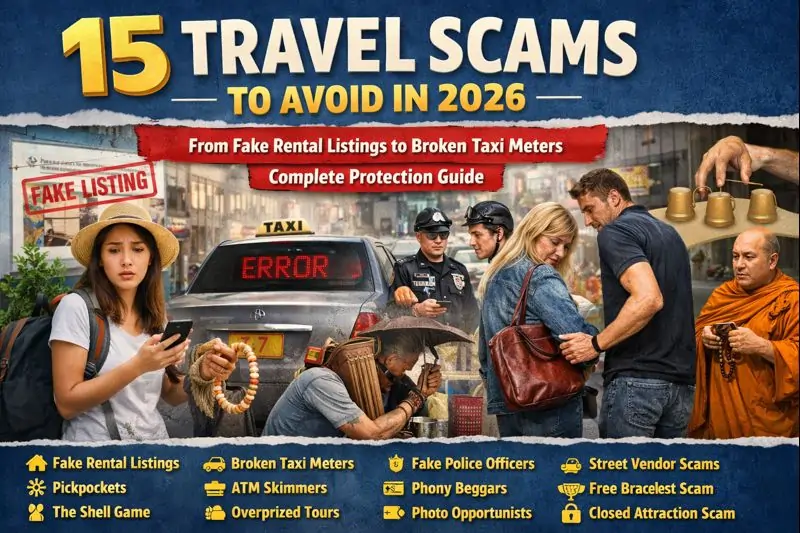
SAFETY ALERT: Travel scams cost Americans $617,000+ annually with rental fraud, timeshare schemes, and taxi scams targeting unsuspecting tourists worldwide
Published: December 30, 2025 Source: Consumer Rescue, US State Department, Action Fraud, Multiple Travel Safety Organizations Alert Level: HIGH – Peak travel season increases scam activity Cost to Victims: $617,000+ in timeshare scams alone
Travel scams targeting tourists reached alarming sophistication levels in 2025-2026 with fake vacation rental listings hijacking real property photos, “broken” taxi meters multiplying costs, and deepfake technology impersonating customer service representatives as Americans plan record travel numbers during holiday periods despite ongoing disruptions.
“Travelers can be easy targets for scammers, pickpockets, and thieves. The more you know about the tricks and traps scammers use, the better off you’ll be on your next trip,” warns Harding Bush, former Navy SEAL and Global Rescue associate director of security operations, as July and August 2025 saw 804 and 781 holiday fraud reports respectively—peak months for travel scams globally.
The devastating reality: “Many travelers fall victim to these tricks simply because they let their guard down while on holiday,” explains Harish Kohli, CEO of Asian Geographical Expeditions. “Scammers target tourists who appear unfamiliar with local customs or those who seem distracted by the excitement of exploring new places,” making awareness and preparation essential for safe international travel in 2026.
How it works: Scammers hijack real property photos and descriptions from legitimate sites like Vrbo and Airbnb, creating convincing listings complete with stolen images and fabricated reviews. Victims pay deposits or full amounts for accommodations that either don’t exist or are already occupied when they arrive.
Real victim experience: Vrbo customer Joanne May was plunged into a vacation rental nightmare in London when her Vrbo rental proved to be a disgusting bait-and-switch scam. The property didn’t match the listing, leaving her without accommodation in an unfamiliar city.
Warning signs:
How to protect yourself:
What to do if scammed:
How it works: A taxi driver tells you his meter is broken AFTER you get in the vehicle. At destination, you’re shocked at the astronomically inflated price—often 10x normal fare.
Consumer Rescue founder’s Paris experience: Travel expert Michelle Couch-Friedman encountered this scam at Charles de Gaulle Airport. An official-looking driver claimed meter issues, attempted to charge outrageous fare. Her knowledge prevented victimization.
Common variations:
Protection strategies:
If caught in scam:
How it works: Tuk-tuk drivers or friendly locals direct you to “special government-sponsored gem sales” claiming wholesale prices. You can supposedly buy gems and resell at huge profit back home. Reality: gems are worthless glass or low-quality stones.
Why it’s expensive: “One of the most expensive scams involves fake gem stores,” confirms Harish Kohli. Victims lose thousands believing they’re making smart investments.
Common locations:
How scam unfolds:
Protection:
How it works: Criminals in police-like uniforms approach tourists claiming problems with counterfeit bills, visa issues, or made-up infractions. They demand to see your passport and wallet—then steal cash or information.
Variation—Planted drugs: A stranger asks you to watch their bag. They return with someone posing as police. The bag contains drugs. Perpetrators demand money to avoid arrest.
Protection strategies:
Emergency contacts:
How it works: Merchants count change slowly, skip notes, or hand back change for smaller denomination than you paid. Works best with tourists unfamiliar with local currency.
Why it succeeds: “Some vendors count change slowly, skipping notes, or hand back change for a smaller denomination than you paid with,” explains Harish Kohli. Tourists feel pressured not to recount, embarrassed to challenge vendor.
Protection:
How it works: Scammers set up game with three shells (or cups) and ball. They move shells, asking audience to bet on which hides ball. Collaborators in crowd make accurate guesses initially. Tourists join, win at first betting more and more. Then scammer sneaks away with ball—tourists lose hundreds.
US State Department warning: This scam operates at popular tourist spots worldwide. The entire “audience” works together—there are no independent winners.
Protection:
How it works: Two scammers work together. One comes up saying there’s something on your clothes (bird droppings, ketchup, etc.) and helps you clean it. Meanwhile, accomplice steals bag or pickpockets wallet during distraction.
Variations:
Protection:
How it works: Someone offers “free” bracelet or flower, puts it on you, then aggressively demands payment. May become confrontational or enlist accomplices to pressure you.
Common locations:
Protection:
How it works: Scammers create fraudulent Wi-Fi networks in hotels, airports, cafes. Networks have no password or suspicious names like “Hotel_Lobby_Free.” When you connect, criminals access your device, stealing passwords, financial information, personal data.
Statistics: These scams are alarmingly common in tourist areas where travelers desperately seek internet access.
Protection:
How it works: Criminals replace legitimate QR codes (restaurants, parking, attractions) with fraudulent versions redirecting to phishing sites that steal payment info or install malware.
Alarming statistics: Roughly 25% of Americans fall victim to these “quishing” scams according to recent data.
How to identify:
Protection:
How it works: When booking flights or cruises, shoppers are pressured to check box for “low-cost insurance.” They assume comprehensive coverage but get minimal protection—often learning during emergency abroad.
Consumer protection advice: “Don’t check the box,” warn insurance experts. These add-on policies rarely provide meaningful coverage.
What’s wrong with them:
Protection:
Statistics: Timeshare scams are the second most costly travel scams in US, with $617,000 lost by victims seeking shared luxury accommodations.
How it works: High-pressure sales tactics at “presentations” push immediate signing. Contracts include hidden fees, escalating costs, impossible exit clauses. Legitimate deals don’t require same-day decisions.
Red flags:
Protection:
How it works: Someone claiming to be art student approaches tourists, invites them to see “local student artwork” at studio. They share food and drinks while showing art, then pressure visitors to buy as “compensation for hospitality.” Rug shops use identical tactics.
US State Department warning: This scam operates in tourist areas worldwide, particularly Middle East, Asia, and Europe.
How pressure builds:
Protection:
How it works: Performers engage in acts (juggling, dancing, music) then aggressively demand tips. May become confrontational if payment deemed insufficient. Some grab you for forced photos then demand cash.
US State Department description: These tactics are particularly prevalent in major European tourist destinations.
Variations:
Protection:
How it works: Perhaps the most chilling development—deepfake technology impersonates travel company customer service representatives through voice calls, video chats, and live chatbots. Fake reps offer assistance with bookings, refunds, delays while harvesting personal data or demanding fraudulent payments.
Why it’s dangerous: These artificial agents appear completely legitimate using stolen company branding, realistic voices/videos, and professional demeanor.
How they contact you:
Protection:
Research and Preparation:
Financial Protection:
Technology Preparation:
Documentation:
Situational Awareness:
Transaction Safety:
Communication Security:
Immediate Actions:
When You Return:
Times Square M&M Store, London: Giant tourist trap offering nothing beyond branded shopping. Visit British Museum or South Bank instead.
Eiffel Tower elevator: Endless lines, expensive tickets, views not better than free alternatives (Montmartre, Sacré-Cœur). Experience Paris from more relaxed vantage points.
Grand Canyon most accessible areas: Extremely overcrowded, lacks quiet nature many seek. Consider less commercialized parks (Zion, Great Smoky Mountains).
Note: These locations aren’t scams per se, but represent poor value for money and time given better alternatives.
The $617,000+ lost annually to timeshare scams alone demonstrates the devastating financial impact of travel fraud, while broken taxi meters, fake rentals, and sophisticated deepfake schemes prove scammers constantly evolve tactics targeting the 122 million Americans traveling during peak seasons.
“Traveling is about exploration and adventure,” concludes former Navy SEAL Harding Bush. “Don’t let scams ruin your journey. Equip yourself with knowledge and stay aware. That’s the best way to ensure a safe and memorable trip.”
Key protection principles:
✓ Research destination-specific scams before every trip ✓ Trust your instincts—if it feels wrong, walk away ✓ Never hand passport/wallet to strangers—even in uniform ✓ Verify everything independently—don’t trust provided information ✓ Use credit cards for fraud protection—never wire transfer/gift cards ✓ Book through established platforms with buyer protection ✓ Enable alerts and notifications on all financial accounts ✓ Stay situationally aware—especially in crowded tourist areas ✓ Question urgency and pressure—legitimate deals don’t expire in hours ✓ Document everything—photos, receipts, names, locations
Cybersecurity experts warn scammers become increasingly sophisticated during peak travel seasons when people are relaxed and distracted. Protection requires vigilance combined with knowledge—understanding scam patterns prevents victimization far more effectively than trying to recover losses afterward.
“The most dangerous part is that these scammers target thousands of tourists daily, making millions each year,” warns Harish Kohli. Yet awareness dramatically reduces risk. Travelers who research scams, trust instincts, and refuse pressure rarely become victims.
For Americans planning 2026 international adventures, domestic getaways, cruise vacations, or solo female travel, scam awareness isn’t paranoia—it’s practical preparation enabling confident exploration without becoming easy targets for criminals who prey on uninformed, distracted tourists.
Resources:
Related Safety Guides:
Final Warning: If you do find yourself in a travel fiasco, remember: you’re not alone. Consumer Rescue and similar organizations exist to help ensure scam artists don’t get the final word. Don’t let embarrassment prevent reporting—your complaint protects future travelers from same criminals.
Posted By : Vinay
This article is provided for general informational purposes only and is based on information available at the time of publication. Travel advisories, airline schedules, airport operations, visa requirements, government regulations, and other travel-related information are subject to change without prior notice. While Travel Tourister makes reasonable efforts to verify information using official announcements, government publications, airline and airport communications, and other reliable sources, we cannot guarantee that all information remains complete, accurate, or up to date at all times. Readers should independently verify any information that may affect their travel plans with the relevant airline, airport authority, government agency, embassy, or other official source before making travel, financial, or other decisions. Travel Tourister shall not be liable for any direct or indirect loss, inconvenience, or damages arising from the use of or reliance on the information contained in this article. Nothing in this publication constitutes legal, immigration, financial, or professional travel advice. If you believe any information in this article is inaccurate or outdated, please contact our editorial team. We review all credible correction requests promptly and update our content whenever appropriate.
Lastest News
2nd Floor, 39, Above Kirti Club, DLF Industrial Area, Kirti Nagar, New Delhi, Delhi 110015



Travel Tourister is a leading Travel portal where we introduce travellers to trusted travel agents to make their journey hasselfree, memorable And happy. Travel Tourister is a platform where travellers get Tour packages ,Hotel packages deals through trusted travel companies And hoteliers who are working with us across the world. We always try to find new and more travel agents and hoteliers from every nook and corners across the world so that you could compare the deals with different travel agents and hoteliers and book your tour or hotel with the one you have chosen according to your taste and budget.
Copyright © Travel Tourister, India. All Rights Reserved

 Call
Call Enquiry