Published on : 01 Jan 2026
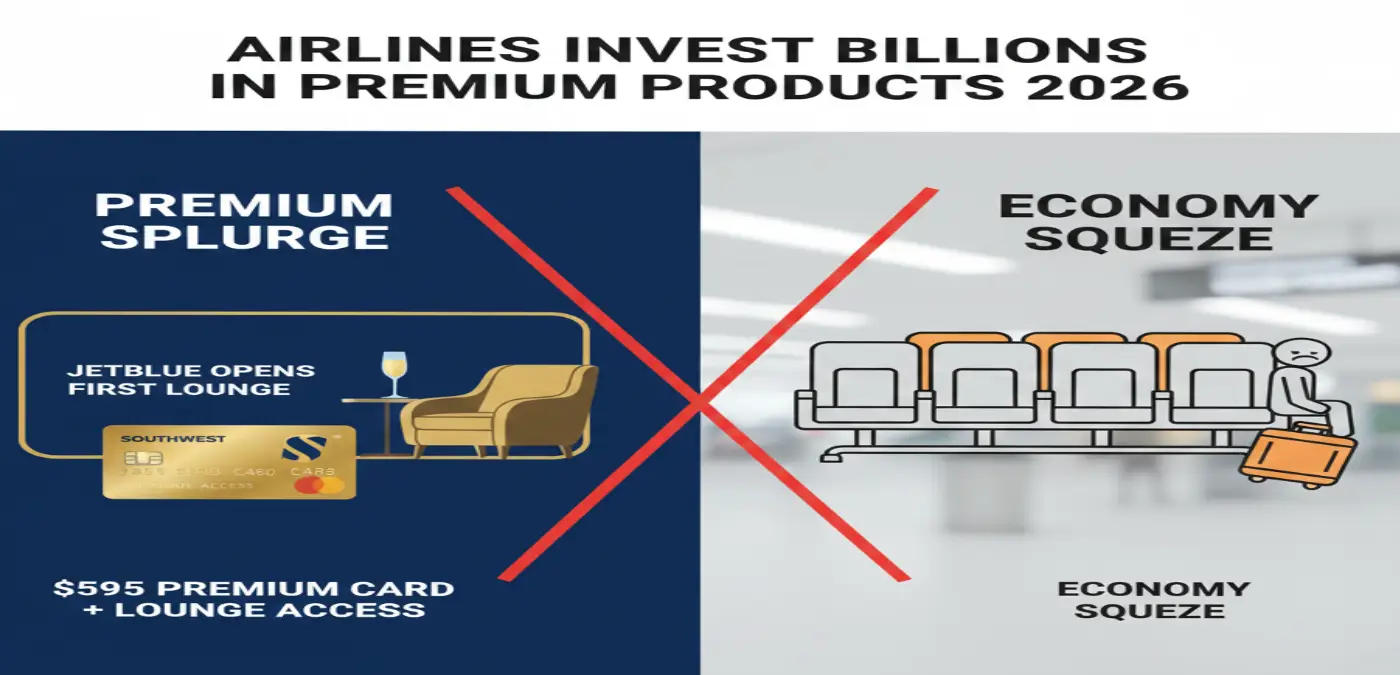
TRENDING: JetBlue’s 9,000-square-foot BlueHouse lounge opened December 18 at JFK marking budget carrier’s premium pivot, while Southwest Airlines surveys $595 annual fee credit card bundling lounge access at Dallas, Chicago, Denver hubs—as US airlines invest billions in premium seats, lounges, and first-class products capitalizing on “K-shaped recovery” where affluent travelers spend record amounts while budget passengers face stagnant wages, higher fares, and diminishing perks
Published: January 2, 2026 Source: JetBlue Airways, Southwest Airlines, Travel Industry Reports, Multiple Sources Key Finding: Delta’s premium revenue will surpass main cabin revenue for first time in 2026 Historic Moment: JetBlue opens first-ever lounge December 18, 2025; Southwest surveying lounge feasibility Economic Context: Premium demand soaring post-pandemic while economy travel stagnates ANZ Impact: Australian travelers are high-spending premium segment airlines covet
JetBlue Airways officially entered the airport lounge business on December 18, 2025 with the grand opening of BlueHouse—a 9,000-square-foot, two-story premium space at New York JFK Terminal 5 featuring Art Deco residential design, locally-curated food from Union Square Events, craft cocktails from Please Don’t Tell, and Joe Coffee barista service—marking the budget carrier’s most significant transformation toward premium products after 25 years of democratized service, while Southwest Airlines simultaneously surveys customers about a potential $595 annual fee Rapid Rewards credit card that would provide unlimited lounge access at major hubs including Dallas Love Field, Chicago Midway, and Denver as America’s fourth-largest carrier follows JetBlue’s premium pivot after abandoning its signature open seating, free checked bags, and egalitarian boarding policies.
The parallel premium pushes by traditionally budget-focused carriers reflect broader industry transformation driven by what economists call “K-shaped recovery”—where affluent travelers emerged from pandemic restrictions with accumulated savings, remote work flexibility, and revenge travel mindsets driving unprecedented premium spending, while middle and lower-income travelers face inflation-squeezed budgets, stagnant real wages, and diminishing airline perks as carriers aggressively shift capacity and investment toward high-margin premium products generating disproportionate profits compared to densified economy cabins where seat pitch shrinks and fees proliferate.
“The steady investment in premium products shows that airlines recognize where the money is—affluent travelers willing to pay $500 annual credit card fees, $50 seat upgrade charges, and $20 cocktails in exclusive lounges generate far more profit per passenger than budget travelers hunting $99 fares and packing carry-ons to avoid $35 baggage fees,” confirms aviation industry analysis. “We’re witnessing fundamental bifurcation of air travel into premium and economy classes with widening service gaps that didn’t exist when Southwest’s egalitarian model dominated the 1990s-2010s.”
Delta Air Lines president Glen Hauenstein confirmed in October 2025 that most or all of the carrier’s 2026 growth will occur in premium sectors, where revenue will surpass main cabin revenue for the first time in airline history—a milestone demonstrating how dramatically premium products now drive profitability for carriers that successfully captured post-pandemic demand from travelers prioritizing comfort, space, and elevated experiences over rock-bottom pricing that defined pre-2020 airline competition.
JetBlue’s inaugural lounge—branded “BlueHouse” to evoke New York apartment-style hospitality rather than sterile corporate waiting areas—spans 9,000 square feet across two floors in JFK Terminal 5 across from gate 526, operating daily 5:00 AM to 10:00 PM with design elements inspired by Grand Central Terminal’s iconic ceiling translated into custom constellation mural by Artists for Humanity depicting JetBlue destinations as stars connecting the airline’s network to New York’s architectural heritage.
“BlueHouse is one of the most significant enhancements we have ever made to our loyalty program,” confirmed JetBlue VP Loyalty and Personalization Ed Pouthier, emphasizing that the 25-year-old carrier finally addresses its most glaring competitive weakness—lack of airport lounges preventing premium travelers from committing full loyalty to JetBlue when competitors Delta, United, and American offer extensive lounge networks accessed through elite status or premium credit cards costing $500-700 annually.
BlueHouse amenities:
The lounge supports JetBlue’s broader “JetForward” strategy improving comfort and hospitality across the entire travel journey—complementing the airline’s December 2025-launched domestic first-class cabins rolling out fleet-wide throughout 2026, with recliner-style premium seats bridging the gap between economy, extra-legroom options, and existing Mint business class currently available only on select premium transcontinental and transatlantic routes.
JetBlue designed BlueHouse access tiers explicitly to maintain comfortable atmosphere and avoid the overcrowding plaguing many airport lounges where proliferation of premium credit cards—combined with relaxed guest policies—created standing-room-only conditions during peak travel periods that diminish the premium experience cardholders expect when paying $500+ annual fees.
Complimentary BlueHouse access:
Paid access starting February 2026:
Notably, JetBlue excludes Blue Basic fare passengers from both complimentary entry and one-time pass purchases—creating clear service differentiation where the airline’s cheapest tickets explicitly lack premium ground amenities even if travelers willing to pay lounge day passes, ensuring BlueHouse maintains exclusivity for higher-revenue customers rather than becoming accessible to bargain hunters undermining the premium positioning.
JetBlue announced plans for its second BlueHouse location at Boston Logan International Airport Terminal C opening in 2026, spanning 11,000 square feet (larger than JFK) with design celebrating Boston’s distinct character rather than replicating New York’s Art Deco aesthetic—demonstrating the airline’s intention to localize each lounge experience reflecting the city’s culture rather than deploying cookie-cutter corporate spaces indistinguishable across airports.
Additional BlueHouse locations under consideration include Fort Lauderdale-Hollywood International Airport in Florida, though JetBlue has not confirmed timeline or commitment for third location as the carrier evaluates JFK and Boston performance before expanding lounge network to additional hubs where the airline maintains significant operations and concentration of high-value customers justifying the capital investment and ongoing operational costs.
Southwest Airlines surveys customers about a potential $595 annual fee Rapid Rewards premium credit card bundling unlimited lounge access—representing the Dallas-based carrier’s most dramatic departure from founder Herb Kelleher’s egalitarian vision that defined Southwest’s identity for 53 years until activist investor Elliott Management’s pressure forced wholesale business model transformation abandoning open seating, free checked bags, and policies treating every passenger equally regardless of payment.
“Southwest Airlines plans to open premium airport lounges in key hubs like Dallas Love Field and Chicago Midway, with a new premium credit card around $595 annual fee offering unlimited access to these lounges for primary cardholders,” confirms Aviation A2Z reporting on survey data suggesting the airline testing multiple versions of premium card positioning Southwest to compete directly with Delta SkyMiles Reserve Card ($650 annual fee) and United Club Infinite Card dominating the premium airline card segment.
Surveyed premium card benefits:
Southwest’s first confirmed lounge location secured lease approval at Honolulu Daniel K. Inouye International Airport—12,000 square feet across two floors in Terminal 2 where all Southwest flights operate—with construction expected to begin soon though the airline has not announced official opening date, while additional locations under consideration include Houston Hobby, Denver, St. Louis, and other Southwest hubs where the carrier maintains dominant market positions justifying lounge investments.
Southwest CEO Bob Jordan’s acknowledgment that the airline is “actively pursuing” lounge development marks stunning reversal for a carrier that spent 53 years differentiating itself through absence of premium products, insisting that every passenger—regardless of ticket price—deserved identical treatment exemplified by open seating where strategic 24-hour check-in timing mattered more than willingness to pay for preferred seats.
“We know we send customers to other airlines because there’s some things you might want that you can’t get on us. That includes things like lounges, like true premium, like flying long-haul international,” Jordan told CNBC in May 2025, explaining that Southwest’s traditional limitations force even loyal customers to book competitors when traveling to Europe, seeking lounge access, or desiring first-class seats—inevitably shifting credit card loyalty and frequent flyer allegiance to rival airlines offering comprehensive premium ecosystems.
Financial pressures drove the transformation. Southwest’s profits fell 42% in first nine months of 2025 compared to same period in 2024, contrasting sharply with Delta and United’s record profitability powered by premium revenue streams—demonstrating that Southwest’s historically successful low-cost model no longer generates competitive margins when the carrier’s costs per available seat mile now match or exceed legacy carriers while lacking premium revenue opportunities offsetting elevated expense structures.
Southwest’s 2024-2026 transformation:
Delta Air Lines’ announcement that premium revenue will exceed main cabin revenue in 2026—the first time in commercial aviation history any carrier’s premium segments outpace economy in absolute dollars—crystallizes the fundamental shift in airline economics where affluent travelers willing to pay multiples of economy fares for incremental comfort now drive profitability while densified economy cabins serve primarily as capacity filler generating marginal contribution after covering direct operating costs.
“Most or all of the airline’s 2026 growth will be in premium sectors, where revenue next year will surpass main cabin revenue for the first time,” Delta president Glen Hauenstein confirmed in October 2025, validating the carrier’s aggressive investment in premium seats, lounge expansions, and elevated service offerings targeting travelers prioritizing experience over price in post-pandemic travel environment where remote work flexibility and accumulated savings enable premium spending patterns unimaginable during pre-2020 penny-pinching era.
Premium investment trends 2026:
While premium travelers enjoy expanding lounge networks, lie-flat business class on transcontinental routes, and elevated dining with celebrity chef partnerships, economy passengers confront shrinking seat pitch (30-31 inches becoming standard vs historical 32-33 inches), proliferating fees for services previously included (checked bags, seat selection, snacks, beverages), and service reductions (hot meals eliminated on longhaul routes, entertainment screens removed, legroom squeezed) as airlines maximize revenue per square foot of increasingly valuable aircraft real estate.
“The K-shaped recovery describes how affluent consumers emerged from pandemic with enhanced financial positions and pent-up travel demand driving premium spending, while middle and lower-income consumers face inflation-eroded purchasing power, stagnant wages, and budget constraints limiting travel frequency and forcing acceptance of diminished economy experiences as airlines prioritize high-margin premium segments,” explains economic analysis of post-pandemic travel patterns.
Australian and New Zealand travelers—among the world’s highest per-capita travel spenders who typically book premium economy or business class for long-haul flights to/from Australia—represent precisely the demographic airlines covet with premium product investments, as Aussies and Kiwis demonstrate willingness to pay for comfort during 14-24 hour journeys connecting Oceania to North America, Europe, and Asia where premium cabins command price premiums justifying the additional costs of larger seats, enhanced catering, and lounge access that economy-focused carriers cannot profitably provide.
JetBlue’s December 18 BlueHouse opening and Southwest’s surveyed $595 premium credit card with lounge access represent the culmination of years-long industry transformation where budget carriers that built brands on egalitarian service and low-frills accessibility now chase premium revenues demonstrated by Delta and United’s record profitability—abandoning founding principles in pursuit of margins that only premium products deliver in an era when affluent travelers splurge while budget passengers squeeze.
The divergence creates fundamentally different air travel experiences depending on willingness and ability to pay premium prices. Travelers with $500+ annual fee credit cards, elite status, or business/first-class tickets enjoy expanding lounge networks with craft cocktails and chef-curated meals, priority boarding through dedicated lanes, spacious recliner or lie-flat seats with 38-80 inches of pitch, complimentary meals and beverages, and attentive service from cabin crew incentivized to prioritize premium cabin satisfaction. Meanwhile, economy passengers face 30-31 inch seat pitch requiring payment for checked bags, seat selection, snacks, beverages, and any deviation from bare-bones basic economy fares that strip away even carry-on bag allowances and advance boarding—creating tiered system where price paid directly correlates to comfort, convenience, and dignity experienced throughout the journey.
Key takeaways for travelers navigating premium-economy divide:
✓ Budget carriers going premium (JetBlue, Southwest abandoning egalitarian models for tiered service) ✓ Lounge access increasingly gated (elite status or $500+ credit cards required) ✓ Premium credit cards essential for lounge access, priority boarding, free checked bags previously standard ✓ Economy experience deteriorating (shrinking seats, proliferating fees, service reductions) ✓ K-shaped recovery benefits affluent while budget travelers face inflation-squeezed options ✓ Australian/NZ travelers targeted as high-spending premium segment airlines covet ✓ Delta’s milestone (premium revenue exceeding economy 2026) signals industry future ✓ Loyalty programs rewarding spending over flying (credit card spend drives elite status tiers) ✓ First-class expanding (JetBlue, Frontier, potentially Southwest adding premium cabins fleet-wide) ✓ Basic economy spreading (unbundled fares stripping even carry-ons, seat selection from cheapest tickets)
“After holding out longer than any other major US airline, Southwest will discontinue its open seating system on January 27, 2026 and beyond, marking the end of an era when egalitarian boarding and identical treatment regardless of ticket price defined a carrier that once represented democratic air travel accessible to all Americans,” notes Newsweek analysis. The transformation from Herb Kelleher’s “people’s airline” to premium-chasing carrier indistinguishable from legacy competitors reflects broader societal trends where economic inequality manifests in tiered services segregating affluent from budget consumers across industries from healthcare to education to transportation—with air travel’s visible premium-economy divide serving as daily reminder of America’s K-shaped recovery favoring those with means to pay for comfort while squeezing those without.
For More Resources:
Related Travel Guides:
Final Reflection: JetBlue’s BlueHouse and Southwest’s premium pivot close the chapter on budget airline egalitarianism that once made air travel accessible to middle-class Americans regardless of means. The new era rewards those who can afford $500 credit card fees, $50 seat upgrades, and $20 airport cocktails with comfort and dignity, while relegating budget travelers to shrinking seats, proliferating fees, and diminished service that transforms flying from aspirational experience into endurance test. For Australian and New Zealand travelers accustomed to premium spending on long-haul flights, these changes offer expanded lounge options and elevated US domestic experiences—but the broader trend toward tiered service segregating passengers by ability to pay marks fundamental transformation in how airlines view their customers: not as people to transport, but as revenue opportunities to maximize through increasingly sophisticated segmentation separating premium from economy in ways that would have appalled aviation pioneers who envisioned flying as democratizing force bringing distant places within reach of ordinary people.
Posted By : Vinay
This article is provided for general informational purposes only and is based on information available at the time of publication. Travel advisories, airline schedules, airport operations, visa requirements, government regulations, and other travel-related information are subject to change without prior notice. While Travel Tourister makes reasonable efforts to verify information using official announcements, government publications, airline and airport communications, and other reliable sources, we cannot guarantee that all information remains complete, accurate, or up to date at all times. Readers should independently verify any information that may affect their travel plans with the relevant airline, airport authority, government agency, embassy, or other official source before making travel, financial, or other decisions. Travel Tourister shall not be liable for any direct or indirect loss, inconvenience, or damages arising from the use of or reliance on the information contained in this article. Nothing in this publication constitutes legal, immigration, financial, or professional travel advice. If you believe any information in this article is inaccurate or outdated, please contact our editorial team. We review all credible correction requests promptly and update our content whenever appropriate.
Lastest News
2nd Floor, 39, Above Kirti Club, DLF Industrial Area, Kirti Nagar, New Delhi, Delhi 110015



Travel Tourister is a leading Travel portal where we introduce travellers to trusted travel agents to make their journey hasselfree, memorable And happy. Travel Tourister is a platform where travellers get Tour packages ,Hotel packages deals through trusted travel companies And hoteliers who are working with us across the world. We always try to find new and more travel agents and hoteliers from every nook and corners across the world so that you could compare the deals with different travel agents and hoteliers and book your tour or hotel with the one you have chosen according to your taste and budget.
Copyright © Travel Tourister, India. All Rights Reserved

 Call
Call Enquiry