Published on : 21 Apr 2026
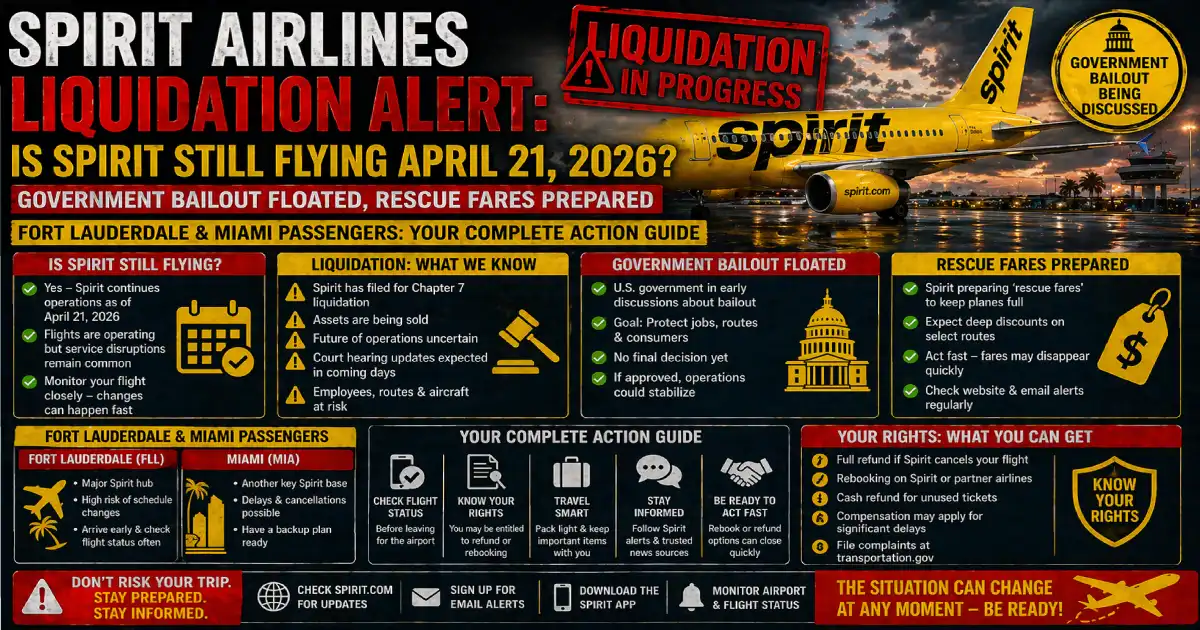
Breaking: Spirit Airlines is still flying today, April 21, 2026 — but the airline’s survival is more uncertain than at any point since its second Chapter 11 bankruptcy filing in August 2025. In the most dramatic development yet, Bloomberg reported Monday April 20 that Spirit has floated offering the US government an equity stake in the carrier in exchange for an emergency cash infusion — an extraordinary move that confirms the airline is running out of options to stay alive. This comes days after Bloomberg and the Wall Street Journal first reported on April 15 that liquidation — a total shutdown and asset sale — could happen “as early as this week.” That week has now passed, and Spirit is still operating. But the underlying crisis has not resolved. Jet fuel prices averaging $3.79 per gallon as of April 17 — up from $2.50 the day before the Iran war began on February 28 — have made Spirit’s restructuring plan mathematically implausible. JPMorgan has calculated that at current fuel prices, Spirit’s 2026 operating margin collapses from a projected negative 7% to negative 20% — and the airline’s cash balance at the end of last year was only $337 million against projected additional costs of $360 million from fuel alone. If you have a Spirit Airlines ticket — for this week, this month, or the summer — here is every confirmed fact, every protection available to you, and exactly what to do right now, whether Spirit survives or collapses.
Published: April 21, 2026 — Tuesday Spirit Status: 🟡 Still flying — but survival uncertain Latest development (April 20): Spirit has floated offering US government an equity stake in exchange for emergency cash infusion Previous development (April 15): Bloomberg + WSJ reported liquidation could happen “as early as this week” Why liquidation risk: Jet fuel $3.79/gal (was $2.50 before Iran war Feb 28) → 2026 margin collapses to -20% → cash balance $337M vs $360M additional fuel cost exposure Chapter 11 status: Second filing — August 2025 (also filed November 2024, emerged March 2025) Original plan: Exit bankruptcy early summer 2026 — now in serious doubt Government equity proposal: Spirit seeking US government cash injection, offering equity stake — similar to White House Intel stake in 2025 Industry lobby: Association of Value Airlines (Spirit + Frontier) asks Congress to suspend 7.5% federal excise tax on tickets Highest-risk passengers: Fort Lauderdale (FLL) · Miami (MIA) · New York · Detroit — Spirit’s core remaining hubs No interline agreements: If Spirit closes, your ticket does NOT automatically transfer to another airline Rescue fares: Other airlines — JetBlue, Frontier, American, Southwest — have rescue fare plans ready if Spirit shuts down Free Spirit miles: Would almost certainly evaporate in liquidation — no cash value, no automatic transfer Primary protection: Credit card chargeback within 60 days of original charge
The story of Spirit Airlines in April 2026 is the story of the Iran war’s collateral damage to the American aviation economy — and specifically to the one airline whose business model is least equipped to survive doubled fuel prices.
Spirit has been in financial crisis since long before the Iran war. The carrier first filed for Chapter 11 bankruptcy in November 2024, following the collapse of its planned $3.8 billion merger with JetBlue — a deal blocked by the Biden-era Department of Justice on antitrust grounds in January 2024. That DOJ decision, intended to protect low-fare competition, instead trapped Spirit in a no-man’s land: too small and too indebted to survive independently, too toxic from the failed merger to attract new partners. Spirit emerged from that first bankruptcy in March 2025 after a restructuring that cut debt from $7.4 billion to approximately $2.1 billion and converted much of that debt to equity.
Then, less than five months later, in August 2025, Spirit filed for Chapter 11 again. The ultra-low-cost model that had made the airline famous — $49 base fares, fees for everything from bags to water — was simply no longer generating enough revenue to cover rapidly rising costs.
The plan that was supposed to work: In late February 2026, Spirit announced a new Restructuring Support Agreement with its creditors. The plan was built around a fuel price assumption of $2.67 per gallon for 2026, declining to $2.14 in 2027. The plan projected an exit from Chapter 11 by early summer 2026, a fleet of 76–80 aircraft focused on Florida, New York, and Detroit, and a path back to operating profitability by 2027.
What destroyed the plan: On February 28, 2026, the US-Israel military strikes on Iran began. Within days, the Strait of Hormuz — through which approximately 20% of the world’s oil supply flows — was effectively closed. Jet fuel prices doubled in weeks: from $2.50 per gallon on February 27 to $3.79 per gallon by April 17. Spirit had built its entire restructuring plan on $2.67 per gallon fuel. The margin for error was already thin. At $3.79 per gallon, the margin is gone.
JPMorgan analyst Jamie Baker put the math starkly: at $4.60 per gallon fuel for the year, Spirit’s projected 2026 operating margin falls from -7% to -20%. The airline’s year-end 2025 cash balance was $337 million. The additional fuel cost exposure alone could exceed $360 million. The numbers do not add up.
What Spirit did next: On April 20, Bloomberg reported that Spirit had floated offering the US government an equity stake in the carrier in exchange for emergency cash — modelling the proposal on the White House’s 2025 decision to become a major shareholder in Intel Corporation. Spirit and other low-cost carriers are expected to meet with Transportation Secretary Sean Duffy this week. The Association of Value Airlines — representing Spirit, Frontier, and other budget carriers — simultaneously wrote to Congressional leaders on April 14 requesting a suspension of the 7.5% federal excise tax on airline tickets until fuel prices stabilise.
The US Bankruptcy Trustee has also requested a court delay in Spirit’s Chapter 11 exit, citing insufficient detail on the revised plan — a further complication for the airline’s survival strategy.
Yes. As of Tuesday April 21, 2026, Spirit Airlines is operating flights.
Spirit’s spokesperson has consistently responded to liquidation reports with a single statement: “We don’t comment on market rumors or speculation. Our operations continue as normal.”
This is technically true — Spirit is flying — but aviation analyst Brett Snyder (Cranky Flier) noted on Sunday April 20: “Spirit is still flying — at least it was when I wrote this on Sunday night. I can’t say I understand why. Spirit’s reorganization plan doesn’t seem realistic, and the likelihood is that creditors will just keep losing money as long as this airline keeps going.”
The key question passengers need to understand: Spirit being “still flying today” does not mean it will be flying tomorrow, next week, or when your summer booking departs. A liquidation, if it occurs, happens extremely fast. When airlines liquidate in the US, they typically cease operations within 24–48 hours of a court order — often with little or no public notice. In the worst case, passengers wake up to find the Spirit app offline and their flights cancelled with no automatic rebooking.
What this means practically:
| Date | Event |
|---|---|
| January 2024 | Federal judge blocks Spirit–JetBlue $3.8B merger on antitrust grounds |
| November 2024 | Spirit files Chapter 11 bankruptcy #1 |
| March 2025 | Spirit emerges from first bankruptcy — debt cut to ~$2.1B |
| August 2025 | Spirit files Chapter 11 bankruptcy #2 |
| Feb 24, 2026 | Spirit announces Restructuring Support Agreement — targets early summer exit |
| Feb 28, 2026 | Iran war begins — jet fuel prices start doubling |
| March 13, 2026 | Spirit affirms bankruptcy exit plan — fuel assumed at $2.67/gal |
| March 14, 2026 | Spirit wins WalletHub “Best Airline” and “Most Affordable” awards |
| March 31, 2026 | Free Spirit Points Mastercard (Mercury Financial) discontinues benefits |
| April 6, 2026 | Spirit releases updated disclosure statement — projects -7.4% 2026 margin |
| April 14, 2026 | Association of Value Airlines writes Congress asking for tax relief |
| April 15, 2026 | Bloomberg + WSJ report liquidation risk “as early as this week” |
| April 15, 2026 | US Bankruptcy Trustee requests delay on Spirit’s Chapter 11 exit |
| April 17, 2026 | Jet fuel price: $3.79/gal (up from $2.50 on Feb 27) |
| April 20, 2026 | Bloomberg: Spirit floats US government equity stake for emergency cash |
| April 21, 2026 | Spirit still flying — status uncertain — this article |
The sequence below is the same advice aviation experts and consumer rights attorneys are providing to Spirit passengers today. Execute these steps in order, regardless of when your flight is booked.
Before you do anything else: open the Spirit app or Spirit.com and capture:
Why this is urgent: When airlines liquidate, their websites and apps often go offline within hours of the announcement. You need this documentation for a credit card chargeback, travel insurance claim, or bankruptcy court filing. Without a booking reference number and proof of payment, your claim is harder to process.
Alternatively: go to Spirit.com → “My Trips” → print or screenshot your full itinerary.
This is your single most powerful financial protection.
How credit card chargeback protection works for airline liquidations: If Spirit ceases operations and your flight is cancelled, you are entitled to dispute the charge with your credit card company as a “service not received.” This is different from a standard refund request — it is a formal dispute with your bank that gives you strong consumer protection.
Critical time limits:
Cards with strongest protections:
What to say: “I have a purchase with Spirit Airlines for a flight on [date]. I am concerned Spirit may cease operations before my flight. I would like to understand my chargeback rights and the deadline to file if Spirit liquidates and cancels my flight. What documentation do I need to gather now?”
Do not wait until Spirit announces liquidation — by then, you may have thousands of other Spirit passengers filing simultaneously, creating a processing backlog at card companies.
If you have travel insurance — either purchased separately or through your credit card’s travel benefits — check your policy for “airline default,” “airline insolvency,” or “cessation of operations” coverage.
The key question to ask your insurer: “Does my policy cover a scenario where Spirit Airlines ceases operations before my travel date?”
Important timing rule: Most travel insurance policies require purchase before the financial distress became a known, publicly reported risk. Bloomberg first reported Spirit’s liquidation risk on approximately April 15, 2026. If you purchased your travel insurance after April 15, you likely cannot claim for Spirit’s liquidation specifically — the “known event” exclusion will apply. If you purchased it before April 15, you may have coverage.
The exception: Many comprehensive travel insurance policies purchased before the Iran war began (February 28) may cover this as an unforeseen event driven by the conflict. Check your policy language carefully, or call your insurer directly.
This is the step that passengers consistently wish they had taken earlier when airlines collapse.
How to do this cost-effectively: Book a refundable fare on an alternative carrier for your same date and route. Most major airlines offer refundable rates that can be cancelled for a full refund up to 24 hours before departure. The refundable fare is your insurance policy.
If Spirit operates normally, cancel your backup before the 24-hour mark and lose nothing. If Spirit announces liquidation, you already have confirmed seats on an alternative carrier — at pre-surge prices. Because when liquidation is announced, competitors raise fares on Spirit’s routes within hours.
Routes to check for refundable alternatives: At FLL, MIA, and other Spirit hubs — JetBlue, Southwest, American, Frontier, and Allegiant all operate overlapping routes. Check google.com/flights or kayak.com for refundable fare options.
Key insight from industry analysts: Without Spirit’s competitive prices, flights on all those major airlines just get more expensive. Spirit’s “Bare Fare” model acted as a ceiling for prices; whenever Spirit entered a route, legacy carriers were forced to lower their prices to compete. The moment Spirit closes, prices on its routes will rise — sometimes dramatically. Book your backup before that happens.
Multiple airlines are confirmed to have rescue fare plans in place for stranded Spirit passengers. Other airlines already have plans in place to offer what they call rescue fares, which are discounted one-way fares to get people home if Spirit flights no longer exist.
Historically, when US carriers have liquidated:
The warning: While other airlines sometimes offer “rescue fares” for displaced passengers, they are not legally required to do so. And there is no guarantee that everyone who booked a Spirit flight will be able to secure a rescue fare — especially at peak summer travel dates when alternatives are already selling out.
Do not plan your travel around the assumption that a rescue fare will be available at a price you can afford. The backup booking (Step 4) is more reliable protection.
Where to watch for rescue fares:
These are the two airports most exposed to a Spirit Airlines liquidation and the two where the consumer impact would be most severe.
Fort Lauderdale-Hollywood International Airport is Spirit’s largest operating hub. Spirit has been cutting FLL routes throughout early 2026 — removing Grand Cayman (April 13), Managua (April 14), San Salvador (April 15), Charleston, Cleveland, Kansas City, Key West, and Las Vegas from the FLL network. Despite these cuts, FLL remains the airport where Spirit has the most remaining flights and the most passenger exposure.
Analysts expect JetBlue to be the primary beneficiary in Fort Lauderdale. Without Spirit as a competitor, JetBlue could finally achieve the dominance in South Florida it sought through the merger. United and American have both signalled readiness to expand into Spirit’s vacated FLL gates.
What FLL Spirit passengers must do:
Miami International Airport is dominated by American Airlines and its oneworld partners. Spirit’s MIA footprint is smaller than FLL, but significant for passengers on ultra-budget routes to Caribbean and Latin American destinations. American Airlines, Avianca, and Copa Airlines operate many of the same routes Spirit serves from MIA.
This is the single highest-urgency Spirit passenger scenario. If your Spirit flight connects to a cruise departure on the same day, you have zero tolerance for a last-minute airline collapse.
Recommended action:
| Your Situation | What Happens | Action |
|---|---|---|
| Booked with credit card | File chargeback for “service not received” | Call card company immediately |
| Booked with debit card | Much harder — file DOT complaint + bankruptcy court claim | Check bank’s dispute options |
| Free Spirit miles | Almost certainly evaporate — no cash value | Redeem immediately if you have active bookings |
| Spirit voucher | May have minimal value in bankruptcy | Use immediately if Spirit still flying |
| Travel insurance (pre-April 15) | May cover “airline cessation” — check your policy | Call insurer today |
| Travel insurance (post-April 15) | Likely excluded as “known event” | Verify with insurer |
| Booked through OTA (Expedia, etc.) | OTA must process refund — but may be slow during chaos | Contact OTA + card company simultaneously |
Free Spirit miles would likely evaporate in liquidation. Spirit owns the miles and “licenses” them to you — you don’t own them. They don’t have an explicit cash value and cannot be transferred by operation of law. So you have basically no claim on them. They are legally not a debt, they are more of a contractual obligation to offer some services in the future.
If you have Free Spirit miles: Redeem them immediately for any flights you can actually use in the near term. If Spirit is still accepting redemptions, use them before they disappear. Do not hold miles hoping for Spirit’s recovery.
Spirit’s crisis is not just Spirit’s problem. It is the consequence of the Iran war hitting the sector of US aviation that is least able to absorb a fuel cost shock.
Jet fuel prices were averaging $3.79 per gallon as of April 17, according to the Argus U.S. Jet Fuel Index, up from $2.50 on Feb. 27, the day before the strikes on Iran.
For a major network carrier like American, Delta, or United, jet fuel is approximately 20–25% of operating costs. These airlines have substantial revenue from premium cabins, loyalty programmes, international routes, and corporate contracts that provide some insulation from fuel shocks.
For Spirit, fuel is approximately 30–35% of operating costs — and there is almost nothing else. The entire Spirit business model is built on keeping costs lower than any competitor and passing the savings to passengers in the form of sub-$50 base fares. The model only works when fuel is cheap and demand is strong.
If fuel stays at about $4.60 a gallon this year, Spirit’s forecast operating margin for the 2026 fiscal year deteriorates from negative 7 percent to negative 20 percent. Spirit could face another $360 million of costs, over a $337 million cash balance as of the end of last year.
Frontier Airlines, Spirit’s closest competitor and the only other major US ultra-low-cost carrier, faces similar structural pressure — though Frontier has not yet reached Spirit’s acute crisis point. If Spirit liquidates, Frontier is the next ultra-low-cost airline whose survival analysts will scrutinise.
| Resource | Contact | What to Do |
|---|---|---|
| Spirit Airlines | spirit.com / 1-855-728-3555 | Monitor flight status; do NOT call for liquidation advice |
| Your credit card company | Number on back of card | Call today — confirm chargeback window and documentation |
| Visa dispute | Via your issuing bank | Request “service not received” chargeback |
| Mastercard dispute | Via your issuing bank | Same as Visa |
| American Express | 1-800-528-4800 | Call to understand purchase protection |
| Chase | 1-800-432-3117 | Chase Sapphire travel protection |
| DOT consumer complaints | airconsumer.dot.gov | File if Spirit refuses refund |
| JetBlue (backup/rescue) | jetblue.com | Check FLL/MIA overlap routes |
| Southwest (backup/rescue) | southwest.com | No change fees — safest backup option |
| American (backup/rescue) | aa.com | Strong FLL/MIA coverage |
| Frontier (backup/rescue) | flyfrontier.com | Most Spirit-similar ULCC alternative |
| Travel insurance | Your policy document | Call insurer — ask about “airline cessation” coverage |
As of April 21, 2026, Spirit Airlines is still flying. But the airline is closer to liquidation than at any point in its history. Spirit has now offered the US government an equity stake in exchange for emergency cash — a last-resort move that confirms the carrier has run out of conventional options. Jet fuel at $3.79 per gallon has destroyed the financial model that Spirit’s restructuring plan was built on. JPMorgan calculates the airline could face $360 million in additional fuel costs against a $337 million cash balance. The US Bankruptcy Trustee is seeking a court delay on Spirit’s Chapter 11 exit plan.
If Spirit survives (via a government bailout, new investor, or fuel price decline): your ticket is valid, you fly normally, no action needed beyond monitoring.
If Spirit liquidates: flights cancel immediately, no automatic rebooking to other carriers, Free Spirit miles evaporate, and your only fast financial protection is a credit card chargeback.
The five things to do TODAY, in order:
Do not wait for Spirit to announce liquidation before taking these steps. When it happens, it happens fast. The time to prepare is now.
Related Articles:
Sources: Bloomberg (Spirit floats US government equity stake, April 20, 2026), Bloomberg (Spirit could liquidate as early as this week, April 15, 2026 — via CNBC), Wall Street Journal (Spirit liquidation risk reporting, April 15, 2026), US Bankruptcy Trustee (Chapter 11 exit delay request), Argus US Jet Fuel Index (April 17, 2026 — $3.79/gal vs $2.50 on Feb 27)
Posted By : Vinay
This article is provided for general informational purposes only and is based on information available at the time of publication. Travel advisories, airline schedules, airport operations, visa requirements, government regulations, and other travel-related information are subject to change without prior notice. While Travel Tourister makes reasonable efforts to verify information using official announcements, government publications, airline and airport communications, and other reliable sources, we cannot guarantee that all information remains complete, accurate, or up to date at all times. Readers should independently verify any information that may affect their travel plans with the relevant airline, airport authority, government agency, embassy, or other official source before making travel, financial, or other decisions. Travel Tourister shall not be liable for any direct or indirect loss, inconvenience, or damages arising from the use of or reliance on the information contained in this article. Nothing in this publication constitutes legal, immigration, financial, or professional travel advice. If you believe any information in this article is inaccurate or outdated, please contact our editorial team. We review all credible correction requests promptly and update our content whenever appropriate.
Lastest News
2nd Floor, 39, Above Kirti Club, DLF Industrial Area, Kirti Nagar, New Delhi, Delhi 110015



Travel Tourister is a leading Travel portal where we introduce travellers to trusted travel agents to make their journey hasselfree, memorable And happy. Travel Tourister is a platform where travellers get Tour packages ,Hotel packages deals through trusted travel companies And hoteliers who are working with us across the world. We always try to find new and more travel agents and hoteliers from every nook and corners across the world so that you could compare the deals with different travel agents and hoteliers and book your tour or hotel with the one you have chosen according to your taste and budget.
Copyright © Travel Tourister, India. All Rights Reserved

 Call
Call Enquiry