Published on : 02 Jan 2026
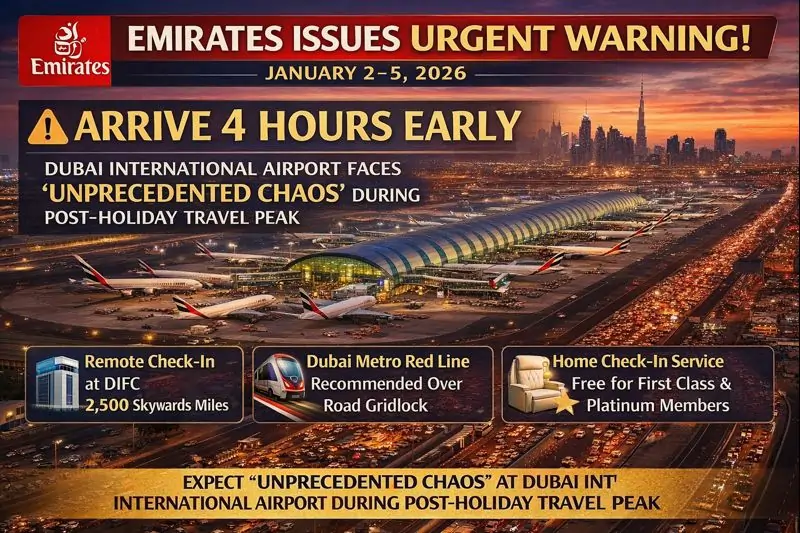
TRENDING: Emirates airline issued urgent travel advisory December 31, 2025 warning passengers to arrive Dubai International Airport (DXB) minimum 4 hours before departure during January 2-5, 2026 post-holiday travel surge—as world’s busiest international hub braces for “unprecedented chaos” with heavy road traffic, packed car parks, long check-in queues, crowded security checkpoints, and immigration delays when millions of holidaymakers return home, students resume classes, and business travelers flood UAE after extended New Year break coinciding with January 1 public holiday creating perfect storm of departures and arrivals overwhelming Terminal 3 infrastructure despite Emirates offering 2,500 Skywards Miles incentive for passengers using DIFC City Check-In, complimentary Home Check-In service for First Class/Platinum members, and Dubai Metro Red Line direct access eliminating road congestion
Published: January 2, 2026 Source: Emirates Official Advisory, Dubai International Airport, Gulf News, Time Out Dubai Critical Period: January 2-5, 2026 (HAPPENING NOW!) Key Recommendation: Arrive 4 hours before departure (not standard 3 hours) Skywards Bonus: 2,500 miles for DIFC check-in through January 15 ANZ Impact: Australian/New Zealand travelers using Dubai as primary Europe/US connection hub face delays
Emirates, the UAE’s flagship airline and world’s largest international carrier, has issued an urgent warning to travelers departing Dubai International Airport (DXB) between January 2-5, 2026 to arrive minimum 4 hours before scheduled departure times—significantly exceeding standard 3-hour international flight recommendations—as the airline anticipates “one of the busiest weeks of the year” with high volumes of both departures and arrivals creating gridlock on access roads leading to Terminal 3, overwhelmed car parks with limited availability, lengthy check-in counter queues despite online check-in availability, packed security screening areas requiring extended wait times, congested immigration halls processing thousands of passengers simultaneously, and crowded gate areas where boarding processes strain capacity as post-holiday travel surge overlaps with school resumptions, university restarts, and business operations returning to normal following UAE’s January 1 public holiday declaration plus January 2 remote work day for public sector employees creating compressed travel window when millions simultaneously attempt departing or arriving Dubai.
The alert comes as families, students, and workers return from year-end breaks globally—particularly from Europe, North America, and Asia where extended holiday periods cluster around December 25-January 5—overlapping with school restarts across multiple time zones and the end of extended vacations creating what Emirates describes as a “significant travel peak” during the first week of January when inbound traffic from travelers visiting Dubai for New Year celebrations intersects with outbound traffic from UAE residents returning from overseas holidays producing bidirectional surge overwhelming airport infrastructure designed to handle steady flow rather than simultaneous spikes in both arrivals and departures compressing check-in, security, immigration, and boarding processes into narrower timeframes than typical operational patterns.
“The airline recommends arriving four hours before departure to account for heavier traffic, busier facilities and the sheer scale of the post-holiday movement,” confirms Gulf News reporting on the December 31, 2025 advisory emphasizing that the 4-hour recommendation applies universally to all Emirates customers regardless of cabin class (Economy, Business, First), destination (short-haul GCC, medium-haul Asia/Africa, long-haul Europe/Americas/Australia), or frequent flyer status (general members, Silver, Gold, Platinum) because congestion affects shared airport infrastructure including access roads where taxis queue for terminal drop-offs, car parks where spaces fill rapidly during peak periods, check-in halls where counters process passengers regardless of status, security screening areas where TSA-style procedures apply equally, immigration zones where border control officers process documents systematically, and gate lounges where boarding procedures follow aircraft-specific protocols—meaning even premium passengers experience delays when infrastructure reaches capacity limits during extraordinary surge periods like January 2-5, 2026.
Emirates stresses early reservations for remote check-in services to secure spots, especially with demand set to spike during this four-day window when traditional airport arrivals 2-3 hours before departure prove insufficient for navigating congestion, completing check-in formalities if not done remotely, dropping checked baggage even with online boarding passes, clearing security screening with lines extending into terminal corridors, passing through immigration with queues reaching 30-45 minutes during peak hours, walking lengthy distances from immigration to gates in Terminal 3’s massive footprint, and reaching boarding gates minimum 1 hour before departure (strictly enforced 20-minute gate closure preventing late arrivals from boarding even if physically present in terminal)—creating cascading time requirements that compress available buffer when roads, parking, and terminal facilities operate at or beyond designed capacity.
For travelers departing Dubai during January 2-5 surge, Emirates City Check-In at ICD Brookfield Place in Dubai International Financial Centre (DIFC) offers strategic alternative to terminal chaos—allowing passengers to complete entire check-in process including document verification, seat assignment confirmation, and most importantly checked baggage drop-off up to 24 hours before flight departure (bags accepted 4 hours minimum before departure), then arrive at Dubai International Airport Terminal 3 with only hand luggage eliminating check-in counter queues, baggage drop lines, and associated wait times that consume 30-60 minutes during peak periods when hundreds of passengers simultaneously attempt processing at limited counter positions.
DIFC City Check-In Details:
“Emirates customers can avail of free parking to check in and drop off luggage up to 4 hours before a flight. Customers who check in and drop luggage at this location by January 15 will receive 2,500 Emirates Skywards Miles each,” confirms Khaleej Times—making DIFC check-in financially rewarding beyond time savings as 2,500 miles typically requires spending $2,500-3,000 on Emirates-issued credit cards or flying 2,500 eligible miles in discounted economy fares, positioning the bonus as $75-100 value equivalent incentivizing passengers to divert from terminal check-in to DIFC facility reducing airport congestion while rewarding travelers with points redeemable for future flights, upgrades, or partner redemptions within Skywards program spanning hotels, car rentals, and experiences across Emirates’ global network.
The DIFC facility particularly benefits business travelers working in Dubai’s financial district who can check bags during lunch break or end of workday then commute home with laptops and briefcases only, tourists staying at downtown Dubai hotels (Burj Khalifa, Dubai Mall, Business Bay area) within 10-minute drive of DIFC avoiding Sheikh Zayed Road traffic toward airport, and families with young children who can complete check-in formalities in quieter DIFC environment rather than navigating crowded Terminal 3 halls with strollers, car seats, and multiple bags while managing tired kids overwhelmed by airport chaos—making remote check-in not just convenience but necessity during January 2-5 surge when terminal conditions deteriorate beyond normal operational standards.
Emirates operates second remote check-in facility at Ajman Central Bus Terminal—available 24 hours daily allowing passengers residing in northern emirates (Ajman, Sharjah, Umm Al Quwain, Ras Al Khaimah) to complete check-in procedures closer to home rather than battling traffic on Emirates Road and Sheikh Mohammed bin Zayed Road leading to Dubai during morning departure rush when commercial vehicles, construction traffic, and commuter flows compound congestion beyond typical patterns creating 60-90 minute journeys that normally consume 30-45 minutes under standard conditions.
Ajman Check-In Facility:
The Ajman facility strategically positions Emirates’ remote check-in network beyond Dubai city limits, recognizing that approximately 25-30% of passengers using Dubai International Airport reside in northern emirates where housing costs remain lower than Dubai proper attracting expatriate workers, young families, and budget-conscious residents who commute to Dubai for employment but prefer Ajman/Sharjah’s affordability—meaning tens of thousands of potential passengers benefit from avoiding Dubai traffic entirely by checking bags at Ajman terminal then traveling lighter to airport with only carry-ons reducing stress, time consumption, and risk of missing flights when road conditions deteriorate during January 2-5 peak as holiday returnees, New Year visitors departing, and regular traffic patterns converge on limited road infrastructure connecting northern emirates to Dubai International Airport.
Emirates Home Check-In service covers Dubai and Sharjah residential areas, hotels, and offices—where Emirates agents come to customer’s location of choice (home, hotel room, office building) to complete check-in formalities and collect checked baggage up to 24 hours before departure, then deliver bags directly to aircraft hold allowing travelers to arrive at airport with only hand luggage bypassing check-in counters, baggage drop-off, and associated queues entirely transforming airport experience from multi-hour ordeal into streamlined security-immigration-gate progression consuming 60-90 minutes maximum versus 2-3 hours when check-in and baggage processes included.
Home Check-In Eligibility & Pricing:
The service shines during peaks like January 2-5 when terminal conditions overwhelm even experienced travelers familiar with Dubai International Airport’s sprawling Terminal 3 layout—turning what could consume 3-4 hours navigating roads, parking, check-in, security, immigration into streamlined 90-minute terminal dash proceeding directly from entrance to security screening (bypassing check-in halls entirely), through immigration (using biometric smart gates when registered), and to boarding gates with minimal queuing because early arrival (4 hours before departure) means security/immigration processing occurs during off-peak hours when fewer passengers compete for screening lanes and immigration counters despite overall daily surge concentrating in specific departure windows when long-haul flights to Europe (evening departures), North America (afternoon/evening), and Australia (midnight/early morning) cluster creating predictable bottlenecks.
“The service needs to be booked at least 24 hours before a flight, and Emirates recommends booking early to avoid disappointment,” emphasizes Khaleej Times warning that Home Check-In slots fill rapidly during peak periods as limited agent availability constrains service capacity—meaning passengers waiting until last minute find no availability when demand spikes January 2-5 as thousands simultaneously attempt booking home check-in to avoid terminal chaos, creating secondary bottleneck in service designed to alleviate primary bottleneck at airport but constrained by agent staffing, vehicle availability, and geographic coverage limitations preventing unlimited scaling during extraordinary surge periods.
Dubai Metro remains the sharpest tool against road chaos during January 2-5 surge—as Red Line connects directly to Terminal 3 at Dubai International Airport with dedicated Airport Terminal 3 station featuring walkways and escalators linking platform directly to check-in halls, departure areas, and arrivals zones eliminating taxi queues, car park searches, and traffic congestion afflicting road-based arrivals when thousands of vehicles simultaneously attempt accessing terminal during peak departure windows creating gridlock on Airport Road, Terminal Road, and internal circulation routes where taxis, private cars, rental vehicles, and ride-share services compete for limited drop-off curb space.
Dubai Metro Red Line to DXB:
Inbound passengers arriving Dubai can hop on metro for smooth exit avoiding taxi queues that extend 30-60 minutes during peak arrival periods when multiple widebody aircraft—A380s carrying 400-500 passengers, 777-300ERs with 350-400 passengers—disembark simultaneously at adjacent gates flooding arrivals hall with thousands of travelers competing for limited ground transportation including taxis (finite queue positions), ride-share vehicles (surge pricing during peaks), rental cars (desk queues, paperwork delays), and hotel shuttles (fixed schedules creating wait times)—whereas Metro offers guaranteed capacity, predictable schedules, and direct connections to major Dubai districts without negotiating fares, explaining destinations to drivers unfamiliar with specific addresses, or paying surge premiums when demand spikes.
“Dubai Metro provides a fast and convenient connection to Terminal 3 at Dubai International Airport (DXB), with direct access from the Red Line. Trains run frequently from early morning until late at night, offering an efficient alternative to road travel during peak traffic periods,” confirms Khaleej Times emphasizing that Metro reliability exceeds road transportation during extraordinary congestion when accidents, construction, special events (New Year celebrations January 1-2), and sheer volume create unpredictable delays ranging 30-90 minutes beyond normal travel times—potentially causing missed flights for passengers departing January 2-5 who underestimate road conditions assuming typical 30-minute journeys from Dubai Marina or 45-minute drives from Jumeirah Beach Residence arrive at airport with insufficient buffer when actual travel consumes 60-90 minutes during surge.
Airport Terminal 3 metro station connects via multiple access points ensuring passengers reach appropriate zones regardless of flight type (departures vs arrivals), airline terminal location (Concourse A, B, or C within Terminal 3’s sprawling footprint), or mobility requirements (elevators throughout facility accommodate wheelchairs, strollers, large luggage)—with clear English/Arabic signage directing passengers from platform to check-in halls (ground floor), departure gates (upper floor), or arrivals halls (ground floor on opposite side) through climate-controlled walkways protecting travelers from Dubai’s January heat (typically 15-25°C/59-77°F but reaching 30°C/86°F midday) and occasional winter rain that disrupts outdoor connections.
Metro Station Terminal Integration:
For Emirates passengers specifically—whose flights exclusively operate from Terminal 3—metro connection proves optimal as station sits directly beneath terminal building versus Terminal 1/2 stations requiring shuttle buses or lengthy walks between terminals when passengers mistakenly arrive at wrong metro station (common error for first-time Dubai visitors unfamiliar with airport’s three-terminal layout where Emirates operates exclusively Terminal 3, flydubai primarily Terminal 2, and other airlines mix across Terminals 1-3 depending on bilateral agreements, gate availability, and operational requirements creating confusion for travelers assuming all airlines share single terminal as in smaller airports).
The January 2-5, 2026 surge results from multiple factors converging simultaneously creating compressed travel window exponentially exceeding normal daily passenger volumes as separate travel segments—holidaymakers, students, business travelers—overlap rather than spreading across weeks as typically occurs during non-holiday periods when passenger flows distribute more evenly across days allowing airport infrastructure to absorb volume within designed capacity parameters without requiring extraordinary measures like 4-hour early arrival recommendations.
Contributing Factors to January 2-5 Surge:
“The surge is being driven by a combination of factors including the end of year holidays in Europe, North America and Asia, the return of residents to the United Arab Emirates after breaks abroad, and school and university resumptions clustered in early January,” confirms aviation analysis explaining why January 2-5 specifically overwhelms Dubai International Airport when these disparate travel segments compress into narrow 96-hour window versus typical distribution across 10-14 days when school schedules vary, business travel staggers, and leisure tourism spreads more evenly allowing airport infrastructure—check-in counters, security lanes, immigration positions, gate capacity—to process passengers within normal operational parameters without queues extending beyond designed waiting areas into terminal corridors.
Dubai International Airport’s position as world’s busiest international airport (89.1 million passengers 2024, surpassing all other airports globally for international traffic) amplifies January 2-5 surge beyond typical hub challenges as DXB serves not just UAE origin/destination passengers but massive connecting traffic between Asia-Europe, Asia-Americas, Africa-Europe, and increasingly Australia-Europe/Americas routings where Emirates’ extensive network—155+ destinations across 6 continents—positions Dubai as optimal connection point geographically (midway between East Asia and Western Europe), operationally (24-hour operations), and commercially (competitive fares versus direct alternatives) attracting millions of connecting passengers annually who never leave Terminal 3 transit areas but still consume immigration capacity (UAE transit passengers clear immigration twice—arrival and departure—unlike European Schengen internal connections), security resources, retail/dining facilities, gate lounges, and baggage systems when transfers involve checked luggage requiring inter-flight transfers.
Dubai International Airport 2024 Statistics:
Australian and New Zealand travelers particularly impact January 2-5 surge as Dubai serves as primary connection hub for Oceania-Europe/Americas routings—with Emirates operating multiple daily A380 services from Sydney, Melbourne, Brisbane, Perth, Auckland carrying 400-500 passengers each flight who typically spend 2-4 hours in Dubai during connections timing European onward flights (majority of Australia-Europe traffic connects through Dubai rather than flying direct due to distance, route economics, and Emirates’ competitive pricing) meaning thousands of Australian/Kiwi passengers flow through Terminal 3 daily under normal conditions multiplied during January surge when Australian summer holidays (December-January) drive peak leisure travel to Europe, UK, and North America for visiting family, escaping Australian heat, or skiing European Alps creating bidirectional surge of Aussies transiting Dubai both outbound (December) and returning home (January) compressing into narrow windows around school calendars and annual leave patterns.
Emirates strongly encourages passengers to register for Dubai International Airport’s Biometric Smart Gate service via Emirates mobile app up to 48 hours before departure—allowing facial recognition technology to verify identity and clear immigration in seconds rather than 3-5 minutes per passenger when border control officers manually inspect passports, visas, entry stamps, and travel documents creating bottlenecks when hundreds of passengers simultaneously arrive at immigration halls from multiple widebody aircraft disembarking within 15-20 minute windows flooding limited officer positions.
Biometric Smart Gate Benefits:
“Passengers are encouraged to register for this service via the Emirates app up to two days before their scheduled flight, ensuring that the process is as swift and hassle-free as possible,” confirms aviation analysis emphasizing that advance registration via app—completed from home, hotel, or office in 5-10 minutes—proves superior to airport kiosk registration requiring passengers to locate kiosks (often crowded during peaks), navigate Arabic/English instructions, scan passports, photograph faces, and complete process while managing luggage and companions in bustling terminal environment where distractions and time pressure create errors requiring staff assistance negating self-service efficiency.
The system particularly benefits frequent travelers who clear Dubai immigration regularly—business travelers visiting monthly, expatriates transiting for regional meetings, crew members positioning between flights—as single registration enables smart gate use indefinitely until passport expiration/renewal when biometric data must update to match new passport document linking facial scan to current travel document number verified against immigration databases confirming visa validity, watch-list status, and entry authorization before gates open permitting passenger into UAE transit zones or onwards to baggage claim/customs areas when Dubai represents final destination rather than connection point.
Smart gates operate at multiple points throughout Terminal 3 immigration zones—both arrivals (for passengers entering UAE or transiting with immigration clearance required) and departures (for passengers leaving UAE after visit or connection)—with clear English/Arabic signage directing eligible passengers toward e-gate lanes versus traditional counter lanes where officers manually process travelers who lack biometric registration, hold passport types incompatible with automated systems, require visa verification beyond automated capability, or face nationality-based restrictions requiring human oversight per UAE immigration regulations.
Smart Gate Process Flow:
Troubleshooting Common Issues:
For January 2-5 surge, smart gate registration becomes essential rather than optional convenience as immigration halls designed for 5,000-7,000 passengers per hour face 10,000-12,000 during peak windows when multiple A380s/777s arrive within 30-minute spans disembarking 2,000-2,500 passengers who converge on immigration simultaneously—exceeding officer capacity even when all positions staffed creating 45-60 minute queues at traditional counters versus 5-10 minute waits at smart gates where automated processing maintains flow rates independent of passenger surge (gates process at consistent 10-15 second intervals regardless of overall volume assuming facial recognition succeeds, passport scans correctly, and system finds registration data).
Emirates’ 4-hour early arrival recommendation represents mandatory guidance during January 2-5 surge—not suggestion or conservative cushion but realistic assessment of time required to navigate road traffic (30-90 minutes depending on origin and time), find parking if driving (15-30 minutes during peaks when car parks fill), complete check-in if not done remotely (30-60 minutes including document verification, baggage drop), clear security screening (20-40 minutes when queues extend), pass through immigration (15-45 minutes depending on smart gate use), walk to distant gates in Terminal 3’s sprawling layout (10-20 minutes for far Concourse C gates), and reach boarding gate minimum 60 minutes before departure (strictly enforced by Emirates with gate closure 20 minutes before pushback preventing late arrivals from boarding even when physically present in terminal).
Time Budget Breakdown for January 2-5:
“Emirates recommends arriving at the airport 4 hours before the scheduled departure of your flight, to ensure you have enough time to check in (if not done online via the Emirates app or its website already), drop off baggage, pass through Immigration and reach the boarding gate at least 1 hour before departure,” confirms Time Out Dubai emphasizing that 4-hour window accommodates worst-case scenarios when every process—roads, parking, check-in, security, immigration, gate walk—consumes maximum time due to surge conditions rather than ideal scenarios when efficient passengers breeze through empty terminals in 60-90 minutes during off-peak periods like 3:00 AM departures or midweek afternoon flights when passenger volumes remain well below capacity.
Boarding gate closure times remain non-negotiable—with Emirates typically closing gates 20 minutes before scheduled departure regardless of passenger presence in terminal—meaning travelers who arrive at check-in counters 90 minutes before departure thinking “I have time” discover after clearing security and immigration (consuming 60-75 minutes during January 2-5 surge) that their gate closed while they progressed through airport formalities, resulting in denied boarding, forfeited tickets, and costly rebooking on next available flight (potentially 12-24 hours later during peak periods when Emirates operates near full capacity with limited standby seats) plus hotel costs, meal expenses, lost connections, and disrupted itineraries that cascade across multi-leg journeys when initial Dubai departure missed triggers dominoes of cancellations, rebookings, and schedule adjustments.
Emirates Gate Closure Policy:
“If you arrive after the gate has closed, you may be denied boarding even if you are in the terminal, which is why Emirates urges passengers to be at the gate at least one hour before their flight,” emphasizes aviation reporting underscoring that physical presence in Terminal 3—even in departure lounge 50 meters from gate—doesn’t guarantee boarding when gate closure occurred minutes earlier and aircraft doors sealed for pushback prep as pilots complete pre-departure checks, cabin crew secure cabin, and ground staff disconnect jet bridges, pushback tugs positioning, and departure clearance obtaining from air traffic control creating irreversible countdown where late passengers miss flights despite proximity to aircraft generating frustration, complaints, and social media outrage that Emirates consistently rejects citing operational necessity of on-time departures and passenger responsibility for timely gate arrival.
Emirates recently updated restricted items policies—particularly concerning power banks and lithium batteries—requiring passengers to verify compliance before arriving at security screening where prohibited items discovered trigger time-consuming bag inspections, surrender of non-compliant electronics, and potential repacking requiring return to check-in areas when batteries embedded in checked luggage violate regulations necessitating removal, repacking in carry-on, or disposal (expensive proposition when premium power banks or battery-integrated devices confiscated).
Power Bank/Battery Restrictions:
“Emirates urges passengers to double-check the latest safety regulations, particularly those concerning power banks and batteries,” confirms reporting emphasizing that many passengers carry high-capacity power banks (20,000-30,000 mAh common sizes) that exceed 100Wh limit (approximately 27,000 mAh at 3.7V typical lithium battery voltage) requiring airline approval obtained minimum 48 hours pre-flight through Emirates customer service—approval rarely granted for passenger convenience items as allowances reserved for medical equipment, professional photography gear, and essential electronics where operational necessity outweighs fire risk concerns that drove International Civil Aviation Organization (ICAO) to restrict lithium battery transport in aircraft cargo holds following cargo fire incidents attributed to thermal runaway when batteries short circuit, overcharge, or sustain physical damage.
With 4-hour early arrivals recommended, passengers will spend 2-3 hours in Terminal 3 departure areas post-security/immigration—making awareness of available amenities essential for comfortable waiting periods particularly for families with young children who struggle entertaining toddlers in restricted gate lounges, elderly passengers requiring rest between walking segments, and business travelers seeking workspace for productivity during extended airport stays that previously consumed 60-90 minutes now stretching to 3-4 hours under January 2-5 recommendations.
Terminal 3 Departure Area Amenities:
Emirates’ January 2-5, 2026 urgent advisory represents rare acknowledgment from world’s largest international carrier that normal operational recommendations—arrive 3 hours early, complete online check-in, proceed to gate—prove insufficient during extraordinary surge periods when post-holiday travel peaks, school resumptions, and business travel restarts converge creating perfect storm overwhelming Dubai International Airport infrastructure despite Terminal 3’s massive capacity designed to handle 60-65 million passengers annually (capacity limits tested when 89+ million actually processed in 2024 as Emirates expanded operations beyond original terminal design parameters).
The 4-hour early arrival recommendation isn’t conservative cushion or excessive caution—it’s realistic assessment of time required navigating road congestion (Sheikh Zayed Road, Airport Road, Emirates Road all affected), finding parking during peaks when car parks fill to capacity forcing drivers to circulation loops searching for spaces, completing check-in formalities if not done remotely (queues extending despite online check-in availability when bag drops overwhelm counter capacity), clearing security screening when queues snake through terminal corridors, passing through immigration when thousands simultaneously arrive from widebody disembarkations, walking lengthy Terminal 3 distances to distant Concourse C gates, and reaching boarding areas minimum 60 minutes before departure when Emirates strictly enforces gate closure 20 minutes before pushback denying boarding to late arrivals regardless of circumstances.
For Australian and New Zealand travelers particularly—who rely on Dubai as primary connection hub for Oceania-Europe/Americas routing with Emirates operating multiple daily A380 services from Sydney, Melbourne, Brisbane, Perth, Auckland—the January 2-5 surge coincides with Australian summer holiday peak when families traveling to Europe for skiing, visiting relatives in UK, or touring North America time departures around school calendars and annual leave patterns creating bidirectional flow through Dubai of outbound Aussies (December) and returning Aussies (January) compressing into narrow windows that overwhelm connection infrastructure designed for steady flows rather than compressed surges.
Key Takeaways for January 2-5 Travelers:
✓ Arrive 4 Hours Early (mandatory guidance, not suggestion—road traffic doubles normal times) ✓ Use Remote Check-In (DIFC City Check-In earns 2,500 Skywards Miles through January 15) ✓ Consider Dubai Metro (eliminates road congestion, AED 3-8.50 vs AED 60-100+ taxi) ✓ Register Smart Gates (via Emirates app 48 hours pre-flight for 10-15 second immigration) ✓ Home Check-In Available (complimentary First Class/Platinum, paid for others) ✓ Gate Closure Strict (20 minutes before departure, no exceptions, no rebooking flexibility) ✓ Check Power Banks (max 100Wh without approval, carry-on only, terminals protected) ✓ Skywards Bonus Active (2,500 miles for DIFC check-in through January 15 = $75-100 value) ✓ Australian Travelers (Dubai primary Oceania-Europe hub, peak traffic January) ✓ Terminal 3 Only (all Emirates flights, don’t mistakenly go Terminal 1/2)
“Travelers who heed Emirates’ warning and arrive 4 hours early will navigate January 2-5 chaos successfully—completing check-in, security, immigration with adequate buffer for inevitable delays, reaching gates comfortably before boarding cutoffs, and maintaining itineraries without stress of missed flights, expensive rebookings, or cascading cancellations across multi-leg journeys when initial Dubai departure sets foundation for successful global connections,” confirms aviation analysis. “Those who gamble on standard 2-3 hour arrivals risk joining unfortunate passengers denied boarding after gate closures, spending unplanned nights in Dubai hotels, and paying premium last-minute fares for next available flights when peak period capacity constraints limit standby options.”
For January 2-5 departures: Arrive 4 hours early, use remote check-in, take Dubai Metro, register smart gates, and reach boarding gates minimum 60 minutes before departure. Your itinerary depends on it.
For More Resources:
Related Travel Guides:
Final Reflection: Emirates’ January 2-5 urgent advisory represents watershed moment when world’s largest international carrier publicly acknowledges that Dubai International Airport infrastructure—despite Terminal 3’s massive footprint and 60+ million passenger design capacity—faces operational limits during extraordinary surge periods when multiple travel segments converge simultaneously overwhelming roads, parking, check-in counters, security lanes, immigration positions, and gate capacity designed for steady flows rather than compressed peaks. The 4-hour early arrival recommendation, 2,500 Skywards Miles incentive for remote check-in, Dubai Metro advocacy, and smart gate registration push collectively signal that traditional airport arrival patterns—show up 2-3 hours early, breeze through check-in, grab coffee, board flight—no longer suffice during peaks when 89+ million passengers annually compress through facilities designed for 60-65 million creating structural capacity deficit that manifests most acutely during January 2-5 when holiday returns, school resumptions, and business travel restarts overlap producing perfect storm testing system limits. For travelers, the message crystallizes: adapt to new reality or risk joining unfortunate passengers missing flights, rebooking at premium fares, and learning expensive lessons that 4-hour arrivals represent mandatory guidance, not conservative suggestion.
Posted By : Vinay
This article is provided for general informational purposes only and is based on information available at the time of publication. Travel advisories, airline schedules, airport operations, visa requirements, government regulations, and other travel-related information are subject to change without prior notice. While Travel Tourister makes reasonable efforts to verify information using official announcements, government publications, airline and airport communications, and other reliable sources, we cannot guarantee that all information remains complete, accurate, or up to date at all times. Readers should independently verify any information that may affect their travel plans with the relevant airline, airport authority, government agency, embassy, or other official source before making travel, financial, or other decisions. Travel Tourister shall not be liable for any direct or indirect loss, inconvenience, or damages arising from the use of or reliance on the information contained in this article. Nothing in this publication constitutes legal, immigration, financial, or professional travel advice. If you believe any information in this article is inaccurate or outdated, please contact our editorial team. We review all credible correction requests promptly and update our content whenever appropriate.
Lastest News
2nd Floor, 39, Above Kirti Club, DLF Industrial Area, Kirti Nagar, New Delhi, Delhi 110015



Travel Tourister is a leading Travel portal where we introduce travellers to trusted travel agents to make their journey hasselfree, memorable And happy. Travel Tourister is a platform where travellers get Tour packages ,Hotel packages deals through trusted travel companies And hoteliers who are working with us across the world. We always try to find new and more travel agents and hoteliers from every nook and corners across the world so that you could compare the deals with different travel agents and hoteliers and book your tour or hotel with the one you have chosen according to your taste and budget.
Copyright © Travel Tourister, India. All Rights Reserved

 Call
Call Enquiry