Published on : 03 Jan 2026
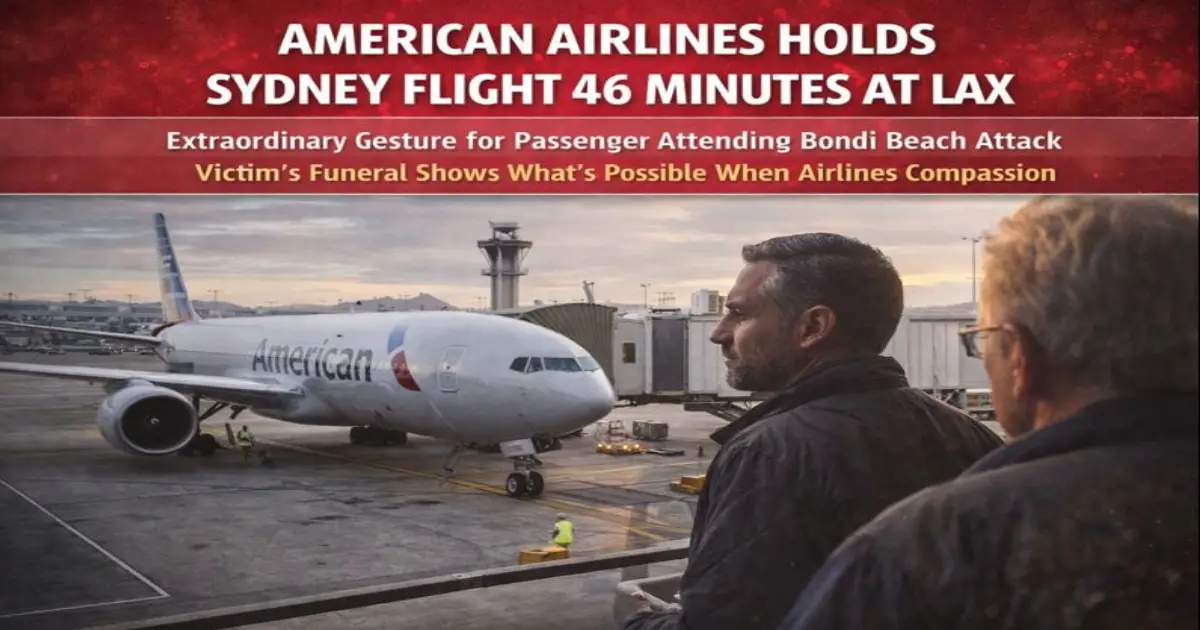
TRENDING: American Airlines held LAX-Sydney flight AA73 for 46 minutes, reassigned gates to eliminate terminal sprint, comped transpacific ticket, coordinated gate escort—enabling grieving Miami passenger to attend Rabbi Eli Schlanger’s funeral after December 14 Bondi Beach terror attack killed 15, demonstrating unprecedented airline compassion when United couldn’t hold its own Sydney service yet both carriers ultimately collaborated ensuring three friends reached funeral moments before it began
Published: January 3, 2026 Source: DansDeals, View from the Wing, Aviation A2Z, Travel and Tour World, Multiple Sources Key Finding: AA73 held 46 minutes, still arrived Sydney 7 minutes early Extraordinary Actions: Gate reassignment, escorted connection, complimentary $2,000+ ticket, crew coordination Bondi Connection: Rabbi Eli Schlanger killed December 14, 2025 terror attack (15 dead, 40+ injured) ANZ Impact: Shows major US carrier’s commitment to Australia routes, passenger welfare
In an era when airline schedules are governed by precision logistics, cost optimization, and operational efficiency metrics that penalize delays, American Airlines made an extraordinary decision that aviation experts describe as “unprecedented”—deliberately holding Los Angeles-Sydney flight AA73 for 46 minutes, reassigning gates to eliminate terminal scrambles, providing personal escort through LAX, and comping a transpacific ticket worth over $2,000 so a grieving traveler from Miami could reach Rabbi Eli Schlanger’s funeral after the December 14 Bondi Beach terror attack that killed 15 people and injured 40+ during a Chanukah menorah lighting event that shocked Australia and Jewish communities worldwide.
What followed was not merely exceptional customer service but a behind-the-scenes orchestration involving cockpit communications, operations coordination, gate staff relay, and inter-airline cooperation—as United Airlines, unable to hold its own LAX-Sydney service UA839 for the delayed passenger, worked with American to facilitate alternative routing while simultaneously expediting handling for two other friends already ticketed on United, ultimately ensuring all three travelers cleared Sydney immigration swiftly, reunited curbside, and reached the funeral at Chabad House Bondi Beach with only moments to spare.
“American Airlines has started holding flights for connecting passengers when possible, in limited circumstances,” notes aviation blogger Gary Leff (View from the Wing). “For one customer, though, they went further than I recall any airline going before… The airline pulled off a sequence that reads like fiction: a gate swap to eliminate a terminal sprint, a crew-and-ops relay waiting at the door, and a transpacific departure that stayed on the ground just long enough to get him on board—then made up the time over the Pacific and arrived early.”
The December 14 Bondi Beach terror attack—targeting a joyous Chanukah celebration on Sydney’s iconic beach—represents one of Australia’s deadliest terror incidents, creating international reverberations as the Jewish community mourned beloved Chabad Rabbi Eli Schlanger while grappling with antisemitism fears that prompted New South Wales Premier to acknowledge Sydney’s Jewish community “still does not feel entirely safe” weeks after the tragedy that coincided with global Chanukah celebrations meant to spread light against darkness.
On Sunday evening December 14, 2025, as Jewish communities worldwide prepared to celebrate Chanukah’s first night, a terror attack at Chabad of Bondi’s annual “Chanukah by the Sea” menorah lighting on Sydney’s Bondi Beach claimed 15 innocent lives including beloved Rabbi Eli Schlanger, with 40+ injured when an attacker opened fire on families gathering for the traditional holiday celebration meant to commemorate the Jewish festival of lights commemorating the Maccabees’ victory and Temple rededication.
Attack details:
New South Wales Premier Chris Minns acknowledged in late December that Sydney’s Jewish community “still does not feel entirely safe” following the attack—with Waverley Council citing “ongoing security concerns” when canceling all New Year’s Eve events at Bondi Beach including the annual fireworks display that typically attracts 15,000+ people, demonstrating how the December 14 attack’s impact extended beyond immediate casualties to fundamental changes in how vulnerable communities approach public celebrations.
Rabbi Eli Schlanger served as Chabad emissary (shaliach) to Bondi Beach, establishing strong community presence through educational programs, Shabbat services, holiday celebrations, and personal relationships with Jewish families across Sydney’s Eastern Suburbs—while maintaining close friendships with three childhood companions from yeshiva decades prior who remained connected through WhatsApp group “Yedidei Nefesh” (Hebrew: “beloved soul friends”) that Rabbi Schlanger created over a decade earlier enabling the four to communicate multiple times weekly despite time zone differences separating Sydney, Los Angeles, Miami, and Brooklyn.
The four friends:
“They were more than friends, they truly considered each other as family members,” explains DansDeals detailed account. “Mendel G. lives in Los Angeles, Eli R. lives in Miami, Levi F. lives in Brooklyn, and Eli Schlanger lived in Sydney, but Eli Schlanger was the glue that kept them in contact multiple times a week, despite the time zone differences.”
Just hours before the Bondi Beach attack, the four friends were chatting on WhatsApp—routine communication that would be their final conversation with Rabbi Schlanger before the terror attack transformed their relationship from living friendship to grief-driven tribute requiring three survivors to travel halfway around the world honoring the fourth member whose murder at Chanukah celebration epitomized the darkness the holiday’s candles symbolically oppose.
When news of Rabbi Schlanger’s murder reached his three childhood friends on December 14-15, all immediately knew without discussion that attending the funeral was non-negotiable—despite logistical challenges of booking last-minute transpacific flights, navigating uncertain funeral timing (Jewish tradition requires burial as soon as possible, though Australian state bureaucracy would ultimately delay until Wednesday December 18 at 11:00 AM Sydney time), and coordinating travel from three separate US cities to Australia requiring at minimum 20-24 hours door-to-door including connections.
Travel plan:
All three selected United Airlines award tickets on flight UA839 (LAX-Sydney, 10:40 PM departure, 9:20 AM+2 arrival Wednesday) for the transpacific leg, with Levi and Eli booking separate American Airlines positioning flights to Los Angeles allowing time for terminal changes, meeting Mendel at the United gate, and departing together—standard strategy for travelers using award miles where positioning flights on separate tickets provide flexibility and savings but carry inherent risk during irregular operations since separate reservations offer no protection if delays cause missed connections.
The critical flight times:
Everything hinged on AA1193 arriving on time—but rolling delays began immediately at Miami gate with “service issue” causing initial boarding halt, gate change adding confusion, and mechanical problems ultimately pushing departure 2+ hours late, devastating Eli R. as he watched comfortable 3-hour connection buffer evaporate into impossible 20-minute window between AA1193’s revised 10:20 PM LAX arrival and UA839’s 10:40 PM departure—assuming no further delays, immediate deboarding, sprint across terminals, no security re-screening, and gate still open for boarding when physically impossible timeline simply couldn’t accommodate reality.
Two-thirds through AA1193’s five-hour Miami-LAX flight, a flight attendant approached Eli R. at his seat in the last row—asking to confirm his identity before handing him a handwritten note from the captain that would transform despair into hope with four words changing everything: “American Airlines would wait.”
The captain’s note:
“He breathed a giant sigh of relief,” describes CrownHeights.info account of the moment. From that instant forward, nothing about AA1193’s arrival would be ordinary—as American Airlines began choreographing an unprecedented operational sequence that aviation experts describe as nearly fictional in its precision, compassion, and willingness to prioritize individual passenger welfare over rigid schedule adherence and operational efficiency metrics that typically govern modern airline decision-making.
As AA1193 approached Los Angeles with delayed passenger aboard, American Airlines operations team made first critical decision: reassign the arriving Miami flight from its scheduled domestic gate to an international gate just two positions away from AA73’s Sydney departure gate—transforming what would have been desperate 10-15 minute terminal sprint (domestic to international requiring potential security re-screening, significant distance, high failure probability) into manageable 2-minute walk between adjacent gates where success became achievable rather than miraculous.
Operational complexity:
“The aircraft, originally scheduled to land far from the American Airlines gate, was reassigned from a domestic gate to an international gate just two numbers away from the Sydney-bound plane,” notes detailed account. This decision alone—moving the Miami arrival to gate immediately adjacent to Sydney departure—represented extraordinary operational flexibility rarely seen in modern aviation where gate assignments are optimized for overall network efficiency rather than individual passenger convenience.
As AA1193’s door opened at LAX after the long Miami-Los Angeles journey with delayed passenger finally on the ground but race against time just beginning, an American Airlines manager was already standing at the jet bridge—having boarded the aircraft before general deplaning to personally identify and escort the Sydney-bound traveler, ensuring no confusion, no delays, no missed opportunities as the clock ticked toward AA73’s departure window that wouldn’t wait indefinitely despite the extraordinary hold decision.
“As the plane docked, an American Airlines manager boarded immediately, bypassing all protocol,” describes eyewitness account. “‘I’m here specifically for the Sydney passenger,’ he said. ‘Is that Mr…?'” The manager’s presence at the aircraft door—bypassing normal deplaning procedures where crew typically allows rows to exit forward progressively—ensured the critical passenger could exit immediately without waiting for 150+ other Miami passengers to collect belongings, crowd aisles, and slowly deplane.
Escort procedures:
While the personal escort rushed the delayed passenger from AA1193 to AA73, the Sydney-bound flight crew, ground staff, and operations coordinators maintained continuous communication about the situation—with captain, flight attendants, gate agents, and operations center all aware of why AA73 sat at the gate 19 minutes after the Miami flight’s arrival, 46 minutes past its scheduled 10:50 PM departure time, burning expensive jet fuel, consuming crew duty hours, and delaying 250+ passengers aboard the Boeing 787 Dreamliner who knew something unusual was happening but didn’t yet understand the full story.
AA73 operational impacts:
American Airlines made announcement aboard AA73 explaining the hold—informing passengers that the delay accommodated a traveler attempting to reach a funeral in Sydney after terror attack, requesting understanding and patience, creating moment of shared humanity where 250 strangers collectively accepted personal inconvenience enabling one grieving friend to say goodbye to another murdered in antisemitic violence half a world away.
The aircraft pushed back from the gate exactly 19 minutes after AA1193 arrived—demonstrating remarkable coordination where ground crews, gate agents, escort, passenger, and crew executed flawless relay covering gate reassignment, personal escort, boarding pass processing, security verification, seat assignment, baggage handling, and boarding in under 20 minutes when such connections typically require 45-90 minutes minimum under normal circumstances.
Perhaps most extraordinary: American Airlines comped the ticket entirely—absorbing the full cost of a last-minute transpacific business or premium economy seat (typical LAX-Sydney fares range $1,500-4,000+ depending on class and booking timing) without hesitation, without requiring payment, reimbursement requests, or lengthy justification processes that typically govern airline compensation decisions reviewed by multiple management layers before approval.
“The airline then extended a gesture rarely seen in commercial aviation: it covered the cost of the ticket entirely,” confirms Aviation A2Z analysis. “What this really means is that individual operational decisions can sometimes shape profoundly personal outcomes.”
The financial decision—absorbing $2,000+ ticket cost, operational delays, gate reassignment complications, and potential knock-on effects throughout American’s network—demonstrates airline leadership’s willingness to prioritize compassion over profit metrics when circumstances warrant, creating goodwill and positive brand narrative worth far more than the ticket’s face value but requiring executive judgment overriding normal cost-control procedures that would typically reject such requests as setting unsustainable precedents.
While American Airlines executed its extraordinary LAX hold and ticket comp for Eli R., United Airlines faced different operational constraints that prevented holding UA839’s 10:40 PM departure—but the carrier didn’t abandon the mission, instead working behind scenes to expedite handling for the two other friends (Mendel G. from LA and Levi F. from Brooklyn) already ticketed on the United flight, ensuring their smooth boarding and preparing Sydney ground staff for rapid immigration processing that would enable all three travelers to reunite despite arriving on different flights with AA73 landing first and UA839 following 30 minutes later.
Why United couldn’t hold UA839:
Despite inability to delay departure accommodating late-arriving Miami passenger, United Airlines coordinated with American ensuring the two friends on UA839 received priority handling, while Sydney ground operations prepared for expedited arrivals knowing the full story and understanding time criticality for funeral attendance scheduled just hours after landing.
The collaboration extended to Sydney where both carriers alerted ground staff, immigration authorities, and airport operations about the situation—resulting in unprecedented cooperation where American’s AA73 and United’s UA839 passengers received:
Sydney arrival facilitation:
“On both the American and United planes, announcements were made to please remain seated for Eli, Mendel, and Levi to rush off the plane, which everyone did,” notes DansDeals. “Both American and United provided escorts from their planes to rush everyone through customs and immigration, which they cleared in record time. They met up curbside to catch a ride to Rabbi Eli Schlanger’s newly built Chabad House in Bondi Beach.”
The coordination demonstrates that despite competitive pressures between American and United (both Star Alliance members competing for premium Pacific business), airlines can cooperate when circumstances demand—with both carriers ultimately facilitating the same mission despite Eli R. flying American while Mendel and Levi flew United, creating seamless traveler experience transcending individual carrier operations through shared commitment to extraordinary circumstances warranting extraordinary responses.
Perhaps most remarkable: despite departing LAX 46 minutes behind schedule, American Airlines flight AA73 made up time during the 15-hour transpacific crossing—arriving Sydney not just on-time relative to revised schedule but actually 7 minutes ahead of the original scheduled arrival, demonstrating how modern long-haul operations build schedule padding for headwinds, air traffic delays, and ground congestion that favorable conditions can recover when crews prioritize timely arrival and favorable jet streams assist the mission.
Flight performance:
“AA73 departed about 46 minutes behind schedule but made up time in flight and still arrived in Sydney (SYD) early,” confirms Aviation A2Z tracking data. The time recovery demonstrates crew prioritization of on-time arrival (flying optimal routing, cruising at most efficient speeds, coordinating with air traffic control for direct routing when available) combined with airline scheduling practices that pad long-haul flight times anticipating delays—creating opportunities to arrive “early” when operations proceed smoothly despite ground delays.
Ironically, United’s UA839—which departed LAX at scheduled 10:40 PM (10 minutes before American’s scheduled departure, 56 minutes before American’s actual departure)—arrived Sydney gate nearly 30 minutes later than American’s AA73 due to gate availability issues upon arrival where UA839’s assigned gate was occupied by another aircraft, forcing the United flight to wait on taxiway or remote stand before passengers could deplane, highlighting how airport ground operations sometimes create more delay than airborne factors.
“Ironically enough, United flight 839 departed earlier than American flight 73 from Los Angeles, but arrived at the gate in Sydney nearly half an hour later, as their gate was occupied upon arrival,” notes DansDeals comparison of the two flights. This twist meant that despite American holding 46 minutes for delayed passenger, the patient AA73 passengers who accepted the delay actually reached Sydney gate before UA839 passengers who departed on-time—demonstrating airport logistics’ unpredictability and vindicating American’s hold decision that ultimately didn’t significantly disadvantage its passengers relative to the competing United flight.
After clearing Sydney immigration in record time with both airlines providing escorts and expedited processing, the three friends reunited curbside at Sydney Airport—exactly as planned despite all the delays, complications, and last-minute coordination that transformed impossible mission into successful tribute to their murdered friend.
“Every effort was made, as per Jewish tradition, for the funeral to be held earlier. However, it just wasn’t meant to happen that way, as state bureaucracy wouldn’t release Eli for burial any sooner, despite heavy pressure from organizations,” explains the timing circumstances. The bureaucratic delays that frustrated Rabbi Schlanger’s family and community ultimately created the narrow time window allowing three friends from Miami, Brooklyn, and Los Angeles to complete their transpacific journeys and reach the funeral—arriving at newly-built Chabad House Bondi Beach with only moments to spare before the 11:00 AM levaya (funeral) began.
American Airlines acknowledged in recent months that it has “started holding flights for connecting passengers when possible, in limited circumstances”—representing policy shift from rigid schedule adherence that dominated airline operations in recent decades toward more flexible approach recognizing that occasional delays benefiting individual passengers create customer loyalty, positive publicity, and humanitarian outcomes worth more than the operational costs and on-time performance metrics that would typically prevent such decisions.
When American holds flights:
However, the Eli R. case exceeded typical hold policies—going beyond simple 10-15 minute waits for sprinting passengers to include gate reassignments, personal escorts, complimentary tickets, and inter-airline coordination lasting 46 minutes, suggesting American’s leadership exercised judgment authorizing extraordinary measures for circumstances that clearly warranted going above and beyond normal customer service protocols when terror attack victim’s funeral created moral imperative transcending operational efficiency concerns.
Aviation industry observers note that this American Airlines response represents outlier rather than standard practice—with most airlines refusing to hold flights more than 5-10 minutes even for passengers with compelling circumstances, citing on-time performance metrics, operational complexity, fairness to other passengers, and precedent concerns that would make similar accommodations unsustainable if granted routinely.
Typical airline response to missed connections:
Gary Leff (View from the Wing) notes: “Airlines do not do this for everyone because if they did they’d never be on-schedule. Glad it worked out for these travelers”—acknowledging that American’s extraordinary response cannot become standard operating procedure without fundamentally breaking airline scheduling systems designed for precision timing where 15-minute delays cascade through entire networks affecting hundreds of subsequent flights as aircraft and crew fall out of position.
The Eli R. case represents what airlines CAN do when leadership chooses compassion over metrics—demonstrating that operational flexibility exists when circumstances warrant, policies aren’t absolute barriers, and individual employees empowered to make judgment calls can create outcomes that rigid rules would prevent, suggesting that the difference between exceptional and mediocre customer service often lies in whether airline culture permits staff to prioritize humanity over algorithms when extraordinary situations demand extraordinary responses.
For Australian and New Zealand travelers, American Airlines’ LAX-Sydney route represents critical transpacific connection—with daily AA72/AA73 services linking Southern California with Australia using Boeing 787 Dreamliners offering premium economy, business class, and economy options that compete with Qantas, United, and other carriers serving the lucrative Pacific market where Australian business and leisure travelers generate significant revenue for airlines offering convenient US connections.
AA LAX-Sydney details:
The Eli R. story demonstrates American’s operational commitment to this route—willing to absorb delays, costs, and complications ensuring passengers reach Sydney even when circumstances challenge normal operations, creating confidence among Australian travelers that American prioritizes Pacific service and understands unique needs of transpacific passengers whose 15-hour flights represent major time and financial investments warranting carrier commitment beyond minimum contractual obligations.
For Aussies and Kiwis accustomed to different consumer protection frameworks—where Australian Consumer Law and New Zealand Fair Trading Act provide stronger passenger rights than US regulations in many circumstances—understanding American airline culture helps managing expectations when flights involve US carriers, US airports, or US connections where different rules and cultural norms govern what airlines must (legally) and will (culturally) provide during disruptions.
US airline landscape:
The Eli R. case demonstrates that exceptional outcomes are possible when individual employees are empowered, circumstances warrant extraordinary responses, and airline leadership supports staff making compassionate decisions—but travelers shouldn’t expect similar treatment routinely, as this case represents outlier enabled by unique circumstances (terror attack funeral, close-timing connection, operational feasibility, willing leadership) rather than standard practice applicable to typical delays.
American Airlines’ decision to hold LAX-Sydney flight AA73 for 46 minutes, reassign gates, provide personal escort, and comp a $2,000+ transpacific ticket enabling grieving Miami passenger to attend Rabbi Eli Schlanger’s funeral after the December 14 Bondi Beach terror attack—combined with United Airlines’ parallel cooperation expediting two friends on separate flight and coordinating Sydney-side arrivals—demonstrates that airlines CAN choose compassion over rigid efficiency when circumstances warrant, individual employees are empowered making judgment calls, and leadership supports operational flexibility prioritizing humanity alongside metrics.
The story resonates because it’s exceptional rather than routine—highlighting how modern aviation’s precision scheduling, cost optimization, and on-time performance pressures typically prevent exactly the kind of flexibility American demonstrated, making the carrier’s choice to hold, assist, and absorb costs all the more remarkable as evidence that humanity persists amid the algorithms, spreadsheets, and operational procedures governing contemporary air travel where passenger welfare sometimes—if rarely—trumps schedule adherence when stakes involve grief, terror victims, and the fundamental human need to say goodbye to loved ones murdered in antisemitic violence.
Key takeaways for travelers:
✓ Exceptional service possible but don’t expect routinely (this case represents outlier) ✓ Separate ticket risks (Eli R.’s Miami-LAX on different reservation than LAX-Sydney created vulnerability that American voluntarily resolved) ✓ Social media matters (friend contacted American via Twitter alerting to situation) ✓ Humanity exists in airlines despite corporate pressures favoring efficiency over compassion ✓ American’s LAX-Sydney commitment validated through extraordinary operational flexibility ✓ United-American cooperation shows competing carriers can coordinate for passenger welfare ✓ Build connection buffers (original 3-hour Miami-LAX to Sydney connection would have succeeded without delays) ✓ Travel insurance essential (covers costs when airlines won’t, though this case airline absorbed everything) ✓ Premium cards help (status/loyalty sometimes unlocks better treatment, though this case succeeded without) ✓ Bondi Beach attack reminds travelers that terrorism impacts real people whose stories deserve compassion
“What followed was not merely exceptional customer service but a behind-the-scenes orchestration involving cockpit communications, operations coordination, gate staff relay, and inter-airline cooperation,” reflects travel industry analysis of the extraordinary sequence. The Eli R. story will be cited for years as example of what airlines can accomplish when choosing humanity over metrics—proof that operational flexibility exists when leadership prioritizes passenger welfare, individual employees are empowered making compassionate decisions, and circumstances create moral imperatives transcending typical cost-benefit calculations governing airline operations where schedule adherence and efficiency typically trump individual passenger emergencies no matter how compelling the circumstances.
For the three friends who traveled from Miami, Brooklyn, and Los Angeles to Sydney honoring Rabbi Eli Schlanger after his murder at Bondi Beach Chanukah celebration, American and United’s extraordinary coordination transformed impossible mission into successful tribute—arriving at the funeral with moments to spare, saying goodbye to the friend who connected them, and experiencing firsthand that even in modern aviation’s algorithm-driven efficiency, space remains for the humanity, compassion, and moral judgment that distinguish great airlines from merely competent ones.
For More Resources:
Related Travel Guides:
Final Reflection: In an industry increasingly defined by algorithms optimizing costs, efficiency metrics penalizing delays, and operational procedures prioritizing network performance over individual welfare, American Airlines’ 46-minute hold of Sydney flight AA73—complete with gate reassignments, personal escorts, and comped $2,000+ ticket—reminds us that humanity persists when circumstances demand and leadership permits. The Eli R. story won’t revolutionize airline industry practices or create expectations that carriers routinely sacrifice on-time performance for individual passengers, but it proves that compassion remains possible when terror victims’ funerals create moral imperatives transcending operational spreadsheets. For the three friends who reached Rabbi Eli Schlanger’s funeral moments before it began, American and United’s extraordinary coordination transformed grief into gratitude—demonstrating that even in modern aviation’s efficiency-obsessed culture, space remains for the judgment, flexibility, and basic human decency that distinguish memorable service from merely adequate operations.
Posted By : Vinay
This article is provided for general informational purposes only and is based on information available at the time of publication. Travel advisories, airline schedules, airport operations, visa requirements, government regulations, and other travel-related information are subject to change without prior notice. While Travel Tourister makes reasonable efforts to verify information using official announcements, government publications, airline and airport communications, and other reliable sources, we cannot guarantee that all information remains complete, accurate, or up to date at all times. Readers should independently verify any information that may affect their travel plans with the relevant airline, airport authority, government agency, embassy, or other official source before making travel, financial, or other decisions. Travel Tourister shall not be liable for any direct or indirect loss, inconvenience, or damages arising from the use of or reliance on the information contained in this article. Nothing in this publication constitutes legal, immigration, financial, or professional travel advice. If you believe any information in this article is inaccurate or outdated, please contact our editorial team. We review all credible correction requests promptly and update our content whenever appropriate.
Lastest News
2nd Floor, 39, Above Kirti Club, DLF Industrial Area, Kirti Nagar, New Delhi, Delhi 110015



Travel Tourister is a leading Travel portal where we introduce travellers to trusted travel agents to make their journey hasselfree, memorable And happy. Travel Tourister is a platform where travellers get Tour packages ,Hotel packages deals through trusted travel companies And hoteliers who are working with us across the world. We always try to find new and more travel agents and hoteliers from every nook and corners across the world so that you could compare the deals with different travel agents and hoteliers and book your tour or hotel with the one you have chosen according to your taste and budget.
Copyright © Travel Tourister, India. All Rights Reserved

 Call
Call Enquiry