Published on : 01 May 2026
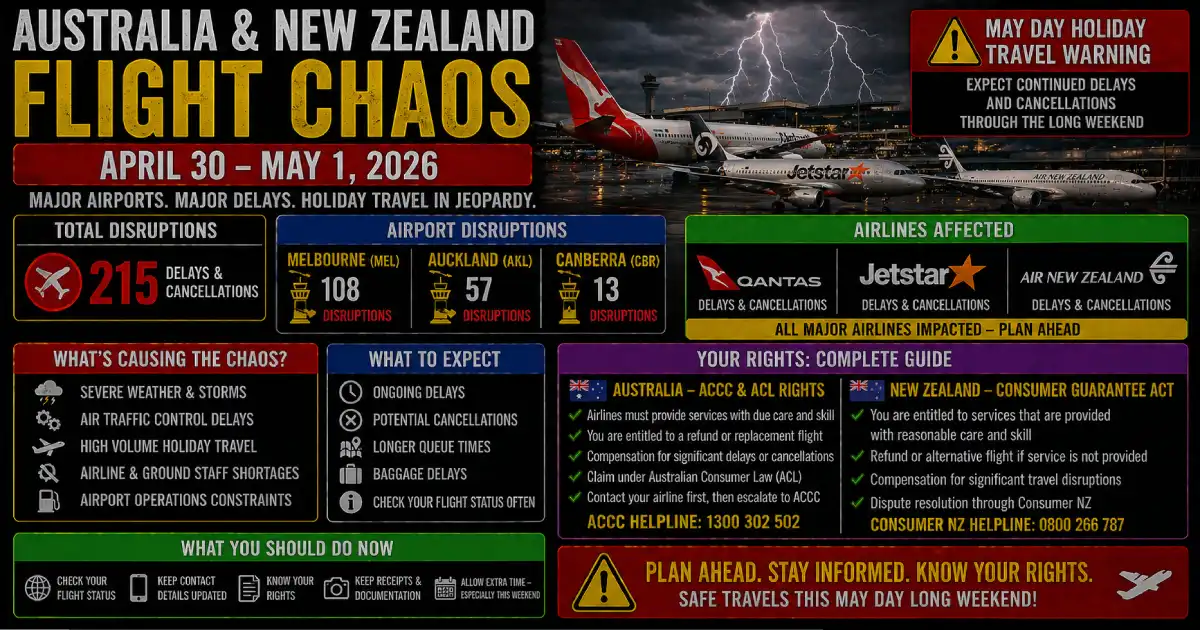
Breaking — May 1, 2026: The Australia and New Zealand aviation network recorded 200 delays and 15 cancellations on April 30 — 215 total disruptions — across five airports including Melbourne Tullamarine, Canberra, Gold Coast, Auckland, and Christchurch. Melbourne led all airports with 101 delays and 7 cancellations, making it the worst-hit hub in the region for the second consecutive week. Auckland recorded 56 delays and 1 cancellation across the Tasman. Qantas, Jetstar, and Air New Zealand are all affected. Today, May 1 — May Day, a public holiday across Queensland, the ACT, and the Northern Territory — is bringing elevated leisure travel volumes to an already-strained aviation network. That combination of holiday demand and structural operational deficit makes today one of the most disruption-prone travel days of the entire Autumn 2026 season. If you are flying anywhere in Australia or New Zealand today or this weekend — here is every number, every carrier, and every right you hold.
Published: May 1, 2026 — Friday (May Day public holiday in QLD, ACT, NT) Data date: April 30, 2026 National Total April 30: 215 disruptions (200 delays + 15 cancellations) Worst Airport — Delays: Melbourne Tullamarine (MEL) — 101 delays + 7 cancellations = 108 total Second Worst: Auckland International (AKL) — 56 delays + 1 cancellation = 57 total Third: Christchurch International (CHC) — 21 delays + 1 cancellation = 22 total Fourth: Gold Coast (OOL) — 14 delays + 1 cancellation = 15 total Fifth: Canberra International (CBR) — 8 delays + 5 cancellations = 13 total ⚠️ Highest proportional cancellation rate of any airport today Carriers Affected: Qantas · Jetstar · Air New Zealand · (Virgin Australia and QantasLink data pending final count) Today May 1: May Day public holiday — Queensland · ACT · Northern Territory — elevated leisure traffic Not disrupted today (notably): Sydney (SYD) and Brisbane (BNE) — not included in confirmed April 30 data, suggesting disruption concentrated in southern/NZ hubs Structural factors active: Jetstar domestic cuts (2.7% capacity, 286 flights, May 18–June 30) · Qantas regional route suspensions · Air NZ Wave 2 cuts (4% May–June) · Fuel surcharges across all carriers Fare impact: Auckland–Wellington round-trip: NZ$160 in May (up 8–12% from April’s NZ$145) Rights regime: Australian Consumer Law (ACL) · NZ Consumer Guarantees Act · Airline Customer Advocate · ACCC enhanced monitoring Source: FlightAware
April 30 is Day 30 of the longest sustained aviation disruption sequence Australia and New Zealand have recorded in 2026. To understand why 215 disruptions on the final day of April still matters — even as the numbers are significantly lower than April’s worst days — you need to see it against the full month.
The April 2026 AU/NZ disruption timeline:
| Date | Total Disruptions | Context |
|---|---|---|
| April 1 | 567 | Post-Easter peak begins |
| April 3 (Good Friday) | 418 | Brisbane rail shutdown begins |
| April 6 (Easter Monday) | 851 | Peak crisis day of the month |
| April 15 | 396 | Day 15 of sustained disruption |
| April 17 | 546 | 504 delays + 42 cancellations |
| April 26 | 306 | Anzac weekend — 272 delays + 34 cancellations |
| April 28 | 279 | Post-Anzac, Air NZ Wave 2 active |
| April 29 | 279 | Day 29 — Jetstar + Qantas + Air NZ |
| April 30 | 215 | Lowest since recovery began — but still elevated |
April 30’s 215 disruptions represent meaningful improvement from the crisis peaks of Easter and mid-April. But they also represent a network that has not had a single normal operating day for the entire month. A normal April day for the combined Australia–New Zealand corridor would produce approximately 80–120 total disruptions — delays and cancellations combined. April 30’s 215 is still nearly double that baseline.
The reason: the structural factors driving disruption have not resolved. They have only been partially compensated by lower Easter and post-Anzac passenger volumes. When May Day holiday volumes return today, those structural factors immediately translate back into operational pressure.
Worst airport today by every metric
Melbourne has led the national disruption table for much of April — and April 30 is no exception. The 101 delays recorded today represent the highest single-airport delay count in the region, with 7 cancellations adding to the pressure. Melbourne’s position as the “Golden Triangle” hub — the centre of the Sydney–Melbourne–Brisbane trunk route that carries more passengers than any other domestic corridor in the country — means that every delay at Melbourne cascades into the highest-traffic routes in Australian aviation.
Why Melbourne leads consistently:
Melbourne Tullamarine is the primary base for both Qantas and Jetstar’s domestic operations, as well as Virgin Australia’s Melbourne hub. When fuel costs force schedule tightening — as they have throughout April 2026 — the Melbourne-based operations absorb the highest absolute disruption volume because they have the most flights to delay.
Qantas at Melbourne: Qantas is cutting 3.6% of domestic flights from May 18 to June 30, including three route suspensions: Adelaide–Mount Gambier (indefinitely), Melbourne–Coffs Harbour (until June 14), and Melbourne–Hamilton Island (until June 28). These cuts have not yet taken effect — but the aircraft and crew scheduling adjustments preparing for those cuts are already creating positioning pressures at Melbourne today.
Jetstar at Melbourne: Jetstar has cut 286 domestic flights (2.7% of domestic capacity) across May 18–June 30 and slashed trans-Tasman frequencies by 12%. The Gold Coast–Darwin seasonal service, originally set to restart in June, has been pushed to October. Again — these cuts are not yet in effect, but the pre-implementation schedule tightening is visible in today’s delay count.
International routes through Melbourne today:
Contact Qantas MEL: 13 13 13 | qantas.com → Manage Booking Contact Jetstar MEL: 131 538 | jetstar.com → Manage My Booking Contact Virgin Australia MEL: 13 67 89 | virginaustralia.com
Auckland’s 56 delays reflect the ongoing operational pressure from Air New Zealand’s Wave 2 capacity cuts — now fully active. Air NZ has removed approximately 1,100 flights in Wave 1 (March–early May) and a further 4% of its May–June schedule in Wave 2. The combined impact at Auckland:
The fare consequence already visible: The Auckland–Wellington round-trip that cost NZ$145 in April 2026 is now pricing at NZ$160 for May departures — an 8–12% premium driven purely by the capacity reduction. Fewer flights means earlier sellouts, less flexibility, and no room to recover when disruption strikes.
The cascade into trans-Tasman: Auckland’s 56 delays today ripple into Melbourne’s delay count — aircraft that should arrive from Auckland on time for their Sydney or Brisbane turnaround are arriving late, seeding downstream Australian disruptions. The trans-Tasman corridor is one of the most tightly scheduled in the world — AKL delays become MEL delays within 3–4 hours.
Air New Zealand rebooking: If your Air NZ flight is cancelled and the alternative doesn’t suit you: request a full refund through the Air NZ website → Manage My Booking → Refund & Credit. New Zealand Consumer Guarantees Act applies — the airline must provide a remedy (rebooking or refund) for services not delivered.
Contact Air New Zealand AKL: 0800 737 000 (NZ) | 132 476 (Australia) | airnewzealand.com
Christchurch is the hardest-hit city in Air New Zealand’s domestic network from the Wave 2 cuts. The May–June schedule loses 27 Auckland rotations and 30 Wellington services through Christchurch. This means Christchurch passengers are operating in a significantly thinned network through June.
For South Island travellers: If your Air NZ Christchurch connection is cancelled in May or June, alternative services may not depart until the following day. This is a material change from April conditions. Book morning departures from Christchurch where possible — they have less cascade exposure than afternoon and evening services.
Connections note: Christchurch is the gateway for South Island ski season traffic — Queenstown and Wanaka visitors often route through CHC for domestic connections. With reduced frequencies, missed connections at CHC carry a higher probability of overnight delays than in previous seasons.
Gold Coast is heavily dependent on fly-in tourism from Sydney and Melbourne. Today’s 14 delays reflect the same Qantas and Jetstar operational pressure seen at Melbourne — but at a smaller scale. Gold Coast’s tourism economy is acutely sensitive to flight reliability: a delayed Friday evening departure from Sydney to Coolangatta directly disrupts the weekend leisure visitor economy.
May Day note: Today is a public holiday in Queensland (May Day). Gold Coast is at maximum leisure travel capacity today. The combination of the public holiday demand spike and elevated underlying disruption makes OOL one of the highest passenger-impact airports today despite its lower absolute delay count.
Highest proportional cancellation rate of any airport today
Canberra’s 5 cancellations alongside 8 delays is a disproportionate result for an airport of its size. Canberra operates a limited daily schedule — typically around 40–60 movements per day — meaning that 5 cancellations represent approximately 8–12% of all planned departures today. For comparison, Melbourne’s 7 cancellations represent approximately 1–2% of Melbourne’s movements.
Why Canberra is disproportionately affected: Canberra is served almost exclusively by Qantas and its regional subsidiaries (QantasLink, Network Aviation). When Qantas is under scheduling pressure, Canberra’s routes — short-haul feeders to Sydney and Melbourne — are typically the first to be consolidated. The capital’s government and diplomatic travel market means many Canberra passengers have time-sensitive itineraries with limited alternative routing options.
If your Canberra flight is cancelled today: The next available Canberra departure may not be until tomorrow. Contact Qantas immediately at 13 13 13. If rebooking is not possible within 4 hours, you have a right to a refund under Australian Consumer Law.
Today’s disruption is not caused by a storm, a strike, or a technical failure. It is the product of three structural changes that are now fully active in the May 2026 Australian and New Zealand aviation landscape — and none of them resolve quickly.
Approximately 60% of Australia’s jet fuel is refined from Middle Eastern crude. Since February 28, 2026 — the day the Iran war began and the Strait of Hormuz was disrupted — fuel costs for Australian carriers have spiked sharply. The most visible impact:
These cuts will not reverse until either jet fuel prices fall substantially — which requires Hormuz to fully reopen and the global supply chain to normalise, a process the IEA estimates at 6 months minimum from a full reopening — or until airlines hedge sufficient forward volume at more sustainable prices.
When airlines cut 3–12% of their schedules, they are not simply removing unwanted flights. They are removing the buffer capacity that the network uses to recover when disruption strikes. In a normal operating environment, a delayed Melbourne departure can be accommodated by moving passengers to the next service 2 hours later. When Jetstar cuts 12% of trans-Tasman frequency, that next service may be tomorrow. The network’s ability to absorb disruption — its resilience — is proportional to its spare capacity. With capacity at multi-year lows, even moderate disruption produces higher passenger impact than it would in normal times.
Every day of elevated disruption generates positioning failures — aircraft that end the day in the wrong city, crews that hit duty-hour limits at the wrong base. After 30 consecutive days of above-normal disruption in April 2026, the Australia–New Zealand network has accumulated a substantial positioning debt. Aircraft that should be in Melbourne are in Canberra. Crews that should be based in Auckland are positioned for rest in Christchurch. These positioning failures do not resolve overnight — they require days of clean operations to work through, and clean operating days have been rare throughout April.
This is the most important section for any Australian or New Zealand passenger planning travel in the next two months.
Three route suspensions confirmed:
International changes:
Qantas rebooking policy (confirmed): Fee-free date changes for flights booked before April 30 for travel between February 28 and April 30. For May and June travel, check Qantas app → Manage Booking for any active waivers on your specific booking.
Contact Qantas: 13 13 13 (AU) | 0800 808 767 (NZ) | qantas.com
Specific cuts confirmed:
The Jetstar interline warning: Jetstar has zero interline agreements with any other carrier. If Jetstar cancels your flight, the airline cannot rebook you onto Qantas, Virgin Australia, Air New Zealand, or any other carrier. You must either rebook within Jetstar’s own network or request a cash refund and purchase a new ticket independently. This is the single most important fact for any Jetstar passenger in May and June 2026 — your backup options are yours to find, not Jetstar’s to provide.
Contact Jetstar: 131 538 (AU) | 0800 800 995 (NZ) | jetstar.com
Confirmed capacity reductions:
Air NZ fare impact: Auckland–Wellington round-trip: NZ$160 (May) vs NZ$145 (April) — 8–12% premium. With fewer flights available, sellouts are happening earlier than usual, and there is less room to absorb disruption.
Air NZ rebooking: If your flight is cancelled and you don’t want the rebooking offered: request a full refund through airnewzealand.com → Manage My Booking → Refund & Credit.
Contact Air New Zealand: 0800 737 000 (NZ) | 132 476 (AU) | airnewzealand.com
Virgin Australia has maintained a relatively lower cancellation rate throughout April — but recorded a 46% delay rate on some days, meaning nearly half of all Virgin Australia departures were running late. This structural delay pattern reflects Virgin’s lean post-restructuring schedule: the airline has fewer spare aircraft than pre-2020 and less buffer capacity to absorb positioning failures.
Virgin Australia routes most affected: Sydney–Melbourne–Brisbane Golden Triangle · Gold Coast routes · Brisbane trans-Tasman services
Contact Virgin Australia: 13 67 89 | virginaustralia.com → Manage Booking
Today is Friday May 1, 2026 — May Day, a public holiday in Queensland, the Australian Capital Territory, and the Northern Territory. For aviation, this means:
🔴 Queensland (May Day public holiday): Brisbane Airport (BNE) — the fourth-busiest airport in Australia — is operating in public holiday mode. Leisure travellers dominate. Long-weekend getaways to the Gold Coast, Cairns, and Hamilton Island are all active. BNE itself did not appear in yesterday’s April 30 disruption data — suggesting it may be in a stronger operational position — but the surge of May Day departures will test that stability today.
🔴 ACT (May Day public holiday): Canberra Airport (CBR) — which recorded the highest proportional cancellation rate of any airport yesterday (5 cancellations on a small schedule) — is under additional public holiday pressure today. Government and diplomatic travellers combining a long weekend add volume to an airport with limited spare capacity.
🔴 Northern Territory (May Day public holiday): Darwin Airport (DRW) has limited services but is a key connection point for north Australian travel. The Jetstar Gold Coast–Darwin seasonal service was pushed to October — travellers who expected that service to begin in June need to find alternatives.
What to do today specifically: ✅ Check your specific flight status on the airline app before leaving for the airport ✅ At Brisbane: allow extra time for road traffic — May Day public holiday road congestion is common on the approaches to BNE ✅ At Canberra: if your May Day morning flight is cancelled, the next available may be late afternoon or tomorrow — contact Qantas immediately at 13 13 13 ✅ At Gold Coast: expect crowded terminals and elevated gate wait times throughout the day
Under Australian Consumer Law (ACL): ✅ Full cash refund if the cancellation is within the airline’s control ✅ Free rebooking on the next available service ✅ Meals, accommodation and transport during long delays — if the cause is within the airline’s operational control
The ACL distinction: Unlike EU261/UK261, Australian law does not specify exact cash compensation amounts for delays. The Australian Consumer Law provides for remedies (refunds or rebooking) but not automatic cash payments for delay duration. The proposed Aviation Consumer Protection Scheme — currently before Parliament — would introduce minimum standards including meals for delays and accommodation for overnight disruptions, but these bills have not yet passed into law as of May 2026.
The exact words to use: “My flight has been cancelled. Under Australian Consumer Law, I am requesting a full cash refund to my original payment method. Please process this now.”
Escalation: If an airline refuses a legitimate refund:
Under the New Zealand Consumer Guarantees Act: ✅ Airlines must provide a remedy (refund or rebooking) when services are not delivered as contracted ✅ If the airline’s alternative rebooking is materially different from your original booking, you can reject it and request a cash refund ✅ No automatic delay compensation amounts — similar to Australia, NZ has no EU261-style fixed payments
Escalation: Commerce Commission NZ | aviation.govt.nz | Disputes Tribunal for claims under NZ$30,000
If you are a UK or European passenger who booked your Australia or New Zealand leg as part of a European carrier ticket:
🇬🇧 UK261 applies if your original departure was from a UK airport — contact your European carrier for the UK261 claim on the UK leg. The Australian/NZ leg itself is governed by ACL/NZ Consumer Guarantees Act.
If you booked on Qantas from London Heathrow (QF operated by Qantas) or via British Airways code-share to Australia, the Australian leg falls under ACL once you depart Australia.
1. Check your specific flight now — not just the airport status Melbourne’s 101 delays mean approximately 1 in 5 Melbourne departures is running late. But not all flights are affected equally. Search your specific flight number on FlightAware (flightaware.com) or the airline’s own app for your precise delay estimate.
2. For Jetstar passengers: book your backup plan before you need it Jetstar has no interline agreements. If your Jetstar service is cancelled, you cannot be rebooked onto another carrier. Before you travel today, identify the equivalent Qantas or Virgin Australia departure for your route and note its price and availability. If Jetstar cancels, you want to purchase that alternative immediately — before it sells out.
3. For Air NZ passengers on Christchurch routes: check your Wave 2 status 27 Auckland–Christchurch rotations and 30 Wellington–Christchurch services have been removed from the May–June timetable. If you booked before the Wave 2 cuts were announced, your specific flight may have been cancelled and a replacement offered. Log into Air NZ’s Manage My Booking portal at airnewzealand.com to confirm your booking status.
4. Keep all receipts during any delay over 2 hours If your airline does not proactively offer meals or refreshment vouchers after a significant delay and the cause is operational (not weather), keep your meal and accommodation receipts. File a claim through the Airline Customer Advocate (airlineadvocate.com.au) within 12 months. Document the delay cause in writing from the airline — a screenshot of the delay notification with the stated reason is sufficient.
5. For May Day travel today: allow 45 minutes extra at every airport Public holiday traffic patterns compress into morning and early afternoon departure banks. Security queues at Melbourne and Brisbane are particularly long during public holiday morning peaks. The standard 90-minute pre-departure arrival guide is not sufficient today — allow 2 hours for domestic, 3 hours for international.
The Bottom Line: April 30 recorded 215 disruptions — the lowest single-day total since the post-Easter crisis began, and a genuine sign that the network is beginning to recover. Melbourne at 108 and Auckland at 57 remain elevated, but the trajectory is downward from April’s worst days. The greater concern for passengers is not today’s disruption count — it is what happens from May 18, when Jetstar’s 286-flight domestic cuts and Qantas’s 3.6% reduction take effect simultaneously. Today is a relatively manageable disruption day. Mid-May may not be. If you are flying anywhere in Australia or New Zealand between now and June 30: book morning departures, carry cabin baggage only, have 90-minute connection buffers at Melbourne and Auckland, and check your Air NZ and Jetstar bookings this weekend — because the schedule you booked may not be the schedule that operates.
For More Resources:
Related Articles:
Posted By : Vinay
This article is provided for general informational purposes only and is based on information available at the time of publication. Travel advisories, airline schedules, airport operations, visa requirements, government regulations, and other travel-related information are subject to change without prior notice. While Travel Tourister makes reasonable efforts to verify information using official announcements, government publications, airline and airport communications, and other reliable sources, we cannot guarantee that all information remains complete, accurate, or up to date at all times. Readers should independently verify any information that may affect their travel plans with the relevant airline, airport authority, government agency, embassy, or other official source before making travel, financial, or other decisions. Travel Tourister shall not be liable for any direct or indirect loss, inconvenience, or damages arising from the use of or reliance on the information contained in this article. Nothing in this publication constitutes legal, immigration, financial, or professional travel advice. If you believe any information in this article is inaccurate or outdated, please contact our editorial team. We review all credible correction requests promptly and update our content whenever appropriate.
Lastest News
2nd Floor, 39, Above Kirti Club, DLF Industrial Area, Kirti Nagar, New Delhi, Delhi 110015



Travel Tourister is a leading Travel portal where we introduce travellers to trusted travel agents to make their journey hasselfree, memorable And happy. Travel Tourister is a platform where travellers get Tour packages ,Hotel packages deals through trusted travel companies And hoteliers who are working with us across the world. We always try to find new and more travel agents and hoteliers from every nook and corners across the world so that you could compare the deals with different travel agents and hoteliers and book your tour or hotel with the one you have chosen according to your taste and budget.
Copyright © Travel Tourister, India. All Rights Reserved

 Call
Call Enquiry