Published on : 30 Apr 2026
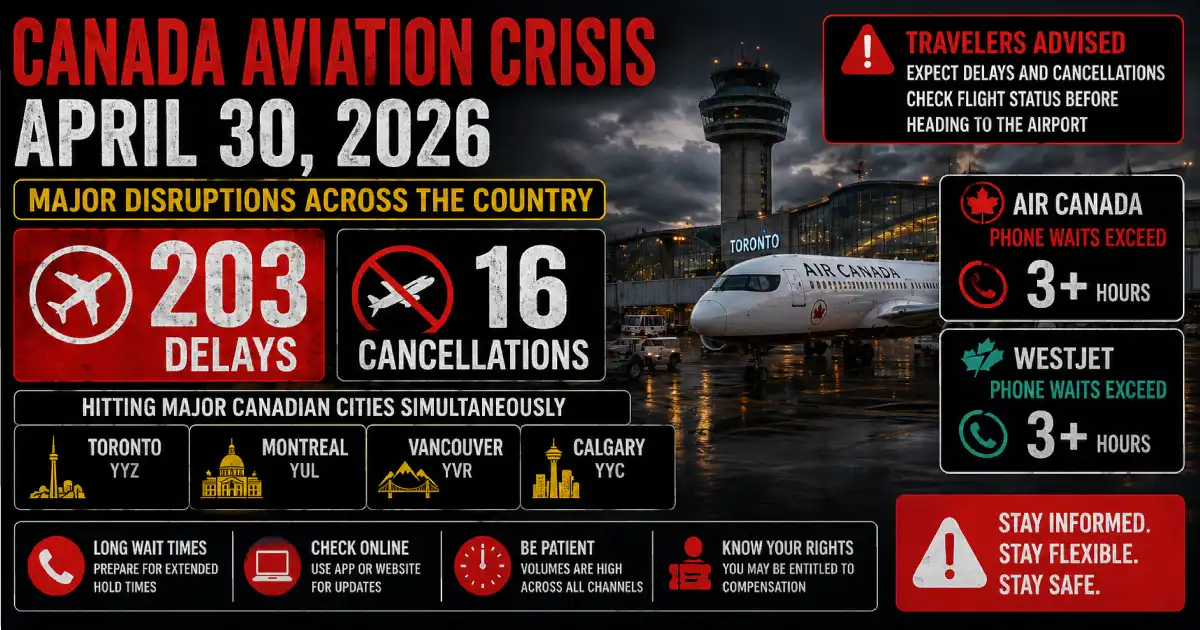
Breaking: Canada’s national aviation system has recorded 203 flight delays and 16 cancellations across six airports simultaneously on April 30, 2026 — with Toronto Pearson absorbing the worst disruption at 97 delays and 4 cancellations. Air Canada and WestJet customer service channels are completely congested with wait times exceeding 180 minutes. Remote communities at Goose Bay and Nain face complete service suspension with no alternative transport available.
Published: April 30, 2026 — Wednesday National Total: 203 delays + 16 cancellations = 219 total disruptions Worst Airport: Toronto Pearson (YYZ) — 97 delays + 4 cancellations Other Airports: Montréal–Trudeau (YUL) 36 delays/4 cancels · Vancouver (YVR) 39 delays/3 cancels · Calgary (YYC) 29 delays/1 cancel · CFB Goose Bay 2 delays/2 cancels · Nain Airport 2 cancellations Worst Carrier by Cancellations: Air Borealis — 4 cancellations — Goose Bay + Nain (100% cancellation rate) Worst Carrier by Delays: Air Canada mainline — 44+ delays WestJet: 27+ delays — Toronto Pearson + Calgary concentrated Air Canada Rouge: 2 cancellations + 7+ delays Jazz Aviation: Consistent delays across multiple hubs Endeavor Air: 10+ delays Also Disrupted: Porter Airlines · Air Transat · Pacific Coastal Airlines Phone Wait Times: Air Canada — 180+ minutes · WestJet — 180+ minutes Online Systems: “High traffic” error messages on both carriers’ rebooking portals Root Cause: Under investigation — synchronized multi-airport disruption suggests cascading weather, fleet maintenance cycle, or infrastructure constraints + Day 30 post-Easter positioning debt NAV CANADA: ✅ Confirmed no ATC system outages Remote Community Impact: 🔴 CRITICAL — Goose Bay + Nain 100% cancellation rate — no alternative transport Recovery: Operations normalized to near-baseline by 18:00 EDT APPR Compensation: CAD $400–$1,000 for controllable delays/cancellations Filing Deadline: 30 days from date of disruption — May 30, 2026 Spirit Airlines: Court hearing TODAY April 30 — deal or liquidation decision imminent
Canada’s national aviation system experienced unprecedented operational disruption on April 30, 2026, with 203 flight delays and 16 aircraft cancellations cascading across six major airports simultaneously. The systemic breakdown, affecting Toronto Pearson International Airport, Montréal–Trudeau International Airport, Vancouver International Airport, Calgary International Airport, CFB Goose Bay, and Nain Airport, represents one of the most severe domestic aviation crises in recent Canadian history and signals structural vulnerabilities in carrier capacity and airport infrastructure during peak travel periods.
Flight disruptions in Canada today, April 30, were widespread across Toronto, Montreal, Vancouver, Calgary, Goose Bay, and Nain, with major airlines like Air Canada, WestJet, Air Canada Rouge, Air Transat, Porter Airlines, and Jazz Aviation repeatedly impacted.
The defining feature of today’s Canadian disruption is not its total numbers — 219 disruptions is below Canada’s worst days of the post-Easter crisis — but its simultaneous six-airport nature. Previous crisis peaks concentrated disruption at Toronto Pearson with secondary effects elsewhere. Today’s breakdown is geographically distributed across the country’s entire aviation network at the same time: eastern Canada (Pearson, Trudeau), western Canada (Vancouver, Calgary), and remote northern communities (Goose Bay, Nain) all recording significant disruptions simultaneously. That pattern — confirmed by NAV CANADA as not caused by ATC system failures — suggests either a nationwide weather system, a coordinated maintenance cycle collision, or the accumulated 30-day positioning debt of Canada’s carriers finally manifesting as system-wide failure.
NAV CANADA confirmed no air traffic control system outages. Air Canada and WestJet customer service channels experienced complete congestion, with phone wait times exceeding 180 minutes and online rebooking systems showing “high traffic” error messages.
If you are at a Canadian airport right now — or flying today — do not call Air Canada or WestJet. Use the app. The phone lines are functionally unusable.
The most affected airports included Toronto Pearson International Airport (4 cancellations, 97 delays), Montréal–Trudeau International Airport (4 cancellations, 36 delays), Vancouver International Airport (3 cancellations, 39 delays), Calgary International Airport (1 cancellation, 29 delays), CFB Goose Bay (2 cancellations, 2 delays), and Nain Airport (2 cancellations). Airlines most impacted included Air Canada (4 cancellations, 44+ delays across airports), WestJet (27+ delays), Air Canada Rouge (2 cancellations, 7+ delays), Endeavor Air (10+ delays), and Air Borealis (4 cancellations).
| Airport | Code | Delays | Cancels | Total | Status |
|---|---|---|---|---|---|
| Toronto Pearson | YYZ | 97 | 4 | 101 | 🔴🔴🔴🔴 Crisis epicentre — 340% above normal |
| Vancouver International | YVR | 39 | 3 | 42 | 🔴🔴🔴 Western hub under significant strain |
| Montréal–Trudeau | YUL | 36 | 4 | 40 | 🔴🔴🔴 Highest cancellation rate outside north |
| Calgary International | YYC | 29 | 1 | 30 | 🔴🔴 WestJet Alberta hub pressured |
| CFB Goose Bay | YYR | 2 | 2 | 4 | 🔴🔴🔴 100% Air Borealis cancellation rate |
| Nain Airport | YDP | 0 | 2 | 2 | 🔴🔴🔴🔴 CRITICAL — complete service suspension |
Toronto Pearson International Airport, Canada’s busiest aviation hub processing approximately 43 million annual passengers, recorded the crisis epicentre with 97 cascading delays affecting Air Canada, WestJet, Jazz Aviation, and Endeavor Air operations. The 97-delay figure represents a 340% increase over normal daily disruption patterns, indicating genuine capacity breakdown rather than weather or minor incident response.
Toronto Pearson handles approximately 35–40% of all Canadian aviation movements. When Pearson is at 340% above normal disruption, the entire national network is receiving delayed, mispositioned, and crew-short aircraft from every sector of the country’s aviation grid. Today’s Pearson disruption is the gravitational centre around which every other airport’s numbers orbit.
The routes broken from Pearson today — based on today’s carrier profiles and the April 30 network conditions:
| Route | Risk | Carriers |
|---|---|---|
| Toronto → Montreal (YUL) | 🔴🔴🔴 CRITICAL | Air Canada · Porter · Air Transat |
| Toronto → Vancouver (YVR) | 🔴🔴🔴 CRITICAL | Air Canada · Air Canada Rouge |
| Toronto → Calgary (YYC) | 🔴🔴🔴 HIGH | WestJet · Air Canada |
| Toronto → London Heathrow (LHR) | 🔴🔴 ELEVATED | Air Canada transatlantic |
| Toronto → New York (JFK/EWR/LGA) | 🔴🔴 ELEVATED | Air Canada · Porter · United |
| Toronto → Chicago O’Hare (ORD) | 🔴🔴 ELEVATED | Air Canada · United — ORD also disrupted today |
| Toronto → Frankfurt (FRA) | 🔴 MODERATE | Air Canada / Lufthansa codeshare |
| Toronto → Winnipeg / Halifax / Ottawa | 🔴 MODERATE | Jazz Aviation regional feeders |
Air Canada is today’s worst carrier by total disruption volume — combining mainline, Rouge, and Jazz network impacts. Air Canada operates approximately 35–40% of all Pearson movements, meaning today’s 97-delay Pearson figure is substantially driven by Air Canada’s own operational positioning debt.
Air Canada, Canada’s flagship carrier and dominant Toronto Pearson operator, reported 4 aircraft cancellations system-wide plus 44+ confirmed delays across major hubs.
Air Canada’s rebooking app — available at aircanada.com → My Bookings — is the fastest tool available today. Phone wait times exceeding 180 minutes make calling functionally useless for most passengers. Use the app. If the app shows “high traffic” errors, close and reopen — the portal is actively processing but under server load.
Air Canada APPR rights:
Contact Air Canada: aircanada.com → My Bookings (fastest) | 1-888-247-2262 (180+ min wait today) | Air Canada app
WestJet was observed to have accounted for the highest number of grounded flights among all carriers, with a total of 11 cancellations spread across the reporting airports. Nine of these cancellations occurred at Toronto Pearson International Airport and the remaining two were logged at Calgary International Airport.
WestJet’s 11 cancellations today — concentrated at Pearson and Calgary — represent the highest single-carrier cancellation count of any carrier in today’s crisis. WestJet’s Calgary hub is its western base; Calgary’s 29 delays and 1 cancellation today reflect WestJet’s home-market pressure. WestJet’s Toronto cancellations (9) are concentrated on domestic routes — Toronto–Calgary, Toronto–Edmonton, Toronto–Winnipeg — where WestJet competes most directly with Air Canada.
WestJet has no published APPR compensation commitment separate from its legal obligations. Under APPR, WestJet owes: CAD $400–$1,000 for controllable delays and cancellations, rebooking or full refund for all cancellations, and hotel accommodation for overnight airline-caused cancellations.
Contact WestJet: westjet.com → Manage Trips (fastest today) | 1-888-937-8538 (180+ min wait) | WestJet app
Jazz Aviation was linked to 5 cancellations across the network, with three at Vancouver International Airport and two at Edmonton International Airport.
Jazz Aviation operates as Air Canada Express — the regional feeder network that connects smaller Canadian cities to Pearson, Trudeau, Vancouver, and Calgary for connections onto Air Canada mainline and transatlantic services. Jazz’s 5 cancellations today — concentrated at Vancouver (3) and Edmonton (2) — mean passengers connecting from British Columbia, Alberta, and regional western Canada cities are missing their Air Canada mainline connections at Vancouver and Calgary.
If your Jazz Aviation flight is cancelled: contact Air Canada directly — not Jazz — for all rebooking. Air Canada is the marketing carrier and owns your complete itinerary obligation.
Air Canada Rouge is Air Canada’s leisure and vacation subsidiary — operating high-density routes to sun destinations, southern US, and international leisure markets. Today’s Rouge cancellations and delays are concentrated on Toronto-based leisure departures. Spring is a peak Rouge season — sun destination capacity is at its highest and there are fewer spare aircraft available to cover disruptions.
Air Borealis, regional northern carrier, reported disproportionate 4 cancellations affecting smaller-market operations in Goose Bay and Nain, signalling cascading regional network failures.
Air Borealis is a critical service provider for remote communities in Labrador and northern Quebec. Unlike passengers at Pearson or Trudeau who can rebook onto alternative carriers — Porter, WestJet, Air Transat — passengers in Goose Bay and Nain have no alternative. Air Borealis is frequently the only commercial air service to these communities. A 100% cancellation rate at Nain today means complete isolation from the Canadian aviation network.
Remote communities Goose Bay and Nain face complete service suspension with no alternative transportation options available.
The Goose Bay and Nain cancellations represent a qualitatively different crisis from Pearson delays. For residents of remote Labrador communities — dependent on Air Borealis for medical appointments, family travel, and essential supply connections — a 100% cancellation day is not an inconvenience. It is a severing of the only transport link to the rest of Canada.
Air Borealis contact: airborealis.ca | 1-866-747-7892
Endeavor Air operates as Delta Connection and contributes US transborder delays into the Canadian network. Today’s 10+ Endeavor delays at Canadian airports reflect the ongoing US cascade from yesterday’s DFW meltdown and Atlanta’s 1,199-delay day trickling into transborder operations at Pearson and Vancouver.
Porter, Air Transat, and Pacific Coastal are all recording disruptions today. Porter — operating from Billy Bishop Toronto City Airport and Pearson — is affected by the same Pearson congestion driving Air Canada and WestJet delays. Air Transat’s leisure fleet is under spring peak pressure. Pacific Coastal operates British Columbia regional routes from Vancouver.
Porter contact: flyporter.com | 1-888-619-8622 | Porter app Air Transat contact: airtransat.com | 1-877-872-6728
The simultaneous nature of disruptions across 6 airports suggests either: (1) a weather system affecting multiple regions simultaneously, (2) coordinated airline maintenance scheduling creating a fleet availability crisis, or (3) ground infrastructure constraints — baggage handling systems, gate availability, catering services — cascading across connected hub networks. Root cause remains under investigation.
The important context NAV CANADA has confirmed: today’s disruption is not caused by an ATC system failure. The Canadian air navigation system is operating normally. This is an airline and airport operational crisis, not a traffic management crisis.
The most likely explanation combining today’s evidence: three separate contributing factors converging simultaneously on Day 30 of the post-Easter crisis.
Factor 1 — Day 30 accumulated positioning debt: Canada’s airlines have not had a single fully normal operating day since Good Friday March 3 [April 3]. Aircraft positioning, crew reserve pools, and maintenance cycle buffers are all degraded from 30 days of elevated disruption. On a day with no dramatic single cause, that accumulated debt is sufficient to produce multi-airport disruption.
Factor 2 — US cascade continuation: Yesterday’s US crisis — DFW 283 cancellations, Atlanta 1,199 delays, national total 4,662 disruptions — is still propagating through the transborder network. US aircraft that should have been at Canadian airports this morning were still out of position from yesterday’s DFW and Atlanta meltdowns. Air Canada and WestJet transborder connections were the first to feel this.
Factor 3 — Spring peak demand surge: Spring 2026 travel demand represents peak North American aviation utilization period. Canadian airports collectively process 35–42% above baseline passenger volumes during April–May, creating structural capacity strain on existing infrastructure designed for baseline demand profiles.
Spirit Airlines’ April 30 bankruptcy court hearing is happening today. The outcome — deal or liquidation — will be announced within hours. This matters for Canadian passengers who have US connection itineraries through Spirit hubs (Fort Lauderdale, Orlando, Las Vegas) or who are booked on Spirit for Canadian gateway connections. If Spirit liquidates today, Canadian passengers with Spirit bookings need to act immediately on the same protocol as US passengers: credit card chargeback, backup flight booking, documentation.
For the full Spirit guide: Spirit Airlines Court Hearing TOMORROW: Deal or Shutdown by May 1
Canada’s Air Passenger Protection Regulations (APPR) — enforced by the Canadian Transportation Agency (CTA) — provide some of the strongest statutory airline passenger protections in the world. Unlike US DOT rules, APPR mandates fixed cash compensation for controllable delays and cancellations — not just refunds.
If your delay is caused by factors within the airline’s control (not weather, not ATC, not extraordinary circumstances):
| Delay Duration | Compensation |
|---|---|
| 3 to 6 hours | CAD $400 |
| 6 to 9 hours | CAD $700 |
| 9+ hours | CAD $1,000 |
This compensation is in addition to any refund or rebooking you receive. It is payable per passenger — not per booking.
Important: If your delay or cancellation is caused by weather or extraordinary circumstances, APPR cash compensation does not apply. However, refund and rebooking rights, duty of care, and hotel accommodation rights still apply regardless of cause.
✅ Rebooking at no extra cost — on the next available flight to your destination ✅ Full cash refund — if you choose not to travel after a cancellation ✅ Hotel accommodation — for overnight airline-caused cancellations ✅ Meals and refreshments — from the moment of the delay ✅ Ground transport — to/from hotel for overnight stays
Step 1 — File directly with your airline first:
Step 2 — Escalate to the Canadian Transportation Agency if refused: The CTA is Canada’s independent statutory regulator for airline passenger rights. If your airline refuses your APPR compensation or rights: file at otc-cta.gc.ca. The CTA has authority to order payment of compensation. Filing is free and can be done entirely online.
CTA: otc-cta.gc.ca | 1-888-222-2592
Step 3 — Credit card chargeback as final remedy: If both the airline and CTA process are too slow for your needs: initiate a credit card chargeback with your card issuer for “services not rendered as contracted.” Most Canadian card issuers process these within 5–15 business days.
UK261 applies to flights operated by EU carriers departing any airport and to all carriers departing UK airports. For Air Canada flights departing from UK airports (London Heathrow to Toronto): UK261 applies. For Air Canada flights departing from Canadian airports: APPR governs. Contact the UK CAA at caa.co.uk/passengers for UK261-covered segment complaints.
Australian Consumer Law applies to Australian carrier operations within Australia. For your Air Canada or WestJet Canadian-operated segments: APPR governs. Keep all receipts from the moment of disruption — recoverable through comprehensive travel insurance.
When Air Canada and WestJet phone lines and online portals are both congested simultaneously — as they are today — knowing your alternative carrier options can get you home faster than waiting for a callback that may not come for hours.
Porter operates from Billy Bishop Toronto City Airport (YTZ) — downtown Toronto — and Toronto Pearson (YYZ) to a growing list of Canadian and US destinations. Porter is not affected at the same scale as Air Canada today, making it a viable alternative for Toronto-based disrupted passengers on shorter-haul domestic routes.
Porter’s key routes from Toronto today: Toronto–Ottawa · Toronto–Montreal · Toronto–Halifax · Toronto–New York Newark · Toronto–Chicago · Toronto–Boston
Porter contact: flyporter.com | 1-888-619-8622 | Porter app
Flair is Canada’s ultra-low-cost carrier — operating from Toronto Pearson, Calgary, Vancouver, and other cities to Canadian leisure destinations. Flair offers lower fares than Air Canada and WestJet on many domestic routes but operates a smaller, less frequent schedule. Check flyflair.com for same-day availability if your Air Canada or WestJet domestic flight is cancelled.
Flair contact: flyflair.com | Flair app
On routes where both carriers compete — Toronto–Calgary, Toronto–Vancouver, Toronto–Edmonton, Montreal–Vancouver — the disrupted carrier’s passengers should check the competing carrier’s same-day availability. Air Canada and WestJet operate the same routes at near-identical frequencies on most trunk routes. If WestJet has cancelled your Toronto–Calgary flight, check Air Canada’s next Calgary departure, and vice versa.
For passengers travelling to US destinations — particularly New York, Chicago, Los Angeles, and other major US gateways — consider whether a US carrier operating from Pearson (United, American, Delta) has available capacity on the same route today. US carriers at Pearson are also recording delays but at lower volumes than Air Canada and WestJet.
Step 1 — Do NOT call Air Canada or WestJet. Phone wait times are 180+ minutes today. Use aircanada.com → My Bookings or westjet.com → Manage Trips instead. The web tools are processing rebookings — they are slower than normal but faster than any phone queue.
Step 2 — Open your airline app right now. Air Canada app and WestJet app both have self-service rebooking. Push notifications will alert you to delay or cancellation updates before departure boards change.
Step 3 — Check Porter and Flair for same-day alternatives. If your Air Canada or WestJet domestic flight is cancelled: flyporter.com and flyflair.com for same-day domestic alternatives before all seats are taken by displaced passengers.
Step 4 — Know your delay threshold. 3 hours of controlled delay triggers APPR cash compensation. Keep your delay notification — a screenshot of the airline’s delay communication is sufficient documentation. Note the time it is received.
Step 5 — Request meals from 2 hours. Walk to your airline’s desk and ask explicitly: “My flight is delayed over 2 hours. I am requesting meal vouchers under Canada’s Air Passenger Protection Regulations.” Keep all receipts regardless of whether vouchers are issued.
Step 6 — If cancelled: cash refund or rebooking — you choose. Airlines will frequently default to offering rebooking. If you want a cash refund instead: state it clearly. “I am requesting a full cash refund to my original payment method under APPR.” The airline cannot refuse.
Step 7 — If stranded overnight: demand hotel and ground transport at the desk tonight. Do not wait until midnight when hotels near Pearson and Trudeau are sold out. The words: “My flight has been cancelled. I need hotel accommodation tonight under APPR.”
Step 8 — File your APPR claim within 30 days. Today’s filing deadline is May 30, 2026. File online at your airline’s complaint portal and keep the reference number. If refused within 30 days, escalate to the CTA at otc-cta.gc.ca.
Posted By : Vinay
This article is provided for general informational purposes only and is based on information available at the time of publication. Travel advisories, airline schedules, airport operations, visa requirements, government regulations, and other travel-related information are subject to change without prior notice. While Travel Tourister makes reasonable efforts to verify information using official announcements, government publications, airline and airport communications, and other reliable sources, we cannot guarantee that all information remains complete, accurate, or up to date at all times. Readers should independently verify any information that may affect their travel plans with the relevant airline, airport authority, government agency, embassy, or other official source before making travel, financial, or other decisions. Travel Tourister shall not be liable for any direct or indirect loss, inconvenience, or damages arising from the use of or reliance on the information contained in this article. Nothing in this publication constitutes legal, immigration, financial, or professional travel advice. If you believe any information in this article is inaccurate or outdated, please contact our editorial team. We review all credible correction requests promptly and update our content whenever appropriate.
Lastest News
2nd Floor, 39, Above Kirti Club, DLF Industrial Area, Kirti Nagar, New Delhi, Delhi 110015



Travel Tourister is a leading Travel portal where we introduce travellers to trusted travel agents to make their journey hasselfree, memorable And happy. Travel Tourister is a platform where travellers get Tour packages ,Hotel packages deals through trusted travel companies And hoteliers who are working with us across the world. We always try to find new and more travel agents and hoteliers from every nook and corners across the world so that you could compare the deals with different travel agents and hoteliers and book your tour or hotel with the one you have chosen according to your taste and budget.
Copyright © Travel Tourister, India. All Rights Reserved

 Call
Call Enquiry