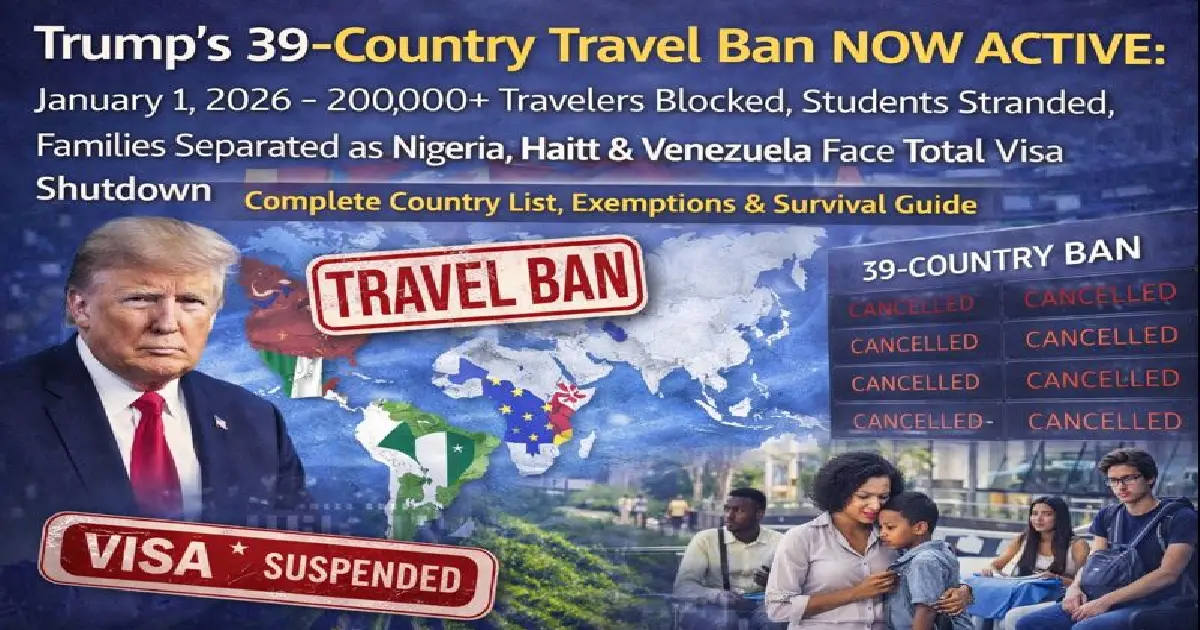
Breaking: Presidential Proclamation 10998 officially activated 12:01 AM January 1, 2026, expanding US travel restrictions from 19 to 39 countries—blocking visa issuance for nationals from Haiti (World Cup qualified), Nigeria (128,000 annual visas), Senegal, Venezuela, Cuba plus 34 other nations affecting 200,000+ travelers annually. Full ban countries (19 nations): zero immigrant/nonimmigrant visas. Partial ban countries (20 nations): no tourist (B), student (F/M), or exchange (J) visas. Valid visas issued before January 1 remain usable but face enhanced screening. Green card holders exempt but endure biometric photography every entry/exit. Immediate relatives exception REMOVED December 16—US citizens can’t sponsor spouses, children from banned countries. Nigerian students (12% visa overstay rate cited), Haitian TPS holders (340,000 losing protection February 3), Venezuelan families fleeing crisis—all trapped. International experts warn: “1 in 5 legal immigrants now barred.” 2026 World Cup fans from Haiti, Iran, Senegal, Côte d’Ivoire cannot attend games in US.
Published: January 6, 2026 (Tuesday Morning)
Effective Date: January 1, 2026 at 12:01 AM ET
Countries Affected: 39 nations + Palestinian Authority
Annual Impact: 200,000+ visa denials projected
Global Response: Lawsuits filed, condemnation from 14 humanitarian organizations
Breaking: 39-Country Ban NOW in Effect—5 Days Active
What Happened at Midnight New Year’s:
At 12:01 AM Eastern Time, January 1, 2026, Presidential Proclamation 10998 activated the largest expansion of US travel restrictions in modern history—doubling banned countries from 19 (June 2025) to 39, plus individuals traveling on Palestinian Authority-issued documents.
The Numbers—Five Days In:
- 39 countries now under full or partial restrictions
- 19 countries face TOTAL visa ban (immigrant + nonimmigrant)
- 20 countries face partial ban (no tourist, student, exchange visas)
- 200,000+ travelers affected annually (pre-ban visa issuance)
- 128,000 Nigerians alone received visas annually (most impacted)
- 25,086 immigrant visas issued to banned countries in 2024
- 136,901 nonimmigrant visas issued to banned countries in 2024
- 340,000 Haitian TPS holders losing protection February 3, 2026
Why Trump Expanded the Ban:
White House Proclamation cites: “Screening and vetting deficiencies,” “information-sharing failures,” “national security threats,” “high visa overstay rates,” and “lack of cooperation accepting deportees.”
Translation: Countries cannot or will not confirm traveler identities to US satisfaction.
Trump’s Statement January 1:
“The United States cannot rely on governments that cannot confirm who their travelers are. We must raise our entry standards to keep Americans safe. No apologies.”
The 39 Countries: Complete List & Restrictions
FULL BAN COUNTRIES (19 Nations)—ZERO Visas
ALL immigrant and nonimmigrant visas suspended indefinitely:
- Afghanistan
- Burkina Faso
- Burma (Myanmar)
- Chad
- Republic of the Congo
- Equatorial Guinea
- Eritrea
- Haiti (World Cup qualified—fans can’t attend)
- Iran (World Cup qualified—fans can’t attend)
- Laos (upgraded from partial to full)
- Libya
- Mali
- Niger
- Sierra Leone (upgraded from partial to full)
- Somalia
- South Sudan
- Sudan (world’s largest humanitarian crisis)
- Syria
- Yemen
- Palestinian Authority travel documents
What “Full Ban” Means:
❌ NO tourist visas (B-1/B-2)
❌ NO student visas (F/M)
❌ NO exchange visas (J)
❌ NO work visas (H-1B, H-2, L-1, etc.)
❌ NO immigrant visas (green cards)
❌ NO family reunification
❌ NO diversity lottery
❌ NO exceptions (except narrow case-by-case waivers)
Real-World Impact:
- Haitian family in Miami cannot sponsor parents
- Afghan interpreter who helped US military BLOCKED
- Iranian graduate student at MIT cannot return from holiday
- Syrian refugee approved for resettlement—denied entry
- Somali tech worker’s H-1B renewal—rejected
PARTIAL BAN COUNTRIES (20 Nations)—Limited Visas
Immigrant visas + B/F/M/J nonimmigrant visas suspended:
- Angola
- Antigua and Barbuda
- Benin
- Burundi
- Côte d’Ivoire (Ivory Coast) (World Cup qualified—fans can’t attend)
- Cuba
- Dominica
- Gabon
- The Gambia
- Malawi
- Mauritania
- Nigeria (most impacted: 128K annual visas)
- Senegal (World Cup qualified—fans can’t attend)
- Tanzania
- Togo
- Tonga
- Venezuela (humanitarian crisis: 7.7M fled)
- Zambia
- Zimbabwe
- Turkmenistan (immigrant visas only—nonimmigrant visas ALLOWED)
What “Partial Ban” Means:
❌ NO tourist visas (B-1/B-2)
❌ NO student visas (F/M)
❌ NO exchange visas (J)
❌ NO immigrant visas (green cards)
✅ Work visas POSSIBLY allowed (H-1B, L-1) BUT with shortest validity
✅ Specialty visas case-by-case (E, O, P, R) ⚠️ All other nonimmigrant visas issued with MINIMUM validity periods
Real-World Impact:
- Nigerian medical student at Johns Hopkins—cannot return from winter break
- Venezuelan family fleeing Maduro—rejected at border
- Cuban artist invited to New York gallery—visa denied
- Senegalese soccer fan desperate to see World Cup in US—blocked
- Tanzanian business owner’s tourist visa—denied
SPECIAL CASE: Nigeria—Biggest Single Impact
Why Nigeria Hurts Most:
- 128,000 visas issued annually (pre-ban)—most of any banned country
- 37,000+ Nigerian students in US universities (2024)
- $20 billion annual remittances from US diaspora to Nigeria
- 12% visa overstay rate cited by Trump (F/M/J visas)—vs 8% national average
Nigeria’s Response:
Foreign Ministry: “Discriminatory, unjustified, devastating to bilateral relations, families, education, business. Nigeria poses no security threat to United States.”
Real Stories:
- Nigerian PhD student at Stanford—stuck in Lagos after holiday visit
- Lagos tech entrepreneur’s business trip to Silicon Valley—cancelled
- Nigerian family’s 10-year reunion with US relatives—impossible
- 5,000+ Nigerian students currently in US—cannot leave/return
Who’s EXEMPT: Can You Still Enter?
EXEMPTIONS That Still Apply:
✅ US Lawful Permanent Residents (Green Card Holders)
- Retain entry rights BUT face enhanced screening + mandatory biometrics
✅ Dual Nationals Using Non-Banned Passport
- Nigerian-British citizen enters on UK passport—allowed
- Iranian-Canadian enters on Canadian passport—allowed
✅ Valid Visas Issued BEFORE January 1, 2026
- Existing visas NOT revoked
- Remain usable until expiration
- BUT expect enhanced screening, delays, confusion at ports
✅ Diplomats & Government Officials
- A, G visa holders exempt
- UN officials, foreign government representatives
✅ Athletes for Major Events
- Olympics, World Cup, professional sports (case-by-case)
- Coaches, support staff, immediate relatives
✅ Special Immigrant Visas (SIVs)
- US government employees abroad
- BUT Afghan SIVs REMOVED December 16 (previously exempt)
✅ Ethnic/Religious Minorities Fleeing Persecution in Iran
- Narrow exception maintained
✅ National Interest Case-by-Case Waivers
- Secretary of Homeland Security discretion
- Secretary of State coordination required
- Extremely rare, no guarantee
EXEMPTIONS REMOVED December 16, 2025:
❌ Immediate Relatives of US Citizens (BIGGEST CHANGE)
- Previously exempt in June ban
- NOW blocked—US citizens CANNOT sponsor:
- Spouses from banned countries
- Children from banned countries
- Parents from banned countries
Real Impact:
US Marine stationed in California married Nigerian woman 2024—she cannot get spousal visa.
American teacher adopted child from Haiti 2025—adoption visa DENIED.
US citizen born in Iran sponsoring elderly parents—rejected under December changes.
❌ International Adoptions
- 29 newly-banned countries added to adoption ban
- No explanation provided by White House
❌ Afghan Special Immigrant Visas (SIVs)
- Afghans who helped US military REMOVED from exemptions
- Previously protected—NOW blocked despite service to US forces
Timeline: How We Got to 39 Countries
ORIGINAL TRAVEL BAN (2017-2021—Trump First Term):
- 7 countries initially
- Expanded to 13 by 2020
- Revoked by Biden January 20, 2021
TRUMP RETURNS—EXECUTIVE ORDER 14161 (January 20, 2025):
Trump’s inauguration day: “Protecting United States from foreign terrorists, national security threats.”
JUNE BAN—PROCLAMATION 10949 (June 4, 2025):
Effective: June 9, 2025
Countries: 19 total
- 12 full ban countries
- 7 partial ban countries
Impact: 25,086 immigrant visas + 136,901 nonimmigrant visas affected (2024 baseline)
Immediate relatives exception maintained.
DECEMBER EXPANSION—PROCLAMATION 10998 (December 16, 2025):
Announced: December 16, 2025
Effective: January 1, 2026 at 12:01 AM ET
Countries: 39 total
- 19 full ban countries (added 7 new)
- 20 partial ban countries (added 13 new)
- 2 countries upgraded: Laos, Sierra Leone (partial → full)
- 1 country downgraded: Turkmenistan (partial → immigrant-only)
Immediate relatives exception REMOVED—biggest policy shift.
JANUARY 1, 2026—BAN ACTIVATES (12:01 AM):
Midnight New Year’s, travel ban goes live.
200,000+ travelers annually affected, families separated, students stranded, business travel destroyed.
JANUARY 6, 2026 (TODAY):
5 days into enforcement:
- Visa denials skyrocketing
- Confusion at ports of entry
- Families separated
- Students unable to return
- International condemnation
Who’s Subject to the Ban—Critical Details
YOU ARE BANNED IF:
- You are a national of one of 39 countries
- You are OUTSIDE the United States on January 1, 2026
- You do NOT have a valid US visa as of January 1, 2026
All three conditions must be true.
YOU ARE NOT BANNED IF:
✅ You are INSIDE the United States on January 1, 2026 (physical presence)
✅ You have a valid US visa issued BEFORE January 1, 2026
✅ You are a US lawful permanent resident (green card)
✅ You qualify for specific exemptions (diplomat, athlete, dual national, etc.)
Even one condition makes you exempt.
Real-World Scenarios: Who’s Affected
SCENARIO 1: Nigerian Student at Harvard
Situation: Oluwaseun, Nigerian citizen, F-1 student visa at Harvard Law School, traveled to Lagos for Christmas break December 20, 2025.
F-1 visa issued: November 2024 (valid until 2029)
January 1, 2026: Oluwaseun in Lagos, Nigeria.
Result:
✅ CAN RETURN—valid F-1 visa issued before January 1. Proclamation explicitly states existing visas not revoked. BUT expect enhanced screening, possible delays at port of entry.
Risk: Confusion, secondary inspection, potential denial despite valid visa (conflicting Proclamation language).
SCENARIO 2: Venezuelan Family Fleeing Crisis
Situation: Hernández family, Venezuelan citizens, applied for tourist B-2 visas December 2025 to visit relatives in Miami. Visa interview scheduled January 10, 2026.
Visa status: NOT issued as of January 1, 2026.
Result:
❌ DENIED—Venezuela partial ban blocks B-2 visas. Interview will be denied automatically. Family cannot visit US.
No waiver available unless Secretary of Homeland Security determines “national interest” case-by-case (extremely rare).
SCENARIO 3: Iranian PhD Candidate MIT
Situation: Reza, Iranian citizen, PhD candidate MIT Engineering, F-1 visa expired December 31, 2025. Applied for renewal December 15, 2025. Currently in US.
Physical presence: INSIDE United States on January 1, 2026.
Result: ⚠️ COMPLICATED
- Exemption applies: physically present in US on January 1
- BUT F-1 renewal application now subject to ban (Iran full ban)
- USCIS may PAUSE adjudication (December 2 Policy Memo)
Likely outcome: Application stuck in limbo. Cannot travel abroad (no valid visa for re-entry). Must remain in US until resolution or deportation.
SCENARIO 4: American Citizen Married to Nigerian
Situation: Sarah, US citizen from Texas, married Chidi (Nigerian citizen) in Lagos, Nigeria August 2025. Filed I-130 spousal immigrant visa petition September 2025.
I-130 status: Approved October 2025, awaiting immigrant visa interview.
January 1, 2026: Chidi in Nigeria, no US visa.
Result:
❌ BLOCKED—December 16 Proclamation REMOVED immediate relative exemption. Even though Chidi is spouse of US citizen, immigrant visa DENIED under Nigeria partial ban.
Previously: June ban allowed immediate relatives—Sarah and Chidi would have been fine.
Now: Sarah must move to Nigeria or separation continues indefinitely.
SCENARIO 5: Haitian on TPS
Situation: Jean-Marc, Haitian national, living in Miami under Temporary Protected Status (TPS) since 2021. TPS expires February 3, 2026 (Trump terminated Haitian TPS December 2025).
Status January 6, 2026: Still has TPS (valid 28 more days).
Result:
❌ DOUBLE JEOPARDY
- TPS ends February 3—becomes undocumented
- Cannot apply for new visa (Haiti full ban)
- Cannot return if travels abroad
- Deportation risk after February 3
340,000 Haitians in identical situation across US.
SCENARIO 6: Senegalese World Cup Fan
Situation: Mamadou, Senegalese citizen, desperate to attend 2026 World Cup in US. Senegal qualified for first time. Tried to apply for B-2 tourist visa January 2026.
Result:
❌ BLOCKED—Senegal partial ban blocks B-2 visas. Even for World Cup. Even though US hosting. Mamadou cannot attend.
Senegal & Côte d’Ivoire qualified for World Cup—both under partial ban. Fans blocked.
Haiti & Iran also qualified—full ban countries. Zero fans allowed.
Impact by Category: Who’s Devastated
STUDENTS (F/M Visas):
Full ban countries: Zero student visas issued—Afghan students hoping for US education BLOCKED.
Partial ban countries: Zero student visas issued—Nigerian students (37,000+ currently in US) cannot leave/return.
Currently in US: Can stay if valid visa—but travel abroad = risk denial re-entry despite valid visa.
New applications: All denied automatically from 39 countries (full or partial ban).
Impact:
- 50,000+ students from banned countries currently in US
- Cannot travel home for emergencies (parents’ illness, funerals)
- Stuck in US until graduation or visa expires
- Family members cannot visit US
- Future students from 39 countries—dreams destroyed
Higher Education Response:
NAFSA (Association of International Educators): “Disappointing and misguided. At a time when China, Canada, Germany, Japan actively courting talented students, this travel ban sends message United States better off without their contributions.”
Presidents’ Alliance on Higher Education & Immigration: “Self-inflicted wound that directly undermines US predominance in research, science, innovation.”
University Impact:
Harvard, MIT, Stanford, Johns Hopkins—dozens of students from Nigeria, Venezuela, Iran, Cuba affected.
Ivy League schools losing top international talent to Canada, UK, Australia.
TOURISTS (B-1/B-2 Visas):
Full ban countries: Zero tourist visas—Iranian family planning Grand Canyon vacation BLOCKED.
Partial ban countries: Zero tourist visas—Venezuelan grandparents visiting Miami grandchildren BLOCKED.
Business travelers: B-1 business visas also blocked—Nigerian entrepreneur’s Silicon Valley pitch meeting CANCELLED.
Impact:
- $200 billion+ annual contribution from international tourists—portion lost
- Las Vegas, New York, Disney, Universal Studios—missing customers from 39 countries
- Hotel industry, restaurants, retail—revenue decline
- World Cup 2026: Fans from Haiti, Iran, Senegal, Côte d’Ivoire cannot attend
FAMILIES (Immigrant Visas):
Full ban countries: Zero immigrant visas—Somali refugee approved for resettlement DENIED.
Partial ban countries: Zero immigrant visas—Cuban citizen winning diversity lottery BLOCKED.
Immediate relatives: REMOVED from exemptions December 16—US citizens cannot sponsor spouses, children, parents from 39 countries.
Impact:
- Families separated indefinitely
- US Marines married to foreign nationals—spouses blocked
- Adoptions from 29 countries—denied
- Elderly parents sponsored by US citizen children—rejected
- Diversity lottery winners from banned countries—dreams destroyed
1 in 5 legal immigrants now barred, according to American Immigration Council.
WORKERS (H-1B, L-1, Other Work Visas):
Full ban countries: ZERO work visas—Afghan tech worker’s H-1B BLOCKED.
Partial ban countries: Work visas POSSIBLY allowed BUT shortest validity—Nigerian software engineer’s H-1B issued for 1 year instead of 3.
Impact:
- Tech industry losing talent to Canada, Europe
- Nigerian engineers, Venezuelan doctors, Iranian researchers—applications denied or delayed
- Companies struggling to fill positions
- Silicon Valley, biotech, healthcare—workforce shortages
Additional Burden:
- $100,000 H-1B fee (new 2026 rule)—plus travel ban uncertainty
- Social media screening (expanded December 3)—invasive, time-consuming
- Shortest visa validity—constant renewals, uncertainty
REFUGEES & ASYLUM SEEKERS:
Full ban countries: All refugee resettlement BLOCKED—Sudanese fleeing world’s largest humanitarian crisis DENIED.
Impact:
- 14 of 20 countries on IRC’s 2026 Emergency Watchlist now under travel ban
- Refugees undergo most rigorous vetting—still blocked
- Families fleeing genocide, war, persecution—rejected
- Trump also suspended ALL refugee resettlement indefinitely (separate Executive Order January 20, 2025)
International Rescue Committee:
“Harmful and discriminatory. No waiver process for urgent humanitarian cases. Separates families, bars entry for most refugees. Further retreat from American values.”
Legal Challenges: Lawsuits Filed
LAWSUITS ALREADY FILED (December 2025—January 2026):
American Immigration Council:
- Constitutional challenge: violates Equal Protection, Due Process
- Arbitrary country selection—no clear national security rationale
- Removal of immediate relative exception—punishes US citizens
NAFSA:
- Economic harm: universities losing international students = $40 billion annual impact
- First Amendment: academic freedom, international exchange
Individual Plaintiffs:
- US citizens separated from spouses, children—constitutional violation
- Students blocked from returning to US universities—property interest in education
LEGAL ARGUMENTS:
Plaintiffs Argue:
- No National Security Justification: Trump cites “screening failures” but provides no evidence citizens of these 39 countries pose greater threat than citizens of 150+ other countries.
- Arbitrary Country Selection: Why Nigeria (128K visas) but not Pakistan (similar overstay rates)? Why Senegal but not Bangladesh?
- Visa Overstay Rates Flawed: NAFSA, immigration experts: “Data deeply flawed, selective, misused.” Overstay rates vary wildly by visa category—banning entire countries unjustified.
- Removal of Immediate Relative Exception: Punishes US citizens for marrying foreign nationals. Constitutional right to family unity violated.
- Economic Harm: Tourism ($200B), education ($40B), tech industry, healthcare—all suffer.
GOVERNMENT DEFENSE:
Trump Administration Argues:
- Section 212(f) Authority: Immigration and Nationality Act grants President authority to “suspend entry of any aliens” if “detrimental to interests of United States.”
- National Security: Screening failures, information-sharing deficiencies, cooperation issues—adequate basis.
- No Constitutional Right: Foreign nationals abroad have no constitutional right to US visa.
- Case-by-Case Waivers: Secretary of Homeland Security can grant exceptions for “national interest”—sufficient flexibility.
SUPREME COURT PRECEDENT:
Trump v. Hawaii (2018):
Supreme Court upheld Trump’s first-term travel ban (2017), ruling President has broad authority under Section 212(f) to suspend entry for national security.
Likely Outcome:
Travel ban will probably be upheld again based on Trump v. Hawaii precedent, despite expanded scope and removal of immediate relative exception.
Courts historically defer to Executive on immigration/national security.
International Response: Global Condemnation
AFFECTED COUNTRIES:
Nigeria: “Discriminatory, devastating, unjustified.” Considers reciprocal visa restrictions on US citizens.
Venezuela: Maduro government: “Imperialist aggression.” (Though ban targets citizens fleeing Maduro.)
Haiti: “Cruel, inhumane.” 340,000 Haitians in US face deportation February 3.
Iran: “Racist, anti-Muslim.” (Though ban includes Christian-majority African nations.)
Senegal, Côte d’Ivoire: “World Cup host blocking fans from attending—disgraceful.”
INTERNATIONAL ORGANIZATIONS:
United Nations High Commissioner for Refugees (UNHCR): “Deeply concerned. Refugee resettlement from 14 Emergency Watchlist countries now blocked. Contradicts international humanitarian obligations.”
International Rescue Committee: “Harmful, discriminatory. No waiver for urgent humanitarian cases. Separates families.”
Human Rights Watch: “Discriminatory, punishes individuals for nationality. Violates international human rights law.”
ALLIED NATIONS:
United Kingdom: Prime Minister: “Sovereign decision of United States. UK maintains visa policies based on individual merit, not blanket nationality bans.”
Canada: Prime Minister Trudeau: “Canada welcomes talented students, workers, refugees from around world. Our diversity is strength.” (Implicit criticism.)
Australia: Foreign Minister: “Australia assesses visa applications individually. We do not implement nationality-based bans.”
European Union: High Representative: “EU committed to fact-based, proportionate migration policies respecting human rights.”
Economic Impact: Who Loses Money
TOURISM INDUSTRY:
2025 Baseline: International tourists contributed $200 billion+ to US economy.
2026 Projected Loss: $5-10 billion from banned countries (direct + indirect).
Cities Affected:
- New York City: Nigerian tourists spend $500M annually
- Miami: Venezuelan, Cuban, Haitian visitors—major market
- Las Vegas: International high-rollers from Middle East, Africa
- Los Angeles: Film industry collaborations with foreign talent
HIGHER EDUCATION:
2024 Baseline: International students contribute $40 billion annually to US economy.
Students from Banned Countries: 50,000+ currently enrolled (estimate).
Revenue at Risk: $2-3 billion annually if current students cannot return or new students blocked.
Universities Affected:
- Harvard, MIT, Stanford, Johns Hopkins—hundreds of students
- State universities (Ohio State, Michigan, Texas)—thousands of students
- Community colleges, language schools—smaller but significant
Beyond Tuition: Housing, food, transportation, books, entertainment—multiplier effects throughout college towns.
TECHNOLOGY SECTOR:
H-1B Workers from Banned Countries: 10,000+ (estimate—Nigeria, Venezuela, Iran).
Impact:
- Talent drain to Canada, UK, Germany
- Silicon Valley, biotech, finance—workforce shortages
- Startups struggling to hire engineers
- Innovation pipeline restricted
Google, Microsoft, Amazon, Meta: All employ thousands of foreign nationals—affected by shortened visa validity, uncertainty.
HEALTHCARE:
Medical Students & Doctors:
- Nigerian medical graduates—US residencies at risk
- Venezuelan doctors fleeing crisis—blocked
- Iranian researchers—visa renewals denied
Hospitals, Clinics:
- Rural healthcare shortages worsened
- Urban medical centers losing international talent
REMITTANCES:
2025 Baseline: US diaspora sends $150+ billion annually in remittances globally.
Nigeria Alone: $20 billion annually from US diaspora.
Impact of Ban:
- Existing diaspora can still send money—but new immigrants blocked
- Family reunification restricted—fewer senders over time
- Economic lifeline for millions in developing countries—threatened
What Travelers Should Do NOW
IF YOU’RE FROM A BANNED COUNTRY:
IF YOU HAVE A VALID VISA (Issued Before Jan 1):
✅ Use it—but be prepared:
- Print visa approval notice, I-20 (students), employment letter (workers)
- Carry proof of ties to US (lease, enrollment, job offer)
- Arrive at airport 4-5 hours early (enhanced screening expected)
- Be patient—secondary inspection likely
- Stay calm—cooperate with CBP officers
- Know your rights—but don’t argue
⚠️ Risk: Despite valid visa, Proclamation contains “conflicting language” allowing consular officers to reduce validity. CBP may deny entry despite valid visa—rare but possible.
Travel Insurance: Buy comprehensive travel insurance—cancellation, medical, trip interruption.
IF YOU DON’T HAVE A VALID VISA:
❌ Accept reality—you’re blocked (with narrow exceptions):
- Tourist, student, exchange visas: DENIED automatically
- Immigrant visas: DENIED automatically
- Work visas: Possibly allowed (partial ban countries) BUT shortest validity
Options:
- Dual Nationality: If you have second passport from non-banned country—use it.
- Case-by-Case Waiver: Contact immigration attorney—”national interest” waiver (extremely rare).
- Wait for 180-Day Review: June 14, 2026—potential policy changes (unlikely).
- Relocate to Third Country: Canada, UK, Australia, Germany—alternatives.
IF YOU’RE A US CITIZEN WITH FAMILY IN BANNED COUNTRIES:
💔 You’re stuck:
- Immediate relative exception REMOVED—cannot sponsor spouse, children, parents
- Tourist visas blocked—family cannot visit US
- No clear path forward
Options:
- Relocate Abroad: Move to banned country to be with family.
- Third Country: Meet family in Canada, Mexico, Europe.
- Legal Challenge: Join lawsuits (unlikely to succeed quickly).
- Political Action: Contact Congressional representatives, advocacy groups.
IF YOU’RE A GREEN CARD HOLDER FROM BANNED COUNTRY:
✅ You’re mostly safe—but caution:
- Green card NOT revoked—entry rights maintained
- BUT enhanced screening mandatory
- Mandatory biometric photography every entry/exit (new December 26 rule)
- Secondary inspection expected
- Longer wait times—budget extra time
Travel Advice:
- Carry green card, passport, re-entry permit (if applicable)
- Avoid extended trips abroad—stays over 6 months risk “abandonment” claim
- Document ties to US—lease, job, bank accounts, tax returns
- Travel insurance
IF YOU’RE A STUDENT FROM BANNED COUNTRY:
📚 Critical decisions:
If You Have Valid F-1 Visa:
✅ Stay in US if possible:
- Do NOT travel abroad unless absolutely necessary (family emergency)
- Travel home for spring break, summer—risks denial re-entry despite valid visa
- Finish degree without leaving US
If Your Visa Expires:
⚠️ Apply for renewal—but complications:
- F-1 renewal applications subject to ban (full or partial ban countries)
- USCIS may PAUSE adjudication (December 2 Policy Memo)
- Stuck in US until resolution—cannot travel abroad
- Consult international student office, immigration attorney
If You’re Applying from Abroad:
❌ Denied automatically—F visas blocked for 39 countries (full or partial ban).
Alternatives:
- Apply to universities in Canada, UK, Australia, Germany
- Defer admission hoping for policy change (risky)
IF YOU’RE APPLYING FOR WORK VISA (H-1B, L-1):
Full Ban Countries:
❌ All work visas BLOCKED—no options.
Partial Ban Countries:
⚠️ Possibly allowed BUT shortest validity:
- H-1B: Issued for 1 year instead of 3 years—constant renewals
- L-1: Same—shortest validity
- O, P, R visas: Case-by-case, shortest validity
- Consular discretion—may deny even if eligible
Additional 2026 Hurdles:
- $100,000 H-1B fee (new employer charge through September 21, 2026)
- Social media screening (expanded December 3 to H-1B/H-4)
- Skills-based lottery (new February 27—favors higher salaries)
Recommendation:
- Consult immigration attorney before applying—expensive, uncertain process
- Consider Canada Express Entry, UK Skilled Worker visa, Australia 482 visa
- Negotiate employer sponsorship of legal fees, relocation to non-US office
180-Day Review: Will Anything Change?
June 14, 2026 (180 Days from December 16, 2025):
Secretary of State, in consultation with Attorney General, Secretary of Homeland Security, Director of National Intelligence, must submit report to President recommending whether bans should be:
- Continued (most likely)
- Terminated (unlikely)
- Modified (possible—add or remove countries)
- Supplemented (add more countries—possible)
Every 180 days thereafter: Same review process.
WHAT TO EXPECT:
Pessimistic Scenario:
- Bans continue indefinitely—Trump committed to “raising entry standards”
- Additional countries added (Pakistan, Bangladesh rumored)
- Restrictions tightened further
Optimistic Scenario:
- Some countries removed after demonstrating improved screening
- Partial ban countries downgraded to targeted restrictions
- Immediate relative exception restored (unlikely)
Realistic Scenario:
- Most bans continue—minor adjustments
- 1-3 countries removed, 1-3 countries added
- Core policy unchanged
POLITICAL PRESSURE:
Who Wants Changes:
- Universities (losing revenue, talent)
- Tech industry (workforce shortages)
- Tourism industry (losing customers)
- Advocacy groups (human rights, immigration)
- Affected families (US citizens separated from loved ones)
Who Supports Ban:
- Trump base (national security, immigration restriction)
- Republican Congress (aligns with Trump agenda)
- Some security agencies (screening concerns legitimate)
Balance of Power:
Trump and Republican Congress control policy—changes unlikely unless political cost becomes too high (2026 midterm elections?).
Expert Analysis: What This Means Long-Term
IMMIGRATION EXPERTS:
American Immigration Council:
“1 in 5 people seeking to immigrate legally now barred. Hundreds of thousands more seeking nonimmigrant visas unable. Arbitrary, discriminatory, punishes individuals for nationality rather than individual conduct.”
NAFSA:
“Self-inflicted wound. At time when China, Canada, Germany, Japan actively courting talented students, scholars, researchers, this travel ban sends message United States better off without their contributions.”
Georgetown Law Immigration Clinic:
“Removal of immediate relative exception unprecedented. Punishes US citizens for marrying foreign nationals. Constitutional concerns—family unity fundamental right.”
ECONOMIC EXPERTS:
US Chamber of Commerce:
“Travel ban costs US economy $10-15 billion annually—tourism, education, healthcare, tech workforce. Short-sighted policy sacrifices economic growth for political symbolism.”
Higher Education Associations:
“International students contribute $40 billion annually. Ban affects 50,000+ students from 39 countries. Universities lose revenue, talent, diversity. American competitiveness undermined.”
HUMANITARIAN ORGANIZATIONS:
International Rescue Committee:
“14 of 20 countries on 2026 Emergency Watchlist now under travel ban. Refugees fleeing genocide, war, persecution—blocked. Contradicts American values, international humanitarian obligations.”
Human Rights Watch:
“Discriminatory policy violates international human rights law. No individual assessment—blanket ban punishes nationality, not conduct.”
GEOPOLITICAL EXPERTS:
Council on Foreign Relations:
“Travel ban damages US soft power. Alienates allies in Africa, Latin America, Middle East. China, Russia, Europe gain influence as US retreats. Short-term security gains (questionable) vs long-term strategic losses.”
Former State Department Officials:
“Screening, vetting concerns legitimate—but blanket bans counterproductive. Targeted restrictions, improved cooperation more effective. Ban creates resentment, harms bilateral relations.”
2026 World Cup: Fans Blocked from US-Hosted Games
Irony of Ironies:
US co-hosting 2026 FIFA World Cup (with Canada, Mexico)—but fans from 4 qualified countries BLOCKED from attending games in US.
QUALIFIED TEAMS UNDER TRAVEL BAN:
- Haiti (full ban—B-2 tourist visas BLOCKED)
- Iran (full ban—B-2 tourist visas BLOCKED)
- Senegal (partial ban—B-2 tourist visas BLOCKED)
- Côte d’Ivoire (partial ban—B-2 tourist visas BLOCKED)
Haiti qualified for first time in over 50 years—fans cannot attend.
Senegal, Côte d’Ivoire—African soccer powerhouses—fans blocked.
Iran—historically strong team—fans blocked.
WORLD CUP EXCEPTIONS?
Proclamation allows:
- Athletes
- Coaches
- Support staff
- Immediate relatives traveling for World Cup
BUT NOT:
- General fans from banned countries—no tourist visas
Result:
Empty sections for Haiti, Iran, Senegal, Côte d’Ivoire games in US. Teams play without fan support. Geopolitical embarrassment for US.
World Cup Games in Canada/Mexico:
Fans can attend games in Toronto, Vancouver, Mexico City—but not games in New York, Los Angeles, Miami, Dallas, etc.
Regional Impacts: How Ban Hits Different Areas
AFRICA (Most Affected Continent):
21 of 39 banned countries are African:
- Full ban: Burkina Faso, Chad, Congo, Equatorial Guinea, Eritrea, Libya, Mali, Niger, Sierra Leone, Somalia, South Sudan, Sudan
- Partial ban: Angola, Benin, Burundi, Côte d’Ivoire, Gabon, The Gambia, Malawi, Mauritania, Nigeria, Senegal, Tanzania, Togo, Zambia, Zimbabwe
Economic Impact:
- $50+ billion annual remittances from US diaspora to Africa—portion at risk
- Tourism, trade, education—all affected
- US influence in Africa declining—China, Russia, Europe fill void
Geopolitical:
- African Union condemned ban—”discriminatory, unjustified”
- Nigeria (largest African economy) considers reciprocal restrictions
- US-Africa relations strained
LATIN AMERICA & CARIBBEAN:
6 banned countries:
- Partial ban: Antigua and Barbuda, Cuba, Dominica, Venezuela
- Full ban: Haiti
Haiti—Humanitarian Crisis:
- 340,000 Haitians in US on TPS—losing protection February 3
- Gang violence, political instability—worsening
- Full travel ban PLUS TPS termination = double crisis
Venezuela—Mass Migration:
- 7.7 million Venezuelans fled Maduro regime (largest refugee crisis in Western Hemisphere)
- Partial ban blocks Venezuelans fleeing oppression
- Families seeking safety in US—rejected
Cuba—Longtime Restrictions:
- Cuba already under partial restrictions since June—continued in December
- Cuban-Americans separated from families
MIDDLE EAST:
4 banned countries:
- Full ban: Afghanistan, Iran, Syria, Yemen
- Palestinian Authority travel documents
Afghanistan—Abandoned Allies:
- Afghans who helped US military during 20-year war—blocked
- Special Immigrant Visas (SIVs) exception REMOVED December 16
- Thousands of interpreters, contractors—abandoned, face Taliban retaliation
Iran—Largest Middle East Ban:
- Full ban—zero visas
- Iranian-Americans separated from families
- Iranian students at US universities—cannot leave/return
Syria, Yemen—Humanitarian Crises:
- Civil wars, famine, displacement—millions need refuge
- Full ban blocks refugees, humanitarian cases
ASIA-PACIFIC:
3 banned countries:
- Full ban: Burma (Myanmar), Laos
- Partial ban: Tonga, Turkmenistan (immigrant only)
Burma (Myanmar)—Rohingya Genocide:
- Rohingya refugees fleeing genocide—blocked
- Military junta atrocities—victims cannot seek US refuge
Laos—Upgraded to Full Ban:
- Previously partial ban (June)—upgraded to full ban (December)
- Visa overstay rates cited
Tonga—Pacific Island Nation:
- Partial ban—surprise inclusion
- Small population, low visa volume—why targeted?
Survival Guide: Navigating the Ban
FOR TRAVELERS WITH VALID VISAS:
BEFORE YOU TRAVEL:
- Verify visa validity—check expiration date, number of entries
- Print documentation—visa approval, I-20 (students), employment letter, lease, bank statements
- Travel insurance—comprehensive coverage (cancellation, medical, trip interruption)
- Legal consultation—if concerned, speak with immigration attorney
AT THE AIRPORT:
- Arrive 4-5 hours early—enhanced screening expected
- Be patient—secondary inspection likely, long waits
- Stay calm—cooperate fully with CBP officers
- Know your rights—but don’t argue or antagonize
- Have attorney contact ready—if detained, call immediately
IF DENIED ENTRY:
- Stay calm—antagonizing officers worsens situation
- Request reason in writing—CBP must provide
- Contact attorney immediately—phone call allowed
- Request voluntary departure—avoids deportation order (better for future applications)
- Document everything—names, badge numbers, statements
FOR TRAVELERS WITHOUT VISAS:
ACCEPT REALITY:
- Tourist, student, exchange visas: DENIED automatically
- Immigrant visas: DENIED automatically
- Work visas (partial ban countries): Maybe—shortest validity
ALTERNATIVES:
- Dual Nationality:
- Use passport from non-banned country—allowed
- Example: Nigerian-British enters on UK passport
- Third Country Visa:
- Apply for Canadian, UK, Australian, German visas
- Relocate family to third country for reunion
- Case-by-Case Waiver:
- Consult immigration attorney—”national interest” waiver
- Extremely rare, expensive, no guarantee
- Evidence needed: unique skills, humanitarian emergency, US national interest
- Wait for 180-Day Review (June 14, 2026):
- Potential policy changes—unlikely
- Additional 180-day reviews every 6 months
- Political Action:
- Contact Congressional representatives
- Join advocacy organizations
- Support legal challenges (donations, testimony)
FOR US CITIZENS WITH BANNED-COUNTRY FAMILIES:
OPTIONS (All Difficult):
- Relocate Abroad:
- Move to banned country to be with family
- Sacrifice US career, connections, lifestyle
- Third Country Meetings:
- Meet family in Canada, Mexico, Europe for visits
- Expensive, temporary, unsatisfying
- Legal Challenge:
- Join class-action lawsuits against ban
- Unlikely to succeed quickly (months/years)
- Trump v. Hawaii precedent favors government
- Political Advocacy:
- Contact Congressional representatives—pressure for exemptions, policy changes
- Support immigration advocacy groups (ACLU, American Immigration Council, NAFSA)
- Share personal stories—humanize impact
- Wait for Policy Change:
- 180-day reviews (June 14, 2026 first)
- 2026 midterm elections—Democratic gains could shift policy
- Trump term ends January 20, 2029—new administration likely reverses
The Bigger Picture: What This Means for America
SOFT POWER DECLINE:
2025 Baseline: US remains global leader in education, innovation, culture, opportunity.
2026 Reality: Travel ban signals US retreat—”we don’t want you.”
Global Response:
- Canada, UK, Australia, Germany—actively recruiting talent, students, workers US rejects
- Chinese universities improving—attracting international students
- European tech hubs (Berlin, London, Paris)—Silicon Valley alternatives
Long-Term:
US loses best and brightest—engineers, doctors, entrepreneurs, artists—from 39 countries (1 billion+ population).
Innovation, diversity, competitiveness—all decline.
ECONOMIC COSTS:
Immediate:
- $10-15 billion annually—tourism, education, tech workforce, healthcare
Long-Term:
- Brain drain accelerates—talent goes elsewhere
- Universities lose revenue, prestige, diversity
- Tech companies move operations abroad (Toronto, London, Berlin)
- Healthcare shortages worsen—especially rural areas
HUMANITARIAN CONSEQUENCES:
Refugees Blocked:
- 14 of 20 IRC 2026 Emergency Watchlist countries under travel ban
- Millions fleeing genocide, war, persecution—rejected
- Sudan (world’s largest humanitarian crisis)—full ban
Families Separated:
- US citizens cannot sponsor spouses, children, parents from 39 countries
- 340,000 Haitian TPS holders losing protection—deportation February 3
Moral Standing:
US historically champions human rights, refugee protection—travel ban contradicts values.
GEOPOLITICAL IMPLICATIONS:
US Influence Declining:
- Africa: 21 banned countries—China, Russia gain influence
- Latin America: Venezuela, Cuba, Haiti bans—alienates region
- Middle East: Iran, Syria, Afghanistan, Yemen—US credibility destroyed
Allied Relations Strained:
- UK, Canada, Australia, EU—implicit criticism of ban
- Soft power advantage eroded
Adversary Advantage:
- China: “US closed, China open”—attracting global talent, investment
- Russia: “US hypocrisy”—propaganda windfall
DOMESTIC POLITICS:
Trump Base:
✅ Loves it—”protecting America,” “raising standards,” “national security”
Opposition:
❌ Outraged—”discriminatory,” “unconstitutional,” “self-defeating”
2026 Midterms:
- Democrats campaign on reversing ban—immigration humanitarian issue
- Republicans defend ban—national security, border control
- Swing voters: Economic costs vs security benefits—depends on messaging
Long-Term:
Travel ban likely remains through Trump term (January 20, 2029)—unless political cost becomes too high.
Next administration (Democrat likely)—immediate reversal Day 1.
What Happens Next: Key Dates
IMMEDIATE (January 2026):
- January 6, 2026 (TODAY): 5 days into ban—visa denials accumulating, confusion at ports
- January 10, 2026: Venezuelan family’s visa interview—denied automatically
- January 15, 2026: Nigerian students returning from winter break—face enhanced screening
- February 3, 2026: 340,000 Haitian TPS holders lose protection—deportation risk begins
SHORT-TERM (February-June 2026):
- February 27, 2026: H-1B skills-based lottery—new rules prioritize higher salaries (separate from ban)
- March 2026: Lawsuits challenging ban proceed—hearings, motions, appeals
- April 2026: Universities report international enrollment declines—especially from banned countries
- June 14, 2026: FIRST 180-DAY REVIEW—Secretary of State reports recommendations to Trump (continue, terminate, modify, supplement)
MID-TERM (July-December 2026):
- July 2026: Edinburgh tourism tax (5%) begins—unrelated but adds cost to UK travel
- Summer 2026: 2026 FIFA World Cup—Haiti, Iran, Senegal, Côte d’Ivoire play without fan support in US games
- November 5, 2026: US MIDTERM ELECTIONS—Democrats campaign on immigration reform, ban reversal
- December 14, 2026: SECOND 180-DAY REVIEW—another chance for policy changes (unlikely)
LONG-TERM (2027-2029):
- Every 180 days: Reviews continue—minor adjustments possible, core policy unchanged
- November 2028: US PRESIDENTIAL ELECTION—travel ban major campaign issue
- January 20, 2029: NEW ADMINISTRATION INAUGURATED
- If Democrat: Travel ban reversed Day 1 (likely)
- If Republican: Travel ban continues, possibly expands
Bottom Line: 39-Country Ban Reshapes Global Travel
January 1, 2026 marks historic expansion of US travel restrictions—39 countries, 200,000+ travelers annually blocked, families separated, students stranded, refugees rejected.
5 days in (January 6, 2026):
- Visa denials skyrocketing
- Confusion at ports of entry—valid visas questioned
- Green card holders face enhanced screening, mandatory biometrics
- 340,000 Haitians losing TPS protection February 3—deportation looms
- Immediate relative exception REMOVED—US citizens cannot sponsor spouses, children, parents from 39 countries
- Nigerian students (37,000+ in US)—trapped, cannot travel home/back
- Venezuelan families fleeing crisis—blocked at border
- 2026 World Cup fans from Haiti, Iran, Senegal, Côte d’Ivoire—cannot attend US games
Who’s affected:
- Tourists: B-1/B-2 visas blocked (full or partial ban countries)—$200B tourism industry loses customers
- Students: F/M visas blocked—$40B education sector loses revenue, talent, diversity
- Workers: H-1B, L-1 blocked (full ban) or shortest validity (partial ban)—tech, healthcare workforce shortages
- Families: Immigrant visas blocked, immediate relatives no longer exempt—separations indefinite
- Refugees: Resettlement blocked—14 of 20 IRC Emergency Watchlist countries under ban
Why it matters:
- Economic: $10-15B annual losses—tourism, education, tech, healthcare
- Humanitarian: Refugees fleeing genocide, war, persecution—rejected
- Geopolitical: US soft power declines—China, Russia, Europe gain influence
- Constitutional: Removal of immediate relative exception—punishes US citizens, violates family unity rights
What you should do:
- Valid visa holders: Use visa but expect enhanced screening—arrive 4-5 hours early, carry documentation, stay calm
- No visa: Accept denial (tourist, student, immigrant)—explore alternatives (dual nationality, third country, case-by-case waiver)
- US citizens with banned-country families: Relocate abroad, meet in third countries, join legal challenges, political advocacy
- Green card holders: Entry rights maintained BUT enhanced screening, mandatory biometrics—avoid extended trips abroad
What happens next:
- June 14, 2026: First 180-day review—potential policy changes (unlikely)
- November 2026: Midterm elections—Democrats campaign on reversal
- Summer 2026: World Cup—banned countries play without fan support in US
- January 20, 2029: New administration—likely reversal if Democrat
The verdict:
Trump’s 39-country travel ban represents largest expansion of US entry restrictions in modern history—prioritizing perceived national security over economic growth, humanitarian values, family unity, and global influence.
For 200,000+ travelers annually, the American dream is now blocked by geography, not merit.
For US citizens married to foreign nationals from 39 countries, family unity is sacrificed to political ideology.
For refugees fleeing genocide, the world’s humanitarian leader has closed its doors.
January 1, 2026: The day America said “you’re not welcome here.”
Additional Resources & Contact Information
GOVERNMENT SOURCES:
LEGAL ASSISTANCE:
Find immigration attorney: ailalawyer.com (American Immigration Lawyers Association)
STUDENT RESOURCES:
University international student offices—contact your school immediately.
HUMANITARIAN ORGANIZATIONS:
TRAVEL INSURANCE:
For More Travel Tourister Coverage:
Published: January 6, 2026
Last Updated: January 6, 2026 at 9:00 AM ET
Reading Time: 45 minutes
Posted By : Vinay
As a lead contributor for Travel Tourister, Vinay is dedicated to serving our Tier 1 audience (US, UK, Canada, Australia). His mission is to deliver precise, fact-checked news and actionable, data-driven articles that empower readers to make informed decisions, minimize travel risks, and maximize their adventure without compromising safety or budget.




 Call
Call Enquiry