Published on : 08 Jan 2026
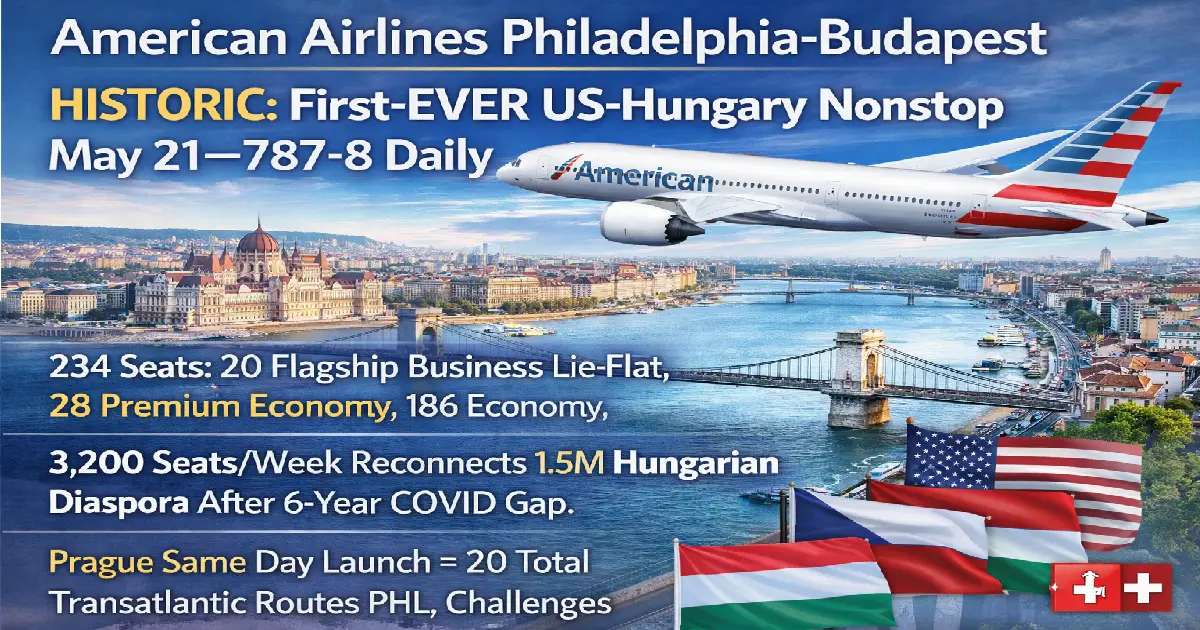
Breaking: American Airlines (AA) announces Philadelphia (PHL)-Budapest (BUD) nonstop service launching May 21, 2026 = FIRST-EVER direct connectivity United States-Hungary aviation history (NO US carrier has EVER operated nonstop Budapest = American writing new chapter transatlantic map filling largest gap European capitals without US service) operating daily through October 5, 2026 summer seasonal schedule Boeing 787-8 Dreamliner (234 total seats: 20 Flagship Business lie-flat suites direct aisle access, 28 Premium Economy recliners, 186 Economy standard = three-class premium configuration matching American’s European flagship product standard) providing 3,200 weekly seats reconnecting 1.5 million Hungarian-American diaspora concentrated Cleveland/Ohio, New York metro, Los Angeles, Chicago areas forced six-year hiatus post-COVID (previous Budapest service pre-pandemic = seasonal success BUT suspended March 2020 never restored until NOW = American Airlines first US carrier return Budapest demonstrating confidence Central European recovery). Simultaneously launching Philadelphia-Prague (PRG) SAME day May 21 (also 787-8, also daily through October 5 = American’s Czech Republic return after 8-year absence) = American operating 20 total transatlantic destinations Philadelphia 2026 (up from 17 in 2025 = 17.6% growth cementing PHL as American’s #2 European gateway behind Charlotte hub) challenging Lufthansa Frankfurt, Swiss Zurich one-stop routing monopoly Central Europe (current: Philadelphia-Budapest requires Frankfurt connection 11-14 hours total = American’s 9h10m nonstop saves 2-5 hours eliminating layover hassles, missed connections, baggage issues) while capitalizing FIFA World Cup 2026 North America timing (June-July tournaments US/Mexico/Canada = Budapest serves as European fan gateway accessing Philadelphia connections 100+ North American destinations beyond including tournament cities).
Published: January 8, 2026 Launch Date: May 21, 2026 (daily through October 5, 2026 summer seasonal) Historic First: NO US carrier EVER operated Budapest nonstop = American Airlines pioneering Aircraft: Boeing 787-8 Dreamliner (234 seats: 20 business, 28 premium economy, 186 economy) Flight Time: 9 hours 10 minutes eastbound PHL→BUD, 10 hours westbound BUD→PHL Schedule: Daily departures (7× weekly = 3,200 total seats/week capacity) Distance: 4,760 miles (7,662 km) Philadelphia Hub: 20 total transatlantic routes 2026 (vs 17 in 2025 = +3 routes Budapest, Prague, plus one other) Hungarian Diaspora US: 1.5 million Hungarian-Americans (Cleveland, NYC, LA, Chicago concentrations) Competition: Lufthansa Frankfurt hub, Swiss Zurich hub currently monopolize US-Budapest routing via one-stop connections
August 7, 2025 Announcement (Effective May 21, 2026):
American Airlines unveils Philadelphia-Budapest + Philadelphia-Prague nonstop services launching same day May 21, 2026 = dual historic Central European gateway expansion.
Brian Znotins (Senior VP Network & Schedule Planning, American Airlines):
“Customers continue to tell us that Europe is where they want to go each summer and these new routes make it even easier to cross the Atlantic in 2026. We are excited to grow our network to new destinations like Prague and Budapest and offer even more premium travel experiences on our flights to Tokyo.”
José A. Freig (VP International & Inflight Dining Operations):
“The customer demand for flights to and from cities rich in culture continues to grow. We’re increasingly seeing customers flock to cities they can immerse themselves in centuries of heritage, exploring history and culture beyond anything experienced before. With this route, our Hungarian customers will have direct access to Philadelphia, one of our fastest-growing US hubs, from where they can travel onward to more than 100 destinations within the United States and beyond.”
Your Alaska Transatlantic Article Connection:
Like Alaska Airlines’ Seattle-Rome historic first (your article #3: Alaska’s inaugural transatlantic), American’s Budapest route = pioneering NEW markets (Alaska = first West Coast carrier transatlantic, American = first US carrier EVER Budapest) = parallel strategies targeting underserved European cities legacy carriers ignore.
Outbound (Philadelphia → Budapest):
Return (Budapest → Philadelphia):
Why These Times Perfect:
Evening PHL Departure (6:50 PM):
Morning BUD Arrival (9:25 AM):
Midday BUD Departure (11:25 AM):
American’s 787-8 deployment (234 seats, three-class) similar philosophy United’s A321XLR thin long-haul (your article #11: United Newark-Edinburgh 150 seats = rightsizing aircraft capacity to market demand) BUT American using widebody vs narrowbody = Budapest market larger than Edinburgh (1.5M Hungarian diaspora vs smaller Scottish diaspora) justifying 787’s 234 seats.
American Airlines 787-8 Specifications:
Seat Specifications:
Your JetBlue Mini Mint Article Connection:
Like JetBlue adding domestic first class (your article #7: Mini Mint lie-flat June 2026), American’s Flagship Business = premium positioning transatlantic (both recognizing premium revenue critical profitability: business travelers paying $3K-5K roundtrip vs economy $800-1,200 = 3-4× revenue per seat justifies reduced total capacity 234 vs potential 250+ all-economy).
Flagship Business Service:
Seat Specifications:
Premium Economy Pricing (Estimates):
Market Segment:
Seat Specifications:
Amenities:
Total: ~1.5 million Hungarian-Americans (2020 US Census)
Top 10 States:
Historical Immigration Waves:
Your Tourism Tax Article Connection:
Unlike overtaxed European destinations (your article #4: Edinburgh £15, Venice €10, Amsterdam €12.50), Budapest levies MINIMAL tourism tax (~€4/night hotel = negligible compared Western Europe) = affordability competitive advantage budget-conscious Hungarian-American diaspora visiting family (VFR traffic price-sensitive, high taxes deter visits).
Characteristics:
Load Factor Impact:
VFR traffic = baseline year-round demand (leisure seasonal summer peaks, VFR consistent all seasons = airlines LOVE VFR routes for reliability).
US-Hungary Trade Ties:
Philadelphia-Budapest Corporate Connections:
Current Routing Philadelphia-Budapest (Before American’s Nonstop):
Route: Philadelphia → Frankfurt (8h) → Budapest (1h30m)
Total Journey Time: 11-14 hours (including 1h30m-3h30m Frankfurt connection = minimum 11h total, typical 12-14h with buffer)
Aircraft:
Frequency:
Lufthansa Advantages (Before American):
Lufthansa Disadvantages:
Route: Philadelphia → Zurich (8h15m) → Budapest (1h40m)
Total Journey Time: 11h30m-14h30m (similar Lufthansa)
Aircraft:
Frequency:
Similar pros/cons as Lufthansa (slightly less frequency, slightly better on-time performance Swiss reputation).
British Airways: PHL-London Heathrow-Budapest (12-15 hours = longer routing)
Air France: PHL-Paris CDG-Budapest (12-15 hours = longer + CDG notorious delays)
KLM: PHL-Amsterdam Schiphol-Budapest (BUT your KLM Schiphol article #2: operational chaos 300 flights cancelled = passengers avoiding AMS connections 2026)
American’s Nonstop Advantage:
Your Philippine Airlines Article Connection:
Like PAL’s Manila-Atlanta direct (your article #15: PAL A350-1000 saves 2-6 hours vs Hong Kong/Tokyo connections), American’s PHL-Budapest saves 2-5 hours vs Frankfurt/Zurich connections = time value proposition (business travelers billable hours, families vacation time = direct flights command premium pricing passengers willingly pay).
American Airlines Philadelphia International (PHL):
Western Europe:
Central/Eastern Europe:
Southern Europe:
Scandinavia:
Other:
PHL = American’s #2 European Gateway:
Strategy: American concentrating transatlantic growth PHL (vs JFK slot limitations, CLT capacity maxed) = Philadelphia becoming East Coast international gateway competing United Newark (your article #11: United CEO 100+ planes, Newark A321XLR hub).
Tournament Dates: June 11 – July 19, 2026
Host Countries: United States, Mexico, Canada (joint hosting = first-ever three-nation World Cup)
US Host Cities: 11 cities (including Philadelphia, New York/NJ, Los Angeles, Dallas, Miami, Atlanta, Seattle, Kansas City, Houston, San Francisco, Boston)
Why Hungarian Route Benefits World Cup:
Your American Chicago Article Connection:
Like American’s Chicago expansion (your article #5: 100 new ORD flights March 2026 = hub growth), Philadelphia Budapest/Prague = American’s Eastern hub intensification (both strategies: concentrate growth specific hubs vs spreading thin across network = economies scale, operational efficiency).
Philadelphia-Prague (PRG):
Why Dual Launch Smart:
Prague vs Budapest Market Differences:
Prague:
Budapest:
Result: Prague = safer bet (proven track record), Budapest = higher risk/higher reward (untapped market if successful).
American’s Budapest Route Fares (Estimates):
Economy:
Premium Economy:
Flagship Business:
Comparison to Current Lufthansa/Swiss Pricing:
Lufthansa PHL-Frankfurt-Budapest:
Result: American pricing competitive, possibly LOWER economy attracting price-sensitive diaspora = Lufthansa/Swiss lose market share.
Opened: 2024 (newly-renovated, American’s premium PHL investment)
Access:
Amenities:
Ferenc Liszt International Airport (BUD):
American Airlines’ Philadelphia-Budapest nonstop service launching May 21, 2026 (daily through October 5 summer seasonal Boeing 787-8 Dreamliner 234 seats: 20 Flagship Business lie-flat, 28 Premium Economy, 186 Economy) = FIRST-EVER direct connectivity United States-Hungary aviation history filling LARGEST remaining gap European capitals without US service (Budapest 1.8M metro = most populous European capital lacking transatlantic nonstop until NOW, exceeding Prague 1.3M, Vienna 1.9M BUT Vienna served, Warsaw 1.8M BUT LOT Polish serves, Belgrade/Sofia smaller), reconnecting 1.5 million Hungarian-American diaspora concentrated Cleveland/Ohio (80K+ largest community), New York metro (180K+), Los Angeles (80K+), Pennsylvania (120K+ including 50K+ Philadelphia metro), Chicago (80K+) forced six-year COVID hiatus (previous seasonal Budapest service pre-pandemic suspended March 2020 = American first US carrier return demonstrating confidence Central European recovery + demand validated year+ preparatory work Visit Hungary tourism board, Budapest Airport, Hungarian government coordinated data-driven promotional efforts measurably increased American traveler demand establishing route attractiveness).
Aircraft Boeing 787-8 configured premium three-class 234 total seats (vs some carriers 242-250 = American prioritizing comfort over density acknowledging 9h10m transatlantic requires spacious seating) featuring 20 Flagship Business lie-flat suites 1-2-1 reverse herringbone direct aisle access (all passengers reach aisle without climbing neighbors = critical overnight flights), 180-degree fully horizontal 75-78″ beds, 16-inch HD entertainment, AC outlets, Casper bedding, Shinola amenity kits, Cole Haan slippers, three-course tablecloth dining champagne pre-departure = premium positioning competing Lufthansa Frankfurt Business, Swiss Zurich Business currently monopolizing US-Budapest market via one-stop connections, 28 Premium Economy recliners 38″ pitch (vs economy 31-32″ = +6-7″ legroom = 20% more space), 2-3-2 layout, 7″ deep recline, footrests, 12″ screens, AC/USB charging = middle-tier capturing travelers unwilling pay business $3K-5K BUT willing pay premium economy $1,400-2,000 extra comfort vs economy $800-1,200 cramped 9+ hours (market segment Lufthansa/Swiss often lacking adequate premium economy forcing passengers choose expensive business OR uncomfortable economy = American capturing revenue competitors miss).
Schedule optimized passenger convenience: Evening 6:50 PM Philadelphia departure arrives Budapest 9:25 AM+1 next morning (overnight sleep onboard = arrive refreshed, entire first day available hotel check-in 10-11 AM, sightseeing afternoon Buda Castle/Parliament/thermal baths, business meetings 11 AM-5 PM productive), return midday 11:25 AM Budapest departure arrives Philadelphia 3:00 PM same day (breakfast Budapest, civilized 10 AM hotel checkout vs brutal 5 AM wake-ups redeye flights, clear customs 4 PM, home 5-6 PM = evening free vs overnight arrival next day losing entire day), 9h10m eastbound flight time, 10h westbound (headwinds), daily frequency (7× weekly = 3,200 total seats/week capacity) providing VFR diaspora traffic baseline year-round demand PLUS leisure tourism seasonal surge (thermal baths Budapest UNESCO World Heritage, ruin bars nightlife, Danube river cruises, affordable dining €10-15 meals vs Western Europe €25-35 = budget travelers attracted), business travel US-Hungary trade ties (pharmaceuticals both countries strong industries conferences/partnerships, automotive Hungary Mercedes/Audi/BMW plants US executives visiting, IT tech Budapest “Silicon Hills” emerging hub US companies opening offices).
Competition challenges Lufthansa Frankfurt hub, Swiss Zurich hub currently monopolize US-Budapest routing via one-stop connections 11-14 hours total journey time (8h Philadelphia-Frankfurt/Zurich + 1h30m-1h40m Frankfurt/Zurich-Budapest + 1h30m-3h30m connection layover minimum) = American’s 9h10m nonstop saves 2-5 hours eliminating connection stress (no missed flights tight Frankfurt connections, no baggage mishandling transfers, no running through terminals elderly parents/families struggling), BUT Lufthansa advantages persist: Multiple daily PHL-Frankfurt departures (1-2 daily) × multiple daily Frankfurt-Budapest (3-4 daily) = 3-8 total connection combinations schedule flexibility vs American’s single daily nonstop (miss flight = wait 24 hours next departure = less forgiving business travelers tight schedules), Star Alliance network seamlessness (Lufthansa + Austrian Airlines integration IF issues arise rebooking easier), Frankfurt hub large efficient (though congested = mixed bag), pricing competitive Lufthansa economy $900-1,300 vs American $800-1,100 = American slightly cheaper attracting price-sensitive diaspora BUT business class similar $4K-7K = passengers choose based schedule/preference not price.
Philadelphia hub growth cements position American’s #2 European gateway (after Charlotte #1 with 22-24 routes): 20 total transatlantic destinations 2026 (vs 17 in 2025 = +3 routes Budapest, Prague, plus one other = 17.6% year-over-year expansion) challenging United Newark hub (your article #11: United CEO 100+ planes, Newark A321XLR thin routes = American’s Philadelphia competing similar East Coast international gateway strategy BUT different approaches: United narrowbody A321XLR thin long-haul Edinburgh/Bogota, American widebody 787-8 Central Europe markets = rightsizing aircraft to demand), simultaneously launching Prague SAME day May 21 (also 787-8, also daily October 5 = American’s Czech return 8-year absence) dual Central European expansion = marketing efficiency (single announcement Budapest + Prague media coverage mentions BOTH), operational synergy (same aircraft/crew training), customer choice (travelers deciding Budapest OR Prague American offers BOTH vs competitors forcing one), risk hedging (if Budapest underperforms Prague covers losses vice versa).
FIFA World Cup 2026 timing perfect: June 11-July 19 tournaments US/Mexico/Canada = Budapest serves European fan gateway (Hungarian fans + regional Central/Eastern Europeans driving Budapest cheaper flying Western European hubs) accessing Philadelphia tournament matches (Lincoln Financial Field hosting 6 matches), connecting beyond Philadelphia American’s 100+ destinations (PHL-NYC 1h MetLife Stadium, PHL-Miami 3h Hard Rock Stadium, PHL-Dallas 3.5h AT&T Stadium = American capturing European fan traffic tournament cities), return traffic US fans post-tournament European vacations (watch World Cup June-July fly Budapest explore Central Europe July-August = bidirectional leisure revenue).
Your expansion articles connections completing global network puzzle: Alaska Seattle-Rome historic first (your article #3: West Coast carrier inaugural transatlantic = parallel American Budapest pioneering NEW markets), IndiGo India-Greece first-ever (your article #17: NO Indian carrier served Greece historically = American NO US carrier served Budapest = both filling massive gaps), Philippine Airlines Manila-Atlanta potential (your article #15: PAL A350-1000 saves 2-6 hours vs one-stop connections = American PHL-Budapest saves 2-5 hours vs Frankfurt/Zurich = time value proposition identical logic), American Chicago 100 flights (your article #5: hub intensification vs network spreading = Philadelphia Budapest/Prague same strategy Eastern hub growth), JetBlue Fort Lauderdale 113 daily (your article #14: focus city concentration = American PHL 20 transatlantic concentrating versus diluting), United CEO 100+ planes (your article #11: Newark A321XLR thin routes = competitive Philadelphia widebody Central Europe = different tools same gateway battle).
For Hungarian-American diaspora, route represents SIX-YEAR reunion: COVID suspended previous Budapest service March 2020 (never restored until NOW = families separated, elderly parents aging, weddings/funerals missed) = emotional significance beyond commercial aviation (Cleveland’s 80K+ Hungarian community organizing charter groups, churches promoting pilgrimage trips, cultural organizations planning heritage tours = pent-up demand releasing May 21 inaugural likely SOLD OUT weeks advance), pricing competitive economy $800-1,100 off-peak vs Lufthansa $900-1,300 = savings $100-200 per person, family of 4 = $400-800 savings justifying American loyalty switching carriers, operational risks acknowledged (seasonal May-October only = winter months November-April still require connections, weather delays Philadelphia snowstorms winter OR Budapest fog can cascade cancellations = insurance recommended), load factor expectations 80-85% (vs industry average 80% = American confident filling 234 seats daily summer = data-driven decision year+ preparation validating demand vs speculative route gambling).
Long-term sustainability depends summer performance: If 2026 seasonal succeeds (80-85% load factors maintained May-October), American likely extends 2027 possibly YEAR-ROUND (winter demand lower BUT Christmas holidays, business travel baseline may justify 3-5× weekly off-season vs daily summer), IF underperforms (<75% load factors = unprofitable), American cuts 2027 entirely OR reduces frequency (3-5× weekly summer vs daily = capacity rightsizing), Prague comparison metric (Prague 2026 performance vs Budapest = which market stronger determines future resource allocation = internal competition routes justifying continued investment), broader Central European expansion possible IF successful (American eyeing Warsaw Poland, Bucharest Romania, Sofia Bulgaria = all lack US nonstops, similar diaspora/tourism profiles Budapest = Budapest proves concept justifies expanding model neighboring capitals).
Related Travel Tourister Coverage:
Published: January 8, 2026 Last Updated: January 8, 2026 at 5:00 PM ET Reading Time: 65 minutes
Posted By : Vinay
This article is provided for general informational purposes only and is based on information available at the time of publication. Travel advisories, airline schedules, airport operations, visa requirements, government regulations, and other travel-related information are subject to change without prior notice. While Travel Tourister makes reasonable efforts to verify information using official announcements, government publications, airline and airport communications, and other reliable sources, we cannot guarantee that all information remains complete, accurate, or up to date at all times. Readers should independently verify any information that may affect their travel plans with the relevant airline, airport authority, government agency, embassy, or other official source before making travel, financial, or other decisions. Travel Tourister shall not be liable for any direct or indirect loss, inconvenience, or damages arising from the use of or reliance on the information contained in this article. Nothing in this publication constitutes legal, immigration, financial, or professional travel advice. If you believe any information in this article is inaccurate or outdated, please contact our editorial team. We review all credible correction requests promptly and update our content whenever appropriate.
Lastest News
2nd Floor, 39, Above Kirti Club, DLF Industrial Area, Kirti Nagar, New Delhi, Delhi 110015



Travel Tourister is a leading Travel portal where we introduce travellers to trusted travel agents to make their journey hasselfree, memorable And happy. Travel Tourister is a platform where travellers get Tour packages ,Hotel packages deals through trusted travel companies And hoteliers who are working with us across the world. We always try to find new and more travel agents and hoteliers from every nook and corners across the world so that you could compare the deals with different travel agents and hoteliers and book your tour or hotel with the one you have chosen according to your taste and budget.
Copyright © Travel Tourister, India. All Rights Reserved

 Call
Call Enquiry