Published on : 08 Jan 2026
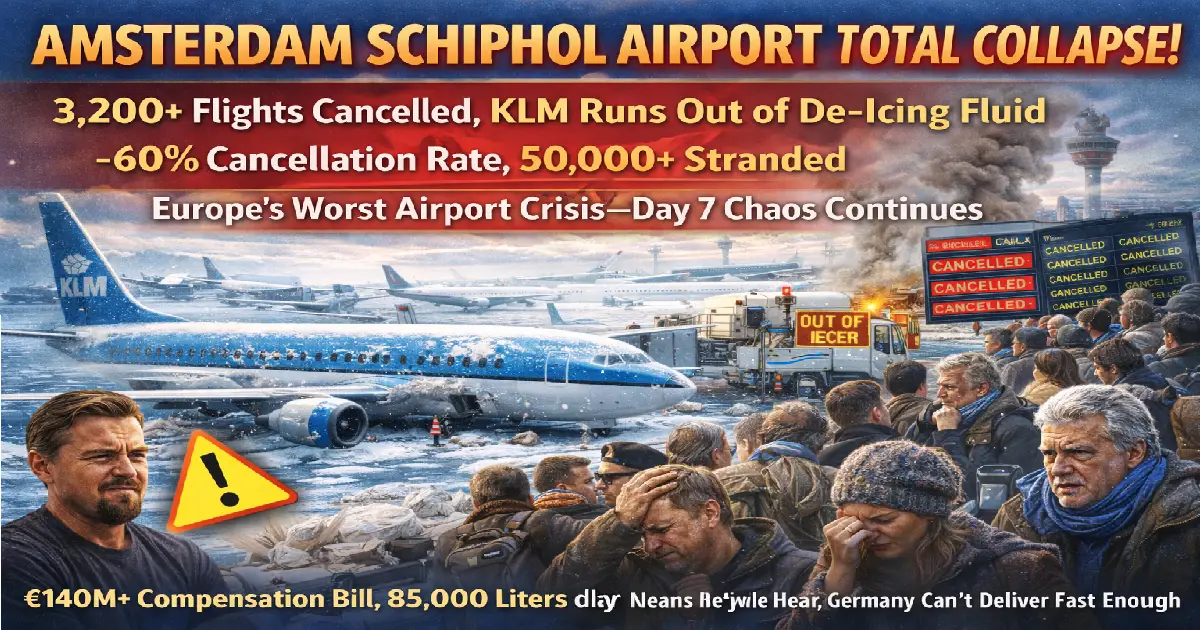
Breaking: Amsterdam Schiphol Airport—Europe’s fifth-busiest hub—entered its SEVENTH straight day of operational meltdown Wednesday, January 8, 2026 as catastrophic winter weather combined with critical de-icing fluid shortages triggered the worst airport crisis in European aviation history. Over 3,200 flights cancelled since Friday, January 2—with 60% cancellation rates at peak, 676 flights grounded Tuesday alone, 600+ Wednesday—stranding an estimated 50,000+ passengers across terminals as KLM Royal Dutch Airlines exhausted its ENTIRE season’s supply of aircraft de-icing fluid in just 72 hours. The Dutch flag carrier now using 85,000 liters daily (normal: 15,000), depleting stocks faster than German suppliers can replenish despite KLM sending employees across the border to physically collect emergency batches. Snow, ice, and 40+ mph winds reduced Schiphol’s capacity by 60%, creating cascading failures across Europe’s aviation network as missed connections rippled from London to Paris to Berlin. Airport warns “limited operations” continue Thursday with recovery not expected until weekend. Compensation bills could exceed €140 million under EU261 rules—though airlines may claim “extraordinary circumstances” exemption.
Published: January 8, 2026, 9:00 AM CET (DEVELOPING – Updated 2 PM CET) Crisis Started: Friday, January 2, 2026 (now Day 7) Status: Ongoing chaos, partial operations, gradual recovery expected by weekend Total Flights Cancelled: 3,308+ (January 2-8) Tuesday Alone: 676 cancelled Wednesday: 600+ cancelled (preemptive) Peak Cancellation Rate: 60% (Monday, January 6) Passengers Affected: 50,000+ estimated Airports Hit: Amsterdam Schiphol (primary), Paris CDG (40% cuts), London Heathrow/Gatwick (connection disruptions) Root Causes: Snow/ice accumulation, 40+ mph winds, de-icing fluid shortage, supply chain failures Compensation Liability: €140M+ potential (€250-€600 per passenger under EU261)
What began as routine winter weather Friday morning has spiraled into the most sustained airport operational failure in modern European history—outlasting even the 2010 Icelandic volcano ash crisis and 2022’s summer staffing meltdowns.
Day-by-Day Breakdown:
The Numbers Paint Disaster:
“This is unprecedented,” stated aviation analyst Hans van der Steenhoven. “Even during the 2010 Eyjafjallajökull eruption, we saw clearer recovery timelines. The combination of weather, supply chain failures, and infrastructure limitations has created a perfect storm that Schiphol simply cannot escape.”
At the heart of Schiphol’s collapse lies a shocking logistics failure: KLM Royal Dutch Airlines—responsible for de-icing not just its own aircraft but MOST planes at Schiphol through its ground handling subsidiary—has completely run out of aircraft de-icing fluid after consuming an entire season’s supply in just three days.
The Crisis Timeline:
Normal Operations:
January 2-8 Reality:
Why This Happened:
“The supplier simply cannot produce and deliver at the rate we’re consuming,” explained KLM spokesperson Lisette Ebeling. “We’ve been using 85,000 liters per day since Friday—that’s five to six times our normal winter consumption. Our supplier based in Germany is doing everything possible, but their production capacity and logistics can’t keep pace with unprecedented demand.”
The Science:
Aircraft de-icing fluid (Type I and Type IV) is a heated mixture of water and propylene glycol sprayed under high pressure to:
Why Planes Can’t Fly Without It:
Even a thin layer of frost (less than 0.8mm) disrupts airflow over wings, reducing lift by up to 30% and increasing drag—making takeoff impossible or catastrophically unsafe. Federal aviation regulations worldwide mandate “clean aircraft concept”—zero contamination on critical surfaces before departure.
The Bottleneck:
KLM’s 25 de-icing trucks can process approximately 8-10 aircraft per hour under optimal conditions. With heavy snowfall, that drops to 4-5 per hour. When 300+ aircraft require de-icing simultaneously during morning departures, and each plane needs 500-1,000 liters of fluid (wide-bodies up to 2,000 liters), the math becomes impossible:
“We’re rationing fluid for long-haul intercontinental flights,” admitted one KLM ground crew supervisor anonymously. “Boeing 787s to New York get priority. Regional Embraers to Brussels? Cancelled. We simply don’t have enough fluid for everyone.”
Critics are asking pointed questions: How did Europe’s fifth-busiest airport—located in the Netherlands where winter snow is NORMAL—fail so catastrophically?
Schiphol’s Limitations:
Runway Capacity:
De-Icing Infrastructure:
Why This Matters:
Major North American airports facing similar snowfall (Chicago O’Hare, Toronto Pearson, Denver) maintain multiple de-icing pads, redundant fluid supplies, and capacity to handle 80%+ of normal traffic even in blizzards. Schiphol’s design assumes mild Dutch winters—a planning failure now exposed.
“Amsterdam invested heavily in slots and terminal expansion but neglected winter resilience infrastructure,” stated airport operations expert Dr. Willem Homan, Technical University Delft. “This is a predictable failure that was avoidable with proper investment.”
The Weather Context:
This is NOT exceptional weather for Northern Europe in January—making Schiphol’s inability to cope even more troubling.
Schiphol’s collapse didn’t stay contained. As Europe’s critical transfer hub (third-largest in Europe by passenger traffic), its failures cascaded across the continent.
Airports Affected:
Paris Airports:
London Airports:
Other European Hubs:
Network Collapse:
Modern airline scheduling depends on “hubbing”—passengers connect through major airports to reach final destinations. When a hub collapses:
“We’ve had passengers booking Amsterdam-New York end up stranded in London for 48 hours because their LHR-AMS connection cancelled, then AMS-JFK cancelled, then no available seats for days,” explained British Airways gate agent Rachel Thompson. “The system is gridlocked.”
European Tourism Impact:
Behind statistics are real people—families, business travelers, honeymooners—trapped in chaos.
Passenger Experiences:
Sarah Mitchell, London (traveling with 2 children): “We’ve been at Schiphol for 38 hours. Our Manchester-Amsterdam-Orlando flight cancelled Sunday. Rebooking queue was 8 hours—by the time we reached the counter, all alternatives were full. KLM gave us €15 meal vouchers but hotels sold out across Amsterdam. My kids are sleeping on the floor using our luggage as pillows. This is inhumane.”
James Chen, New York (business traveler): “I have a critical meeting in Amsterdam Tuesday morning—flew in from JFK via London. Heathrow-AMS cancelled. Tried train—Dutch rail shut down due to snow AND IT system failure simultaneously. Now stuck at Heathrow watching my career opportunity evaporate. KLM won’t even answer phones.”
Terminal Conditions:
Social Media Explosion:
TikTok videos showing Schiphol chaos have gone viral:
If You Have Flights Involving Schiphol This Week:
DO:
✅ Check flight status obsessively – Airlines cancelling with 6-12 hours notice ✅ Contact airline immediately – Rebooking queues growing by the hour ✅ Explore alternative routes – Consider train (Eurostar Amsterdam-Paris-London if rail operational), driving, or accepting delays ✅ Document everything – Photos, receipts, timestamps for compensation claims ✅ Book hotels EARLY – Amsterdam metro area hotels sold out; try suburbs or even Rotterdam/Utrecht ✅ Pack patience – Staff are overwhelmed, not incompetent
DON’T:
❌ Don’t go to airport without confirmation – “Check at airport” means cancelled ❌ Don’t assume “extraordinary circumstances” blocks compensation – Fluid shortage may be airline’s fault (poor planning) ❌ Don’t accept first rebooking offer – Ask for all options including other airlines ❌ Don’t abandon hope of compensation – EU261 may still apply depending on situation
Your Rights Under EU261:
What Airlines MUST Provide (Regardless of Weather):
Cash Compensation (€250-€600):
Normally required for cancellations UNLESS “extraordinary circumstances” (weather typically qualifies). HOWEVER:
Travel Insurance:
If even 25% of affected passengers pursue EU261 compensation (and courts rule in their favor), airlines face catastrophic financial liability.
The Math:
Airlines’ Defense:
“This is clearly extraordinary weather circumstances beyond our control,” stated KLM’s legal team. “EU261 provides explicit exemptions for weather events.”
Passenger Lawyers’ Response:
“The de-icing fluid shortage is NOT weather—it’s operational failure and poor planning,” countered EU aviation rights attorney Claudia van der Berg. “KLM knew winter was coming. They chose not to stockpile adequate reserves. That’s negligence, not extraordinary circumstances. We will fight every single compensation claim in court.”
Precedent:
In 2018’s “Beast from the East” snowstorm, UK courts ruled airlines MUST compensate if disruptions extend beyond reasonable weather duration. After 3-4 days, it becomes operational failure, not weather.
Schiphol is now on Day 7.
Airport’s Official Statement (Wednesday):
“We expect gradual improvement Thursday and Friday as weather conditions moderate. Full normal operations likely Saturday, January 11 at earliest. Passengers should continue checking flight status before traveling to airport.”
Weather Forecast:
But Infrastructure Reality:
Even when weather improves:
Realistic Timeline:
“Don’t expect normal service until mid-month,” cautioned airport analyst Hans Timmers. “This will be a week-long recovery process minimum.”
This crisis exposes uncomfortable truths about Schiphol’s limitations.
The Controversy:
Amsterdam Schiphol handles 71+ million passengers annually—more than:
Yet unlike truly resilient airports (London Heathrow, Paris CDG, Frankfurt), Schiphol has:
Political Pressure Building:
Dutch Parliament’s Infrastructure Committee has scheduled emergency hearings for January 15 demanding answers:
“This is a national embarrassment,” stated MP Pieter van der Veen (opposition leader). “Amsterdam markets itself as Europe’s gateway but collapses when it snows. Unacceptable.”
Airline Industry Response:
Airlines for Europe (A4E) lobbying group issued statement demanding:
Schiphol’s crisis has sent shockwaves through European aviation, forcing immediate reviews:
Frankfurt Airport (Germany): Announced Wednesday it’s doubling de-icing fluid stockpiles and adding third supplier contract “to prevent Schiphol scenario.”
Paris Charles de Gaulle: Already maintaining 3x normal fluid reserves and has backup storage at Le Bourget.
London Heathrow: Confirmed it holds 6-week supply at all times with four different suppliers under contract.
North American Perspective:
Denver International Airport (notorious for snow) maintains:
“Europeans need to learn from us,” stated Denver airport operations director. “Winter happens every year. Plan for it.”
Amsterdam Schiphol’s seven-day operational collapse—triggered by combination of snow, infrastructure limitations, and catastrophic de-icing fluid shortage—represents the worst sustained airport crisis in modern European history.
Over 3,200 flights cancelled, 50,000+ passengers stranded, €140M+ in potential compensation, and a hub airport reduced to 40% capacity exposes fundamental failures in:
For travelers, the lessons are brutal:
For Schiphol and KLM, the reckoning has just begun:
Check airline websites continuously. Do NOT go to Schiphol without confirmed, boarding-pass-in-hand flight status. This crisis continues.
Flight Status:
Airline Customer Service:
Passenger Rights:
Weather:
Related Articles:
Posted By : Vinay
This article is provided for general informational purposes only and is based on information available at the time of publication. Travel advisories, airline schedules, airport operations, visa requirements, government regulations, and other travel-related information are subject to change without prior notice. While Travel Tourister makes reasonable efforts to verify information using official announcements, government publications, airline and airport communications, and other reliable sources, we cannot guarantee that all information remains complete, accurate, or up to date at all times. Readers should independently verify any information that may affect their travel plans with the relevant airline, airport authority, government agency, embassy, or other official source before making travel, financial, or other decisions. Travel Tourister shall not be liable for any direct or indirect loss, inconvenience, or damages arising from the use of or reliance on the information contained in this article. Nothing in this publication constitutes legal, immigration, financial, or professional travel advice. If you believe any information in this article is inaccurate or outdated, please contact our editorial team. We review all credible correction requests promptly and update our content whenever appropriate.
Lastest News
2nd Floor, 39, Above Kirti Club, DLF Industrial Area, Kirti Nagar, New Delhi, Delhi 110015



Travel Tourister is a leading Travel portal where we introduce travellers to trusted travel agents to make their journey hasselfree, memorable And happy. Travel Tourister is a platform where travellers get Tour packages ,Hotel packages deals through trusted travel companies And hoteliers who are working with us across the world. We always try to find new and more travel agents and hoteliers from every nook and corners across the world so that you could compare the deals with different travel agents and hoteliers and book your tour or hotel with the one you have chosen according to your taste and budget.
Copyright © Travel Tourister, India. All Rights Reserved

 Call
Call Enquiry