Published on : 17 Jan 2026
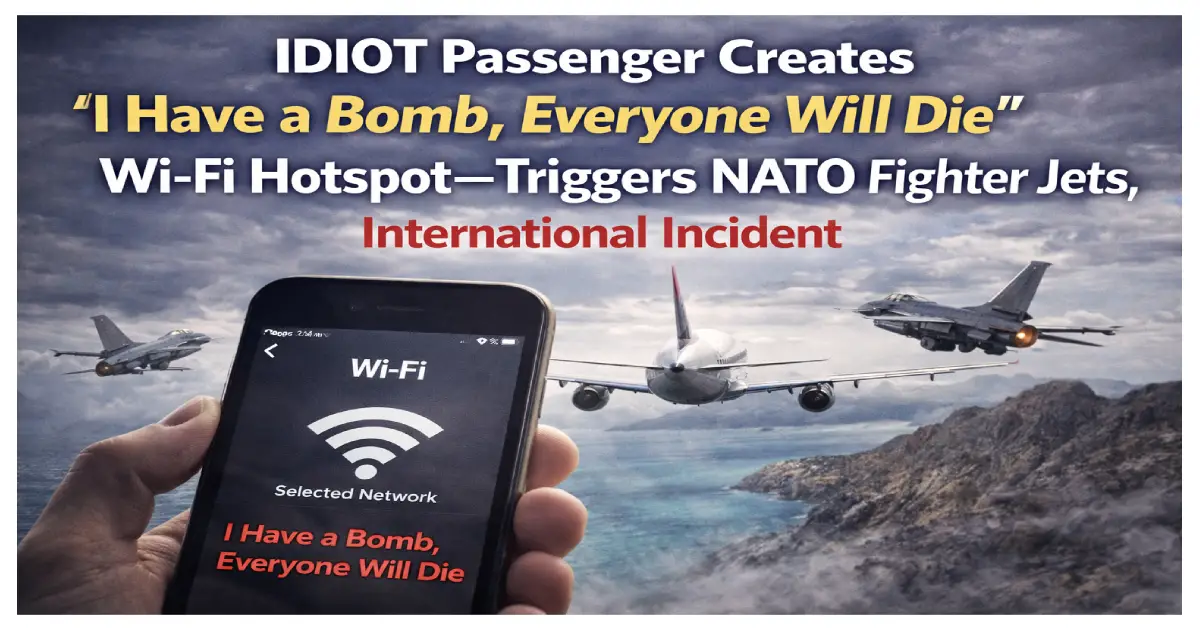
Breaking: A passenger’s moronic “prank” WiFi hotspot named “I have a bomb, everyone will die” sparked a full-scale NATO military response, forcing Turkish Airlines Flight TK1853 into emergency landing with TWO fighter jet escorts. 148 terrified passengers evacuated. Bomb squads, sniffer dogs, Civil Guard deployed. Flight circled 20 minutes. Passenger now facing YEARS in prison. This is the STUPIDEST aviation incident of 2026—and it happened just 2 days ago. Here’s the complete timeline of how one idiot’s WiFi name triggered an international emergency.
Published: January 17, 2026 Incident Date: Thursday, January 15, 2026 Flight: Turkish Airlines TK1853 Route: Istanbul (IST) → Barcelona (BCN) Aircraft: Airbus A321 (Registration TC-JRR) Passengers: 148 + 7 crew = 155 total WiFi Name: “I have a bomb, everyone will die” Military Response: French Rafale + Spanish Eurofighter Typhoon fighter jets Emergency Code: Squawk 7700 (general emergency) Landing: 10:57 AM local time, Runway 02, Barcelona-El Prat Airport Bomb Squad Response: TEDAX (Spanish explosive disposal), canine units, Guardia Civil, Mossos d’Esquadra, National Police, firefighters Explosives Found: ZERO Passenger Status: Under investigation, criminal charges pending Potential Penalty: Up to 20+ years prison in some jurisdictions
At approximately 3 hours into Turkish Airlines Flight TK1853’s routine morning journey from Istanbul to Barcelona, a crew member scanning available WiFi networks made a discovery that would trigger one of the most dramatic aviation security responses of 2026.
The WiFi hotspot name read:
“I have a bomb, everyone will die”
Not “Free WiFi.” Not “John’s iPhone.” Not even a mildly inappropriate joke.
A passenger had deliberately created a mobile hotspot with a direct bomb threat visible to anyone within WiFi range—including flight crew, passengers, and air traffic control monitoring systems.
What happened next was inevitable and catastrophic:
✈️ Immediate crew alert – Flight attendants notified captain ✈️ Emergency declared – Squawk 7700 code transmitted ✈️ NATO Quick Reaction Alert activated – Military scrambled ✈️ French Rafale fighter jets launched – Intercepted over Mediterranean ✈️ Spanish Eurofighter Typhoons scrambled – Took over escort in Spanish airspace ✈️ 20-minute circling – Aircraft held in holding pattern ✈️ Emergency landing Barcelona – Diverted to isolated area ✈️ Full evacuation – 155 people evacuated to tarmac ✈️ Bomb squad deployment – TEDAX explosive disposal teams ✈️ Airport partial closure – Approaches temporarily halted ✈️ International incident – Spain, France, Turkey, NATO all involved
All because someone thought it would be funny to name their WiFi hotspot after a bomb threat.
Turkish Airlines Flight TK1853 departs Istanbul Airport approximately 30 minutes behind schedule—a routine delay unrelated to the chaos to come.
On board:
Everything is normal. Passengers settle in. Some sleep. Others read. A few connect to the aircraft’s WiFi system.
And one passenger—whose identity remains under investigation—creates a personal mobile hotspot.
Approximately 3 hours into the flight, as the Airbus A321 cruises over the Mediterranean Sea approaching Italian airspace, a crew member notices something alarming while checking available WiFi networks.
A personal hotspot named: “I have a bomb, everyone will die”
The crew member immediately alerts the flight deck.
Turkish Airlines Communication Director Yahya Üstün later explained:
“It was detected that a passenger established an in-flight internet access point and set the network name to include a bomb threat.”
The exact phrasing—”I have a bomb, everyone will die”—left zero room for interpretation. This wasn’t ambiguous. It wasn’t a misunderstanding. It was an explicit threat.
The captain and first officer face an impossible choice:
Option 1: Assume it’s a prank and do nothing → Risk 155 lives if it’s real
Option 2: Treat it as a credible threat and activate emergency protocols → Massive disruption but everyone lives if it’s real
There’s only one choice in aviation: Always assume the worst.
The captain declares a Squawk 7700 emergency —the universal code for “general emergency” that alerts air traffic control, military authorities, and emergency services that an aircraft is in serious distress.
The moment Squawk 7700 was declared with a bomb threat mentioned, a cascade of military responses activated across Europe.
NATO Quick Reaction Alert (QRA) Protocol:
Under NATO’s collective defense agreement, member nations maintain fighter jets on constant alert—ready to scramble within minutes to intercept potential threats.
French Military Response:
French Air Force scrambles Rafale fighter jets from the nearest base. The Rafales are supersonic multirole fighters capable of:
The Rafales locate Flight TK1853 over the Mediterranean near Sardinia and take up escort positions—one on each wingtip.
As the Turkish Airlines flight crosses from international airspace into Spanish territory, the escort mission transfers to Spain.
Spanish Air Force Response:
Spanish Eurofighter Typhoons scramble from a mainland base, intercepting the flight and relieving the French Rafales.
The Typhoons—equally advanced supersonic fighters—maintain close escort as Flight TK1853 approaches Barcelona.
What passengers saw:
Imagine looking out your window mid-flight and seeing a military fighter jet flying 50 feet away, matching your speed perfectly. Terrifying.
Some passengers noticed the fighter jets. Others remained oblivious, focused on the chaos unfolding inside the cabin as word spread about a bomb threat.
Flight TK1853 doesn’t proceed directly to Barcelona. Instead, it enters a holding pattern—circling over the Catalonian coast while ground authorities prepare for emergency landing.
Why the delay?
For 20 agonizing minutes, 148 passengers and 7 crew circle knowing there’s a bomb threat—but not knowing if it’s real.
With fighter jets flanking each wing, Flight TK1853 descends toward Barcelona-El Prat Airport.
Landing details:
The pilots execute a perfect landing despite extraordinary pressure.
But the ordeal is far from over.
Instead of taxiing to a gate, the Airbus A321 is directed to a remote, isolated area of the airport—specifically near the Iberia maintenance hangars, far from passenger terminals and other aircraft.
Why isolation?
If the bomb is real and detonates, the explosion will be contained away from:
Spanish Air Traffic Controllers tweet:
“We have momentarily stopped approach traffic at Barcelona-El Prat Airport. A plane from Turkey has landed on Runway 02 with a possible bomb threat.”
The aircraft comes to a complete stop. Engines shut down. The cabin is silent except for terrified whispering.
Then the order comes: EVACUATE.
All 148 passengers and 7 crew exit via emergency stairs onto the tarmac. No jetbridges. No orderly deplaning. Just 155 frightened people standing on hot asphalt surrounded by armed security forces.
A massive security presence surrounds the aircraft:
Spanish Security Forces Deployed:
🚔 Guardia Civil (Civil Guard) – National law enforcement 👮 National Police – Federal police force 🇪🇸 Mossos d’Esquadra – Catalonian regional police 🚒 Firefighters (Generalitat) – Emergency response 💣 TEDAX – Spanish bomb disposal specialists 🐕 Canine Units – Explosive-sniffing dogs 🚑 Paramedics – Medical standby
The operation:
TEDAX bomb disposal experts in full protective gear approach the aircraft. Sniffer dogs trained to detect explosives board the plane, checking:
Meanwhile, security personnel interview passengers, trying to identify who created the threatening WiFi hotspot.
After approximately 1.5 hours of intensive searching, the verdict is announced:
NO EXPLOSIVES FOUND.
The bomb threat was fake. A hoax. A “prank.”
148 passengers, 7 crew members, dozens of security personnel, two NATO fighter jets, bomb disposal teams, and an entire airport’s operations disrupted—all because someone thought it would be funny to name their WiFi hotspot after a bomb threat.
Spanish authorities, working with Turkish Airlines, begin the process of identifying the passenger responsible.
How they identified the culprit:
As of January 17, 2026:
Spanish and Turkish authorities have not publicly named the passenger, citing ongoing investigation. However, sources confirm the responsible party has been identified and is facing criminal charges.
Creating a fake bomb threat on an aircraft is one of the most serious crimes in aviation law. The passenger faces catastrophic legal consequences across multiple jurisdictions.
Primary Charge: False bomb threat / Terrorist hoax
Spanish Penal Code Penalties:
What that includes:
Total bill: Potentially €500,000-€1,000,000 ($550,000-$1.1 million USD)
Turkey may also prosecute since:
Turkish Penal Code penalties for aviation-related threats:
EU Regulation 300/2008 mandates severe penalties for aviation security breaches:
If this happened on a US flight:
Federal Aviation Act:
Post-9/11 laws make aircraft bomb threats among the most harshly punished crimes in America.
Previous bomb hoax convictions:
2016, Australia (Qantas “Mobile Detonation Device” WiFi):
2017, Turkey (Nairobi-Istanbul “Bomb on Board” WiFi):
2014, USA (Southwest “Bomb on Board” WiFi):
Legal experts predict this January 2026 case will result in the HARSHEST penalty yet because:
Many people question: Why scramble fighter jets for a WiFi name?
The answer lies in post-9/11 aviation security protocols that treat ALL aircraft bomb threats as potentially real until proven otherwise.
NATO member countries maintain fighter jets on 24/7/365 alert status at airbases across Europe. These jets can be airborne within minutes of an alert.
Purpose:
How it works:
Why two fighter jets (French + Spanish)?
Capabilities:
✈️ Visual inspection – Pilots can see if aircraft is behaving normally ✈️ Communication – Radio contact with civilian aircraft ✈️ Guidance – Direct aircraft to specific runways/airports ✈️ Deterrence – Presence discourages hijackers ✈️ Force – Can shoot down aircraft if necessary (only in extreme circumstances)
The last resort:
If an aircraft is hijacked and heading toward a populated area (think 9/11), fighter jets have authorization to shoot it down to prevent greater casualties.
This is why fighter jet responses are NOT overreactions—they’re the last line of defense against catastrophic terrorism.
The 148 passengers on Flight TK1853 experienced a nightmare they’ll never forget.
What passengers experienced:
Passenger interviews (reported by Spanish media):
“I thought we were all going to die. I texted my family goodbye.”
“When I saw the fighter jet outside my window, I knew it was serious. I’ve never been so scared in my life.”
“We had no idea what was happening. The crew wouldn’t tell us details. We just knew there was a bomb threat.”
Passenger reactions shifted from terror to FURY:
Social Media Comments:
“Whoever did this should be in prison for YEARS. This isn’t a joke.”
“148 people traumatized because some idiot wanted attention. Unforgivable.”
“I hope they throw the book at this person. This is terrorism even if there was no bomb.”
One passenger told reporters:
“I understand pranks. I understand jokes. This is neither. This is psychological terrorism. Everyone on that plane thought we might die.”
The incident delayed the flight by approximately 4+ hours. Passengers who had connecting flights in Barcelona missed them. Business meetings were cancelled. Families waiting at the airport spent hours in anxiety.
Turkish Airlines response:
“Our aircraft’s return flight will be carried out after the completion of passenger boarding.”
The airline provided:
Total passenger compensation: Estimated €60,000-€90,000 ($66,000-$99,000 USD)
Shockingly, this is NOT the first time a WiFi hotspot bomb threat has targeted Turkish Airlines.
Date: November 30, 2017
Flight: Turkish Airlines from Nairobi, Kenya → Istanbul, Turkey
WiFi name discovered: “Bomb on Board”
Response:
Outcome:
Two major WiFi bomb hoax incidents in 8 years suggests:
Either:
Aviation security experts:
“Once is an isolated incident. Twice is a pattern. Airlines and security services need to implement WiFi monitoring systems that automatically flag threatening network names and alert crew immediately.”
Turkish Airlines isn’t alone. Multiple airlines have faced similar WiFi-based threats:
Flight: Seattle → Denver
WiFi name: “Southwest – Bomb on Board”
Response:
Flight: Melbourne → Perth
WiFi name: “Mobile Detonation Device”
Response:
Flight: Cancun, Mexico → London Gatwick
WiFi name: “Jihadist Cell London 1”
Response:
Unlike shouting “bomb” in a cabin (which crew can immediately investigate):
WiFi threats are:
This ambiguity forces airlines to treat ALL such threats as credible, triggering massive security responses.
While the Turkish Airlines incident was unfolding, Barcelona-El Prat Airport faced significant operational challenges.
Spanish Air Traffic Controllers (@controladores) tweeted:
“We have momentarily stopped approach traffic at Barcelona-El Prat Airport. A plane from Turkey has landed on Runway 02 with a possible bomb threat.”
Impact:
Total delayed flights: Estimated 20-30
Passengers affected: Estimated 3,000-4,000
Spanish airport operator AENA statement:
“Barcelona airport continued to operate as normal” (after initial emergency protocols).
Timeline:
Total disruption: Approximately 3-4 hours of reduced capacity
The passenger responsible for the WiFi hoax triggered costs exceeding €1 million ($1.1 million USD). Here’s the breakdown:
French Rafale Fighter Jet Scramble:
Spanish Eurofighter Typhoon Scramble:
Total military costs: €34,000 ($37,000 USD)
Spanish Bomb Squad (TEDAX):
Spanish Law Enforcement:
Emergency Services:
Total security costs: €31,000 ($34,000 USD)
Flight TK1853:
Return Flight (Istanbul):
Passenger Compensation (EU261):
Total Turkish Airlines costs: €82,200 ($90,000 USD)
Barcelona-El Prat:
€207,200 ($228,000 USD) minimum
Likely closer to €500,000-€1,000,000 when including:
The passenger will likely be ordered to pay:
Plus years in prison.
In response to this and previous WiFi bomb hoaxes, airlines and aircraft manufacturers are implementing new technologies:
1. Automated WiFi Network Monitoring
Aircraft systems that automatically:
2. WiFi Jamming Technology
Systems that can:
3. Pre-Flight Screening
Enhanced security checks that:
International Air Transport Association (IATA) statement:
“Aviation security depends on zero tolerance for threats—real or perceived. Airlines, airports, and security agencies must continue to treat all threats seriously while implementing technologies to quickly distinguish real dangers from hoaxes.”
Airline Pilots Association:
“WiFi bomb hoaxes are not pranks. They endanger lives, waste critical resources, and traumatize passengers and crew. Perpetrators must face maximum legal consequences.”
Aviation experts, security professionals, and even casual observers have reacted with near-universal condemnation of the passenger’s actions.
Bored Panda headline:
“People Are Idiots”: Fighter Jets Scrambled To Escort Flight Over Passenger’s WiFi Hotspot Name
The article’s title perfectly captures public sentiment. Comments across social media platforms echo the same theme:
Top Social Media Reactions:
Twitter/X:
“Imagine being so desperate for attention that you create an international incident and face prison time. Peak stupidity.” – @AviationDaily, 45K likes
“This person should be banned from flying for LIFE. Globally. Forever.” – @TravelSafety, 38K likes
“The fighter jet pilots were probably thinking ‘we scrambled for THIS?'” – @MilitaryHumor, 52K likes
Reddit (r/aviation):
Top comment with 89K upvotes: “Play stupid games, win stupid prizes. Enjoy prison, idiot.”
Instagram:
Aviation influencers posting photos of fighter jets with captions like: “When your WiFi name costs taxpayers €500,000 and gets you 10+ years in prison. #DarwinAward”
“This incident demonstrates the impossible position airlines and security services face. They MUST respond to every threat as if it’s real. The alternative—ignoring a warning and 155 people dying—is unthinkable. So pranksters effectively hijack the entire security system with a single WiFi name. The legal consequences must be severe enough to deter future incidents.”
“As a commercial pilot, this infuriates me. We train for emergencies—real emergencies. Engine failures, medical crises, severe weather. Not some bored passenger’s idea of a joke. The psychological toll on the crew who had to declare that emergency, knowing they might be overreacting but unable to take the risk, is real. This pilot and crew deserve recognition for their professionalism under circumstances they should never have faced.”
If there’s one takeaway from this disaster, it’s this:
NEVER create WiFi hotspot names that reference:
❌ Bombs ❌ Explosives ❌ Terrorism ❌ Hijacking ❌ Threats of any kind ❌ Weapons ❌ Violence
Even if you think it’s funny.
Even if you’re “just joking.”
Even if you don’t think anyone will notice.
As this case proves:
Aviation security is not a joke. 9/11 changed everything forever.
If you absolutely must have a creative WiFi hotspot name while traveling, stick to HARMLESS options:
✅ “FBI Surveillance Van” ✅ “Pretty Fly for a WiFi” ✅ “The Promised LAN” ✅ “404 Network Unavailable” ✅ “Drop It Like It’s Hotspot”
Notice what all these have in common? ZERO references to violence, threats, or aviation safety.
The January 15, 2026 Turkish Airlines WiFi bomb hoax incident proves beyond doubt that aviation security operates under absolute zero tolerance for perceived threats.
The facts:
What it means:
For the passenger responsible:
You wanted attention. You got it—along with:
Was it worth it?
For the rest of us:
This incident is a stark reminder that aviation security is serious business. The freedoms and conveniences we enjoy when flying exist only because comprehensive security systems protect us from real threats.
When someone abuses that system for laughs, everyone suffers.
The lesson is simple: Don’t be an idiot. Don’t make bomb threats—real or fake. Don’t name your WiFi hotspot after explosives. Just… don’t.
Your “joke” could cost €1 million, 20 years of your life, and traumatize 155 innocent people.
Not funny. Not ever.
For More Resources:
Related Articles:
Posted By : Vinay
This article is provided for general informational purposes only and is based on information available at the time of publication. Travel advisories, airline schedules, airport operations, visa requirements, government regulations, and other travel-related information are subject to change without prior notice. While Travel Tourister makes reasonable efforts to verify information using official announcements, government publications, airline and airport communications, and other reliable sources, we cannot guarantee that all information remains complete, accurate, or up to date at all times. Readers should independently verify any information that may affect their travel plans with the relevant airline, airport authority, government agency, embassy, or other official source before making travel, financial, or other decisions. Travel Tourister shall not be liable for any direct or indirect loss, inconvenience, or damages arising from the use of or reliance on the information contained in this article. Nothing in this publication constitutes legal, immigration, financial, or professional travel advice. If you believe any information in this article is inaccurate or outdated, please contact our editorial team. We review all credible correction requests promptly and update our content whenever appropriate.
Lastest News
2nd Floor, 39, Above Kirti Club, DLF Industrial Area, Kirti Nagar, New Delhi, Delhi 110015



Travel Tourister is a leading Travel portal where we introduce travellers to trusted travel agents to make their journey hasselfree, memorable And happy. Travel Tourister is a platform where travellers get Tour packages ,Hotel packages deals through trusted travel companies And hoteliers who are working with us across the world. We always try to find new and more travel agents and hoteliers from every nook and corners across the world so that you could compare the deals with different travel agents and hoteliers and book your tour or hotel with the one you have chosen according to your taste and budget.
Copyright © Travel Tourister, India. All Rights Reserved

 Call
Call Enquiry