Published on : 19 Jan 2026
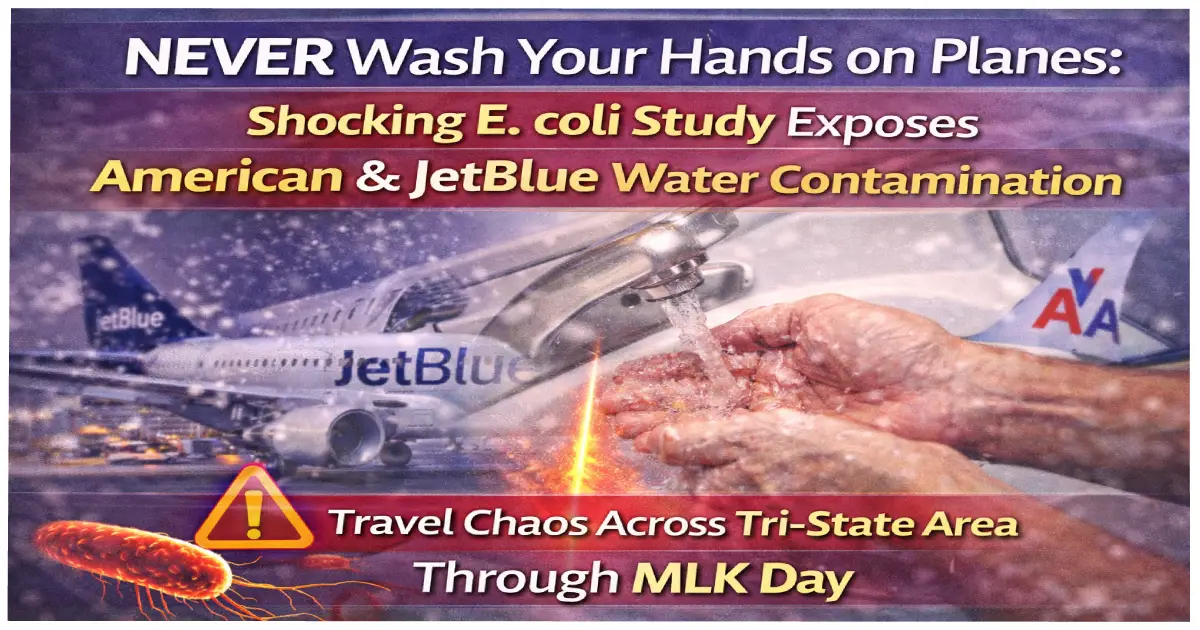
Breaking: A comprehensive 3-year study testing 35,674 airline water samples has exposed a terrifying truth: American Airlines and JetBlue serve water contaminated with E. coli bacteria, earning Grade D ratings—the WORST among major carriers. The official recommendation? NEVER wash your hands in airplane bathrooms. NEVER drink coffee or tea. NEVER drink tap water. Delta and Frontier earn perfect Grade A ratings while American had 3 E. coli cases and JetBlue had 6. Here’s everything travelers MUST know about the water you’re drinking at 35,000 feet.
Published: January 19, 2026 Study Released: January 2, 2026 (2 weeks ago – STILL TRENDING!) Study Period: October 1, 2022 → September 30, 2025 (3 years) Total Samples Tested: 35,674 water samples across 21 airlines Airlines Evaluated: 10 major carriers + 11 regional airlines Study Conducted By: Center for Food as Medicine and Longevity (Hunter College NYC) Lead Researcher: Dr. Charles Platkin, PhD, JD, MPH Coliform Positive Rate: 2.66% (nearly 3% of all samples contaminated) Total E. coli Violations: 32 cases across airlines WORST Airlines: American Airlines (Grade D, 1.75 score) & JetBlue (Grade D, 1.80 score) BEST Airlines: Delta (Grade A, 5.00 perfect score) & Frontier (Grade A, 4.80 score)
The 2026 Airline Water Study analyzed three full years of Environmental Protection Agency (EPA) data, testing water quality on aircraft from October 2022 through September 2025. The results are disturbing.
Key Findings:
💧 2.66% of water samples tested POSITIVE for coliform bacteria – indicating potential disease-causing pathogens 💧 32 E. coli violations across 21 airlines over 3 years 💧 American Airlines: 3 E. coli positive tests in water system 💧 JetBlue: 6 E. coli positive tests – DOUBLE American’s contamination 💧 CommuteAir: 33.33% coliform-positive rate – 1 in 3 samples contaminated! 💧 Mesa Airlines: Grade F – absolute worst regional carrier 💧 EPA enforcement: ALMOST ZERO – civil penalties “extremely rare”
Dr. Charles Platkin, Study Director:
“Which may not seem like a lot, but E. coli is very dangerous. Delta Air Lines and Frontier Airlines win the top spots with the safest water in the sky, and Alaska Airlines finishes No. 3. The airlines with the worst score are American Airlines and JetBlue.”
Based on the study’s findings, the Center for Food as Medicine and Longevity issues clear, unequivocal guidance for airline passengers:
Why: Bathroom sink water comes from the same contaminated tanks that tested positive for coliform and E. coli bacteria.
What to do instead: Bring 60%+ alcohol-based hand sanitizer. Use it instead of washing hands.
Why: Water from onboard tanks may contain disease-causing pathogens.
What to do instead: ONLY drink water from sealed, commercially bottled water provided by the airline or brought from home.
Why: Coffee and tea are brewed using water from the same potentially contaminated tanks. Boiling does NOT eliminate all bacteria and pathogens.
What to do instead: Order bottled beverages, canned drinks, or bring your own. Skip the coffee and tea entirely on flights.
Why: Even a small amount of contaminated water entering your mouth can cause illness.
What to do instead: Use bottled water from sealed bottles to brush teeth, or wait until you reach your destination.
Why: E. coli and coliform bacteria can cause severe gastrointestinal illness even in small quantities. For children, elderly, and immunocompromised travelers, the risks are even higher.
The bottom-line advice is unequivocal: Treat ALL airplane tap water as potentially contaminated. Period.
Grade A (3.5+ Score):
🥇 1. Delta Air Lines: 5.00 (Perfect Score, Grade A)
🥈 2. Frontier Airlines: 4.80 (Grade A)
Grade B (3.5-4.99 Score):
🥉 3. Alaska Airlines: 3.85 (Grade B)
4. Allegiant Air: 3.65 (Grade B)
Grade C (2.5-3.49 Score):
5. Southwest Airlines: 3.30 (Grade C)
6. Hawaiian Airlines: 3.15 (Grade C)
7. United Airlines: 2.70 (Grade C)
Grade D (1.5-2.49 Score):
8. Spirit Airlines: 2.05 (Grade D)
9. JetBlue: 1.80 (Grade D) ⚠️
10. American Airlines: 1.75 (Grade D) ⚠️
Grade B:
🥇 1. GoJet Airlines: 3.85 (Grade B) ← Best regional carrier
Grade C:
2. Piedmont Airlines: 3.05 (Grade C) 3. Sun Country Airlines: 3.00 (Grade C) 4. Endeavor Air: 2.95 (Grade C)
Grade D:
5. SkyWest Airlines: 2.40 (Grade D) 6. Envoy Air: 2.30 (Grade D) 7. PSA Airlines: 2.25 (Grade D) 8. Air Wisconsin Airlines: 2.15 (Grade D) 9. Republic Airways: 2.05 (Grade D) 10. CommuteAir: 1.60 (Grade D) ← 33.33% coliform-positive rate!
Grade F:
11. Mesa Airlines: 1.35 (Grade F) ← WORST regional carrier, WORST overall
Dr. Platkin’s Assessment:
“Nearly all regional airlines need to improve their onboard water safety, with the exception of GoJet Airlines.”
The study evaluated airlines using five weighted criteria:
What it measures: Total Aircraft Drinking Water Rule (ADWR) violations divided by fleet size.
Why it matters: Shows how consistently an airline fails to meet federal water safety standards. A low number (like Delta’s 0.01) means excellent compliance. A high number (like JetBlue’s 0.65) indicates systemic problems.
What it measures: How many times E. coli bacteria was detected in water samples at levels exceeding federal safety limits.
Why it matters: E. coli is extremely dangerous. Even ONE violation is serious. JetBlue had 2 MCL violations, American had 1.
What it measures: Percentage of water samples that tested positive for coliform bacteria (indicators that pathogens MAY be present).
Why it matters: Coliform bacteria don’t directly cause illness, but their presence signals that disease-causing organisms could be in the water system. JetBlue’s 5.36% rate is alarming—over 1 in 20 samples contaminated.
What it measures: How often airlines had to notify passengers about water safety issues.
Why it matters: Federal law requires airlines to post public notices when water systems fail testing. More notices = more problems. JetBlue issued 8.63 notices per 100 aircraft—nearly 9 times per 100 planes over 3 years.
What it measures: How often airlines clean and disinfect their water tanks.
Federal requirement: Airlines must disinfect and flush water tanks either:
Why it matters: Regular cleaning prevents bacteria buildup. Airlines that skip or delay disinfection allow contamination to accumulate.
Scoring System:
Understanding WHY E. coli is terrifying helps explain the study’s urgency.
Escherichia coli (E. coli) is a group of bacteria commonly found in the intestines of humans and animals. Most strains are harmless. But pathogenic (disease-causing) strains can cause severe, sometimes fatal illness.
How you get infected:
Symptoms (appear 3-4 days after exposure):
For most healthy adults: Symptoms last 5-7 days, then recovery without treatment.
For vulnerable populations:
What it is: A life-threatening condition where E. coli toxins destroy red blood cells, leading to kidney failure.
Who gets it: 5-10% of people infected with certain E. coli strains (particularly O157:H7).
Symptoms:
Treatment: Hospitalization, blood transfusions, kidney dialysis. Some patients never fully recover kidney function.
Deaths: E. coli kills approximately 100 Americans per year. Thousands more are hospitalized.
What they are: A group of bacteria found in soil, plants, and the digestive systems of humans and animals.
Why they matter: While coliform bacteria themselves are usually harmless, their presence in drinking water indicates:
Think of coliform as the “canary in the coal mine” – if you find coliform, you should assume dangerous pathogens are lurking.
American Airlines—the world’s largest airline by fleet size and passengers carried—earned the WORST water safety score among major carriers. Their response? Defensive and inadequate.
American Airlines Spokesperson:
“American’s potable water program is fully in compliance with the Environmental Protection Agency’s (EPA) Aircraft Drinking Water Rule (ADWR). A recent EPA audit showed there were no significant findings with our program, and we have not received any violations for any potable water cabinets or trucks that we use.”
Translation: “We’re technically legal, so stop complaining.”
The problems with this response:
1. “Fully in compliance” doesn’t mean “safe”
The ADWR sets MINIMUM standards. Compliance means you’re not breaking the law—not that your water is actually safe to drink.
Analogy: A restaurant can be “in compliance” with health codes while still serving mediocre, borderline-unsafe food.
2. “No significant findings” ≠ “No contamination”
The EPA audit may not have found violations worthy of penalties, but that doesn’t change the fact that:
3. “We have not received any violations for potable water cabinets or trucks”
This is a narrow, technical statement that dodges the real issue: The water on American’s aircraft tested positive for dangerous bacteria multiple times.
American Airlines continued:
“Our team is closely reviewing the Center for Food as Medicine & Longevity’s analysis—including its methodology and whether it was peer reviewed—to determine any potential changes that would further enhance the safety and wellbeing of our customers and team.”
Translation: “We’re going to pick apart the study’s methodology instead of fixing our water systems.”
Deflection tactics:
What American SHOULD have said:
“We take these findings extremely seriously. We’re immediately implementing enhanced water testing, increasing disinfection frequency, and upgrading our water filtration systems to ensure passengers have the safest possible drinking water.”
What they ACTUALLY said: Technical compliance jargon and vague promises to “review.”
Facts the statement ignores:
Millions of passengers fly American Airlines every year. How many have unknowingly consumed contaminated water? How many got sick and never knew the airline was responsible?
JetBlue’s water safety record is objectively WORSE than American’s—yet their public response was slightly less defensive.
JetBlue Detailed Profile:
Study Comment: “JetBlue shows a high violations-per-aircraft burden and an elevated indicator-positive rate.”
Translation: JetBlue’s water safety problems are systemic, widespread, and persistent.
JetBlue Spokesperson:
“Safety is our first responsibility to both our crewmembers and customers. We serve bottled purified drinking water on all of our flights. For coffee and tea preparation, JetBlue follows processes outlined by the EPA, the FDA, and the FAA to ensure our water supply is safe.”
Better than American’s response because:
Still problematic because:
1. “We serve bottled purified drinking water”
Great! But what about:
Providing bottled water doesn’t solve the contamination problem—it just gives passengers ONE safe option while leaving other water sources dangerous.
2. “For coffee and tea preparation, JetBlue follows processes outlined by the EPA, FDA, and FAA”
This is vague reassurance. What “processes”? The same processes that resulted in:
Following federal guidelines clearly ISN’T ENOUGH when your airline has the MOST E. coli contamination incidents among all major carriers.
If JetBlue’s water is safe, why did 6 separate samples over 3 years test positive for E. coli?
If JetBlue follows EPA/FDA/FAA processes, why do they have 0.65 violations per aircraft—the HIGHEST rate among majors?
If safety is JetBlue’s “first responsibility,” why haven’t they invested in the same water filtration/disinfection systems that allowed Delta to achieve a PERFECT 5.00 score?
JetBlue passengers deserve answers—not corporate boilerplate.
Spirit Airlines scored 2.05 (Grade D), ahead of JetBlue and American but still dangerously low.
Spirit’s Statement:
“The well-being and comfort of our guests is very important to us. Our data shows we have made progress in this area in recent years, and we continue to evaluate and refine our procedures as necessary.”
Spirit maintains a comprehensive testing and maintenance program that complies with the EPA’s aircraft drinking water rule.
Credit where due:
Spirit at least acknowledges progress is needed and claims they’re improving.
The problem:
Spirit passengers are essentially beta testing improved water systems while hoping they don’t get sick.
Delta Air Lines earned a perfect 5.00 score (Grade A)—the ONLY major airline to do so. How?
Delta Air Lines Profile:
How Delta achieved perfection:
1. Aggressive Disinfection Schedule
Delta disinfects and flushes water tanks MORE frequently than the minimum federal requirement.
2. Advanced Filtration Systems
Delta invested in state-of-the-art water filtration technology across its fleet, removing contaminants before water reaches passengers.
3. Rigorous Testing Protocol
Delta tests water quality MORE often than required, catching problems early before they escalate.
4. Rapid Response to Issues
When Delta detects even minor contamination indicators, they immediately:
5. Culture of Accountability
Delta treats water safety as a TOP PRIORITY—not an afterthought or regulatory checkbox.
If Delta can achieve a perfect 5.00 score with 1,028 aircraft, there’s NO excuse for:
This isn’t about fleet size. It’s about priorities.
Delta CHOSE to invest in water safety. Other airlines chose NOT to.
Frontier Airlines—often criticized for aggressive fees and no-frills service—earned the SECOND-BEST water safety score in the entire study.
Frontier Airlines Profile:
The irony: Frontier charges for carry-on bags, seat selection, and drinks—but ensures the water is CLEAN.
Meanwhile, “premium” carriers like American and JetBlue:
But serve contaminated water.
The lesson: Brand reputation ≠ actual safety performance.
The study awards its “Shame on You” designation to the U.S. Environmental Protection Agency (EPA)—the federal agency responsible for enforcing aircraft drinking water safety.
Why the EPA failed:
Finding: “Civil penalties for ADWR violations remain extremely rare.”
Despite:
The EPA issued almost NO penalties.
Translation: Airlines can violate water safety rules with near-impunity.
Finding: The EPA “didn’t answer most penalty-related questions” from study researchers.
When experts investigating public health tried to determine WHY airlines weren’t being penalized for contaminated water, the EPA refused to provide information.
Lack of transparency = lack of accountability.
The Aircraft Drinking Water Rule (ADWR) was implemented in 2011—over 14 years ago. Yet in 2025:
If the EPA were doing its job, these numbers would be near ZERO—not 3%.
Compare to restaurant health inspections:
Airlines face:
Why would airlines prioritize water safety when there’s no penalty for failure?
The Airlines for America (A4A) trade association—representing major US carriers—issued a defensive statement.
A4A Statement:
“The top priority of the airline industry is the safety of all passengers and crew members. U.S. airlines follow the guidelines of several government agencies—the Environmental Protection Agency (EPA) protocols for testing drinking water, the Federal Aviation Administration (FAA) requirements to routinely check water systems, and the Food and Drug Administration (FDA) requirements applicable to water systems—to ensure the water onboard an aircraft is safe and reliable for consumption.”
Classic corporate deflection:
What the statement DOESN’T say:
Industry response: “We’re following the rules!”
Study response: “The rules aren’t working. Passengers are being exposed to dangerous bacteria.”
This 2026 study is actually the SECOND comprehensive airline water safety analysis. The first was conducted in 2019.
Comparing 2019 vs 2026:
Delta went from WORST to BEST. Proof that airlines CAN fix water safety when they choose to prioritize it.
JetBlue made minimal progress in 7 years—remaining among the worst performers despite having 7 years to address problems.
Slight improvement but still dangerous.
American wasn’t among the absolute worst in 2019, but by 2026 fell to dead last among majors.
Question: Did American’s water quality decline, or was the 2019 baseline already terrible and just not measured as precisely?
2019 Finding: Regional airline sector showed “pervasive problems.”
2026 Finding: “Nearly all regional airlines need to improve their onboard water safety, with the exception of GoJet Airlines.”
Translation: Regional carriers STILL have terrible water quality 7 years later.
Understanding HOW aircraft water systems get contaminated helps explain why this problem is so persistent.
How it works:
Contamination points:
Problem: Not all airports have pristine water supplies.
Problem: The trucks that fill aircraft tanks can harbor bacteria.
Problem: Water sits in tanks for hours/days, allowing bacteria to grow.
Problem: Miles of pipes throughout aircraft can harbor bacteria.
Problem: Faucet aerators and coffee makers accumulate bacteria.
The result: Even if water enters the aircraft clean, it can become contaminated by the time it reaches passengers.
While healthy adults can usually fight off bacteria from contaminated water, certain groups face serious risks.
1. Children Under 5
2. Elderly (65+)
3. Pregnant Women
4. Immunocompromised Individuals
For these travelers, even “minor” bacterial contamination can lead to:
If you or your travel companions fall into these categories, the study’s recommendations are CRITICAL:
Armed with this study’s findings, here’s your complete action plan for staying safe on flights:
1. Pack These Items:
✅ Hand sanitizer (60%+ alcohol) – Multiple travel-size bottles ✅ Disinfecting wipes – For tray tables, armrests, seatbelt buckles ✅ Bottled water – At least 1 liter per person (buy after security) ✅ Sealed snacks – Avoid needing galley water for preparation
2. Research Your Airline:
Check the study rankings:
3. Book Accordingly:
If water safety is a priority, consider:
4. Drinking Water Rules:
✅ ONLY drink bottled water – Request sealed bottles from flight attendants ✅ Inspect bottles before opening – Ensure seals are intact ✅ Bring your own – Don’t rely on airline supply
❌ NEVER drink tap water – Even “just a sip” ❌ NEVER drink coffee or tea – Made with contaminated water ❌ NEVER accept ice – Made from tap water ❌ NEVER drink fountain beverages – Mixed with tap water
5. Hand Hygiene:
✅ Use hand sanitizer – Before eating, after bathroom, frequently ✅ Wipe surfaces – Tray table, armrests, seatbelt, touchscreens
❌ NEVER wash hands in airplane bathrooms – Water is contaminated ❌ NEVER touch faucets unnecessarily – Bacteria hotspot
6. Bathroom Protocols:
7. Food and Beverage Choices:
✅ Canned/bottled drinks – Sealed and safe ✅ Sealed packaged foods – No water contact ✅ Dry snacks – Crackers, chips, nuts
❌ Hot beverages – Coffee, tea, hot chocolate (all use tap water) ❌ Soups – Made with tap water ❌ Fresh fruits – May be washed with contaminated water
8. Monitor for Symptoms:
If you DID consume airplane tap water (accidentally or before knowing better), watch for:
Seek medical attention if:
9. Report Issues:
If you get sick after consuming airplane water:
The study’s findings make clear that current practices are inadequate. Here’s what airlines MUST do to protect passengers:
1. Increase Disinfection Frequency
2. Upgrade Filtration Systems
3. Expand Testing
4. Ground Contaminated Aircraft
5. Improve Ground Servicing
6. Install UV Disinfection
7. Implement Point-of-Use Filtration
8. Replace Aging Systems
9. Transparency and Accountability
10. Cultural Shift
11. Strengthen the ADWR
12. Mandatory Public Reporting
13. Third-Party Oversight
The 2026 Airline Water Safety Study reveals an uncomfortable truth: Most airlines serve contaminated water to millions of passengers every year.
The numbers don’t lie:
What this means for travelers:
The official recommendations are crystal clear:
❌ NEVER drink airplane tap water ❌ NEVER drink coffee or tea made onboard ❌ NEVER wash hands in airplane bathrooms ❌ NEVER brush teeth with tap water ✅ ALWAYS use hand sanitizer ✅ ALWAYS drink only sealed bottled water ✅ ALWAYS wipe down surfaces before touching
For high-risk travelers (children, elderly, pregnant, immunocompromised):
These recommendations aren’t suggestions—they’re survival protocols. One sip of contaminated water could lead to hospitalization or death.
For airlines:
Delta and Frontier prove that perfect water safety IS achievable—even with large fleets and high passenger volumes. American, JetBlue, Spirit, and others have NO excuse.
Invest in filtration. Increase disinfection. Test frequently. Ground contaminated aircraft. Prioritize passenger safety over profits.
Until then, passengers should assume the worst and protect themselves accordingly.
The sky may be friendly, but the water definitely isn’t.
For More Resources:
Related Articles:
Posted By : Vinay
This article is provided for general informational purposes only and is based on information available at the time of publication. Travel advisories, airline schedules, airport operations, visa requirements, government regulations, and other travel-related information are subject to change without prior notice. While Travel Tourister makes reasonable efforts to verify information using official announcements, government publications, airline and airport communications, and other reliable sources, we cannot guarantee that all information remains complete, accurate, or up to date at all times. Readers should independently verify any information that may affect their travel plans with the relevant airline, airport authority, government agency, embassy, or other official source before making travel, financial, or other decisions. Travel Tourister shall not be liable for any direct or indirect loss, inconvenience, or damages arising from the use of or reliance on the information contained in this article. Nothing in this publication constitutes legal, immigration, financial, or professional travel advice. If you believe any information in this article is inaccurate or outdated, please contact our editorial team. We review all credible correction requests promptly and update our content whenever appropriate.
Lastest News
2nd Floor, 39, Above Kirti Club, DLF Industrial Area, Kirti Nagar, New Delhi, Delhi 110015



Travel Tourister is a leading Travel portal where we introduce travellers to trusted travel agents to make their journey hasselfree, memorable And happy. Travel Tourister is a platform where travellers get Tour packages ,Hotel packages deals through trusted travel companies And hoteliers who are working with us across the world. We always try to find new and more travel agents and hoteliers from every nook and corners across the world so that you could compare the deals with different travel agents and hoteliers and book your tour or hotel with the one you have chosen according to your taste and budget.
Copyright © Travel Tourister, India. All Rights Reserved

 Call
Call Enquiry