Published on : 22 Jan 2026
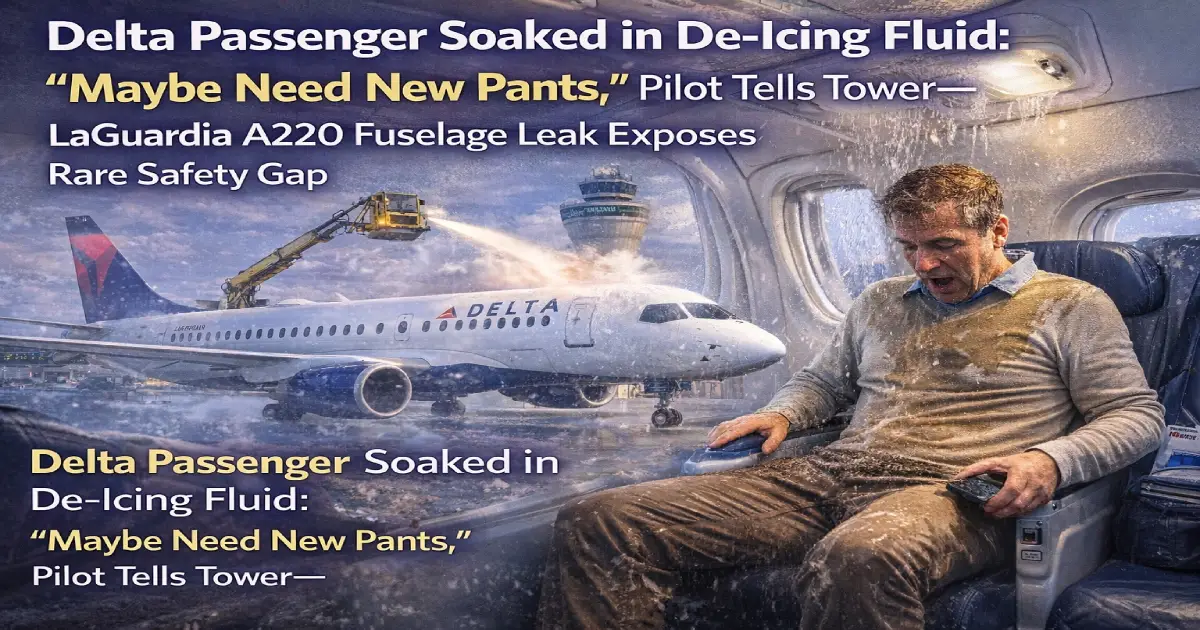
Breaking: A Delta passenger got drenched in de-icing fluid after chemicals leaked through the fuselage mid-departure Sunday, January 18, 2026—forcing Flight 1307 back to the gate at LaGuardia Airport just minutes before takeoff to Jacksonville. The Airbus A220-100’s exterior coating leaked “a bunch” of propylene glycol into the cabin near the wings, soaking a passenger’s clothes and raising urgent questions about aircraft maintenance standards during winter operations. Here’s the complete investigation.
Published: January 22, 2026 Incident Date: Sunday, January 18, 2026 Flight: Delta 1307 (LaGuardia to Jacksonville) Aircraft: Airbus A220-100 Passengers Affected: 1 soaked, 90+ delayed 3 hours Delay: 3 hours (scheduled 2:20 PM, departed 5:22 PM) Cause: De-icing fluid fuselage penetration (extremely rare)
Delta Flight 1307 taxied to LaGuardia’s de-icing pad Sunday afternoon for routine winter treatment. New York was experiencing light snow with temperatures hovering around 28°F—standard conditions requiring aircraft de-icing.
Ground crews sprayed the Airbus A220-100 with Type I de-icing fluid—a heated mixture of propylene glycol and water designed to remove ice and snow from wings, fuselage, and control surfaces.
Normal procedure. Happens thousands of times daily across U.S. airports during winter months.
While taxiing from the de-icing pad toward the runway, the flight crew received reports from passengers in rows 10-12 (near the wings) that liquid was dripping from the overhead panels and cabin walls.
The pilot immediately requested to return to the gate.
Air Traffic Control Recording (LiveATC.net):
Pilot: “Still coordinating for a gate at this time, uh, but we need to go back to a gate.”
Tower: “What’s the issue?”
Pilot: “We had a bunch of de-icing fluid leak inside the aircraft and soak a passenger.”
Tower: “Do you need any medical services or anything, or do they just need to get dried off?”
Pilot: “Yeah, I think maybe a new pair of pants. We’re not used to that coming into the fuselage like that so we want to have maintenance take a look at it, make sure that we don’t have a leak.”
Flight 1307 returned to the gate. Maintenance teams boarded to inspect the aircraft. The affected passenger—seated in Row 11, window seat on the left side (near the wing root)—had de-icing fluid on their clothing, hands, and lap.
Delta ground staff provided towels and fresh clothes. Medical evaluation was offered but declined—propylene glycol is classified as “non-hazardous” in the concentrations used for aircraft de-icing.
After a 20-minute inspection, Delta maintenance determined the A220-100 had a fuselage integrity issue—specifically, the seam where the wing-to-body fairing meets the cabin skin was not properly sealed, allowing external de-icing fluid to penetrate into the pressurized cabin.
Delta immediately pulled the aircraft from service and arranged a replacement aircraft.
All 90+ passengers transferred to a different aircraft. Flight 1307 finally departed LaGuardia at 5:22 PM—3 hours and 2 minutes late.
The soaked passenger flew on the replacement aircraft after changing clothes.
The grounded A220-100 remains in LaGuardia maintenance hangars as of January 22, 2026, undergoing intensive fuselage seal inspections.
Aircraft de-icing fluid contains:
The fluid is sprayed at high pressure to melt ice, snow, and frost from aircraft surfaces. It’s color-coded:
Delta Flight 1307 used Type I fluid—the standard for quick turnarounds at busy airports like LaGuardia.
According to the CDC (Center for Disease Control), propylene glycol exposure causes:
Low exposure (brief contact):
Moderate exposure (prolonged contact):
High exposure (industrial levels, NOT aviation):
Aviation de-icing concentrations are LOW and considered non-hazardous. The FAA, EASA, and Transport Canada all classify it as safe for external aircraft use.
However: Propylene glycol is NOT designed to contact passengers. It’s an external-only substance—the fact it leaked into the cabin represents a maintenance failure, not a chemical hazard.
Delta’s official statement:
“The liquid was not hazardous. Only a small amount of fluid landed on the passenger’s clothing. The crew returned to the gate so the aircraft could be evaluated.”
Technically true—propylene glycol won’t kill you. But the statement downplays the real issue: a fuselage breach that allowed external chemicals into a pressurized cabin.
If de-icing fluid can penetrate, so could:
This isn’t about the chemical. It’s about the structural integrity failure.
Delta Air Lines operates the world’s largest Airbus A220 fleet—70+ aircraft across the A220-100 and A220-300 variants. The carrier invested heavily in the Bombardier-designed (later Airbus-acquired) aircraft as a replacement for aging MD-88/MD-90 and Boeing 717 fleets.
The A220 offers:
But the aircraft has a troubled history.
Just 10 months ago, Airbus announced a corrosion investigation affecting A220 passenger jets globally, including Delta’s fleet.
Problems found:
Delta confirmed corrosion on “some passenger seat fittings requiring additional inspection and lubrication” but claimed it had NOT found wing-to-body fairing corrosion—until now.
The January 18 de-icing leak occurred at the wing-to-body junction—the exact location Airbus flagged for corrosion issues.
The A220’s PW1500G engines have faced:
Delta complies with FAA directives but the engine problems eroded passenger confidence in the aircraft type.
Delta and Airbus repeatedly cite the A220 as a “new, clean-sheet aircraft” where teething problems are “not surprising.”
Reality check:
Corrosion, engine failures, and now fuselage leaks suggest systemic quality control issues, not just growing pains.
Delta spokesperson to media:
“Deicing fluid leaks into the cabin are very rare. We’re not used to that coming into the fuselage like that.”
Translation: This shouldn’t happen.
Modern aircraft fuselages are pressure vessels. They must maintain:
The wing-to-body fairing—where Flight 1307’s leak occurred—is a critical junction:
If de-icing fluid penetrated, the seal failed.
Possible causes:
Delta’s maintenance teams are investigating, but the aircraft remains grounded 4 days later—suggesting the problem is serious.
Aviation databases show zero similar incidents on commercial flights in the past 10 years involving de-icing fluid leaking into passenger cabins through fuselage breaches.
Cargo holds? Occasionally (less critical, unpressurized on some aircraft). Flight decks? Once in 2018 (Ryanair, minor). Passenger cabins? Unheard of.
This is a first-of-its-kind failure for modern commercial aviation—and it happened on Delta’s flagship next-generation aircraft.
While the affected passenger’s identity remains private, fellow passengers described:
The pilot’s calm demeanor—calling it a “minor” issue—contrasts sharply with the ATC recording where he admits, “We’re not used to that coming into the fuselage.”
3-hour delay = compensation eligibility under:
Delta provided:
What Delta did NOT provide:
Passengers deserve honesty. When a fuselage leaks, don’t call it a “small amount.”
“Delta Air Lines flight 1307 from New York-LaGuardia to Jacksonville returned to the gate before departure due to a mechanical issue. The aircraft was swapped, and customers were accommodated on a new aircraft. We apologize for the delay.”
Notice what’s missing: No mention of de-icing fluid, cabin leak, or passenger being soaked.
“A small amount of deicing fluid leaked into the cabin of Delta flight 1307 on Sunday, January 18. The fluid is non-hazardous. The passenger seated near the wings experienced minor contact with their clothing. The aircraft was swapped as a precautionary measure and is undergoing maintenance evaluation.”
Downplaying language:
“On January 18, a Delta Airbus A220 experienced an extremely rare fuselage seal failure that allowed de-icing fluid to enter the passenger cabin. One passenger’s clothing was affected. We immediately grounded the aircraft for comprehensive inspection and transferred all passengers to a replacement aircraft with a 3-hour delay. We sincerely apologize for this unacceptable maintenance lapse and are conducting a full investigation into how our quality checks missed this fuselage integrity issue. Passenger safety is our top priority, and we’re reviewing our entire A220 fleet for similar seal degradation.”
That’s transparency. Delta chose corporate spin instead.
Delta operates 70+ A220s. If one has a fuselage seal failure, how many others might?
Corrosion found in March 2025 on “some” A220s suggests a fleet-wide issue, not isolated to one aircraft.
What Delta should do:
What Delta is likely doing:
The Airbus A220 corrosion issue was known since March 2025. Why didn’t the FAA mandate immediate fuselage seal inspections?
After the Boeing 737 MAX scandal (2018-2020), the FAA faced intense criticism for:
Is the FAA repeating mistakes with Airbus?
The Association of Professional Flight Attendants wrote in 2019:
“There were serious breakdowns in the supervision of the 737 MAX and we have fundamental questions about whether the FAA has the resources necessary for oversight moving forward.”
Five years later, those questions remain unanswered—and now an Airbus A220 is leaking de-icing fluid into passenger cabins.
De-icing is a maintenance-controlled function, not just a ground crew task. Pilots are responsible for ensuring aircraft are “clean” (free of contamination), but maintenance must present an airworthy aircraft.
If fuselage seals are compromised:
Every airline operating A220s in winter climates must now ask: Are our fuselage seals secure?
Airlines affected:
If Air Baltic experiences a similar leak, their entire fleet could be grounded.
Check your aircraft type:
You have options:
No airline is legally required to swap aircraft types, but customer service often obliges if you cite safety concerns.
If you notice ANY unusual liquid, odor, or substance in the cabin:
Do NOT assume it’s “normal condensation” or “cleaning fluid.” Propylene glycol has a distinctive sweet smell—if you smell it in the cabin, something is wrong.
Document everything:
File a complaint:
Consider legal action if:
Small claims court handles damages up to $5,000-$10,000 (varies by state)—more than enough for most passenger incident claims.
October 2025: Delta A330 engine failure, diverted to Greenland November 2025: Delta 757 emergency landing, hydraulic leak December 2025: Delta 767 cargo smoke, evacuated in Atlanta January 2026: Delta A220 de-icing fluid cabin leak
Four serious mechanical incidents in four months—is this a trend?
Delta’s maintenance spending:
Delta reported record profits in Q3 2025—$1.8 billion net income—while:
Passengers fear maintenance budgets are next. When airlines prioritize profits over safety, disasters follow (see: Boeing 737 MAX, ValuJet 592, Alaska Airlines 261).
Delta must prove maintenance isn’t being sacrificed for shareholder returns.
A Delta passenger getting soaked in de-icing fluid isn’t just an embarrassing mishap—it’s a red flag about fuselage integrity on the Airbus A220 fleet.
Delta downplayed it. Airbus has known about A220 corrosion issues since March 2025. The FAA hasn’t mandated fleet-wide inspections. And passengers are left wondering: Is my plane leaking chemicals into the cabin?
This incident demands:
Until those happen, every A220 flight during winter is a gamble: Will the fuselage hold, or will passengers get an unwanted chemical shower?
The pilot joked about “new pants.” Passengers deserve better than punchlines when aircraft integrity fails.
For More Resources:
Related Articles:
Posted By : Vinay
This article is provided for general informational purposes only and is based on information available at the time of publication. Travel advisories, airline schedules, airport operations, visa requirements, government regulations, and other travel-related information are subject to change without prior notice. While Travel Tourister makes reasonable efforts to verify information using official announcements, government publications, airline and airport communications, and other reliable sources, we cannot guarantee that all information remains complete, accurate, or up to date at all times. Readers should independently verify any information that may affect their travel plans with the relevant airline, airport authority, government agency, embassy, or other official source before making travel, financial, or other decisions. Travel Tourister shall not be liable for any direct or indirect loss, inconvenience, or damages arising from the use of or reliance on the information contained in this article. Nothing in this publication constitutes legal, immigration, financial, or professional travel advice. If you believe any information in this article is inaccurate or outdated, please contact our editorial team. We review all credible correction requests promptly and update our content whenever appropriate.
Lastest News
2nd Floor, 39, Above Kirti Club, DLF Industrial Area, Kirti Nagar, New Delhi, Delhi 110015



Travel Tourister is a leading Travel portal where we introduce travellers to trusted travel agents to make their journey hasselfree, memorable And happy. Travel Tourister is a platform where travellers get Tour packages ,Hotel packages deals through trusted travel companies And hoteliers who are working with us across the world. We always try to find new and more travel agents and hoteliers from every nook and corners across the world so that you could compare the deals with different travel agents and hoteliers and book your tour or hotel with the one you have chosen according to your taste and budget.
Copyright © Travel Tourister, India. All Rights Reserved

 Call
Call Enquiry