Published on : 22 Jan 2026
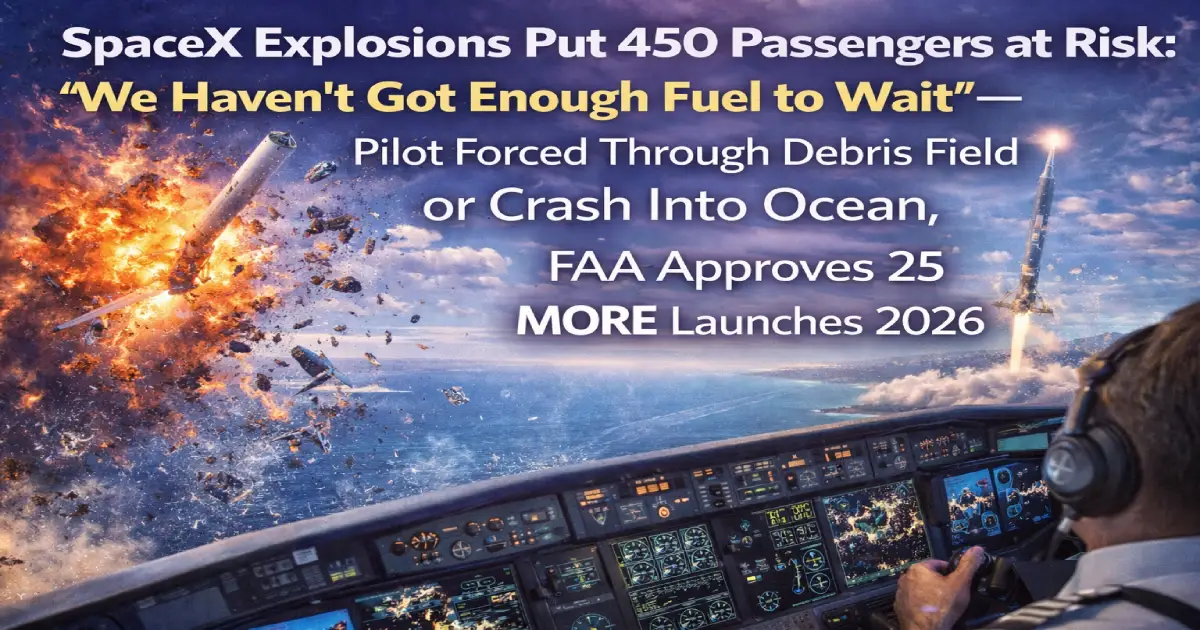
Breaking: Three passenger planes carrying 450 people were forced to fly through SpaceX rocket debris fields or risk running out of fuel over the Caribbean—after Elon Musk’s Starship exploded January 16, 2026, raining fiery metal across busy flight paths for 50 minutes. An Iberia pilot with 283 souls aboard declared a fuel emergency and told air traffic control: “We haven’t got enough fuel to wait.” Controllers warned him proceeding through the debris zone was “at your own risk.” He flew anyway. Nobody died—but FAA documents obtained by The Wall Street Journal reveal the incident posed an “extreme safety risk” far worse than SpaceX or regulators admitted. And it’s about to get 5X worse: the FAA just approved 25 Starship launches per year starting 2026, up from five. Here’s the complete investigation.
Published: January 22, 2026 Incident Date: Thursday, January 16, 2026 Location: Gulf of Mexico, Caribbean airspace Passengers Endangered: 450+ across 3 aircraft Debris Field Active: 50+ minutes Flights Affected: Iberia (Madrid-San Juan), JetBlue, private jet FAA Classification: “Extreme safety risk” SpaceX Response: “Misleading story,” denies danger 2026 Approved Launches: 25 (up from 5)
SpaceX’s Starship Flight 7 lifted off from Starbase, Texas at 7:13 PM Eastern on January 16, 2026—Elon Musk’s seventh attempt to perfect the world’s largest rocket. The 400-foot megarocket was supposed to demonstrate engine reliability improvements after Flight 6’s successful landing in November 2025.
Instead, 10 minutes into flight, one of Starship’s 33 Raptor engines failed. The upper stage spacecraft—traveling at over 17,000 mph through the edge of space—suffered a “rapid unscheduled disassembly.”
SpaceX’s euphemism for: it blew up.
Thousands of metal fragments—some weighing hundreds of pounds—began raining down across a 500-mile path from the Gulf of Mexico through the Caribbean toward Turks and Caicos.
Right through the busiest Caribbean flight corridor in the Western Hemisphere.
Miami air traffic controllers got their first warning NOT from SpaceX’s official hotline—but from terrified pilots radioing in:
Pilot: “Are you guys seeing this? There’s debris everywhere. Looks like a meteor shower but it’s METAL.”
Controllers frantically activated pre-coordinated “Debris Response Areas” (DRAs)—massive no-fly zones covering 50,000+ square miles of airspace.
Problem: At least 11 commercial aircraft were already inside the danger zone when the DRA activated.
Flight tracking data shows those planes had 15 minutes to get out before flaming rocket parts started hitting the ocean.
Three aircraft couldn’t escape in time:
1. Iberia Flight IB6251 (Airbus A350)
2. JetBlue Flight (Exact number redacted in FAA docs)
3. Private jet (Unidentified)
All three were north of San Juan when the DRA locked them out of their planned routes.
Their options:
ATC recordings obtained by ProPublica reveal the conversation:
Iberia Pilot: “We haven’t got enough fuel to wait.”
Miami Center Controller: “Understood. If you’re going to pass through the DRA, you guys’re going to be proceeding at your own risk.”
Iberia Pilot: “We have no choice. We’re going through.”
The Airbus A350 with 283 people—families returning from Christmas vacations, business travelers, tourists—flew directly through an active debris field where SpaceX rocket fragments were splashing into the Caribbean.
They made it. All three planes landed safely.
But they shouldn’t have been forced to choose between running out of fuel or dodging space junk.
The FAA kept the debris response area active for 71 minutes total—despite debris falling for only about 20 minutes.
Why? Because SpaceX didn’t immediately confirm Starship was disintegrating.
According to FAA documents:
Fifteen minutes. That’s how long SpaceX took to officially notify the FAA that their rocket had exploded and was endangering passenger aircraft.
The official hotline—designed for exactly this scenario—wasn’t used.
Miami controllers learned about the explosion from pilots, not from SpaceX.
Aircraft: Airbus A350-900 Route: Madrid-Barajas → San Juan Luis Muñoz Marín Flight Time: 8 hours 45 minutes Fuel Load: ~90 tons at takeoff, ~8 tons remaining
Iberia’s flight from Spain was in its final descent phase when the DRA activated. The A350 was burning fuel at cruise consumption rates—roughly 5,500 pounds per hour—when suddenly it couldn’t proceed to San Juan.
Fuel reserves on transatlantic flights:
The Iberia pilot calculated: “We don’t have 45+ minutes to hold.”
Flying through the debris field wasn’t reckless—it was the only option that didn’t guarantee ditching 283 people in the ocean.
The plane landed in San Juan with fuel gauges in the red. Passengers had no idea how close they’d come to catastrophe.
Iberia declined to comment when contacted by media.
FAA documents heavily redact the JetBlue flight details—flight number, route, exact passenger count—citing “security reasons.”
What we know:
Why the secrecy? Aviation analysts speculate JetBlue—already facing PR disasters in January 2026 (Pratt & Whitney engine failures, Aruba emergency landing)—pressured the FAA to minimize publicity.
JetBlue’s only statement: “The incident had no impact on our operations or passenger safety.”
Translation: We almost ran out of fuel dodging rocket debris but please don’t sue us.
The third aircraft—a private business jet—carried an estimated 17 passengers.
Unconfirmed speculation: Given the route and timing (Caribbean, Thursday evening), this may have been a corporate executive jet or celebrity aircraft.
The jet landed safely. No further details released.
Irony: Elon Musk himself frequently flies private. If one of his rockets endangered his jet, would SpaceX still call it “misleading reporting”?
Hours after The Wall Street Journal published its investigation, SpaceX’s official account (@SpaceX) posted on X:
“Yet another misleading ‘story.’ The reporters were clearly spoon-fed incomplete and misleading information from detractors with ulterior motives. No aircraft have been put at risk and any events that generated vehicle debris were contained within pre-coordinated response areas.”
Translation through the corporate BS:
❌ “No aircraft put at risk” = FALSE → FAA documents classify it as “extreme safety risk”
❌ “Debris contained within pre-coordinated areas” = TECHNICALLY TRUE BUT IRRELEVANT → Yes, the DRA covered where debris fell—but planes were already in that area
❌ “Reporters spoon-fed by detractors” = AD HOMINEM ATTACK → Translation: “We don’t like bad press so we’ll attack journalists instead of addressing facts”
SpaceX’s statement carefully avoids:
When corporations say “misleading,” they usually mean: “Accurate but makes us look bad.”
This isn’t Musk’s first time denying obvious danger:
2018: Called Thai cave rescue diver “pedo guy” after criticism 2020: Tweeted “Tesla stock price is too high” (lost $14B in minutes) 2022: Called Twitter’s child safety claims “false” (they weren’t) 2023: Denied Neuralink monkey deaths (FDA docs proved otherwise) 2024: Said Tesla FSD is “safer than humans” (NHTSA disagrees) 2026: Now claims rocket debris near planes is “no risk”
Pattern: Elon Musk doesn’t do accountability. He does attacks.
The Wall Street Journal obtained internal FAA communications, incident reports, and ATC recordings. Here’s what they reveal:
The FAA’s own assessment memo states:
“The January 16 Starship mishap posed an extreme safety risk to commercial aviation. Three aircraft with approximately 450 passengers total were forced to navigate around or through active debris fields. Fuel emergencies were declared. Controllers experienced potential extreme safety risk due to increased workload managing multiple simultaneous emergencies while tracking falling debris.”
“Extreme safety risk” is the FAA’s highest threat classification short of an actual crash.
It means: People almost died.
FAA regulations (14 CFR § 450.173) require launch operators to immediately notify the FAA via a dedicated hotline when anomalies occur.
SpaceX didn’t call.
According to the documents:
The delay forced controllers to make life-or-death decisions without complete information.
Imagine you’re a controller:
That’s not “contained within pre-coordinated areas.” That’s chaos.
The FAA assessment notes controllers faced “potential extreme safety risk” from increased workload.
Translation: They were so overwhelmed managing the emergency that they might have made mistakes.
Air traffic control is already one of the most high-stress jobs in America. Controllers manage dozens of aircraft simultaneously, each with hundreds of lives aboard.
Adding a surprise rocket explosion to the mix—without immediate notification from the responsible party—creates cascading failure risks.
One controller told investigators:
“I don’t know if you guys were advised, but there was a rocket launch and apparently the rocket exploded and there was debris in the area between us and Miami which basically covers our entire airspace. So I need to keep all the aircraft clear of that area because of the debris.”
“I don’t know if you guys were advised”—nobody told him in advance this was happening.
On May 6, 2025, the FAA released its Final Environmental Assessment approving SpaceX’s request to increase annual Starship launches from 5 to 25 per year at Starbase, Texas.
That’s one launch every 2 weeks on average.
The assessment concluded the impact on commercial aviation would be “minor or minimal.”
That was before January 16, 2026.
Now we know “minor or minimal” means:
And the FAA still approved 5X more launches.
SpaceX is also seeking approval for 44 Starship launches annually from Kennedy Space Center Launch Complex 39-A in Florida.
44 launches per year = roughly one every 8 days.
The flight path from Florida wouldn’t cross the Caribbean—it would cross the North Atlantic flight corridor.
Routes affected:
If Starship explodes over the North Atlantic with 1,000 planes in the air—how many fuel emergencies then?
The FAA’s Texas EA dedicated 3 pages to aviation impacts out of a 160-page document.
3 pages.
It concluded: “No airport would need to close and no airplane would be denied access for an extended period of time.”
Reality check: Iberia 6251 was “denied access” to San Juan for 71 minutes and almost ditched in the ocean.
The EA also states: “The FAA predicted the impact to the national airspace would be minor or minimal, akin to a weather event.”
Weather doesn’t cause fuel emergencies. Weather is predictable. Weather doesn’t involve 100-pound metal fragments traveling at terminal velocity.
This isn’t weather. It’s Russian roulette with passenger jets.
Elon Musk pioneered the “fail fast, iterate faster” approach to rocket development:
This works great for unmanned test flights in isolated areas.
It works terribly when flight paths cross the busiest airspace on Earth.
Starship’s failure rate:
Success rate: 2 out of 7 (28.6%)
Imagine if commercial airlines had a 28.6% success rate. Nobody would fly.
SpaceX’s Starbase facility in Boca Chica, Texas seemed like a perfect location in 2019:
What SpaceX didn’t account for: The flight path crosses the Gulf of Mexico and Caribbean, which hosts:
When you launch a 400-foot rocket that explodes 60% of the time, you’re playing dice with thousands of lives.
The FAA faces an impossible conflict of interest:
Mission 1: Promote U.S. commercial space industry Mission 2: Ensure aviation safety
These goals are incompatible when SpaceX wants to launch explosive prototypes through passenger flight corridors.
Post-Boeing 737 MAX scandal, the FAA promised to prioritize safety over industry interests.
But then:
Aviation safety advocate groups accuse the FAA of “regulatory capture”—where the agency meant to regulate an industry instead becomes its advocate.
Air Line Pilots Association (ALPA) President Jason Ambrosi:
“Any safety risk posed to commercial airline operations is unacceptable. It’s critical that a national space integration strategy include establishing launch planning and recovery standards.”
Translation: The FAA isn’t doing its job.
The Air Line Pilots Association—representing 80,000 pilots at 43 airlines—filed a formal letter with the FAA after the January 16 incident.
Key excerpts:
“Flight crews traveling in the Caribbean didn’t know where planes might be at risk from rocket debris until after the explosion. By that time, it’s much too late for crews who are flying in the vicinity of the rocket operation to be able to make a decision for the safe outcome of the flight.”
“Testing Starship over a densely populated area should not be allowed (given the dubious failure record) until the craft becomes more reliable.”
“The planned air closures could prove crippling for the Central Florida aviation network.”
The letter demands:
FAA response: “We will review existing processes and determine whether additional measures can be taken.”
Translation: “We’re doing nothing but we’ll say we’re looking into it.”
Captain Steve Kriese, who flies transatlantic and Caribbean routes, submitted this comment to the FAA docket:
“Last night’s SpaceX rocket explosion, which caused the diversion of several flights operating over the Gulf of Mexico, was pretty eye opening and scary. As a captain for a major airline and often flying over the Gulf, this is unacceptable.”
He’s not alone. Pilot forums are exploding (pun intended) with concern:
PPRuNe Forum (Professional Pilots Rumour Network):
“So let me get this straight—SpaceX can blow up rockets over my flight path and I’m supposed to just…hope I don’t get hit? Where’s the regulation?” – 737 Captain, 15,000 hours
Airline Pilot Forums:
“I flew through a DRA last week (different launch). Controllers gave me a choice: hold for 30 minutes or proceed at own risk. I had a full passenger load. What would YOU do?” – A320 FO
Reddit r/flying:
“Elon tweets about Mars while his rockets rain metal on my passengers. Cool cool cool.” – Regional airline pilot
Delta Air Lines—one of the largest Caribbean operators—issued this statement to ProPublica:
“The incident had minimal impact to our operation and no aircraft damage. Our safety management system and our safety culture help us address potential issues to reinforce that air transportation remains the safest form of travel in the world.”
Translation:
Notice what Delta doesn’t say:
Iberia Airlines refused to comment when contacted by media.
Why? Several theories:
But their silence speaks volumes.
If the incident was truly “no risk” as SpaceX claims, why wouldn’t Iberia say so?
Airlines are caught between:
Option A: Speak out about SpaceX danger → Risk political backlash, SpaceX retaliation, FAA friction Option B: Stay silent → Risk passenger safety, crew morale, future catastrophes
Most choose Option B because:
Result: Passengers have no idea their flights are dodging rocket debris.
While 450 passengers flew through danger, residents of Turks and Caicos got a different nightmare: burning rocket debris falling from the sky.
Videos circulated on social media January 16-17 showing:
One Turks resident told CNN:
“We thought it was a meteor shower. Then pieces started landing on the beach. My kids were out there an hour earlier.”
The FAA confirmed “reports of public property damage” but provided no details.
Unconfirmed reports include:
SpaceX has not commented on damage or potential compensation.
This isn’t Turks and Caicos’ first SpaceX debris shower.
Flight 8 (March 2024): Similar explosion, debris landed on the same islands.
Residents now joke: “Is it Tuesday? Must be SpaceX debris day.”
But it’s not funny. These fragments are traveling at terminal velocity—fast enough to penetrate roofs, vehicles, and human bodies.
Nobody has died yet. Yet.
Starting 2026, SpaceX can launch Starship 25 times per year from Boca Chica.
Best case scenario: All 25 succeed. No debris. No emergencies. Worst case scenario: 60% failure rate = 15 explosions over the Caribbean.
15 explosions.
Each one potentially endangering hundreds of passengers.
The FAA is still evaluating SpaceX’s request for 44 annual Starship launches from Kennedy Space Center.
If approved, that’s 69 Starship launches per year combined (25 Texas + 44 Florida).
One Starship launch every 5.3 days.
The North Atlantic and Caribbean would become permanent rocket debris hazard zones.
SpaceX’s Version 3 Starship—planned for late 2026—will be even larger:
Bigger rocket = bigger debris field when it explodes.
The entire Artemis moon program depends on Starship:
If Starship keeps exploding, NASA’s $93 billion program fails.
But NASA can’t say that publicly because they need SpaceX.
So NASA stays silent while commercial aviation bears the risk.
The FAA should immediately suspend the 5→25 launch increase until:
Current 60% failure rate = unacceptable for flight path testing.
SpaceX should be required to:
Counterargument: “But that’s expensive!” Response: So is killing 450 passengers.
Airlines need direct access to launch telemetry:
Technology exists. SpaceX shares this data with YouTube livestreams—why not pilots?
SpaceX should be financially liable for:
Currently, SpaceX faces zero financial consequences for endangering aircraft.
The FAA’s conflict of interest (promote industry + ensure safety) requires separation:
Congress won’t do this because Elon Musk donates millions to campaigns.
Use FlightRadar24 or FlightAware to see if your route crosses:
High-risk areas:
Especially risky:
Email customer service:
“I’m booked on [flight number] on [date]. Does the route cross SpaceX launch corridors? What procedures exist if a rocket explodes during my flight?”
Most airlines won’t have a good answer. That’s the point—make them uncomfortable.
If possible:
Contact your representatives:
US Congress:
Message:
“I’m a constituent and a frequent flyer. SpaceX’s Starship explosions are endangering commercial aviation. The FAA should suspend launch approvals until safety improves. Please investigate.”
EU Passengers: Contact European Aviation Safety Agency (EASA) if your flights cross Starship zones.
UK Passengers: Contact Civil Aviation Authority (CAA).
Elon Musk was appointed co-leader of Trump’s “Department of Government Efficiency” in January 2025.
DOGE’s mission: “Dismantle government bureaucracy and slash regulations.”
Which regulations? Ones like FAA oversight.
Musk has publicly attacked the FAA for “stifling innovation” and “slowing SpaceX progress.”
Translation: Regulations that prevent rocket debris from hitting passenger planes are “bureaucracy.”
With Musk advising Trump, the FAA faces immense political pressure:
This is regulatory capture at the highest level.
When the billionaire owner of the company you’re regulating is also advising the President who controls your budget and appointments—how can you say no?
SpaceX plans to go public in 2026 with a target valuation of $1.5 trillion (reported December 2025).
That would make it the most valuable company in history.
But that valuation assumes:
If the FAA cracks down on safety, SpaceX’s valuation craters.
$1.5 trillion reasons for Musk to fight any regulation.
On January 16, 2026, 450 passengers nearly died because a SpaceX rocket exploded over the Caribbean and the company didn’t immediately notify air traffic control.
An Iberia pilot with 283 souls aboard had to choose: fly through a debris field or ditch in the ocean.
He chose the debris field. Everyone lived. This time.
The FAA approved 25 more launches per year anyway.
SpaceX called accurate reporting “misleading.”
Elon Musk deflected with attacks on journalists.
Airlines stayed silent to protect their business interests.
Regulators are captured by the industry they’re supposed to oversee.
And passengers have no idea their flights are dodging rocket debris.
This is the new normal.
Until it’s not—because one day, a passenger plane will get hit. Metal fragments traveling at terminal velocity will penetrate a fuselage. Hundreds of people will die.
And SpaceX will tweet: “Success is uncertain, but entertainment is guaranteed!”
The pilot’s words echo:
“We haven’t got enough fuel to wait.”
Neither does commercial aviation. The FAA must act before the inevitable disaster.
Or the next fuel emergency won’t end with a safe landing.
For More Resources:
Related Articles:
Posted By : Vinay
This article is provided for general informational purposes only and is based on information available at the time of publication. Travel advisories, airline schedules, airport operations, visa requirements, government regulations, and other travel-related information are subject to change without prior notice. While Travel Tourister makes reasonable efforts to verify information using official announcements, government publications, airline and airport communications, and other reliable sources, we cannot guarantee that all information remains complete, accurate, or up to date at all times. Readers should independently verify any information that may affect their travel plans with the relevant airline, airport authority, government agency, embassy, or other official source before making travel, financial, or other decisions. Travel Tourister shall not be liable for any direct or indirect loss, inconvenience, or damages arising from the use of or reliance on the information contained in this article. Nothing in this publication constitutes legal, immigration, financial, or professional travel advice. If you believe any information in this article is inaccurate or outdated, please contact our editorial team. We review all credible correction requests promptly and update our content whenever appropriate.
Lastest News
2nd Floor, 39, Above Kirti Club, DLF Industrial Area, Kirti Nagar, New Delhi, Delhi 110015



Travel Tourister is a leading Travel portal where we introduce travellers to trusted travel agents to make their journey hasselfree, memorable And happy. Travel Tourister is a platform where travellers get Tour packages ,Hotel packages deals through trusted travel companies And hoteliers who are working with us across the world. We always try to find new and more travel agents and hoteliers from every nook and corners across the world so that you could compare the deals with different travel agents and hoteliers and book your tour or hotel with the one you have chosen according to your taste and budget.
Copyright © Travel Tourister, India. All Rights Reserved

 Call
Call Enquiry