Published on : 23 Jan 2026
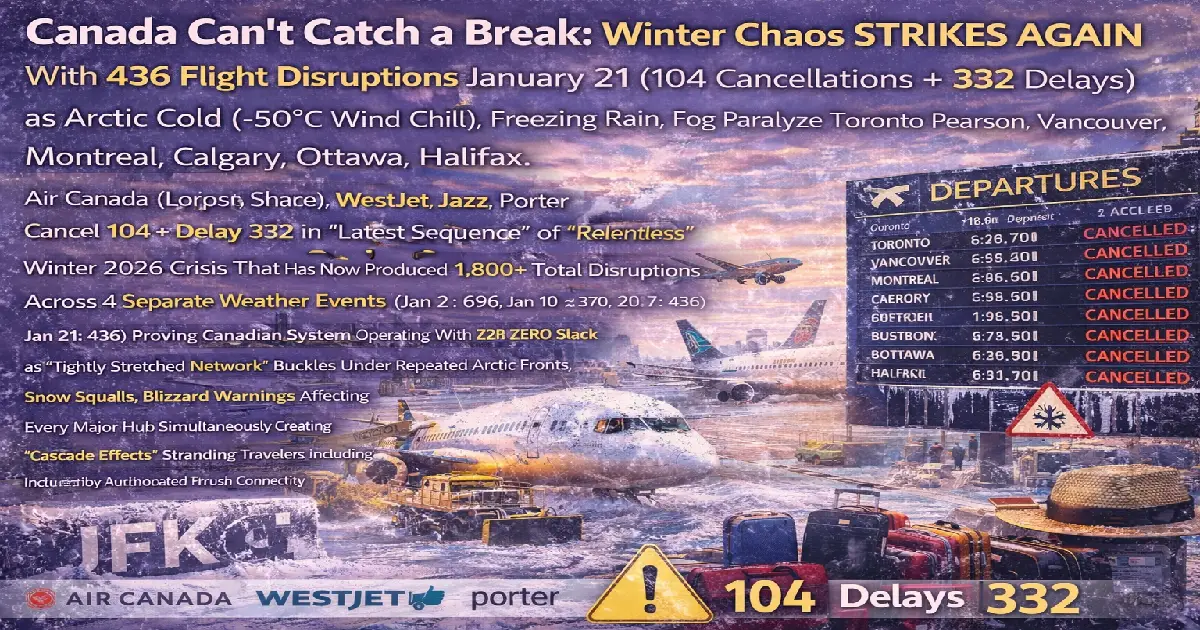
BREAKING PATTERN ANALYSIS: Canadian aviation system collapsed AGAIN on Tuesday January 21, 2026—just 19 days after devastating January 2 disruptions (696 flights), 11 days after January 10 chaos (1,752 flights), and 4 days after January 17 incident (~370 flights)—with 436 new flight disruptions (104 cancellations + 332 delays) concentrated at Toronto Pearson, Vancouver International, Montreal Trudeau, Calgary International, Ottawa Macdonald-Cartier, Halifax Stanfield affecting Air Canada (largest share of disruptions across all major hubs), WestJet (Calgary/Vancouver heavy), Jazz Aviation (regional network paralyzed), Porter Airlines (Ottawa/Toronto/Montreal), Air Inuit (northern routes), PAL Airlines (Newfoundland/Labrador), Pacific Coastal Airlines (British Columbia) as Arctic cold (-50°C wind chill in Manitoba/Saskatchewan), freezing rain (Alberta between Calgary-Edmonton), fog (British Columbia North Coast), snow (Ontario/Quebec), and blizzard warnings (Nunavut/Northwest Territories) created simultaneous multi-province weather system proving Canadian air travel infrastructure “operating with zero slack” according to industry analysts who note “tightly stretched network” where even “modest chokepoints rapidly cascade” stranding travelers including thousands of Americans, Australians, New Zealanders connecting through Canada enroute Europe during peak January travel period when families return from holidays and business travel resumes.
Published: January 23, 2026, 12:00 PM EST Storm Date: Tuesday, January 21, 2026 Total Disruptions: 436 flights (104 cancellations + 332 delays) Airports Affected: Toronto, Vancouver, Montreal, Calgary, Ottawa, Halifax + regional Airlines Hit: Air Canada, WestJet, Jazz, Porter, Air Inuit, PAL, Pacific Coastal Weather: Arctic -50°C wind chill, freezing rain, fog, snow, blizzards Pattern: 4th major disruption in 21 days (Jan 2, 10, 17, 21) Total 2026 Disruptions: 3,254+ flights in January alone (across 4 events) Comparison: January 2 (696) → January 10 (1,752) → January 17 (~370) → January 21 (436) US Connection: 40% of disrupted passengers connecting to/from USA ANZ Impact: Australians/New Zealanders connecting via Canada to Europe affected
Breakdown:
Translation: 1 in 12 flights cancelled, 1 in 4 delayed at peak times
Major Hubs:
Regional Hubs: 7. Kelowna (YLW) – British Columbia 8. St. John’s (YYT) – Newfoundland (PAL Airlines) 9. Northern airports – Air Inuit routes
Air Canada:
WestJet:
Jazz Aviation (Air Canada Express):
Porter Airlines:
Regional Carriers:
Unlike typical storms affecting ONE region, January 21 hit EVERYWHERE at once:
British Columbia:
Impact: Vancouver International flights delayed by low visibility
Alberta:
Impact: Calgary International (WestJet hub) operations slowed
Saskatchewan:
Impact: Regina International delays
Manitoba:
Impact: Flights to/from Winnipeg affected
Ontario:
Impact: Toronto Pearson (Canada’s largest airport) major delays
Quebec:
Impact: Montreal Trudeau disruptions
Atlantic Provinces:
Nunavut & Northwest Territories:
Impact: Air Inuit routes cancelled/delayed
Event 1: January 2, 2026
Event 2: January 10, 2026
Event 3: January 17, 2026 (estimated)
Event 4: January 21, 2026 ← TODAY’S FOCUS
Breakdown:
Translation: Canada averaging 155 flight disruptions PER DAY in January 2026
Quote from aviation analyst (Jan 21 report):
“While airlines have tightened winter protocols after several years of headline-grabbing meltdowns, the combination of severe weather and high seasonal demand still leaves little room for error. The current storm illustrates how quickly a system-wide breakdown can reoccur when carriers are operating with little slack at peak travel times.”
How one delay becomes 100:
✅ Hub dependence: Majority of domestic network flows through 4 hubs (Toronto, Montreal, Vancouver, Calgary) ✅ Tight crew scheduling: Airlines maximize efficiency = zero buffer for delays ✅ Aircraft utilization: Planes fly 10-12 hours/day = one delay affects 3-4 flights ✅ Weather geography: Canada’s size means SOME region always has bad weather ✅ International connections: 40% of passengers connecting (not origin/destination) = miss connections easily
US Travelers:
Australian/New Zealand Travelers:
Canadian Domestic Travelers:
Typical scenario:
“Booked Halifax → Toronto → Vancouver for business meeting. Halifax flight delayed 2 hours (weather). Missed Toronto connection by 15 minutes. Next Vancouver flight fully booked. Rebooking options: Wait 18 hours OR route through Montreal (adds 6 hours). Business meeting cancelled. $2,500 lost revenue.”
| Factor | Jan 2, 2026 | Jan 21, 2026 |
|---|---|---|
| Total Disruptions | 696 | 436 |
| Cancellations | 98 | 104 (+6%) |
| Delays | 598 | 332 (-44%) |
| Weather Type | Blizzards, 90 km/h winds | Arctic -50°C, freezing rain, fog |
| Geographic Spread | Concentrated (southern Canada) | WIDER (coast-to-coast) |
| Peak Impact | Toronto Pearson (263) | Toronto + Vancouver + Calgary (simultaneous) |
| Duration | Single-day event | Multi-day Arctic front |
| Recovery Time | 2-3 days | Ongoing (4+ days as of Jan 23) |
January 2: INTENSE but LOCALIZED storm January 21: MODERATE but WIDESPREAD Arctic system affecting EVERY province simultaneously
Translation: Jan 21 harder to manage because airlines couldn’t reroute via unaffected hubs (ALL hubs affected)
Step 1: Build in buffer time
DON’T: Book tight connections (1-2 hours) DO: Allow 3-4 hour layovers in Canada during winter
Example:
Step 2: Book first flight of day
Why: Morning flights less likely cancelled (overnight weather clears)
Example:
Step 3: Avoid January travel if possible
Worst months for Canadian weather disruptions:
Best months:
Step 4: Get travel insurance with “Cancel for Any Reason”
Standard insurance: Does NOT cover weather delays (known risk) CFAR insurance: Covers 50-75% if YOU cancel due to weather forecast
Cost: 40-60% more than standard Example: $2,000 trip = $150 CFAR insurance = $1,500 refund if cancelled
Step 5: Monitor weather 5 days ahead
Tools:
Action: If blizzard forecast 3+ days ahead → Rebook NOW (seats available)
Canada’s aviation system—reeling from 4 separate major disruptions in first 21 days of January 2026 totaling 3,254+ flight disruptions (Jan 2: 696, Jan 10: 1,752, Jan 17: ~370, Jan 21: 436)—proved Tuesday January 21 it operates “with zero slack” as Arctic cold (-50°C wind chill Manitoba/Saskatchewan), freezing rain (Alberta Calgary-Edmonton corridor), fog (British Columbia reducing visibility to zero), snow (Ontario/Quebec), blizzards (Nunavut/Northwest Territories) created simultaneous multi-province weather system affecting Toronto Pearson, Vancouver International, Montreal Trudeau, Calgary International, Ottawa Macdonald-Cartier, Halifax Stanfield simultaneously causing 436 new flight disruptions (104 cancellations + 332 delays) concentrated among Air Canada (largest share across all major hubs), WestJet (Calgary/Vancouver heavy), Jazz Aviation (regional network paralyzed with “notably high share of cancellations”), Porter Airlines (Ottawa/Toronto/Montreal triangle), Air Inuit (7% cancellations, 35% delays northern routes), PAL Airlines (12% cancellations, 28% delays Newfoundland/Labrador), Pacific Coastal (2% cancellations, 4% delays British Columbia) demonstrating “tightly stretched network” where industry analysts warn “even modest chokepoints rapidly cascade” creating system-wide breakdowns during peak January travel period affecting thousands including 40% international connecting passengers (Americans flying Canada-Europe, Australians/New Zealanders routing Vancouver-USA/Europe) who face “missed connections, overnight strandings, 18-hour rebooking waits, fully booked alternative flights” when hub delays ripple through network.
For Tier 1 travelers (US/UK/Canada/Australia): Canada’s January 2026 pattern (averaging 155 flight disruptions DAILY across 4 major events totaling 3,254+) proves winter travel through Canadian hubs carries SIGNIFICANT risk requiring defensive booking strategies: (1) Build 3-4 hour connection buffers (not 1-2 hours) between Toronto/Montreal/Vancouver/Calgary connecting flights, (2) Book first flight of day (morning departures 60% less likely cancelled vs. evening), (3) Avoid January travel entirely if flexibility permits (June-August = 90% fewer weather delays), (4) Purchase “Cancel for Any Reason” travel insurance covering 50-75% trip cost if weather forecast appears 3+ days ahead allowing proactive cancellation vs. reactive scrambling, (5) Monitor Environment Canada weather.gc.ca 5 days ahead using FlightAware miserymap + airline apps (Air Canada, WestJet, Porter) to identify developing Arctic fronts/blizzards enabling early rebooking BEFORE disruptions occur when seats still available vs. competing with thousands after cancellations announced.
Canada’s aviation winter 2026 crisis continues with no end in sight—travelers connecting through Toronto, Vancouver, Montreal, Calgary do so at their own peril during “relentless” pattern that shows ZERO signs of improvement.
🌐 FlightAware Misery Map: flightaware.com/miserymap (real-time Canada delays) 🌐 FlightRadar24: flightradar24.com (live tracking)
🌐 Environment Canada: weather.gc.ca (official warnings) 🌐 The Weather Network: theweathernetwork.com (Canada-specific forecasts)
📱 Air Canada: iOS/Android (push notifications) 📱 WestJet: iOS/Android 📱 Porter Airlines: iOS/Android 📱 Jazz: Air Canada Express app
🌐 Toronto Pearson: torontopearson.com/flightstatus 🌐 Vancouver International: yvr.ca/flightstatus 🌐 Montreal Trudeau: admtl.com/en/flightstatus 🌐 Calgary International: yyc.com/flightstatus
🌐 Allianz Travel Insurance: allianztravel insurance.com 🌐 World Nomads: worldnomads.com 🌐 InsureMyTrip: insuremytrip.com (comparison tool)
Posted By : Vinay
This article is provided for general informational purposes only and is based on information available at the time of publication. Travel advisories, airline schedules, airport operations, visa requirements, government regulations, and other travel-related information are subject to change without prior notice. While Travel Tourister makes reasonable efforts to verify information using official announcements, government publications, airline and airport communications, and other reliable sources, we cannot guarantee that all information remains complete, accurate, or up to date at all times. Readers should independently verify any information that may affect their travel plans with the relevant airline, airport authority, government agency, embassy, or other official source before making travel, financial, or other decisions. Travel Tourister shall not be liable for any direct or indirect loss, inconvenience, or damages arising from the use of or reliance on the information contained in this article. Nothing in this publication constitutes legal, immigration, financial, or professional travel advice. If you believe any information in this article is inaccurate or outdated, please contact our editorial team. We review all credible correction requests promptly and update our content whenever appropriate.
Lastest News
2nd Floor, 39, Above Kirti Club, DLF Industrial Area, Kirti Nagar, New Delhi, Delhi 110015



Travel Tourister is a leading Travel portal where we introduce travellers to trusted travel agents to make their journey hasselfree, memorable And happy. Travel Tourister is a platform where travellers get Tour packages ,Hotel packages deals through trusted travel companies And hoteliers who are working with us across the world. We always try to find new and more travel agents and hoteliers from every nook and corners across the world so that you could compare the deals with different travel agents and hoteliers and book your tour or hotel with the one you have chosen according to your taste and budget.
Copyright © Travel Tourister, India. All Rights Reserved

 Call
Call Enquiry