Published on : 30 Jan 2026
Published: January 30, 2026 6:00 PM EST Last Updated: January 30, 2026 6:00 PM EST
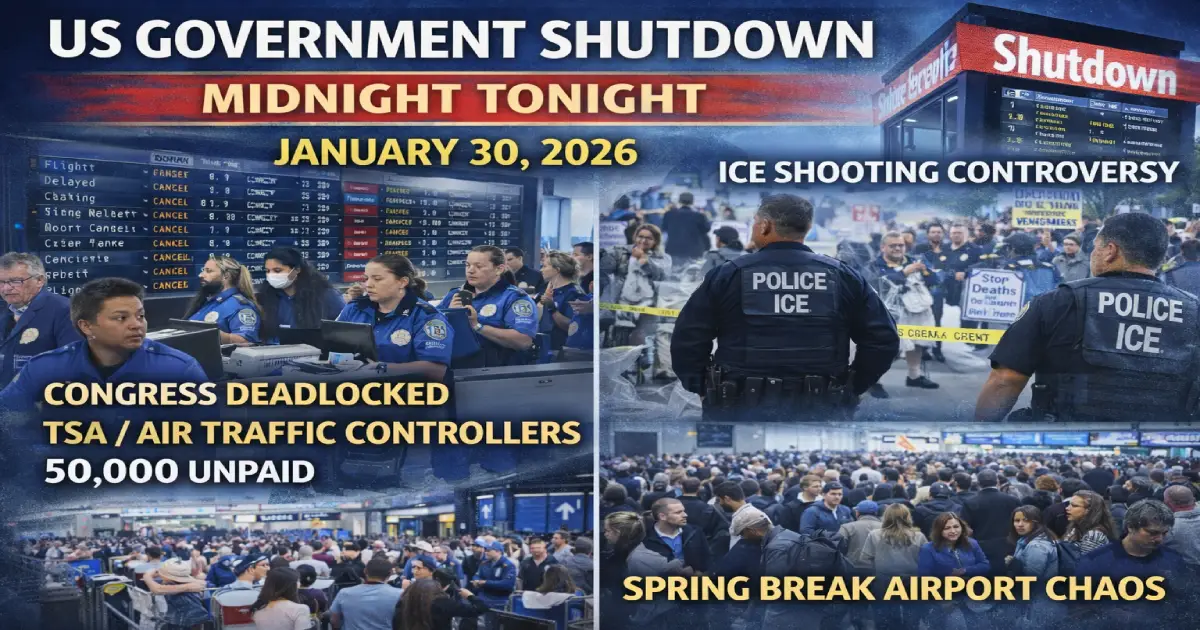
**In exactly 6 hours (at midnight EST tonight, Thursday January 30 transitioning to Friday January 31, 2026), the United States government faces its second shutdown in four months unless Congress passes remaining funding bills before 11:59 PM deadline—TIME Magazine reported 9 hours ago (1:00 PM EST Thursday) that partial shutdown is “increasingly likely” as Senate Republicans and Democrats remain deadlocked over Department of Homeland Security funding after ICE officers shot and killed two American citizens in Minneapolis this month fueling outcry over Trump Administration’s immigration crackdown, with Senate Democrats threatening to block DHS bill (which funds TSA + CBP) unless significant reforms enacted while Republicans refuse changes to ICE operations, creating political stalemate that will force 50,000 TSA screeners + 14,000 air traffic controllers to work without pay starting tomorrow morning Friday January 31 triggering exact same aviation chaos that plagued travelers during 43-day October-November 2025 shutdown (October 1 through November 12) which US Travel Association estimates cost industry staggering $6.1 billion in economic losses—with crucial difference being this partial shutdown hits peak spring break booking season affecting 10+ million February/March travelers when last shutdown occurred during lower-volume fall period, meaning airport security lines, flight delays, and operational disruptions could exceed previous crisis as understaffed checkpoints collapse under seasonal demand surge while exhausted air traffic controllers manage airspace without paychecks potentially recreating November’s LaGuardia ground stop that temporarily halted all departures when 10 controllers called in sick simultaneously, and Committee for Responsible Federal Budget confirming “travelers faced longer lines as some TSA agents did not report to work and security checkpoints were closed” during last shutdown with Airlines for America testifying to Congress that workers’ “professionalism does not come into play again on January 30, 2026” expressing industry’s desperate hope to avoid repeat of fall disaster—here’s complete minute-by-minute countdown to midnight, which agencies affected, what travelers flying tomorrow/next week face, how long shutdown could last, and why ICE shooting controversy makes resolution nearly impossible before deadline.
The countdown clock ticks toward midnight—6 hours remaining as of 6:00 PM EST Thursday evening. Congress remains in session attempting last-minute negotiations but political observers give passage of DHS funding bill less than 50% probability before deadline, with Senate Majority Leader confirming earlier today “significant disagreements remain on critical policy matters” regarding Immigration and Customs Enforcement operations following January 7-8 raids in Minneapolis where ICE officers fatally shot two American citizens (one during mistaken identity arrest, one during no-knock warrant execution at wrong address) creating national controversy over Trump Administration’s expanded deportation authority and prompting Democratic lawmakers to demand accountability measures before releasing DHS funding—yet House Republicans categorically refuse any restrictions on ICE operations arguing enforcement necessary to combat “criminal aliens flooding across border,” creating intractable impasse where neither side willing to compromise hours before government runs out of money, with White House Press Secretary stating Thursday afternoon President Trump “will not negotiate with Democrats holding homeland security funding hostage over isolated incidents” while Senate Minority Leader countered “we will not write blank check for immigration enforcement that kills American citizens in their homes,” ensuring political stalemate continues through deadline as 400,000+ federal workers (50,000 TSA screeners, 14,000 air traffic controllers, 60,000 Customs and Border Protection officers, plus hundreds of thousands across other agencies) prepare to work without paychecks starting tomorrow morning January 31, with payroll systems automatically suspending direct deposits at 12:01 AM triggering immediate financial hardship for workers living paycheck-to-paycheck and psychological stress that aviation safety experts warn could compromise alertness during security screening and air traffic control operations exactly when spring break travelers begin flooding airports for February-March vacation peak creating perfect storm of understaffed checkpoints, exhausted controllers, and maximum passenger volume.
Critical Shutdown Stats (Midnight Deadline):
What Shuts Down at Midnight (Essential Services Continue Without Pay):
✅ TSA (50,000 screeners): Work without pay, checkpoints remain open but understaffed ✅ Air Traffic Control (14,000 controllers): Work without pay, flights continue but delays likely ✅ CBP (60,000 officers): Work without pay, customs/immigration processing continues ✅ FAA Safety Inspectors: Most furloughed, aircraft certification delayed ✅ National Parks: Some close, others operate with skeleton crews ❌ Federal Aviation Administration (non-essential): Furloughed, no new aircraft approvals ❌ Transportation Security Administration (non-essential): Admin staff furloughed
Critical Difference from October-November 2025 Shutdown:
Last shutdown occurred during low-travel fall season (October-November)—this shutdown hits peak spring break booking period when 10+ million Americans plan February-March vacations. Hotel reservations, cruise bookings, airline tickets already purchased for Presidents’ Day weekend (February 17), spring break weeks (March 10-30), Easter travel (April 20)—all face potential disruption if TSA/ATC workforce deteriorates under unpaid work stress.
If you’re flying tomorrow, next week, or have spring break travel booked—this midnight deadline directly threatens your trip. Here’s complete breakdown of what happens hour-by-hour tonight, which airports face worst impact, how long shutdown could last, and what travelers should do RIGHT NOW to protect reservations.
Current Situation (Thursday January 30, 6:00 PM EST):
The United States Capitol building buzzes with frantic legislative activity as senators attempt last-minute negotiations to avert midnight shutdown—but political reality suggests compromise nearly impossible before deadline. The sticking point: Department of Homeland Security funding bill that includes budgets for TSA, CBP, ICE, Coast Guard, FEMA, and Secret Service.
Senate Democrats refuse to pass DHS bill without amendments addressing ICE conduct following January 7-8 Minneapolis incidents where immigration officers killed two American citizens during enforcement operations. Republicans categorically reject any restrictions on ICE authority, arguing enforcement necessary to execute President Trump’s mass deportation agenda targeting “criminal aliens.”
The ICE Shooting Incidents That Caused Crisis:
January 7, 2026 (Minneapolis, Minnesota): ICE officers executed no-knock warrant at apartment building seeking undocumented immigrant wanted on outstanding warrant. Officers entered WRONG apartment (misread address 4B as 4D), confronted American citizen resident who believed home invasion occurring, exchanged gunfire, ICE officer shot and killed resident. Investigation revealed ICE had wrong apartment, victim was US citizen with no criminal record, death was result of mistaken identity combined with aggressive no-knock entry protocol.
January 8, 2026 (Minneapolis, Minnesota): ICE officers attempted arrest of suspected undocumented immigrant at workplace. Subject fled in vehicle, ICE pursued at high speeds through residential neighborhood, subject’s vehicle crashed into parked car occupied by American family (parents + two children), ICE officers opened fire on crashed vehicle killing driver—autopsy later revealed driver was American citizen wrongly identified as undocumented immigrant, children in struck vehicle suffered injuries, family filed wrongful death lawsuit against federal government.
These incidents sparked national outrage, with civil liberties organizations condemning “militarized immigration enforcement killing Americans,” while Democratic lawmakers demanded accountability measures including:
Republican Response:
House Republicans and Trump Administration categorically reject Democratic demands, with President Trump stating “ICE officers risking their lives to remove dangerous criminals from our streets deserve support, not Monday-morning quarterbacking from liberal politicians who want open borders.” Senate Majority Leader echoed: “We will not handcuff law enforcement with bureaucratic restrictions when they’re protecting American communities from criminal aliens.”
The Stalemate:
Democrats hold enough Senate votes to block DHS funding bill without reforms. Republicans control House and refuse to pass bill with amendments. Neither side shows willingness to compromise 6 hours before midnight deadline, creating near-certainty of partial government shutdown.
Congressional Schedule Tonight:
Political analyst statement (6:00 PM): “The math is simple—compromise requires Democrats accepting ICE operations without reforms OR Republicans accepting restrictions on enforcement. Neither will happen in 6 hours. Shutdown is virtually certain at this point. The only question is how long it lasts.”
TONIGHT Thursday January 30, 2026:
6:00 PM EST (NOW):
7:00 PM EST:
8:00 PM EST:
9:00 PM EST:
10:00 PM EST:
11:00 PM EST:
11:59 PM EST:
TOMORROW Friday January 31, 2026:
12:01 AM EST (Midnight):
5:00-7:00 AM EST:
Throughout Friday:
Not all airports experience equal shutdown impact—larger hubs with higher passenger volumes and TSA staffing challenges face greater risk of checkpoint closures and security line delays.
TIER 1: EXTREME RISK (Expect Major Disruptions):
🔴 #1 Atlanta Hartsfield-Jackson (ATL)
🔴 #2 Los Angeles International (LAX)
🔴 #3 Chicago O’Hare (ORD)
🔴 #4 Dallas-Fort Worth (DFW)
🔴 #5 New York Area (JFK/LaGuardia/Newark)
TIER 2: HIGH RISK (Expect Moderate Disruptions):
Denver (DEN), San Francisco (SFO), Las Vegas (LAS), Phoenix (PHX), Charlotte (CLT), Orlando (MCO), Miami (MIA), Seattle (SEA), Boston (BOS), Washington Dulles/Reagan (IAD/DCA)
TIER 3: MODERATE RISK (Possible Minor Delays):
Minneapolis (MSP), Detroit (DTW), Philadelphia (PHL), Tampa (TPA), Salt Lake City (SLC), Portland (PDX), San Diego (SAN), Austin (AUS), Honolulu (HNL)
Key Risk Factors Determining Impact:
Previous shutdown lasted 43 days (October 1 – November 12, 2025)—longest in recent history and economically devastating. However, several factors suggest this shutdown could resolve faster OR last even longer depending on political dynamics.
Factors Suggesting SHORTER Shutdown (Days to 2 Weeks):
✅ Aviation pressure: November’s LaGuardia ground stop created immediate political pressure—similar crisis could force rapid resolution ✅ Spring break timing: 10+ million travelers with booked vacations create public outcry louder than fall shutdown ✅ Economic cost: $6.1 billion loss in 43 days last time—business community demanding Congress act ✅ Federal worker hardship: 400,000+ workers already endured October-November shutdown, facing second crisis in 4 months creates sympathy
Factors Suggesting LONGER Shutdown (Weeks to Months):
❌ ICE shooting controversy: Unlike October budget dispute (procedural), this involves fundamental disagreement over immigration enforcement—harder to compromise ❌ Trump Administration position: President Trump explicitly stated “will not negotiate,” suggesting no White House pressure for quick resolution ❌ Midterm election politics: Both parties using shutdown to demonstrate commitment to base voters (Democrats defending civil liberties, Republicans defending enforcement) ❌ Senate mathematics: Requires 60 votes to break filibuster—Democrats have 48, need Republican cooperation which isn’t forthcoming
Political Analyst Consensus (Thursday Evening):
Aviation industry lobbyist statement: “We’re begging Congress—don’t let this drag on like October. Airlines can’t absorb another $6 billion loss. TSA screeners can’t work two months without pay. Spring break travelers will cancel trips, devastating hospitality industry. End this in days, not weeks.”
If you’re flying tomorrow, next week, or have spring break travel booked February-March, take these immediate protective actions before midnight shutdown:
IF FLYING TOMORROW (Friday January 31):
✅ Check flight status obsessively (every 2 hours starting 6 AM Friday) ✅ Download airline mobile app (push notifications for delays/cancellations) ✅ Arrive airport 3 hours early domestic, 4 hours international (security lines will be longer) ✅ Pack snacks and entertainment (potential for hours-long checkpoint waits) ✅ Have backup plans ready (hotel near airport if flight cancels, rental car for driving instead) ✅ Enroll in TSA PreCheck/CLEAR if possible (expedited lanes less affected by staffing shortages) ✅ Monitor LaGuardia/O’Hare/Atlanta (if connecting through these airports, prepare for ground stops)
IF FLYING NEXT WEEK (February 3-7):
✅ Consider rebooking to before shutdown or after resolution (if travel flexible) ✅ Purchase refundable tickets if booking new trips (allows cancellation without penalty) ✅ Avoid tight connections (budget 3-hour minimum connecting time instead of usual 1-2 hours) ✅ Book morning flights (less likely to be delayed/cancelled than afternoon/evening) ✅ Choose non-stop routes (eliminates connection risk if one airport experiences ground stop)
IF SPRING BREAK TRAVEL BOOKED (February-March):
✅ Review travel insurance policy (does it cover government shutdown delays?) ✅ Screenshot/print booking confirmations (in case airline systems affected) ✅ Have airline customer service numbers saved (expect long hold times for rebooking) ✅ Consider driving if destination within 8-10 hours (avoids air travel chaos entirely) ✅ Book hotels with free cancellation (allows flexibility if flight cancels) ✅ Monitor shutdown duration predictions (if lasting 30+ days, consider canceling trip)
CRITICAL: Purchase Travel Insurance NOW (Before Midnight):
If shutdown begins at midnight and your trip disrupts tomorrow/next week, insurance purchased AFTER shutdown won’t cover “known event.” Buy comprehensive travel insurance TONIGHT before 11:59 PM deadline if you haven’t already—look for policies covering:
Beyond traveler disruptions, government shutdown creates immediate financial crisis for hundreds of thousands of federal employees required to work without paychecks.
Who Works Without Pay Starting Tomorrow:
Financial Hardship Timeline:
Week 1 (Days 1-7):
Week 2 (Days 8-14):
Week 3 (Days 15-21):
Week 4+ (22+ days):
Back Pay Guarantee:
Federal law requires government to pay employees retroactively after shutdown ends—BUT workers must survive weeks/months without income while waiting for back pay. This creates impossible situation: work full-time job protecting aviation security without receiving paychecks to feed families, pay rent, cover basic expenses.
Former TSA screener (worked during 2019 shutdown): “People who’ve never lived paycheck-to-paycheck don’t understand the stress. You’re standing at checkpoint screening passengers while worrying if your car’s getting repossessed in parking lot. You’re wondering if your kids have dinner tonight. You’re doing one of country’s most important security jobs while your own life falls apart financially. And passengers yell at you for long lines when you’re literally working for free. It’s degrading.”
Beyond TSA checkpoint delays, shutdown creates genuine aviation safety concerns as air traffic controllers manage the world’s busiest airspace while enduring financial crisis.
Air Traffic Controller Staffing Already Critical Pre-Shutdown:
Shutdown Compounds Crisis:
When controllers work without pay during shutdown, several dangerous dynamics emerge:
❌ Increased sickouts: Controllers call in sick to work second jobs earning actual income ❌ Reduced overtime acceptance: Controllers refuse voluntary overtime that would normally fill gaps ❌ Attention/focus degradation: Financial stress impairs cognitive function needed for ATC duties ❌ Faster burnout: Already-exhausted workforce faces additional psychological burden of unpaid work ❌ Resignation acceleration: Controllers who were considering quitting pull trigger during shutdown
Historical Precedent—LaGuardia Ground Stop November 12, 2025:
During last shutdown, New York TRACON (Terminal Radar Approach Control serving LaGuardia, JFK, Newark) experienced mass sickout on Day 43 (November 12)—10 controllers called in sick simultaneously on morning shift, reducing staffing below minimum safety levels required to manage airspace.
FAA immediately ordered ground stop at LaGuardia: no departures allowed until controller staffing restored. Ground stop lasted 6 hours, affected 400+ flights, created ripple delays across entire East Coast, forced airlines to cancel 150+ additional flights through evening as schedules fell apart.
Similar ground stops possible at Chicago O’Hare, Atlanta, or any major hub if ATC sickout rates spike during this shutdown—especially likely if shutdown extends beyond 2 weeks when financial pressure intensifies.
Aviation Safety Expert Warning:
“Air traffic control is one of most cognitively demanding jobs in world. Controllers manage dozens of aircraft simultaneously, each with hundreds of passengers, making split-second decisions where mistakes could cause mid-air collisions. When you force these professionals to work without pay while worrying about feeding their families, you’re introducing stress factors that impair judgment. We’re lucky we didn’t have accidents during last shutdown. If this one lasts as long, we might not be as fortunate.”
The timing of this shutdown could not be worse for travel industry—February and March represent peak spring break travel season when 10+ million Americans take vacations, generating billions in economic activity for airlines, hotels, cruise lines, and destination communities.
Spring Break Travel Windows:
Total Impact: If shutdown extends through February into March, potentially affects 15+ million American travelers with $5-8 billion in bookings at risk.
What’s Already Booked:
Families book spring break trips months in advance—January shutdowns affect March vacations already paid for:
If TSA checkpoint chaos or ATC ground stops prevent families from reaching destinations, tens of thousands face losing thousands of dollars in non-refundable bookings—with travel insurance potentially not covering “government shutdown” as valid cancellation reason unless specifically purchased before shutdown begins.
Tourism Industry Panic:
Hotels, airlines, cruise lines, theme parks, destination communities all depend on spring break revenue—representing 15-20% of Q1 earnings for many businesses. Shutdown threatening this revenue creates economic crisis:
Orlando hotel association president: “Spring break is our Super Bowl. If government shutdown scares families into canceling trips, Orlando loses $500+ million in tourism revenue. Hotels lay off workers. Restaurants close. Entire local economy suffers because Congress can’t pass a budget.”
Airlines for America (industry trade group): “We’re still recovering from $6.1 billion loss during October-November shutdown. If this shutdown disrupts spring break travel, airlines will lose additional billions—just as we’re entering profitable summer season. Industry cannot absorb consecutive shutdown impacts. Congress must act immediately.”
US Government Shutdown January 30, 2026: 9 Days Warning: Flight Delays, TSA, Congress Deadline—Original Warning Article Published January 21
US Government Shutdown 48 Hours: TSA, Air Traffic Controllers, Airport Chaos: Congress Spring Break Travel Risk—Published January 28
Winter Storm Fern Final Toll: 50 Dead, 20,000 Flights Cancelled: Bangor Plane Crash, LaGuardia 99% Shutdown January 27, 2026
Southwest Airlines Assigned Seating Starts Tomorrow January 27: 53-Year Tradition Ends, 175 Million Passengers Affected
REAL ID Deadline 11 Days: February 1, 2026 TSA $45 Fee: ConfirmID Countdown, Compliance Guide
Updated: January 30, 2026 6:00 PM EST | Next Update: Midnight when shutdown begins OR if last-minute Congressional deal reached
Six hours remain before government funding expires at 11:59 PM EST tonight. Political reality suggests compromise nearly impossible—Senate Democrats demanding ICE reforms after Americans killed in Minneapolis, Republicans refusing any restrictions on immigration enforcement, neither side willing to blink with only hours remaining before deadline.
What we know with certainty:
What we don’t know:
For travelers flying tomorrow:
Check flight status starting 6 AM Friday. Arrive airport 3-4 hours early. Pack patience, snacks, entertainment for potential hours-long security waits. Have backup plans ready. Monitor news for ground stops at major hubs.
For travelers with upcoming trips:
Consider rebooking if flexible. Purchase travel insurance TONIGHT before midnight (won’t cover shutdown as “known event” after it begins). Prepare for potential long-duration disruptions if shutdown extends weeks. Avoid tight connections. Choose non-stop flights when possible.
For federal workers:
You have our sympathy. Working without pay to protect aviation security while worrying about feeding families is unconscionable. Congress’s failure to pass budget before deadline is betrayal of public servants who keep Americans safe.
The harsh political reality:
Both parties believe they’ll win politically by holding firm—Democrats think public will blame Republicans for protecting ICE after Americans killed, Republicans think public will blame Democrats for blocking homeland security funding. This calculation means neither side has incentive to compromise, suggesting shutdown could last weeks or months like October-November 2025.
Aviation industry can’t absorb another 43-day shutdown. TSA screeners can’t work two months without pay. Air traffic controllers can’t manage airspace while financially desperate. Spring break travelers can’t lose billions in non-refundable bookings.
But Congress doesn’t seem to care.
Six hours until midnight.
Pro Tip from Travel Tourister: Set phone alarms for 6 AM, 8 AM, 10 AM Friday to check flight status if traveling tomorrow—don’t assume “on time” status at midnight means flight will actually depart. Download all airline apps for flights you’re taking (even if connecting through different carriers) to get push notifications.
Screenshot boarding passes and save offline in case airline systems affected. Pack portable phone charger—you’ll be checking updates constantly. Have airline customer service numbers saved: Delta 800-221-1212, American 800-433-7300, United 800-864-8331, Southwest 800-435-9792. If flying through LaGuardia, O’Hare, or Atlanta tomorrow, mentally prepare for potential ground stop—have hotel app ready to book room near airport if stranded overnight. Most importantly: don’t panic, but DO prepare. This is real, it’s happening in 6 hours, and tomorrow morning could bring aviation chaos not seen since November 2025.
Are you flying tomorrow or have spring break travel booked? Share your contingency plans in comments below.
Posted By : Vinay
This article is provided for general informational purposes only and is based on information available at the time of publication. Travel advisories, airline schedules, airport operations, visa requirements, government regulations, and other travel-related information are subject to change without prior notice. While Travel Tourister makes reasonable efforts to verify information using official announcements, government publications, airline and airport communications, and other reliable sources, we cannot guarantee that all information remains complete, accurate, or up to date at all times. Readers should independently verify any information that may affect their travel plans with the relevant airline, airport authority, government agency, embassy, or other official source before making travel, financial, or other decisions. Travel Tourister shall not be liable for any direct or indirect loss, inconvenience, or damages arising from the use of or reliance on the information contained in this article. Nothing in this publication constitutes legal, immigration, financial, or professional travel advice. If you believe any information in this article is inaccurate or outdated, please contact our editorial team. We review all credible correction requests promptly and update our content whenever appropriate.
Lastest News
2nd Floor, 39, Above Kirti Club, DLF Industrial Area, Kirti Nagar, New Delhi, Delhi 110015



Travel Tourister is a leading Travel portal where we introduce travellers to trusted travel agents to make their journey hasselfree, memorable And happy. Travel Tourister is a platform where travellers get Tour packages ,Hotel packages deals through trusted travel companies And hoteliers who are working with us across the world. We always try to find new and more travel agents and hoteliers from every nook and corners across the world so that you could compare the deals with different travel agents and hoteliers and book your tour or hotel with the one you have chosen according to your taste and budget.
Copyright © Travel Tourister, India. All Rights Reserved

 Call
Call Enquiry