Published on : 10 Feb 2026
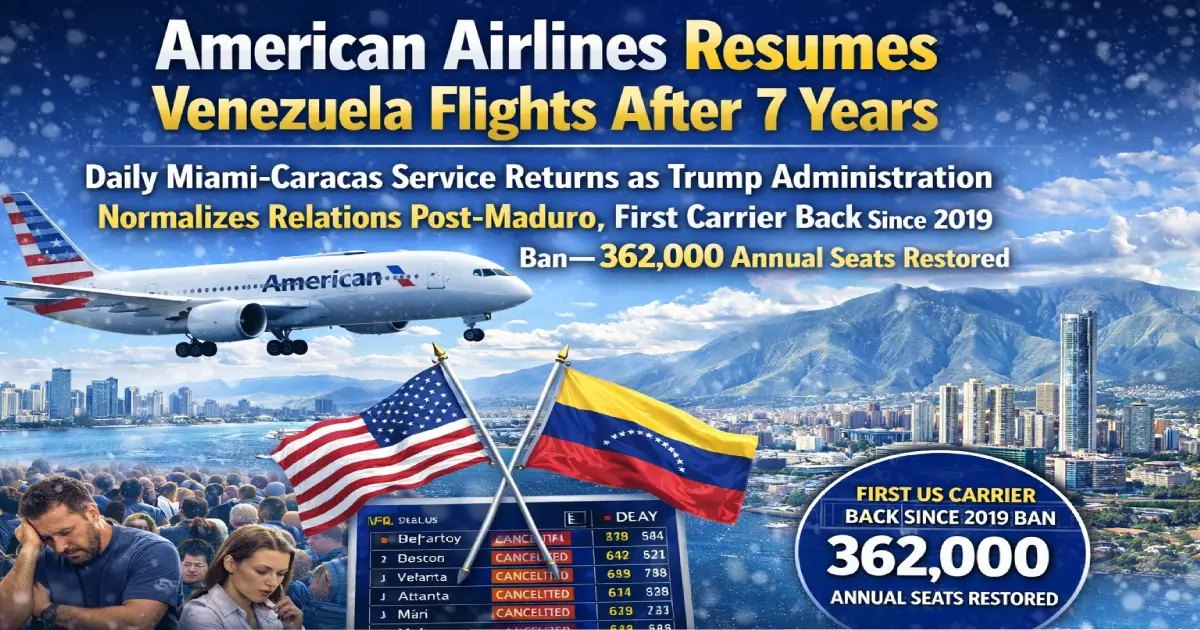
MAJOR GEOPOLITICAL SHIFT: American Airlines announced January 29-30, 2026, that it will become the first US carrier to resume nonstop flights to Venezuela after a near 7-year suspension, pending final government approvals and security assessments following the Trump administration’s dramatic reopening of Venezuelan airspace just weeks after the January 3 US military operation that captured President Nicolás Maduro. The Fort Worth-based carrier—which operated the last US commercial flight to Caracas in March 2019 before the DOT/DHS indefinitely banned all Venezuela service—plans daily Miami (MIA) to Caracas (CCS) routes leveraging its 30+ year history in the country where it once provided 362,000 annual two-way seats (58% of all US-Venezuela capacity). This marks an extraordinary reversal from “complete closure” (Trump’s November 2025 declaration) to full commercial reopening within 90 days, enabled by Acting President Delcy Rodríguez’s interim government cooperation with Washington on oil sector stabilization, diplomatic normalization, and aviation infrastructure assessments now underway by FAA/TSA teams evaluating Simón Bolívar International Airport safety protocols after years of isolation.
Published: February 10, 2026 Announcement Date: January 29-30, 2026 Last US Flight to Venezuela: March 2019 (American Airlines) Suspension Duration: Nearly 7 years (2019-2026) Planned Service: Daily Miami-Caracas nonstop Aircraft Likely: Boeing 737-800 or 737 MAX 8 Regulatory Status: Pending FAA safety assessment + TSA security clearance Launch Timeline: Estimated March-April 2026 (not confirmed) Historical Context: American operated Venezuela 1987-2019, largest US presence
On January 29-30, 2026, American Airlines became the first and only US carrier to publicly commit to restarting Venezuela service:
Official Statement (AA Newsroom):
“American Airlines is proud to be the first airline to announce plans to reinstate nonstop service between the United States and Venezuela. The airline remains in close contact with federal authorities, and is ready to commence flights to Venezuela, pending government approval and security assessments.”
Nat Pieper, Chief Commercial Officer:
“We have a more than 30-year history connecting Venezolanos to the U.S., and we are ready to renew that incredible relationship. By restarting service to Venezuela, American will offer customers the opportunity to reunite with families and create new business and commerce with the United States.”
The announcement comes after extraordinary geopolitical developments in January 2026:
November 2025: Trump declares Venezuelan airspace “completely closed,” issues NOTAM warnings grounding international airlines
January 3, 2026 (~3 AM ET): US military operation in Venezuela captures President Nicolás Maduro, flies him out of country
January 3-4: FAA closes Caribbean airspace 24 hours, 400+ flights cancelled affecting 50,000+ travelers
January 4: Airspace reopens, Trump says US will “run” Venezuela, tap oil reserves
January 29, 2026: Trump administration lifts Venezuela flight restrictions, instructs DOT/FAA to allow commercial service
January 29: Trump calls Acting President Delcy Rodríguez to announce airspace reopening
January 30: American Airlines announces resumption plans (first US carrier)
Oil Access:
Diplomatic Normalization:
Economic Reopening:
American Airlines wasn’t a random choice—it was Venezuela’s dominant US carrier for decades:
Routes Operated:
2018 Capacity:
Aircraft Used:
Amenities:
Why American Stopped:
May 2019 – Official Ban:
While American hasn’t finalized details, industry analysts expect:
Why Miami:
Why not Dallas or other hubs:
Initial service: 1 daily roundtrip (likely)
Rationale:
Most Likely:
Configuration (MAX 8 Example):
Why narrow-body:
Same-day turns (likely):
Security protocols:
American emphasized “pending government approval and security assessments”—what does that mean?
What FAA Must Evaluate:
Timeline: Typically 2-4 months for comprehensive assessment
Risk: FAA could deny approval if standards don’t meet US requirements
What TSA Must Evaluate:
Timeline: 1-3 months typically
Risk: TSA could require additional security measures or deny clearance
What Venezuela Must Do:
Timeline: Depends on cooperation level with Rodríguez government
Risk: Minimal (Venezuela wants US flights resumed)
Best case: FAA/TSA fast-track assessments (given political pressure), flights begin late March
Realistic: April 2026 launch after thorough but expedited reviews
Worst case: Delays push to May-June if infrastructure deficiencies found
Short answer: Unlikely immediately.
Delta Air Lines:
United Airlines:
Why American is alone (for now):
When might others return:
Laser Airlines (Venezuelan Carrier):
Conviasa (State-Owned Venezuelan Airline):
Copa Airlines (Panama):
Immediate impact:
Demand expectations:
Oil/energy sector:
Humanitarian organizations:
US State Department still warns:
Reality:
Direct flights restore belly cargo capacity, which is critical for:
Medical supplies:
Spare parts:
Perishables:
Economic impact:
State Department warnings persist:
Crew safety:
Infrastructure decay:
GPS interference:
Government instability:
US policy shifts:
Copa Airlines (Panama):
Wingo (Colombia):
European carriers:
Turkish Airlines:
LATAM, Avianca:
Pattern: Gradual, cautious reopening—not sudden flood of service
Q: When exactly will American’s Venezuela flights start? A: No confirmed date. Estimated March-April 2026, pending FAA/TSA approvals.
Q: Can I book tickets now? A: No. American hasn’t opened reservations. Wait for official launch announcement.
Q: Is it safe to travel to Venezuela? A: US State Department says NO (Level 4: Do Not Travel). High crime, kidnapping, detention risks. Only travel if absolutely necessary.
Q: Will flights be cheap? A: Unknown. Expect premium pricing initially (limited competition, high demand from diaspora).
Q: What about US citizens—can we visit Venezuela? A: Legally yes, but State Department strongly advises against it. Travel at your own risk.
Q: Will Delta or United also resume flights? A: Not announced. Likely wait to see how American’s service performs before committing.
Q: Can Venezuelans get US visas? A: Complicated. Trump’s 39-country visa ban includes Venezuela (effective January 1, 2026). Existing visa holders can travel, but new applicants face restrictions.
American Airlines’ January 29-30 announcement to resume Venezuela service represents a historic reversal from 7 years of complete US-Venezuela aviation isolation. Enabled by the Trump administration’s dramatic policy shift following Maduro’s capture and Rodríguez’s interim government cooperation, the planned daily Miami-Caracas route will restore 362,000 annual seat capacity and reconnect the largest Venezuelan diaspora community (South Florida) with their homeland for the first time since 2019.
However, significant hurdles remain:
For travelers, the message is nuanced:
American Airlines is betting that geopolitical normalization creates viable commercial opportunity. If FAA/TSA assessments confirm safety/security standards meet US requirements, flights could launch as early as late March 2026—marking the first US commercial service to Venezuela in nearly 7 years and a symbolic milestone in Trump administration’s Venezuela strategy.
Whether this becomes sustained reopening or temporary experiment depends on political stability, security improvements, and market demand in coming months.
For More Information:
Related Articles:
Posted By : Vinay
This article is provided for general informational purposes only and is based on information available at the time of publication. Travel advisories, airline schedules, airport operations, visa requirements, government regulations, and other travel-related information are subject to change without prior notice. While Travel Tourister makes reasonable efforts to verify information using official announcements, government publications, airline and airport communications, and other reliable sources, we cannot guarantee that all information remains complete, accurate, or up to date at all times. Readers should independently verify any information that may affect their travel plans with the relevant airline, airport authority, government agency, embassy, or other official source before making travel, financial, or other decisions. Travel Tourister shall not be liable for any direct or indirect loss, inconvenience, or damages arising from the use of or reliance on the information contained in this article. Nothing in this publication constitutes legal, immigration, financial, or professional travel advice. If you believe any information in this article is inaccurate or outdated, please contact our editorial team. We review all credible correction requests promptly and update our content whenever appropriate.
Lastest News
2nd Floor, 39, Above Kirti Club, DLF Industrial Area, Kirti Nagar, New Delhi, Delhi 110015



Travel Tourister is a leading Travel portal where we introduce travellers to trusted travel agents to make their journey hasselfree, memorable And happy. Travel Tourister is a platform where travellers get Tour packages ,Hotel packages deals through trusted travel companies And hoteliers who are working with us across the world. We always try to find new and more travel agents and hoteliers from every nook and corners across the world so that you could compare the deals with different travel agents and hoteliers and book your tour or hotel with the one you have chosen according to your taste and budget.
Copyright © Travel Tourister, India. All Rights Reserved

 Call
Call Enquiry