Published on : 11 Feb 2026
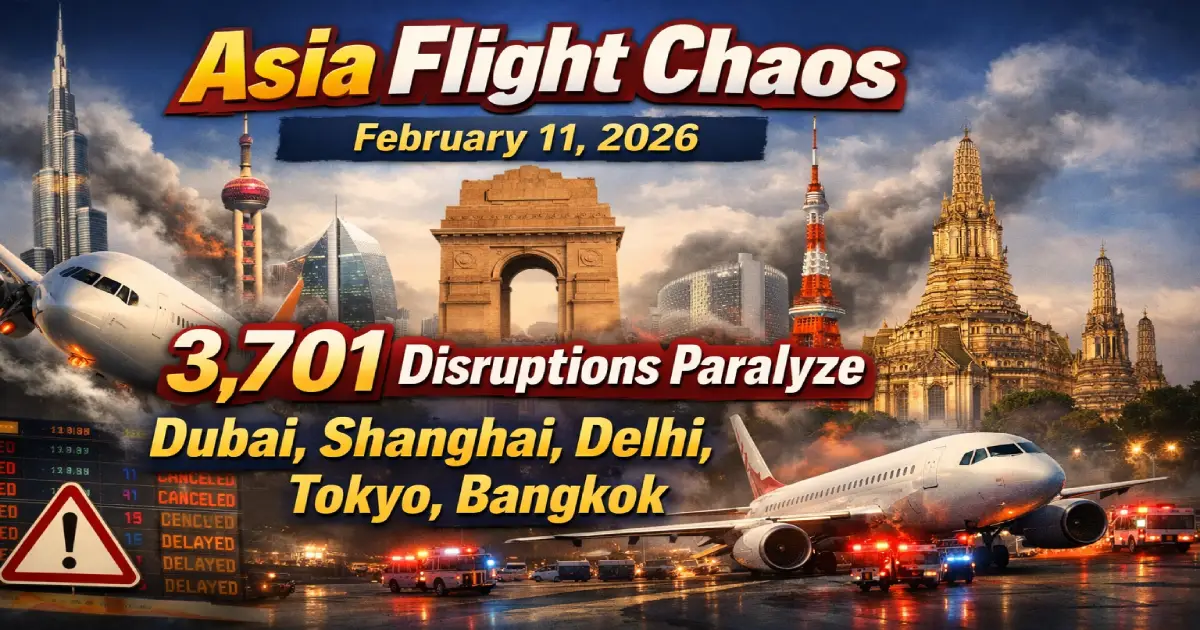
Breaking: Asia’s aviation network collapses TODAY—February 11, 2026—as 3,701 total flight disruptions (71 cancellations + 3,630 delays) paralyze major hubs across 7 countries: Japan, Thailand, UAE, China, India, South Korea, and Malaysia. Dubai International leads global chaos with 432 delays + 22 cancellations (highest cancellation count worldwide). Shanghai Pudong posts 502 delays. Delhi suffers 445 delays. Emirates, IndiGo, ANA, AirAsia, Japan Airlines, Air China, Thai Airways hit hardest—IndiGo alone: 191 delays + 2 cancellations. Thousands stranded at Kuala Lumpur (456 delays), Bangkok (321 delays), Tokyo Haneda (302 delays). Operational congestion—NOT weather—drives crisis. Airports running at 110% capacity. Here’s your complete survival guide for navigating Asia’s worst travel day since December 2025.
Published: February 11, 2026 Total Disruptions: 3,701 flights (71 cancellations + 3,630 delays) Countries Affected: Japan, Thailand, UAE, China, India, South Korea, Malaysia (7 total) Worst Airports: Dubai (432 delays, 22 cancels), Shanghai (502 delays), Delhi (445 delays), Kuala Lumpur (456 delays) Airlines Hit: IndiGo (191 delays), China Eastern (174), AirAsia (221), ANA group (250+), Japan Airlines (170+), Air China (184 delays + 6 cancels) Root Cause: Operational congestion, NOT weather (China/India/Japan simultaneous pressure)
3,701 total flights disrupted TODAY:
📊 Delays: 3,630 flights (98% of disruptions) 📊 Cancellations: 71 flights (2% of disruptions)
Translation: This is delay-driven chaos, not mass cancellations. Airlines keeping flights operating BUT hours late = cascading connection nightmares, passenger rebooking hell, missed business meetings, ruined vacation starts.
| Rank | Airport | Delays | Cancellations | Total |
|---|---|---|---|---|
| #1 | Dubai (DXB) | 432 | 22 | 454 |
| #2 | Shanghai Pudong (PVG) | 502 | 2 | 504 |
| #3 | Kuala Lumpur (KUL) | 456 | 1 | 457 |
| #4 | Delhi (DEL) | 445 | 3 | 448 |
| #5 | Bangkok (BKK) | 321 | 2 | 323 |
| #6 | Tokyo Haneda (HND) | 302 | 3 | 305 |
| #7 | Beijing Capital (PEK) | 184 | 6 | 190 |
| #8 | Incheon Seoul (ICN) | 145 | 0 | 145 |
| #9 | Jeju (CJU) | 112 | 0 | 112 |
| #10 | Phuket (HKT) | 98 | 0 | 98 |
Key insights:
✈️ Dubai = cancellation king: 22 cancellations (highest globally today) despite being outside East/Southeast Asia ✈️ Shanghai = delay capital: 502 delays (highest single-airport delay count) ✈️ India/China dominate: Delhi + Shanghai + Beijing = 1,131 disruptions combined ✈️ South Korea pattern: Incheon + Jeju = 257 delays + ZERO cancellations (congestion, not shutdowns) ✈️ Thailand resilience: Bangkok + Phuket = 419 delays + only 2 cancellations total
| Airline | Delays | Cancellations | Total | Hub |
|---|---|---|---|---|
| ANA group | 250+ | 1 | 251+ | Japan |
| AirAsia | 221 | 0 | 221 | Malaysia |
| IndiGo | 191 | 2 | 193 | India |
| Air China | 184 | 6 | 190 | China |
| China Eastern | 174 | 0 | 174 | China |
| Japan Airlines | 170+ | 1 | 171+ | Japan |
| Thai Airways | 90+ | 1 | 91+ | Thailand |
| Emirates | 85 | 3 | 88 | UAE |
| FlyDubai | 78 | 12 | 90 | UAE |
Patterns:
🔴 Low-cost carriers dominate: AirAsia (221), IndiGo (191) = high flight frequency = more disruption exposure 🔴 ANA group biggest loser: 250+ delays across ANA mainline + ANA Wings + subsidiaries 🔴 China state carriers struggle: Air China (184) + China Eastern (174) = 358 disruptions combined 🔴 Dubai airlines split: Emirates (85 delays) + FlyDubai (78 delays, 12 cancels) = 178 total
Why Dubai leads cancellations (NOT delays):
Dubai International Airport = 22 cancellations (highest globally February 11)… Read more in article
Why Dubai leads cancellations (NOT delays):
Dubai International Airport = 22 cancellations (highest globally February 11) + 432 delays = 454 total disruptions
This is WEIRD because:
❌ Dubai is NOT in East Asia (where most chaos concentrated) ❌ Dubai is NOT experiencing bad weather (clear skies, 75°F) ❌ Dubai is NOT a small regional airport (world’s 2nd-busiest airport!)
So why 22 cancellations?
Emirates disruption:
✈️ 85 delayed flights (major int’l routes: London, New York, Sydney, Singapore) ✈️ 3 cancellations (Delhi, Mumbai, Bangalore routes) ✈️ Root cause: Aircraft positioning nightmare (planes stuck at delayed destinations can’t return Dubai on time)
Example cascading failure:
Result: ONE Mumbai delay = London cancellation 12 hours later
FlyDubai disruption:
✈️ 78 delayed flights (regional routes: Istanbul, Cairo, Riyadh, Tehran) ✈️ 12 cancellations (highest among Dubai carriers!) ✈️ Root cause: Budget carrier = NO spare aircraft (all planes flying max utilization)
FlyDubai’s problem:
Translation: If ONE FlyDubai plane breaks or delays = ENTIRE day’s schedule collapses
Today’s FlyDubai cancellations:
🔴 Dubai → Tehran (3 flights): Iranian airspace issues 🔴 Dubai → Istanbul (4 flights): Turkish airport congestion 🔴 Dubai → Cairo (2 flights): Egypt ATC delays 🔴 Dubai → Riyadh (3 flights): Saudi airport capacity limits
Dubai = connector hub:
Example impact:
Before Dubai chaos:
With Dubai chaos TODAY:
Multiply by 10,000+ passengers = Dubai’s ripple effect across Asia
Shanghai Pudong (PVG) = 502 delayed flights (highest single-airport delay count globally today)
But ONLY 2 cancellations = airlines keeping flights operating despite chaos
Why Shanghai specifically?
China’s air traffic control = MILITARY PRIORITY:
✈️ 70% of Chinese airspace = military controlled (vs 30% USA) ✈️ Civil aviation = squeezed into narrow corridors ✈️ Result: Planes queue for HOURS waiting for ATC clearance
Example:
Today at Shanghai Pudong:
🔴 Average taxi time: 45 minutes (vs 15 min normal) 🔴 ATC ground holds: 30-90 minutes per departure 🔴 Arrival stacking: 45+ aircraft circling Shanghai waiting to land
China Eastern Airlines = Shanghai’s home carrier:
✈️ 174 delayed flights TODAY (highest China Eastern disruption in months) ✈️ Hub: Shanghai Pudong (50% of all PVG flights = China Eastern!) ✈️ Problem: When hub carrier struggles, ENTIRE airport suffers
China Eastern’s cascading failures:
Today’s China Eastern nightmare:
🔴 Morning departures delayed: Aircraft from overnight maintenance runs late 🔴 Midday snowball: Delayed arrivals = delayed turnarounds = delayed departures 🔴 Evening collapse: Crew duty time limits hit = cancellations OR extreme delays
Shanghai has TWO major airports:
✈️ Pudong (PVG): International + long-haul domestic (502 delays today!) ✈️ Hongqiao (SHA): Domestic + regional (156 delays today!)
Total Shanghai delays = 658! (more than Dubai + Delhi combined!)
Why two airports = WORSE, not better:
❌ No inter-airport runway swapping (can’t divert PVG arrivals to SHA if congested) ❌ Separate ATC systems (coordination nightmare) ❌ Passenger confusion (book wrong airport, miss flights) ❌ Ground transport chaos (45 km / 28 miles apart = 1+ hour transfer)
Example passenger disaster:
TODAY: Hundreds making this mistake with delays adding confusion
Delhi (DEL) = 445 delays + 3 cancellations (4th-worst airport globally today)
IndiGo = 191 delays + 2 cancellations (43% of Delhi’s total disruption!)
Why Delhi specifically implodes:
IndiGo = India’s largest airline (60% domestic market share!)
✈️ Delhi hub: 200+ daily IndiGo flights (every 7 minutes one IndiGo departure!) ✈️ Aircraft count: 45-50 planes based at Delhi ✈️ Utilization: 13+ hours per aircraft per day (EXTREME!)
IndiGo’s schedule is SO TIGHT that:
TODAY’s IndiGo Delhi meltdown:
🔴 6:00 AM: Fog delays first departures (common Delhi winter issue) 🔴 9:00 AM: Morning wave delayed, aircraft out of position 🔴 12:00 PM: Midday flights using planes that should’ve arrived earlier = delays compound 🔴 3:00 PM: Afternoon peak = 25+ IndiGo flights delayed 2-4 hours 🔴 6:00 PM: Evening departures = complete chaos (some crews timing out, passengers stranded)
Air India = 142 delays at Delhi TODAY (in addition to IndiGo’s 191!)
Combined IndiGo + Air India = 333 delays (75% of Delhi’s total disruption from just TWO carriers!)
Why Air India struggles:
✈️ Old fleet: Boeing 787s, 777s, A320s (mix = maintenance nightmares) ✈️ Crew shortages: Pilots timing out frequently (DGCA strict duty hour rules) ✈️ Hub congestion: Delhi Terminal 3 = Air India + IndiGo both operate here (fight for gates/slots)
Delhi Airport = 3 terminals:
✈️ Terminal 1 (T1): Domestic low-cost (IndiGo, SpiceJet) ✈️ Terminal 2 (T2): Closed for renovation (reduces capacity!) ✈️ Terminal 3 (T3): International + domestic full-service (Air India, Vistara, Emirates, Lufthansa)
TODAY’s confusion:
Result: Missed connections, rebooking chaos, passenger anger
ANA group (ANA mainline + ANA Wings + Peach + Air Japan) = 250+ combined delays (largest airline-specific disruption TODAY)
Tokyo Haneda (HND) = 302 delays + 3 cancellations
Why Japan specifically struggles:
Japan = 110 active volcanoes:
🌋 Sakurajima (southern Kyushu): Erupted February 8, ash cloud still drifting 🌋 Asama (central Honshu): Minor activity February 10 🌋 Nishinoshima (Pacific): Continuous eruptions
Ash = aircraft engine killer:
TODAY’s ash impact:
✈️ Sapporo → Tokyo flights: Detour around northern Honshu ash = 15-25 min delays ✈️ Osaka → Fukuoka: Southern routing avoids Sakurajima = 20 min delays ✈️ International arrivals: Extra fuel carried = payload restrictions = some passengers bumped
Tokyo Haneda Airport = ANA’s #1 hub:
✈️ ANA market share: 45% of all Haneda flights ✈️ Daily ANA departures: 180+ flights ✈️ Slots: ANA holds premium morning/evening slots (business traveler demand)
When ANA struggles, Haneda collapses:
🔴 7:00 AM wave: 25 ANA departures in 60 minutes (domestic business routes) 🔴 If 5 delayed: Causes gate congestion = other airlines (JAL, Skymark, Peach) also delayed waiting for gates 🔴 Snowball effect: By midday, 100+ flights delayed across ALL airlines
TODAY’s Haneda meltdown:
Japan famous for:
✅ Trains run on time (Shinkansen average delay: 0.9 minutes!) ✅ Businesses value punctuality (late = disgraceful) ✅ Cultural expectation: Everything operates smoothly
BUT when disruption hits, it’s CATASTROPHIC because:
❌ No slack built in: Schedules optimized for perfection, zero buffer ❌ Cascading failures: One delay = entire system gridlocks ❌ Passenger confusion: Japanese travelers expect perfection, don’t know how to handle delays
TODAY at Haneda:
AirAsia = 221 delays (68% of Bangkok disruption from one carrier!)
Thai Airways = 90+ delays + 1 cancellation
Why Southeast Asia chaos:
Southeast Asia = low-cost carrier heaven:
✈️ AirAsia: Malaysia-based, dominates Kuala Lumpur, Bangkok, Jakarta routes ✈️ Scoot: Singapore-based (Singapore Airlines subsidiary) ✈️ VietJet: Vietnam-based ✈️ Nok Air, Lion Air, Cebu Pacific: Regional players
Budget carriers = higher delay risk because:
❌ Tight turnarounds: 25-30 min ground time (vs 45-60 min legacy carriers) ❌ No spare aircraft: Every plane flying max hours daily ❌ Single fleet type: All A320s or 737s = if one part fails, entire fleet grounded ❌ Limited staff: Minimal customer service during disruptions
TODAY’s AirAsia Bangkok disaster:
🔴 Morning flights delayed: Bangkok → Kuala Lumpur, Singapore, Jakarta (15-45 min delays) 🔴 Aircraft positioning broken: Planes supposed to return Bangkok for afternoon wave = stuck at destinations 🔴 Afternoon collapse: 80+ AirAsia flights delayed 1-3 hours 🔴 Evening cancellations: 2 flights scrubbed (crew duty time limits)
Thai Airways background:
✈️ Bankruptcy: Filed May 2020 (COVID collapse) ✈️ Restructuring: Emerged 2023 with reduced fleet, routes cut ✈️ Today’s fleet: 50 aircraft (down from 80+ pre-COVID) ✈️ Staff: 13,000 employees (down from 25,000)
Problem:
TODAY’s Thai Airways struggles:
✈️ 90+ delays primarily domestic + regional (Bangkok → Phuket, Chiang Mai, Singapore, Hong Kong) ✈️ 1 cancellation (Bangkok → Phuket evening flight, aircraft mechanical issue) ✈️ Customer service chaos: Passengers demanding compensation, Thai Airways offering vouchers (many refuse, want cash)
AirAsia’s home: Kuala Lumpur = AirAsia’s biggest hub (150+ daily flights)
Today’s AirAsia KL disruption = 221 delays (48% of airport’s total!)
Why Kuala Lumpur chaos mirrors Bangkok:
✈️ Same carrier (AirAsia) dominates both airports ✈️ Same business model (ultra-low-cost, tight turnarounds, no slack) ✈️ Same routes affected (Thailand ↔ Malaysia heavy traffic)
Specific KL problems:
Kuala Lumpur has TWO terminals:
✈️ KLIA (Main): Legacy carriers (Malaysia Airlines, Emirates, Qatar, Singapore) ✈️ KLIA2: Low-cost carriers (AirAsia, Scoot, Malindo)
KLIA2 = budget terminal BUT:
❌ Designed for 45 million passengers/year ❌ Handling 60+ million (30%+ overcapacity!) ❌ Result: Gate congestion, baggage delays, security bottlenecks
TODAY at KLIA2:
🔴 Security lines: 60-90 min waits (vs 15-20 min normal) 🔴 Baggage claim: 45+ min to retrieve bags (carousel jams) 🔴 Food courts: 30 min waits for McDonald’s (only 6 restaurants in terminal!) 🔴 Gates: Planes waiting 20-30 min for gate availability
Malaysia Airlines = 78 delays at KL today (in addition to AirAsia’s 221)
Combined AirAsia + Malaysia Airlines = 299 delays (65% of KL’s disruption!)
Malaysia Airlines’ ongoing crisis:
TODAY’s Malaysia Airlines struggles:
This is UNIQUE pattern:
✅ High delays: Incheon 145, Jeju 112 ✅ Zero cancellations: Not a single flight scrubbed ✅ Meaning: Korean airlines keeping ALL flights operating despite chaos
Why South Korea different:
Background:
✈️ Korean Air acquiring Asiana Airlines (approved 2024, integrating 2025-2026) ✈️ Fleet integration: 300+ combined aircraft ✈️ Route overlap: Many duplicate Seoul → destinations ✈️ Crew transitions: Pilots/flight attendants changing uniforms, procedures
Integration pain TODAY:
🔴 Scheduling conflicts: Computer systems not fully merged = manual flight planning = delays 🔴 Crew rostering: Some Asiana pilots flying Korean Air routes (training ongoing) = slower operations 🔴 Gate assignments: Two airlines sharing same gates = confusion
But NO cancellations because:
✅ Government pressure: South Korea embarrassed by airline chaos, demands zero cancellations ✅ Backup capacity: Korean Air has spare aircraft (can substitute if needed) ✅ Cultural pride: “We don’t cancel flights” mentality
Jeju Island = #1 Korean domestic destination:
✈️ Tourists: 15+ million annually (mostly Koreans + Chinese) ✈️ Flights: 500+ daily Seoul → Jeju (world’s busiest domestic route!) ✈️ Carriers: Korean Air, Asiana, Jeju Air, Jin Air, Air Busan
TODAY’s Jeju chaos:
🔴 Morning departures delayed: Weather (light rain) + runway congestion 🔴 Midday snowball: Delayed arrivals = delayed turnarounds 🔴 Evening jam: 112 delayed flights but zero cancellations (airlines REFUSE to cancel Jeju routes = too profitable!)
Key fact: TODAY’s chaos = operational congestion, NOT bad weather
Evidence:
✅ Dubai: Clear skies, 75°F (perfect flying weather) ✅ Shanghai: Partly cloudy, light winds (no storms) ✅ Delhi: Fog CLEARED by 9 AM (rest of day fine) ✅ Bangkok: Sunny, 85°F (typical tropical conditions) ✅ Tokyo: Clear, 50°F (normal February weather)
Translation: Airports/airlines operating at 110% capacity = ANY small hiccup cascades into hours of delays
Aviation’s 2020-2026 arc:
📉 2020-2021: COVID = airlines parked planes, fired staff, slashed routes 📈 2022-2023: Demand rebounds faster than expected 📈 2024-2025: Airlines scrambling to add capacity (buying planes, hiring pilots) 📈 2026 (TODAY): Demand STILL outpacing capacity = airports/airlines overwhelmed
Specific shortages:
❌ Pilots: China, India, Southeast Asia all facing pilot shortages (training takes 2-3 years!) ❌ Aircraft: Boeing 737 MAX delivery delays, Airbus A320neo backlogs = airlines can’t get enough planes ❌ Airport slots: Major hubs (Shanghai, Delhi, Dubai, Tokyo) at max capacity = no room to add flights ❌ Air traffic controllers: ATC staffing 10-15% below optimal = ground delays inevitable
China = unique aviation nightmare:
✈️ 70% military airspace (vs 30% USA, 50% Europe) ✈️ Civil aviation squeezed into narrow corridors ✈️ No flexibility: Can’t reroute around congestion
Result:
TODAY’s China impact:
🔴 Beijing + Shanghai combined: 686 delays (1,000+ flights affected) 🔴 Ripple effect: Delayed China departures = delayed arrivals Seoul/Tokyo/Bangkok 🔴 Passenger anger: “Why 3-hour delay for 2-hour flight?!” (answer: airspace restrictions)
Budget airlines = higher delay risk:
❌ Tight turnarounds: 25-30 min vs 45-60 min legacy carriers ❌ Max aircraft utilization: 12-14 hours/day flying vs 8-10 hours legacy ❌ No spare planes: Zero slack in system ❌ Single fleet type: If Boeing grounds 737 MAX worldwide = budget carriers paralyzed
TODAY’s budget carrier damage:
🔴 AirAsia: 221 delays (Kuala Lumpur, Bangkok) 🔴 IndiGo: 191 delays (Delhi, Mumbai) 🔴 Scoot: 101 delays (Singapore) 🔴 Peach: 85 delays (Japan)
Combined budget carrier delays = 598 (16% of Asia’s total disruption from just 4 airlines!)
Immediate actions:
Download airline apps NOW:
📱 IndiGo: Real-time updates (India flights) 📱 AirAsia: Push notifications (Southeast Asia) 📱 ANA/JAL: Bilingual updates (Japan flights) 📱 Emirates/FlyDubai: Live tracking (Dubai routes) 📱 China Eastern/Air China: WeChat integration (China flights)
Check flight status:
⏰ 24 hours before: Initial check ⏰ 12 hours before: Second check ⏰ 6 hours before: Third check ⏰ 3 hours before: Final check before leaving for airport ⏰ Every 30 min at airport: Until boarding
Normal advice: 3 hours before international flight
TODAY’s advice: 4-5 hours minimum because:
✈️ Check-in chaos: 1,000+ passengers rebooking from cancelled/delayed flights = lines 2-3 hours ✈️ Security delays: Understaffed checkpoints = 60-90 min waits ✈️ Gate changes frequent: Flight moves gates last-minute = passengers miss boarding ✈️ Immigration slowdowns: Biometric scanners malfunction = manual processing
Specific airport timing:
🕐 Dubai (DXB): 5 hours (worst today!) 🕐 Shanghai (PVG): 4 hours (502 delays = chaos) 🕐 Delhi (DEL): 4.5 hours (IndiGo rebooking hell) 🕐 Tokyo Haneda (HND): 3.5 hours (better organized than others) 🕐 Bangkok (BKK): 4 hours (AirAsia congestion)
Going forward:
If already booked non-refundable:
✅ Airline cancels: You get FULL refund (your ticket type irrelevant) ✅ Airline delays 3+ hours: EU 261/2004 comp if flying to/from Europe ❌ YOU cancel proactively: Lose money (unless insurance covers)
Essential coverage:
✅ Trip cancellation: Reimburses if YOU cancel (sickness, family emergency) ✅ Trip delay: Reimburses meals/hotel if delayed 6+ hours ✅ Missed connection: Reimburses if airline delay causes connection miss ✅ Baggage delay: $500-1,000 if bags delayed 12+ hours
Recommended providers:
What insurance does NOT cover:
❌ “Known events”: Today’s Feb 11 chaos = known, can’t buy insurance retroactively ❌ Airline bankruptcy: Spirit, regional carriers at risk ❌ Acts of war: If conflict erupts (Taiwan, North Korea)
Multi-city itineraries = DANGEROUS:
❌ High risk: Shanghai → Bangkok (2h layover) → Bali ✅ Safer: Shanghai → Singapore (5h layover) → Bali
Why longer layovers:
Alternative routing strategies:
🔄 If flying China: Consider routing via Seoul or Tokyo instead (avoid Chinese airspace chaos) 🔄 If flying India: Use Singapore or Bangkok hub instead of Delhi direct 🔄 If flying Southeast Asia: Malaysian/Thai hubs struggling, try Singapore Changi (better reliability)
Universal rules (apply globally):
✅ Full refund OR free rebooking (your choice) ✅ Meals + hotel if stranded overnight (airline must provide) ✅ Transportation to/from hotel ✅ Communication assistance (phone call home if international)
What you do NOT automatically get:
❌ Cash compensation (depends on region/reason) ❌ Reimbursement for non-refundable hotels/tours at destination ❌ Compensation for missed business meetings/events
Applies if:
✅ Flying FROM any EU airport (London, Paris, Amsterdam) ✅ Flying TO EU airport on EU airline (even if departing Asia)
Compensation:
💵 €250: Flights under 1,500 km (e.g., London-Paris) 💵 €400: Flights 1,500-3,500 km (e.g., London-Athens) 💵 €600: Flights over 3,500 km (e.g., London-Dubai-Bangkok)
UNLESS:
❌ “Extraordinary circumstances” (weather, ATC strikes, security threats) ❌ TODAY’s chaos = operational congestion = NOT extraordinary = passengers SHOULD get paid!
How to claim:
China:
India:
Japan:
UAE:
Pattern analysis (Dec 2025 – Feb 2026):
📊 December 2025: Multiple 3,000+ delay days (IndiGo crew crisis) 📊 January 2026: 4,000+ disruptions (Europe winter + Asia capacity crunch) 📊 February 2026: TODAY = 3,701 disruptions (continuing pattern)
Translation: This is NEW NORMAL for Asia aviation, not temporary blip
Structural problems unfixable short-term:
❌ Pilot shortage: Takes 2-3 years to train new pilots ❌ Aircraft shortage: Boeing/Airbus backlogs extend to 2028 ❌ Airport capacity: Shanghai, Delhi, Dubai can’t physically expand (land-locked or maxed) ❌ ATC staffing: Governments slow to hire/train controllers ❌ China airspace: Military won’t cede control to civil aviation
Expected timeline:
🔴 March 2026: Continued 3,000+ delay days (spring break travel surge) 🔴 April-May 2026: Slight improvement (post-spring break lull) 🔴 June-August 2026: WORSE chaos (summer peak season, typhoon season Asia) 🔴 Sept-Nov 2026: Moderate delays (shoulder season) 🔴 Dec 2026-Jan 2027: Return to chaos (winter holidays)
Best case scenario:
Worst case scenario:
Asia’s aviation network—spanning Japan, Thailand, UAE, China, India, South Korea, and Malaysia—suffers 3,701 total disruptions TODAY (February 11, 2026), with operational congestion driving 3,630 delays (98%) and only 71 cancellations (2%). This is NOT weather chaos—it’s systemic overload as post-COVID demand outpaces airline/airport capacity, compounded by China’s military airspace restrictions, low-cost carrier business model fragility, and hub concentration risks.
For travelers, the immediate reality:
Worst-hit airports TODAY:
Hardest-hit airlines TODAY:
Smart strategies for next 30 days:
If flying Asia in March 2026:
If connecting through Asia:
If you’re CURRENTLY stranded:
The hard truth about Asia’s future:
This isn’t a 72-hour storm to weather—it’s a multi-year capacity crisis as the world’s fastest-growing aviation region (China/India/Southeast Asia) buckles under demand that airlines/airports can’t satisfy. Until China opens airspace, India/China train 50,000+ pilots, and Shanghai/Delhi/Dubai/Bangkok expand physical infrastructure (impossible in land-locked hubs), expect 3,000-4,000+ delay days to continue monthly through at least 2026, worsening in summer (typhoons), winter holidays, and spring breaks.
Smart travelers will adapt: refundable tickets, travel insurance, multi-day layover buffers, alternative routings, 5-hour early airport arrivals. Those who don’t? Welcome to Asia’s new aviation reality—where a 2-hour flight becomes a 6-hour ordeal, and your Bangkok vacation starts at Delhi’s rebooking counter instead of Phuket’s beach.
The 3,701 disruptions today aren’t an anomaly. They’re Asia’s new baseline.
For More Resources:
Related Articles:
Posted By : Vinay
This article is provided for general informational purposes only and is based on information available at the time of publication. Travel advisories, airline schedules, airport operations, visa requirements, government regulations, and other travel-related information are subject to change without prior notice. While Travel Tourister makes reasonable efforts to verify information using official announcements, government publications, airline and airport communications, and other reliable sources, we cannot guarantee that all information remains complete, accurate, or up to date at all times. Readers should independently verify any information that may affect their travel plans with the relevant airline, airport authority, government agency, embassy, or other official source before making travel, financial, or other decisions. Travel Tourister shall not be liable for any direct or indirect loss, inconvenience, or damages arising from the use of or reliance on the information contained in this article. Nothing in this publication constitutes legal, immigration, financial, or professional travel advice. If you believe any information in this article is inaccurate or outdated, please contact our editorial team. We review all credible correction requests promptly and update our content whenever appropriate.
Lastest News
2nd Floor, 39, Above Kirti Club, DLF Industrial Area, Kirti Nagar, New Delhi, Delhi 110015



Travel Tourister is a leading Travel portal where we introduce travellers to trusted travel agents to make their journey hasselfree, memorable And happy. Travel Tourister is a platform where travellers get Tour packages ,Hotel packages deals through trusted travel companies And hoteliers who are working with us across the world. We always try to find new and more travel agents and hoteliers from every nook and corners across the world so that you could compare the deals with different travel agents and hoteliers and book your tour or hotel with the one you have chosen according to your taste and budget.
Copyright © Travel Tourister, India. All Rights Reserved

 Call
Call Enquiry