Published on : 07 Feb 2026
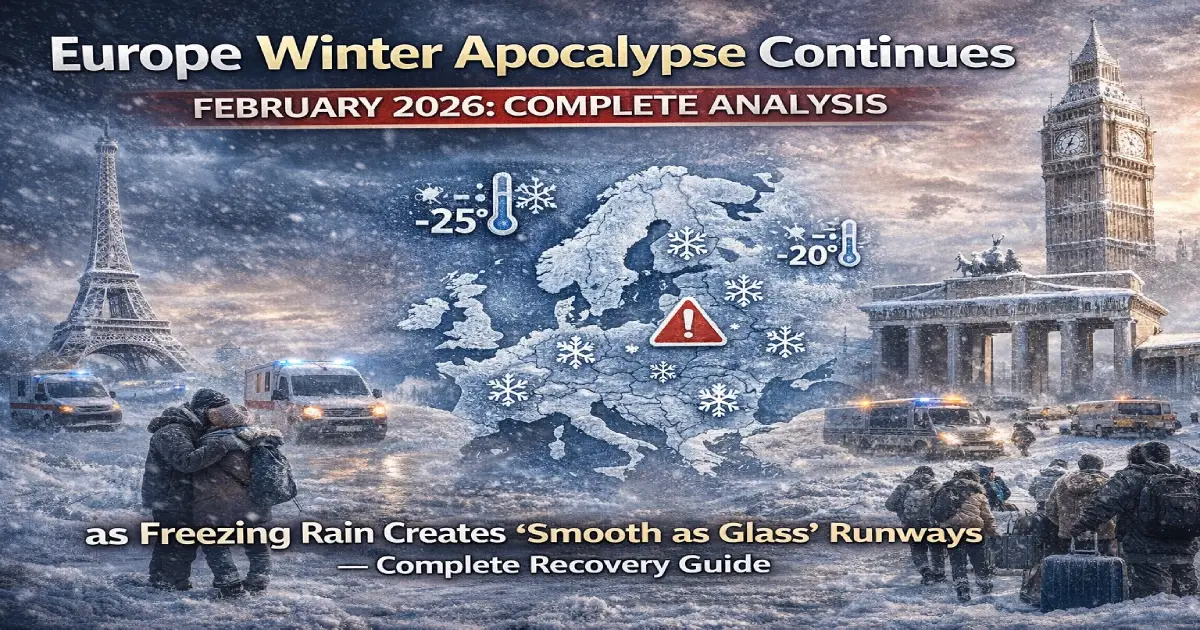
Breaking: Europe’s winter apocalypse shows no signs of stopping—February 2026 marks the second consecutive month of relentless airport chaos across the continent. Berlin Brandenburg Airport completely shut down for 48 hours (February 5-6) due to black ice that de-icing crews called “as smooth as glass.” Amsterdam Schiphol still recovering from January’s 3,200-flight meltdown. Paris Charles de Gaulle and London Heathrow battling continuous disruptions. Here’s the complete pattern analysis and what travelers need to know now.
Published: February 7, 2026 Latest Crisis: Berlin Airport shutdown February 5-6 (150+ flights canceled) Cumulative Disruption: 5,000+ flights affected across Europe January-February 2026 Hardest Hit: Berlin Brandenburg, Amsterdam Schiphol, Paris CDG, London Heathrow Duration: 38 consecutive days of continuous winter chaos (January 1 – February 7)
Berlin Brandenburg Airport—Germany’s third-busiest hub serving 25+ million annual passengers—experienced its most severe winter disruption in modern history when freezing rain created black ice so dangerous that operations halted completely for 48 hours.
What happened:
❄️ Thursday evening, February 5 – Freezing rain begins coating runways ❄️ 6:00 PM local time – De-icing crews report glycol spray freezing before taking effect ❄️ 6:30 PM – Airport suspends all takeoffs and landings indefinitely ❄️ Overnight Thursday-Friday – Clearing teams work non-stop with zero success ❄️ Friday morning 7:30 AM – Runways still “as smooth as glass” per airport spokesperson ❄️ Friday all day – Complete operational shutdown continues ❄️ Saturday February 7 – Gradual reopening begins (TODAY)
The numbers from Berlin:
Why it was so bad:
Black ice forms when freezing rain hits surfaces below 32°F (0°C), creating a transparent, glass-like coating impossible to see and incredibly dangerous for aircraft. Unlike regular ice or snow, black ice:
As one airport technician told German media: “We threw everything we had at it—glycol, scrapers, sweepers—and within 15 minutes the runways were glass again.”
Berlin’s shutdown isn’t an isolated event—it’s the latest chapter in Europe’s worst sustained winter travel crisis in decades.
JANUARY 2026:
January 4-12: Amsterdam Schiphol Meltdown
January 10: Italy Airport Strikes
January 19: NYC/Northeast Winter Storm
January 23: Europe-Wide Storm Goretti
FEBRUARY 2026:
February 5-6: Berlin Brandenburg Shutdown
February 6-7: Ongoing disruptions continue
Cumulative February 1-7 totals:
Climate Factor: Winter 2025-26 is tracking as one of Europe’s coldest and wettest in 40 years, with Arctic air masses stalling over the continent longer than normal.
Infrastructure Factor: European airports designed for mild winters—average temperatures of 35-45°F (2-7°C)—can’t cope with sustained below-freezing conditions.
Resource Factor: Schiphol’s de-icing fluid shortage (had to truck supplies from Germany) revealed systemic preparation failures across multiple airports.
Geography Factor: Northern Europe (Netherlands, Germany, UK) facing worst conditions while southern airports (Spain, Italy, Greece) remain largely unaffected—creating massive rerouting bottlenecks.
Status: Partial reopening underway after 48-hour shutdown
Recent Impact:
Current Situation:
German Weather Service Warning:
Passenger Rights:
Status: Recovering from January meltdown but vulnerable to relapse
Recent Impact (January):
Current Situation (February):
What Went Wrong: Schiphol—Europe’s 4th busiest airport—failed to anticipate that heavy snowfall would deplete de-icing fluid faster than usual. When trucks couldn’t resupply quickly enough, the entire operation collapsed.
Lessons NOT Learned: Other European airports still maintaining minimal de-icing stockpiles despite Schiphol’s warning, setting up potential repeat crises.
Status: Continuous disruptions but operational
Recent Impact (January-February):
Current Situation:
French Weather Patterns: Paris experiencing unusual sustained cold—normally mild winters averaging 40-45°F (4-7°C), but January-February 2026 seeing prolonged periods below freezing.
Status: Operational but struggling with capacity
Recent Impact:
Current Situation:
UK Weather Service:
Status: Better than Berlin but still disrupted
Recent Impact:
Current Situation:
Every major European carrier has implemented flexible booking policies:
Lufthansa:
KLM (Dutch):
EasyJet:
British Airways:
Air France:
EU Regulation 261/2004 applies to:
✅ Flights departing from EU airports ✅ Flights to EU airports on EU-based airlines ✅ Delays over 3 hours or cancellations
Short flights (<1,500 km): €250 per passenger Medium flights (1,500-3,500 km): €400 per passenger Long flights (>3,500 km): €600 per passenger
Airlines argue winter storms = “extraordinary circumstances” = no cash compensation required.
BUT passengers still entitled to:
✅ Meals and refreshments during delays ✅ Hotel accommodation if stranded overnight ✅ Transportation between airport and hotel ✅ Two free phone calls/emails to inform others ✅ Full refund if choosing not to travel ✅ Rebooking to alternative flight at no extra cost
Step 1: Keep ALL receipts (meals, hotels, taxis, phone calls)
Step 2: Submit claim to airline within reasonable time (recommend 30 days)
Step 3: If airline denies, escalate to national enforcement body:
Step 4: Consider third-party claims companies (they take 25-35% commission but handle everything)
“Extraordinary circumstances” definition is murky:
Airlines often deny initially, then pay after passenger escalation. Don’t accept first “no.”
Option 1: Delay Travel
Option 2: Buy Comprehensive Travel Insurance
Option 3: Book Direct Flights Only
Option 4: Monitor Weather Forecasts Obsessively
Option 5: Arrive at Airport 4+ Hours Early
Standard travel insurance WON’T cover:
❌ Canceling trip because you “don’t want to risk weather delays” ❌ Rebooking to earlier flight at your own choice ❌ Upgrading to business class to avoid middle seat
Comprehensive policies WILL cover:
✅ Trip cancellation if airport closes before departure ✅ Trip interruption if stranded mid-journey ✅ Meals/hotels if airline doesn’t provide ✅ Missed connection costs if first flight delayed ✅ Alternative transportation (trains, rental cars) to reach destination
Cancel For Any Reason (CFAR) adds:
✅ Cancel trip for literally any reason (75% refund typically) ✅ Must purchase within 14-21 days of booking trip ✅ Must cancel 48+ hours before departure ✅ Costs 40-60% more than standard insurance
Timing matters:
Best providers for European winter coverage:
Read the fine print:
European rail as backup:
Pros:
Cons:
Car rental considerations:
Pros:
Cons:
Climate scientists’ warnings:
European winters are becoming more variable—not necessarily colder overall, but with more extreme swings between mild and arctic conditions.
What’s changing:
Traditional European winter:
New pattern (2025-26 as example):
January 2026 statistics:
Infrastructure wasn’t built for this:
European airports designed for climate of 1960-1990 are facing 2020-2030 climate reality. Billion-euro upgrades needed:
Timeline for fixes: 5-10 years minimum
2026 Winter Disruption (January 1 – February 7):
Previous Major European Winter Crises:
December 2010 – “The Big Freeze”:
March 2018 – “Beast from the East”:
January 2019 – Munich Snow Chaos:
2026 is worse than any previous event because:
Current measures airlines implementing:
✅ Extended weather waivers (most offering 7-14 day flexibility) ✅ Proactive flight cancellations (better than last-minute) ✅ Extra de-icing fluid contracts ✅ Increased staffing at disrupted airports
What airlines AREN’T doing but should:
❌ Building weather delay costs into base fares ❌ Investing in cold-weather aircraft equipment ❌ Creating European-wide de-icing fluid sharing agreements ❌ Establishing backup airport partnerships ❌ Improving real-time passenger communication
The financial reality:
Airlines lose millions during winter disruptions but resist spending billions on prevention. Insurance and occasional compensation payouts cheaper than infrastructure overhauls.
Passenger advocacy groups demanding:
Weather models show:
February 8-14:
February 15-21:
February 22-28:
Long-range outlook (March 2026):
Europe’s winter apocalypse February 2026 isn’t a single event—it’s a sustained 38-day (and counting) pattern of relentless airport chaos that shows NO signs of stopping before March. Berlin’s 48-hour black ice shutdown (February 5-6) where de-icing crews called runways “as smooth as glass” is just the latest disaster in a continent-wide crisis that’s stranded hundreds of thousands of passengers, cost airlines €200+ million, and revealed catastrophic infrastructure failures.
For travelers, the math is brutal:
The smart moves:
If you must fly to/from/within Europe in February:
If you have ANY flexibility:
The hard truth nobody wants to hear:
This is the new normal. Climate change is making European winters more volatile, airports weren’t built for sustained arctic conditions, and infrastructure upgrades will take 5-10 years minimum. February 2026’s chaos is a preview of 2027, 2028, 2029…
Plan accordingly. The days of reliable European winter travel are over.
For More Resources:
Related Articles:
Posted By : Vinay
This article is provided for general informational purposes only and is based on information available at the time of publication. Travel advisories, airline schedules, airport operations, visa requirements, government regulations, and other travel-related information are subject to change without prior notice. While Travel Tourister makes reasonable efforts to verify information using official announcements, government publications, airline and airport communications, and other reliable sources, we cannot guarantee that all information remains complete, accurate, or up to date at all times. Readers should independently verify any information that may affect their travel plans with the relevant airline, airport authority, government agency, embassy, or other official source before making travel, financial, or other decisions. Travel Tourister shall not be liable for any direct or indirect loss, inconvenience, or damages arising from the use of or reliance on the information contained in this article. Nothing in this publication constitutes legal, immigration, financial, or professional travel advice. If you believe any information in this article is inaccurate or outdated, please contact our editorial team. We review all credible correction requests promptly and update our content whenever appropriate.
Lastest News
2nd Floor, 39, Above Kirti Club, DLF Industrial Area, Kirti Nagar, New Delhi, Delhi 110015



Travel Tourister is a leading Travel portal where we introduce travellers to trusted travel agents to make their journey hasselfree, memorable And happy. Travel Tourister is a platform where travellers get Tour packages ,Hotel packages deals through trusted travel companies And hoteliers who are working with us across the world. We always try to find new and more travel agents and hoteliers from every nook and corners across the world so that you could compare the deals with different travel agents and hoteliers and book your tour or hotel with the one you have chosen according to your taste and budget.
Copyright © Travel Tourister, India. All Rights Reserved

 Call
Call Enquiry