Published on : 17 Feb 2026
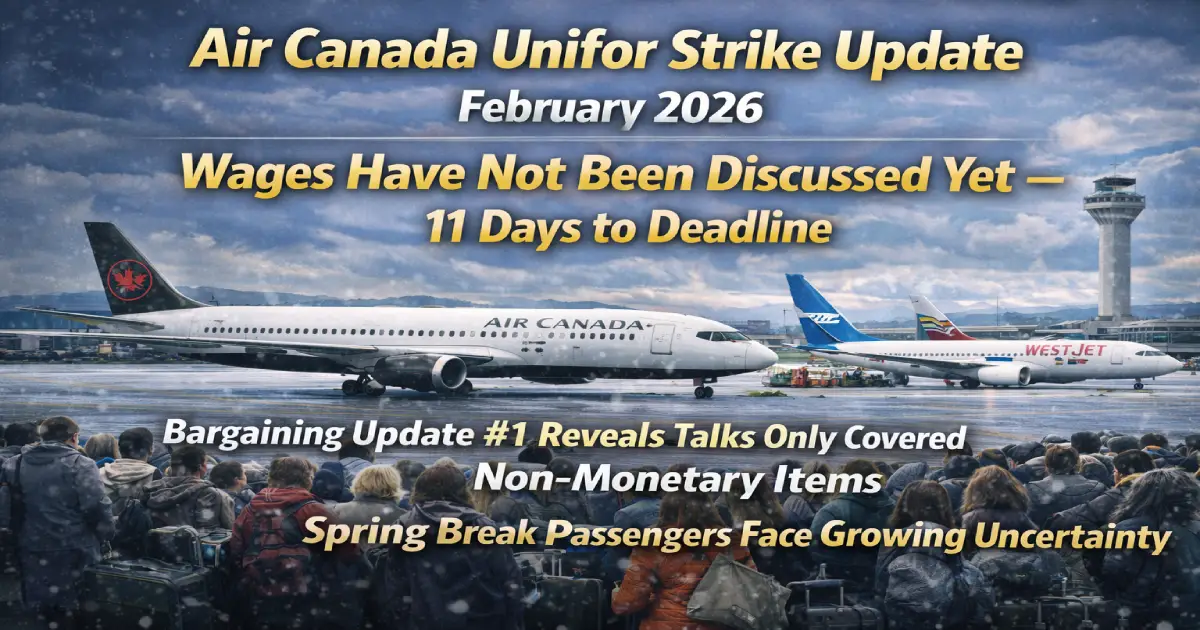
Breaking Update: Unifor Local 2002 has published its first official bargaining update from the negotiating table with Air Canada — revealing that in nine full days of talks running January 28 through February 6, the two sides have discussed ONLY non-monetary items such as editorial changes, clarifying language, and notice items, meaning that wages — the central demand of 5,826 customer service agents who say they are paid below industry standard despite Air Canada posting record profits — have not been discussed at all with just 11 days remaining until the February 28 contract expiry, while the union simultaneously warns members to “be aware of clickbait websites” and unauthorised social media content spreading misinformation about the negotiations, confirms that a statutory freeze means nothing changes automatically when the contract expires on February 28, and makes clear that the earliest any legal strike action could occur is late April or May 2026 following mandatory 60-day conciliation and 21-day cooling-off periods — leaving Spring Break travel at genuine risk and placing the FIFA World Cup 2026 matches in Toronto and Vancouver firmly within the potential labour action window. Here is the complete updated picture every Air Canada passenger needs to understand today.
Published: February 17, 2026 Days to Contract Expiry: 11 days (February 28, 2026) Bargaining Update #1 Published: 1 week ago — February 10, 2026 Talks Duration So Far: 9 days (January 28 – February 6, 2026) Items Discussed: Non-monetary ONLY — editorial changes, clarifying language, notice items Wages Discussed: NO — the central demand has NOT been tabled yet Workers Affected: 5,826 Unifor Local 2002 customer service agents Statutory Freeze Status: Active — collective agreement remains in effect after Feb 28 expiry Earliest Legal Strike: Late April / May 2026 (60-day conciliation + 21-day cooling-off) Spring Break Peak: March 14–21, 2026 — within potential action window World Cup Toronto/Vancouver Matches: June 11–July 19, 2026 — within potential action window Air Canada 2025 Profit: Record revenue year — agents argue wages don’t reflect performance Union Anniversary: 80 years — CALPAA founded November 8, 1946 Last Major Air Canada Strike: August 2025 — flight attendants, 500,000 passengers stranded
When Unifor published its first official bargaining update from the Air Canada negotiating table, the detail that every passenger and industry observer should focus on is buried in plain language:
“The Bargaining Committee met with the company, (YYZ snowstorm included) from January 28 until February 6th, focusing on non-monetary items. We have been progressing through the non-monetary items such as editorial changes, clarifying language and discussion about notice items that have arisen over the life of the collective agreement. We have many more issues to address on your behalf.”
Nine days of talks. Zero discussion of wages.
In any labour negotiation, the monetary items — wages, benefits, premiums — are the heart of the dispute. Everything else is framework. Editorial changes and clarifying language are the housekeeping of a contract renewal, not the substance. When a union represents 5,826 workers who say they have not received wage increases commensurate with their employer’s record profits, and nine days of bargaining produce zero monetary discussion, the actual fight has not yet begun.
“We have many more issues to address on your behalf.”
This single line from the bargaining committee is the most important sentence in the update. It is the union’s polite way of telling its members: we have barely started. The hard conversations — wages, benefits, scheduling, job security — are all still ahead.
With 11 days until contract expiry on February 28, and the most contentious items not yet on the table, the trajectory of these negotiations is concerning for passengers and workers alike.
One of the most misunderstood aspects of this situation is what February 28 means legally. Most passengers assume that when a contract expires, workers can immediately strike. Under Canadian labour law, this is incorrect — and the union is actively correcting misinformation.
“Remember, although our collective agreement expires on February 28, 2026, it remains in effect (called a statutory freeze) until we ratify a new agreement — nothing changes.”
The statutory freeze is a fundamental protection in the Canada Labour Code. When a federally regulated contract expires, all existing terms and conditions — wages, schedules, benefits, working rules — continue unchanged until a new agreement is ratified OR until legal strike/lockout action begins. Air Canada cannot unilaterally change any employment condition after February 28. Unifor workers continue under existing terms.
“The parties can continue bargaining under the protections of the Canada Labour Code after the contract expires, as there is no fixed length of time for collective bargaining itself — negotiations continue as long as progress is being made.”
What this means for passengers on February 28: Nothing changes operationally on that date. No automatic service degradation. No immediate strike risk. The date that matters for passengers is not February 28 — it is the date conciliation is requested, which starts the legal clock toward potential job action.
Once Air Canada’s contract with Unifor Local 2002 expires, the union and the airline enter a 60-day conciliation period. During this time, federal mediators help the two parties negotiate a new agreement. If the process fails, a 21-day cooling-off period follows, preventing any work stoppages. However, once this cooling-off period ends, federally regulated strikes or lockouts can occur — provided that the appropriate legal steps are followed.
The critical strike timeline in plain numbers:
| Event | Earliest Date | Notes |
|---|---|---|
| Contract expires | February 28, 2026 | Statutory freeze begins — nothing changes |
| Conciliation requested | March 1–7 (est.) | Either party can request at any time |
| Conciliation period | 60 days from request | Federal mediator assigned |
| Conciliation ends | Late April / early May | If no deal reached |
| Cooling-off period | 21 days | Mandatory after conciliation report |
| Earliest legal strike | Late May / early June | If ALL steps fail |
| Spring Break peak | March 14–21 | Before earliest legal strike |
| World Cup Toronto/Vancouver | June 11+ | Directly within potential window |
The passenger-critical insight: Spring Break in March is almost certainly safe from direct strike action — the legal timeline makes a March strike mathematically impossible. The genuine risk window is late May through the summer — precisely when World Cup 2026 matches are scheduled at Toronto and Vancouver.
“Any job action would require careful planning and could vary in scope depending on strategic decisions made by the union and the airline. The union has stressed that its objective is to negotiate terms that reflect the critical work its members perform, not to cause disruptions for travellers.”
“Air Canada’s customer service agents are the backbone of the passenger experience,” said Lana Payne, Unifor National President. “They manage delays, disruptions, and customer care under immense pressure, yet too often without the staffing and protections that reflect the value of their work. This bargaining round is about respect, safety, and fairness for the workers who keep Canada flying.”
“Our members are the people travellers rely on when flights are cancelled, connections are missed, or plans fall apart,” said Tammy Moore, President of Unifor Local 2002. “They deserve improved wages, predictable schedules, and working conditions that allow them to do their jobs properly. Air Canada must recognize that strong customer service starts with respecting the workers who deliver it.”
The 5,826 Unifor Local 2002 members perform every frontline passenger-facing function at Air Canada:
At airports (Toronto Pearson, Vancouver, Montréal, Calgary, Ottawa + 60 stations nationwide):
At contact centres:
The demands Unifor has not yet formally tabled: Their chief concerns include competitive wages in light of rising living costs, job security, respect for seniority, and working conditions that support safety and long-term sustainability.
Unifor has long called for systemic improvements in Canada’s aviation sector through its Air Transportation Workers’ Charter of Rights, which urges governments, airlines, and airport authorities to address chronic understaffing, contracting out, unsafe workloads, and inadequate training across the industry.
The staffing angle is particularly significant. Air Canada’s customer service agents have been managing five consecutive days of Toronto Pearson major disruptions this February — 1,000+ cumulative disruptions, Cuba crisis repatriation operations, and Presidents Day surge — all while working toward a wage negotiation that hasn’t even started substantively. The operational stress of this month is precisely the environment that hardens union resolve.
One of the most unusual elements of Bargaining Update #1 is a direct warning to members about misinformation:
“Also, be aware of click bait websites, social media content, as well as information within messaging apps that have been not authorized by the bargaining committee may not necessarily be accurate or true. The only reliable information is issued by Unifor direct from unifor2002.org and unifor.org, as well from Unifor Local 2002 e-news messaging.”
This warning — appearing in the very first official bargaining communication — signals that the information environment around these negotiations is already noisy enough to warrant a formal alert. Unofficial WhatsApp groups, Facebook posts, and Twitter/X accounts are apparently circulating unverified claims about strike timing, management offers, and negotiating positions.
For passengers, this warning carries a practical implication: any social media post claiming to know the strike date, the wage offer on the table, or the likelihood of job action is almost certainly speculation or misinformation. The ONLY reliable source for negotiation status is unifor.org/aircanada and unifor2002.org.
At this point, the travelling Canadian public is pretty triggered by the word “strike,” and for good reason. Contract disputes between airlines and various unions have resulted in mass delays and cancellations over the past several years. Most recently, the union representing Air Canada’s flight attendants went on strike in August 2025, resulting in mass cancellations across the country for several days.
The August 2025 flight attendant strike provides the operational template for what a customer service agent strike would look like — and why it is simultaneously less immediately disruptive and more structurally damaging than a pilot or flight attendant action.
Flight attendant strike (August 2025): Immediate, visible, catastrophic. Planes cannot fly without flight attendants. 500,000 passengers stranded within 72 hours. Cancellations visible on every departure board in Canada.
Customer service agent strike (potential 2026): Slower onset, less visible initially, but deeply damaging. Planes CAN fly without customer service agents — Air Canada would deploy managers, supervisors, and contracted third-party agents to cover basic check-in and gate functions. But:
The negotiations follow a previous labour conflict involving Air Canada, specifically with its flight attendants. In August 2025, over 10,000 flight attendants went on strike, resulting in significant flight cancellations and travel disruptions.
“Unifor’s predecessor, Canadian Airline Passenger Agent Association (CALPAA), united on November 8, 1946, and negotiated our first collective agreement, the foundation of the contract we apply today. We celebrate 80 years of building and strengthening our power. Like our predecessors, our commitment remains clear: defend our gains, make improvements with today’s reality, and to reach a collective agreement that reflects the value of our work.”
This is not incidental context — it is deliberate framing by the union. By invoking 80 years of collective bargaining history in the first update from the table, Unifor is telling its members: this fight has deep roots, we have won before, and we will not accept a deal that doesn’t reflect our history and our value.
The 80th anniversary framing also signals something to management: these workers have institutional memory of every Air Canada labour dispute since 1946. They know the playbook. They know Air Canada’s negotiating patterns. And they are approaching this round with the confidence of a union that has survived airline privatisation, Alitalia-style bankruptcy scares, pandemic furloughs, and the August 2025 strike — and emerged with their collective agreement intact.
Air Canada’s public communications on the Unifor negotiations have been minimal. The airline has issued no public statement on bargaining progress, no counter-offer disclosure, and no passenger-facing communication about February 28.
This silence is itself informative. Air Canada’s communications strategy during labour disputes follows a consistent pattern: say nothing publicly until a deal is close or a strike notice is imminent. The absence of any management statement does not mean talks are going well — it means they are managing the narrative.
The contrast with Air Canada’s other announcements this week is striking. While negotiating wages with 5,826 frontline agents, Air Canada simultaneously announced a firm order for 8 Airbus A350-1000 widebody aircraft for delivery from 2030 — the most ambitious long-haul fleet expansion in a decade. The airline is planning South Africa, India, and Australian routes for 2030 while its 2026 agents wait to table their first wage demand.
Union members are aware of this contrast. The A350 announcement — symbolising Air Canada’s confidence in its long-term financial future — is precisely the kind of corporate action that motivates workers to demand their share of that future.
Good news: Spring Break travel in March 2026 is very unlikely to be affected by any job action. The statutory freeze, conciliation process, and cooling-off period make a March strike legally impossible even if talks completely collapse on February 28.
✅ No immediate action required for March bookings ✅ Monitor unifor.org/aircanada for any significant negotiation developments ✅ Book refundable fares if purchasing new Spring Break tickets — not because of strike risk but as general travel insurance best practice
This is the genuine risk window. If conciliation is requested immediately after February 28 and fails within 60 days, a legal strike could coincide with late May–June.
✅ Book flexible/refundable fares for May and June travel — fare difference protection is worth it ✅ Consider travel insurance with “strike” coverage for World Cup travel packages ✅ Monitor the negotiation timeline — if Unifor files for conciliation in March, note the 60-day + 21-day timeline and watch for strike vote announcements ✅ Know your rights: Under APPR, Air Canada must notify passengers 14 days before a strike’s impact on specific flights — you will not be left without warning
The most important monitoring signals are:
Unifor Local 2002’s first official Bargaining Update from the Air Canada negotiating table reveals a concerning picture: nine days of talks covered only non-monetary items, wages have not been discussed at all, and 5,826 customer service agents’ central demands remain untabled with 11 days to contract expiry. The statutory freeze means nothing changes automatically on February 28 — but if talks fail and conciliation is requested, the earliest legal strike window opens in late May 2026, placing World Cup matches in Toronto and Vancouver directly in the potential labour action zone. Spring Break in March is legally protected from any strike action. The critical months to watch are May and June. The critical signal to monitor is whether Unifor files for federal conciliation after February 28 — that filing starts the clock that every Air Canada passenger with summer travel plans needs to understand.
Your Air Canada Strike Update Action Checklist:
✅ Flying Air Canada in March? Spring break is safe — statutory freeze + legal timeline makes March strike impossible ✅ Flying Air Canada in May–June? Book flexible/refundable fares — this is the genuine risk window ✅ Monitoring the situation? Only trust unifor.org/aircanada and unifor2002.org — ignore social media speculation ✅ Key signal to watch: Conciliation request filing — starts 60-day + 21-day clock ✅ World Cup Toronto/Vancouver tickets? Buy travel insurance with strike coverage NOW ✅ Travel agent? Brief clients on March safety vs May–June risk window immediately
Track the negotiation live:
For More Resources:
Related Articles:
Posted By : Vinay
This article is provided for general informational purposes only and is based on information available at the time of publication. Travel advisories, airline schedules, airport operations, visa requirements, government regulations, and other travel-related information are subject to change without prior notice. While Travel Tourister makes reasonable efforts to verify information using official announcements, government publications, airline and airport communications, and other reliable sources, we cannot guarantee that all information remains complete, accurate, or up to date at all times. Readers should independently verify any information that may affect their travel plans with the relevant airline, airport authority, government agency, embassy, or other official source before making travel, financial, or other decisions. Travel Tourister shall not be liable for any direct or indirect loss, inconvenience, or damages arising from the use of or reliance on the information contained in this article. Nothing in this publication constitutes legal, immigration, financial, or professional travel advice. If you believe any information in this article is inaccurate or outdated, please contact our editorial team. We review all credible correction requests promptly and update our content whenever appropriate.
Lastest News
2nd Floor, 39, Above Kirti Club, DLF Industrial Area, Kirti Nagar, New Delhi, Delhi 110015



Travel Tourister is a leading Travel portal where we introduce travellers to trusted travel agents to make their journey hasselfree, memorable And happy. Travel Tourister is a platform where travellers get Tour packages ,Hotel packages deals through trusted travel companies And hoteliers who are working with us across the world. We always try to find new and more travel agents and hoteliers from every nook and corners across the world so that you could compare the deals with different travel agents and hoteliers and book your tour or hotel with the one you have chosen according to your taste and budget.
Copyright © Travel Tourister, India. All Rights Reserved

 Call
Call Enquiry