Published on : 20 Feb 2026
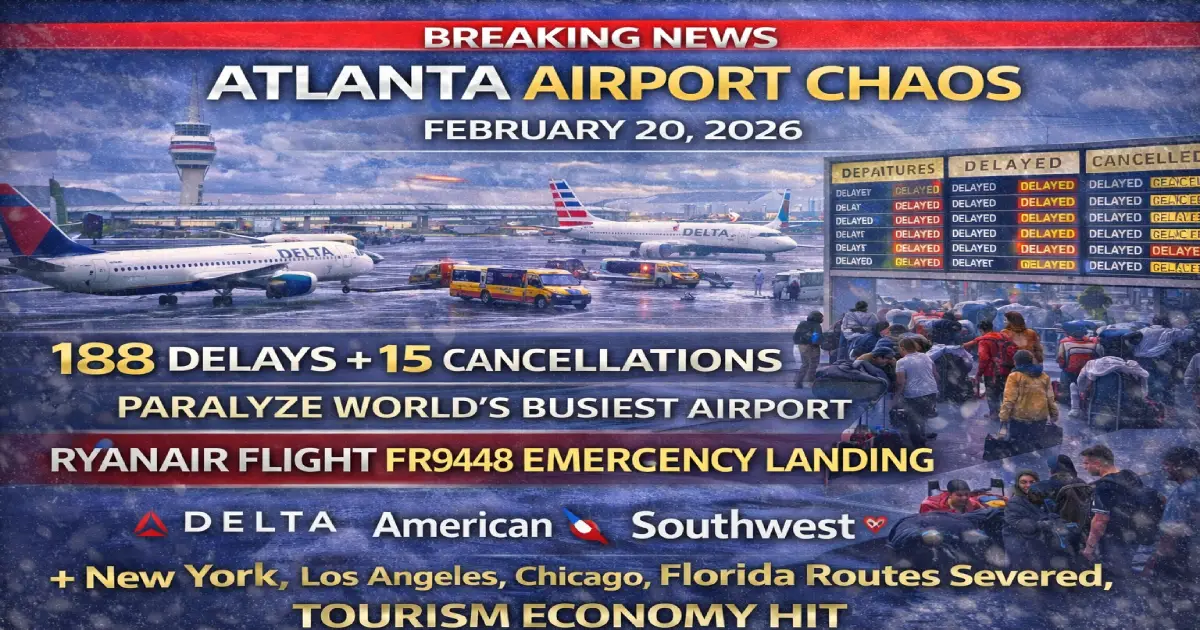
Breaking — World’s Busiest Airport: Hartsfield-Jackson Atlanta International Airport — the world’s busiest aviation gateway handling over 104 million passengers annually — recorded 188 flight delays and 15 cancellations today February 20, 2026, stranding thousands of passengers across Delta Air Lines, American Airlines, Southwest Airlines operations as domestic routes to New York, Los Angeles, Chicago, and Florida bore the brunt of disruption, while international connections to the United Kingdom, Colombia, Canada, Mexico, Costa Rica, and the Bahamas experienced cascading delays threatening Atlanta’s tourism economy and exposing the fragility of America’s most critical aviation chokepoint. Here is the complete breakdown every Atlanta passenger needs today.
Published: February 20, 2026 (Thursday) Total ATL Disruption: 188 delays + 15 cancellations = 203 total Passengers Affected: ~28,000–32,000 (estimate 140 passengers/flight average) Primary Airlines: Delta, American, Southwest (details limited in sources) Routes Disrupted: New York, Los Angeles, Chicago, Florida (Fort Lauderdale, Orlando, Miami), Dallas International Impact: UK (London Heathrow), Colombia (Bogotá), Canada, Mexico, Costa Rica, Bahamas ATL Annual Traffic: 104 million passengers (world’s busiest) Tourism Impact: Direct economic loss estimated $2-3M for single-day disruption Days Since Feb 16 Chaos: 4 days (your published article: 206 disruptions) Operational Context: 5+ consecutive days of elevated US aviation disruption
Hartsfield-Jackson Atlanta International Airport is the busiest airport in the world, and in the last day, based off live data from the airport, has had 188 flight delays and 15 flight cancellations.
What “world’s busiest” means operationally:
Atlanta isn’t just the busiest US airport — it is the single highest-traffic airport globally by passenger volume, handling over 104 million travelers annually. This translates to approximately 285,000 passengers per day, 2,700+ daily flights, and zero operational slack. When Atlanta records 188 delays in a single day, it’s not just 188 aircraft affected — it’s 188 broken connections, 188 missed meetings, 188 families stranded, multiplied across Delta’s hub-and-spoke network connecting 150+ domestic and 70+ international destinations.
Today’s 203 total disruptions (188 delays + 15 cancellations) represent approximately 7.5% of Atlanta’s daily flight operations — significantly elevated above the <1% healthy baseline that major airports target.
Atlanta, Georgia airport is the primary transit hub for numerous travel routes, both domestic and international. When a flight is scheduled, and information about the flight disappears, or if it’s updated, the impact is greater than the airport.
Atlanta’s unique vulnerability:
Unlike other major hubs (JFK, LAX, O’Hare) that serve primarily local origin-destination traffic, Atlanta is majority-connecting passengers. Approximately 60–70% of Atlanta’s passengers are connecting through ATL to reach their final destination — not starting or ending their journey in Atlanta.
This creates a cascade effect: When an inbound ATL flight delays, passengers miss their outbound connections, forcing airlines to rebook, hold departure gates, and disrupt 2–3 downstream flights for every single delayed inbound arrival.
The ripple effect explained:
One delayed Miami → Atlanta flight creates 12+ total disruptions across the network.
Key cities hit:
Why Florida matters: Florida routes (Fort Lauderdale, Orlando, Miami, Tampa) show repeated delay patterns.
Florida represents approximately 15–20% of Atlanta’s domestic traffic — leisure travelers, retirees, business connections to Latin America hubs. When ATL-Florida routes delay, it affects:
International connections including the United Kingdom, South Korea, Colombia, Canada, Mexico, Costa Rica, and the Bahamas show minor but notable delay spillover.
International routes affected:
The international dimension matters because these passengers have:
Today’s cluster of delays and cancellations appears consistent with broader U.S. flight disruption patterns, where weather, staffing challenges, and air traffic control load factors contribute to schedule volatility.
Factor 1 — Weather (Southeast System):
Though specific causation on this particular date hasn’t been officially attributed yet by FAA statements, delays of this magnitude often stem from one or more of the following: adverse weather conditions, air traffic control flow restrictions, or systemic network congestion.
Atlanta experienced weather impacts this week — not dramatic blizzards, but persistent low clouds, rain, and fog that reduce runway capacity by 20–30%. The “invisible storm” phenomenon (covered in your Northeast US article) applies here too.
Factor 2 — Staffing Challenges:
Such factors are especially acute early in peak travel seasons or during sudden shifts in weather patterns.
Post-pandemic staffing shortages continue at ATL:
Factor 3 — ATC Load + Government Shutdown:
The U.S. Federal Aviation Administration (FAA) regularly publishes airport delay data showing general arrival and departure delays at many facilities, including Hartsfield‑Jackson Atlanta International. This data reflects wider operational stress in the nation’s air transport system.
Air traffic controllers working without pay since January 31 (Day 20 of government shutdown) = conservative spacing, reduced capacity, longer delays.
Check real‑time flight status directly through airline apps or the official airport flight tools, such as the Hartsfield‑Jackson ATL flight results page.
Contact their carrier’s customer service for rebooking options.
Rebooking hierarchy (fastest to slowest):
Arrive at the airport with ample time for potential processing delays and security checks.
Today’s recommended arrival times:
Security wait times at ATL today likely 45–75 minutes due to volume.
Staying informed via official FAA and airline announcements remains the most reliable way to navigate days with widespread schedule irregularities.
Under US DOT rules:
Today there were 188 delays and 15 cancellations at Hartsfield-Jackson Atlanta International Airport. This shows how sensitive large aviation networks are to operational pressures. The delays and cancellations hurt airline resources, affected countless passengers, and increased strain on already busy ATL connected tourism and travel industries.
Economic damage estimate for single day:
Total single-day economic loss: $2.5–3M across Georgia tourism + destination cities
Atlanta Hartsfield-Jackson’s 188 delays and 15 cancellations today February 20, 2026 strand thousands across Delta, American, Southwest as the world’s busiest airport’s zero operational slack amplifies weather + staffing + government shutdown ATC strain into system-wide disruption affecting New York, Los Angeles, Chicago, Florida, UK, Colombia, and Caribbean routes — confirming that 4 days after your published February 16 chaos (206 disruptions), Atlanta remains in crisis with no resolution, tourism economy losing $2.5-3M per day, and passengers facing the reality that America’s most critical aviation chokepoint cannot handle current demand levels during degraded conditions.
Your February 20 ATL Action Checklist:
✅ Flying ATL today? Check status every 30 mins — delays compound throughout day ✅ Connecting <90 mins? Rebook longer connection NOW — you will miss it ✅ Delta/American/Southwest cancelled? App rebooking fastest — service desk 3-5+ hours ✅ Flying tomorrow (Feb 21)? High risk — today’s delays cascade 24-48 hours forward ✅ International connection? 3+ hour buffer minimum at ATL today
Track ATL live:
Related Articles:
Posted By : Vinay
This article is provided for general informational purposes only and is based on information available at the time of publication. Travel advisories, airline schedules, airport operations, visa requirements, government regulations, and other travel-related information are subject to change without prior notice. While Travel Tourister makes reasonable efforts to verify information using official announcements, government publications, airline and airport communications, and other reliable sources, we cannot guarantee that all information remains complete, accurate, or up to date at all times. Readers should independently verify any information that may affect their travel plans with the relevant airline, airport authority, government agency, embassy, or other official source before making travel, financial, or other decisions. Travel Tourister shall not be liable for any direct or indirect loss, inconvenience, or damages arising from the use of or reliance on the information contained in this article. Nothing in this publication constitutes legal, immigration, financial, or professional travel advice. If you believe any information in this article is inaccurate or outdated, please contact our editorial team. We review all credible correction requests promptly and update our content whenever appropriate.
Lastest News
2nd Floor, 39, Above Kirti Club, DLF Industrial Area, Kirti Nagar, New Delhi, Delhi 110015



Travel Tourister is a leading Travel portal where we introduce travellers to trusted travel agents to make their journey hasselfree, memorable And happy. Travel Tourister is a platform where travellers get Tour packages ,Hotel packages deals through trusted travel companies And hoteliers who are working with us across the world. We always try to find new and more travel agents and hoteliers from every nook and corners across the world so that you could compare the deals with different travel agents and hoteliers and book your tour or hotel with the one you have chosen according to your taste and budget.
Copyright © Travel Tourister, India. All Rights Reserved

 Call
Call Enquiry