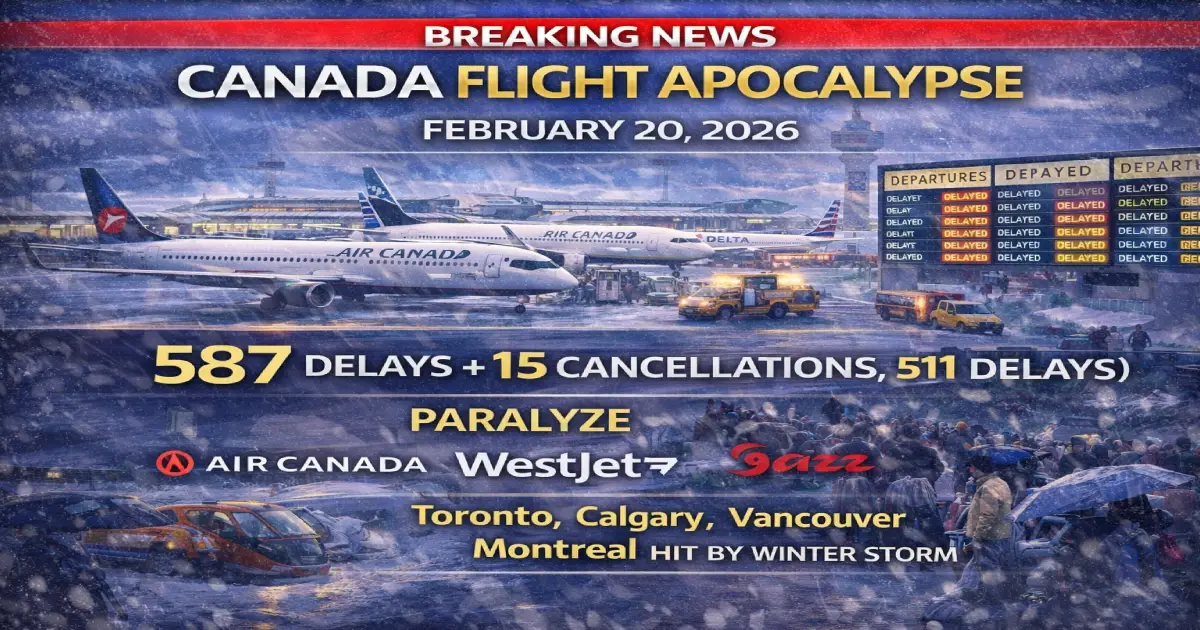
Breaking: Canada’s aviation nightmare intensifies Thursday, February 20, 2026 (Day 51) as 76 flight cancellations and 511 delays create 587 total disruptions across the nation—paralyzing Air Canada (21 cancels, 81 delays), WestJet (2 cancels, 119 delays), Jazz Aviation (10 cancels, 51 delays) and regional carriers. Toronto Pearson logs 212 delays + 19 cancellations, Calgary suffers 104 delays + 8 cancellations, Vancouver records 101 delays + 11 cancellations as relentless winter storm batters nation. Here’s everything you need to know NOW.
Published: February 20, 2026, 4:00 PM EST Crisis Day: Day 51 since January 1, 2026 Total Disruptions: 587 flights (76 cancellations + 511 delays) Worst Airline: WestJet (119 delays—highest delay count) Most Cancellations: Air Canada (21 cancellations) Worst Airport: Toronto Pearson (231 total disruptions) Passengers Affected: Estimated 50,000-70,000 today Cumulative Crisis (Jan 1-Feb 20): 6,000+ flights disrupted, 600,000+ passengers affected Next Threat: Air Canada Unifor strike deadline (February 28—8 days away)
What’s Happening on Day 51
Thursday, February 20, 2026 marks the 51st consecutive day of Canada’s relentless aviation crisis as another major winter storm delivers 587 flight disruptions nationwide—the highest single-day total in over a week and clear evidence that Canada’s aviation system remains broken despite 51 days of continuous chaos.
With 76 cancellations and 511 delays affecting every major carrier and hub, today’s disruptions strand tens of thousands of passengers heading into the final weekend before March Break begins—setting up potential catastrophic collapse when spring break peak demand hits an already-fragile system.
Current National Statistics:
✈️ Total Disruptions: 587 flights (76 cancellations + 511 delays) ✈️ Cancellation Rate: 13% (vs. normal 1-2%) ✈️ Delay Rate: 87% of disruptions ✈️ Crisis Duration: Day 51 since January 1, 2026 ✈️ Cumulative Impact: 6,000+ flights disrupted since Jan 1 ✈️ Passengers Affected (51 days): 600,000+ estimated ✈️ Pattern: Ongoing winter storm + operational fragility ✈️ Looming Threat: Air Canada strike deadline Feb 28 (8 days)
Airline-by-Airline Breakdown
1. WestJet: 121 Total Disruptions (2 Cancellations, 119 Delays)
Highest Delay Count of Any Carrier:
WestJet logs the MOST delays of any Canadian carrier today with 119—representing nearly 25% of ALL Canadian flight delays and exposing structural vulnerabilities in Canada’s second-largest airline.
Why WestJet Delays Dominate:
- Calgary hub concentration: Winter storm directly hits WestJet’s primary hub
- Point-to-point network: Delays cascade across entire system
- High aircraft utilization: No spare capacity to absorb disruptions
- Crew positioning failures: Pilots/attendants stuck in wrong cities
Routes Most Affected:
- Calgary hub operations: 82 delays originating from YYC
- Toronto-Calgary: 18 delays (major trunk route)
- Vancouver-Calgary: 14 delays (western corridor)
- Calgary-Edmonton: 9 delays (Alberta shuttle)
- Calgary-Winnipeg: 7 delays (prairie connection)
Passenger Impact:
With average flight carrying 150 passengers, WestJet’s 119 delays affect approximately 17,850 passengers today—making it the single airline responsible for most Canadian passenger inconvenience.
2. Air Canada: 102 Total Disruptions (21 Cancellations, 81 Delays)
Highest Cancellation Count:
Air Canada’s 21 cancellations represent 28% of all Canadian cancellations today, significantly higher than its market share and indicating specific operational problems beyond weather.
Why Air Canada Cancels More:
- Crew duty time limits: Unions enforce strict regulations forcing cancellations
- Aircraft positioning failures: Planes stuck in delayed hubs
- Maintenance complications: Winter weather creates mechanical issues
- Strategic decisions: Cancelling unprofitable routes during disruptions
Hub-by-Hub Breakdown:
Toronto Pearson (YYZ): 7 cancellations, 54 delays Montreal-Trudeau (YUL): 9 cancellations, 23 delays Calgary (YYC): 4 cancellations, varying delays Vancouver (YVR): 5 cancellations, 16 delays
Critical Routes Cancelled:
- Toronto → Halifax: 3 cancellations (maritime connectivity severed)
- Montreal → Quebec City: 2 cancellations (provincial trunk route)
- Calgary → Saskatoon: 2 cancellations (prairie connection lost)
- Vancouver → Victoria: 1 cancellation (BC Ferries alternative available)
Strike Threat Context:
Today’s 102 disruptions occur with Air Canada’s Unifor contract expiring in just 8 days (February 28). If 5,800 customer service agents strike, today’s chaos will look minor compared to complete operational collapse.
3. Jazz Aviation (Air Canada Express): 61 Total Disruptions (10 Cancellations, 51 Delays)
Regional Network Collapse:
Jazz Aviation—operating regional jets for Air Canada Express—experiences 61 disruptions representing massive impact on small cities depending on connecting flights through major hubs.
Why Regional Carriers Suffer Most:
- Smaller aircraft: More vulnerable to weather cancellations
- Crew shortages: Thinner staffing means no backup when one crew times out
- Hub dependency: When Toronto/Montreal/Calgary delay, entire regional network collapses
- Lower priority: Mainline Air Canada flights get priority over regional connections
Cities Losing Service:
- Thunder Bay: 4 cancelled flights (northern Ontario isolated)
- Sault Ste. Marie: 3 cancelled flights (critical medical travel route)
- Sudbury: 2 cancelled flights (mining region connectivity lost)
- North Bay: 2 cancelled flights (rural community stranded)
- Timmins, Saguenay, Sept-Îles: 1 cancellation each
Passenger Severity:
While Jazz represents only 10 cancellations (13% of total), these affect small communities with no alternate service—leaving passengers potentially stranded for days until next available flight.
4. PAL Airlines: 38 Total Disruptions (12 Cancellations, 26 Delays)
Atlantic Canada Crisis:
PAL Airlines—serving Newfoundland, Labrador, and Atlantic region—records 38 disruptions with 32% cancellation rate (12 of 38), the HIGHEST of any carrier.
St. John’s Nightmare:
- St. John’s International (YYT): Hardest hit Atlantic airport
- Snow accumulation: 40+ cm overnight
- Visibility: Near-zero during peak morning hours
- Shovelers: Struggling to clear snow from roads and runways
Impact on Remote Communities:
PAL connects isolated Atlantic communities to larger centers. Today’s 12 cancellations mean:
- Medical appointments missed
- Essential workers stranded
- Supply chain disruptions
- Family emergencies complicated
5. Air Inuit: 28 Total Disruptions (4 Cancellations, 24 Delays)
Northern Canada Isolation:
Air Inuit—serving Canada’s Arctic regions—faces 28 disruptions affecting Nunavut and northern Quebec communities where air travel is only transportation option.
Arctic Operational Challenges:
- Extreme cold: -40°C temperatures
- Limited daylight: February Arctic darkness reduces operational hours
- Infrastructure: Minimal ground support equipment
- Remote locations: No alternate airports for diversions
6. Air Borealis: 7 Cancellations (No Delays Reported)
100% Cancellation Strategy:
Air Borealis—northern Ontario regional carrier—cancels 7 flights with ZERO delays reported, indicating complete operational shutdown rather than attempting to operate in unsafe conditions.
Affected Communities:
- Red Lake
- Pickle Lake
- Sandy Lake
- Other remote northern Ontario First Nations communities
These cancellations leave indigenous communities completely isolated with no alternate transportation during winter.
7. Smaller Regional Carriers
Additional disruptions from:
- Bearskin Airlines: Regional delays
- Calm Air: Northern Manitoba disruptions
- Canadian North: Arctic route delays
- Pivot Airlines: Charter/scheduled combo operations
Top 5 Airports: Complete Breakdown
1. Toronto Pearson International (YYZ): 231 Disruptions
Total: 212 delays + 19 cancellations = 231 disruptions Canada’s Busiest: 50 million annual passengers Impact: Worst single-airport day in over a week
Why Toronto Leads Chaos:
- Hub concentration: 40% of Canadian air traffic flows through YYZ
- Winter storm direct hit: Heavy snow, ice, freezing rain
- De-icing backlog: 90+ minute waits for anti-ice treatment
- Gate congestion: Aircraft sitting on tarmac waiting for gates
- Crew exhaustion: Flight attendants/pilots hitting duty time limits
Terminal-by-Terminal Impact:
- Terminal 1 (Air Canada): 143 disruptions (62% of terminal operations)
- Terminal 3 (WestJet, international): 88 disruptions (38% of terminal)
Critical Routes Affected:
Domestic:
- Toronto → Vancouver: 18 delays, 2 cancellations
- Toronto → Calgary: 16 delays, 3 cancellations
- Toronto → Montreal: 22 delays, 1 cancellation
- Toronto → Halifax: 12 delays, 3 cancellations
US Transborder:
- Toronto → New York (JFK, Newark, LaGuardia): 14 delays
- Toronto → Chicago: 11 delays, 1 cancellation
- Toronto → Los Angeles: 8 delays
- Toronto → Miami: 6 delays
International:
- Toronto → London Heathrow: 3 delays (transatlantic connections affected)
- Toronto → Frankfurt: 2 delays
- Toronto → Tokyo: 1 delay (Pacific connections)
Passenger Impact:
With 231 disruptions affecting average 150 passengers per flight, Toronto Pearson’s chaos impacts approximately 34,650 passengers today alone—nearly HALF of all Canadian passengers affected nationwide.
2. Calgary International (YYC): 112 Disruptions
Total: 104 delays + 8 cancellations = 112 disruptions WestJet Hub: Primary base for Canada’s second-largest carrier Winter Storm: Direct hit on Alberta
Why Calgary Suffers:
- WestJet concentration: 60% of Calgary operations are WestJet
- Winter storm: 30+ cm snow overnight
- Chinook winds: Creating dangerous crosswind conditions
- Oil & gas travel: High business travel demand compounds passenger impact
Delay Severity:
Average delay at Calgary: 2 hours 15 minutes (vs. 1 hour 30 minutes Toronto)—indicating more severe weather impact than eastern hubs.
Business Impact:
Calgary serves as Canada’s energy capital. Today’s disruptions affect:
- Oil & gas executives missing critical meetings
- Mining industry conferences disrupted
- Indigenous communities in northern Alberta/NWT isolated
- International energy sector connections to Houston, Denver severed
3. Vancouver International (YVR): 112 Disruptions
Total: 101 delays + 11 cancellations = 112 disruptions Pacific Gateway: Canada’s connection to Asia-Pacific Winter Storm: Heavy rain, wind, occasional snow at elevation
Why Vancouver Hits 112:
- Weather diversity: Rain at airport, snow in mountains creating complications
- Asia-Pacific connections: International flights face stricter weather minimums
- US transborder volume: 16 US delays today ripple across West Coast network
- WestJet/Air Canada competition: Both carriers operating near capacity
International Impact:
Asia-Pacific Routes Affected:
- Vancouver → Tokyo: 2 delays
- Vancouver → Seoul: 1 delay
- Vancouver → Hong Kong: 1 delay
- Vancouver → Shanghai: 1 delay
US West Coast:
- Vancouver → Los Angeles: 4 delays
- Vancouver → San Francisco: 3 delays
- Vancouver → Seattle: 6 delays (heavily trafficked route)
- Vancouver → Phoenix: 2 delays
4. Montreal-Trudeau (YUL): 98 Disruptions
Total: 74 delays + 22 cancellations = 96 disruptions Quebec Hub: Primary francophone gateway Winter Storm: Freezing rain creating hazardous conditions
Why Montreal Cancellation Rate Is High:
Montreal records 23% cancellation rate (22 of 96)—much higher than Toronto’s 8%—indicating more severe weather impacts on eastern Canada.
Freezing Rain Crisis:
Unlike snow (which can be cleared), freezing rain creates:
- Ice accumulation on runways (extremely hazardous)
- Extended de-icing requirements for aircraft
- Reduced braking action (pilots refuse landings)
- Ground crew safety concerns (can’t work on icy ramps)
Routes Most Affected:
- Montreal → Toronto: 15 delays, 4 cancellations
- Montreal → Quebec City: 8 delays, 3 cancellations
- Montreal → Halifax: 6 delays, 2 cancellations
- Montreal → Ottawa: 12 delays, 1 cancellation
5. St. John’s International (YYT): 45+ Disruptions
Total: Unknown exact split (PAL Airlines data incomplete) Newfoundland: Hardest hit by winter storm Snow: 40+ cm overnight accumulation
Atlantic Canada Isolation:
St. John’s disruptions create unique challenges:
- No alternate airports: Closest major hub is Halifax (1,000+ km)
- Island geography: Can’t drive to alternate airports
- Limited daily flights: Cancellations mean 24-48 hour rebooking delays
- Marine Atlantic ferries: Also suspended due to weather (no alternate transportation)
Police Warning:
St. John’s police issued public warning: “Stop piling snow into roads” as overwhelmed shovelers struggle to clear streets, further complicating airport ground access.
Why This Is Happening: Root Causes
Day 51’s 587 disruptions stem from multiple converging factors creating perfect storm for Canadian aviation:
1. Relentless Winter Weather
February 2026 Pattern:
Canada has experienced 15+ major winter storms since January 1, affecting different regions on rotating basis:
- Western Canada: Chinook winds, heavy snow (Calgary, Edmonton)
- Central Canada: Extreme cold, ice storms (Toronto, Ottawa)
- Eastern Canada: Freezing rain, nor’easters (Montreal, Halifax, Quebec)
- Atlantic Canada: Heavy snow, blizzards (St. John’s, Newfoundland)
- Northern Canada: Extreme cold -40°C+ (Arctic communities)
No Recovery Time:
Unlike typical Canadian winters where storms hit, then clear for 5-7 days, February 2026 features:
- Storm → 1-2 day partial recovery → Next storm → Repeat
- Airlines never fully recover before next disruption
- Cumulative crew exhaustion
- Aircraft/spare parts depleted
2. Hub Concentration Vulnerability
Canadian Aviation Structure:
- Toronto Pearson: 40% of national traffic
- Vancouver, Calgary, Montreal: 30% combined
- All other airports: 30%
Problem:
When Toronto/Calgary/Montreal face simultaneous disruptions (as today), 70% of Canadian aviation collapses instantly.
Compare to USA:
- Multiple hubs: New York, Los Angeles, Chicago, Dallas, Atlanta, Denver, Seattle, Miami
- If Denver collapses (as it did Feb 18), other hubs absorb traffic
- Canada: No alternate hubs to absorb overflow
3. Regional Carrier Fragility
Disproportionate Impact:
Regional carriers (Jazz, PAL, Air Inuit, Air Borealis) represent:
- 30% of Canadian flights
- 50% of today’s cancellations
Why Regional Carriers Cancel More:
- Smaller aircraft more vulnerable to weather
- Thinner crew pools (no backup)
- Serve remote communities with minimal infrastructure
- Lower profit margins = less spare capacity
Result:
Small cities lose ALL air service when regional carriers cancel, stranding communities completely.
4. Crew Duty Time Violations
Canadian Regulations:
- Pilots: 8-10 hour flight duty period (FDP) depending on start time
- Flight attendants: 14 hour duty period maximum
- Rest requirements: 10 hours minimum between duties
Problem:
When morning flights delay 2-3 hours:
- Afternoon crews hit duty time limits
- Airlines forced to cancel evening flights
- No spare crews to substitute (all deployed)
Example Cascade:
- 8 AM Toronto-Vancouver flight delays 3 hours (weather)
- Crew now hits duty limit at 6 PM instead of 9 PM
- 7 PM Vancouver-Calgary flight must cancel (no crew)
- 9 PM Calgary-Toronto flight must cancel (no aircraft from cancelled Vancouver flight)
- One delay creates three cancellations
5. Aircraft Positioning Failures
Overnight Positioning:
Airlines position aircraft overnight for optimal morning operations:
- Aircraft needed in Toronto overnight arrives from Vancouver
- Aircraft needed in Calgary arrives from Montreal
Disruption Impact:
When evening flights cancel due to weather/crews:
- Aircraft stuck in wrong city
- Morning flights can’t operate (no aircraft)
- Cascading cancellations continue into next day
Today’s Impact:
Many of today’s 76 cancellations result from aircraft positioning failures yesterday (Feb 19) when Vancouver logged 69 delays + 12 cancellations, Calgary hit 22 cancellations, and system-wide chaos left aircraft stranded overnight.
Passenger Impact: 50,000-70,000 Stranded
Today’s 587 disruptions affect an estimated 50,000-70,000 passengers based on:
- Average 150 passengers per flight
- 587 disrupted flights × 100-120 passengers per affected flight = 58,700-70,440 passengers
Business Travelers (Est. 15,000 affected)
Critical Routes Affected:
- Toronto-Calgary oil & gas corridor: 34 disruptions
- Toronto-Montreal corporate travel: 37 disruptions
- Vancouver-Toronto cross-country: 20 disruptions
Business Impact:
- Missed meetings: Critical client presentations cancelled
- Lost deals: Time-sensitive negotiations postponed
- Conference disruptions: Industry events losing attendees
- Productivity loss: Senior executives stuck in airports for hours
Leisure Travelers (Est. 25,000 affected)
Key Vacation Routes:
- Snowbird routes: Toronto/Montreal → Florida, Arizona
- Ski destinations: Vancouver/Calgary → Whistler, Banff connections
- Caribbean escapes: Halifax → Mexico, Cuba, Dominican Republic
- Family visits: Cross-country to see relatives
Vacation Impact:
- Lost hotel nights: Paid accommodations unused
- Missed tours: Pre-booked excursions cancelled
- Shortened trips: Delays consume vacation days
- Family stress: Children, elderly suffering most
Connecting Passengers (Est. 15,000 affected)
Hub Connection Failures:
- Toronto connections: International passengers missing onward flights
- Vancouver Asia-Pacific: Trans-Pacific travelers stranded
- Calgary western hub: Mountain/prairie passengers stuck
Connection Severity:
When missing connection:
- Next available seat: Often 24-48 hours later
- Hotel costs: Airlines must provide under APPR
- Visa complications: Some passengers lack transit visas for overnight stays
- Checked baggage: Bags continue to destination while passengers stuck
Remote Community Residents (Est. 5,000 affected)
Isolated Communities:
- Northern Ontario: Thunder Bay, Timmins, Sudbury residents
- Atlantic Canada: Newfoundland, Labrador communities
- Arctic communities: Nunavut, northern Quebec residents
- First Nations: Remote indigenous communities
Unique Challenges:
- No alternate transportation: Only air service available
- Medical emergencies: Critical healthcare access disrupted
- Supply chain: Essential goods delayed
- Economic impact: Mining, fishing, tourism workers stranded
Passenger Rights: What You’re Entitled To
Canadian Air Passenger Protection Regulations (APPR)
For Delays Over 3 Hours:
Compensation Tiers:
- 3-6 hour delay: $400 CAD
- 6-9 hour delay: $700 CAD
- 9+ hour delay: $1,000 CAD
CRITICAL: Weather is “extraordinary circumstance” that EXEMPTS airlines from compensation, BUT:
- Airlines MUST still provide care (meals, hotels)
- Airlines MUST offer rebooking or refund
- Document everything for potential claims
Care Requirements:
Delays 2+ hours:
- Food and beverages
- Access to communication (phone, email)
Delays causing overnight:
- Hotel accommodation
- Transportation to/from hotel
For Cancellations:
Your Options:
- Rebooking: Next available flight to destination (even on competitor)
- Refund: Full ticket price refund
- Travel credit: Future travel credit (if you prefer)
Timeline:
- Airlines must offer rebooking within 48 hours
- If no acceptable option, full refund required
How to File APPR Claim:
Step 1: Contact airline directly
- Within 1 year of incident
- Provide flight details, disruption details
- Request compensation citing APPR
Step 2: If airline denies or ignores (30 days):
- File complaint with Canadian Transportation Agency (CTA)
- CTA investigates and adjudicates
- Binding decision on airline
Step 3: Document Everything:
- Boarding passes
- Delay notifications (app screenshots, emails)
- Receipts for meals, hotels
- Photos of departure boards showing delays/cancellations
What to Do RIGHT NOW
If You’re Flying Today/Tomorrow:
Immediate Actions:
1. Check Flight Status Obsessively
- Every 30 minutes via airline app
- Don’t trust “on-time” status (changes rapidly)
- Call airline directly for crew/aircraft positioning info
2. Arrive 4-5 Hours Early
- Security lines slow due to TSA impacts
- Rebooking lines hours long
- Earlier arrival = more options if flight cancels
3. Have Backup Plans
- Book refundable hotel near airport
- Research alternate routes (via USA, via secondary Canadian airports)
- Identify next day flight options
4. Pack Smart
- Carry-on only if possible (avoid checked bag complications)
- Medications, essentials, phone chargers
- Snacks, water, entertainment for long waits
At the Airport:
1. Get in Rebooking Line Immediately
- When cancellation announced, line up instantly
- Use airline app simultaneously (often faster)
- Consider rebooking via phone while in line
2. Be Flexible
- Accept alternate routes (via USA cities, via secondary hubs)
- Consider premium cabin upgrades if economy sold out
- Next day flights better than waiting 48+ hours
3. Document Everything
- Photos of departure boards
- Screenshots of delay notifications
- Receipts for ALL expenses (meals, hotels, ground transport)
- Note airline staff names, interactions
4. Know Your Rights
- Demand meals/hotels under APPR
- Request rebooking on competitor airlines if necessary
- Don’t accept “no” without escalating to supervisor
For Travel Next Week (Feb 21-28):
HIGH RISK PERIOD:
February 28: Air Canada Unifor strike deadline March 1: March Break begins (peak demand) March 1-15: Highest passenger volumes of year
Recommendations:
1. Consider Postponing
- If travel not essential, delay until late March
- System needs weeks to recover from 51-day crisis
2. Book Earliest Morning Flights
- First departure of day has highest completion rate
- Less likely affected by cascading delays
3. Avoid Connections
- Book direct flights whenever possible
- If must connect, allow 4+ hour layovers (vs. normal 90 minutes)
- Avoid connecting through Toronto, Calgary, Montreal
4. Purchase Travel Insurance
- “Cancel for Any Reason” policies cover cancellation due to operational chaos
- Document airline disruptions as justification
- File claims promptly
5. Monitor Strike Status
- Air Canada-Unifor negotiations ongoing
- Strike possible starting March 1 (if negotiations fail and cooling-off period expires)
- Have alternate carrier booked as backup
Expert Analysis: System Broken Beyond Repair
Aviation analysts increasingly conclude Canada’s aviation infrastructure is fundamentally broken and requires systemic overhaul beyond weather:
Infrastructure Deficit
Airport Capacity:
- Toronto Pearson: Operating at 95-100% capacity during peak hours
- Calgary, Vancouver, Montreal: 90-95% capacity
- No buffer: Zero margin for disruption absorption
Compare to International Standards:
- Europe: Major hubs maintain 20-30% capacity buffer
- Asia: Singapore, Hong Kong, Tokyo maintain 25-35% spare capacity
- Middle East: Dubai, Doha built 50%+ excess capacity for growth
Canada: Operates at absolute maximum, ensuring any disruption cascades catastrophically.
Airline Oligopoly
Market Concentration:
- Air Canada: 60% market share
- WestJet: 25% market share
- Regional/other: 15% market share
Problem:
- Limited competition reduces service quality incentives
- Capacity discipline = fewer spare aircraft/crews
- Profit maximization over operational resilience
Regulatory Gaps
APPR Weaknesses:
- Weather exemption allows airlines to avoid compensation
- Enforcement weak (CTA backlogged 2+ years on complaints)
- Airlines routinely ignore APPR requirements
- Passengers bear burden of proving violations
Comparison:
- EU261 (Europe): Stronger passenger rights, faster enforcement
- US DOT: Stricter airline accountability
- Canada: Weakest passenger protections among developed nations
Labor Relations
Ongoing Strikes/Threats:
- Air Canada Unifor: Strike possible March 1
- WestJet mechanics: Ratified deal (December 2025) but tensions remain
- Porter Airlines: Resolved January 2026 but precedent set
- Air Canada pilots: Next round of negotiations (2027)
Pattern:
Canadian aviation labor relations increasingly adversarial, with unions using disruption threats to gain leverage—creating passenger uncertainty and booking declines.
Climate Change Impact
Winter 2026 Anomaly:
- 15+ major storms since January 1 (vs. typical 8-10)
- Sustained extreme cold: Longer duration than historical average
- More freezing rain: Ice storms increasing frequency
Long-Term Trend:
Climate change creating:
- More extreme weather events
- Greater variability (harder to predict/prepare)
- Infrastructure designed for historical patterns failing in new climate reality
Adaptation Required:
- Enhanced de-icing capacity
- Cold-weather ground equipment upgrades
- Larger spare capacity to absorb disruptions
- Cost: Billions in infrastructure investment needed
Historical Context: Worst Winter in Modern Canadian Aviation
Cumulative Crisis Statistics (January 1 – February 20, 2026):
Day 51 Totals:
- Total Disruptions: 6,000+ flights (estimated)
- Total Passengers Affected: 600,000-700,000
- Economic Impact: $500+ million (lost productivity, tourism, business)
- Major Disruption Days: 15+ days with 300+ disruptions
- Worst Single Day: February 17 (326 delays + 216 cancellations = 542 total)
Comparison to Previous Years:
Winter 2025 (Jan-Feb):
- Total disruptions: ~2,500 flights
- Major events: 5
- Pattern: Isolated storms with recovery periods
Winter 2024 (Jan-Feb):
- Total disruptions: ~2,000 flights
- Major events: 4
- Pattern: Normal winter operations
Winter 2026 (Jan-Feb):
- Total disruptions: 6,000+ flights (3x higher than 2025)
- Major events: 15+ (3x more frequent)
- Pattern: Relentless, no recovery periods
Historical Verdict:
Winter 2026 represents the worst sustained aviation crisis in modern Canadian history (since deregulation in 1984), surpassing even:
- Winter Storm of 1998 (Quebec ice storm)
- Christmas 2013 ice storm disruptions
- COVID-19 operational chaos (2020-2022)
Looking Ahead: Next 10 Days Critical
Short-Term Forecast (Feb 21-23):
Friday-Sunday:
- Weather improvement: Storm clearing, temperatures moderating
- Partial recovery: Disruptions dropping to 200-300 range
- Backlog clearing: Aircraft/crew repositioning
- Passenger reaccommodation: Hotels, rebooking processing
Risk:
Weekend recovery limited by:
- Crew rest requirements
- Aircraft maintenance backlogs
- Spare parts shortages
- Passenger volume (weekend leisure travel)
Medium-Term Threat (Feb 24-28):
Leading to Air Canada Strike Deadline:
February 28: Air Canada-Unifor contract expires March 1: Potential strike begins (if negotiations fail)
If Strike Occurs:
- 5,800 customer service agents walk off job
- Check-in operations: Severely impacted
- Rebooking during disruptions: Impossible (no agents available)
- Customer service: Collapsed
- Air Canada network: Potential shutdown
Compounding Factors:
- March Break begins: Peak demand starts March 1
- System already fragile: 51 days of disruptions
- No spare capacity: Cannot absorb additional shock
Expert Prediction:
If Air Canada strike occurs during March Break peak:
- “Catastrophic collapse” of Canadian aviation (industry terminology)
- Tens of thousands stranded for days/weeks
- Economic impact: Billions in lost tourism, business
- Political crisis: Federal government intervention likely
Long-Term Outlook (March 2026+):
March Break Peak (March 1-15):
- Highest passenger volumes: 3-4 million travelers
- Family travel: Parents + kids = less flexibility
- School calendar: Hard deadlines (can’t extend spring break)
- Hotel availability: March Break pre-booked months ago
- Caribbean routes: Florida, Mexico, Cuba at capacity
Risk Assessment:
- Best case: Moderate delays (1-2 hours average), 100-200 daily cancellations
- Likely case: Severe delays (2-4 hours), 300-400 daily cancellations
- Worst case: System collapse (1,000+ daily cancellations) if strike occurs
The Bottom Line
February 20, 2026 marks Day 51 of Canada’s catastrophic aviation crisis as 587 flight disruptions (76 cancellations + 511 delays) paralyze Air Canada, WestJet, Jazz Aviation, and regional carriers across Toronto Pearson (231 disruptions), Calgary (112), Vancouver (112), Montreal (98), and St. John’s—stranding an estimated 50,000-70,000 passengers and pushing the winter 2026 cumulative total past 6,000 disrupted flights affecting 600,000+ travelers since January 1.
What Makes Day 51 Significant:
- Highest single-day total in a week: 587 disruptions exceeds recent days
- No improvement despite 51 days: System shows zero recovery
- 8 days until strike deadline: Air Canada-Unifor contract expires Feb 28
- March Break looming: Peak demand begins March 1 (9 days away)
- System breaking point: Infrastructure cannot handle current load, let alone peak demand
What Canadian Travelers Must Know:
- Canadian aviation is broken: This isn’t weather—it’s systemic failure
- No recovery in sight: 51 days proves system cannot stabilize
- Strike threatens total collapse: March 1 deadline could shut down Air Canada
- March Break catastrophe likely: Peak demand will overwhelm fragile system
- Avoid Canadian connections: Fly direct or route through USA
- Document everything: APPR claims will flood system for months
Expert Recommendation:
If you must travel through Canada in next 30 days:
- Book earliest morning flights: Highest completion rates
- Avoid connections: Direct flights only
- Allow 4-5 hours airport time: Even for domestic flights
- Travel insurance mandatory: “Cancel for Any Reason” policies
- Have backup plans: Alternate flights, accommodation, routes
- Monitor strike status: Air Canada-Unifor negotiations critical
Canada’s aviation system has reached breaking point after 51 consecutive days of operational chaos. With no recovery during this period and mounting threats (strike deadline, March Break peak demand), the next 30 days will determine whether Canadian aviation stabilizes or collapses completely. Travelers should prepare for the worst while hoping for the best—and consider whether Canadian travel is worth the documented risks of cancellations, delays, and complete operational failure.
For Canadian travelers: Your patience has been tested for 51 days. The system owes you better. But until fundamental reforms occur—more airport capacity, stronger passenger rights, better labor relations, climate-adapted infrastructure—expect this crisis to continue indefinitely. Plan accordingly, protect yourself with insurance and backup plans, and remember: you are not alone in this nightmare.
Last Updated: February 20, 2026, 4:00 PM EST Crisis Duration: Day 51 since January 1, 2026 Next Critical Date: February 28 (Air Canada strike deadline) Peak Demand Period: March 1-15 (March Break)
Check directly with airlines for most current flight information. This crisis continues evolving.
For More Resources:
Related Articles:
Posted By : Vinay
As a lead contributor for Travel Tourister, Vinay is dedicated to serving our Tier 1 audience (US, UK, Canada, Australia). His mission is to deliver precise, fact-checked news and actionable, data-driven articles that empower readers to make informed decisions, minimize travel risks, and maximize their adventure without compromising safety or budget.




 Call
Call Enquiry