Published on : 21 Feb 2026
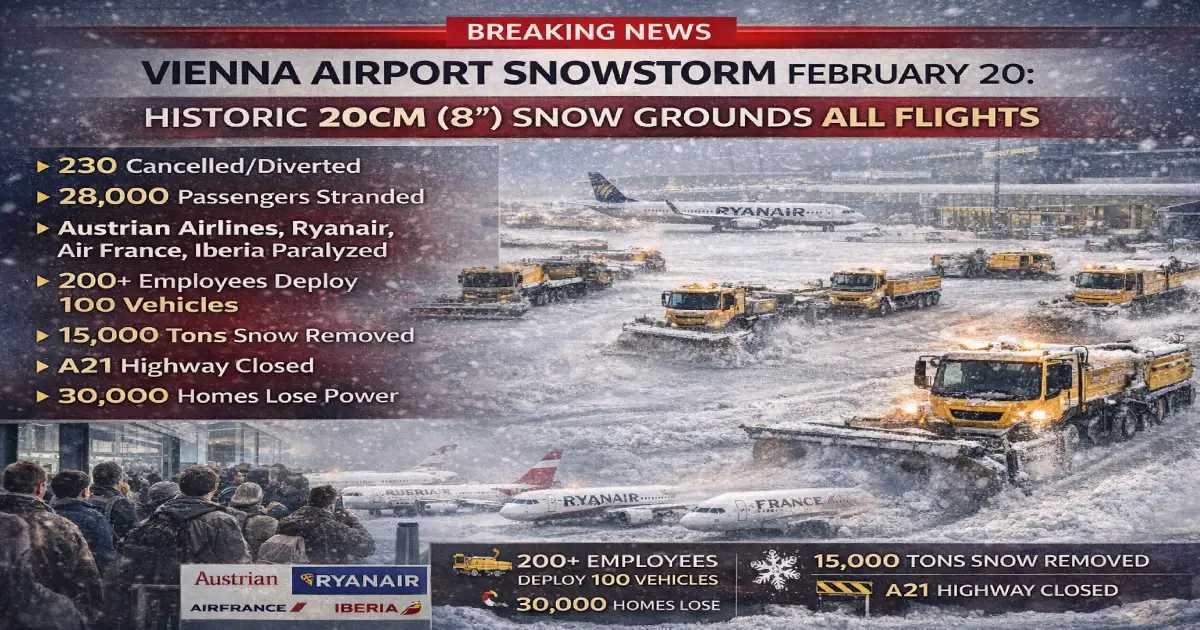
HISTORIC AUSTRIAN BLIZZARD: Vienna International Airport (VIE), Central Europe’s critical aviation gateway, suffered a complete operational shutdown Thursday, February 20, 2026 as a ferocious winter storm dumped 20 centimeters (8 inches) of heavy, wet snow in just a few hours across eastern Austria — forcing suspension of ALL flight operations at 6:00 AM local time, cancelling or diverting more than 230 flights, stranding an estimated 28,000 passengers, and paralyzing airlines including Austrian Airlines (dozens of short/medium-haul European flights), Ryanair, Air France, Iberia, Condor, and Ethiopian Airlines as 200+ winter maintenance crew operating 100+ specialized vehicles worked around the clock to remove 15,000 tons of snow (1,000+ truckloads) from runways, taxiways, and aprons while Austrian emergency services battled cascading transport chaos including Vienna Outer Ring Road (A21) closure for several hours, motorway avalanches, 30,000 Styria homes losing electricity, and local trams, buses, trains grinding to complete halt — marking Austria’s worst single-day aviation disaster of 2026 and exposing even Europe’s most efficient winter-prepared airports as structurally vulnerable when “heavy, wet snow” falls at rates exceeding physical clearing capacity.
Published: February 20, 2026 Airport Closure Began: 6:00 AM local time (5:00 AM UTC) Flights Cancelled/Diverted: 230+ (exact breakdown TBD) Passengers Affected: 28,000 (estimated by airport operator Flughafen Wien AG) Snowfall Amount: 20 centimeters (8 inches) — “historic” for February Snow Removal: 15,000 tons (1,000+ truckloads), 200+ crew, 100+ vehicles Airlines Hit: Austrian Airlines, Ryanair, Air France, Iberia, Condor, Ethiopian Airlines Diversions: Munich, Frankfurt, Linz, Graz, Brno (Czech Rep.), Klagenfurt Reopening: Limited takeoffs 12:00 PM (noon), landings 1:00 PM Extended Impact: “Knock-on delays well into the weekend” (official statement) A21 Highway: Closed for several hours Power Outages: 30,000 Styria homes without electricity Local Transport: Trams, buses, trains suspended or severely delayed
A fierce winter storm swept across eastern Austria in the early hours of 20 February, dumping up to 20 centimetres of heavy, wet snow on the capital and paralysing one of Central Europe’s busiest aviation hubs.
Storm timeline:
🌨️ Wednesday evening, Feb 19: Storm system arrives from Italy overnight 🌨️ Thursday 12:00 AM – 6:00 AM: 20cm (8″) snow accumulates (unprecedented rate) 🌨️ Thursday 6:00 AM: Vienna Airport suspends ALL operations 🌨️ Thursday morning: 230+ flights cancelled/diverted, 28,000 passengers stranded 🌨️ Thursday 12:00 PM (noon): Limited takeoffs resume 🌨️ Thursday 1:00 PM: Landings resume 🌨️ Weekend forecast: “Knock-on delays well into weekend”
Why this storm was historic:
According to official reports, Vienna International Airport had to suspend all flights early in the morning due to the heavy snow accumulation on the runway.
Airport spokesperson Peter Kleemann told Austrian public broadcaster ORF that snow depth had reached 20 centimeters on the ground.
“Heavy, wet snow” = especially difficult:
Shortly after 06:00 local time Vienna International Airport (VIE) suspended all departures and arrivals, citing “unsafe runway conditions” and poor visibility.
What “complete shutdown” meant:
❌ ALL takeoffs suspended ❌ ALL landings suspended ❌ 230+ inbound flights diverted to alternative airports ❌ Dozens of departures cancelled or indefinitely delayed ❌ 28,000 passengers directly affected ❌ Airport advised: “Passengers whose flights have been cancelled are asked not to come to the airport”
By mid-morning more than 230 flights had been cancelled or diverted, affecting an estimated 28,000 passengers according to operator Flughafen Wien AG.
Breakdown:
✈️ 230+ arrivals: Cancelled or diverted (exact split TBD) ✈️ Dozens of departures: Cancelled or delayed ✈️ 28,000 passengers: Stranded at Vienna or diverted airports ✈️ Multiple airlines: Austrian, Ryanair, Air France, Iberia, Condor, Ethiopian
Diverted flights sent to:
🇩🇪 Munich, Germany (closest major hub, 450 km west) 🇩🇪 Frankfurt, Germany (major Lufthansa hub) 🇦🇹 Linz, Austria (domestic alternative, 185 km west) 🇦🇹 Graz, Austria (southern Austria, 200 km southwest) 🇨🇿 Brno, Czech Republic (100 km north) 🇦🇹 Klagenfurt, Austria (southern Austria, 310 km southwest)
Austrian Airlines, the airline’s home carrier, was particularly affected, having to cancel or severely delay numerous short- and medium-haul flights within Europe.
Why Austrian hit hardest:
Routes affected (typical Austrian network):
✈️ Vienna → Frankfurt, Munich, Berlin (Germany) ✈️ Vienna → London, Paris, Amsterdam (Western Europe) ✈️ Vienna → Rome, Milan, Venice (Italy) ✈️ Vienna → Warsaw, Prague, Budapest (Central/Eastern Europe) ✈️ Vienna → Zurich, Geneva (Switzerland)
Airlines that have had flights cancelled or diverted include Ryanair, Austrian Airlines, Air France, Iberia, Condor and Ethiopian Airlines.
Ryanair’s Vienna operations:
Air France impact:
✈️ Paris CDG ↔ Vienna: Multiple daily flights (Star Alliance partner cooperation with Austrian) ✈️ Connecting passengers: Paris → Vienna → Eastern Europe connections missed ✈️ Business travelers: France-Austria corridor disrupted
Iberia impact:
✈️ Madrid ↔ Vienna: Daily flights ✈️ Spanish tourists: Vienna = popular Spanish tourist destination (culture, music, history)
Condor impact:
✈️ Frankfurt ↔ Vienna: Leisure/tourism route ✈️ Vacation packages: German tourists to Vienna stranded
Ethiopian Airlines impact:
✈️ Addis Ababa ↔ Vienna: Long-haul intercontinental route ✈️ Africa-Europe gateway: Ethiopian uses Vienna as European hub ✈️ Diverted passengers: Stranded far from home, expensive rebooking
“Since yesterday evening, winter maintenance crews at Vienna Airport have been working around the clock. More than 200 employees are operating over 100 specialized vehicles to keep runways, taxiways, the apron, and traffic areas operational,” said an airport spokesperson.
Snow removal statistics:
🚜 200+ employees: Winter maintenance crews 🚜 100+ specialized vehicles: Snow blowers, plows, de-icing trucks 🚜 15,000 tons of snow: Removed from airport grounds 🚜 1,000+ truckloads: Snow hauled off-site 🚜 24-hour shifts: Crews worked continuously since Wednesday evening
Why even 200 employees couldn’t keep up:
While Vienna Airport employs a specialized winter service with high-performance snow blowers in such situations, the persistent snowfall makes repeated closures of individual runway sections for cleaning unavoidable.
The clearing challenge:
While winter maintenance at Vienna Airport (Schwechat) is considered one of the most efficient in Europe, the current hourly snowfall has pushed it to its physical limits.
The snowstorm didn’t just affect the airport — all of Austria faced transport paralysis.
The Vienna Outer Ring Road (A21) was closed for several hours.
Why A21 matters:
The Austrian Automobile Club reported that other motorway sections were also temporarily shut down due to avalanches.
ÖAMTC (Austrian automobile association) report:
❌ Main highway south of Vienna: Closed for several hours ❌ Other highway sections: Temporarily inaccessible (snowdrift, stranded lorries, poor visibility) ❌ Avalanches: Mountain roads blocked ❌ Official warning: Non-essential travel discouraged
Local transportation in Vienna ground to a halt as the snowstorm covered the city’s streets and public transport systems.
What stopped:
🚋 Trams: Significant delays, some routes completely suspended 🚌 Buses: Significant delays, hazardous conditions 🚂 Trains: Faced significant delays 🚗 Roads: Traffic jams, slippery conditions all over city
Austrian capital’s response:
The Austrian capital, typically known for its efficiency, found itself buried under snow, with emergency services and city crews working tirelessly to clear the roads.
Official travel warnings:
⚠️ Authorities issued official travel warnings ⚠️ Public urged to stay off the roads unless absolutely necessary ⚠️ Many international tourists unable to navigate snow-covered streets ⚠️ Concerns about missing onward connections or being unable to reach hotels
Electric companies reported power outages in several regions in the south and east, including Styria, where 30,000 homes lost electricity.
Why Styria hit hardest:
In the Austrian region of Styria, where particularly wet and therefore heavy snow fell, 30,000 households were without electricity.
Wet snow = power line risk:
For passengers whose travel plans were affected on Friday, airlines and Vienna Airport authorities are urging them to check flight status directly with carriers before attempting to travel.
What stranded passengers faced:
😰 Long queues: Ground staff overwhelmed 😰 Check-in chaos: Because de-icing capacity pushed to limits 😰 Rebooking challenges: Limited seats on alternative flights 😰 Hotel shortages: 28,000 people need accommodation 😰 Expensive last-minute hotels: Surge pricing in Vienna 😰 Missed connections: Europe-wide cascade effects
Multiple inbound flights were diverted to alternative airports—including Munich, Frankfurt, Linz, Graz, Brno, and Klagenfurt—while dozens of departures were cancelled or delayed.
Diverted passenger challenges:
🚗 Munich to Vienna: 450 km (4.5 hour drive in good weather, longer in snow) 🚗 Frankfurt to Vienna: 700 km (7+ hour drive) 🚗 Brno to Vienna: 130 km (1.5 hour drive) 🚗 Limited transport: Buses, trains also disrupted by snow 🚗 Expensive taxis: Surge pricing, long distances 🚗 Hotel costs: Unexpected overnight stays
Many travelers were advised to take advantage of indoor activities like the Vienna State Opera, or the famous Kunsthistorisches Museum, providing opportunities to enrich their experiences even while dealing with flight disruptions.
Vienna, known for its stunning baroque architecture, vibrant arts scene, and charming winter markets, has long been a favorite among winter travelers.
Vienna tourism profile:
🎨 Culture capital: Vienna State Opera, Kunsthistorisches Museum, Hofburg Palace 🎄 Winter markets: Rathausplatz Christmas Market (extended through February) ☕ Historic cafes: Café Central, Café Sacher (world-famous) 🎵 Music city: Mozart, Beethoven, Strauss heritage 🏰 Imperial history: Habsburg palaces, UNESCO World Heritage sites
Snowstorm’s tourism impact:
💰 Hotels: Stranded passengers = unexpected occupancy (but bad publicity) 💰 Restaurants: Many tourists unable to reach reservations 💰 Attractions: Some closed due to transport chaos 💰 Tour operators: Groups unable to continue winter tours 💰 Austrian Alps: Ski resorts also affected (though fresh snow = better skiing conditions)
Economic losses (estimated):
Airport spokesperson Peter Kleemann told Austrian public broadcaster ORF that limited take-offs might resume around noon, with landings following an hour later, but cautioned that “irregular operations and knock-on delays will last well into the weekend”.
Phased reopening:
✅ 12:00 PM (noon): Limited takeoffs possible ✅ 1:00 PM: Landings resume ⚠️ Throughout weekend: Expect knock-on delays, irregular schedules
Why delays continue even after reopening:
Travelers should expect irregular flight schedules throughout the weekend, as stabilizing the network after a complete closure lasting several hours typically takes a considerable amount of time.
1. Check flight status:
2. Know your rights:
EU Regulation 261/2004:
3. Rebooking options:
Many airlines are offering rebooking options or refunds for cancelled flights, and ground staff continue to support affected travellers at temporary reception points around the airport.
4. Alternative transport:
Authorities also reminded travellers that trains and buses, while disrupted, may offer alternative routes where roads are passable. However, winter driving conditions remain challenging, and avoidance of non-essential travel was encouraged.
1. Monitor weather forecasts:
Austrian meteorological agencies forecast that while snowfall might ease later in the weekend, hazardous winter conditions could remain and require ongoing caution.
2. Build buffers:
3. Travel insurance:
Comprehensive travel insurance MAY cover weather delays:
💰 Trip delay coverage: Reimburses hotels, meals during extended delays 💰 Trip interruption: If forced to abandon trip mid-journey 💰 Additional accommodation: Hotels while waiting for flights
Read policy fine print: Weather coverage varies by insurer.
Q: Why couldn’t Vienna Airport handle 20cm of snow? A: Vienna’s winter maintenance is among Europe’s most efficient. But “heavy, wet snow” falling at 3-4cm/hour exceeds physical clearing capacity. Crews clear one section, snow accumulates again before they finish the next section. It’s not infrastructure failure — it’s physics.
Q: Will this happen again this winter? A: Austria’s winter forecast shows more snow likely through March. Vienna Airport will remain vulnerable to similar rapid-accumulation events. Book refundable tickets.
Q: Can I get cash compensation for weather delays? A: No. Weather = “extraordinary circumstances” under EU261. Only entitled to refund or rebooking, plus meals/hotels during waits.
Q: Why were flights diverted to Munich/Frankfurt instead of waiting? A: Safety regulations prohibit aircraft from circling indefinitely. After ~30-45 minutes holding, pilots must divert to alternative airport with fuel reserves remaining.
Q: Is Vienna Airport safe? A: Absolutely. Closure was precautionary (unsafe runway conditions). Reopening only occurred after runways deemed safe. Vienna’s safety record is excellent.
Vienna International Airport’s complete shutdown February 20, 2026 — triggered by 20 centimeters (8 inches) of heavy, wet snow accumulating in just hours — exposed even Central Europe’s most winter-prepared aviation infrastructure as vulnerable when snowfall rates exceed physical clearing capacity, as 230+ flights cancelled or diverted, 28,000 passengers stranded, and Austrian Airlines, Ryanair, Air France, Iberia, Condor, Ethiopian Airlines paralyzed while 200+ crew operating 100+ vehicles removed 15,000 tons of snow (1,000+ truckloads) in a 24-hour battle that ultimately couldn’t prevent Austria’s worst single-day aviation disaster of 2026 — demonstrating that even with Europe’s most efficient winter maintenance systems, “persistent snowfall” overwhelms any clearing operation when heavy, wet snow falls continuously at 3-4cm/hour, leaving passengers with hard lessons about refundable tickets, travel insurance, and connection buffers during Central European winter travel season.
For Vienna travelers:
For More Information:
Related Articles:
Posted By : Vinay
This article is provided for general informational purposes only and is based on information available at the time of publication. Travel advisories, airline schedules, airport operations, visa requirements, government regulations, and other travel-related information are subject to change without prior notice. While Travel Tourister makes reasonable efforts to verify information using official announcements, government publications, airline and airport communications, and other reliable sources, we cannot guarantee that all information remains complete, accurate, or up to date at all times. Readers should independently verify any information that may affect their travel plans with the relevant airline, airport authority, government agency, embassy, or other official source before making travel, financial, or other decisions. Travel Tourister shall not be liable for any direct or indirect loss, inconvenience, or damages arising from the use of or reliance on the information contained in this article. Nothing in this publication constitutes legal, immigration, financial, or professional travel advice. If you believe any information in this article is inaccurate or outdated, please contact our editorial team. We review all credible correction requests promptly and update our content whenever appropriate.
Lastest News
2nd Floor, 39, Above Kirti Club, DLF Industrial Area, Kirti Nagar, New Delhi, Delhi 110015



Travel Tourister is a leading Travel portal where we introduce travellers to trusted travel agents to make their journey hasselfree, memorable And happy. Travel Tourister is a platform where travellers get Tour packages ,Hotel packages deals through trusted travel companies And hoteliers who are working with us across the world. We always try to find new and more travel agents and hoteliers from every nook and corners across the world so that you could compare the deals with different travel agents and hoteliers and book your tour or hotel with the one you have chosen according to your taste and budget.
Copyright © Travel Tourister, India. All Rights Reserved

 Call
Call Enquiry