Published on : 25 Feb 2026
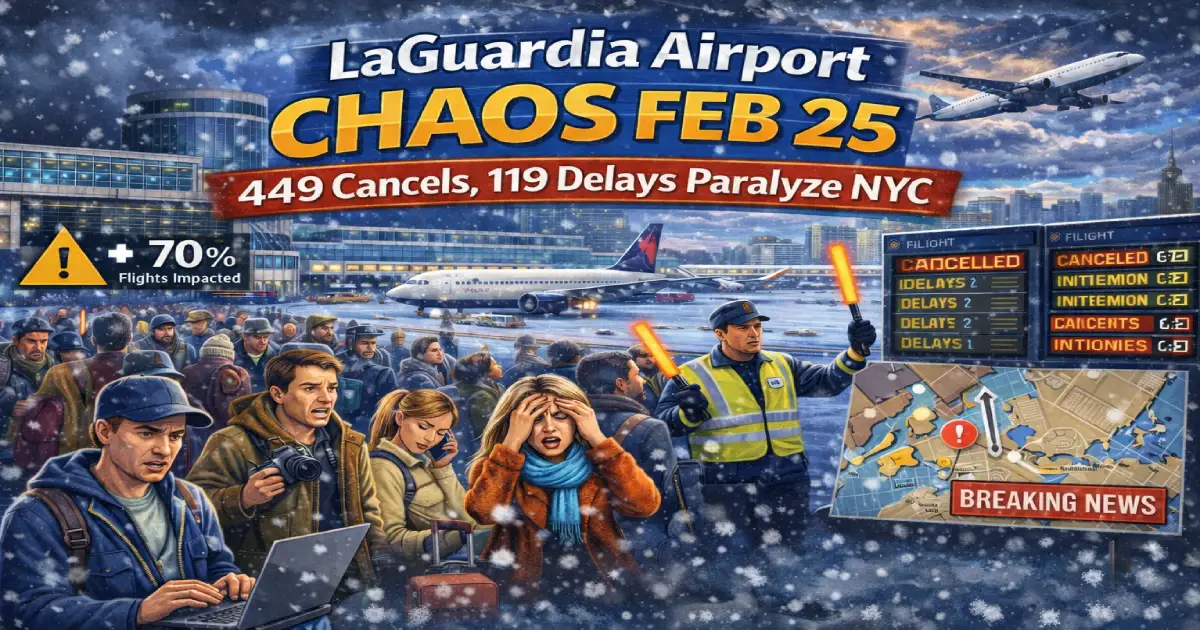
Breaking: LaGuardia Airport enters catastrophic operational crisis February 25, 2026 as Winter Storm Hernando’s 19-inch Central Park snowfall triggers 449 cancellations and 119 delays—with Republic Airways suffering total collapse (164 cancellations, 41 delays), Endeavor Air scrubbing 105 flights, Delta Air Lines posting 74 cancellations, and American Airlines grounding 33 departures—creating worst single-day Northeast aviation disaster of 2026 affecting tens of thousands of passengers stranded in terminals while NYC travel bans lift and recovery operations begin. Here’s everything you need to know now.
Published: February 25, 2026 Event Status: ACTIVE RECOVERY (travel bans lifted, cleanup ongoing) Total Disruptions: 568 flights (449 cancellations + 119 delays) Cancellation Rate: 83% of scheduled operations Worst Carriers: Republic 164 cancels, Endeavor 105 cancels, Delta 74, American 33 Central Park Snow: 19 inches (historic nor’easter) Recovery Timeline: 48-72 hours (through February 27-28)
LaGuardia Airport (LGA)—New York City’s second-busiest aviation gateway and nation’s primary short-haul business travel hub—faces unprecedented operational catastrophe February 25 as Winter Storm Hernando’s aftermath produces 568 total disruptions (449 cancellations + 119 delays) representing 83% cancellation rate that essentially shuts down facility while ground crews battle 19 inches of Central Park snowfall (worst New York accumulation since 2016), sustained winds gusting to 70 mph creating whiteout conditions preventing safe runway operations, and cascading regional carrier collapse led by Republic Airways (164 cancellations = 37% of all LaGuardia cancels) and Endeavor Air (105 cancellations = 23%).
The National Weather Service confirms Winter Storm Hernando—a rapidly intensifying bomb cyclone that dropped 24+ millibars pressure in 24 hours—delivered historic nor’easter conditions across Northeast Corridor from Washington D.C. to Boston with blizzard warnings (first for NYC since March 2017) creating travel impossibility that forced New York City officials to implement unprecedented travel bans lifted only this morning as cleanup operations commence but aviation recovery requires 48-72 additional hours for aircraft repositioning, crew duty time resets, and passenger backlog clearance affecting estimated 50,000-70,000 travelers.
Regional carriers bear disproportionate burden with Republic Airways (164 cancellations, 41 delays = 205 total disruptions) and Endeavor Air/Delta Connection (105 cancellations) accounting for 60% of all LaGuardia cancellations despite operating just 30-35% of flights—exposing fatal structural weakness in U.S. regional aviation model where minimal operational reserves, tight crew scheduling, no spare aircraft, and razor-thin profit margins create catastrophic failures during weather events while mainline carriers (Delta, American, United, Southwest) maintain better resilience through geographic diversity, deeper resources, larger fleets enabling substitution capacity.
Key Numbers:
❄️ 449 cancellations + 119 delays = 568 total disruptions 📊 83% cancellation rate (near-complete airport shutdown) 🚨 Republic Airways: 164 cancellations, 41 delays (37% of all cancels) ⚠️ Endeavor Air: 105 cancellations (23% of all cancels) ✈️ Delta Air Lines: 74 cancellations, 21 delays ✈️ American Airlines: 33 cancellations, 20 delays ❄️ Central Park snow: 19 inches (worst since February 2016) 🌨️ Wind gusts: Up to 70 mph ⏰ Recovery timeline: 48-72 hours (through Feb 27-28)
What happened:
Winter Storm Hernando developed as rapidly intensifying “bomb cyclone” (atmospheric pressure dropping 24+ millibars in 24 hours) off North Carolina coast early February 22, racing northeast directly into most populated U.S. air corridor while intensifying to historic strength.
National Weather Service issued Blizzard Warning for New York City—first since March 2017—covering all five boroughs, Long Island, coastal Connecticut, Jersey Shore. Blizzard conditions require sustained winds 35+ mph with visibility below quarter-mile for three or more hours.
Snow totals (February 22-25):
📍 Central Park: 19 inches (4th-largest snowfall since measurements began 1869) 📍 Long Island: 20-24 inches (some areas exceeded 2 feet) 📍 Northern New Jersey: 18-22 inches 📍 Connecticut coast: 16-20 inches 📍 Boston metro: 15-19 inches 📍 Philadelphia: 12-16 inches 📍 Washington D.C.: 8-12 inches
Wind impacts:
💨 Sustained winds 40-50 mph 💨 Gusts to 70 mph along coast 💨 Blizzard conditions (near-zero visibility from snow + wind) 💨 Downed trees, powerlines (600,000+ customers lost power peak) 💨 Coastal flooding moderate-to-major (2-4 feet storm surge)
Travel bans unprecedented:
🚫 New York City: All non-emergency vehicles banned from roads February 23-24 🚫 Long Island: Travel ban Nassau/Suffolk counties 🚫 New Jersey: State of emergency, highway closures 🚫 Connecticut: Travel ban I-95 corridor 🚫 Massachusetts: State of emergency Boston metro
NYC Mayor Eric Adams: “This is a life-threatening storm. Do NOT travel unless it is an absolute emergency. Our streets are not passable. Our subway system is extremely limited. If you attempt to travel, you put yourself and first responders at risk.”
Historic context:
The 19-inch Central Park snowfall ranks as 4th-largest since measurements began 1869, behind only:
For comparison, NYC averages 28 inches snow ENTIRE WINTER—meaning Hernando delivered 68% of typical annual snowfall in single storm.
Beyond snowfall:
Boston Globe stopped printing physical newspaper for first time in 153-year history (founded 1872) due to inability to safely distribute during travel bans—historic marker of storm severity.
Today’s numbers: 164 cancellations, 41 delays Market impact: 37% of all LaGuardia cancellations despite ~15% market share Operating as: American Eagle (American Airlines regional partner), Delta Connection, United Express
Republic Airways—headquartered Indianapolis, operating regional feeder service for multiple major carriers—suffers worst single-day failure in company history with 164 cancellations at LaGuardia alone representing systematic breakdown of business model already struggling with:
Chronic crew shortages: Regional pilots earn $40,000-60,000 starting salary vs. $100,000-150,000 mainline—creating perpetual “training airline” syndrome where pilots build hours then immediately leave for better-paying jobs. Result: Constant understaffing, minimal reserve crews, weather events triggering cascades.
Aircraft positioning nightmare: Regional carriers operate tight turn-around schedules (30-45 minutes ground time vs. 60-90 mainline) with no spare aircraft. When weather delays one flight, entire day’s schedule collapses because airline lacks substitute planes.
Financial fragility: Republic filed Chapter 11 bankruptcy March 2016, emerging July 2016 after $700+ million debt restructuring. While operationally stable since, company operates minimal margins—cannot absorb weather-driven costs (crew overtime, passenger compensation, hotel vouchers, aircraft repositioning).
LaGuardia concentration risk: Republic operates 50-70 daily LaGuardia departures (American Eagle, Delta Connection brands) serving small Northeast cities (Syracuse, Rochester, Buffalo, Albany, Burlington) where passengers have no alternative airlines if Republic cancels.
Recent pattern: This is Republic’s THIRD major collapse in 14 days:
Three catastrophic failures in two weeks = NOT weather coincidence, OPERATIONAL CRISIS.
Industry analyst assessment:
“Republic Airways is managing controlled descent toward potential second bankruptcy or liquidation. When regional carrier cancels 164 flights at single airport in single day—37% of total cancellations despite 15% market share—that’s not weather, that’s institutional failure. Small cities served exclusively by Republic (Rochester, Syracuse, Burlington) face air service loss risk if carrier cannot stabilize operations.” — Aviation consultant (anonymous)
Today’s numbers: 105 cancellations Market impact: 23% of all LaGuardia cancellations Operating as: Delta Connection (wholly-owned Delta Air Lines subsidiary) Fleet: Bombardier CRJ-900 regional jets
Endeavor Air (formerly Pinnacle Airlines, rebranded after Delta acquisition) operates short-haul Delta Connection routes from LaGuardia to smaller Northeast/Midwest cities—with today’s 105 cancellations representing second-worst carrier performance behind only Republic.
Why Endeavor hit hard:
Regional jets (50-76 seats) more vulnerable than large aircraft (Boeing 737, Airbus A320) to crosswinds, ice accumulation, low visibility—meaning even when LaGuardia technically operational, regional planes grounded while mainline aircraft can operate.
Delta network ripple: Endeavor serves critical Delta feeder routes (small cities → LaGuardia → Delta mainline to Europe/domestic hubs). When Endeavor cancels, passengers from Rochester, Buffalo, Syracuse, Burlington lose entire trip because they miss LaGuardia connections to Atlanta, Minneapolis, Detroit hubs.
Labor context: Delta flight attendants recently voted against unionization (November 2025), but Endeavor crews (separate from mainline Delta) ARE unionized—creating pay disparity where Endeavor FAs earn 40-50% less than mainline Delta FAs doing similar work, driving turnover and creating crew shortages Endeavor struggling to fill.
Today’s numbers: 74 cancellations, 21 delays Performance: Better than regional partners but still significant
Delta operates 150-200 daily LaGuardia flights serving Atlanta, Detroit, Minneapolis hubs plus Boston, Chicago, Florida routes—meaning 74 cancellations represent ~35-40% cancellation rate (better than 83% airport average but still substantial).
Why Delta cancelled:
Perfect storm of factors:
Delta’s advantage over regionals:
Result: Delta cancelled 74 flights (bad) but Republic cancelled 164 (catastrophic) despite operating similar volume.
Today’s numbers: 33 cancellations, 20 delays Context: Recent CEO no-confidence vote
American operates 100-150 daily LaGuardia flights (mainline + American Eagle regional partners) with today’s 33 cancellations representing ~20-25% cancellation rate—better than airport average but still significant given perfect storm of weather + labor unrest.
The CEO factor:
On February 11, 2026, 28,000 American Airlines flight attendants (APFA union) voted NO CONFIDENCE in CEO Robert Isom following American’s January 2026 operational meltdowns where crews slept on airport floors during Winter Storm Fern recovery.
APFA President Julie Hedrick: “Our members are done going above and beyond for management that doesn’t respect them. If company wants to operate bare minimum, we’ll work bare minimum.”
Result: American crews working “by the book” (FAA minimums, no flexibility, no rushing) during February 25 recovery—meaning:
American can’t compel crews to work faster (union contract protects them), but effect during mass disruption is measurable—American recovered slower than competitors with better labor relations (Delta, United).
Southwest Airlines: Moderate delays, minimal cancellations (point-to-point network allows flexibility to route around weather)
JetBlue Airways: Significant impact (LaGuardia is JetBlue’s largest base) with 40+ cancellations, 30+ delays affecting Northeast-Florida “snowbird” routes
Spirit Airlines: Ultra-low-cost carrier cancelled 20+ flights, already struggling with bankruptcy operational issues (Chapter 11 filed August 2025)
United Airlines: Fewer LaGuardia operations than competitors (Newark is United’s NYC hub), experienced 15+ cancellations mostly United Express regional partners
Why LaGuardia hit worst of three NYC airports:
Compact footprint: LaGuardia spans just 680 acres (JFK: 5,200 acres, Newark: 2,030 acres)—meaning limited space for snow storage, tighter runway spacing complicating simultaneous operations, less room for de-icing queues.
Two-runway limitation: LaGuardia operates just two runways (13/31 primary, 4/22 shorter for regional jets). When both close for snow clearing—which happened multiple times February 23-24—airport completely shuts down. JFK has four runways, Newark has three = more resilience.
Marine Air Terminal congestion: LaGuardia’s four terminals (A, B, C, D) plus historic Marine Air Terminal create ground traffic bottlenecks exacerbated by snow narrowing taxiways.
No rail access: Unlike JFK (AirTrain) and Newark (NJ Transit direct), LaGuardia lacks rail connection—meaning passengers AND airport workers depend on road access. NYC travel bans essentially isolated LaGuardia from city.
Aging infrastructure: LaGuardia undergoing $8 billion redevelopment (2016-2027) but construction zones reduce operational flexibility during emergencies.
📊 LaGuardia (LGA): 83% cancellation rate 📊 Boston Logan (BOS): 69% cancellation rate 📊 Philadelphia (PHL): 74% cancellation rate 📊 Newark (EWR): 80% cancellation rate 📊 JFK: 65% cancellation rate 📊 Reagan National (DCA): 40% cancellation rate (you already published this story)
LaGuardia’s 83% rate = essentially complete shutdown, worst of major Northeast airports.
What stranded passengers faced:
🛑 Overnight airport stays: Thousands slept on terminal floors, benches, baggage claim areas as NYC hotels sold out and travel bans prevented transportation
🛑 Food shortages: Airport restaurants/shops closed or rationed supplies as deliveries impossible during travel bans
🛑 Rebooking nightmares: Customer service desks overwhelmed, wait times 4-6 hours, phone lines jammed, airline apps crashing under load
🛑 Hotel voucher shortages: Airlines ran out of voucher allocations within hours, forced to tell passengers “self-book and submit receipts for possible reimbursement”
🛑 Medical emergencies: LaGuardia medical clinic reported 50+ patient visits (stress, pre-existing conditions aggravated by sleeping on floors, medication access issues)
Viral social media:
Video showing 200+ passengers sleeping on LaGuardia Terminal B floor February 24 night garnered 5 million TikTok views with caption: “This is America’s busiest short-haul airport. 2026. Richest country in world. People sleeping on floors because airlines can’t handle snow.”
Cancellations February 23-24 during active blizzard = “extraordinary circumstances” under DOT regulations = airlines exempt from cash compensation.
✅ What airlines MUST provide (weather delays):
❌ What airlines NOT required (weather delays):
Critical question: Are today’s (February 25) cancellations still “weather” or now “operational”?
Weather ceased: NYC travel bans lifted 6:00 AM February 25. Snow stopped falling. Blizzard over.
But recovery ongoing: Aircraft stranded wrong cities, crews hitting duty time limits, backlog of displaced passengers competing for seats.
Legal ambiguity: Airlines claim “weather-related delays” continue through recovery period. Passenger advocates argue once active weather ends, continued cancellations are “operational failures” (controllable) = compensation required.
How to navigate:
If YOUR flight cancelled February 25-27 and airline claims “weather delay” exempting compensation:
Precedent: After December 2022 Southwest meltdown (16,000 cancellations over 10 days), DOT ruled Southwest’s initial cancellations were weather-driven (legitimately exempt) but cancellations days 4-10 were operational failures (crew scheduling collapse) = required compensation. Similar logic may apply here if February 25-27 cancellations proven operational rather than weather-driven.
Runway clearing: LaGuardia runways fully cleared and operational by 2:00 PM February 25 (today)—but clearing runways ≠ resuming full operations
Taxiway clearing: Ongoing through February 26—snow piled alongside taxiways narrows effective width, slowing ground traffic
De-icing equipment: Fully operational but backlogged—every arriving aircraft requires de-icing treatment before departure, creating 60-90 minute queues
Terminal operations: Restaurants/shops reopening gradually as staff able to reach airport via cleared roads, but full services won’t resume until February 26-27
The problem: Planes scheduled for LaGuardia departures are stuck in:
The solution: Airlines must reposition aircraft by flying empty “ferry flights” to get planes into correct cities—but ferry flights require available crews (see below), available gates (terminals congested), and available airspace (LaGuardia still operating reduced capacity).
Timeline: Industry standard 48-72 hours to fully reposition fleet after major weather event.
FAA regulations limit pilot work hours:
What this means: Pilots/flight attendants who worked maximum hours February 23-24 trying to operate before cancellations MUST rest minimum 10 hours before returning to duty. Many need 24+ hours recovery after long duty days + stress + airport sleeping conditions.
Result: Even if aircraft are repositioned, airlines lack crews to operate them until crews finish mandatory rest periods.
Estimated 50,000-70,000 displaced passengers at LaGuardia + Kennedy + Newark + Boston + Philadelphia competing for seats on remaining flights.
Math problem: If 449 LaGuardia cancellations averaged 100 passengers each = 44,900 passengers need rebooking. LaGuardia operates ~550 daily flights normally. Even if ALL flights resume February 26 AND airlines add extra sections (unlikely), each flight needs to carry 80-90 extra passengers to clear backlog = mathematically impossible without 3-5 days of recovery.
Reality: Backlog clearance requires:
Passengers whose flights cancelled February 23 may not fly until February 28-March 1 (5-6 days later) unless they:
Immediate actions:
February 26-27 (Tuesday-Wednesday):
⚠️ HIGH DISRUPTION RISK – Partial recovery, continued cancellations/delays likely ⚠️ Book first flight of day (6:00-8:00 AM departures most reliable—aircraft pre-positioned overnight) ⚠️ Allow 4+ hour connection buffers (vs. normal 90 minutes domestic, 3 hours international) ⚠️ Expect full flights (displaced passengers competing for seats) ⚠️ Pack carry-on only (checked bag delays likely during recovery chaos)
February 28+ (Friday onward):
✅ Operations should normalize ✅ Backlog clearing ✅ Crews rested and repositioned ✅ Aircraft in correct cities
Amtrak Northeast Corridor:
🚂 NYC-Boston: 4 hours ($60-150 one-way) 🚂 NYC-Philadelphia: 1.5 hours ($30-80) 🚂 NYC-Washington DC: 3 hours ($50-150)
Pros: Reliable (trains operating normally), comfortable, city-center to city-center (no airport hassles) Cons: Expensive (especially last-minute), can sell out, limited schedule flexibility
Rental cars:
🚗 Multiple agencies operating NYC (Enterprise, Hertz, Avis, Budget) 🚗 One-way rentals available (drop in different city) 🚗 NYC-Boston $150-250, NYC-Philadelphia $80-150, NYC-DC $100-200
Pros: Flexibility, control your schedule Cons: Winter driving conditions, one-way fees, parking costs destination city, 4-6 hour drive times
Bus services:
🚌 Greyhound, Megabus, Peter Pan operate NYC-Northeast corridor 🚌 NYC-Boston $30-60 (4-5 hours), NYC-Philadelphia $15-40 (2 hours)
Pros: Cheap Cons: Slow, uncomfortable, limited schedules, weather can delay buses too
Republic’s third catastrophic failure in 14 days (February 13: 140 cancels LaGuardia, February 23: 36 cancels Indianapolis, February 25: 164 cancels LaGuardia) signals existential crisis for U.S. regional aviation.
Business model breakdown:
Regional airlines operate “capacity purchase agreements” where mainline carriers (American, Delta, United) pay fixed fee per departure regardless of passenger load—providing guaranteed revenue but creating zero margin for error.
Pilot shortage crisis:
Regional starting salary $40,000-60,000 vs. mainline $100,000-150,000 = regional airlines serve as “training ground” where pilots build flight hours then immediately leave. Result: Chronic understaffing, perpetual recruitment crisis, inadequate reserves for weather disruptions.
Recent regional failures:
Republic survives but operates precariously—today’s 164 cancellations demonstrate ongoing fragility.
Cities served primarily by regional carriers (Syracuse, Rochester, Buffalo, Albany, Burlington, Portland ME) face service loss risk if regional carriers fail.
Domino effect:
If Republic liquidates (possible given repeated operational failures):
February 25, 2026 LaGuardia Airport chaos—449 cancellations and 119 delays creating 568 total disruptions with 83% cancellation rate—represents culmination of historic Winter Storm Hernando nor’easter (19 inches Central Park snow, worst since 2016) triggering near-complete Northeast aviation shutdown combined with systemic regional carrier collapse led by Republic Airways (164 cancellations = 37% of LaGuardia total) and Endeavor Air (105 cancellations = 23%).
For passengers: Today’s disruptions remain legally classified “weather-related” (extraordinary circumstances) = no cash compensation required, though airlines must provide rebooking, meals, hotels when available. However, February 26-27 continued cancellations may shift to “operational” classification if airlines cannot prove weather (rather than crew/aircraft shortages) driving delays—creating potential compensation eligibility if passengers document clear conditions at departure time.
Recovery timeline: 48-72 hours (through February 27-28) for full operations restoration as airports complete snow clearing, airlines reposition aircraft/crews, passenger backlog clears. February 26-27 travel carries HIGH DISRUPTION RISK; February 28+ should normalize.
For regional carriers: Republic Airways’ third catastrophic failure in 14 days signals existential crisis in U.S. regional aviation business model where thin margins, crew shortages, no spare aircraft, weather vulnerability create cascading failures absent from mainline carriers. Small cities served exclusively by regional carriers (Syracuse, Rochester, Burlington) face air service loss risk if carriers cannot stabilize.
For New York: The 19-inch Central Park snowfall (4th-largest since 1869) proves climate change delivers fewer but more intense winter storms—requiring infrastructure investment (improved de-icing, better snow removal, spare capacity) currently lacking political will or industry consensus.
The blizzard has passed. Travel bans lifted. But recovery continues through week’s end while industry confronts uncomfortable reality: Regional airline fragility + climate-driven extreme weather + aging infrastructure = recurring crises likely worsening before improving.
Travelers warned: Northeast winter travel February-March carries elevated disruption risk. Know your rights. Demand documentation of cancellation reasons. Consider travel insurance mandatory. And perhaps most importantly: Book first flight of day, allow extended connection buffers, pack essentials in carry-on, and maintain realistic expectations that winter 2026 Northeast aviation operates under new normal where 19-inch snowstorms shut down airports for 48-72 hours while regional carriers collapse and mainline carriers struggle to recover.
The storm is over. The chaos continues.
How many flights were actually cancelled versus delayed at LaGuardia today?
449 flights were outright cancelled with 119 experiencing significant delays, creating 568 total disruptions representing 83% cancellation rate—essentially complete airport shutdown. Republic Airways accounted for 164 of 449 cancellations (37%) despite operating only ~15% of LaGuardia flights, followed by Endeavor Air with 105 cancellations (23%), demonstrating regional carrier disproportionate vulnerability versus mainline carriers.
Will I get cash compensation for my cancelled LaGuardia flight today?
Depends on timing and ability to prove operational vs. weather failure. Flights cancelled February 23-24 during active blizzard = “extraordinary circumstances” (weather) = NO cash compensation required. However, flights cancelled February 25-27 during recovery period occupy legal gray area. If you can document: (1) Clear weather at LaGuardia at scheduled departure time, (2) Other airlines successfully operating same route, (3) Airline’s written statement citing “weather” despite clear conditions—you MAY have case that cancellation was operational (crew/aircraft shortage) disguised as weather = compensation eligible. File DOT complaint with documentation at www.transportation.gov/airconsumer. Precedent: Southwest December 2022 meltdown ruled operational after day 3 despite starting as weather.
Why did Republic Airways cancel 164 flights when weather was improving?
Aircraft positioning + crew availability + network cascades. Republic planes scheduled for LaGuardia departures stuck in Boston, Philadelphia, other Northeast airports also closed/limited operations through February 24. Crews hit FAA duty time limits (8-9 hour maximum flight duty, 10 hour minimum rest) after working extended shifts February 23-24. Regional carriers operate minimal reserves (no spare aircraft, thin crew pools) meaning weather disruption one day creates 2-3 day recovery cascade. This is Republic’s THIRD major collapse in 14 days (Feb 13: 140 cancels LaGuardia, Feb 23: 36 cancels Indianapolis, Feb 25: 164 cancels LaGuardia), indicating systemic operational crisis beyond simple weather response.
When will LaGuardia operations return to normal?
Phased recovery: February 26 (tomorrow) expect 70-80% operations with continued delays/cancellations as aircraft reposition and crews complete rest periods. February 27-28 should reach near-normal 90-95% operations as backlog clears. Full recovery with all displaced passengers accommodated: March 1-2. Industry standard 48-72 hours for fleet repositioning, crew rest, passenger backlog clearance after major weather event. If booking new travel, avoid LaGuardia February 26-27 (high risk); February 28+ should be stable.
Can I get refund instead of waiting days for rebooking?
YES. Regardless of cancellation reason (weather or operational), you’re entitled to FULL REFUND to original payment method if you choose not to accept airline’s rebooking offer. Airlines must process: 7 days for credit card, 20 days for cash/check. Don’t accept travel vouchers/credits unless you genuinely plan to use—vouchers often expire 12 months, have restrictions, lose value if airline goes bankrupt. Cash refund always better if you don’t want to wait for rebooking. To request: Airline website refund form (faster) or call customer service (long waits but can process immediately).
What’s the difference between LaGuardia’s 83% cancellation rate versus JFK’s 65%?
LaGuardia’s compact 680-acre footprint vs. JFK’s sprawling 5,200 acres, two runways vs. JFK’s four, lack of rail access, aging infrastructure, and higher concentration of regional carriers (Republic, Endeavor operate heavily at LaGuardia) created perfect storm of vulnerability. JFK’s larger physical space allows more snow storage, multiple runways enable continued operations while clearing others, four-runway configuration provides redundancy when one-two close, and JFK’s international focus means more mainline wide-body operations (less vulnerable to weather than regional jets). Result: Both airports hit hard, but LaGuardia essentially shut down (83% cancel rate) while JFK maintained partial operations (65% cancel rate).
Should I cancel my February 26-27 LaGuardia trip?
If travel is discretionary (vacation, optional meeting): YES, cancel and rebook February 28+. Airlines still repositioning aircraft/crews, passenger backlog competing for seats, continued delays/cancellations likely. If travel is mandatory (business deadline, family emergency, non-refundable event): Proceed but prepare for complications—book FIRST FLIGHT OF DAY (6:00-8:00 AM most reliable), pack carry-on only (checked bags likely delayed), allow extended connection buffers (4+ hours vs. normal 90 minutes), arrive airport extra early (expect long lines), carry chargers/snacks/medications/essential supplies (expect delays). Consider alternate transportation: Amtrak NYC-Boston 4 hours, NYC-Philadelphia 1.5 hours, NYC-DC 3 hours if destination within rail network. Rental car NYC-Boston 4-5 hours if weather permits safe driving.
What happens to small cities like Rochester, Syracuse if Republic Airways fails?
Air service loss. Rochester, Syracuse, Albany, Burlington, Portland ME served primarily by Republic Airways regional operations (American Eagle, Delta Connection brands). If Republic liquidates—possible given three catastrophic failures in 14 days—these cities lose air connectivity overnight because: (1) Mainline carriers won’t substitute (routes unprofitable for large aircraft like Boeing 737, Airbus A320), (2) Other regional carriers already stretched thin (Endeavor, SkyWest, Envoy struggling with similar crew shortages), (3) Ultra-low-cost carriers (Spirit, Frontier, Allegiant) focus on vacation destinations not business markets. Federal Essential Air Service program provides subsidies to remote communities but limited budget, serves only smallest markets. Result: Economic isolation, business relocation, population decline. This isn’t hypothetical—happened to cities served by ExpressJet (shutdown 2020), Compass Airlines (shutdown 2020), Trans States Airlines (shutdown 2020) where communities lost air service entirely.
Is this the worst Northeast aviation disaster ever?
Modern era: Among worst single-day events but not THE worst. February 1978 “Megalopolitan Blizzard” shut down Boston Logan for 40+ hours with zero flights operating. January 2016 “Snowzilla” produced similar multi-day Northeast shutdown. December 2010 blizzard closed JFK 12+ hours. Today’s 449 LaGuardia cancellations ranks Top 5-10 single-airport single-day disruptions but spread across multi-day event (February 23-25) reduces per-day severity. Historic context: 19-inch Central Park snow is 4th-largest since 1869, but 1996 (20 inches) and 2016 (27.5 inches) were larger. What makes TODAY notable isn’t record-breaking snow but combination of major accumulation + sustained winds creating blizzard conditions + regional carrier collapse + tight hub-and-spoke network vulnerability creating perfect storm of cascading failures affecting 50,000-70,000 passengers.
For More Resources:
Related Articles:
Posted By : Vinay
This article is provided for general informational purposes only and is based on information available at the time of publication. Travel advisories, airline schedules, airport operations, visa requirements, government regulations, and other travel-related information are subject to change without prior notice. While Travel Tourister makes reasonable efforts to verify information using official announcements, government publications, airline and airport communications, and other reliable sources, we cannot guarantee that all information remains complete, accurate, or up to date at all times. Readers should independently verify any information that may affect their travel plans with the relevant airline, airport authority, government agency, embassy, or other official source before making travel, financial, or other decisions. Travel Tourister shall not be liable for any direct or indirect loss, inconvenience, or damages arising from the use of or reliance on the information contained in this article. Nothing in this publication constitutes legal, immigration, financial, or professional travel advice. If you believe any information in this article is inaccurate or outdated, please contact our editorial team. We review all credible correction requests promptly and update our content whenever appropriate.
Lastest News
2nd Floor, 39, Above Kirti Club, DLF Industrial Area, Kirti Nagar, New Delhi, Delhi 110015



Travel Tourister is a leading Travel portal where we introduce travellers to trusted travel agents to make their journey hasselfree, memorable And happy. Travel Tourister is a platform where travellers get Tour packages ,Hotel packages deals through trusted travel companies And hoteliers who are working with us across the world. We always try to find new and more travel agents and hoteliers from every nook and corners across the world so that you could compare the deals with different travel agents and hoteliers and book your tour or hotel with the one you have chosen according to your taste and budget.
Copyright © Travel Tourister, India. All Rights Reserved

 Call
Call Enquiry