Published on : 26 Feb 2026
✈️ US AVIATION NEWS | Published: February 26, 2026 | Last Updated: February 26, 2026, 8:00 AM EST
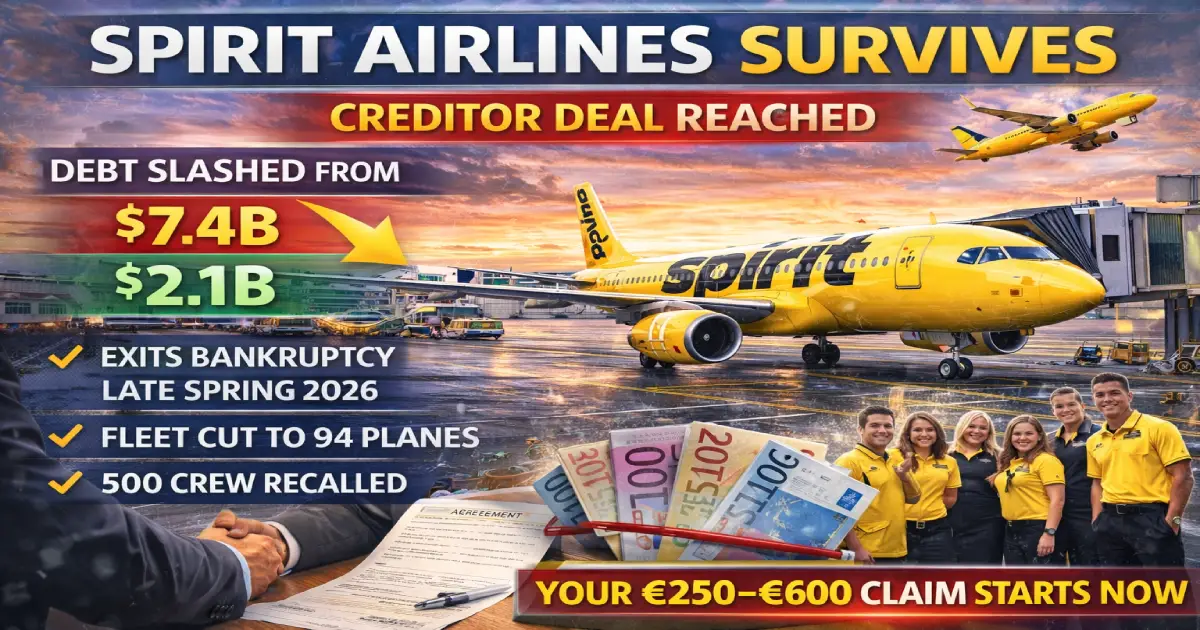
Breaking: Spirit Airlines will NOT shut down Deal Confirmed: Agreement in principle with secured creditors + DIP lenders — February 24, 2026 Court: U.S. Bankruptcy Court, Southern District of New York — Tuesday hearing CEO: Dave Davis — “Spirit will emerge as a strong, leaner competitor” Bankruptcy Type: Chapter 11 — Spirit’s second filing in 12 months (August 2025) Exit Timeline: Late spring or early summer 2026 Debt Reduction: $7.4 billion → $2.1 billion (a cut of $5.3 billion) Fleet: 214 aircraft (pre-filing) → 94 aircraft (post-restructuring) Aircraft Sold: 20 Airbus jets sold (13 A320s + 7 A321s) — April 20 auction Fleet Cost Savings: ~$550 million annually — a 65% cut from pre-bankruptcy levels 500 Flight Attendants: Recalled from furlough — TODAY — ahead of spring break Hub Focus: Fort Lauderdale, Orlando, New York area, Detroit New Products: Spirit First, Premium Economy expansion, Big Front Seat third row Frontier Merger: Still possible — “we’ll have a lot of options in front of us” — CEO Spring Break: Spirit IS flying — 500 FAs recalled, spring schedule intact Stock Impact: Spirit shares gained in after-hours trading post-announcement
Spirit Airlines is not going anywhere. Not yet, anyway — and if its CEO and newly aligned creditors are right, not ever.
Spirit Airlines, which had been in danger of going out of business due to ongoing losses and two bankruptcy filings, has reached a deal that will allow it to survive, albeit as a smaller company. The budget airline announced Tuesday that it made an agreement with creditors that will allow it to emerge from bankruptcy later this spring or early summer.
For the millions of Americans who fly Spirit every year — lured by fares that can undercut the Big Three by $50, $100, or more on popular routes — this is the news they have been waiting for through months of meltdowns, cancellations, furloughs, and bankruptcy court headlines. Spirit is not liquidating. It is restructuring. And when it emerges, it will look and fly very differently from the airline that nearly collapsed twice in under 18 months.
This is the complete story of what happened, what the deal means, what the “new Spirit” will look like, and — most importantly — what every Spirit passenger needs to know before booking a flight for spring break, summer, or beyond.
Spirit lawyer Marshall Huebner said during a New York court hearing on Tuesday that the company has reached a deal with a key creditor group on the terms of the Chapter 11 exit plan that will trim billions of dollars in debt and reduce the cost of its fleet.
The carrier says it has reached an agreement in principle with its secured creditors and DIP (debtor-in-possession) lenders, clearing a major hurdle in its Chapter 11 restructuring. The goal is to emerge from bankruptcy in late spring or early summer 2026.
In plain English: the people Spirit owes the most money to — its senior noteholders, its aircraft lessors, and its bankruptcy lenders — have agreed on the terms under which they will let Spirit restructure its debts, keep flying, and emerge as an independent airline. Without this agreement, Spirit would have faced liquidation — its planes sold off, its routes abandoned, its employees permanently laid off.
The restructuring is anticipated to reduce Spirit’s debt and aircraft lease obligations from $7.4 billion to about $2.1 billion. That is a reduction of $5.3 billion — a massive financial reset that eliminates the crushing debt load that made Spirit’s survival as a going concern impossible under its old capital structure.
“In order for us to be good consolidation partners we need to be a profitable standalone airline. When we achieve that, we will be looking around for strategic opportunities in the business,” Chief Executive Officer Dave Davis said in an interview with Bloomberg.
The message from the CEO is deliberate and important. Spirit is not emerging from bankruptcy to immediately merge with someone else. It is emerging to prove it can stand on its own — and then, from a position of strength, consider what comes next.
To understand why this deal matters — and why so many people had written Spirit off entirely — a brief timeline of the last 18 months is essential.
Late 2023 — The JetBlue Merger Collapse: Spirit’s proposed acquisition by JetBlue was blocked by a federal judge in early 2024, leaving Spirit without its lifeline and with no clear path to financial stability. Spirit was uniquely challenged by a massive engine recall from Pratt & Whitney and a failed plan to get acquired by JetBlue Airways, a deal knocked down by a federal judge in early 2024.
November 2024 — First Chapter 11 Filing: Spirit filed its first Chapter 11 bankruptcy in November 2024 after unsuccessful merger talks with JetBlue and Frontier. The first restructuring reduced debt by roughly $795 million. It was not enough.
March 2025 — First Bankruptcy Exit: Spirit emerged from its first Chapter 11 in March 2025 — but the underlying structural problems had not been solved. The airline returned to profitability forecasts it couldn’t meet, and the cash kept bleeding.
August 2025 — Second Chapter 11 Filing: The budget carrier filed for fresh bankruptcy protection in August, months after emerging from a Chapter 11 reorganization. This second filing shocked even industry observers who had been following the airline’s struggles — a double bankruptcy in under 12 months is extraordinarily rare in US aviation history.
December 2025 — The Furlough Crisis: Spirit placed approximately 1,800 flight attendants on unpaid furlough beginning December 1, 2025 as part of emergency cost-cutting. Within weeks of implementing furloughs, Spirit faced an unexpected operational imbalance. Senior executives activated Level 3 staffing contingency plans after high sickness rates left the airline unable to crew scheduled flights. At the height of the disruption, the airline reportedly cancelled up to 60 flights per day due to insufficient cabin crew availability.
February 12, 2026 — The Recall: Spirit is also calling 500 flight attendants back from furlough, just as it gears up for the spring break travel season.
February 24, 2026 — The Creditor Deal: The moment that changes everything. The court hearing, the agreement in principle, and the announcement that Spirit will exit Chapter 11 by late spring or early summer 2026.
The restructuring is not cosmetic. The scale of the changes Spirit is making to its fleet, network, cost structure, and product is fundamental — this is effectively a new airline operating under a familiar brand.
Spirit has moved to auction off 20 Airbus aircraft, comprising 13 A320s and 7 A321s, to raise critical liquidity and reduce maintenance overhead. This sale, slated for an April 20 auction date, would leave the airline with a core fleet of approximately 94 narrowbody jets, a staggering reduction from the 214 aircraft it operated before the August 2025 filing.
Spirit has already exited 14 airports and rejected leases for more than 80 aircraft under court-approved measures. February filings suggest that after pending aircraft sales and lease returns, the fleet could comprise 28 owned aircraft and 66 leased jets — a dramatic downsizing.
Spirit plans to remove from operation another 15 to 20 aircraft in mid-April, with another cut at the end of the US summer. The size of the final post-summer fleet has not yet been determined.
The fleet composition shift: The new fleet would be made up of mostly older Airbus planes, “with the potential rejection of additional high cost NEO aircraft,” Huebner said, referring to the more modern Airbus A320 family of planes. This is a deliberate financial choice — older aircraft have lower lease costs, even if their fuel efficiency is slightly lower.
The airline also projects a further reduction in annualised fleet costs — about $550 million, representing roughly a 65 percent cut from pre-bankruptcy levels. Additional nonfleet savings of around $300 million are also targeted.
Total targeted annual cost reduction: approximately $850 million — a genuinely transformative restructuring that would give the new Spirit a fundamentally different operating economics from the airline that filed in August 2025.
Much of the airline’s focus will be on flying to destinations from its major Florida airports, Fort Lauderdale and Orlando, as well as from the New York area and Detroit, CEO Dave Davis told CNBC.
Routes that do not touch those airports, CEO Dave Davis told CNBC, “will be an even smaller part of the network.” Spirit has exited 14 airports under court-approved measures.
For passengers: if you fly Spirit regularly on routes that touch Fort Lauderdale (FLL), Orlando (MCO), New York-area airports (JFK/LGA/EWR/LGA), or Detroit (DTW) — your routes are most likely to survive. If you fly Spirit on routes that don’t touch those four hubs — check your specific routes carefully as Spirit rebuilds its post-bankruptcy schedule.
Spirit had 3.9% market share in domestic passenger miles during the 12-month period ending in September, making it the seventh largest domestic operator. Delta, American, Southwest and United collectively had 68.5%.
Spirit has slashed its network and fleet and furloughed more than 1,300 flight attendants and hundreds of pilots to save cash.
Today — February 26 — 500 of those furloughed flight attendants are receiving their recall notices. The recall process will follow standard seniority rules, and returning crew members will have 15 days to resume duty once notified.
“This is good news for 500 Flight Attendants and their families and critical to those of us on the line that have faced a grueling operation over the last two months,” the Association of Flight Attendants-CWA said in a message to members.
The recall is timed deliberately for spring break — Spirit’s single highest-revenue travel period. With 500 additional flight attendants returning to active duty over the next 15 days, Spirit will have significantly more crew coverage for the March 8–22 spring break surge than it had during January and February’s chaos.
The most surprising element of Spirit’s restructuring plan — and the detail that will most directly affect passengers who book the airline — is the aggressive push into premium seating.
Perhaps the most surprising element of Spirit’s reset is the expansion of premium seating. The airline plans to roll out premium economy seating across the fleet and is considering adding a third row of its “Big Front Seat,” Spirit’s long-standing extra-legroom product.
The early-stage agreement would help Spirit finalise changes to its fleet, route network and cost structure as it works toward emerging as “a new Spirit” — a smaller, leaner carrier still focused on offering low fares but with more options like premium economy and its version of first-class seating with more legroom.
The three new fare tiers replacing Spirit’s old Go/Go Savvy/Go Comfy/Go Big bundles:
| New Fare Tier | What’s Included | Spirit’s Old Equivalent |
|---|---|---|
| Value | Basic no-frills fare — Spirit’s classic model | Go / Go Savvy |
| Premium Economy | 4 extra inches legroom across most of fleet | Go Comfy |
| First (Big Front Seat) | Extra-legroom first row + checked bag + priority boarding + gate-to-gate Wi-Fi | Go Big |
Spirit also plans to grow its Spirit First offering and refresh its loyalty program.
The pivot toward premium is not accidental. Large US airlines like American Airlines, Delta Air Lines, and United Airlines have launched their own no-frills basic economy fares that look more like Spirit’s model, though they were attached to larger carriers. The Big Three have effectively eaten Spirit’s core value proposition from above. Spirit’s response is to move upmarket — not to compete with Delta One, but to offer a Big Front Seat experience at a price point that legacy carriers cannot match.
For passengers, the immediate implications are practical. Expect a tighter network centred on core leisure and visiting-friends-and-relatives markets. Frequency reductions midweek may limit schedule flexibility but could also improve load factors and operational reliability. Onboard, premium seating options will become more prominent.
In its second bankruptcy, Spirit had held deal talks with Frontier Airlines, and with investment firm Castlelake. Nothing materialised, but Huebner hinted a combination could be back on the table. “This emergence will allow Spirit to do many things from a position of strength and stability, including to consider potential future industry transactions,” Huebner said.
Davis said that more consolidation among low-cost airlines “makes sense” but added that “if we build a sustainably profitable entity here, we’ll have a lot of options in front of us.”
The subtext is clear. Spirit’s management wants to emerge from bankruptcy, prove profitability for one to two quarters, and then re-enter merger discussions from a position of financial credibility. A Spirit–Frontier combination — the deal that was first floated in 2022 and has been discussed in various forms ever since — remains the most frequently cited strategic outcome. Combined, Spirit and Frontier would operate approximately 200–220 aircraft and have a combined market share in the low single digits — enough to be a genuine alternative to the Big Three on leisure routes.
No timeline has been set. No deal has been agreed. But the language from both the CEO and the lead bankruptcy lawyer suggests a merger is viewed as a matter of when, not if — after Spirit proves it can fly profitably on its own.
Spirit is recalling 500 flight attendants today specifically to prepare for spring break. The airline has a clearer financial picture than at any point since August 2025. The creditor deal removes the immediate liquidation threat.
However: Spirit’s operational reliability during January and February has been significantly below its pre-bankruptcy standards. The airline cancelled up to 60 flights per day at the height of its staffing crisis. While the recall addresses some of that gap, 500 flight attendants being recalled with 15 days to return to duty means the full staffing benefit won’t be felt until approximately March 12 — right in the middle of spring break.
Practical advice for spring break Spirit passengers:
Spirit expects to emerge from bankruptcy in late spring or early summer. The exact exit date has not been confirmed. There is a non-zero probability that the court process takes longer than planned, that additional creditor negotiations are required, or that operational issues arise during the transition.
Practical advice for summer Spirit passengers:
Spirit has exited 14 airports already and will exit more as it rightsizes its network to 94 aircraft. If you have regularly flown Spirit out of a smaller or mid-size city — check whether your origin airport is on Spirit’s core network list.
Cities most likely to retain strong Spirit service: Fort Lauderdale, Orlando, New York metro, Detroit, Las Vegas, Cancún, Montego Bay, Punta Cana, San Juan, and other high-volume leisure destinations.
Cities at higher risk of reduced frequency or exit: Mid-size domestic cities with primarily connecting traffic, lower-volume routes in Latin America, and routes that don’t connect to Spirit’s four anchor hubs.
Spirit’s operational distress and network shrinkage have created route vacuums that competitors are actively filling — and have been filling since the first bankruptcy in November 2024.
Some competitors have prepared for the airline to shrink, if not cease operations entirely. American Airlines and United Airlines have taken over Spirit’s gates at several airports. Frontier Airlines has expanded frequency on routes where Spirit reduced service.
For Spirit passengers who find their route has been cancelled or reduced: Frontier is the most direct alternative on many leisure markets. Allegiant Air serves several of the same Florida and Sun Belt leisure markets. On routes touching New York, JetBlue remains a strong ultra-low-cost alternative.
The irony of Spirit’s survival is that it will re-enter competitive markets where American, Delta, United, Frontier, and Allegiant have all strengthened their positions during the 18 months of Spirit’s distress. The “new Spirit” will have to earn back both passengers and investor confidence simultaneously.
Spirit’s survival is not just good news for Spirit passengers. It is good news for every American traveler who has ever benefited from low-fare competition.
Spirit’s model — ultra-low base fares, high fees for extras — created genuine price competition on leisure routes that forced American, Delta, and United to introduce basic economy fares of their own. Spirit had 3.9% market share in domestic passenger miles — a modest number that understates its competitive impact, because Spirit disproportionately serves price-sensitive leisure routes where its presence keeps fares low for everyone.
If Spirit had liquidated, those routes would have seen immediate fare increases as the Big Three and Frontier absorbed the void without competitive pressure. Spirit’s survival — even as a much smaller carrier — maintains at least some of that downward pricing pressure on the leisure routes it continues to serve.
The Department of Transportation has long recognized the role ultra-low-cost carriers play in keeping fares accessible for lower-income travelers and families who cannot afford Big Three pricing. Spirit’s emergence from bankruptcy preserves that role, at least partially.
| Category | Detail |
|---|---|
| Bankruptcy status | Chapter 11 — second filing, August 2025 |
| Creditor deal date | February 24, 2026 |
| Expected exit date | Late spring or early summer 2026 |
| Debt before deal | $7.4 billion |
| Debt after restructuring | ~$2.1 billion |
| Fleet size (pre-filing) | 214 aircraft |
| Fleet size (post-restructuring) | ~94 aircraft |
| Airports exited | 14 (and counting) |
| Flight attendants on furlough | ~1,300 |
| Flight attendants recalled today | 500 |
| Spring break status | Flying — 500 FAs recalled |
| New fare tiers | Value / Premium Economy / First |
| Big Front Seat expansion | Third row under consideration |
| Merger talks | Frontier and Castlelake — no deal yet |
| CEO | Dave Davis |
| Headquarters | Dania Beach, Florida |
| Customer service | spirit.com / 1-855-728-3555 |
The headline answer is: yes for spring break, carefully for summer, refundable only for fall.
Spirit Airlines isn’t disappearing after all — but it’s not exactly returning to business as usual either. The creditor deal removes the liquidation threat that has been hanging over the airline since August. The 500 flight attendant recalls improve spring break operational reliability. The “new Spirit” — leaner, more premium, Florida-focused — has a coherent strategy for survival.
But “emerging from bankruptcy in late spring or early summer” means the formal exit is still weeks or months away. Until that exit is confirmed by the court, Spirit passengers are technically flying an airline still under Chapter 11 protection. Your DOT refund rights provide meaningful protection — but your best protection is booking refundable fares wherever possible and having travel insurance for any non-refundable Spirit itinerary.
“Spirit will emerge as a strong, leaner competitor that is positioned to profitably deliver the value American consumers expect at a price they want to pay,” CEO Dave Davis said.
If Davis is right — and the creditors who just agreed to erase $5.3 billion of Spirit’s debt seem to believe he is — American travelers will still have a yellow-liveried option at the bottom of the fare matrix for years to come.
Published: February 26, 2026. Information sourced from Bloomberg (February 25, 2026), CNN Business (February 24, 2026), CNBC (February 24, 2026), Fox Business (February 24, 2026), Fortune (February 25, 2026), Axios (February 24, 2026), Business Traveller (February 25, 2026), AeroXplorer (February 2026), Crain’s Detroit Business (February 25, 2026), Parade (February 26, 2026), Avgeekery.com (February 25, 2026), Aviation A2Z (February 12, 2026), Paddle Your Own Kanoo (February 12, 2026), Skift (February 12, 2026), US Bankruptcy Court Southern District of New York official proceedings, Spirit Airlines official press release February 24, 2026. All figures accurate as of 8:00 AM EST February 26, 2026.
For More Resources:
Related Articles:
Posted By : Vinay
This article is provided for general informational purposes only and is based on information available at the time of publication. Travel advisories, airline schedules, airport operations, visa requirements, government regulations, and other travel-related information are subject to change without prior notice. While Travel Tourister makes reasonable efforts to verify information using official announcements, government publications, airline and airport communications, and other reliable sources, we cannot guarantee that all information remains complete, accurate, or up to date at all times. Readers should independently verify any information that may affect their travel plans with the relevant airline, airport authority, government agency, embassy, or other official source before making travel, financial, or other decisions. Travel Tourister shall not be liable for any direct or indirect loss, inconvenience, or damages arising from the use of or reliance on the information contained in this article. Nothing in this publication constitutes legal, immigration, financial, or professional travel advice. If you believe any information in this article is inaccurate or outdated, please contact our editorial team. We review all credible correction requests promptly and update our content whenever appropriate.
Lastest News
2nd Floor, 39, Above Kirti Club, DLF Industrial Area, Kirti Nagar, New Delhi, Delhi 110015



Travel Tourister is a leading Travel portal where we introduce travellers to trusted travel agents to make their journey hasselfree, memorable And happy. Travel Tourister is a platform where travellers get Tour packages ,Hotel packages deals through trusted travel companies And hoteliers who are working with us across the world. We always try to find new and more travel agents and hoteliers from every nook and corners across the world so that you could compare the deals with different travel agents and hoteliers and book your tour or hotel with the one you have chosen according to your taste and budget.
Copyright © Travel Tourister, India. All Rights Reserved

 Call
Call Enquiry