Published on : 28 Feb 2026
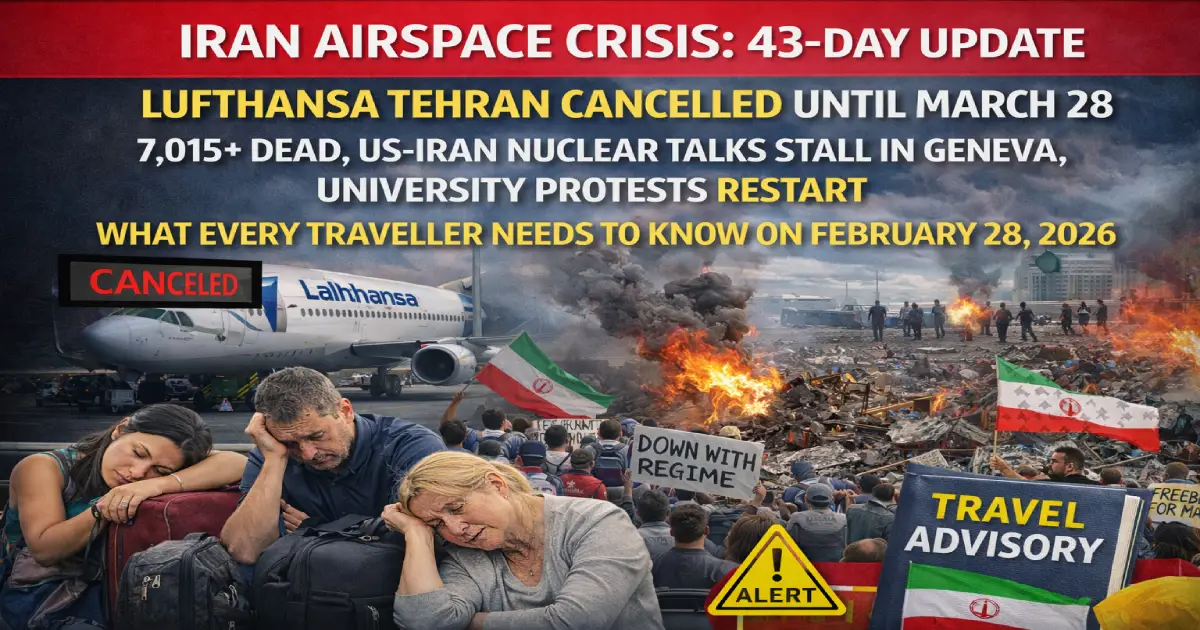
Published: February 28, 2026 (Updated from January 16 original) Days Since Original Coverage: 43 days Iran Protest Death Toll: 7,015+ confirmed (HRANA, as of Feb 5) | 30,000–36,500 estimated maximum Protest Status: Main wave suppressed Jan 21 — university protests RESTARTING Feb 16–25 Lufthansa Tehran: Cancelled through March 28, 2026 (entire winter schedule) Austrian Airlines Tehran: Suspended — potential late February return (not yet confirmed) Iran Airspace Overflights: European carriers still avoiding — Central Asia detours continue IndiGo (India) Suspension: Extended through March 28 — routes unsustainable on narrow-body US-Iran Nuclear Talks: Round 3 completed Geneva, Feb 26 — “significant progress” — Vienna technical talks start this week US Military Buildup: USS Abraham Lincoln + carrier strike group off Iran coast New US Sanctions: Imposed Feb 26 targeting 14 Iranian oil export vessels Travel Advisories: US, UK, Canada, Australia all remain at Do Not Travel / Level 4 Next Flashpoint: Vienna technical talks this week — outcome determines whether flight resumptions accelerate or crisis deepens
The story has changed dramatically since January 16 — and not in the direction airlines were hoping. When we last covered this crisis 43 days ago, the question was whether Lufthansa would resume Tehran flights by January 28. Today the answer is confirmed: Lufthansa has cancelled its entire winter schedule to Tehran, with no return before March 28 at the earliest. The protest death toll has risen from the 2,571 figure we reported to a confirmed 7,015 — with estimates from some sources ranging as high as 36,500. The main wave of protests was crushed by January 21 through one of the deadliest government crackdowns in modern history. But as of this week, new university protest waves are restarting. And the diplomatic picture has suddenly shifted: the US and Iran held their most intense nuclear talks yet in Geneva on February 26, just yesterday, with “significant progress” reported — but no deal, and US warships remain positioned off Iran’s coast. Here is a complete 43-day update, airline by airline, event by event, and what it all means for your travel planning right now.
The situation on January 16 seemed like it might resolve in weeks. Instead, it has deepened, militarised, and entered a new diplomatic phase that makes the aviation picture more uncertain than ever.
January 19: ABC News reported that the violent crackdown had “appeared to quell the protests” — with Iranian opposition member Mehdi Yahyanejad confirming “the crackdown has been so severe the protests have pretty much come to a halt.”
January 21: Iranian authorities formally announced protests had been suppressed. Prosecutor-General Mohammad Movahedi Azad declared the unrest over. Main street protests ceased — largely because, in the words of human rights activist Roya Boroumand, “each time, one-third of [protesters] is not coming back.”
January 21: Total estimated death toll confirmed in a range of 3,117 (Iranian government figure) to upwards of 36,500 (academic and human rights estimates). HRANA, the most methodologically rigorous tracker, confirmed 7,015 deaths by February 5.
January 27: The Guardian reported the Islamic Republic was concealing protest deaths through mass graves and clandestine burials.
January 29: The European Union designated Iran’s Islamic Revolutionary Guard Corps (IRGC) as a terrorist organisation — the first time the EU had taken this step — in direct response to the crackdown.
February 1: Reports emerged that unknown substances forcibly injected into detainees had been linked to multiple deaths in custody.
February 2: The UK government designated ten additional individuals and one organisation — the Law Enforcement Forces — under its Iran sanctions regime, including Iran’s Interior Minister and police chiefs.
February 5: HRANA confirmed 7,015 deaths as of this date. Death toll continues to rise as information trickles out of Iran’s internet blackout.
February 6: First round of indirect US-Iran nuclear talks held in Muscat, Oman — mediated by Omani Foreign Minister Badr al-Busaidi. Both sides described discussions as “constructive.”
February 11: Iran’s 1979 Revolution anniversary — the regime held official ceremonies while Iranians in multiple cities chanted anti-government slogans from their homes in an act of civil disobedience.
February 14: Global Day of Action for Iran — worldwide solidarity protests. Nightly home chanting in Iran described by HRANA as an “enduring form of civil disobedience.”
February 16: 40-day memorial ceremonies for January massacre victims held across multiple Iranian cities — turned into large protest gatherings and political demonstrations. Security forces attempted to restrict attendance.
February 16–17: New protest waves restarted in western Iran and at universities. Fortieth-day memorial protests in multiple cities.
February 19: A senior regime official publicly admitted that security forces performed “coup de grâce” — fatal final shots on wounded protesters — during the January crackdown.
February 21: New university protests at five universities in Tehran and Mashhad, described by NPR as students “demonstrating around memorials for thousands of people killed.”
February 23: Former Iranian President Mohammad Khatami publicly called for the release of those arrested solely for protesting — the highest-profile reform voice to speak out since the crackdown.
February 24: UN General Assembly President Annalena Baerbock referenced Iran at Geneva’s Palais des Nations, describing the shooting of a woman “simply for demonstrating peacefully” as an attack on fundamental rights.
February 24 (ongoing): University students boycotted classes for a fifth consecutive day — sustained student uprising across Iranian campuses.
February 26 — YESTERDAY: Third round of US-Iran nuclear talks held in Geneva — described by Oman’s foreign minister as producing “significant progress.” Technical talks to continue next week in Vienna. Simultaneously, the US announced new sanctions on 14 Iranian oil export vessels.
Status as of February 28: Tehran flights cancelled through March 28, 2026 — entire winter schedule scrapped.
When we last reported on January 16, Lufthansa’s Tehran resumption had been pushed to “at least January 28.” That date came and went without a resumption. Then the airline confirmed the full winter schedule cancellation through end of March.
Al-Monitor confirmed this week that “a Lufthansa Group spokesperson told Al-Monitor that, for operational reasons, Lufthansa is canceling its flights to Tehran until the end of the winter flight schedule on March 28.”
The spokesperson added a notable detail: “The airlines of the Lufthansa Group will continue to refrain from flying over Iranian and Iraqi airspace. In contrast, part of Bahrain’s airspace can be used again.” This partial Bahrain airspace reopening is the only marginal improvement since January 16 — allowing slightly shorter routing for Gulf-bound flights — but does not affect the core Iran airspace avoidance.
Affected Lufthansa Group carriers: Lufthansa, SWISS, Austrian Airlines, Brussels Airlines, Eurowings.
Austrian Airlines: A subsidiary update from mid-January indicated Austrian was targeting “late February” for a potential return to Vienna-Tehran. That date has not been confirmed as of today. Austrian is effectively suspended.
The March 28 question: Lufthansa’s winter schedule ends March 28. Whether Tehran service appears on the summer schedule depends entirely on the outcome of the US-Iran nuclear talks and the trajectory of university protests. Given that talks resumed only yesterday and no deal has been reached, a summer resumption is possible but far from certain.
Status: Continuing to avoid Iranian airspace. No direct Tehran service — BA has not served Tehran in years.
The Bahrain route cancellations from January (January 9–16) have since been resolved with rerouted service. BA confirmed to Al-Monitor that “part of Bahrain’s airspace can be used again” — allowing Bahrain routes to resume with longer but viable routing.
European overflights of Iran: still avoided. All London–India and London–Southeast Asia routings continue to arc north of Iran.
Status: Limited, confirmed service maintained — but majority suspended.
Qatar Airways has confirmed it will maintain its Doha–Tehran (DOH-IKA) service with two daily flights (QR498/QR499) from March 11 to June 30. This is a scaled-back version of previous service but represents a meaningful commitment that no European carrier is currently willing to make.
All other Qatar Airways services to and from Iran remain suspended through June 30. This is the clearest indication from a major international carrier of what limited Iran aviation looks like in 2026 — one thin lifeline through Doha, everything else suspended.
Status: Suspended routes extended to March 28 — a significant development since January 16.
India’s largest carrier originally suspended four routes (Almaty, Baku, Tashkent, and Tbilisi) through February 28 due to Iran airspace avoidance. IndiGo has now confirmed an extension to March 28, with the airline citing that “the routes [are] unsustainable with the longer diversions required, given the Airbus A321neo’s range limitations.”
This is a significant development: it is the first airline to explicitly state that the Iran avoidance has made specific city-pairs commercially unviable rather than merely operationally more expensive. IndiGo’s A321neo simply cannot reach Kazakhstan, Georgia, and Azerbaijan efficiently without Iranian overflight rights. If Iran airspace avoidance continues past March 28, IndiGo faces permanent route suspension — not just temporary delay.
Status: Continuing to operate. Rerouting but not suspending.
Emirates, flydubai, and Air Arabia have maintained operations throughout the 43-day crisis — but not without cost. The rerouting around the Tehran Flight Information Region (FIR) incurs approximately $6,000 in operating costs per flight hour. For a carrier the size of Emirates with 20+ affected European routes daily, these costs accumulate rapidly.
The key distinction remains: Gulf carriers fly over Iran on their Europe routes (or used to) and continue to Iran by landing in Tehran. The landing-in-Tehran component is suspended or reduced. The overflight component has been rerouted at significant cost.
Arrivals at Tehran’s Imam Khomeini International Airport (IKA) are largely limited to:
All European carriers remain suspended or cancelled. The only two non-Middle East international airlines confirmed landing at IKA this week were Azerbaijan Airlines and Armenia Airways — both small regional operators.
European airlines not yet resumed: Lufthansa Group, British Airways, KLM, Finnair, Air France, ITA Airways.
On January 16, we reported a death toll of 2,571+ confirmed by HRANA.
The full picture, as of late February 2026, is substantially grimmer:
| Source | Death Toll Figure | Date |
|---|---|---|
| HRANA (confirmed) | 7,015 confirmed deaths | February 5, 2026 |
| HRANA (under review) | 11,744 additional cases | February 5, 2026 |
| Iranian government | 3,117 killed | January 21, 2026 |
| Time / The Guardian | 30,000–36,500 killed (Jan 8–9 alone) | Late January 2026 |
| Trump State of the Union | 32,000 acknowledged | February 2026 |
| Minimum confirmed | 7,015 | February 5, 2026 |
The January 8–9 massacre — now being described as “Iran’s Babi Yar” by some observers — was the single deadliest 48-hour period. Internal Iranian Ministry of Health estimates suggested at least 30,000 killed in those two days alone, per Britannica’s confirmed reporting.
The EU designated the IRGC as a terrorist organisation on January 29 specifically in response to the scale of the massacre. The Australian government imposed sanctions on 20 Iranian individuals and three organisations. The UK sanctioned 10 additional individuals on February 2.
The original protest wave — which began December 28, 2025 — was effectively crushed by January 19–21. But the underlying conditions have not changed, and the repression itself is generating new waves.
The 40-day cycle: In Iranian Shia tradition, the 40th day after a death is marked with memorial ceremonies. The January massacre victims’ 40-day memorials fell on February 16–17. Across multiple cities, what began as mourning events became political demonstrations. Security forces attempted to restrict attendance. New protest waves began in western Iran simultaneously.
University protests — February 16–25: Universities became the new frontline. Students boycotted classes for five consecutive days by February 24–25, turning campuses into “hubs of resistance.” Protests at five Tehran universities and universities in Mashhad, Shiraz, and Tabriz were confirmed. The academic community withdrew en masse from the Fajr International Film Festival as a cultural protest.
What this means for airlines: The protest resumption matters for two reasons. First, it signals that the Iranian regime’s control is not fully restored — creating continued security risk assessments for carriers. Second, it reduces the political space for a US-Iran deal — Iran is fighting a domestic war while simultaneously negotiating with Washington, and any deal that appears to reward the regime while protesters are being killed faces enormous international pressure.
The most significant development since January 16 for aviation is not protests or death tolls — it is the diplomatic track. US-Iran nuclear negotiations have restarted and are, as of yesterday, at their most advanced point since the 12-day Iran-Israel war of June 2025.
Round 1 — February 6, Muscat (Oman): First indirect talks between US Special Envoy Steve Witkoff and Iranian Foreign Minister Abbas Araghchi, mediated by Omani FM Badr al-Busaidi. Described as “constructive.”
Round 2 — February, Oman: Second round. Continued framework discussions.
Round 3 — February 26, Geneva (YESTERDAY — most intense round): This is the pivotal development. Yesterday’s talks in Geneva produced “significant progress” by the Omani mediator’s assessment. Iranian FM Araghchi described it as the “most intense talks so far.” Both sides agreed to continue with technical-level negotiations in Vienna next week — specifically at the International Atomic Energy Agency (IAEA).
What the US wants: Full dismantlement of nuclear enrichment infrastructure at Fordow, Natanz, and Isfahan. Surrender of enriched uranium stockpile to the US. Limits on ballistic missile programme. End to support for regional armed groups. A “forever” deal with no sunset clauses.
What Iran wants: Right to continue enriching uranium for civilian use. Full lifting of US primary and secondary sanctions. Access to frozen financial assets. Recognition of Iran’s regional role.
The gap: Iran rejected the demand to transfer enriched uranium abroad and maintained enrichment is non-negotiable. The US insists missiles and regional proxies must also be on the table. Iran refuses to discuss these. The gap remains wide, but both sides are talking.
The military shadow: The USS Abraham Lincoln carrier strike group is currently positioned off the Iranian coast. For the first time in these talks, the US brought its top military commander in the Middle East — US Navy Admiral Brad Cooper, head of CENTCOM — to the negotiating table in Geneva. His presence in dress uniform was, as NPR described it, “a reminder that the aircraft carrier USS Abraham Lincoln and other warships were now off the coast of Iran.”
Simultaneously with yesterday’s talks concluding, the US State Department announced new sanctions on 14 Iranian oil-export vessels. This dual-track — talk and pressure simultaneously — is the Trump administration’s stated strategy.
In our original article, we modelled four scenarios. Here is an honest update on each:
No change. The protests were crushed but not because of resolution — because of massacre. University protests restarting. No quick path to normalisation visible.
We reduce this probability. The Geneva talks yesterday represent a genuine diplomatic opening that didn’t exist on January 16. A deal is not imminent but the trajectory is different from pure grinding unrest. Reduced from 50% to 35%.
We increase this probability slightly. The USS Abraham Lincoln positioning, CENTCOM commander presence at talks, and Trump’s simultaneous sanctions-while-talking strategy all indicate military action remains a live option. Iran’s stated red lines — retain enrichment, no missile discussion — clash with US red lines. If Vienna technical talks fail next week, the window for diplomacy may close fast. Increased from 35% to 40%.
This scenario did not exist on January 16. The Geneva talks yesterday introduced a genuine possibility that did not exist before. Both sides made “significant progress.” Technical talks start in Vienna next week. If Vienna produces a framework before mid-March, airline resumptions could cascade rapidly. Estimate: 20% probability of a deal that meaningfully changes the aviation picture before May 1, 2026.
Bottom line: The most dangerous 4-6 weeks of this crisis are probably now — between the current diplomatic talks and the next flashpoint. Either the Vienna talks produce a framework, or the military threat assessment escalates sharply.
Every major Tier 1 government travel advisory remains at the highest possible warning level. None have been downgraded since January 16.
| Country | Advisory Level | Status |
|---|---|---|
| 🇺🇸 United States | Level 4 — Do Not Travel | Unchanged since long before Jan 16 |
| 🇬🇧 United Kingdom | Advise Against All Travel | New sanctions Feb 2 — situation worsened |
| 🇨🇦 Canada | Avoid All Travel | Unchanged |
| 🇦🇺 Australia | Do Not Travel | New sanctions on 20 individuals/3 orgs |
| 🇩🇪 Germany | Warnung vor Reisen (Warning against travel) | Unchanged |
| 🇪🇺 European Union | EU designated IRGC as terrorist organisation Jan 29 | Strongest EU action ever taken against Iran |
If you hold any nationality with a dual Iran-[your country] citizenship: The risk is acute. Iran does not recognise dual nationality. Dozens of dual nationals have been arrested during and after the protests. The UK government has been especially emphatic about the risk to British-Iranians.
Every European flight that previously routed over Iran is still detouring. The detour routes (over Afghanistan, Central Asia, or the Arabian Peninsula depending on the route) are adding 60–90 minutes and $15,000–$30,000 per flight in fuel costs. Those costs are absorbed by airlines in the short term but pressure fares over time.
If you are booked on any of these route types, expect:
Routes most affected:
If you have IndiGo flights between India and Almaty (Kazakhstan), Baku (Azerbaijan), Tashkent (Uzbekistan), or Tbilisi (Georgia) — your service is suspended through March 28. IndiGo has confirmed these routes are commercially unsustainable under the current Iran avoidance. Book alternative routing through Turkish Airlines (via Istanbul) or Flydubai (via Dubai) for these city pairs.
Do not travel to Iran. This is the unambiguous guidance of every Tier 1 government. It is not hedged with “exercise caution” or “reconsider.” It is “Do Not Travel” — the maximum warning. University protests are active now. Executions of detained protesters are being fast-tracked. Dual nationals are being arrested. Internet is still heavily restricted. The situation on the ground is not improving.
Qatar Airways is the only major international carrier maintaining meaningful service to Tehran, starting March 11 with two daily QR498/QR499 Doha flights. If you are travelling to Iran despite all advisories — or if you have unavoidable family or humanitarian reasons — Doha remains the best connection hub. Emirates and Flydubai also maintain Gulf-region service to IKA.
The most important thing happening this week for Iran aviation is not a strike announcement or a protest — it is the IAEA technical talks in Vienna, which begin tomorrow or Monday, March 1–2, 2026.
These talks are the follow-on from yesterday’s Geneva round. Technical teams from the US and Iran will meet at IAEA headquarters in Vienna to work through the detailed nuclear parameters of a potential framework agreement.
What a successful Vienna round means for aviation: If technical teams in Vienna reach even a preliminary framework — not a full deal, just a framework — expect the following aviation sequence within weeks:
What a failed Vienna round means: If talks break down in Vienna before a framework:
Watch Vienna next week. It is the hinge point for everything.
One factor we didn’t cover on January 16 is the economic context that drove the protests — and that context directly affects travel economics.
The Iranian rial has lost more than 40% of its value since the Iran-Israel 12-day war of June 2025, and nearly 90% of its value since the US reimposed sanctions in 2018. For the very few travellers who do visit Iran (domestic tourism or visiting family), this collapse means:
Iran’s tourism revenue has collapsed from an annual $10 billion+ to near-zero. The regime’s response has been to increase security spending by nearly 150%, while offering wage increases of only about two-fifths of the inflation rate — the precise formula for continued unrest.
Since January 16, the international sanctions response has escalated significantly:
European Union — January 29: First-ever designation of the Islamic Revolutionary Guard Corps (IRGC) as a terrorist organisation. This is a significant legal step that complicates any resumption of normal Iran-EU aviation links — airlines must verify that no sanctioned entity is involved in handling their aircraft at Iranian airports.
United Kingdom — February 2: Ten additional individuals sanctioned, including the Interior Minister and police chiefs. Legislation to also designate the IRGC as a terrorist organisation is proceeding through Parliament.
Australia: Sanctions on 20 individuals and three organisations imposed in response to the “horrific use of violence against its own people.”
United States — February 26 (yesterday): New sanctions specifically targeting 14 Iranian oil-export vessels, announced immediately after the Geneva talks concluded. The simultaneous action — diplomacy and pressure in the same 24 hours — is deliberate Trump strategy.
Aviation implication of IRGC terrorist designation (EU and pending UK): Airlines operating to Iran must now perform enhanced due diligence to ensure no aircraft servicing, ground handling contracts, or fuel supply arrangements involve IRGC-affiliated entities. Given the IRGC’s extensive involvement in Iran’s economy, this compliance burden is a significant additional obstacle to European carrier resumption — even if the political situation improves.
If you have unavoidable reasons to travel to or through Iran — family emergency, humanitarian mission, dual national with obligations — here is the practical picture:
Getting there: Doha (via Qatar Airways) is your best gateway. Two daily QR498/499 flights from March 11. Alternatively: Dubai (Emirates/flydubai), Istanbul (Turkish Airlines/Pegasus), Abu Dhabi (Air Arabia), Baku (Azerbaijan Airlines).
Internet: Still heavily restricted. Assume you will have limited or no access to Western social media, Google services, or VPN-based workarounds. Download offline maps (maps.me for Iran) before departure.
Communication: Inform your embassy of your travel. Register with your government’s traveller notification system (STEP for Americans, FCDO travel alert for British, Smartraveller for Australians). Leave detailed itinerary with family at home.
Currency: Iran does not accept international credit or debit cards due to sanctions. You must carry cash in euros, dollars, or UAE dirhams and exchange on arrival at Tehran airport’s official exchange desks. The parallel rate varies — use official channels to avoid legal complications.
Dual nationality: If you hold Iranian citizenship alongside US, UK, Canadian, or Australian citizenship, Iran will treat you solely as an Iranian national. You will not have consular protection from your other country’s embassy while in Iran. This is not theoretical — many dual nationals have been detained.
On January 16, the question was whether Lufthansa would resume Tehran flights by January 28. Forty-three days later, the answer is no — and the new question is whether any European carrier returns to Tehran before summer 2026, and whether the US-Iran nuclear talks conclude a framework before military action makes the question moot.
What has worsened since January 16:
What has improved since January 16:
The honest picture: This is not resolved. University protests are active. Nuclear talks are ongoing but no deal. Military threat is live. Every major government travel advisory remains at maximum warning. European airlines are not flying to Tehran and are still detouring around Iran’s airspace. If Vienna technical talks fail next week, the situation could deteriorate faster than it has since January 16.
Watch this week. Vienna determines the next chapter.
Government Travel Advisories:
Airline Status Pages:
Safe Airspace Monitoring:
Iran News:
Human Rights Tracking:
Posted By : Vinay
This article is provided for general informational purposes only and is based on information available at the time of publication. Travel advisories, airline schedules, airport operations, visa requirements, government regulations, and other travel-related information are subject to change without prior notice. While Travel Tourister makes reasonable efforts to verify information using official announcements, government publications, airline and airport communications, and other reliable sources, we cannot guarantee that all information remains complete, accurate, or up to date at all times. Readers should independently verify any information that may affect their travel plans with the relevant airline, airport authority, government agency, embassy, or other official source before making travel, financial, or other decisions. Travel Tourister shall not be liable for any direct or indirect loss, inconvenience, or damages arising from the use of or reliance on the information contained in this article. Nothing in this publication constitutes legal, immigration, financial, or professional travel advice. If you believe any information in this article is inaccurate or outdated, please contact our editorial team. We review all credible correction requests promptly and update our content whenever appropriate.
Lastest News
2nd Floor, 39, Above Kirti Club, DLF Industrial Area, Kirti Nagar, New Delhi, Delhi 110015



Travel Tourister is a leading Travel portal where we introduce travellers to trusted travel agents to make their journey hasselfree, memorable And happy. Travel Tourister is a platform where travellers get Tour packages ,Hotel packages deals through trusted travel companies And hoteliers who are working with us across the world. We always try to find new and more travel agents and hoteliers from every nook and corners across the world so that you could compare the deals with different travel agents and hoteliers and book your tour or hotel with the one you have chosen according to your taste and budget.
Copyright © Travel Tourister, India. All Rights Reserved

 Call
Call Enquiry