Published on : 21 Mar 2026
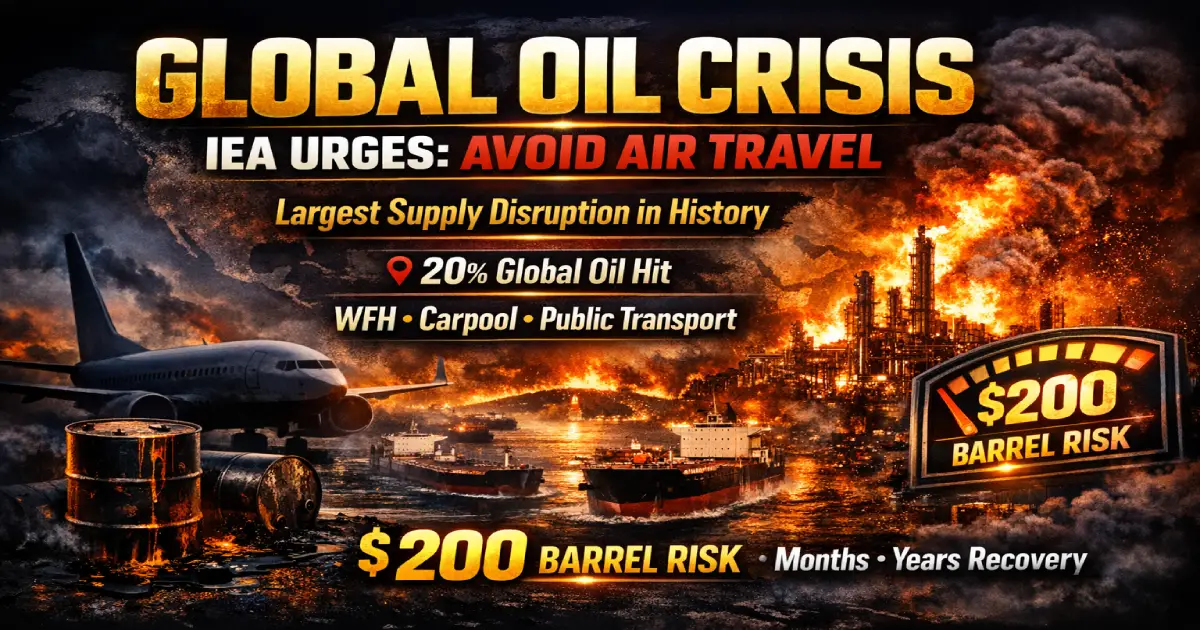
Breaking: International Energy Agency (IEA) urges “avoid air travel” + work from home Friday March 21, 2026 as US-Israeli war with Iran creates “largest supply disruption in history of global oil market” with Strait of Hormuz effectively closed (20% of global oil = ~20 million barrels/day halted!), pushing Brent crude from $70 to $120/barrel (near-record highs!), devastating jet fuel + diesel markets with “astronomical” price premiums, while IEA Executive Director Fatih Birol warns “in absence of swift resolution, impacts on energy markets and economies set to become more and more severe” as agency launches 400 million barrel emergency stock release (largest in IEA’s 50-year history!) + recommends 10 immediate actions: work from home, reduce highway speeds 6 MPH (10 km/h), use public transport/carpool, avoid business flights, limit city car access, affecting global aviation industry already struggling with fuel costs as analysts warn oil could hit $200/barrel with “months or even years to restore oil and gas flows from region.” Here’s what every traveler needs to know now.
Published: March 21, 2026 (Friday) — IEA ADVISORY ISSUED IEA Recommendation: “Avoid air travel where alternatives exist” Crisis Trigger: US-Israeli war with Iran (started Feb 28, 2026) Strait of Hormuz Status: Effectively closed (~20% global oil halted!) Oil Supply Loss: ~20 million barrels/day (crude + products) Oil Prices: $70 → $120/barrel (Brent crude, 71% surge since late 2025!) Jet Fuel/Diesel: “Astronomical” price premiums over crude Emergency Stocks Released: 400 million barrels (largest IEA release ever!) Recovery Timeline: “Months or even years” to restore Middle East flows IEA Warning: “Largest supply disruption in history of global oil market”
Friday, March 21, 2026 marks unprecedented intervention as International Energy Agency—global energy authority representing 31 member countries—issues stark advisory urging “avoid air travel where alternatives exist” while calling for work from home, reduced highway speeds (10 km/h/6 MPH cuts), public transport shifts, carpooling to combat “largest supply disruption in history of global oil market” triggered by US-Israeli war with Iran (started Feb 28) that effectively closed Strait of Hormuz (vital maritime chokepoint carrying ~20% of global oil = ~20 million barrels/day crude + products), devastating global energy markets as Brent crude surged $70 → $120/barrel (near-$120 highs!) while jet fuel + diesel premiums hit “astronomical” levels, forcing IEA to launch 400 million barrel emergency stock release (largest in agency’s 50-year history since 1974 founding!) as Executive Director Fatih Birol warns “war in Middle East creating major energy crisis… in absence of swift resolution, impacts set to become more and more severe.”
IEA Advisory (March 21, 2026):
✈️ “Avoid air travel where alternatives exist”: Official IEA recommendation! ✈️ “Reducing business flights can quickly ease pressure on jet fuel markets”: Agency quote ✈️ Work from home: Where possible to cut commuting fuel demand ✈️ Reduce highway speeds: At least 10 km/h (6 MPH) reduction recommended ✈️ Public transport/carpool: Shift away from private vehicle use ✈️ Limit city car access: Alternating number plate schemes, car-free zones
Strait of Hormuz Crisis:
✈️ Location: Narrow maritime corridor off Iran’s coast (connects Persian Gulf + Gulf of Oman) ✈️ Normal throughput: ~20 million barrels/day (~20% of global oil consumption!) ✈️ Current status: “Near halt” in shipping traffic (effectively closed!) ✈️ Crude oil: ~15 million barrels/day halted ✈️ Oil products: ~5 million barrels/day halted (diesel, jet fuel, LPG) ✈️ IEA quote: “Resumption of transit through Strait of Hormuz is single most important action to return to stable oil and gas flows”
Oil Price Surge:
✈️ Brent crude (late 2025): $60.85/barrel ✈️ WTI (late 2025): $57.95/barrel ✈️ Brent peak (March 2026): Near $120/barrel (98% surge!) ✈️ Current (March 21): ~$107/barrel Brent, ~$94 WTI (still 71-77% above late 2025!) ✈️ Analyst warning: Could reach $200/barrel if crisis continues
Jet Fuel + Diesel Crisis:
✈️ “Astronomical” premiums: Jet fuel + diesel prices surging FASTER than crude! ✈️ Limited refining flexibility: Middle East refinery shutdowns (4+ million barrels/day capacity at risk!) ✈️ Gulf product exports halted: 3.3 million barrels/day refined products + 1.5 million barrels/day LPG normally exported ✈️ Airlines devastated: Fuel = 20-30% of airline operating costs (now surging!)
IEA Emergency Response:
✈️ 400 million barrel stock release: Largest coordinated action in IEA’s 50-year history! ✈️ Previous releases: 1991 (Gulf War), 2005 (Hurricane Katrina), 2011 (Libya), 2022 (Ukraine war, twice) ✈️ This = 6th intervention: Unprecedented scale demonstrates crisis severity ✈️ Member countries: 31 countries coordinating release from strategic petroleum reserves
Production Losses:
✈️ Gulf countries slashed output: Kuwait, Iraq, Saudi Arabia, UAE collectively down 10+ million barrels/day! ✈️ Refineries shut: 4+ million barrels/day refining capacity offline (attacks, safety concerns, no export outlets) ✈️ Global supply plunge: 8 million barrels/day March decline expected
IEA Warning:
Quote from Fatih Birol, IEA Executive Director:
“The war in the Middle East is creating a major energy crisis, including the largest supply disruption in the history of the global oil market. In the absence of a swift resolution, the impacts on energy markets and economies are set to become more and more severe.”
Recovery Timeline:
✈️ IEA assessment: “Could take months or even years to restore oil and gas flows from region” ✈️ Critical dependency: Strait of Hormuz reopening = ONLY path to recovery ✈️ No immediate solution: No viable bypass capacity available
Interpretation: IEA’s unprecedented “avoid air travel” advisory exposes global aviation industry’s vulnerability to Middle East energy crisis, with Strait of Hormuz closure halting 20% of global oil (~20 million barrels/day) creating “largest supply disruption in history” that forces Brent crude $70 → $120/barrel surge while jet fuel + diesel premiums hit “astronomical” levels, devastating airlines’ fuel costs during crisis IEA warns “could take months or even years” to resolve, forcing agency to deploy largest-ever 400 million barrel emergency stock release + demand 10 immediate consumer actions including avoid air travel, work from home, reduce highway speeds to prevent economic catastrophe.
IEA outlines 10 concrete measures governments, businesses, households can implement immediately to reduce oil demand + shelter consumers from crisis:
✈️ Impact: Reduces fuel demand from commuting ✈️ Target: Office workers, professionals where roles allow ✈️ Already implemented: Philippines (4-day work week for government employees), multiple countries
Example—US Commuter:
Sarah normally drives 30 miles each way (60 miles/day, 300 miles/week):
✈️ Impact: Cuts fuel use across passenger vehicles + freight ✈️ Mechanism: Lower speeds = better fuel efficiency (physics!) ✈️ Example: 70 MPH → 64 MPH = ~10-15% fuel savings
Already Implemented:
✈️ Impact: Shifts demand away from private car use ✈️ Mechanism: Buses, trains, metros = more fuel-efficient per passenger ✈️ Challenge: Requires available public transport infrastructure (not all cities have it!)
✈️ Impact: Lowers congestion + fuel-intensive driving ✈️ Mechanism: Number plate rotation schemes (odd/even days), car-free zones ✈️ Precedent: Used during previous oil crises (1970s), pollution emergencies (Delhi, Beijing)
✈️ Impact: Improves vehicle utilization, reduces consumption ✈️ Carpooling: Multiple people in one car vs. multiple cars ✈️ Efficient driving: Smooth acceleration, proper tire pressure, reduce idling
✈️ CRITICAL FOR AVIATION: “Reducing business flights can quickly ease pressure on jet fuel markets” (IEA quote!) ✈️ Target: Corporate travel, non-essential flights ✈️ Alternatives: Video conferencing, rail travel (where available) ✈️ Impact: Business travel = 20-30% of airline revenue (significant if reduced!)
Example—Corporate Travel Ban:
Tech company normally flies 100 employees/month NYC ↔ San Francisco:
✈️ Impact: Prioritize LPG for essential uses (cooking vs. vehicle fuel) ✈️ Context: LPG prices surging alongside oil (5 million barrels/day Middle East exports halted!) ✈️ Cooking alternative: Electric cooking methods reduce LPG reliance
✈️ Impact: Reduces reliance on LPG for cooking ✈️ Options: Electric stoves, induction cooktops, solar cookers ✈️ Critical for developing countries: Many rely on LPG for cooking (now expensive!)
✈️ Target: Manufacturing, processing industries ✈️ Methods: Optimize processes, reduce waste, switch feedstocks ✈️ Impact: Industry = major oil consumer (efficiency gains = significant savings)
✈️ Target: Industries using oil/gas as raw materials (petrochemicals, etc.) ✈️ Options: Alternative feedstocks where technically feasible ✈️ Impact: Frees up constrained fuels, reduces overall demand
Strait of Hormuz—world’s most important oil transit chokepoint—is effectively closed, triggering global energy catastrophe.
Geography:
✈️ Location: Narrow strait (21 miles wide at narrowest!) between Iran + Oman ✈️ Connects: Persian Gulf (oil-producing region) ↔ Gulf of Oman ↔ Indian Ocean ✈️ Strategic importance: ONLY sea route for Gulf oil exports (Saudi Arabia, UAE, Kuwait, Iraq, Iran, Qatar)
Normal Operations:
✈️ Crude oil: ~15 million barrels/day transit ✈️ Oil products: ~5 million barrels/day (diesel, jet fuel, gasoline, LPG) ✈️ Total: ~20 million barrels/day = 20% of global oil consumption! ✈️ LNG: Also transits (Qatar = world’s largest LNG exporter)
Current Crisis Status:
✈️ Tanker traffic: “Near halt” (IEA description) ✈️ Ships stranded: ~200 vessels reportedly waiting in region ✈️ Reasons: (1) Iranian military threats, (2) Insurance unavailable, (3) Physical danger (attacks, mines) ✈️ Result: Gulf oil producers cannot export → forced production cuts!
Why Closure is Catastrophic:
No Viable Bypass:
Production Cuts Forced:
✈️ Kuwait, Iraq, Saudi Arabia, UAE: Collectively slashed 10+ million barrels/day ✈️ Reason: Cannot export = storage tanks fill up = must shut wells! ✈️ Refineries: 4+ million barrels/day capacity offline (no export outlets!)
IEA Quote:
“Resumption of transit through Strait of Hormuz is single most important action to return to stable oil and gas flows and reduce strains on markets and prices.”
Interpretation: Without Strait reopening, crisis cannot resolve = months/years of disruption!
Aviation industry facing worst fuel crisis as jet fuel + diesel prices surge FASTER than crude oil.
Why Jet Fuel Hit Hardest:
Refining Capacity Loss:
✈️ Middle East refineries: 4+ million barrels/day capacity offline (shutdowns from attacks, safety concerns, no export routes!) ✈️ Gulf product exports: 3.3 million barrels/day refined products normally exported (now halted!) ✈️ Jet fuel exports: Significant share of Gulf refineries’ output = aviation fuel supply destroyed!
Limited Refining Flexibility:
✈️ Asian refiners: Considering slashing processing rates (can’t access Middle East crude!) ✈️ Other regions: Cannot easily replace Middle East jet fuel supply (refining configurations differ!) ✈️ Result: Jet fuel supply squeeze while crude might be available elsewhere!
Price Premium Explosion:
IEA Quote:
“Jet fuel and diesel markets have seen biggest supply squeezes and price hikes amid soaring fuel price premiums over crude.”
What “Astronomical Premiums” Mean:
Diesel Similar Crisis:
✈️ Diesel = critical: Trucking, shipping, agriculture, heating all depend on diesel ✈️ Supply squeeze: Middle East = major diesel exporter (now halted!) ✈️ Economic impact: Diesel shortage = food prices surge (trucking costs!), supply chain disruption
Aviation Industry Impact:
Fuel = 20-30% of Airline Operating Costs:
Example—Major Airline Quarterly Fuel Bill:
Large airline normally burns 1 billion gallons/quarter:
Airlines’ Options:
IEA’s Solution:
“Avoid air travel where alternatives exist… reducing business flights can quickly ease pressure on jet fuel markets.”
Translation: IEA asking passengers to stop flying to save aviation industry from fuel crisis!
Iran war’s energy crisis creating widespread economic damage across regions:
Bangladesh:
✈️ Severe fuel crisis: Panic buying, hoarding, artificial shortages ✈️ Long queues: Vehicles waiting hours at filling stations ✈️ Movement disrupted: Daily life paralyzed ✈️ Rationing: March 5 limits imposed on refueling
India:
✈️ Imports 88% crude: Heavily dependent on Middle East oil ✈️ Macroeconomic risks: Widening current account deficit, rupee pressure, fuel cost surge ✈️ LPG price hikes: ₹60/cylinder increase already (cooking gas!) ✈️ Petrol/diesel: Prices held steady (for now) but pressure building
Asia LNG Crisis:
✈️ March 4 spot prices: More than doubled to 3-year highs ($25.40/MMBtu!) ✈️ Qatar force majeure: Giant Ras Laffan LNG plant declared force majeure (Iran attacks!) ✈️ Energy insecurity: Asia depends on Middle East LNG (now disrupted!)
Stock Crashes:
✈️ Japan Nikkei: Dropped 2%+ ✈️ Pakistan KSE 100: Largest-ever single-day decline (-16,089 points, -9.57%!) ✈️ South Korea KOSPI: Biggest crash since 2008 financial crisis (down 12%, circuit breaker triggered!) ✈️ Thailand Stock Exchange: 8% decline triggered trading curbs
Gold Disruption:
✈️ Dubai flights grounded: Gold shipments disrupted (Dubai = major gold hub!) ✈️ India gold prices: $50 discount → London price in days (massive swing!)
Buffered but Affected:
✈️ Domestic production: US = major oil producer (less dependent on Middle East) ✈️ Gasoline prices: Rising 5-10 cents/gallon DAILY! ✈️ Inflation risk: Energy costs feeding into broader inflation ✈️ Economic slowdown: Higher energy costs = consumer spending pressured
Another Energy Crisis:
✈️ Post-winter depletion: Stockpiles depleted during 2025-2026 winter (recent cold!) ✈️ Middle East dependence: Still significant despite Russian cutoffs ✈️ Electricity security: Natural gas disruptions = power generation risks ✈️ Poorest households hit hardest: IEA warning on energy poverty
Government Responses:
✈️ Austria: Cut fuel taxes, capped margins ✈️ Spain: Planning VAT reduction on fuel (21% → 10%), reduce electricity levies ✈️ EU Summit (Thursday): Leaders discussing short-term measures (taxes, network fees, carbon costs relief)
UAE Energy Infrastructure Attacked:
✈️ Iranian retaliation: Targeting UAE energy sites ✈️ Tanker struck: Near Strait of Hormuz ✈️ Airspace shutdowns: UAE briefly closed airspace (Iran attacks) ✈️ Regional instability: Escalation spreading beyond Iran-US/Israel
If You Have Air Travel Booked:
If You’re Currently Abroad:
Alternative Travel Options:
Train Travel (Where Available):
✈️ Europe: Excellent rail network (use trains instead of flights!) ✈️ US: Limited long-distance rail (Amtrak exists but slow) ✈️ Asia: Good rail in China, Japan, India (consider vs. flying!)
Ground Transport:
✈️ Driving: Use if distance reasonable (but note: gasoline prices also rising!) ✈️ Buses: Intercity buses = fuel-efficient option ✈️ Carpooling: Share rides (BlaBlaCar in Europe, similar services elsewhere)
Work from Home:
✈️ Cancel business trips: Use Zoom, Teams, Google Meet instead ✈️ Postpone conferences: Wait for crisis resolution ✈️ Virtual events: Many conferences moving online anyway
Short Answer: “Could take months or even years to restore oil and gas flows from region” (IEA assessment).
Recovery Depends On:
1. Strait of Hormuz Reopening:
✈️ Critical requirement: Shipping MUST resume through Strait ✈️ Challenges:
2. War De-Escalation:
✈️ Current status: Escalating (not de-escalating!) ✈️ Recent events:
3. Alternative Supply Routes:
✈️ Pipelines: Saudi East-West, UAE Abu Dhabi = insufficient capacity ✈️ New construction: Would take YEARS to build bypass capacity ✈️ Result: NO viable short-term alternatives!
Scenarios:
Optimistic (Low Probability):
Realistic (Moderate Probability):
Pessimistic (Possible):
IEA’s March 21 advisory marks unprecedented moment in global energy history:
Historical Context:
Previous IEA Interventions:
What Makes 2026 Different:
✈️ Scale: 400 million barrel release = LARGEST in IEA’s 50-year history! ✈️ Supply loss: 20 million barrels/day = DOUBLE any previous crisis! ✈️ Duration warning: “Months or even years” vs. previous crises (weeks/months) ✈️ Geographic scope: Strait of Hormuz = 20% global oil (no alternative route!) ✈️ IEA’s tone: Asking people to “avoid air travel” = unprecedented urgency!
Comparison to 1970s Oil Crises:
1973 Arab Oil Embargo:
1979 Iranian Revolution:
2026 Iran War:
International Energy Agency’s unprecedented “avoid air travel” advisory Friday March 21, 2026 exposes global aviation industry’s existential threat as US-Israeli war with Iran creates “largest supply disruption in history of global oil market” (IEA official designation) with Strait of Hormuz effectively closed halting ~20 million barrels/day (~20% of global oil consumption!) forcing Brent crude $70 → $120/barrel surge while jet fuel + diesel markets face “astronomical” price premiums devastating airlines’ operating costs, prompting IEA Executive Director Fatih Birol to warn “in absence of swift resolution, impacts on energy markets and economies set to become more and more severe” as agency deploys largest-ever 400 million barrel emergency stock release + demands 10 immediate consumer actions: work from home, reduce highway speeds 6 MPH, use public transport/carpool, avoid business flights, limit city car access.
For travelers: Reconsider all non-essential air travel (IEA official recommendation!). Expect ticket prices to surge 50-100%+ (airlines’ fuel costs tripling). Expect flight cancellations (airlines cutting routes to conserve fuel). Use train/ground transport alternatives where feasible. Cancel business trips (use video conferencing). If currently abroad, return home ASAP before flights stop operating. Avoid Middle East hubs (Dubai, Doha, Abu Dhabi uncertain). Travel insurance may NOT cover war exclusions. Recovery timeline = “months or even years” (IEA assessment). Crisis exposes aviation industry’s complete dependence on Middle East oil flows through single chokepoint (Strait of Hormuz) with NO viable alternatives, while IEA warning that oil could hit $200/barrel + Strait closure could persist years suggests global travel industry faces potential collapse if war continues, forcing unprecedented demand-side measures (avoid air travel, work from home) as only path to prevent economic catastrophe when supply-side solutions (emergency stock releases) prove insufficient to offset largest oil disruption in modern history.
Avoid air travel. Work from home. Reduce highway speeds 6 MPH. Strait of Hormuz closed. 20% global oil halted. $120/barrel Brent. Jet fuel “astronomical”. 400M barrel release. Months/years recovery. Aviation industry threatened. Historic energy crisis.
For More Resources:
Related Articles:
Posted By : Vinay
This article is provided for general informational purposes only and is based on information available at the time of publication. Travel advisories, airline schedules, airport operations, visa requirements, government regulations, and other travel-related information are subject to change without prior notice. While Travel Tourister makes reasonable efforts to verify information using official announcements, government publications, airline and airport communications, and other reliable sources, we cannot guarantee that all information remains complete, accurate, or up to date at all times. Readers should independently verify any information that may affect their travel plans with the relevant airline, airport authority, government agency, embassy, or other official source before making travel, financial, or other decisions. Travel Tourister shall not be liable for any direct or indirect loss, inconvenience, or damages arising from the use of or reliance on the information contained in this article. Nothing in this publication constitutes legal, immigration, financial, or professional travel advice. If you believe any information in this article is inaccurate or outdated, please contact our editorial team. We review all credible correction requests promptly and update our content whenever appropriate.
Lastest News
2nd Floor, 39, Above Kirti Club, DLF Industrial Area, Kirti Nagar, New Delhi, Delhi 110015



Travel Tourister is a leading Travel portal where we introduce travellers to trusted travel agents to make their journey hasselfree, memorable And happy. Travel Tourister is a platform where travellers get Tour packages ,Hotel packages deals through trusted travel companies And hoteliers who are working with us across the world. We always try to find new and more travel agents and hoteliers from every nook and corners across the world so that you could compare the deals with different travel agents and hoteliers and book your tour or hotel with the one you have chosen according to your taste and budget.
Copyright © Travel Tourister, India. All Rights Reserved

 Call
Call Enquiry