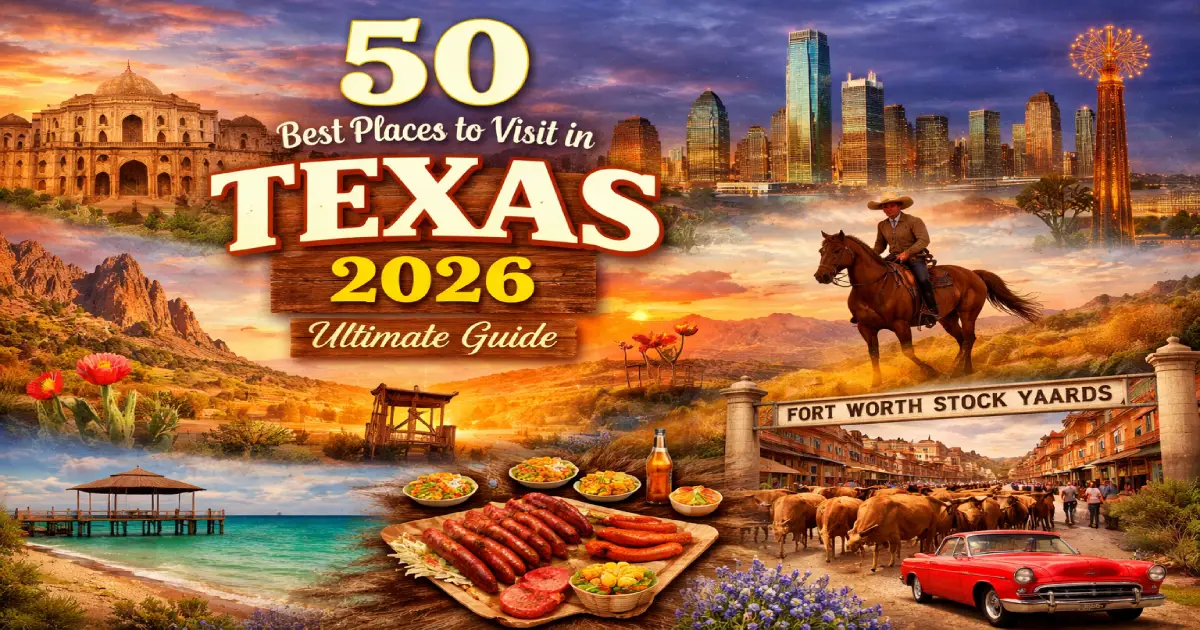
50 Best Places to Visit in Texas 2026: Ultimate Guide
Published on : 27 Mar 2026
Places to Visit in Texas — From the Alamo to Big Bend, Live Music Capitals to Working Cattle Towns
By Travel Tourister | Updated March 2026
Texas is the most geographically and culturally diverse state in the continental United States — a place where the Guadalupe Mountains rise to 8,751 feet and the Gulf Coast barrier islands stretch 113 miles of undeveloped national seashore, where San Antonio’s River Walk is the most visited attraction in Texas and Big Bend National Park is among the least visited in the lower 48, where the Stockyards in Fort Worth still moves cattle through working pens that have operated since 1890 and Austin’s 6th Street has been producing live music for six decades, where the Alamo holds the most loaded three acres of Texas identity and the McDonald Observatory holds one of the finest dark-sky facilities accessible to public visitors in North America. Texas is 268,596 square miles of entirely legitimate argument about what the most essential places are — and this guide has visited enough of them to provide the honest answer.
This comprehensive 2026 guide covers Texas’s 50 best places using verified information from Travel Texas, National Park Service resources, and years of on-the-ground exploration. We organize places by region — San Antonio and the Hill Country, Austin and Central Texas, Houston and the Gulf Coast, Dallas and Fort Worth, West Texas, and the Panhandle — with realistic visit times, costs, and strategic advice for building a Texas itinerary that captures the full state.
Texas Places by Region
Region
Top Places
Drive Distance
Best Season
San Antonio / Hill Country
Alamo, River Walk, Fredericksburg, Enchanted Rock
San Antonio hub
March–May, Oct–Nov
Austin / Central Texas
6th Street, Barton Springs, Capitol, Gruene
Austin hub
March–May, Sept–Nov
Houston / Gulf Coast
Space Center, Galveston, Padre Island, Menil
Houston hub
Oct–April
Dallas / Fort Worth
Arts District, Stockyards, Dealey Plaza
DFW hub
March–May, Sept–Nov
West Texas
Big Bend, Guadalupe Mountains, Marfa, McDonald Obs.
305–450 mi from major cities
Oct–April
Panhandle
Palo Duro Canyon, Cadillac Ranch
Amarillo hub
April–June, Sept–Oct
San Antonio and the Hill Country
1. The Alamo (San Antonio) — THE MOST TEXAS PLACE IN TEXAS
Why It’s Essential: The Alamo — the 1718 Spanish mission where 189–257 Texian defenders held against up to 6,000 Mexican troops for 13 days before being overwhelmed on March 6, 1836 — is the most charged three acres of ground in Texas. The battle’s defeat became the rallying cry for Texas independence (“Remember the Alamo”), the Republic of Texas was secured at San Jacinto 46 days later, and the Alamo’s limestone facade in the middle of downtown San Antonio has been the most visited site in Texas ever since. The building is smaller than most visitors expect and more affecting than most photographs suggest.
The church (mission church): The 1757 limestone church — free to enter; contains the flags of the six nations that have governed Texas and artifacts of the 1836 battle
The Long Barracks: The oldest surviving structure on the site — where the final defenders made their stand; houses Travis’s letter and Jim Bowie’s knife
The Alamo Museum (2024): The most comprehensive documentation of the 1836 battle available to any visitor ($22/adult)
Best time: Weekday mornings before 10 AM for manageable crowds
Cost: Church grounds free; museum $22/adult; thealamo.org; Alamo Plaza, San Antonio; open daily
2. San Antonio River Walk
Why Essential: The 15-mile landscaped riverfront promenade running through downtown San Antonio — 20 feet below street level — is the most visited single attraction in Texas. A 1930s WPA project transformed a flood control channel into a restaurant-lined urban river, generating the specific atmosphere of a European canal city inside a Texas downtown that has no other cultural referent in the American Southwest.
The historic downtown bend (Paseo del Rio): The 2.6-mile original loop between the Alamo and Rivercenter Mall — the most concentrated restaurant and bar section, with cypress trees arching over illuminated water after dark
The Museum Reach: The 1.3-mile northern extension through the Pearl District — the finest daytime section, passing historic bridges to the Culinary Institute of America campus
River Walk boat tours: 35-minute narrated tours every 15 minutes ($12/adult)
Evening atmosphere: String lights reflected in water, mariachi music from outdoor restaurants — the specific San Antonio evening available in no other American city
Cost: FREE to walk; boat tour $12; downtown San Antonio
3. Fredericksburg and the Texas Hill Country Wine Country
The Hill Country town founded by German immigrants in 1846 — Fredericksburg’s Main Street is the finest small-town commercial district in Texas, with 150+ independent shops and German bakeries, and the surrounding Gillespie County wine region contains 50+ wineries (the most concentrated wine region in Texas)
National Museum of the Pacific War: The most important WWII Pacific Theater museum in the US — Admiral Nimitz was born here; covers the full Pacific War from Pearl Harbor to Tokyo Bay ($18/adult)
Wildseed Farms: The largest working wildflower farm in the US — in spring (March–May), 500 acres in full bloom; the most photographed Hill Country destination during bluebonnet season
Cost: Free Main Street; NMPW $18; winery tastings $15–$25; 80 miles from San Antonio
4. Enchanted Rock State Natural Area
The 425-foot pink granite batholith (the second-largest exposed batholith in the US) rising from the Hill Country brush — the most dramatic geological feature in Central Texas and the finest hiking destination in the San Antonio–Austin corridor
Summit trail: 1.4 miles round trip — the finest Hill Country panoramic view without driving to West Texas
Advance reservations essential: tpwd.texas.gov; capacity-controlled; book weeks ahead for spring and fall weekends
Cost: $8/adult; tpwd.texas.gov; 18 miles north of Fredericksburg; reservation required
5. Natural Bridge Caverns
The largest known commercial caverns in Texas — containing 10,000 years of stalactite and stalagmite formations in a constant 60°F underground environment. The most popular summer day trip from San Antonio.
Discovery Tour: 1.25 miles underground, 180-foot depth, past the 40-foot Watchtower stalactite column
Cost: $25/adult; naturalbridgecaverns.com; 26 miles north of San Antonio
6. San Antonio Missions National Historical Park
Four Spanish colonial missions south of downtown — a UNESCO World Heritage Site, with Mission San José’s Rose Window considered one of the finest examples of Spanish Baroque architecture in North America. Three of the four missions still operate as active Catholic parishes.
Free NPS admission at all four; the 9-mile Mission Trail connects all five missions (including the Alamo) by bicycle, foot, or car
Cost: FREE; nps.gov/saan; open daily
7. Gruene Historic District (New Braunfels)
A preserved 1870s German settlement on the Guadalupe River — Gruene Hall (the oldest continuously operating dance hall in Texas, open since 1878, where George Strait performed his first paying gigs) anchors a Main Street of antique shops and cafés
Gruene Hall: Corrugated tin roof, bare wood dance floor, cold Shiner Bock, live music Friday and Saturday nights ($10–$20 cover)
Guadalupe River tubing: Rent tubes and float 3–5 miles of cypress-shaded river ($15–$25)
Cost: Free to walk; Gruene Hall cover $10–$20; 45 miles from Austin via I-35
8. Lost Maples State Natural Area
The finest fall foliage destination in Texas — a naturally occurring grove of Uvalde bigtooth maple trees producing scarlet and gold color in late October–early November; the most surprising natural color display in Texas. Peak foliage draws 10,000+ visitors per weekend — weekday visits strongly recommended.
Cost: $6/adult; tpwd.texas.gov; 100 miles from San Antonio; peak foliage late Oct–early Nov
Austin and Central Texas
9. Sixth Street Entertainment District (Austin)
Why It’s the Live Music Capital’s Heart: The 6-block entertainment corridor from Congress Avenue to I-35 in downtown Austin — bars and music venues with live music in every venue simultaneously from 9 PM to 2 AM — is the physical location of the Austin live music tradition that made the city the Live Music Capital of the World. The Rainey Street District and the Red River Cultural District extend the live music geography into an ecosystem with no equivalent in any other American city.
Continental Club (1315 S. Congress Avenue): The Austin music institution since 1957 — the finest roots and honky-tonk venue in Austin
Stubb’s Amphitheater (801 Red River): The limestone outdoor amphitheater delivering the finest full-production live music in Austin
Rainey Street: 1920s bungalows converted to craft cocktail bars and outdoor patios — the most neighborhood-feeling entertainment district in Austin
Cost: Free to walk; cover charges $5–$20; open nightly
10. Barton Springs Pool
The 68°F spring-fed pool in Zilker Park — a 1,000-foot-long natural swimming hole fed continuously by the Edwards Aquifer at constant 68°F year-round. The Barton Springs salamander (Eurycea sosorum) — an endangered species existing only in this spring system — makes the pool simultaneously a recreational facility and a critically important endemic species habitat.
Year-round swimming: The most democratic public outdoor space in Austin, used every day of the year
Cost: $5/adult; 2201 Barton Springs Road, Zilker Park; open daily
11. Texas State Capitol (Austin)
The 1888 Texas State Capitol — taller than the US Capitol (308 feet vs 289 feet) and constructed from “Sunset Red” granite from Marble Falls. Free guided tours include the rotunda and the acoustic whispering gallery effect at the center floor star.
The rotunda: Stand at the center of the terrazzo star and speak normally — the acoustic geometry reflects the sound 218 feet upward and back
Cost: FREE; free guided tours; 1100 Congress Avenue; open daily
12. South Congress Avenue (SoCo)
The most characteristically Austin commercial street — independent boutiques, vintage stores, restaurants, and food trucks in a genuinely independent retail corridor
I Love You So Much mural (Jo’s Coffee): The most photographed public art in Austin; the single most visited non-institutional location on South Congress
First Thursday (monthly): Shops open late, street music, and the most social SoCo evening available
Cost: Free to walk; dining $15–$55/person
13. Congress Avenue Bat Colony (Lady Bird Lake)
1.5 million Mexican free-tailed bats emerging from under the Congress Avenue Bridge at sunset from March through October — the largest urban bat colony in the world. The emergence begins 20–30 minutes before sunset and lasts 30–45 minutes. Free to watch from the bridge.
Best months: August–September for peak colony size when the young bats join the nightly emergence
Cost: FREE; Congress Avenue Bridge, Austin; sunset March–October
14. Wimberley and Jacob’s Well
The Hill Country’s most visited artisan town — Wimberley’s Market Day (first Saturday of each month, April–December) is the most celebrated outdoor market in Texas with 475+ vendors in a riverside Hill Country setting
Jacob’s Well Natural Area: A 12-foot diameter artesian spring — the most photogenically dramatic natural swimming hole in Central Texas; reservations required at jacobswellnaturalarea.com ($10/person)
Cost: Free town; Jacob’s Well $10; 45 miles from Austin
15. San Marcos and the San Marcos River
The clearest spring-fed river in Texas — emerging from the Edwards Aquifer at 72°F year-round through the Aquarena Center on Texas State University’s campus. Texas wild rice grows naturally only here.
Glass-bottom boat tours: The most accessible way to see the spring’s extraordinary underwater habitat ($10/adult)
Cost: Glass-bottom boat $10; meadowscenter.org; 30 miles from Austin
Houston and the Gulf Coast
16. Space Center Houston
Why It’s One of America’s Finest Museums: The official visitor center of NASA’s Johnson Space Center contains the Apollo Mission Control room (preserved exactly as it appeared on July 20, 1969), the Saturn V rocket at full 363-foot length, and the Independence Plaza shuttle carrier aircraft with a full-scale shuttle replica — the most significant spaceflight hardware collection accessible to the public anywhere in the world.
Historic Mission Control (Apollo FCR-1): Restored to its exact 1969 configuration — the most moving room in any American science museum; the coffee cups and cigarette ashtrays of the era preserved in place
Saturn V rocket: Full 363-foot length displayed horizontally — the scale only becomes comprehensible in person
Tram tour of Johnson Space Center: 90-minute tour of the active NASA campus including the ISS training facility mockup
Cost: $35/adult; spacecenter.org; 25 miles from downtown Houston
17. Galveston Island
The 32-mile barrier island 50 miles from Houston — Galveston’s Seawall Boulevard beach, the Victorian commercial architecture of the Strand Historic District, the Bishop’s Palace (the finest Victorian house museum in Texas), and the Galveston Island Historic Pleasure Pier create the most historically rich Gulf Coast day trip from Houston
The Strand Historic District: Six blocks of 1870s–1890s cast-iron commercial buildings — the finest Victorian commercial streetscape in Texas ($0 to walk)
Bishop’s Palace (1895): The most architecturally significant house in Galveston ($12/adult)
Cost: Free to walk; beach free; Bishop’s Palace $12; 50 miles from Houston
18. Padre Island National Seashore
The longest undeveloped barrier island in the world — 70 miles of Gulf Coast shoreline south of Corpus Christi preserving the most wild stretch of Texas coastline
Kemp’s ridley sea turtle nesting (June–July): The most important nesting beach for the world’s most endangered sea turtle; NPS releases are among the most publicly accessible sea turtle conservation events in the US
Cost: $10/vehicle; nps.gov/pais; 5 miles from Corpus Christi
19. The Menil Collection (Houston)
One of the finest private art museums in the world — entirely free in Houston’s Montrose neighborhood. The permanent collection of 17,000 works (including the world’s finest Surrealist collection outside Paris) is available free to anyone who walks through the Renzo Piano-designed building’s door.
Adjacent Rothko Chapel (free) and Cy Twombly Gallery (free) extend the campus into the most concentrated free museum district in the American South
Cost: FREE; menil.org; 1515 Sul Ross Street, Montrose, Houston
20. San Jacinto Battleground State Historic Site
The site of the Battle of San Jacinto (April 21, 1836) — where Sam Houston’s army defeated Santa Anna in 18 minutes, securing Texas independence. The 570-foot San Jacinto Monument (the world’s tallest masonry column) provides the finest elevated view of the Houston Ship Channel.
Cost: Grounds free; elevator $10; 21 miles east of Houston
21. Big Thicket National Preserve
The “biological crossroads of North America” — 112,000 acres of Southeast Texas where longleaf pine forest, cypress swamp, and palmetto flats create one of the most biologically diverse temperate forest ecosystems on earth. Four carnivorous plant species visible along the Pitcher Plant Trail.
Cost: FREE; nps.gov/bith; 90 miles from Houston
Dallas and Fort Worth
22. Fort Worth Stockyards National Historic District
Why It’s Irreplaceable: The Fort Worth Stockyards — where more than 100 million cattle were processed between 1890 and 1971 — delivers the most authentic Western heritage experience in Texas. The twice-daily longhorn cattle drive (10 AM and 4 PM, seven days a week) is the only twice-daily longhorn cattle drive in the world; the Cowtown Coliseum is the site of the world’s first indoor rodeo (1918); and Billy Bob’s Texas (the world’s largest honky-tonk at 127,000 square feet) anchors the evening culture.
Longhorn cattle drive: Texas longhorns driven down Exchange Avenue at 10 AM and 4 PM daily — the only twice-daily cattle drive in the world, free to watch from the sidewalk
Cowtown Coliseum: The world’s first indoor rodeo venue (1918) — weekly rodeos Friday and Saturday evenings ($20–$30)
Billy Bob’s Texas: The world’s largest honky-tonk — 127,000 square feet with a live bull riding arena inside the building
White Elephant Saloon: Open since 1887 — the most atmospherically authentic bar in the Stockyards
Cost: Free to walk; cattle drive free; stockyardsstation.com; Fort Worth, 32 miles from Dallas
23. Dallas Arts District
The largest urban arts district in the United States — 68 acres containing the Dallas Museum of Art (free general admission), the Nasher Sculpture Center, the Crow Museum of Asian Art (free), and the AT&T Performing Arts Center
Dallas Museum of Art: Free general admission — the most generous major museum admission policy in Texas; 70,000+ works including extraordinary Latin American and African art collections
Nasher Sculpture Center: Renzo Piano’s building with one of the finest private sculpture collections in the world — the garden is the finest outdoor sculpture space in Texas ($10/adult)
Cost: DMA free; Nasher $10; Crow Museum free; Arts District, downtown Dallas
24. Dealey Plaza and the Sixth Floor Museum (Dallas)
The site of President Kennedy’s assassination on November 22, 1963 — Dealey Plaza is the most emotionally charged public space in Dallas. The Sixth Floor Museum in the former Texas School Book Depository documents the assassination and investigation; the sniper’s perch window is preserved behind glass.
The X on Elm Street marks where the fatal shot struck — free to walk to; the Sixth Floor Museum is $18/adult with audio guide included
Cost: Museum $18/adult; jfk.org; 411 Elm Street, downtown Dallas
25. Kimbell Art Museum (Fort Worth)
Louis Kahn’s 1972 masterwork and one of the most beautiful museum buildings in the United States — the Kimbell houses Caravaggio, Fra Angelico, and Velázquez in a building of natural light management that is the finest example of Kahn’s architecture accessible to the public anywhere. Free permanent collection admission.
Tadao Ando’s 2002 masterwork — 5 concrete and glass pavilions reflected in a 1.5-acre pond, housing the most visited contemporary art museum in Texas. Adjacent to the Kimbell, making the pair the finest museum combination accessible on a single Fort Worth afternoon.
Cost: $16/adult; themodern.org; 3200 Darnell Street, Fort Worth
27. Deep Ellum (Dallas)
Dallas’s most historic entertainment neighborhood — where Blind Lemon Jefferson and Leadbelly performed in the 1920s–1940s, and where the current live music and mural art scene preserves that creative legacy in independently owned venues and galleries
The murals: The most concentrated mural art program in Dallas, covering the warehouses of the commerce street corridor
Cost: Free to walk; covers $10–$20; Deep Ellum, east of downtown Dallas
West Texas
28. Big Bend National Park — TEXAS’S MOST EXTRAORDINARY NATURAL PLACE
Why It’s Essential: Big Bend National Park — 801,163 acres of the Chihuahuan Desert where the Rio Grande cuts through three spectacular canyons, the Chisos Mountains rise to 7,832 feet above the desert floor, and the night skies rank among the darkest in the continental United States — is the most geographically dramatic national park in Texas. It receives about 500,000 annual visitors vs Yellowstone’s 4 million, resulting in extraordinary solitude in an extraordinary landscape.
Santa Elena Canyon: The Rio Grande cutting through 1,500-foot limestone walls — the most dramatic single geological feature in Texas; a 1.6-mile round trip trail is the finest short hike in Big Bend
The Window Trail (Chisos Basin): 5.6 miles round trip to the V-shaped rock opening framing the desert below — the finest sunset view hike in the park
Night skies: International Dark Sky Park — on moonless nights, the Milky Way casts a shadow; the finest free astronomical viewing in Texas
Planning: 3-night minimum required; supplies from Alpine or Marathon; no cell service inside the park; best October–April (summer heat can exceed 110°F)
Cost: $35/vehicle (7-day pass); nps.gov/bibe; 305 miles from San Antonio; open year-round
29. Marfa
Why Marfa Is Texas’s Most Surprising Place: A West Texas town of 1,700 people where minimalist sculptor Donald Judd moved in 1971 and spent 23 years creating the Chinati Foundation — the most significant permanent minimalist art installation in the world. The Marfa Lights have been documented since 1883 without scientific explanation. Nothing else in Texas looks like Marfa or functions like Marfa.
Chinati Foundation: 100 untitled works in mill aluminum by Judd in two former artillery sheds — the world’s most significant permanent minimalist art collection ($25/adult; Thursday–Sunday tours)
Marfa Lights Viewing Area (9 miles east on US-67): The atmospheric lights documented since 1883 — free, open every night, the most specific free natural curiosity in Texas
Prada Marfa: The Elmgreen & Dragset faux Prada boutique in the desert on US-90 — the most photographed artwork in West Texas ($0, roadside, 37 miles from Marfa)
Cost: Chinati $25; chinati.org; Marfa is 60 miles from Alpine, 200 miles from El Paso
30. Guadalupe Mountains National Park
The highest peak in Texas (Guadalupe Peak, 8,751 feet) rising from the Chihuahuan Desert — the Capitan Reef (the world’s finest exposed fossil marine reef) forms the park’s spine, and McKittrick Canyon’s bigtooth maples turn scarlet in October–November in the most spectacular fall color display in Texas
Guadalupe Peak Trail: 8.4 miles round trip, 3,000-foot elevation gain — the most rewarding day hike in Texas, summiting the state’s highest point
McKittrick Canyon: 6.8 miles round trip — the most beautiful canyon in Texas, at its finest in October fall color
Cost: $15/person; nps.gov/gumo; 110 miles east of El Paso on US-62/180
31. McDonald Observatory (Davis Mountains)
The University of Texas’s research facility on Mount Locke (6,791 feet) — one of the finest dark-sky sites in North America, with public Star Parties (Tuesday, Friday, Saturday evenings) providing the most educationally comprehensive public astronomical viewing in the United States
Star Parties ($15/adult): Guided telescopic observation of planets, nebulae, and star clusters in a sky so dark that the Milky Way requires no optical aid
Cost: Star Party $15; mcdonaldobservatory.org; Fort Davis, 190 miles from Midland
32. Palo Duro Canyon State Park (Texas Panhandle)
Why It’s the Grand Canyon of Texas: 120 miles of canyon carved by the Red River’s Prairie Dog Town Fork through the Texas Panhandle’s caprock — walls up to 800 feet deep, 6 miles wide, and layered in red, purple, and white rock. The second-largest canyon in the United States.
The Lighthouse Trail: 5.8 miles round trip to the canyon’s signature rock formation — the finest Palo Duro hike
Texas (musical drama): Running in the Pioneer Amphitheater since 1966 — the longest-running outdoor drama in America; 90 minutes of Texas history with the canyon walls as backdrop ($25–$35/adult, June–August)
Cost: $8/adult; tpwd.texas.gov; 25 miles south of Amarillo
More Essential Texas Places
33. Houston Museum District
19 museums within a walkable corridor in Midtown Houston — the Museum of Fine Arts Houston, the Houston Museum of Natural Science, and the Holocaust Museum Houston (free). Free Thursday evening admission at most institutions makes this the finest free cultural evening in Houston.
Cost: MFAH $25; Natural Science $25; Holocaust Museum free; free Thursday evenings at most institutions
34. Lyndon B. Johnson Ranch (Johnson City)
The Texas White House — LBJ’s Hill Country ranch that served as his presidential retreat, managed by the NPS. Includes the LBJ Ranch (accessible via bus tour), the LBJ Boyhood Home, and the adjacent LBJ State Park with white-tailed deer and wild turkey viewing.
Cost: $3/bus tour; nps.gov/lyjo; 65 miles from Austin
35. Padre Island (South Padre Island)
The southernmost beach resort town in Texas — the finest windsurfing in the Gulf of Mexico, Spring Break’s largest Texas gathering, and the World Birding Center’s South Padre Island unit (the finest accessible birding on the Texas Gulf Coast).
Cost: Free beach; 30 miles from Brownsville
36. The King Ranch (Kingsville)
The largest ranch in the contiguous United States — 825,000 acres of South Texas brush country, larger than Rhode Island, founded in 1853 by Richard King and still operating as a working cattle and horse ranch. Ranch tours provide the most comprehensive access to working ranch operations available in Texas.
Cost: Ranch tour $20/adult; king-ranch.com; 45 miles from Corpus Christi
37. Cadillac Ranch (Amarillo)
The Ant Farm’s 1974 public art installation — 10 Cadillacs buried nose-first in a wheat field west of Amarillo, spray-painted by visitors continuously since installation. Bring spray paint; adding to the layers is encouraged and expected. The most photogenically eccentric free roadside attraction in Texas.
Cost: FREE; I-40 frontage road, west Amarillo; open 24 hours
38. Waco — Magnolia Market at the Silos
Chip and Joanna Gaines’s Magnolia Market — a bakery, garden, food truck park, and retail complex drawing 1 million+ visitors annually to downtown Waco. The Dr Pepper Museum (Waco is where Dr Pepper was invented in 1885) and the Baylor University campus provide the historical and academic context that Magnolia provides the cultural.
Cost: Free grounds; magnolia.com; 601 Webster Avenue, Waco; 90 miles from Dallas
39. Texas Hill Country Wine Trail
The 50+ winery corridor from Fredericksburg east to Dripping Springs — the most concentrated wine destination in Texas, with Becker Vineyards (largest in Texas), Fall Creek Vineyards, and boutique producers of the Hye and Stonewall area creating a self-guided trail through beautiful Hill Country vineyard landscapes.
Cost: Tasting fees $15–$25/winery; trail extends 80 miles from San Antonio to Austin
40. San Antonio Pearl District
The most successful adaptive reuse project in Texas — the former Pearl Brewery campus transformed into a mixed-use neighborhood of restaurants, the Hotel Emma (finest boutique hotel in San Antonio), the Culinary Institute of America San Antonio campus, and a Saturday farmers market that is the finest in South Texas.
Cost: Free to walk; pearlsa.com; River Walk Museum Reach accessible by boat
41. Corpus Christi Waterfront
The Corpus Christi waterfront — the USS Lexington (a WWII aircraft carrier museum permanently docked on the bayfront), the Texas State Aquarium, and the Art Museum of South Texas provide the most complete waterfront cultural experience on the Gulf Coast between Houston and Brownsville.
Cost: Lexington $20; Aquarium $25; waterfront walking free
42. Inks Lake State Park (Llano County)
The Hill Country’s finest swimming and camping lake — the clearest spring-influenced water of any Highland Lake, with pink granite boulder shoreline and consistent warm water making it the most popular camping destination in the Highland Lakes chain.
Cost: $7/adult; tpwd.texas.gov; 65 miles from Austin
43. El Paso and the Franklin Mountains State Park
The most geographically dramatic Texas city — El Paso is surrounded by the Franklin Mountains (the southernmost tip of the Rocky Mountains, rising 7,192 feet inside the city limits) and contains the largest urban park in the US. The Wyler Aerial Tramway ($12/adult) provides the finest El Paso city panorama.
Cost: Free park; tramway $12; El Paso, I-10
44. Hueco Tanks State Park (El Paso)
The finest rock climbing destination in Texas — volcanic rock formations with natural water-collecting basins, 10,000+ pictographs painted over 10,000 years of occupation, and a world-class bouldering environment. Guided tours required for pictograph viewing.
Cost: $7/adult; tpwd.texas.gov; 32 miles east of El Paso; reservations required
45. George W. Bush Presidential Library (Dallas)
The SMU-campus presidential library documenting the Bush presidency — the Decision Points Theater (simulation of four major presidential decisions) is the most engaging interactive experience at any Texas presidential facility.
Cost: $24/adult; georgewbushlibrary.smu.edu; Southern Methodist University, Dallas
46. Port Aransas and Mustang Island
The most beloved small beach town on the Texas Gulf Coast — the finest fishing on the Texas coast, Gulf Coast beach access, and the free ferry crossing from Aransas Pass (15 minutes, the shortest and most scenic ferry ride in Texas).
Cost: Free beach and ferry; 30 miles from Corpus Christi
47. Wimberley Market Day
The most celebrated outdoor market in Texas — 475+ vendors in a riverside Hill Country setting on the first Saturday of each month (April–December). The Texas crafts, antiques, and food make Wimberley the most arts-concentrated small town in Central Texas.
Cost: Free entry; wimberley.com; first Saturday monthly, April–December
48. National Museum of the Pacific War (Fredericksburg)
The most important WWII Pacific Theater museum in the United States — Admiral Nimitz was born here. The George H.W. Bush Gallery and the Pacific Combat Zone living history area are the most immersive exhibits covering the full Pacific War from Pearl Harbor to Tokyo Bay.
Cost: $18/adult; pacificwarmuseum.org; 340 E. Main Street, Fredericksburg
49. San Marcos River Tube Chute
Texas’s most urban tubing experience — the San Marcos River’s tube chute through the city park system delivers the most accessible river float in Central Texas, 30 miles from Austin, in the 72°F spring-fed water that makes San Marcos’s river system the clearest in Texas year-round.
Cost: $5–$10 tube rental; City Park, San Marcos
50. San Jacinto Monument Observation Deck
The world’s tallest masonry column (570 feet) rising from the coastal plain where Texas independence was secured — the observation deck provides the finest elevated view of the Houston Ship Channel and Galveston Bay from the exact geography where the Republic of Texas began on April 21, 1836.
Cost: $10/adult elevator; monument grounds free; 21 miles east of Houston
Texas Places: Practical Tips
Topic
What to Know
Scale Reality
Texas is 800 miles wide and 773 miles tall — driving from Beaumont to El Paso takes 12+ hours on I-10. No single visit covers Texas; plan by region. Best regional combinations: (1) San Antonio + Hill Country + Austin (5–7 days, 300-mile circuit); (2) Big Bend + Guadalupe Mountains + Marfa (5–7 days, West Texas circuit); (3) Houston + Galveston + Padre Island (4–5 days, Gulf Coast). Dallas/Fort Worth is a separate 3–4 day visit. Do not attempt Big Bend as a day trip from any Texas city.
Best Seasons
Spring (March–May): Bluebonnet season (peak mid-March to mid-April along US-290), comfortable temperatures statewide. Fall (Oct–Nov): Lost Maples and McKittrick Canyon fall color, Big Bend and West Texas at their finest. Summer: Avoid West Texas and Big Bend (110°F+ heat); Hill Country rivers, Gulf Coast beaches, and the air-conditioned Texas museums are manageable. Winter: Big Bend at its most comfortable, Gulf Coast mild, Hill Country uncrowded.
Free Places
Alamo church, San Antonio River Walk, all San Antonio Missions (NPS), Menil Collection Houston (always), Dallas Museum of Art, Kimbell Art Museum permanent collection, Fort Worth Stockyards and cattle drive, Texas State Capitol tours, Lady Bird Lake trail, Congress Avenue bat colony, Prada Marfa (roadside), Cadillac Ranch, San Jacinto Battleground grounds. Most Texas state parks: $4–$8/adult. Big Bend: $35/vehicle. Guadalupe Mountains: $15/person.
Bluebonnet Season
Texas bluebonnets peak mid-March through mid-April, varying 1–2 weeks annually. Best corridors: US-290 from Austin to Fredericksburg (the “Bluebonnet Highway”), Willow City Loop north of Fredericksburg (18 miles of Hill Country ranch road), and Ennis (the “Bluebonnet Capital of Texas,” 45 miles south of Dallas). Texas Wildflower Hotline: 1-800-452-9292 for daily bloom updates.
Big Bend Planning
Big Bend is 305 miles from San Antonio, 395 miles from El Paso — plan 3 nights minimum. Lodging: Chisos Mountains Lodge inside the park (book 6+ months ahead) or Terlingua ghost town (10 miles from west entrance). Bring all supplies from Alpine or Marathon — last significant stores before the park. No cell service inside the park. Required visits: Santa Elena Canyon trail, the Window Trail, and at least one night sky session from the Chisos Basin.
Getting Around
Texas is car-dependent outside downtown cores. Rent at any major Texas airport. Best scenic drives: I-10 San Antonio to El Paso (crosses three mountain ranges); US-290 Austin to Fredericksburg (Bluebonnet Highway); FM-170 River Road, Presidio to Big Bend (most scenic river road in Texas); Willow City Loop north of Fredericksburg (most beautiful 13-mile Hill Country spring drive).
Frequently Asked Questions: Places to Visit in Texas
What are the must-see places in Texas?
Five places are non-negotiable: (1) The Alamo — the most loaded three acres in Texas, free to enter in downtown San Antonio; (2) Big Bend National Park — the most geographically dramatic national park in Texas, requiring 3 nights and a significant drive but returning every mile; (3) The San Antonio River Walk — the most visited attraction in Texas and the most atmospheric evening walk in the American Southwest; (4) The Fort Worth Stockyards — the only place in America with twice-daily longhorn cattle drives on a 30-year-unchanged schedule; (5) Space Center Houston — the Saturn V rocket, Apollo Mission Control in 1969 configuration, and the active Johnson Space Center tram tour.
What is the most beautiful natural place in Texas?
Big Bend National Park — specifically Santa Elena Canyon — is the most universally cited answer. McKittrick Canyon in Guadalupe Mountains National Park is the most specifically beautiful in October–November fall color. Enchanted Rock’s pink granite dome is the most distinctively Texan geological landmark. Palo Duro Canyon’s multi-colored walls are the most surprising — the “Grand Canyon of Texas” genuinely earns the nickname.
Is Big Bend worth the drive?
Unambiguously yes — for the visitor who invests 3 nights minimum and treats the drive (particularly FM-170, the River Road from Presidio to the park’s west entrance) as part of the experience. The Santa Elena Canyon trail, the night sky from the Chisos Basin (the darkest accessible sky in the lower 48), and the solitude of 800,000 acres justify every mile. The operational requirements (supplies from Alpine, lodging booked months ahead, no cell service) are real and must be respected. So is the experience they enable.
What Texas places are free?
The Alamo church, San Antonio River Walk, all four San Antonio Missions (NPS), the Menil Collection Houston (always free), Dallas Museum of Art (free general admission), Kimbell Art Museum permanent collection, Fort Worth Stockyards walk and cattle drive, Texas State Capitol tours, Lady Bird Lake trail, Congress Avenue bat colony, Prada Marfa (roadside), Cadillac Ranch, and San Jacinto Battleground grounds are all free. Most Texas state parks charge $4–$8/adult. Big Bend is $35/vehicle and Guadalupe Mountains is $15/person.
What is the best Texas road trip?
The West Texas circuit — Big Bend National Park (3 nights) to Marfa (1 night) to McDonald Observatory at Fort Davis (1 night) to Guadalupe Mountains National Park (1–2 nights) to El Paso — is the finest road trip in Texas. The 5–7 day journey covers the darkest skies, the most dramatic geology, the most surprising art scene, and the highest peak in the state. Drive FM-170 (the River Road) from Presidio to Big Bend’s west entrance — the most scenically dramatic road in Texas.
What is Texas’s most unique place?
Marfa — a town of 1,700 people where the Chinati Foundation houses the world’s most significant permanent minimalist art installation, where the Marfa Lights have been documented since 1883 without scientific explanation, and where international art collectors and working ranchers share the same diner — is the most genuinely unique place in Texas. Nothing else in the state looks like Marfa or functions like Marfa.
Final Thoughts: Texas Rewards the Curious Driver
After years of exploring Texas’s places — from the Alamo’s limestone walls to Santa Elena Canyon’s river silence, from the Continental Club’s Tuesday night blues to the Chinati Foundation’s aluminum sculptures in the West Texas desert, from Enchanted Rock’s pink granite summit to Palo Duro Canyon’s red rock walls — three principles emerge for experiencing the largest state in the continental United States:
1. Texas’s finest places require the willingness to drive — and the drive itself is often the finest part. The River Road (FM-170) from Presidio to Big Bend along the Rio Grande is the most scenically dramatic road in Texas. The Willow City Loop north of Fredericksburg in April, when the Hill Country wildflowers bloom through the live oak branches, is the most specifically beautiful 13-mile drive in the state. The US-290 Bluebonnet Highway from Austin to Fredericksburg in mid-March, when the roadside is a continuous blue-purple carpet of the state flower, is the most specifically Texas drive available anywhere in the world. The drive matters. The destination rewards the drive. In Texas, the road is the destination too.
2. Big Bend is not a park you can visit in a day — it requires 3 nights minimum, and every hour of that investment returns compound interest in geological drama, biological diversity, and darkness unavailable anywhere else accessible from a Texas highway. The Santa Elena Canyon trail in morning light, when the Rio Grande is emerald and the canyon walls are gold, is the most irreplaceable Texas experience. The night sky from the Chisos Basin campground, when the Milky Way casts a shadow and coyotes are audible from every direction, is the most specific astronomical experience accessible to any person driving a rental car in the lower 48. Big Bend requires the planning. It returns everything.
3. The Fort Worth Stockyards’ twice-daily longhorn cattle drive is the single most specifically Texas free experience available anywhere in the state. Watching Texas longhorns move down Exchange Avenue at 10 AM or 4 PM, with the cowboys on horseback and the horns spanning 6 feet, the crowd stepping aside as they would have in 1890 — this is the most continuous and most democratically accessible expression of the Texas cattle tradition available to any visitor for free on any day of the year. The Stockyards is not a museum. The cattle drive is not a performance. The cowboys work there and the cattle are real. That is the most Texas thing in Texas, and it costs exactly nothing.
Texas is too large for a single visit and too specific in every region for any guide to do more than point at the richest places and trust the visitor to encounter them honestly. Start with the San Antonio–Hill Country–Austin circuit. Drive West Texas on your second visit. The state will expand to fill whatever time you bring to it.
For current hours, reservation requirements, and Texas visitor information, consult Travel Texas, Texas Parks and Wildlife for state park reservations, and National Park Service Texas for Big Bend, Guadalupe Mountains, and Padre Island.
—
—
About Travel TouristerTravel Tourister’s Texas specialists provide honest place recommendations based on extensive exploration across all six Texas regions — from the Alamo’s courtyard to Big Bend’s Santa Elena Canyon, from the Fort Worth Stockyards’ morning cattle drive to Marfa’s evening Lights viewing. We understand Texas rewards visitors who accept the scale, embrace the drive, and go where the road takes them beyond the nearest interstate exit.Need help planning your Texas places itinerary? Contact our specialists for optimal regional circuit planning, Big Bend logistics, Hill Country wildflower timing, and West Texas road trip routing for any visit length.
Posted By : Vinay
As a lead contributor for Travel Tourister, Vinay is dedicated to serving our Tier 1 audience (US, UK, Canada, Australia). His mission is to deliver precise, fact-checked news and actionable, data-driven articles that empower readers to make informed decisions, minimize travel risks, and maximize their adventure without compromising safety or budget.
Travel Tourister is a leading Travel portal where we introduce travellers to trusted travel agents to make their journey hasselfree, memorable And happy. Travel Tourister is a platform where travellers get Tour packages ,Hotel packages deals through trusted travel companies And hoteliers who are working with us across the world. We always try to find new and more travel agents and hoteliers from every nook and corners across the world so that you could compare the deals with different travel agents and hoteliers and book your tour or hotel with the one you have chosen according to your taste and budget.




 Call
Call Enquiry