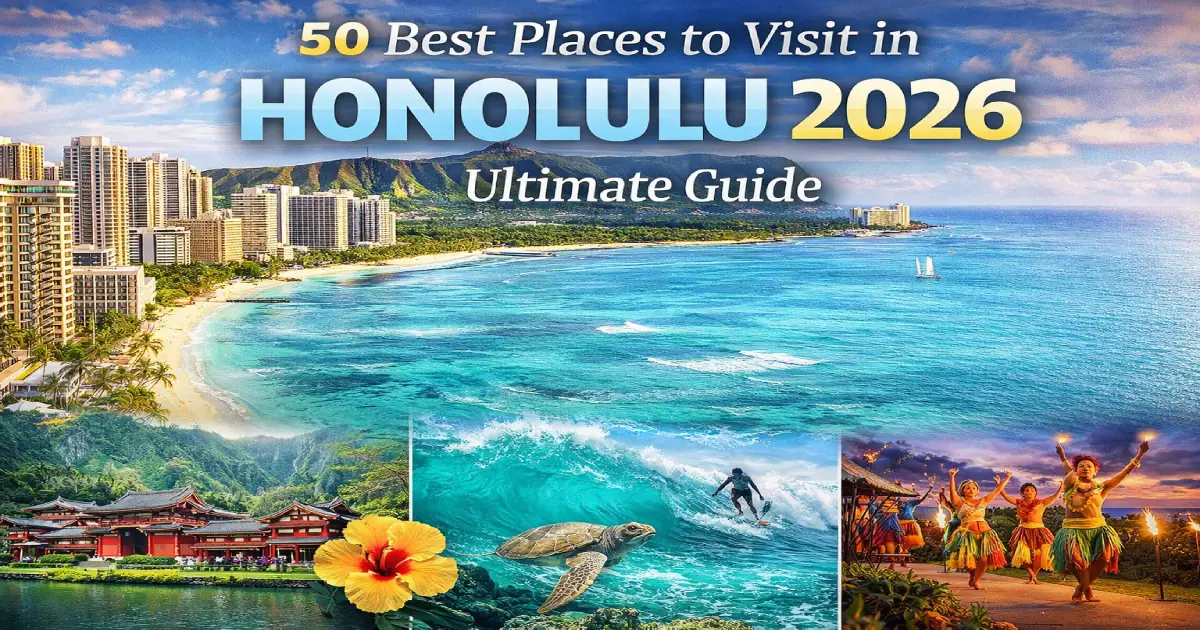
50 Best Places to Visit in Honolulu 2026: Ultimate Guide
Published on : 26 Mar 2026
Places to Visit in Honolulu — From Royal Palaces to Wild Coastlines to the World’s Most Famous Beach
By Travel Tourister | Updated March 2026
Honolulu’s places to visit are distributed across one of the most geographically dramatic islands in America — an island where Diamond Head’s 760-foot volcanic cone rises directly from the eastern end of Waikiki Beach, where Hanauma Bay’s 400+ species of reef fish occupy a collapsed volcanic crater 8 miles from the hotel corridor, where the North Shore’s Banzai Pipeline produces the world’s finest surfing waves on the same island where Iolani Palace housed the last Hawaiian monarchs before American annexation, and where the Ko’olau Pali’s 2,000-foot vertical cliff face separates the dry, sunny Honolulu coast from the lush, rain-soaked windward valleys in a geographic drama that no visitor expects and every visitor remembers. Honolulu’s best places span a 40-mile island — and every mile of it delivers something extraordinary that the Waikiki hotel corridor, beautiful as it is, cannot replicate.
I’ve mapped Honolulu’s best places across multiple visits and every season — the USS Arizona Memorial in November when the silence above the submerged battleship is the most specific silence in America, the Bishop Museum’s Hawaiian Hall in January when the feathered cloaks of the Hawaiian ali’i hang in the gallery’s winter light and the weight of pre-contact Hawaiian civilization is comprehensible for the first time, the Byodo-In Temple at dawn in March when the Ko’olau Pali is wrapped in cloud above the reflecting pool and the 3-ton brass bell’s tone reverberates off the cliff face, the Kailua Beach in June when the Mokulua Islands are a kayak’s paddle offshore and the water is the specific turquoise of a windward Oahu morning, and the North Shore’s Haleiwa town in December when the North Shore swell is running and the Pipeline is firing and Matsumoto’s shave ice is the only thing that makes the winter heat on the walk back from the beach bearable. Each place confirmed that Honolulu’s finest places are available to any visitor willing to drive 45 minutes in any direction from Waikiki — and that the entire island rewards the curiosity to go beyond the beach that started everything.
This comprehensive 2026 guide covers Honolulu’s 50 best places using verified information from Hawaii Tourism Authority, years of island exploration, and honest assessments of which places deliver genuinely memorable experiences. We organize places by category — iconic landmarks, beaches and coastline, cultural and historical sites, nature and hiking destinations, neighborhoods and districts, North Shore places, windward coast places, and hidden gems — with realistic visit times, costs, and strategic advice for building a Honolulu itinerary that captures the full island.
Whether visiting for 5 days or 14, for a first-time tourist pilgrimage to Pearl Harbor and Waikiki or a return trip reaching deeper into the windward coast’s botanical gardens and the North Shore’s summer snorkeling, this guide gives you the honest, experience-backed intelligence to find Honolulu’s best places — from the Royal Hawaiian’s beachfront to the Ka’ena Point monk seal colony at the island’s far western tip, where the Pacific stretches to the horizon and the tourist map ends entirely.
Honolulu Places by Category
Category
Top Places
Best Area
Cost Range
Iconic Landmarks
Diamond Head, Pearl Harbor, Waikiki Beach
Waikiki, Pearl City
Free–$35
Beaches & Coastline
Hanauma Bay, Kailua Beach, Lanikai, Waimea Bay
East Oahu, Windward, North Shore
Free–$30
Cultural & Historical
Bishop Museum, Iolani Palace, Chinatown
Kalihi, Downtown, Nuuanu
Free–$30
Nature & Hiking
Manoa Falls, Makapu’u, Nu’uanu Pali, Ka’ena Point
Ko’olau Range, East Oahu, Westside
Free–$10
North Shore Places
Pipeline, Haleiwa, Sunset Beach, Polynesian Cultural Center
North Shore, Laie
Free–$120
Windward Coast
Byodo-In Temple, Ho’omaluhia Garden, Kaneohe
Kane’ohe, Kailua
Free–$10
Iconic Landmarks & Must-See Places
1. Diamond Head State Monument — THE MOST ICONIC PLACE IN HONOLULU
Why It’s Essential: Diamond Head is the most recognizable natural landmark in Hawaii — the 760-foot tuff cone volcanic crater that forms the eastern backdrop of Waikiki Beach is visible from almost everywhere in the city, appears in more photographs of Honolulu than any other single feature, and delivers via a 1.6-mile round-trip trail one of the finest 360-degree panoramic views accessible in the United States. The crater’s interior contains the WWII military infrastructure (tunnels, bunkers, spiral staircases, observation stations) that was constructed during the period when Diamond Head served as the U.S. Army’s coastal defense command center — making it simultaneously a natural wonder, a historical site, and the finest viewpoint in Honolulu.
What Makes Diamond Head Irreplaceable:
The summit view: 360 degrees of Oahu — Waikiki’s hotel towers to the west, the Ko’olau Range to the north, Koko Head crater to the east, and the Pacific Ocean to the horizon in every ocean-facing direction. The finest freely accessible elevated view in Honolulu.
The WWII military tunnels: Two tunnels cut through the crater wall during the 1908–1943 defense installation period — 225 feet of unlit tunnel requiring a phone torch, the most unexpected element of the Diamond Head hike
The 99 steps: Cut directly into the crater wall — the steepest and most dramatic section of the trail, climbed by millions of visitors who assumed a hike to a volcanic crater summit would be easier
The crater interior: The flat floor of the crater — visible from the rim trail and completely hidden from Waikiki — contains the Tripler Army Medical Center helipad and a radar installation still in active military use
Best time: 6:30–7:30 AM on a weekday — the summit at dawn before the tourist rush, with the Pacific turning gold and the city below still in shadow
Cost: $5/person non-resident; $10 parking or free shuttle; gostateparks.hawaii.gov for advance reservation; open daily 6 AM–6 PM
2. Pearl Harbor National Memorial
Why It’s America’s Most Moving War Memorial: Pearl Harbor — the USS Arizona Memorial, the Battleship Missouri, the USS Bowfin submarine, and the Pacific Aviation Museum — is simultaneously the site of the attack that brought the United States into World War II and the site of Japan’s formal surrender that ended it. The USS Arizona Memorial, built over the sunken battleship where 1,177 sailors remain entombed, is the most historically consequential single site in Honolulu and the most emotionally affecting war memorial in the United States — the oil that has been rising continuously from the ship’s fuel tanks since December 7, 1941 creates a visible surface sheen on the harbor water that is the most powerfully immediate physical artifact of any American war accessible to any visitor.
USS Arizona Memorial (free, recreation.gov reservation): The white structure built over the sunken battleship — the oil slick visible on the harbor surface, the names of the 1,177 entombed sailors on the marble wall, and the silence that the space seems to demand
Battleship Missouri (BB-63): The site of Japan’s surrender — the brass plaque marking the surrender ceremony’s location on the Missouri’s deck is accessible on guided tours; the kamikaze impact scar on the hull is visible from the exterior ($36/adult)
USS Bowfin (SS-287): A complete World War II attack submarine — interior self-guided tour of crew quarters, torpedo tubes, and the conning tower ($18/adult)
Pacific Aviation Museum: World War II aircraft including a Zero, a B-25, and an SBD Dauntless dive bomber in the original Ford Island hangars ($30/adult)
Cost: Arizona Memorial free (book recreation.gov); Missouri $36; Bowfin $18; Full Day Pass $89; 9 AM–5 PM daily; 10 miles west of Waikiki
3. Waikiki Beach
Why It’s the World’s Most Famous Urban Beach: Waikiki is not merely a beach — it is the place where modern beach culture as the world understands it was invented, where Duke Kahanamoku introduced surfing to the world in the early 20th century, where the beach boy tradition of outrigger canoe riding and surf instruction created the template for beach resort culture globally, and where 2 miles of coral sand backed by the Ko’olau mountains and fronted by the Pacific Ocean produces the most recognizable beach scene in any American city. The Royal Hawaiian Hotel (1927), the Moana Surfrider (1901 — the oldest hotel in Hawaii), and the Waikiki Beach Walk all contribute to a specific sense of layered history that no other American beach destination delivers.
The stretch from the Royal Hawaiian to the Outrigger Reef: The finest section of Waikiki Beach — the widest sand, the best surf break at Canoes reef, and the most historic hotels as backdrop
Duke Kahanamoku statue: The bronze statue of Hawaii’s most celebrated athlete and surfing ambassador at Kūhiō Beach — the most photographed public sculpture in Waikiki ($0)
The Waikiki shore at sunset: The most consistently photographed sunset in Honolulu — the Ko’olau mountains catching the final light behind the hotel towers, Diamond Head visible to the east, the Pacific turning every shade of gold simultaneously
Kūhiō Beach at night: The torch lighting ceremony and free hula show (Tuesday, Thursday, Saturday evenings) transforms the beach’s eastern section into the finest free evening cultural event in Waikiki ($0)
Cost: FREE; Kalakaua Avenue, Waikiki; open 24 hours
4. Iolani Palace
Why It’s Honolulu’s Most Politically Significant Place: ‘Iolani Palace is the only royal palace in the United States — the official residence of the Hawaiian monarchs from 1882 until the illegal overthrow of the Hawaiian Kingdom in 1893, where King Kalakaua hosted state dinners for the monarchs and presidents of the world in the Throne Room, and where Queen Lili’uokalani was imprisoned for eight months in 1895 after the failed counter-revolution attempt. Walking the palace’s restored rooms is the most politically charged and most specifically Hawaiian historical experience available in Honolulu — more so than Pearl Harbor, which is American history; ‘Iolani Palace is Hawaiian history, and the distinction carries weight on every floor of the building.
The Throne Room: The state reception room where Kalakaua hosted state dinners — Hawaiian and European throne chairs side by side, the physical expression of the Hawaiian Kingdom’s diplomatic equality with the world’s monarchies
The basement gallery: Where the crown jewels are displayed and where Queen Lili’uokalani was held under house arrest after the 1893 overthrow — the most politically affecting space in the palace, and the room where she composed music and quilted during her imprisonment
The palace grounds: The ‘Iolani Barracks (the only surviving Hawaiian Kingdom military barracks), the Royal Bandstand (where the Royal Hawaiian Band performs free Friday noon concerts), and the original Hawaiian flag at the entrance ($0 to walk the grounds)
Cost: $29/adult guided; $21/adult audio; iolanipalace.org; 364 S. King Street, Downtown Honolulu; closed Sunday–Monday
5. The Bishop Museum
Why It’s the World’s Finest Hawaiian Cultural Institution: The Bernice Pauahi Bishop Museum in Kalihi — founded 1889 with the personal collection of Princess Bernice Pauahi Bishop, last direct descendant of King Kamehameha I — is the most important museum of Hawaiian and Pacific cultural history in the world. The feathered cloaks and helmets of Hawaiian royalty (each representing thousands of hours of honey-creeper feather collection), the 55-foot sperm whale skeleton suspended in the Hawaiian Hall, the world’s finest collection of Pacific Island cultural objects, and the planetarium demonstrating Hawaiian celestial navigation combine into the most intellectually dense single cultural institution in Honolulu.
The feathered cloaks (kahu’ula): The most technically extraordinary objects in Hawaii — full-length cloaks made from the red and yellow feathers of honey-creeper birds, requiring decades of feather collection, representing the most labor-intensive art form in pre-contact Hawaii. The ali’i who wore these cloaks were visually announcing their lineage, their power, and their connection to the gods in a single garment.
Hawaiian Hall: The three-story Victorian gallery housing the feathered objects, the whale skeleton, and the finest collection of Hawaiian cultural objects assembled at any institution
Pacific Hall: Artifacts from every Pacific Island culture — the most comprehensive Pacific collections outside the region at any US museum
Planetarium: Shows on Hawaiian celestial navigation — the wayfinding tradition that enabled Polynesian settlement of the Pacific using star paths, ocean swells, and bird behavior
Cost: $27/adult, $19/child; bishopmuseum.org; 1525 Bernice Street, Kalihi; open daily
6. The Royal Hawaiian Hotel (Pink Palace)
The Royal Hawaiian Hotel — the “Pink Palace of the Pacific,” opened 1927 on the original site of the royal family’s summer cottage at Waikiki — is the most historically significant hotel in Hawaii and the most architecturally distinctive in Waikiki: a Spanish-Moorish pink building surrounded by mature coconut palms and fronting the finest section of Waikiki Beach, with the Mai Tai Bar on the beach delivering the most atmospheric cocktail experience available in Honolulu
The hotel grounds: Even non-guests can walk the lushly landscaped grounds and access the beach-fronting Mai Tai Bar — the most beautiful hotel garden walk in Waikiki
Historical significance: The Royal Hawaiian was built on land owned by Queen Lili’uokalani and later by the Damon family — the hotel represents the transformation of Waikiki from royal retreat to international resort, and its pink walls have been photographed continuously since 1927
Cost: Free to walk grounds; Mai Tai Bar cocktails $18–$26; 2259 Kalakaua Avenue, Waikiki
Beaches & Coastline Places
7. Hanauma Bay Nature Preserve — OAHU’S FINEST SNORKELING PLACE
Why It’s Irreplaceable: Hanauma Bay — a collapsed volcanic crater on Oahu’s southeast coast, 8 miles from Waikiki — is the most protected and most fish-dense marine environment accessible to recreational snorkelers in Hawaii. The bay’s conservation status (no fishing since 1967, mandatory conservation education before entry, strict no-touch regulations) has produced a reef fish population so accustomed to human presence that 400+ species of reef fish approach snorkelers without apparent concern. The Hawaiian green sea turtles (honu) that cruise the inner reef have been legally protected here for so long that they approach swimmers within arm’s reach and are genuinely indifferent to human proximity in a way unavailable at any unprotected reef in Hawaii.
The inner reef: The most fish-dense snorkeling area in Hawaii — 3–10 feet deep directly from the beach, the highest concentration of reef fish available to anyone wearing a mask and snorkel
Hawaiian green sea turtles: Protected by federal law; present year-round in the inner bay — the most reliably accessible sea turtle encounter in Honolulu
The bay itself: A collapsed tuff cone — the geological history visible in the cone’s eroded walls on both sides; the bay is simultaneously a marine reserve and a geological classroom
Reservation required: hanaumabayreservations.com; $30/adult non-resident; opens 2 days ahead at midnight HST; fills within minutes July–August
Cost: $30/adult non-resident; TheBus #22 from Waikiki ($3); open Wednesday–Monday 6:45 AM–4 PM; closed Tuesday
8. Kailua Beach
Why It’s Oahu’s Most Beautiful Beach: Kailua Beach on the windward coast — consistently ranked among the top 5 beaches in the United States by Dr. Beach and other assessors — is a 2.5-mile stretch of powder-white coral sand, turquoise water, and consistent trade winds that produces the finest conditions for kayaking, windsurfing, and kiteboarding in Hawaii. The Mokulua Islands (the “Mokes”) — a pair of sea bird sanctuary islands 1.5 miles offshore — are accessible by kayak and contain white sand beaches, a sea arch, and the possibility of Hawaiian monk seal sightings that make the paddle among the most rewarding outdoor activities accessible from Honolulu.
Kailua Beach Park: The main beach park — free parking, lifeguards daily, the widest and whitest sand on the windward coast
The Mokulua Islands: 1.5 miles offshore by kayak — Moku Nui (the larger island) has a white sand beach and a sea arch accessible from the north side; Moku Iki is a protected sea bird sanctuary (no landing)
Kayak rentals: Kailua Beach Adventures — single and double kayaks, $75–$95/day; guided tours available for first-timers to the Mokes
Best time: Weekday mornings — Kailua Beach is significantly less crowded on weekdays than summer weekends; arrive before 9 AM for the finest beach experience
Cost: FREE beach; kayak $75–$95/day; TheBus #56 from Waikiki (45 minutes); 30-minute drive from Waikiki
9. Lanikai Beach
The 500-meter crescent of white coral sand adjacent to Kailua Beach — accessible via the Lanikai neighborhood’s beach access paths (the strand is backed by private residential property, with narrow public access paths every 200 meters) — is consistently described by visitors as the most beautiful single beach they have encountered, with turquoise water, the Mokulua Islands as the offshore backdrop, and a sense of quiet residential exclusivity that Waikiki’s hotel corridor cannot approximate
The color of the water: The specific turquoise of Lanikai — produced by the combination of white sand bottom, shallow depth, and trade wind lighting from the northeast — is the most photogenic beach water color in Honolulu
Best time: Early morning (7–9 AM) before the residential neighborhood parking fills; the Lanikai Pillboxes sunrise hike (just above the beach) produces the finest morning combination of hiking and beach on Oahu
Cost: FREE; Mokulua Drive, Lanikai; access via public beach access paths between residential properties
10. Waimea Bay Beach Park (North Shore)
Waimea Bay is the most seasonally dramatic beach on Oahu — the bay where the Eddie Aikau Big Wave Invitational is held when waves reach 20 feet in January–February, and the bay where locals and visitors swim, cliff jump, and sunbathe in flat, protected water from May through September. The two versions of Waimea Bay — winter’s terrifying big-wave arena and summer’s tranquil swimming cove — are available in the same curved arc of white sand, backed by the Waimea Valley’s lush green wall, on the world’s most consequential surfing coastline.
The Waimea Bay rock: The 25-foot lava outcropping at the north end of the bay — a legendary cliff jump (summer only, when the bay is completely flat) that has been the test of local courage for generations
Winter spectating: The finest free big-wave surf viewing on Oahu, with the bay’s crescent beach providing an amphitheater perspective on waves that can exceed 30 feet on the largest swells
Cost: FREE; 61-031 Kamehameha Highway, Haleiwa; 45-minute drive from Waikiki
11. Sandy Beach Park (East Oahu)
Sandy Beach on Oahu’s southeast coast — the most powerful shore break on the island, nicknamed “Broke-Neck Beach” for the injury rate among tourists who underestimate the force of its waves — is the most dramatic free beach spectacle accessible from Waikiki for visitors who want to observe rather than participate in the most intense shore break in Hawaii
The shore break: Waves that rise vertically from a shallow sand bottom and break with a force that can drive a body headfirst into the sand — experienced bodysurfers make this look graceful; first-time visitors should observe from the sand
The landscape: Sandy Beach’s crescent of dark sand backed by Koko Head’s volcanic profile to the west and the Makapu’u headland to the east constitutes the most dramatic coastal scenery accessible by car on Oahu’s southeast shore
Cost: FREE; 8801 Kalaniana’ole Highway, East Oahu; 25-minute drive from Waikiki
12. Ala Moana Beach Park
The 76-acre beach park adjacent to Ala Moana Center — the finest free urban beach in Honolulu proper, with a protected lagoon (calm water, no breaking surf), a long western-facing beach (the finest sunset views of any Honolulu public beach), and Magic Island (the artificial peninsula at the park’s eastern end) providing the finest harbor-level view of the Waikiki skyline and Diamond Head from within the city limits
Magic Island: The man-made peninsula extending into Kewalo Basin — the most popular sunrise walking destination for Honolulu residents, with a clear view of Diamond Head catching the first morning light across the Ala Wai Harbor
The lagoon: The protected, flat swimming area between Ala Moana Beach and Magic Island — the finest calm-water swimming accessible without a reservation or admission fee in Honolulu
Cost: FREE; Ala Moana Boulevard; open daily; adjacent to the Ala Moana Center shopping complex
Cultural & Historical Places
13. Chinatown Honolulu
Why It’s Honolulu’s Most Sensory Neighborhood: Honolulu’s Chinatown — the oldest Chinatown in the United States (established 1860 by Chinese laborers brought to work the sugar plantations), dense with lei shops, fresh fish markets, dim sum restaurants, Vietnamese noodle houses, Filipino bakeries, and art galleries — is the most multisensory single neighborhood in Honolulu: the plumeria and pikake from the Maunakea Street lei shops, the fresh ginger and fish from the Oahu Market, the incense from the Kuan Yin Temple, and the afternoon coffee from the Chinatown art gallery cafés create an olfactory geography available nowhere else in the city.
Maunakea Street lei shops: 10+ family-operated lei shops on a single block — the finest fresh lei selection in Hawaii at the most honest prices ($5–$15 per lei, vs $25–$40 at airport shops). The lei makers construct garlands to order while you wait, using plumeria, pikake, orchid, and tuberose from their morning flower deliveries.
Oahu Market (King Street): The oldest continuously operating fresh market in Honolulu — fresh Pacific fish (mahi-mahi, ono, ahi tuna), exotic Hawaiian fruits, and the specific sensory experience of a market that has been selling the Pacific’s produce since 1904
Kuan Yin Temple (170 N. Vineyard Boulevard): The oldest Buddhist temple in Hawaii (1911) — red and gold incense-filled worship space where the Chinatown community has prayed for 100+ years; visitors welcome during non-service hours
Foster Botanical Garden (adjacent): The oldest botanical garden in Hawaii (1850), adjacent to Chinatown — free admission on some days, the finest collection of historic exceptional trees in Honolulu
Cost: Free to walk; lei $5–$15; budget $20–$40 for food and market; 15-minute drive from Waikiki or TheBus #2
14. USS Arizona Memorial (Pearl Harbor)
Already described in the Iconic Landmarks section — worth its own separate entry as a place: the white open-air memorial structure built over the sunken battleship (designed by Alfred Preis, a Honolulu architect who was himself interned as an enemy alien on the very day of the Pearl Harbor attack) is the most architecturally and historically specific place accessible to a Honolulu visitor. The structure spans the mid-section of the sunken Arizona, and visitors standing at the center of the memorial are standing directly above the largest single-ship loss of American life in any naval battle in history. The oil that still rises from the hull — called the “tears of the Arizona” — makes the loss present in a way that no wall of names or photographic exhibit can replicate.
Cost: FREE; recreation.gov advance booking required; open daily 7 AM–5 PM; 10 miles west of Waikiki
15. Honolulu Museum of Art
The finest general art museum in Hawaii — a 1927 Spanish Mission courtyard building housing 50,000+ works with the most significant Asian art collection at any Hawaiian museum, the finest European master collection in the Pacific, and rotating exhibitions of national significance. The four courtyard gardens connecting the gallery wings are the most beautiful outdoor museum spaces in Honolulu — stone lanterns, tropical plantings, and the specific hush of an open-air museum space in trade wind weather.
Asian art collection: Japanese woodblock prints (the finest Japanese print collection at any Hawaiian museum), Chinese scroll paintings, Korean ceramics, and South Asian textiles of extraordinary quality
Doris Duke Theatre: The museum’s film and performance space — screenings of international cinema and performances in the most beautifully designed cultural venue in Honolulu’s museum district
Cost: $20/adult; honolulumuseum.org; 900 S. Beretania Street; closed Monday
16. King Kamehameha Statue (Downtown)
The gilded bronze statue of King Kamehameha I at the front of Ali’iolani Hale (the Hawaii State Supreme Court building) on King Street in downtown Honolulu — the most widely reproduced image of Hawaii’s most significant historical figure, with the finest version of the statue on June 11 (King Kamehameha Day), when the statue is draped in 30-foot lei garlands made from thousands of fresh flowers by Chinatown lei makers who have been performing this specific ceremony for generations
Three casts of the statue exist: The downtown Honolulu version is the most accessible; the original (discovered on the ocean floor after the first casting was lost at sea) is in Kapa’au on Hawaii Island
The building behind: Ali’iolani Hale (1874) was built as the Hawaiian Kingdom’s government building — the only remaining Hawaiian Kingdom government building in daily use, now housing the Hawaii Supreme Court and the Judiciary History Center (free)
Cost: FREE; 417 S. King Street, Downtown Honolulu
17. Hawaii State Capitol
The most architecturally distinctive state capitol building in the United States — the 1969 Capitol building designed by John Carl Warnecke as a symbolic representation of Hawaii: the cone-shaped legislative chambers represent the volcanic origins of the island chain, the reflecting pool represents the surrounding Pacific Ocean, the 40 columns represent the 40 species of royal palm native to Hawaii, and the open-air design allows the trade winds to circulate through the building’s central atrium
The grounds: The ‘Iolani Palace is directly adjacent — the state capitol and the royal palace occupy adjacent blocks of downtown Honolulu, producing the most historically layered block in the city
Damien statue: Father Damien’s statue on the Capitol grounds — the Belgian priest who served the leprosy colony on Moloka’i from 1873 to 1889, represented in the US Capitol’s Statuary Hall alongside Queen Lili’uokalani
Why Essential: The Manoa Falls trail — 1.6 miles round trip through the densest tropical rainforest accessible from Honolulu — delivers the most dramatic ecosystem contrast available within 30 minutes of Waikiki: from the concrete and coral of the hotel district to a dripping jungle canopy of bamboo, guava, ginger, and mountain apple, ending at a 100-foot waterfall in a jungle pool that is the most beautiful natural destination accessible to anyone without a car (TheBus #5 reaches the trailhead from Waikiki). The Manoa Valley is Honolulu’s green interior — it receives 155+ inches of rain annually while Waikiki, 5 miles away, receives 17 — and the valley’s lushness is the result of a geographic accident of the Ko’olau Range that makes the Manoa feel like a different climate zone entirely.
The bamboo grove: The most atmospheric trail section — a stand of introduced bamboo 20–30 feet tall, through which the trail passes before the final approach to the falls; the bamboo’s clatter in the trade wind is the finest natural sound effect on any Honolulu trail
Manoa Falls: 100 feet of waterfall falling into a jungle pool — the visual reward for the 45-minute walk; swimming in the pool is not recommended (leptospirosis bacterial risk) but the viewing platform above the pool provides the finest waterfall perspective
Lyon Arboretum (at trailhead): The University of Hawaii’s 194-acre botanical garden — 5,000+ tropical species accessible on a network of trails extending from the Manoa Falls parking area
Cost: $5 parking; TheBus #5 from Waikiki ($3); 2-mile drive from UH Manoa campus
19. Nu’uanu Pali Lookout
Why It’s the Most Dramatic Free View on Oahu: The Nu’uanu Pali Lookout — a 1,200-foot viewpoint on the Ko’olau Pali (the sheer windward face of the Ko’olau Range), 10 miles from downtown Honolulu via the Pali Highway — delivers the most geographically dramatic panorama available by car on Oahu: the windward coast’s green valleys and Kaneohe Bay extending to the northeast, the Ko’olau Ridge rising 3,000 feet behind, and trade winds so consistently strong at the cliff edge (30–40 mph) that leaning into the wind at a 30-degree angle is possible and frequently photographed. The Pali is also the most historically significant viewpoint on Oahu — the site of the Battle of Nu’uanu (1795), where Kamehameha I’s forces drove the O’ahu warriors over these cliffs, unifying the Hawaiian Islands under a single ruler for the first time.
The view: Kaneohe Bay, the Mokolii (Chinaman’s Hat) island, the Ko’olau valleys, and the windward coast in a single panorama
The wind: Strong enough to blow hats, sunglasses, and light items from hands — secure everything before approaching the lookout railing
Old Pali Highway: The original road (accessible by a short walk from the parking area) winds down the pali face and is now a pedestrian walkway offering a different and more intimate perspective on the cliff
Cost: $3 parking; 10 miles from Waikiki via Pali Highway; open daily
20. Makapu’u Lighthouse and Headland
The Makapu’u Lighthouse Trail — 2 miles round trip on a paved switchback road to the 647-foot cliffs at Oahu’s easternmost point — delivers the finest coastal hiking view on the island: the 1909 Makapu’u Lighthouse below, Rabbit Island and Manana Island offshore, and the Pacific in every ocean-facing direction. The Makapu’u headland is also Oahu’s finest land-based whale watching platform (December–May), with humpbacks regularly visible from the cliff summit.
Best time: Sunrise — the Makapu’u cliffs at the exact moment the sun clears the ocean horizon over Rabbit Island is one of the most specifically beautiful free sunrise views accessible by car in Honolulu
The tidal pools: At the base of the Makapu’u headland — accessible from the beach parking area below the lighthouse trail, with diverse tidal pool marine life in the volcanic rock formations
Cost: FREE; end of Kalaniana’ole Highway; open daily; 25-minute drive from Waikiki
21. Ka’ena Point Natural Area Reserve
Oahu’s westernmost point — the Ka’ena Point Natural Area Reserve at the end of both the north and south Farrington Highways — is the most ecologically significant and most remotely accessible nature destination on Oahu: a 5-mile round trip trail along the rocky coastline to a protected colony containing the only accessible Hawaiian monk seal haul-out and one of the only accessible Laysan albatross breeding colonies on the island. Hawaiian monk seals (the world’s most endangered marine mammal) are visible year-round hauled out on the rocks within the colony fence; the albatross colony is active November–July.
Hawaiian monk seals: 5–15 seals present on any given day in the haul-out area; federal protection requires maintaining distance, but the colony fence allows close viewing
Laysan albatross: The breeding pairs are visible from the colony perimeter fence November–July — adults performing elaborate courtship dances, fluffy grey chicks waiting to be fed
Cost: FREE; end of Farrington Highway (north or south access); 5-mile round trip; bring water and sun protection
22. Koko Head Crater Trail
The Koko Head Crater hike — 1,048 stairs (the former military railway ties of a wartime supply route) climbing 642 feet from the Koko Head Regional Park to the rim of the Koko Crater — is the most physically demanding accessible hike on Oahu’s southeast coast, delivering panoramic views of Hanauma Bay, Sandy Beach, the Koolau Range, and the Pacific in a 1.8-mile round trip that the island’s fitness community treats as a daily training ritual
The railway stairs: The wartime military railway (used to supply the Koko Head radar installation during WWII) provides the trail’s surface — wooden ties in varying states of repair, with a 200-foot wooden trestle bridge crossing the crater’s interior valley as the most dramatic section
Best time: Sunrise (the view of Hanauma Bay in morning light from the crater rim is the finest sunrise view on the southeast coast); arrive 30 minutes before sunrise to complete the climb in the cool darkness
Cost: FREE; Koko Head Regional Park; 25-minute drive from Waikiki
North Shore Places
23. Banzai Pipeline (Ehukai Beach Park)
Why It’s the World’s Most Famous Surf Spot: The Banzai Pipeline at Ehukai Beach Park — 59-337 Ke Nui Road on Oahu’s North Shore — is the most consequential surf break on earth: the shallow reef that produces the most perfectly shaped barreling waves in the world, the site of the most dramatic professional surfing in the annual tour calendar, the location where the modern surfing aesthetic was defined by the Gerry Lopez era of the 1970s, and a place where on any given January morning, the world’s finest big-wave surfers may be riding 25-foot tubes while visitors stand on the beach in stunned, silent awe at zero cost. No other sporting venue on earth admits the public for free to watch performances of this athletic extremity at this proximity.
November–February: Big wave season — waves of 15–30 feet when the North Pacific swells arrive; free from the Ehukai Beach Park beach
Vans Triple Crown contest days: The most concentrated professional surfing of the year — the beach fills with 2,000–5,000 spectators on major swell days during the November–December contest period
May–September: Pipeline in summer — the same reef is flat and swimmable; beautiful, accessible, and completely transformed from the winter version
Cost: FREE; 59-337 Ke Nui Road, Haleiwa; 45-minute drive from Waikiki
24. Haleiwa Town
Why It’s the North Shore’s Most Essential Town: Haleiwa is the most characterful small town on Oahu — the former sugar plantation town that has become the North Shore’s social and commercial center, with an independent restaurant and shop scene that resists the Waikiki resort aesthetic, a small-boat harbor with the finest fishing boat and charter operation on the North Shore, the historic 1943 Rainbow Bridge, and Matsumoto Shave Ice at 66-087 Kamehameha Highway (since 1951 — the most celebrated shave ice in Hawaii) at the town’s commercial center.
Matsumoto Shave Ice: The benchmark since 1951 — the most famous shave ice in Hawaii, a pilgrimage worth every minute of the line ($4–$7)
Kua Aina Sandwich Shop: The North Shore burger institution — the Haleiwa original location (66-214 Kamehameha Highway) serves the finest burger accessible from the North Shore surf beaches, a local institution since 1975
Haleiwa Small Boat Harbor: The North Shore’s working fishing harbor — charter fishing boats, the morning fish market, and the specific working-harbor atmosphere of a place that remembers when tourism was not the primary industry
Surf shops and independent retail: Strong Current, Surf N’ Sea, and the independent clothing boutiques along Kamehameha Highway represent the most authentically North Shore retail available on Oahu
Cost: Free to walk; shave ice $4–$7; budget $20–$50 for food and shopping; Kamehameha Highway, Haleiwa
25. Sunset Beach (North Shore)
Sunset Beach — the 2-mile stretch of sand on the North Shore’s northeastern coast, home to the Vans World Cup of Surfing and one of the most famous surf spots in the world — is the most dramatic winter beach on Oahu when the North Pacific swells are running (15–25 foot waves at the Sunset break, 200 yards offshore) and the most expansively beautiful summer beach when the swells have cleared and the sand has returned (winter surf removes significant sand from Sunset Beach; summer deposits it back in a seasonal cycle visible from the parking area)
Winter: The Vans World Cup of Surfing contest window (November–December) produces the finest professional surfing accessible from the Sunset Beach parking area
Summer: The broad, flat beach extending north from the parking area delivers the finest summer beach walking on the North Shore — less crowded than Waimea Bay, more spacious than Pipeline beach
Cost: FREE; 59-100 Kamehameha Highway; 45-minute drive from Waikiki
26. Polynesian Cultural Center (Laie)
The Polynesian Cultural Center — the most comprehensive Pacific cultural education facility in the world, 45 minutes north of Waikiki on Oahu’s windward coast — presents six Pacific Island cultures (Hawaii, Samoa, Fiji, Tonga, Tahiti, Aotearoa) through village environments staffed by students from the represented Pacific nations who are pursuing degrees at BYU-Hawaii. The evening Ha: Breath of Life theatrical show is the most technically ambitious cultural performance in Hawaii.
The authenticity distinction: The village demonstrators are not performers hired to simulate Pacific cultures — they are students from Samoa, Fiji, Tonga, Tahiti, New Zealand, and Hawaii who are presenting their own inherited cultural traditions. The distinction between genuine cultural transmission and cultural performance is clearly felt.
Closed Sunday: The Center is closed on Sunday due to its LDS affiliation — plan accordingly
Cost: $70–$120/adult (various packages including Ha show); polynesia.com; 55-370 Kamehameha Highway, Laie; closed Sunday
27. Shark’s Cove (Pupukea Marine Life Conservation District)
Shark’s Cove — a natural lava rock snorkeling cove at the Pupukea Marine Life Conservation District on the North Shore — is the finest accessible shore snorkeling on Oahu in summer conditions (May–September), with visibility of 40–80 feet, a diverse reef fish population, and the protection of conservation district status that has maintained the ecosystem’s integrity while Hanauma Bay’s visitor population was managed elsewhere. The cove is free, requires no reservation, and is accessible from the roadside parking on Kamehameha Highway.
The inner cove: Protected by a natural lava rock wall — calm conditions even when the outer North Shore is moderately active in shoulder season
Seasonal restriction: Shark’s Cove becomes genuinely dangerous when North Shore winter swells are running — visit only May through September
Cost: FREE; 59-712 Kamehameha Highway; open May–September; bring own snorkel gear
Windward Coast Places
28. Byodo-In Temple (Valley of the Temples)
Why It’s the Most Photographed Non-Beach Place on Oahu: The Byodo-In Temple — a 1/3-scale replica of the 900-year-old Byodo-In temple in Uji, Japan, built in 1968 to honor Hawaii’s first Japanese immigrants — sits at the base of the Ko’olau Pali in Kane’ohe, with the 2,000-foot sheer vertical cliff rising directly behind the temple’s scarlet reflection in the koi-filled pool. The combination of the Japanese architectural perfection of the temple with the volcanic drama of the Ko’olau Pali and the specific green of the windward coast’s vegetation produces the most photogenically perfect single composition on Oahu — the photograph that everyone who visits takes and that looks identical every time because the scene is already composed perfectly by geography and architecture without any photographer’s intervention.
The reflecting pool: Koi and turtles in a pool that reflects both the temple and the cliff — the most photographed single composition on Oahu
The 3-ton brass bell: Ring it for good fortune — the tone reverberates off the Ko’olau Pali and fills the valley in a way that no bell in Waikiki replicates
The peacocks: Free-roaming peacocks inhabit the garden — the most unexpected wildlife encounter on a cultural site visit in Honolulu
Best time: Dawn (the morning mist on the cliff and the empty garden path to the temple are the most beautiful version of the Byodo-In experience)
Cost: $5/adult; 47-200 Kahekili Highway, Kane’ohe; open daily 8 AM–5 PM; 30-minute drive from Waikiki
29. Ho’omaluhia Botanical Garden
The 400-acre botanical garden at the base of the Ko’olau Pali in Kane’ohe — maintained by the City and County of Honolulu, free to enter, and possessing the most dramatically beautiful garden setting on Oahu: the Ko’olau Pali’s 2,000-foot vertical wall rising directly above the garden’s lakes and plant collections, with the specific green of the windward coast’s constant moisture creating a lushness impossible in Waikiki’s rain shadow
The lake: The garden’s central lake — fishing (catch-and-release permits free at the visitor center), photography, and the finest Ko’olau Pali reflection available from any Honolulu botanical garden
The plant collections: Themed by geographic origin — African, Sri Lanka, Polynesia, India, and America collections organized in the garden’s seven sections
Photography note: The Ho’omaluhia is the most frequently used location for Oahu fashion photography and wedding photography — the Ko’olau Pali backdrop is incomparably dramatic
Cost: FREE; 45-680 Luluku Road, Kane’ohe; open daily 9 AM–4 PM; 30-minute drive from Waikiki
30. Kailua Town
The most beloved windward coast town — Kailua’s Kailua Road and Kuulei Road commercial corridors contain the finest independent restaurants, cafés, and surf shops accessible from the windward coast, in a neighborhood that serves the significant residential population that has chosen the windward coast over Honolulu’s urban intensity for the specific trade wind, the beach quality, and the sense of a Hawaiian town that has not been fully consumed by tourism
Cinnamon’s Restaurant: The windward coast breakfast institution — guava chiffon pancakes and malasadas that have been the Kailua morning standard since 1985
Whole Foods Kailua (Kailua Shopping Center): The finest acai bowl available in the Kailua area — and the gathering point for the windward coast’s morning surf community
The independent surf shops: Aaron’s Dive Shop and Twogood Kayaks serve the Kailua dive and kayak community with rentals and local knowledge unavailable in Waikiki’s tourist-facing shops
Cost: Free to walk; budget $15–$40 for breakfast and coffee
Parks & Gardens
31. Kapi’olani Regional Park
The 300-acre beachside park at the base of Diamond Head — the oldest public park in Hawaii (1877, granted by King Kalakaua), containing the Honolulu Zoo, the Waikiki Aquarium, the Kapiolani Bandstand, tennis courts, and the finest free public parkland adjacent to Waikiki Beach. The park’s Kalakaua Avenue frontage — where the Honolulu Marathon finishes, where the Kapiolani Bandstand hosts free concerts, and where the Waikiki Shell outdoor amphitheater presents major Hawaiian and international performers — makes Kapi’olani the most publicly active park in Honolulu.
Sunday morning activities: The Kapi’olani Park Bandstand hosts free Sunday concerts by the Royal Hawaiian Band (Sundays 2–3 PM) — the oldest municipal band in the US (1836), performing traditional Hawaiian music and international standards in the most beautiful free concert setting in Honolulu
Cost: FREE; Kalakaua Avenue at Diamond Head Road; open daily 24 hours
32. Foster Botanical Garden (Chinatown)
Hawaii’s oldest botanical garden (1850), adjacent to Chinatown — 14 acres of the finest historical tree collection in Honolulu, including the Exceptional Trees of Hawaii (trees protected by state law for their age, size, and cultural significance), a prehistoric glen (plants unchanged since the dinosaur era — cycads and Norfolk pines 40+ feet tall), and a poisonous plants section (the most unusual specialty garden in the Honolulu botanical garden system)
The orchid section: The finest orchid collection in the public Honolulu garden system — bloom varies by season but some orchids are flowering year-round
The exceptional trees: Hawaii’s oldest monkeypod, banyan, and royal palm trees — several specimens over 100 years old and legally protected from removal or alteration
Cost: $5/adult; honoluluparks.org; 180 N. Vineyard Boulevard, Downtown Honolulu; open daily 9 AM–4 PM
33. Lyon Arboretum (Manoa Valley)
The University of Hawaii’s 194-acre research arboretum in the upper Manoa Valley — 5,000+ exotic and native plant species accessible via a trail network that extends from the garden’s formal sections into the Ko’olau foothills, with the most comprehensive palm collection in Hawaii (200+ species) and the most diverse tropical plant assemblage accessible at any Honolulu public garden
The native Hawaiian forest sections: The upper trails access a genuine native Hawaiian forest of ‘ōhi’a lehua, hapu’u tree ferns, and native mosses — the finest accessible native forest ecosystem within 20 minutes of Waikiki
Honolulu’s most culinarily diverse neighborhood — the Waialae Avenue corridor in Kaimuki, 10 minutes from Waikiki by car or TheBus, contains the highest concentration of independently owned restaurants in Honolulu: Mud Hen Water (the finest contemporary Hawaiian cuisine in Honolulu), 12th Avenue Grill (New American with the finest wine list in the neighborhood), Koko Head Café (the most creative brunch on Oahu), and dozens of smaller operations representing Japan, Korea, Vietnam, and the Hawaiian plate lunch tradition in a neighborhood that serves residents rather than tourists
Wai’olu Lounge (Trump International Waikiki): One block from the neighborhood center, the most affordable fine cocktail experience in Kaimuki
The bookshops: Bestsellers and Bess Press on 10th Avenue — the finest independent bookshops in Kaimuki, serving the neighborhood’s well-educated residential community
Cost: Free to walk; dining $15–$60/person
35. Downtown Honolulu Historic District
The 6-block downtown historic district around ‘Iolani Palace — Ali’iolani Hale (the former Hawaiian Kingdom government building, now the Hawaii Supreme Court), the Hawaii State Capitol, the King Kamehameha statue, the Honolulu Hale (City Hall, 1929, the finest Spanish Mission public building in Honolulu), and Kawaiaha’o Church (1842, constructed from 14,000 coral blocks quarried from the offshore reef, the “Westminster Abbey of Hawaii”) constitute the most historically concentrated block of Hawaiian and American civic architecture accessible in the city
Kawaiaha’o Church: The first permanent Christian church in Hawaii (1842) — the 14,000 coral blocks, the royal pews, and the burial vault of Hawaiian ali’i on the grounds make it the most historically specific religious building in Honolulu ($0 for grounds; tours available)
Cost: Free to walk; Capitol tours free; Kawaiaha’o Church grounds free
36. University of Hawaii Manoa Campus
The flagship University of Hawaii campus in the Manoa Valley — 300 acres of the finest university botanical landscape in Hawaii, with the UH Art Gallery (free rotating exhibitions), the East-West Center (the most significant Pacific regional studies institution in the United States), and the gateway to the Manoa Falls trail and Lyon Arboretum — makes the UH Manoa campus the most intellectually rich and most botanically beautiful campus walk accessible from Honolulu
The campus architecture: A blend of Hawaiian Renaissance and International Style buildings dating from 1907 to the present — the 1931 Hawaii Hall is the most architecturally significant building on campus
Cost: Free campus; UH Art Gallery free; 15-minute drive from Waikiki
Unique & Hidden Places
37. Lanikai Pillboxes (Kaiwa Ridge)
The Lanikai Pillboxes hike — 1.8 miles round trip from the Kaiwa Ridge trailhead in the Lanikai neighborhood — delivers the finest sunrise view accessible by a short hike on Oahu: the Mokulua Islands in the morning light, Lanikai Beach below, and the Ko’olau Range rising behind in a composition that has made this one of the most photographed hiking viewpoints in Hawaii. The WWII-era concrete observation bunkers at the summit provide a windbreak and a sitting platform for the sunrise — the most purposeful design feature of any Hawaii hiking destination.
Trail access: From Kaelepulu Drive in Lanikai; street parking only (limited); arrive before 6 AM for sunrise timing and parking availability
Cost: FREE; Lanikai; adjacent to Kailua; best experienced at sunrise
38. Pali Highway Tunnels Overlook
The two tunnels on the H-3 Freeway (the most expensive per-mile highway ever built in the US, at $80 million per mile in 1997 dollars) emerge from the Ko’olau Range on the windward side at the most dramatic single highway moment on Oahu — the tunnels exit directly into a panoramic view of the Ko’olau Pali cliffs, the windward coast, and Kaneohe Bay that drivers typically observe for approximately 2 seconds before the road demands attention. Stop at the H-3 pull-off on the windward side for the photograph that the freeway design makes almost impossible to take from a moving vehicle.
The two Mokulua Islands — Moku Nui and Moku Iki — 1.5 miles offshore from Kailua Beach are the finest kayak destination accessible from any Oahu beach, combining a sea arch (on Moku Nui’s north face), a protected white sand beach, and the possibility of Hawaiian monk seal encounters in a 3-mile round trip kayak from Kailua Beach Park that is simultaneously the most scenic and the most wildlife-rich paddling accessible from Honolulu
Moku Nui (the larger island): Landing permitted on the south beach — bring snorkel gear for the south bay’s clear, protected water, and walk the interior trail for the finest view of the Kailua coastline available from sea level
Moku Iki: A protected seabird nesting sanctuary — no landing; the brown boobies and wedge-tailed shearwaters nesting on the island are visible from the water
Cost: Kayak rental $75–$95/day from Kailua Beach Adventures; 1.5-mile paddle from Kailua Beach
40. Magic Island (Ala Moana)
The artificial peninsula at the eastern end of Ala Moana Beach Park — built in 1964 as the site of a planned hotel that was never constructed, repurposed as a public park — is the finest harbourside walking destination in Honolulu proper: the full Waikiki skyline and Diamond Head visible across the Ala Wai Yacht Harbor, the Ko’olau mountains above, and the specific light of a Honolulu morning on the water create the finest free city view accessible without driving or hiking
Sunrise: The best sunrise viewpoint accessible by flat walking in Honolulu — Diamond Head catching the first light across the Ala Wai Harbor, the Waikiki hotel towers silhouetted against the brightening sky
Cost: FREE; Ala Moana Beach Park, Honolulu; open 24 hours
More Essential Honolulu Places
41. Ala Moana Center
The largest open-air shopping center in the United States — 2.4 million square feet of retail across 350 stores on four levels, including every major luxury brand accessible in Hawaii alongside the finest concentration of Hawaiian-brand retailers (Sig Zane Designs, Na Hoku jewelers, Mahina) in a single location. The Friday evening free Aloha Festivals hula show at the Centerstage is the most accessible free hula performance in Honolulu for visitors staying near the Ala Moana area.
Cost: Free to walk; 1450 Ala Moana Boulevard; open daily 9:30 AM–9 PM
42. Punchbowl National Memorial Cemetery
The National Memorial Cemetery of the Pacific — inside the 500-foot Punchbowl crater (the ancient sacrificial site known as Puowaina, the Hill of Sacrifice) above downtown Honolulu — is the most moving non-Pearl Harbor military memorial accessible from Honolulu: 53,000 American war dead buried in the terraced green bowl of the crater, with Ernie Pyle among the most famous, and the Honolulu Memorial’s courts of the Missing listing 28,788 names of those lost in the Pacific and Korean theaters. The view of Honolulu from the Punchbowl rim provides the most aerial city perspective accessible without hiking.
The open-air amphitheater in Kapi’olani Park — the finest outdoor concert venue in Honolulu, with the Ko’olau Range as the backstage scenery and Diamond Head visible from the lawn seating. The Honolulu Symphony, visiting Hawaiian performers, and the Aloha Festivals headline concerts all use the Shell as the most acoustically and scenically appropriate venue in Honolulu.
Cost: Varies by event ($20–$85 for ticketed concerts); lawn seating sometimes available; Kalakaua Avenue at Monsarrat, Kapi’olani Park
44. Tantalus Crater and Round Top Drive
The Tantalus/Round Top Drive — a winding summit road above the Makiki Valley behind Honolulu — provides the most accessible above-city panoramic view in Honolulu accessible by car: the entire Waikiki hotel corridor, Pearl Harbor, the Ewa plain, and the Ko’olau Range visible from Pu’u ‘Ualaka’a State Park at the summit. The Tantalus hiking trail network in the Makiki Valley below is the most diverse and most accessible hiking system on Oahu’s southern slopes, with trails ranging from 30-minute loops to 7-mile circuits.
Cost: FREE; Round Top Drive; open daily 7 AM–7:45 PM (Pu’u ‘Ualaka’a Park)
45. Dole Plantation (Central Oahu)
The Dole Plantation in Wahiawa — the most popular single attraction in Central Oahu, 30 miles north of Waikiki — offers the Pineapple Garden Maze (the world’s largest outdoor maze at 3.11 acres), a pineapple field train tour, pineapple harvesting demonstrations, and the Dole Whip (soft-serve pineapple ice cream in a cup or cone) that has developed an independent cult following among Hawaii visitors and Disneyland veterans who recognize the same product from the Tiki Room queue
The Dole Whip: The soft-serve pineapple dessert that most visitors cite as one of the finest single food experiences in Hawaii — $5–$7, available at the plantation gift shop and at multiple Waikiki locations
The Makiki Valley trail system above Honolulu — the most diverse hiking network on Oahu’s southern slopes, accessible from the Makiki Forest Recreation Area — provides the finest accessible native Hawaiian forest experience within 20 minutes of Waikiki: ‘ōhi’a lehua, koa, and hapu’u tree ferns in a valley that receives enough Ko’olau moisture to support the native forest while remaining accessible without driving to the windward coast. The Makiki Valley Loop (2.5 miles) and the Pu’u ‘Ōhi’a Trail (connects to Tantalus summit) are the most rewarding routes.
Cost: FREE; Makiki Forest Recreation Area; 15-minute drive from Waikiki
47. Waikiki Historic Trail
The Waikiki Historic Trail — 26 bronze surf-board shaped markers placed along Kalakaua and Kuhio Avenues documenting the history of Waikiki from the royal bathing grounds of Hawaiian ali’i through the 1920s development to the present — is the finest free self-guided historical tour available in Waikiki itself, revealing the royal, military, and cultural history buried beneath the resort infrastructure that most visitors see only at surface level
The markers: Located throughout the Waikiki hotel corridor — the most interesting historical walking available in the 2-mile beach town, $0 to follow
Cost: FREE; Kalakaua Avenue through Waikiki; self-guided
48. Aloha Tower Marketplace (Downtown)
The 1926 Aloha Tower — once the tallest building in Hawaii (184 feet, 10 stories), the landmark that greeted arriving steamship passengers with “ALOHA” visible from every face of the building — still stands at Pier 9 in Honolulu Harbor, open for observation deck visits (free, 8th floor) that provide the finest downtown harbor view accessible without hiking or a boat tour. The adjacent Aloha Tower Marketplace has the most authentic working harbor atmosphere accessible from downtown Honolulu.
The summer retreat of Queen Emma Kaleleonalani (1836–1885) and King Kamehameha IV — a modest Greek Revival home in the Nu’uanu Valley above downtown Honolulu, maintained by the Daughters of Hawaii as a museum of Hawaiian Victorian-era royal life, with the finest collection of Hawaiian Victorian-era royal household objects in the most intimate accessible royal residence in Honolulu
The collection: Queen Emma’s personal possessions — furniture, clothing, and the decorated cradle of the prince who died at age 4 — preserved in the house where the Hawaiian monarchy retreated from the Honolulu heat in the pre-air conditioning era
The Kapiolani Community College Farmers Market — Saturday 7:30–11 AM on the KCC campus below Diamond Head — is the finest fresh food market in Honolulu: dragonfruit, rambutan, longan, starfruit, and locally grown tropical produce alongside fresh Pacific fish from Honolulu Harbor, prepared foods representing Hawaii’s multi-ethnic culinary traditions, and the Leonard’s Bakery malasada booth (sold out by 9 AM) that attracts the longest queue in the market. The KCC market is where Honolulu’s food community — the chefs, the farmers, and the residents who care most specifically about where their food comes from — shops every Saturday morning.
Cost: FREE entry; budget $20–$40 for food and produce; 4303 Diamond Head Road; Saturday 7:30–11 AM
Honolulu Places: Practical Tips
Topic
What to Know
Getting Around
Honolulu requires a car for most places beyond Waikiki. Rent from Honolulu Airport on arrival — all major agencies; budget $55–$90/day. TheBus ($3/ride, day pass $7.50) serves: Chinatown (#2 or #13), Hanauma Bay (#22, 40 min), North Shore (#55 or #52, 90 min), Kailua (#56, 45 min), University/Manoa (#5). Diamond Head shuttle from Waikiki ($6 each way) eliminates parking reservation complexity. Do not attempt to park near Pipeline on a big-swell contest day — the shoulder of Kamehameha Highway fills by 7 AM.
Geographic Clustering
Group places by geographic proximity: Waikiki cluster (Waikiki Beach, Duke Kahanamoku statue, Royal Hawaiian, Kapi’olani Park, Diamond Head — all within 2 miles). East Oahu cluster (Diamond Head, Hanauma Bay, Sandy Beach, Koko Head, Makapu’u — single driving day). Downtown cluster (‘Iolani Palace, State Capitol, King Kamehameha statue, Kawaiaha’o Church, Chinatown, Foster Garden — walkable from downtown parking). Windward cluster (Byodo-In Temple, Ho’omaluhia Garden, Kailua Beach, Lanikai, Mokulua Islands kayak). North Shore cluster (Haleiwa, Waimea Bay, Sunset Beach, Pipeline, Shark’s Cove, Polynesian Cultural Center).
Free Places
Waikiki Beach, Ala Moana Beach Park, Magic Island, Kapi’olani Park, Makapu’u Lighthouse Trail, Nu’uanu Pali Lookout (small parking fee), Ka’ena Point, Koko Head Crater Trail, Kūhiō Beach Hula Show (Tue/Thu/Sat evenings), North Shore surf watching (Pipeline, Sunset Beach, Waimea Bay), Chinatown walking, Punchbowl National Memorial Cemetery, Aloha Tower observation deck, King Kamehameha statue and ‘Iolani Palace grounds, Hawaii State Capitol grounds, Ho’omaluhia Botanical Garden, Haleiwa town walking, Waikiki Historic Trail, KCC Farmers Market (free entry), Lanikai Pillboxes hike.
Advance Booking Required
Hanauma Bay: hanaumabayreservations.com, 2 days ahead at midnight HST (fills within minutes in July–August); $30/adult. USS Arizona Memorial (Pearl Harbor): recreation.gov, book 60 days ahead for peak season; free. Diamond Head State Monument: gostateparks.hawaii.gov, parking reservation recommended; $5/person. Polynesian Cultural Center: polynesia.com, 1–2 weeks ahead for evening shows; $70–$120. Luau (Royal Hawaiian, Paradise Cove): 2–4 weeks ahead; $115–$225. Whale watching cruises: 1–2 weeks ahead in peak season (February–April).
Seasonal Place Availability
North Shore surf watching (Pipeline, Sunset Beach): November–March best; May–September the same beaches are flat swimming destinations. Shark’s Cove snorkeling: May–September ONLY (dangerous with winter swells). Whale watching from Makapu’u Lighthouse: December–April. Waimea Bay rock jump: Summer only (May–September, flat conditions only). Ka’ena Point albatross colony: November–July (breeding season). Arnold Arboretum equivalent — Ho’omaluhia Garden: Year-round, most lush during rainy season (November–March). Hanauma Bay snorkeling: Best clarity April–June; reservation required April–October.
Photography Tips
Best sunrise photos: Lanikai Pillboxes (Mokulua Islands in morning light), Makapu’u Lighthouse Trail (Pacific horizon, lighthouse below), Magic Island (Diamond Head across the harbor). Best sunset photos: Waikiki Beach (Diamond Head to the east, open Pacific to the west), Ala Moana Beach Park (Ewa plain), Haleiwa sunset from the harbor. Best Ko’olau Pali photos: Byodo-In Temple (pali reflection in pool), Ho’omaluhia Garden (pali above the lake), Nu’uanu Pali Lookout (standing on the pali). Best North Shore surf photos: Pipeline from Ehukai Beach (telephoto required for wave detail); Sunset Beach from the beach access road at sunset.
Frequently Asked Questions: Places to Visit in Honolulu
What are the must-see places in Honolulu?
Five places are non-negotiable for any Honolulu visit: (1) Diamond Head State Monument — the 760-foot volcanic crater hike delivering the finest 360-degree view of Honolulu, with WWII military tunnels and 99 carved steps, completing in 90 minutes what most visitors rate as their most memorable Honolulu experience; (2) Pearl Harbor — specifically the USS Arizona Memorial, the oil still rising from the sunken battleship, and the silence that demands reverence; (3) Hanauma Bay — Hawaii’s finest snorkeling reserve, 400+ fish species and Hawaiian green sea turtles in a protected volcanic crater bay (reservation required); (4) The Bishop Museum — the world’s finest Hawaiian and Pacific cultural institution, the feathered cloaks of the Hawaiian ali’i justifying the entire visit; (5) The North Shore — in any season, for any purpose, the 45-minute drive from Waikiki to Haleiwa delivers the most complete picture of Oahu that the Waikiki hotel corridor cannot provide. These five places constitute the full Honolulu — from the geological to the historical, the ecological to the cultural, and the specific to the universal.
What places in Honolulu are free?
An exceptional number: Waikiki Beach, Ala Moana Beach Park and Magic Island, Kapi’olani Park, Makapu’u Lighthouse Trail, the North Shore beaches (Pipeline, Sunset Beach, Waimea Bay — all free, all extraordinary), Ka’ena Point (monk seals and albatross), Koko Head Crater Trail, Nu’uanu Pali Lookout (small parking fee), Ho’omaluhia Botanical Garden, Punchbowl National Memorial Cemetery, Aloha Tower observation deck, the ‘Iolani Palace grounds and Royal Bandstand, Hawaii State Capitol grounds, King Kamehameha statue, Kawaiaha’o Church grounds, Chinatown walking (Maunakea Street lei shops, Oahu Market, Kuan Yin Temple), Kūhiō Beach Hula Show (Tuesday/Thursday/Saturday evenings), the Waikiki Historic Trail, KCC Farmers Market (free entry), and the Lanikai Pillboxes hike. An extraordinary Honolulu week — including the North Shore, the windward coast, and the finest sunset beaches — requires minimal admission spending.
Is the North Shore worth the drive from Waikiki?
Yes — unambiguously worth the 45-minute drive in every season. In November–March, the North Shore is the world’s most consequential surf coast: Pipeline and Sunset Beach at 20–30 foot wave heights, the Vans Triple Crown professional surfing contests (free to watch), and Waimea Bay in winter-swell configuration are the most athletically dramatic free spectacles accessible from any major American city. In May–September, the North Shore is entirely transformed: Waimea Bay is a flat, turquoise swimming cove; Shark’s Cove has the finest shore snorkeling on Oahu; Haleiwa town has the finest shave ice in Hawaii at Matsumoto’s. The drive up Kamehameha Highway through the pineapple fields to Haleiwa is itself among the finest drives accessible from Honolulu, delivering a landscape and a town character that Waikiki cannot approximate. The one-day Circle Island Drive (North Shore + windward coast return) is the single most productive day-trip investment available to any Honolulu visitor.
What is the most beautiful place in Honolulu?
Beauty in Honolulu is distributed across a 40-mile island rather than concentrated in a single location, but three places produce the most consistently overwhelming responses: (1) Lanikai Beach — the turquoise water and the Mokulua Islands, best at dawn when the Kaiwa Ridge shadow is still on the water and the trade wind has not yet picked up, is the most purely beautiful beach scene accessible from Honolulu; (2) The Byodo-In Temple at dawn — the temple’s scarlet reflection in the koi pool with the 2,000-foot Ko’olau Pali rising directly behind is the most photogenically composed single scene on the island; (3) The Diamond Head summit view at 7 AM — Waikiki below, the Pacific extending to the horizon, Diamond Head’s volcanic geology comprehensible from above in a way unavailable from Waikiki’s hotel windows. All three are available to any visitor willing to arrive before 8 AM and make the drive or the hike required to reach them.
How do you spend a perfect day exploring Honolulu?
The optimal single-day Honolulu exploration: 5:30 AM — Lanikai Pillboxes sunrise hike (arrive at trailhead by 5:30 AM, 20-minute climb to the first pillbox for the sunrise over the Mokulua Islands); 8:00 AM — Kailua Beach (30 minutes from the pillboxes, the finest beach morning on Oahu, kayak to the Mokulua Islands if time permits); 10:30 AM — Byodo-In Temple (15 minutes from Kailua, the Ko’olau Pali reflection in the temple pool); 12:00 PM — Haleiwa lunch (30 minutes from Kane’ohe, shave ice at Matsumoto’s after a Kua Aina burger); 2:00 PM — North Shore (Waimea Bay, Sunset Beach, Pipeline — surf watching in winter, swimming in summer); 4:30 PM — return to Waikiki (45 minutes); 6:00 PM — Diamond Head hike (early evening light on the Pacific, the summit in golden hour light); 8:00 PM — Royal Hawaiian Mai Tai Bar sunset cocktail. Total paid admissions: under $25. Total miles: approximately 80. Total Honolulu character encountered: more than a week of Waikiki hotel-corridor tourism.
What places near Honolulu are worth visiting?
Honolulu’s surrounding Oahu geography delivers several day-trip destinations that extend the island’s range beyond the immediate Honolulu area: (1) Polynesian Cultural Center in Laie (45 minutes north) — the most comprehensive Pacific cultural education experience in the world; (2) Kailua and Lanikai (40 minutes east) — the finest beaches on the windward coast; (3) Hanauma Bay (20 minutes east) — the finest marine conservation snorkeling in Hawaii; (4) Ka’ena Point (45–60 minutes west) — Hawaiian monk seals and albatross at the island’s far western tip; (5) Dole Plantation in Wahiawa (30 minutes north) — the pineapple fields, maze, and Dole Whip that represent Central Oahu’s agricultural history. The complete Circle Island Drive (one day, 85 miles, counterclockwise) covers the North Shore, the windward coast, and East Oahu in the single most comprehensive Oahu experience available without flying to another island.
Final Thoughts: Honolulu Rewards the Driver
After building a complete map of Honolulu’s places across multiple visits — from the Diamond Head summit at dawn to the Byodo-In Temple’s 3-ton bell, from the Pipeline beach in December to the Lanikai Pillboxes in June, from the USS Arizona Memorial’s harbor silence to the KCC Farmers Market’s dragonfruit stalls — three principles emerge for experiencing the most geographically complete island city in America:
1. The places that make Honolulu extraordinary are distributed across a 40-mile island, and the visitor who leaves Waikiki will find the finest version of every experience. Hanauma Bay is better than Waikiki’s hotel beach for snorkeling. Kailua Beach is better than Waikiki for the full beach experience. The North Shore is better than anywhere on the south shore for the specific drama of a surf coast. Byodo-In Temple is better than anything in Waikiki for the specific beauty of a composed natural and architectural scene. The Bishop Museum is better than any hotel historical presentation for understanding Hawaiian culture. None of these places is more than 45 minutes from the Waikiki hotel corridor. All of them require the willingness to rent a car and drive. All of them deliver experiences that Waikiki cannot replicate. Leave Waikiki. Drive in any direction. The island rewards every mile.
2. The Bishop Museum’s feathered cloaks are the most important objects in Honolulu, and the museum that houses them is the most important cultural institution — more significant for understanding Hawaii than Pearl Harbor, because Pearl Harbor is American history while the Bishop Museum is Hawaiian history, and the distinction is one that the cloak-wearing ali’i and the still-rising oil from the Arizona equally demand. The feathered cloaks in the Hawaiian Hall’s upper galleries — each representing decades of honey-creeper feather collection, each announcing the rank and divinity of the ali’i who wore it in a visual language that European silk and gold could not replicate — are the most technically extraordinary objects in Hawaii and the most culturally specific: made here, for reasons specific to here, by people whose relationship to this specific archipelago was total and whose artistic achievement was matched by the commitment of the museums that preserved it. Go to the Bishop Museum before Pearl Harbor. Understanding what Hawaii was before 1893 makes understanding what was lost after 1893 — and what was attacked in 1941 — more complete.
3. The North Shore in any season is the most available and most consistently underestimated destination accessible from Honolulu, and the 45-minute drive to Haleiwa is the single most rewarding investment in any Honolulu itinerary. The visitor who drives to Haleiwa in December and stands on the Ehukai Beach sand while the Pipeline barrels 60 yards offshore, who then walks to Matsumoto’s for a shave ice and back to the car to drive past the flat summer swimming cove of Waimea Bay that is the same bay that held the Eddie Aikau’s 40-foot waves three months before, is encountering the most complete version of Oahu’s geographic and cultural character available in a half-day drive. The North Shore is not a tourist attraction. It is the island’s character, expressed in surf, pineapple fields, independent town commerce, and the most beautiful and most dangerous stretch of coastline in America. Drive to it. Stop at Haleiwa. Get the shave ice. Watch the ocean from Waimea Bay. The drive back to Waikiki through the Ko’olau foothills will make the hotel tower corridor look like what it actually is — the newest and most temporary version of an island that has been extraordinary for a great deal longer than the Royal Hawaiian has been pink.
Honolulu’s places are available to any visitor who arrives with a car and the willingness to drive in every direction from Waikiki. The trade winds will make the drive pleasant. The mountains will be visible. The Pacific will be present on every coastal road. And somewhere on the North Shore, whether the waves are 30 feet or flat and turquoise, the island will be entirely, completely, irreversibly itself. That is worth every mile of the 40-mile island. That is always worth the trip.
For current hours, reservation requirements, and Honolulu visitor information, consult Hawaii Tourism Authority (Oahu), Hawaii State Parks for Diamond Head and Pali Lookout reservations, and Hanauma Bay Reservations for the most booking-critical activity in Honolulu.
—
—
About Travel TouristerTravel Tourister’s Honolulu specialists provide honest place recommendations based on extensive exploration across every neighborhood, beach, hiking trail, cultural institution, and hidden corner that Oahu offers — from the Diamond Head summit to the Ka’ena Point monk seal colony, from the Bishop Museum’s feathered cloaks to the Byodo-In Temple’s reflecting pool. We understand that Honolulu’s finest places require a car and the willingness to drive the full island.Need help planning your Honolulu places itinerary? Contact our specialists who can recommend optimal geographic clustering, Hanauma Bay reservation strategy, Pearl Harbor ticket booking, North Shore seasonal planning, windward coast day-trip combinations, and Circle Island Drive routing for any visit length or travel style. We help travelers find the full Honolulu — not just the hotel corridor.
Posted By : Vinay
As a lead contributor for Travel Tourister, Vinay is dedicated to serving our Tier 1 audience (US, UK, Canada, Australia). His mission is to deliver precise, fact-checked news and actionable, data-driven articles that empower readers to make informed decisions, minimize travel risks, and maximize their adventure without compromising safety or budget.
Travel Tourister is a leading Travel portal where we introduce travellers to trusted travel agents to make their journey hasselfree, memorable And happy. Travel Tourister is a platform where travellers get Tour packages ,Hotel packages deals through trusted travel companies And hoteliers who are working with us across the world. We always try to find new and more travel agents and hoteliers from every nook and corners across the world so that you could compare the deals with different travel agents and hoteliers and book your tour or hotel with the one you have chosen according to your taste and budget.




 Call
Call Enquiry