Published on : 21 Sep 2026
By Travel Tourister | Updated Sep 2026
Orlando’s “best time to visit” question is more specifically complex than almost any other American destination — because the factors that determine the best Orlando visit involve not just weather and crowds (the standard travel season variables) but the specific intersection of three separate systems that interact to create Orlando’s specific seasonal character: the Florida subtropical climate (hot, humid summers with daily afternoon thunderstorms; mild, dry winters; hurricane season from June through November), the theme park crowd calendar (the US school holiday structure dictating the specific weeks when Magic Kingdom and Universal are at maximum capacity versus the quiet weeks when the same parks operate at 30% of peak visitor volume), and the theme park pricing system (Disney’s date-based dynamic pricing means that the same ticket costs $109 on a slow January Tuesday and $189 on the last day of spring break, the price difference creating a specific additional incentive to choose lower-demand dates).
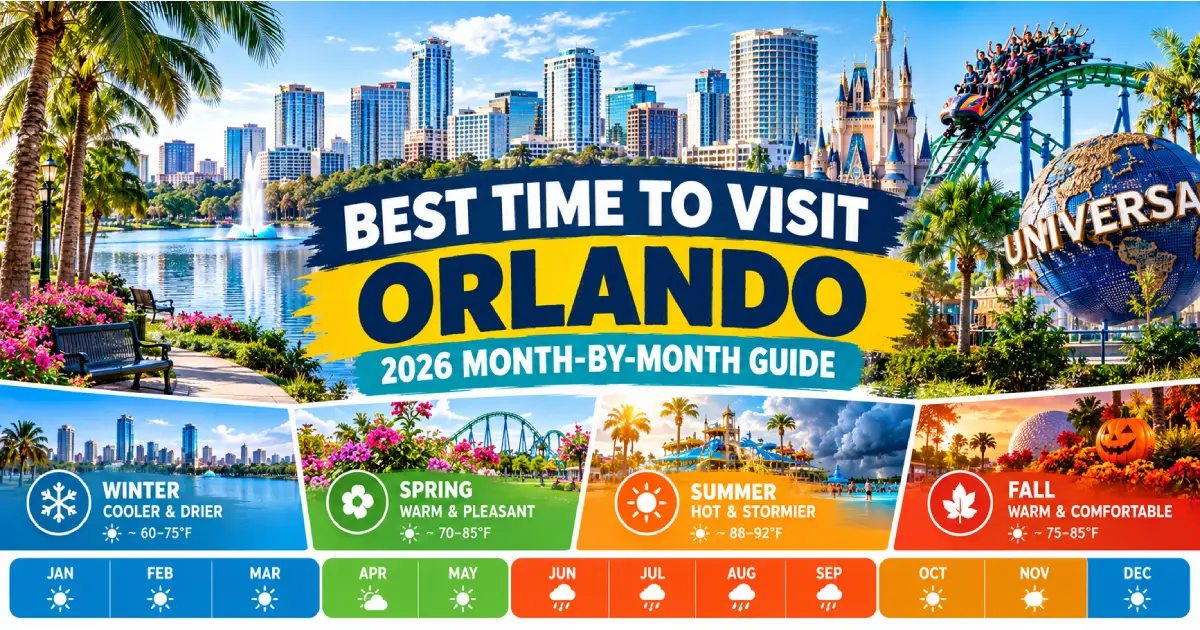
The honest answer to when to visit Orlando in 2026: the best weather is November through April (the dry season, the comfortable temperatures, the absence of the summer’s daily 2 PM thunderstorms), the lowest crowds are in late August–September and the first two weeks of January (when the school year keeps families at home), the best combination of good weather and manageable crowds is the two shoulder windows of mid-January through mid-February and mid-September through early October (both providing genuinely comfortable temperatures, significantly reduced theme park crowds, and meaningfully lower ticket prices), and the worst time for first-time visitors is the period between the last week of June and the last week of July (when the crowds are at their annual maximum, the Florida summer heat and humidity are at their most extreme, and the daily afternoon thunderstorms add a weather management layer to an already logistically demanding day). This guide provides the complete month-by-month Orlando planning calendar for 2026.
For complete Orlando planning, see our Things to Do in Orlando 2026, Orlando Travel Guide 2026, Orlando Trip Cost 2026, and Best Theme Parks in Orlando 2026.
| Month | Avg High/Low | Crowds | Hotel Prices | Theme Park Tickets | Best For |
|---|---|---|---|---|---|
| January (early) | 72°F/51°F | Low–Medium | Low | Lowest | Best winter value |
| January (MLK week) | 72°F/51°F | High | High | High | Avoid or accept |
| February | 74°F/53°F | Low–Medium | Low–Medium | Low–Medium | Best winter month |
| March (non-spring break) | 79°F/57°F | Medium | Medium | Medium | Good weather, manageable |
| March (spring break) | 79°F/57°F | Very High | Very High | Highest | Avoid if possible |
| April (post-spring break) | 84°F/62°F | Medium | Medium | Medium | Good but warming |
| May | 89°F/68°F | Medium–Low | Medium | Medium–Low | Last comfortable month |
| June | 92°F/74°F | Very High | High | High | Avoid — heat + crowds |
| July | 92°F/76°F | Highest | Highest | Highest | Worst month overall |
| August (early) | 92°F/75°F | Very High | High | High | Avoid |
| August (late) | 92°F/75°F | Medium–Low | Medium–Low | Medium–Low | Budget opportunity |
| September | 90°F/73°F | Lowest | Lowest | Lowest | Best budget month |
| October | 85°F/65°F | Low–Medium | Low–Medium | Low–Medium | Best fall month |
| November (early) | 79°F/57°F | Low–Medium | Low–Medium | Low–Medium | Very good shoulder |
| November (Thanksgiving) | 79°F/57°F | Very High | Very High | Highest | Avoid |
| December (early) | 74°F/53°F | Low–Medium | Medium | Medium | Good holiday atmosphere |
| December (Christmas/NYE) | 74°F/53°F | Extreme | Extreme | Highest | Avoid or prepare |
These two shoulder windows represent Orlando’s finest visiting windows for visitors without specific event requirements — the combination of comfortable temperatures, significantly reduced theme park crowds, lower hotel prices, and lower theme park ticket prices (Disney’s date-based pricing reflecting the demand reality that fewer visitors means lower prices) creating the most cost-effective and most enjoyable Orlando visits available in the annual calendar.
Late January–February specifics: After the Martin Luther King Jr. Day weekend (the third Monday of January) through the end of February, Orlando enters its most genuinely manageable crowd window — the school year keeping most families at home, the weather in the ideal 74–78°F/23–26°C range with low humidity, and the theme park ticket prices at their annual minimum. The specific February advantage: the combination of the dry season (the lowest monthly rainfall of the year) and the comfortable temperatures creates the most consistently pleasant outdoor theme park conditions available.
Late September–Early October specifics: The post-Labor Day crowd drop (the American school year’s September resumption removing the largest single visitor demographic from the theme park population) creates the most dramatically sudden crowd improvement of any Orlando seasonal transition — the Labor Day weekend crowds vanishing almost immediately in the week following, the parks dropping from their peak summer volume to the year’s lowest levels within days. The September weather (still hot at 88–90°F/31–32°C, with the afternoon thunderstorms continuing) makes September more weather-compromised than February but the significantly lower prices (the lowest hotel rates and ticket prices of the year in September) make it the most cost-effective single Orlando month.
These periods combine maximum crowds with maximum prices and (for June–July) maximum heat — the triple-negative that the most experienced Orlando visitors specifically avoid and that first-time visitors most frequently experience with regret.
Average high: 72°F (22°C) | Average low: 51°F (11°C) | Rain: 2.3 inches | Crowds: Low–Medium (High around MLK weekend) | Hotel rates: Low (Highest around MLK weekend) | Theme park tickets: Lowest of the year (lowest pricing tier)
January divides into two distinct Orlando experiences: the very quiet first two weeks (January 1–14, after the New Year’s holiday crowd disperses through January 13) providing the year’s lowest theme park crowds, lowest hotel prices, and the lowest Disney ticket prices; and the Martin Luther King Jr. Day holiday weekend (the third weekend of January, typically January 17–20 in 2026 — confirm specific 2026 date) bringing a significant crowd spike that temporarily reverses the January quiet.
The post-New Year’s January opportunity: The first two weeks of January (January 2–13 in most years) represent the single lowest crowd period in the entire Orlando theme park year — the Christmas and New Year’s crowds having departed, the school year fully resumed, and the next holiday influx not yet arrived. Walt Disney World in this window operates at a fraction of its summer capacity, the popular attractions routinely accessible with 10–20 minute waits that become 60–90 minute waits at peak summer. The Magic Kingdom at opening on a January Tuesday morning is the specific theme park experience that most rewards the visitor who has previously experienced the summer crowds — the visual difference (the park’s capacity, the queue lengths, and the general ambient energy) is immediately apparent and specifically remarkable.
January weather reality: The 72°F/22°C average high is genuinely pleasant for outdoor theme park activity, but the lows (51°F/11°C at night) require a light jacket or sweater for evening events — the specific Florida winter temperature drop (the overnight cold fronts that periodically bring temperatures into the 40s°F/4–9°C for 1–2 days before warming returns) creating a variable January weather pattern that the average temperature partially obscures. The specific cold-front evenings (the Magic Kingdom’s evening parade or Disney’s Hollywood Studios after-dark entertainment in 45°F weather) are the most commonly reported January surprise for visitors expecting year-round Florida warmth.
January events:
Who should visit in January: Budget-conscious families (the combination of the lowest ticket prices and the lowest hotel rates), visitors who want the most crowd-efficient single Disney experience, and anyone who has previously visited in summer and wants to experience the contrast.
Average high: 74°F (23°C) | Average low: 53°F (11°C) | Rain: 2.3 inches (lowest of the year) | Crowds: Low–Medium | Hotel rates: Low–Medium | Theme park tickets: Low pricing tier | Overall rating: ⭐⭐⭐⭐⭐
February is the month that the most Orlando-experienced visitors (the locals who have tried every month and settled on their preference) most consistently recommend — the specific combination of the year’s lowest rainfall (February’s 2.3 inch monthly average the absolute minimum of the annual cycle), the most consistently comfortable temperatures (74°F/23°C average high, the humidity at its annual minimum, creating the most genuinely pleasant outdoor conditions of any Florida winter month), the lowest theme park crowds outside of the very early January window, and the specific February Orlando event calendar (the EPCOT Festival of the Arts continuing from January, the flower and landscape preview in some years beginning in February) creating the most rewarding single month available.
The February weather advantage: February’s specific claim on “best Orlando month” is primarily meteorological — the 2.3-inch monthly rainfall (compared to July’s 7.3 inches), the 25% humidity (compared to July’s 75%), and the 74°F average high (compared to July’s 92°F) together create the outdoor physical comfort conditions that maximize the pleasure of a theme park day (the walking, the queue-standing, and the general outdoor exposure that theme park visits involve are most enjoyable in February’s conditions). The specific absence of the afternoon thunderstorm pattern (the summer’s daily 2–5 PM lightning closures that shut down outdoor attractions, send guests to cover, and disrupt the day’s rhythm) is February’s most specific practical advantage over the summer months.
February events:
Who should visit in February: The single most broadly recommended Orlando visiting month — excellent for first-time visitors (the weather and crowd conditions provide the most rewarding first Disney experience), returning visitors (the specific February park experience most dramatically contrasts with a previous summer visit), and anyone visiting specifically for weather comfort rather than a specific event.
Average high: 79°F (26°C) | Average low: 57°F (14°C) | Rain: 3.2 inches | Crowds: Very High (spring break weeks); Medium (non-spring break weeks) | Hotel rates: Very High (spring break); Medium (non-spring break) | Theme park tickets: Highest tier (spring break); Medium (non-spring break)
March is the most internally variable Orlando month — the split between the spring break weeks (the specific period when the largest single cohort of school-age visitors descends on Orlando simultaneously, creating the year’s highest single sustained crowd event outside of the Christmas holiday) and the non-spring break weeks (which maintain manageable crowd levels) makes March visit quality entirely dependent on the specific week chosen.
Spring break timing: The US spring break is not a single week but a rolling 4–6 week period determined by individual school district calendars. The most crowded single period is typically the 10-day window centered on Easter (which falls on April 5, 2026 — making the spring break peak in late March and early April 2026). The week of March 16–22 and March 23–29 in 2026 will likely be the highest-demand weeks — check the specific 2026 Disney crowd calendar (multiple third-party sites including TouringPlans.com and Undercover Tourist provide historical and projected crowd calendars) for 2026-specific guidance.
The non-spring-break March opportunity: The first two weeks of March (March 1–14, before most spring breaks begin in 2026) provide the most favorable March conditions: the weather improving from February’s pleasant baseline (the 79°F/26°C average high, the humidity still low), the crowds at the February level rather than the spring break peak, and the specific opportunity to experience EPCOT’s flower and landscape preview (the International Flower & Garden Festival typically beginning in late February or early March — check disneyworld.com for the exact 2026 start date).
EPCOT International Flower & Garden Festival: The EPCOT spring festival (the elaborate topiary displays throughout the park grounds, the outdoor garden venues serving spring-themed food and cocktails, and the Flower Power concert series featuring classic rock performers on the America Gardens Theatre stage) provides the most specifically EPCOT-distinct seasonal content of any spring Orlando event — a specific reason to visit EPCOT during the March–May period even without the non-EPCOT theme park motivation.
Who should visit in March: Visitors with children whose school break falls in early March (before the peak spring break weeks), adults visiting without school-age children who can specifically target the non-spring-break March weeks, and EPCOT enthusiasts specifically interested in the Flower & Garden Festival’s seasonal content.
Average high: 84°F (29°C) | Average low: 62°F (17°C) | Rain: 2.6 inches | Crowds: Medium (post-spring break); Medium–High (Easter week) | Hotel rates: Medium | Theme park tickets: Medium
April in 2026 is complicated by the specific Easter date (April 5, 2026 — a relatively early Easter creating a spring break peak in late March and early April rather than the more typical mid-April timing). The week of Easter (March 30–April 5, 2026) will be the highest-demand week of the spring, followed by a relatively rapid crowd decline in the weeks after Easter (April 6–30 in 2026 should be meaningfully less crowded than the Easter week).
The post-Easter April opportunity: April 6–30, 2026 provides the most specific post-spring-break value opportunity — the crowds declining rapidly after the Easter holiday conclusion, the temperatures warm but not yet at the summer extreme (84°F/29°C is genuinely warm but not the 92°F/33°C of July), and the EPCOT Flower & Garden Festival continuing through early June (the festival providing ongoing EPCOT seasonal content throughout the month).
April weather: The 84°F/29°C average high requires genuine heat management — sun protection (SPF 50+ sunscreen, a hat, and UV-protective clothing), consistent hydration (the Florida spring humidity [the annual cycle moving from February’s dry conditions back toward the summer’s high humidity through April and May], and the specific strategy of indoor-to-outdoor activity rotation provide the most comfortable April theme park experience.
Average high: 89°F (32°C) | Average low: 68°F (20°C) | Rain: 3.6 inches | Crowds: Medium–Low | Hotel rates: Medium | Theme park tickets: Medium–Low
May provides the last genuine opportunity for acceptable heat management before the summer’s extreme — the 89°F/32°C average high is warm but below the 92°F/33°C of the June–August peak, the afternoon thunderstorm pattern beginning to establish itself but not yet at the summer’s daily reliability, and the crowds (the school year still in session for most US school districts through late May) at manageable levels that the post-Memorial Day summer surge hasn’t yet produced.
Memorial Day weekend (May 23–26, 2026): The specific crowd warning — the Memorial Day weekend (the last Monday of May, initiating the unofficial US summer season) is one of the highest single-weekend crowd events of the early summer. Visiting the week BEFORE Memorial Day weekend (May 18–22 in 2026) provides the most favorable late-May conditions; visiting during or after Memorial Day signals the summer season’s crowd and pricing escalation.
The EPCOT Flower & Garden Festival conclusion: The Flower & Garden Festival typically runs through late May or early June — the final weeks of the festival providing EPCOT’s most established topiary displays (the topiaries reaching their most developed condition after the months of growth since the festival’s start) alongside the waning attendance of the spring’s visitor volume.
Who should visit in May: Visitors who want reasonably comfortable weather at lower prices than summer, families whose school year ends in late May (the window before Memorial Day being the specific late-May value opportunity), and EPCOT Flower & Garden Festival enthusiasts wanting the most established topiary displays.
Average high: 92°F (33°C) | Average low: 74°F (23°C) | Rain: 7.3 inches | Crowds: Very High | Hotel rates: High | Theme park tickets: High
June marks the beginning of Orlando’s most challenging visiting period — the simultaneous arrival of the full summer heat (the 92°F/33°C average high with the heat index regularly reaching 100–105°F/38–40°C), the daily afternoon thunderstorm pattern (the 7.3 inches of monthly rainfall concentrated in the specific 2–5 PM window that affects outdoor theme park operations), and the summer crowd surge (the US school year’s June conclusion releasing the largest single visitor demographic simultaneously).
The afternoon thunderstorm reality: The specific Florida summer weather pattern most relevant to theme park planning — the daily convective thunderstorms (the Gulf moisture-fed storms that develop over the Florida peninsula in the afternoon heating cycle, producing lightning, heavy rain, and the outdoor ride and attraction closures that their lightning proximity triggers) create a specific daily rhythm in every Orlando theme park: the morning dry period (7–11 AM, the best outdoor attraction time of day), the midday building heat (11 AM–2 PM, the queue times at their daily peak as the crowds concentrate in the heat), the afternoon storm window (2–5 PM, when the lightning-triggered closures drive guests under cover and the outdoor attractions pause), and the post-storm recovery (5–8 PM, when the storms typically clear and the evening’s cooler temperatures make outdoor activities pleasant again).
The June heat index: The 92°F/33°C average high in Florida’s high humidity (the specific combination of temperature and humidity that the heat index captures) creates effective felt temperatures regularly reaching 100–108°F/38–42°C during peak afternoon hours. This is not theoretical — the physical reality of spending 8–10 hours in a theme park in these conditions requires specific heat management (the $4 ice water at every Disney quick-service location, the complimentary cold wet towels at select Magic Kingdom locations, the frequent air-conditioned show breaks, and the specific midday retreat-and-return strategy) that the inexperienced Orlando summer visitor frequently underestimates.
Who should visit in June: Visitors constrained to summer travel by school year schedules — the June visit is genuinely manageable with proper preparation, but not the most enjoyable. Book early (the best hotel rates at summer-demand pricing sell out 6+ months ahead), use Lightning Lane/Genie+ aggressively, plan for the afternoon thunderstorm break, and start early.
Average high: 92°F (33°C) | Average low: 76°F (24°C) | Rain: 7.3 inches | Crowds: Highest of the year | Hotel rates: Highest | Theme park tickets: Highest (top pricing tier) | Overall rating: Avoid if possible
July represents Orlando’s annual maximum on every negative metric simultaneously — the highest crowds (the global school holiday period bringing visitors from Europe, Latin America, and domestic summer break simultaneously), the highest temperatures (92°F/33°C average high with heat indices regularly reaching 105–110°F/40–43°C), the highest daily rainfall (the July thunderstorm pattern at its most reliable and most intense), the highest hotel rates, and the highest theme park ticket prices. July is genuinely manageable for visitors who understand what they’re entering — but it is the specific month that most directly generates the “we should have come in February” retrospective from visitors who didn’t know better.
The July 4th specific: Independence Day (July 4, 2026) is the single highest-demand day in the Walt Disney World calendar — the fireworks at Magic Kingdom that evening driving the park to capacity (Disney’s physical capacity limit, not just crowding — the park closes to new admissions when capacity is reached, and July 4th reaches that limit by mid-afternoon on most years). The July 4th Magic Kingdom fireworks are genuinely extraordinary (the largest single fireworks display at any US theme park, the Cinderella Castle providing the most specifically spectacular American Independence Day backdrop available at any US attraction) but the crowd conditions require specific advance planning: the earliest possible park entry, the Lightning Lane Premier Pass for every major attraction, and complete acceptance of the crowd reality.
Who should visit in July: Visitors with no schedule flexibility — international visitors whose home country school holidays fall in July, domestic visitors for whom July is the only family schedule window. Budget accordingly ($189/day Disney tickets, $280–$400/night hotels on-site), manage expectations about wait times (60–90+ minutes for major attractions without Lightning Lane), and leverage every crowd-management tool available.
Average high: 92°F (33°C) | Average low: 75°F (24°C) | Rain: 7.4 inches | Crowds: High early; Medium–Low late | Hotel rates: High early; Medium–Low late
August provides Orlando’s most dramatic single-month crowd transition — the US school year’s August resumption (most US school districts beginning around August 10–20 in 2026, varying by state and district) producing the most immediately dramatic crowd reduction in the Orlando annual calendar. The specific window of late August (typically August 15–September 5) provides the most dramatic crowd-to-price improvement ratio available at any point in the year: the heat and the daily afternoon storms continue (August is Orlando’s second-wettest month at 7.4 inches), but the theme park crowds drop from July’s peak to the year’s lowest levels, and the hotel and ticket prices follow immediately.
The late August value opportunity: For heat-tolerant visitors (the $15,000 family Disney trip that costs $7,000 in late August rather than $12,000 in July is a genuinely significant saving), the late-August window provides the best single-week theme park value available in the calendar year: the near-empty Magic Kingdom on a mid-week late August morning provides 6–8 major attractions in 4 hours that would require 8–10 hours in July’s crowd conditions.
Average high: 90°F (32°C) | Average low: 73°F (23°C) | Rain: 5.9 inches | Crowds: Lowest of the year | Hotel rates: Lowest of the year | Theme park tickets: Lowest pricing tier | Weather caveat: Still hot; hurricane season peak
September is the most specifically cost-effective single Orlando month and the most specifically misunderstood — the combination of the year’s lowest crowd levels (the school year fully resumed, the summer visitors gone, and the fall season’s visitors not yet arrived), the year’s lowest hotel rates (the demand-driven pricing hitting its annual minimum with the year’s lowest visitor volume), and the lowest Disney ticket prices (the base pricing tier reflecting the demand reality) together creating the most affordable single month available.
The September caveats:
Who should visit in September: Budget-maximizing families whose school calendar allows the early-September withdrawal, adults without school-age children who prioritize cost-efficiency and heat tolerance over comfort, and EPCOT Food & Wine Festival enthusiasts who want the festival’s opening weeks at the year’s lowest hotel prices.
Average high: 85°F (29°C) | Average low: 65°F (18°C) | Rain: 2.9 inches | Crowds: Low–Medium | Hotel rates: Low–Medium | Theme park tickets: Low–Medium | Events: Mickey’s Not-So-Scary Halloween Party; EPCOT Food & Wine Festival
October provides the best fall visiting window — the temperature dropping from September’s 90°F to a more manageable 85°F/29°C, the rainfall declining from the summer peak to the comfortable 2.9 inch October level, the crowds at the manageable post-summer level, and the specific October event calendar providing genuinely worthwhile seasonal content.
Mickey’s Not-So-Scary Halloween Party: The separately-ticketed Halloween event (held on specific evenings in September and October at Magic Kingdom — check disneyworld.com for the 2026 specific event dates, typically Tuesday, Thursday, Friday, and Saturday evenings from mid-September through October 31) provides the most specifically extraordinary non-standard Disney experience of the annual calendar: the special after-hours Magic Kingdom access (the separately-ticketed event running 7 PM–midnight, the park open exclusively to event ticket holders after 7 PM, the crowd level at the lowest of any Magic Kingdom operating day), the Halloween-specific entertainment (the Boo-to-You Halloween Parade, the Hocus Pocus Villain Spelltacular stage show, and the various Halloween character meets not available during regular park hours), and the complimentary trick-or-treating (the candy stations distributed throughout the park providing unlimited treats — the most specifically child-beloved single Halloween party element).
EPCOT Food & Wine Festival (continuing): The Food & Wine Festival in October (typically running from late August through mid-November) provides the most developed iteration of the festival’s food and drink programming — the October crowds are lower than the September Food & Wine opening excitement, and the temperatures more comfortable for the outdoor marketplace exploration.
Who should visit in October: Visitors who want the best single-month combination of weather, crowds, and seasonal event content — October provides all three simultaneously, making it the most broadly recommended fall Orlando month for visitors without a specific event constraint.
Average high: 79°F (26°C) | Average low: 57°F (13°C) | Rain: 2.3 inches | Crowds: Low–Medium (early); Extreme (Thanksgiving week)
November divides into two dramatically different Orlando periods: the excellent early-to-mid November (November 1–20, the post-Halloween crowd decline and the pre-Thanksgiving quietude creating the second-most favorable single crowd window of the fall after October), and the catastrophic Thanksgiving holiday week (November 22–30 in 2026, the second-highest single-week crowd event of the year after the Christmas holiday, the Disney parks literally reaching capacity on the peak Thanksgiving days).
The early November opportunity: November 1–20 provides conditions very close to October’s ideal — the temperatures improving slightly (79°F/26°C average vs. October’s 85°F), the EPCOT Food & Wine Festival in its final weeks (typically ending in mid-November, the festival’s last week providing the final opportunity for the year’s most distinctively EPCOT experience), and the crowds at the early November minimum.
EPCOT Festival of the Holidays: The EPCOT holiday festival (typically beginning in late November — check disneyworld.com for the specific 2026 start date) provides the Christmas season’s EPCOT overlay: the Candlelight Processional (the narrated choral retelling of the Christmas story with celebrity narrator and the 50-voice choir — the most specifically extraordinary single EPCOT recurring performance), the international holiday traditions in the World Showcase country pavilions, and the various seasonal food and entertainment additions.
The Thanksgiving specific: The Thanksgiving holiday week (the Wednesday before through the Sunday after Thanksgiving) is the second-highest single-week demand period in the Walt Disney World annual calendar. The specific Thanksgiving Wednesday (the day before Thanksgiving, historically the most-traveled single day in the US calendar) creates specific Magic Kingdom crowd pressure that results in actual park capacity closures by 10 AM in some years. If visiting during Thanksgiving week is unavoidable, book the most popular Lightning Lane Premier Pass attractions before 7 AM, arrive at park opening, and accept that afternoon waits will be 90–120 minutes for the most popular attractions regardless of strategy.
Average high: 74°F (23°C) | Average low: 53°F (11°C) | Rain: 2.3 inches | Crowds: Low–Medium (early); Extreme (Christmas/NYE week)
December follows the November pattern with greater extremes — the excellent early December (December 1–20) providing the most specifically holiday-atmosphere Orlando experience at manageable crowd levels, and the final week (December 21–January 1) providing the year’s absolute maximum crowd event, the specific Christmas-to-New-Year’s week traditionally representing the single most crowded week in Walt Disney World’s history with the Magic Kingdom and EPCOT potentially reaching physical capacity before noon on the peak days.
The early December opportunity: December 1–20 provides the most specifically holiday-atmosphere Orlando visit at the most manageable conditions: the Christmas decorations installed throughout Walt Disney World (the Main Street USA Christmas tree, the Cinderella Castle’s holiday overlay, and the specific holiday additions that Disney’s holiday program deploys across all four parks from late November through January 1), the EPCOT Candlelight Processional running (the Candlelight Processional’s celebrity narrator performance schedule for December covers every day of the month — check disneyworld.com for the 2026 narrator lineup and performance times), and the crowd levels remaining manageable until the school-holiday departure after December 20.
Mickey’s Very Merry Christmas Party: The separately-ticketed Magic Kingdom Christmas event (similar format to the Halloween Party — specific evenings in November and December, separately ticketed, after-hours access) provides the Magic Kingdom’s most specifically holiday entertainment: the Mickey’s Once Upon a Christmastime Parade, the Holiday Wishes fireworks, the falling snow on Main Street USA, and the complimentary holiday treats.
The Christmas week honest assessment: December 21–January 1 in Orlando requires complete acceptance of extreme conditions — the highest prices, the longest waits, and the largest crowds of the year. The specific Magic Kingdom on December 26 or 27 is genuinely extraordinary from a spectacle perspective (the fully decorated park at maximum capacity creates the most visually overwhelming single Disney experience available) but requires the most aggressive Lightning Lane strategy, the earliest possible arrival, and the most flexible schedule of any Orlando visit. If Christmas week is the only available window, book on-site hotels (the on-site hotel’s early park entry provides the single most valuable crowd-management tool of the Christmas period), purchase Lightning Lane Premier Pass for all of the most popular attractions simultaneously, and arrive at the earliest possible entry time.
| Date Range | Event | Crowd Level | Action |
|---|---|---|---|
| Jan 1–14 | Post-holiday quiet | Low | Excellent window |
| Jan 18–20 | MLK Day weekend | High | Avoid or book early |
| Mar 30–Apr 5 | Easter week 2026 | Extreme | Avoid or prepare fully |
| Late March | Spring break peak | Very High | Non-spring-break week only |
| May 23–26 | Memorial Day weekend | High | Avoid weekend |
| June–July | Summer peak | Highest | Late August better |
| Jul 4 | Independence Day | Extreme (Disney) | Start at 7 AM or skip |
| Aug 15–Sep 5 | Back-to-school drop | Low | Best summer budget window |
| Sep | All month | Lowest | Best budget month |
| Oct | All month | Low-Medium | Best fall visit |
| Nov 22–30 | Thanksgiving week | Very High | Avoid or accept |
| Dec 21–Jan 1 | Christmas/NYE week | Extreme | Avoid or fully pre |
About Travel Tourister Travel Tourister’s destination specialists have visited Orlando in every month of the year — from January’s rope-drop near-empty Magic Kingdom mornings and February’s Flower and Garden Festival preview walks through spring break’s Easter week capacity crowds and May’s last-comfortable-before-summer temperatures to July 4th’s Magic Kingdom capacity-close reality, September’s late-afternoon Food and Wine Festival nearly-empty marketplace exploration, October’s Mickey’s Not-So-Scary Halloween Party midnight Boo-to-You parade, and December’s early-month Candlelight Processional Celebrity Narrator evenings — to deliver the most practically honest and most crowd-truthful Orlando seasonal guide for every type of 2026 visitor.
Posted By : Vinay
Latest Article
2nd Floor, 39, Above Kirti Club, DLF Industrial Area, Kirti Nagar, New Delhi, Delhi 110015



Travel Tourister is a leading Travel portal where we introduce travellers to trusted travel agents to make their journey hasselfree, memorable And happy. Travel Tourister is a platform where travellers get Tour packages ,Hotel packages deals through trusted travel companies And hoteliers who are working with us across the world. We always try to find new and more travel agents and hoteliers from every nook and corners across the world so that you could compare the deals with different travel agents and hoteliers and book your tour or hotel with the one you have chosen according to your taste and budget.
Copyright © Travel Tourister, India. All Rights Reserved

 Call
Call Enquiry