Published on : 23 Sep 2026
By Travel Tourister | Updated Sep 2026
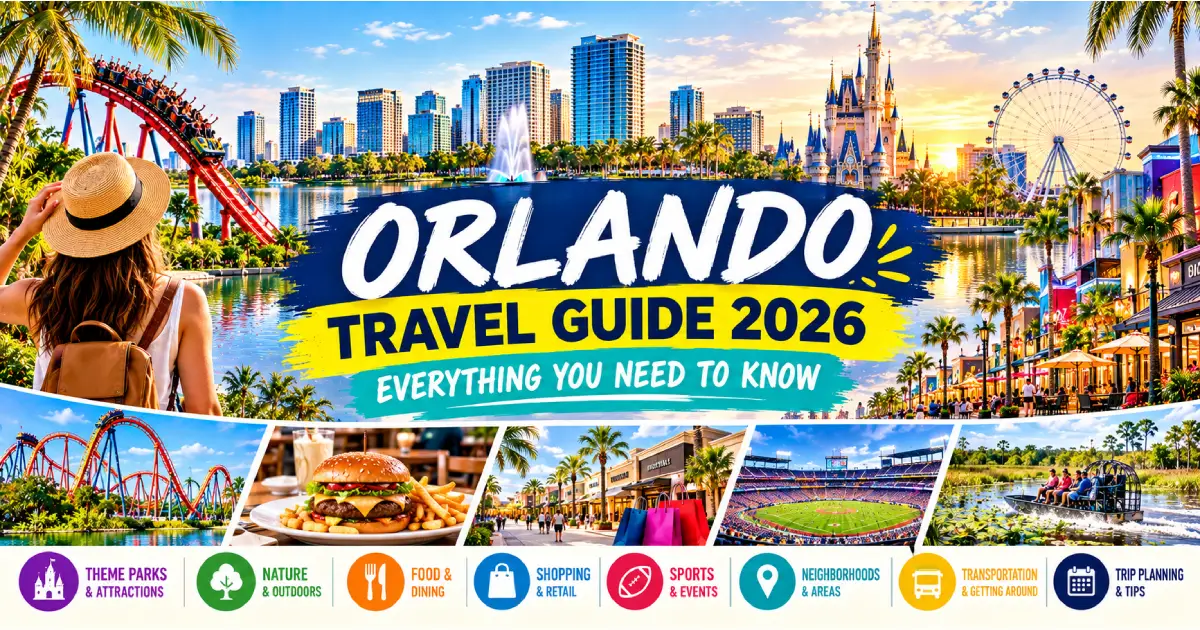
Orlando is the most visited destination in the United States — a city whose permanent population of 320,000 hosts approximately 74 million annual visitors, the specific gravitational pull of Walt Disney World, Universal Orlando Resort, LEGOLAND Florida, SeaWorld Orlando, and Epic Universe together creating the most concentrated theme park landscape on Earth and the single most logistically complex American vacation destination. Planning an Orlando visit in 2026 requires understanding a set of specific decisions — the park selection (which parks, how many days each), the accommodation choice (on-site Disney vs. Universal Premier vs. off-site value), the ticket purchasing strategy (the date-based dynamic pricing that makes the same Disney ticket cost $80 more on July 4th than on a January Tuesday), the Lightning Lane and Express Pass investment (the paid front-of-line systems that meaningfully affect the park day experience but add $15–$35/person/day to the already-substantial ticket cost), and the transport logistics (the specific Orlando geography, where the theme parks are dispersed across a 15-mile corridor and the International Drive tourist zone sits between the Disney complex to the southwest and the Universal complex to the northwest) — that together determine whether the Orlando visit is the most rewarding American family vacation or the most expensive American family disappointment.
This complete Orlando Travel Guide for 2026 covers everything from getting there and getting around through neighborhood orientation, the theme park landscape, accommodation selection, practical planning, safety, and the specific insider knowledge that makes the difference between a good Orlando visit and a genuinely extraordinary one.
For specific activity, timing, and cost guidance, see our Things to Do in Orlando 2026, Best Time to Visit Orlando 2026, Orlando Trip Cost 2026, and Best Theme Parks in Orlando 2026.
| Category | Details |
|---|---|
| Location | Central Florida, Orange County |
| Population | 320,000 (city); 2.7 million (metro) |
| Annual visitors | ~74 million |
| Nickname | The Theme Park Capital of the World |
| Airport | Orlando International Airport (MCO) |
| Airport to Disney | 25–30 minutes (car/shuttle) |
| Airport to Universal | 20–25 minutes (car/shuttle) |
| Climate | Subtropical — hot humid summers; mild dry winters |
| Best season | January–February and September–October |
| Average hotel (mid-range) | $150–$280/night (off-site); $200–$400 (on-site Disney Value–Moderate) |
| Disney ticket range | $109–$189/day (date-based pricing) |
| Universal ticket range | $109–$369/day (varies by park combo) |
| Car necessary? | Strongly recommended for most visitors |
| Currency | US Dollar (USD) |
| Time zone | Eastern Time (ET) — UTC-5 standard; UTC-4 DST |
Airport code: MCO | Distance to Disney: 26 miles (25–35 min drive) | Distance to Universal: 20 miles (20–25 min drive) | Distance to International Drive: 18 miles (20–25 min drive) | Website: orlandoairports.net
Orlando International Airport (MCO) is the 10th busiest airport in the United States by passenger volume — the high traffic driven by the concentration of theme park visitors creating the specific airport infrastructure (the Terminal C expansion, the SunRail connection, and the various ground transportation options) that handles 50+ million annual passengers.
Getting from MCO to your hotel:
Mears Connect (shared shuttle): The most popular budget-conscious airport transfer — the shared shuttle service ($39–$55/person round-trip, book at mearsglobal.com) picks up at the MCO ground transportation level and delivers to all major hotel areas (International Drive, Disney resort hotels, Universal area, Kissimmee). Travel time is 30–60 minutes depending on the number of stops. The shared shuttle is the best value for solo travelers and couples; for families of 4+, the cost comparison with rideshare or car rental favors the alternatives.
Rideshare (Uber/Lyft): $35–$55 one-way to the International Drive/Disney area in normal conditions, with surge pricing adding 1.5–3x during peak arrival windows (Sunday evening, the day before major holidays). The rideshare pickup at MCO is at the Ground Transportation level — follow the MCO signs to the rideshare staging area (not the taxi/shuttle area, which is different).
Rental car: The most flexible option for most families — the MCO Rental Car Center (connected to the terminal by automated people mover) houses all major rental companies. Compact cars run $40–$80/day; SUVs (the most practical family choice) run $60–$120/day. The specific Orlando rental car consideration: most visitors need the car primarily for airport transfers and off-site dining rather than daily park transport (Disney’s internal transportation system eliminates the car need for Disney-focused stays; Universal’s walkable resort concentration does the same for Universal-focused stays).
Taxi: The fixed-rate taxi (approximately $55–$75 to the Disney area, $45–$65 to International Drive) provides consistent pricing without the rideshare surge uncertainty — available at the MCO taxi stand on the Ground Transportation level.
SunRail: The commuter rail connecting MCO with downtown Orlando and the northern suburbs — useful primarily for visitors staying downtown or in the Sanford area, not for the theme park corridors.
Airport code: SFB | Distance to Disney: 37 miles (40–50 min drive) | Airlines: Allegiant, Sunwing, various charters
Sanford Airport (35 miles north of Disney) provides significantly cheaper flights from certain origin cities (Allegiant Air’s network of smaller American cities connects to SFB at prices 25–40% below equivalent MCO service). The trade-off: the additional distance requires a $45–$65 rideshare or rental car to reach the Disney area — compare the total cost (flight + transfer) vs. the MCO alternative before committing to SFB.
From Miami: Florida’s Turnpike (Florida Turnpike, Toll Road) or I-95 North + Florida Turnpike; 3.5 hours (235 miles) From Tampa: I-4 East; 1.5 hours (85 miles) From Jacksonville: I-95 South + I-4 West; 2.5 hours (140 miles) From Atlanta: I-75 South + I-4 West; 7 hours (460 miles) From Washington DC: I-95 South; 14 hours (1,090 miles — more practical as a fly-drive)
Interstate note: I-4 (the east-west interstate that cuts through Orlando connecting Tampa and Daytona Beach) is the most critical single highway for Orlando visitors — the Disney exits (exits 64–68) and the Universal/International Drive exits (exits 72–75) are the specific I-4 junctions that every Orlando visitor navigates. The specific I-4 traffic reality: the stretch between exits 62 and 82 through the Orlando tourist corridor is among the most congested in Florida, with rush hour (7–9 AM and 4–7 PM) and event-day traffic (the Disney park opening and closing rush) creating delays that GPS navigation doesn’t fully predict.
Orlando’s specific geography is the single most important piece of orientation knowledge for first-time visitors — understanding the spatial relationship between the major attraction zones eliminates the planning errors that come from treating “Orlando” as a single walkable city rather than the dispersed tourist corridor it actually is.
Walt Disney World Resort (Southwest — Lake Buena Vista/Bay Lake): The 25,000-acre Disney complex 20 miles southwest of downtown Orlando — its own self-contained resort city with four theme parks, two water parks, the Disney Springs shopping district, and 30+ hotels. Disney World is NOT in Orlando city proper — it occupies an area straddling Orange and Osceola Counties with its own governing Reedy Creek Improvement District. The Disney complex is approximately 8 miles across — the drive from the Magic Kingdom to EPCOT is 15 minutes, from EPCOT to Animal Kingdom 20 minutes.
Universal Orlando Resort (Northwest of I-Drive): The three-park Universal complex (Universal Studios Florida, Islands of Adventure, and the 2025-opened Epic Universe) on Universal Boulevard, approximately 6 miles north of Disney Springs and 2 miles from International Drive. The Universal parks are walkable between each other — the 5-minute walk from Universal Studios Florida to Islands of Adventure through CityWalk is the most compact multi-park layout of any major Orlando resort.
International Drive (Central Tourist Corridor): The 11-mile commercial strip running through the heart of the Orlando tourist zone — the hotels, restaurants, outlet malls (the Orlando Premium Outlets at the north and south ends), the SeaWorld/Discovery Cove complex (south end), the Icon Park complex (north-central), and the various entertainment venues that serve visitors not spending the day in a theme park. International Drive is the practical base for most mid-range visitors — the central location providing roughly equal driving distance to Disney (20 minutes southwest) and Universal (10 minutes northwest).
Kissimmee (South of Disney): The city immediately south of the Disney complex — the most budget-priced hotel corridor in the Orlando area, the US 192 strip providing the largest concentration of under-$100/night family hotels within driving distance of Disney. The specific Kissimmee trade-off: the lowest prices and the highest density of budget family restaurants, at the cost of a 15–25 minute drive to Disney’s gates and the specific Kissimmee tourist-strip aesthetic (the go-kart tracks, the souvenir shops, and the specific commercial character of a 1980s–2000s Florida tourist corridor).
Downtown Orlando: The actual city center — the Orange Avenue commercial district, the Dr. Phillips Center for Performing Arts, the Lake Eola Park, the Orlando Museum of Art, and the Thornton Park and Mills 50 neighborhoods. Downtown Orlando is 20 minutes from Disney and 15 minutes from Universal — relevant primarily for visitors extending their trip beyond the theme park corridor to experience the specific Orlando urban culture that the International Drive tourist zone doesn’t represent.
Winter Park: The affluent suburb 15 minutes north of downtown — the Park Avenue boutique corridor, the Morse Museum of American Art (the world’s largest Tiffany collection), the Rollins College campus, and the Winter Park Scenic Boat Tour providing the most specifically non-theme-park cultural Orlando experience.
The specific Orlando transport reality: unlike New York, San Francisco, or Chicago, Orlando has no public transit system that meaningfully serves the theme park corridor. The I-Ride Trolley (the tourist bus on International Drive, $2.50/ride) provides International Drive corridor service; the SunRail commuter rail serves downtown and the northern suburbs; but neither reaches Disney World or Universal’s park gates in a practically useful way. For most visitors — especially families — a rental car is the most practical single transport choice.
Car rental daily rates at MCO (2026 estimates):
Parking costs:
For visitors staying at a Walt Disney World on-site hotel, Disney’s internal transportation system (the Monorail, the buses, the boats, and the Disney Skyliner gondola system) connects every Disney hotel to every Disney theme park and to Disney Springs — all at no additional cost, all included with the hotel stay. The specific Disney transportation advantages:
The Monorail: The iconic Disney transportation — the elevated train connecting the Ticket and Transportation Center (TTC) with the Magic Kingdom, the Grand Floridian, the Polynesian, and the Contemporary Resort. The most specifically atmospheric single Disney transport experience — the Monorail ride through the Contemporary Resort’s main building (the train literally passing through the resort’s 15-story atrium) is one of Disney’s most uniquely dramatic single moments.
The Disney Skyliner: The gondola system connecting EPCOT and Disney’s Hollywood Studios with the Caribbean Beach, Pop Century, Art of Animation, and Riviera Resort hotels — the most scenic Disney transportation option (the gondola providing aerial views of EPCOT’s Spaceship Earth and Disney’s Hollywood Studios’ Hollywood Tower of Terror from above) and the most pleasant alternative to the bus system for EPCOT and Hollywood Studios access.
Disney buses: The comprehensive bus network connecting every Disney resort hotel with every Disney theme park and Disney Springs — less scenic than the Monorail or Skyliner but the most comprehensive single connectivity option within the Disney resort.
For Universal on-site hotel guests (particularly Premier hotel guests at the Royal Pacific, Portofino Bay, and Hard Rock Hotel), the water taxi (the boat service on the resort’s canal system connecting the Premier hotels with CityWalk) provides the most specifically pleasant Universal resort transportation — the 15-minute boat ride replacing the equally short walk but providing the specific relaxation of a boat journey through the resort’s landscaped waterways.
For visitors staying off-site (International Drive, Kissimmee, or downtown hotels), rideshare provides the most practical park access:
Typical rideshare costs:
Surge pricing warning: The specific high-surge rideshare moments in Orlando (the 30 minutes after major park fireworks or parades end, when thousands of visitors simultaneously request rides from the park area) can produce 3–5x normal pricing. The surge-avoidance strategy: waiting 20–30 minutes after the park’s peak exit time (the fireworks end, then the crowd wave exits, then the surge subsides) before requesting rideshare consistently provides better pricing for visitors who can absorb the brief wait.
The tourist-oriented bus service on International Drive ($2.50/ride, day passes available) connecting the hotels and attractions along the 11-mile I-Drive corridor — SeaWorld at the south end, the Icon Park complex in the middle, and the Universal area connector at the north end. Useful primarily for International Drive-specific activities (the Icon Park, the outlet malls, the various I-Drive restaurants and entertainment) rather than theme park access.
Who it’s for: First-time Disney visitors, families with young children, Disney enthusiasts who want the maximum Disney immersion, visitors planning 4+ Disney park days
The advantages:
The trade-offs:
On-site Disney hotel price categories:
Who it’s for: Universal and Harry Potter enthusiasts, visitors planning 2+ Universal park days, families who specifically want the Universal Express Pass benefit without the daily purchase cost
The Premier Hotel advantage (Royal Pacific, Portofino Bay, Hard Rock Hotel): The included Universal Express Pass (unlimited front-of-line access for all Express Pass-eligible attractions throughout the stay) is the most specifically valuable single on-site hotel perk in Orlando — worth $89–$189/person/day at the current Express Pass purchase price, the hotel’s $300–$600/night rate frequently justified for families of 3+ planning 2+ Universal days when the Express Pass value is calculated.
Who it’s for: Budget to mid-range visitors splitting time between Disney and Universal, adults without children, visitors who want off-site dining access
Character: The tourist commercial strip — convenient, affordable, character-free. International Drive provides the most hotel density, the most restaurant variety, and the most central location in the Orlando tourist corridor at prices meaningfully below the on-site Disney alternatives.
Recommended I-Drive hotel tier:
Who it’s for: Budget-maximizing families, visitors planning 4+ days exclusively at Disney
Trade-offs: The lowest hotel prices in the Orlando area ($70–$120/night for decent family hotels) at the cost of the least aesthetically appealing surroundings (the US 192 Kissimmee strip’s specific tourist-commercial character) and the 15–25 minute drive to Disney’s gates that the price savings require.
Magic Kingdom: The most iconic, the most crowded, the most family-focused — the Cinderella Castle, the classic Disney attractions, and the TRON Lightcycle/Run coaster. Best for: First-time visitors, families with young children, classic Disney fans.
EPCOT: The most adult-friendly Disney park — the World Showcase’s 11-country cultural circuit, the Guardians of the Galaxy: Cosmic Rewind coaster, and the rotating international festivals (Festival of the Arts, Flower & Garden Festival, Food & Wine Festival, Festival of the Holidays). Best for: Adults, food and culture enthusiasts, returning Disney visitors.
Disney’s Hollywood Studios: The most thrill-focused Disney park — Star Wars: Galaxy’s Edge (with Rise of the Resistance and Millennium Falcon: Smugglers Run), the Slinky Dog Dash coaster, and the Tower of Terror. Best for: Star Wars fans, older children and teens, thrill-seekers.
Disney’s Animal Kingdom: The most nature-integrated Disney park — Pandora: The World of Avatar (with Flight of Passage and Na’vi River Journey), the Kilimanjaro Safaris live animal encounter, and the Expedition Everest roller coaster. Best for: Animal lovers, Avatar fans, visitors wanting a non-standard Disney experience.
Universal Studios Florida: The movie-themed park with Diagon Alley (Harry Potter), Jurassic World, and the classic Universal Studio attractions. Best for: Harry Potter fans (Diagon Alley), movie enthusiasts.
Islands of Adventure: The most thrill-oriented Orlando theme park — Hagrid’s Magical Creatures Motorbike Adventure (consistently rated the world’s best theme park ride), Hogsmeade (Wizarding World), and the VelociCoaster. Best for: Thrill-seekers, Harry Potter fans (Hogsmeade), older children and adults.
Epic Universe (OPENED 2025): The newest Orlando theme park — five themed worlds including the Wizarding World of Harry Potter: Ministry of Magic, Super Nintendo World, How to Train Your Dragon, and Classic Monsters. Best for: Harry Potter enthusiasts wanting the newest Potter experience, Nintendo fans, first-time Universal visitors wanting the newest park.
SeaWorld Orlando: The marine-themed park with the Mako hypercoaster (tallest in Orlando), the Ice Breaker launch coaster, and the marine animal encounters. Best for: Roller coaster enthusiasts, marine biology interested visitors.
LEGOLAND Florida (Winter Haven): The most specifically 2–12 age-appropriate theme park in Florida — the building activities, the gentle rides, and the Cypress Gardens botanical remnant. Best for: Young children, LEGO enthusiasts.
Never purchase Disney tickets at the park gate on the day of your visit — the Disney website and authorized discount vendors (Undercover Tourist typically offers 6–10% below gate pricing) provide the same tickets at better prices, and the gate line (particularly on busy days) adds waiting time before you’ve even entered the park.
Disney requires a Park Pass reservation (in addition to the ticket) for each park visit — these are free but essential, and the most popular parks (Magic Kingdom) on the most popular dates (spring break, summer weekends) can sell out weeks ahead. Make Park Pass reservations immediately after purchasing tickets at disneyworld.com/reserve.
The My Disney Experience app (Disney’s official app — Lightning Lane purchase, wait time monitoring, mobile food ordering, park map, and the daily entertainment schedule all in a single tool) and the Universal app (wait times, Virtual Line for Epic Universe, mobile ordering) are the single most practical planning tools available on-site. Download both before arriving and set up accounts in advance.
The first 60–90 minutes after park opening provide the shortest wait times of the entire day for every attraction — the crowd distribution in the first hour (visitors spread across the entire park rather than concentrated at specific attractions) creating the most efficient single window for attraction access. The specific rope-drop strategy (heading directly to the park’s single most popular attraction in the first 10 minutes of opening) provides the most efficient single Disney or Universal park start.
The specific Florida summer weather pattern (the daily convective thunderstorms typically arriving between 2–5 PM) creates the most predictable single Orlando weather event. The specific strategy: maximize morning attraction time (7–11 AM), use the early afternoon for sit-down lunch or an indoor show (11 AM–2 PM), take shelter and use indoor attractions during the storm (2–4 PM), and return to outdoor attractions in the post-storm evening (4–9 PM). This rhythm makes summer Orlando genuinely manageable for visitors who understand and plan for it.
Both Disney and Universal’s mobile ordering systems (within the My Disney Experience and Universal apps respectively) allow ordering quick-service food from the app and picking up at the counter without waiting in the food-ordering queue — a 10–20 minute daily time saving that compounds significantly across a multi-day visit.
Several Universal attractions (Hagrid’s Motorbike Adventure does NOT have single rider; the VelociCoaster, MEN IN BLACK, Harry Potter and the Escape from Gringotts, and Transformers do) offer single rider lines for solo visitors willing to be seated separately from their group — wait times 30–60% below the standard queue, the most significant crowd-avoidance tool available at Universal for solo travelers or couples willing to ride separately.
The most compelling non-theme-park Orlando day trip — the Space Shuttle Atlantis on permanent display, the active launch viewing opportunities, and the specific NASA history creating the most genuinely awe-inspiring single day outside the Orlando theme park complex.
The manatee winter refuge (November–March) — 100+ manatees visible in the crystal-clear spring run on cold winter mornings. The most specifically extraordinary free-to-observe wildlife encounter within day-trip distance.
The Morse Museum’s Tiffany collection, the Park Avenue boutique corridor, and the Scenic Boat Tour — the most specifically cultural and most specifically non-Disney single Orlando half-day.
The natural freshwater swimming hole — the 68°F constant-temperature spring providing the most specifically Florida natural swimming experience at the lowest possible cost ($6/vehicle).
| Season | Temperatures | Key Characteristic |
|---|---|---|
| Winter (Dec–Feb) | 65–75°F / 18–24°C days; 45–55°F / 7–13°C nights | Mild, dry, comfortable — best theme park weather |
| Spring (Mar–May) | 75–88°F / 24–31°C | Warming; spring break crowds in March–April |
| Summer (Jun–Sep) | 88–92°F / 31–33°C | Hot, humid; daily afternoon thunderstorms |
| Fall (Oct–Nov) | 75–85°F / 24–29°C | Pleasant; declining crowds from September peak |
The standard US tipping applies throughout Orlando:
Orlando is a generally safe destination for tourists in the theme park corridor areas. The specific safety considerations:
Traffic: The most practically relevant Orlando safety concern — the I-4 corridor’s high traffic density, the unfamiliar road layout for first-time visitors, and the specific intersection complexity of the I-Drive area require careful GPS navigation attention. Never attempt to navigate the I-4/I-Drive interchange without GPS.
Heat: The specific summer Orlando safety consideration — heat stroke and severe dehydration are genuine risks for visitors who underestimate the Florida summer heat index (the felt temperature regularly reaching 105–110°F/40–43°C with humidity). The specific prevention: consistent hydration (consuming water every 30 minutes regardless of thirst), frequent shade and air-conditioning breaks (the midday indoor strategy is both practical and safety-relevant), and recognizing the early signs of heat exhaustion (dizziness, nausea, cessation of sweating) before they progress.
Lightning: The specific Florida summer weather safety note — Florida leads all US states in annual lightning fatalities, and the afternoon thunderstorms that affect Orlando’s theme parks are a genuine outdoor safety event. The parks’ outdoor attraction closure policy (triggered when lightning is within 8 miles) is a safety protocol, not an inconvenience — waiting in the covered area during the storm closure is the appropriate response.
Theme park scams: The specific Orlando visitor-facing scam category — unauthorized ticket sellers (anyone other than Disney/Universal direct, authorized resellers like Undercover Tourist, or confirmed AAA/military discount channels) offering discounted tickets are consistently fraudulent. Never purchase Orlando theme park tickets from street vendors, parking lot solicitors, or unofficial websites.
Day 1 — Magic Kingdom: Arrive at rope drop (7:30 AM for an 8 AM opening) → TRON Lightcycle/Run (use Lightning Lane Premier Pass — this is the highest-demand single attraction, worth the LLPP cost) → Haunted Mansion → Pirates of the Caribbean → Lunch at Columbia Harbour House → Splash Mountain and Big Thunder Mountain Railroad in early afternoon → Break from heat 2–4 PM (hotel pool or resort rest) → Return for evening parade and Cinderella Castle projection show + Happily Ever After fireworks (9 PM)
Day 2 — Universal Islands of Adventure + Studios: Rope drop at Islands of Adventure → Hagrid’s Magical Creatures Motorbike Adventure immediately (the single highest-demand ride in Orlando — the virtual queue or single rider line are the primary access strategies) → Hogsmeade exploration (butterbeer, Honeydukes) → VelociCoaster → Transfer to Universal Studios via CityWalk → Diagon Alley (Escape from Gringotts + butterbeer comparison between the two versions) → Despicable Me → Lunch at The Leaky Cauldron → Hogwarts Express (connecting the two Wizarding World areas — requires both parks on the ticket)
Day 3 — EPCOT: World Showcase opens at 11 AM (Future World at park opening) → Guardians of the Galaxy: Cosmic Rewind at opening → Test Track → Remy’s Ratatouille Adventure → World Showcase from 11 AM (France pavilion for crêpes, Morocco for the visual, Japan for the food, Canada for the scenic views) → EPCOT Food & Wine Festival booths (September–November) or Flower & Garden Festival (March–June) → IllumiNations/Harmonious nighttime spectacular
Day 4 — Disney’s Animal Kingdom + Pool Day: Morning: Animal Kingdom rope drop → Flight of Passage (Lightning Lane Premier recommended — another extremely high-demand attraction) → Kilimanjaro Safaris (best in morning when animals are most active) → Expedition Everest → Lunch at Yak & Yeti Restaurant Afternoon: Pool day at hotel → Disney Springs evening (World of Disney, The BOATHOUSE, The Edison)
Days 1–4 as above, plus:
Day 5 — Hollywood Studios + Kennedy Space Center: Option A: Hollywood Studios — Galaxy’s Edge (Rise of the Resistance, Millennium Falcon) + Tower of Terror + Slinky Dog Dash Option B: Kennedy Space Center day trip (depart 8 AM, arrive 9 AM, 5–6 hours at KSC, return 4 PM)
Day 6 — Universal Epic Universe: Full day at Epic Universe — the new 2025 park’s five worlds providing the most comprehensively new single-day Orlando theme park experience
Day 7 — Rest, Water Park, or Non-Park Day: Disney’s Typhoon Lagoon or Universal’s Volcano Bay water park (summer) → Winter Park half-day (Morse Museum + Scenic Boat Tour + Park Avenue lunch) → Kennedy Space Center (if not visited Day 5)
About Travel Tourister Travel Tourister’s destination specialists have visited Orlando across multiple seasons, budgets, and trip configurations — from the January rope-drop near-empty Magic Kingdom mornings and September Food & Wine Festival nearly-empty EPCOT evenings through spring break Hollywood Studios Rise of the Resistance Lightning Lane Premier Pass navigations and July 4th Magic Kingdom capacity-closure experiences to Universal Royal Pacific Express Pass family-of-four value calculations, Epic Universe Ministry of Magic opening-week visits, Kennedy Space Center Shuttle Atlantis curtain-drop reveals, Blue Spring January manatee boardwalk mornings, and Winter Park Morse Museum Tiffany chapel meditations — to deliver the most practically complete and most honestly calibrated Orlando travel guide for every type of 2026 visitor.
Posted By : Vinay
Latest Article
2nd Floor, 39, Above Kirti Club, DLF Industrial Area, Kirti Nagar, New Delhi, Delhi 110015



Travel Tourister is a leading Travel portal where we introduce travellers to trusted travel agents to make their journey hasselfree, memorable And happy. Travel Tourister is a platform where travellers get Tour packages ,Hotel packages deals through trusted travel companies And hoteliers who are working with us across the world. We always try to find new and more travel agents and hoteliers from every nook and corners across the world so that you could compare the deals with different travel agents and hoteliers and book your tour or hotel with the one you have chosen according to your taste and budget.
Copyright © Travel Tourister, India. All Rights Reserved

 Call
 Enquiry