Published on : 29 Sep 2026
By Travel Tourister | Updated Sep 2026
Philadelphia’s seasonal character is the most genuinely four-seasoned of any major American East Coast city south of Boston — the specific combination of the Mid-Atlantic climate (the humid subtropical system whose specific Philadelphia expression creates genuinely cold winters [the January average low of 24°F/-4°C reflecting a genuine continental cold that coastal moderation softens but doesn’t eliminate], genuinely hot and humid summers [the July average high of 86°F/30°C with humidity that produces heat indices regularly reaching 95–100°F/35–38°C in the afternoon], and two shoulder seasons [spring and fall] whose specific Philadelphia quality [the May dogwood bloom, the October foliage in Fairmount Park and Wissahickon Valley, and the specific transition temperatures that make both seasons ideal for the walking-heavy Independence Hall, Italian Market, and Fishtown neighborhood itineraries] makes them the most specifically recommended single Philadelphia visiting windows.
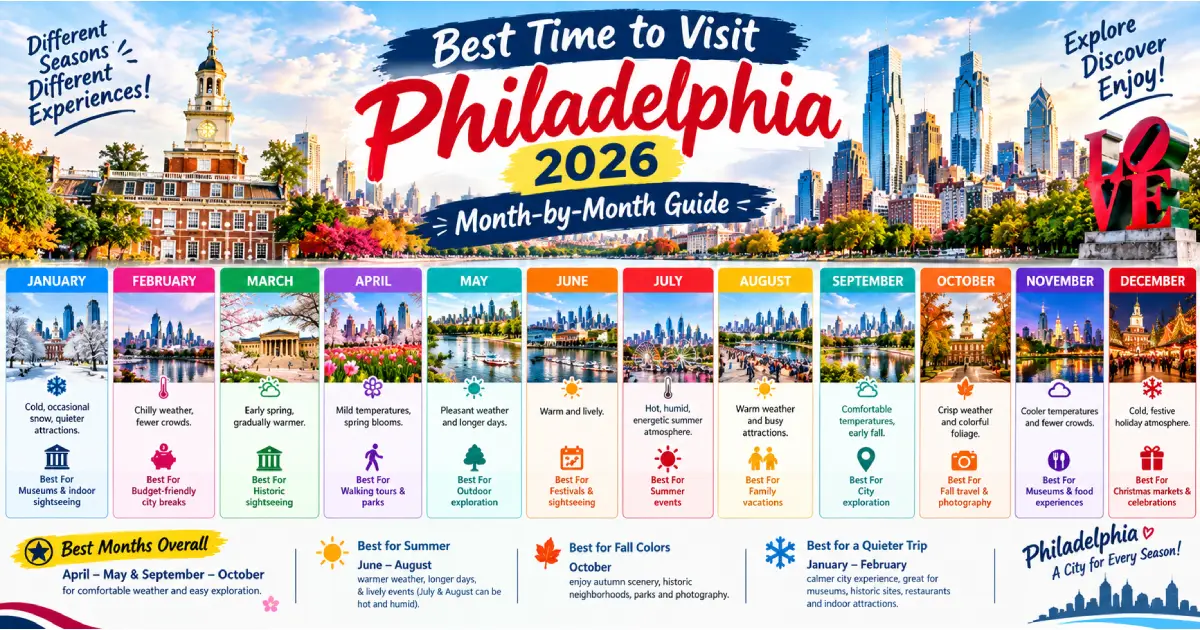
The most broadly honest answer to “when is the best time to visit Philadelphia?”: April through June and September through November, when the temperatures are comfortable for the outdoor-activity-heavy Philadelphia visit that the historic district walking, the Reading Terminal Market neighborhood, and the Italian Market specifically reward, and when the specific Philadelphia event calendar (the Philadelphia Flower Show in March, the Philadelphia Orchestra season from September through May, the specific Mummers Parade on January 1, and the various neighborhood festivals concentrated in the spring and fall months) provides the most Philadelphia-specific annual programming. The most specifically pragmatic addition: late September and October are the single most underrated Philadelphia visiting window in the American travel community — the summer crowds at Independence Hall dramatically reduced, the hotel rates below the summer and spring peaks, the temperatures in the most outdoor-comfortable range, and the specific fall character of Fairmount Park and Wissahickon Valley Park providing the most beautiful single Philadelphia seasonal landscape available.
For complete Philadelphia planning, see our Things to Do in Philadelphia 2026, Places to Visit in Philadelphia 2026, Best Restaurants in Philadelphia 2026, and Philadelphia Travel Guide 2026.
| Month | Avg High/Low | Humidity | Crowds | Hotel Rates | Best For |
|---|---|---|---|---|---|
| January | 40°F/24°F (4°C/-4°C) | Low | Lowest | Lowest | Mummers Parade (Jan 1); budget visits |
| February | 43°F/26°F (6°C/-3°C) | Low | Low | Low | Budget; Philadelphia Flower Show prep |
| March | 53°F/34°F (12°C/1°C) | Low–Medium | Low–Medium | Low–Medium | Philadelphia Flower Show |
| April | 64°F/43°F (18°C/6°C) | Medium | Medium | Medium | Best spring month overall |
| May | 74°F/53°F (23°C/12°C) | Medium | Medium–High | Medium–High | Very good; Cherry Blossom peak |
| June | 83°F/63°F (28°C/17°C) | Medium–High | High | High | Warm; outdoor festivals begin |
| July | 86°F/68°F (30°C/20°C) | High | Highest | Highest | Avoid; most challenging month |
| August | 84°F/66°F (29°C/19°C) | High | High | High | Hot; late August improving |
| September | 77°F/58°F (25°C/14°C) | Medium | Medium | Medium | Excellent; most underrated month |
| October | 65°F/46°F (18°C/8°C) | Low–Medium | Medium | Medium | Best fall month; foliage |
| November | 54°F/37°F (12°C/3°C) | Low | Low–Medium | Low–Medium | Good; quieter; Thanksgiving spike |
| December | 44°F/29°F (7°C/-2°C) | Low | Low–Medium | Medium (holidays) | Holiday atmosphere; Christmas Village |
Philadelphia’s two shoulder seasons provide the most comprehensively rewarding visitor experience — the spring (April–May) and fall (September–October) windows combining comfortable temperatures for the walking-heavy Philadelphia itinerary (the Independence Hall walk, the Italian Market, the BeltLine-equivalent Fairmount Park cycling, and the Fishtown evening restaurant circuit all most specifically rewarding in the 55–75°F/13–24°C temperature range that both shoulder seasons provide), the lowest Independence Hall crowd levels relative to the summer peak (the summer [June–August] produces the longest Independence Hall timed-entry queues and the most fully-booked recreation.gov calendar — the shoulder season windows providing meaningfully more available timed-entry slots), and the most specifically Philadelphia-character seasonal landscapes (the April cherry blossoms on the Benjamin Franklin Parkway, the October foliage in Fairmount Park and Wissahickon Valley).
The single most specifically undervalued Philadelphia visiting window in the national travel community — the specific late September–October combination (the summer crowds at Independence Hall, Reading Terminal Market, and the Liberty Bell Center all dramatically reduced [September visitor volumes are typically 30–40% below July–August at the Independence NHP sites], the hotel rates dropping below the summer peak [typically 15–25% lower than July–August], and the specific October Philadelphia landscape [the Wissahickon Valley fall foliage, the Fairmount Park color, and the specific East Coast autumn that the Mid-Atlantic’s deciduous tree canopy produces]) creates the most value-optimized and most atmosphere-rich single Philadelphia visiting window.
The lowest hotel rates of the Philadelphia year (the post-holiday demand reduction creating the most favorable supply-to-demand hotel pricing, typically 30–45% below the July–August peak) combined with manageable temperatures (the 40–43°F/4–6°C range requiring a genuine winter coat but falling well short of the genuinely cold conditions that January produces in Boston or Chicago) and the most uncrowded single Independence Hall, Liberty Bell, and Philadelphia Museum of Art visitor volumes make January and February the most cost-optimized Philadelphia visits for the budget-conscious traveler who can accept winter conditions.
The July combination (the 86°F/30°C heat, the high humidity, the maximum Independence National Historical Park crowd volumes, and the highest single Philadelphia hotel prices of the year) creates the most consistently challenging single Philadelphia visiting month — the specific Independence Hall timed-entry tickets booking out weeks ahead during July, the Reading Terminal Market most crowded at midday when the heat drives visitors indoors, and the outdoor Italian Market at its most uncomfortable heat-wise during the peak afternoon hours all contributing to the most specifically demanding single Philadelphia visitor month.
Average high: 40°F (4°C) | Average low: 24°F (-4°C) | Snow: 2–5 inches average | Crowds: Lowest | Hotel rates: Lowest | Key event: Mummers Parade (January 1)
January is Philadelphia’s most specifically local and most specifically culturally distinctive single month — the combination of the lowest tourist volumes of the year, the most affordable hotel rates, and the singular Philadelphia cultural event of the Mummers Parade (January 1 on Broad Street — the most specifically Philadelphia single annual event, the 10,000+ costumed Mummers [the String Bands, the Comics, the Fancy Clubs, and the Fancy Brigades in the most elaborately feathered, sequined, and bejeweled single American parade costumes] marching and performing down Broad Street in the most completely self-generated single American street celebration that has no equivalent in any other American city) creating the most specifically Philadelphia-identity single January experience.
The Mummers Parade (January 1, 2026): The most specifically Philadelphia annual event — the Mummers Parade has been held continuously since 1901 (the specific parade tradition dating in informal form from the 17th century, the formal annual January 1 parade established at the turn of the 20th century) and represents the most comprehensively community-generated single American annual street performance: the String Bands (the costumed marching string bands whose specific banjo, accordion, and saxophone instrumentation is the most specifically Mummers-identity single musical sound — the “Oh Dem Golden Slippers” [the most specifically Mummers-associated single song, the post-Civil War minstrel song that became the Mummers’ unofficial anthem and is played by virtually every String Band in every parade] audible throughout the Broad Street parade route from sunrise to mid-afternoon), the Comics (the humorous performance brigades whose specific South Philadelphia rowhouse-community humor and the elaborate costumes [the most dramatically oversized single Mummers costume category — the Comics’ specific tradition of the most physically massive single costume elements] create the most specifically working-class-Philadelphia single parade tradition), and the Fancy Brigades (the indoor theatrical performance groups whose specific Convention Hall [the Philadelphia Convention Center’s backstage use during Mummers weekend] performance represents the most technically elaborate single Mummers production — the large-scale theatrical sets, the choreographed performances, and the specific Fancy Brigade elaborateness making the indoor competition the most specifically spectacular single Mummers event).
The Mummers viewing strategy: The most specifically recommended single Mummers viewing position — the Broad Street between City Hall and Washington Avenue provides the most continuous parade coverage, the City Hall area (the northern end of the parade route) providing the most compressed and most specifically photographable single parade viewing while the Washington Avenue area (the southern end) provides the most specific String Band performance proximity. Arriving by 9 AM provides the most uncrowded single viewing position; the parade typically runs from approximately 9 AM through 4 PM with continuous performances along the route.
January weather considerations: The specific Philadelphia January (the 40°F/4°C average high with genuine 24°F/-4°C overnight lows and the occasional snow event [the Philadelphia area averages 2–5 inches of January snowfall]) requires the most specifically winter-prepared clothing of any month — the heavy coat, the warm layers, the waterproof boots, and the specific Mummers Parade preparation (the standing-in-the-cold for potentially 4–5 hours requiring the most warmly-dressed single Philadelphia outdoor event preparation).
Who should visit in January: The Mummers Parade is worth a January Philadelphia visit for the right visitor — the most specifically Philadelphia-identity single annual cultural event, the most community-generated single American parade, and the most specifically memorable single January experience available at any American major city. Budget travelers who can accept the winter conditions find January Philadelphia’s most cost-effective single visiting month.
Average high: 43°F (6°C) | Average low: 26°F (-3°C) | Snow: 3–5 inches average | Crowds: Low | Hotel rates: Low | Key event: Philadelphia Flower Show preparation (early March show)
February is Philadelphia’s quietest and most cost-effective single visiting month after January — the specific February character (the winter conditions persisting [the 43°F/6°C average high requires a warm coat throughout], the snow events statistically more likely than January [Philadelphia’s snowiest single month is typically February with an average of 3–5 inches], and the tourist volume at its annual minimum creating the most uncrowded single Liberty Bell, Independence Hall, and Philadelphia Museum of Art visitor conditions of the year) combined with the significantly reduced hotel pricing (typically 30–40% below the summer peak) provides the most cost-optimized single Philadelphia museum and historic site experience.
The Philadelphia Museum of Art in February: The most specifically rewarding single February Philadelphia indoor activity — the PMA in February provides the most uncrowded single encounter with the collection (the summer July visitor volumes at the Rocky Steps area contrasted with the February February conditions [the steps themselves potentially snow-dusted, the Thinker at the Rodin Museum across the Parkway visible through the bare winter tree canopy in the way the summer foliage prevents] creating the most specifically seasonal PMA exterior experience), the Friday evening extended hours (the PMA open until 8:45 PM on Fridays providing the most specifically art-and-evening-Philadelphia single winter activity), and the specific Barnes Foundation (the Barnes in February — the most specifically intimate single Barnes experience, the collection without the summer visitor density creating the most specifically contemplative single Barnes encounter with the Renoir and Cézanne ensemble arrangements).
Who should visit in February: Budget travelers, museum enthusiasts who want the most uncrowded single collection encounter, and visitors who are specifically comfortable with winter conditions and want the maximum single hotel value for a Philadelphia museum-and-history visit.
Average high: 53°F (12°C) | Average low: 34°F (1°C) | Rain: 3.7 inches | Crowds: Low–Medium | Hotel rates: Low–Medium | Key event: Philadelphia Flower Show (typically early-to-mid March)
March is the most specifically event-driven single Philadelphia month — the Philadelphia Flower Show (the annual show at the Pennsylvania Convention Center, the most attended single indoor flower show in the world, the specific Philadelphia Flower Show [established 1829 by the Pennsylvania Horticultural Society, making it the oldest single continuously-operated horticultural show in the United States] providing the most dramatically floral single Philadelphia indoor event) transforming the Pennsylvania Convention Center’s massive exhibition hall into the most comprehensively designed single floral environment available at any American indoor event.
Philadelphia Flower Show 2026 (check phsonline.org for exact dates — typically the first or second week of March): The most specifically extraordinary single Philadelphia annual indoor event — the specific Philadelphia Flower Show character (the Pennsylvania Horticultural Society’s annual theme [a different design concept each year, the 2026 theme available at phsonline.org from November 2025] applied to the most comprehensively designed single exhibition hall floral installation in the world: the full-size trees in bloom, the constructed garden environments, the specific competition gardens [the most technically demanding single competitive horticultural displays in any American show], and the specific floral design competitions [the cut flower arrangements, the botanical art, and the various other competitive categories that make the Philadelphia Flower Show the most specifically competitive single American horticultural exhibition]) creating the most dramatically beautiful single indoor event available in Philadelphia.
The Flower Show practical planning: Tickets ($40 general admission — check phsonline.org for 2026 pricing) sell out for the most popular single Flower Show days (the first weekend is typically the most attended single Flower Show period); weekday visits (Tuesday–Thursday mornings) provide the most uncrowded single Flower Show experience. The Convention Center location (12th and Arch Streets — directly across Arch Street from the Reading Terminal Market) makes the Flower Show the most naturally combined single day with the Reading Terminal Market lunch.
The March weather transition: The specific Philadelphia March (the 53°F/12°C average high with 34°F/1°C overnight lows and the specific weather variability [the late-winter nor’easters that can deposit 6–12 inches of snow in March, the warm-spell days that reach 65°F/18°C, and the specific “lion-to-lamb” variability that makes March Philadelphia the most specifically weather-variable single visiting month]) requires the most specifically layered packing of any Philadelphia month — the winter coat for the mornings and evenings, the lighter layer for the warm-spell afternoons, and the waterproof boot for the specific March rain-and-melting-snow mix that the Philadelphia streets produce most specifically in this month.
Who should visit in March: Philadelphia Flower Show enthusiasts (the most specifically nationally-attended single Philadelphia March event), budget travelers who want the warming-but-affordable transition pricing, and visitors whose schedules specifically allow the most uncrowded single historic site visiting before the spring tourist season builds in April.
Average high: 64°F (18°C) | Average low: 43°F (6°C) | Rain: 3.5 inches | Crowds: Medium | Hotel rates: Medium | Key events: Cherry blossoms (Parkway); Azalea Garden (Fairmount); Spring Garden tour season
April is Philadelphia at its most specifically beautiful and most specifically rewarding — the specific combination of the ideal outdoor temperatures (64°F/18°C average high in the most comfortable range for the walking-heavy Philadelphia itinerary, the cool mornings [43°F/6°C] warming through the day to the ideal afternoon range without the summer humidity), the spring bloom (the cherry blossoms on the Benjamin Franklin Parkway [the specific Japanese cherry trees planted along the Parkway in the 2000s, their specific mid-to-late April bloom creating the most dramatic single seasonal transformation of the Parkway’s most-photographed axis], the Azalea Garden in West Fairmount Park [the 3.5-acre historic garden whose thousands of azalea plants bloom simultaneously in the most specifically dramatic single Philadelphia springtime landscape event, the typical peak occurring in the third and fourth weeks of April], and the dogwood bloom in Wissahickon Valley Park [the native Cornus florida trees in the hemlock forest creating the most specifically naturalistic single Philadelphia spring bloom]), and the most specifically welcoming spring cultural programming (the Philadelphia Orchestra season at full programming, the outdoor dining patios re-opening, and the Independence National Historical Park visitor volumes at the most specifically manageable pre-summer single level).
The Azalea Garden (West Fairmount Park): The most specifically dramatic single Philadelphia spring landscape event — the Fairmount Park Azalea Garden (the 3.5-acre historic garden adjacent to the Philadelphia Museum of Art in West Fairmount Park, the thousands of azalea plants [the American, Kurume, and Glenn Dale azalea varieties] simultaneously blooming in the most comprehensively colorful single Philadelphia spring landscape display) provides the most specifically dramatic single Philadelphia annual spring photograph opportunity. The specific Azalea Garden bloom timing (typically the third and fourth weeks of April, variable by year’s winter temperature — check the Philadelphia Department of Parks and Recreation for 2026 specific bloom updates) aligns with the PMA visit to create the most naturally combined single April Philadelphia cultural-and-botanical day.
The Benjamin Franklin Parkway cherry blossoms: The most photographically celebrated single Philadelphia spring event — the Japanese cherry trees along the Benjamin Franklin Parkway (planted in the 2000s as part of the Parkway’s landscape renovation, the specific trees lining both sides of the Parkway from Logan Circle to the PMA in the most Philadelphia-specific single cherry blossom alignment) bloom simultaneously in mid-to-late April creating the most specifically dramatic single Philadelphia boulevard transformation: the pink blossom canopy visible from City Hall (1 mile to the east) providing the most specifically romantic single Philadelphia Parkway view of the year.
Who should visit in April: The most broadly recommended single Philadelphia spring month — the excellent temperatures, the spring bloom, the manageable Independence Hall crowds, and the outdoor dining season opening together make April the most well-rounded single Philadelphia visiting month.
Average high: 74°F (23°C) | Average low: 53°F (12°C) | Rain: 3.6 inches | Crowds: Medium–High | Hotel rates: Medium–High | Key events: Philadelphia International Children’s Festival; outdoor festival season opening
May is Philadelphia’s last consistently comfortable pre-summer month — the 74°F/23°C average high is warm but still far from the summer’s humidity-amplified discomfort, the outdoor dining culture at its most specifically active (the Italian Market most specifically rewarding in May’s pleasant temperatures, the Reading Terminal Market’s outdoor tables most used), and the specific Philadelphia May calendar (the Philadelphia International Children’s Festival at the Annenberg Center [check annenbergcenter.org for 2026 dates], the various neighborhood outdoor festivals beginning, and the specific Rittenhouse Square outdoor cultural programming starting) providing the most festival-adjacent single pre-summer Philadelphia month.
Memorial Day weekend: The specific Memorial Day weekend (May 23–26, 2026) creates Philadelphia’s first significant summer-demand hotel spike — the holiday weekend bringing the first major tourist concentration of the warm season, the specific hotel rate increase (15–25% above the surrounding weeks) and the significantly increased Independence Hall timed-entry demand (the Memorial Day weekend being one of the most specifically patriotic-destination-motivated single Philadelphia visitor weekends, the specific concentration of American history tourists on the most specifically patriotic single American holiday weekend) creating the most specifically pre-book-required single Philadelphia spring weekend.
Who should visit in May: Visitors who want the last comfortable outdoor month before the summer humidity establishes, families with children for whom the Children’s Festival programming is specifically appealing, and travelers who want the full outdoor Philadelphia experience at below-summer-peak pricing.
Average high: 83°F (28°C) | Average low: 63°F (17°C) | Rain: 3.7 inches | Crowds: Medium–High | Hotel rates: Medium–High | Key event: Outdoor festival season in full swing
June marks the transition to Philadelphia’s summer character — the temperatures reaching the low-to-mid 80s°F/28°C range, the humidity beginning to establish its summer levels (the specific Philadelphia summer humidity [the Mid-Atlantic position between the continental interior and the Atlantic coast creating a specific humidity that is more pronounced than Boston’s and less oppressive than Atlanta’s but genuinely significant in its impact on outdoor activity comfort]), and the outdoor festival season at its most active (the various neighborhood festivals, the Penn’s Landing waterfront programming, and the specific June outdoor concert calendar creating the most event-dense single pre-summer-peak Philadelphia month).
The Wissahickon Valley in June: The most specifically rewarding single Philadelphia June outdoor experience — the Wissahickon Valley Park in June (the specific woodland creek-gorge environment providing the most specifically temperature-moderated single Philadelphia outdoor activity, the hemlock canopy’s specific shade reducing the felt temperature by 8–12°F relative to the exposed city streets, and the creek-side trail moisture providing the specific natural cooling that makes the Wissahickon the most specifically comfortable single Philadelphia outdoor space in warm-weather months).
Who should visit in June: Visitors whose schedules are constrained to the early summer and who specifically plan the morning-outdoor/midday-indoor strategy (the mornings outdoors at Independence Hall and the Italian Market, the midday at Reading Terminal Market, the Barnes, or the Philadelphia Museum of Art, and the evening return to outdoor dining on East Passyunk or in Fishtown providing the most specifically enjoyable June Philadelphia day structure).
Average high: 86°F (30°C) | Average low: 68°F (20°C) | Rain: 3.9 inches | Crowds: Highest | Hotel rates: Highest | Overall rating: Most challenging visiting month
July is Philadelphia’s most specifically demanding single visiting month — the combination of the 86°F/30°C heat (with humidity creating heat indices of 95–100°F/35–38°C during peak afternoon hours), the maximum Independence National Historical Park crowd volumes (the summer school vacation bringing the most specifically family-travel-motivated patriotic destination visitors to the Liberty Bell and Independence Hall, the specific July Fourth holiday [July 4 — the most singularly appropriate single date to visit Philadelphia for American history-motivated visitors] creating the most dramatically patriotic single Philadelphia annual event alongside the most significantly crowded single Philadelphia annual day), and the highest hotel rates of the year.
The July 4th Exception: The specific July 4th in Philadelphia (Independence Day at the most specifically appropriate single American city — the specific 1776 Declaration of Independence signed 2.5 blocks from the current Liberty Bell Center, the most specifically historically-resonant single American Independence Day location) creates the most dramatically patriotic single American city experience: the specific July 4th programming (the Welcome America festival’s July 4th concert and fireworks [the Penn’s Landing concert with the most dramatically Delaware River-framed fireworks finale creating the most specifically Philadelphia-waterfront single Independence Day experience], the specific historic site programming [the Independence National Historical Park’s July 4th programming — the ranger-led tours of Independence Hall, the dramatic readings of the Declaration, and the specific Liberty Bell anniversary programming providing the most historically-immersive single July 4th American experience]), the parade (the specific July 4th parade down Benjamin Franklin Parkway creating the most specifically Independence-Day-appropriate single American parade outside of Washington DC), and the overall city character (the specific feeling of Philadelphia on July 4th — the most specifically historically-appropriate single American city for the most historically significant single American annual holiday — that no other American city can replicate).
The July management strategy:
Who should visit in July: July Fourth specifically is worth the specific July challenges for American history enthusiasts — no other American city provides the specific July 4th experience that Philadelphia does, and the specific programming makes it the most appropriate single American July 4th destination. Other July visitors should understand the conditions thoroughly and plan accordingly.
Average high: 84°F (29°C) | Average low: 66°F (19°C) | Rain: 3.6 inches | Crowds: High (declining in late August) | Hotel rates: High (declining in late August)
August follows July’s heat and crowd pattern while providing the specific late-August improvement (the school year resumption in mid-to-late August removing the family-vacation demographic that drives the summer visitor volumes, the specific late-August Independence Hall timed-entry availability improving relative to July’s fully-booked conditions, and the hotel rates beginning their end-of-summer decline) that makes late August meaningfully better than July despite equivalent thermometer readings.
The late-August transition: The specific August 20–31 window (the most dramatically crowd-improved single August Philadelphia period relative to the preceding weeks) provides meaningfully improved Independence Hall ticket availability, meaningfully reduced Liberty Bell Center queues, and the first hotel rate declines of the post-summer transition — making late August the most specifically value-improving single Philadelphia summer window.
Who should visit in August: Visitors whose schedules require the summer window and who have the flexibility to choose late August over July or early August, and travelers who specifically plan the indoor-activity-focused Philadelphia visit (the museum-heavy itinerary with the Barnes, the PMA, the Penn Museum, the Mütter, and the Reading Terminal Market providing the most air-conditioned-focused single Philadelphia summer visit structure).
Average high: 77°F (25°C) | Average low: 58°F (14°C) | Rain: 3.5 inches | Crowds: Medium (declining) | Hotel rates: Medium | Overall rating: Most underrated single Philadelphia visiting month
September is the single most underrated Philadelphia visiting month in the American travel community — the specific combination of the dramatically improved Independence Hall and historic district crowd levels (the summer peak visitor volumes declining 30–40% from July–August as the school-year resumption removes the family-vacation demographic), the hotel rates dropping below the summer peak (typically 15–25% lower than July–August while the weather and outdoor conditions remain excellent), and the specific Philadelphia September character (the outdoor dining scene still fully active, the Wissahickon Valley Park at its most specifically lush before the autumn color, and the specific Philadelphia cultural season [the Philadelphia Orchestra season opening, the various fall cultural programming beginning, and the specific September energy of a university city [the University of Pennsylvania, Temple University, Drexel University, and the various other Philadelphia colleges returning their student populations creating the most specifically urban-energy single September city moment]).
The September Independence Hall experience: The most specifically rewarding single comparison with the summer — the September visitor who books a September Tuesday or Wednesday morning Independence Hall tour typically encounters:
The September East Passyunk dining: The most specifically rewarding single September Philadelphia evening — the East Passyunk Avenue restaurant corridor in September (the outdoor dining season still fully operational, the specific September evening temperatures [the low-60s°F/16°C evenings ideal for outdoor dining without the summer heat or the autumn chill], and the restaurant reservations meaningfully more available than the summer peak) provides the most specifically accessible single Philadelphia fine-dining evening of the year.
Who should visit in September: The most broadly recommended single Philadelphia month for the maximum value-to-experience ratio — the combination of excellent weather, dramatically reduced Independence NHP crowds, below-summer-peak hotel rates, and the full Philadelphia cultural season makes September the most specifically recommended single “underrated Philadelphia” visiting month.
Average high: 65°F (18°C) | Average low: 46°F (8°C) | Rain: 3.3 inches | Crowds: Medium | Hotel rates: Medium | Key events: Halloween attractions (Eastern State Penitentiary); fall foliage
October is Philadelphia’s most specifically beautiful fall month and the most comprehensively recommended single fall visiting window — the ideal outdoor temperatures (65°F/18°C average high in the most comfortable walking range), the fall foliage (the Wissahickon Valley Park’s specific hemlock-and-oak forest canopy transitioning in the second and third weeks of October, the Fairmount Park’s deciduous trees providing the most continuously-accessible single Philadelphia fall color landscape, and the specific October light [the lower sun angle creating the most specifically warm and directional single outdoor light quality of any Philadelphia month] creating the most photogenic single Philadelphia outdoor conditions of the year), and the Eastern State Penitentiary’s Terror Behind the Walls event.
Eastern State Penitentiary — Terror Behind the Walls: The annual Halloween haunted attraction at Eastern State Penitentiary (typically September 18 through November 1 — check easternstate.org for exact 2026 dates and ticket prices) is the most specifically nationally-acclaimed single American Halloween haunted attraction: the specific Terror Behind the Walls character (the authentically Gothic 1829 prison building [the 30-foot stone walls, the radiating cellblocks in varying states of dramatic decay, and the specific architectural scale of the Eastern State Penitentiary creating the most genuinely atmospheric single American haunted attraction environment — the building itself provides more genuine Gothic atmosphere than any constructed haunted house could fabricate], the professional theatrical production [the specific Terror Behind the Walls production quality [the custom actor performances, the sophisticated lighting and sound design, and the specific scare programming that Eastern State has refined over 30+ years of Halloween operations creating the most consistently terrifying single American Halloween attraction by multiple national rankings], and the specific Philadelphia tradition [Terror Behind the Walls is the most beloved single Philadelphia October event by resident community consensus, the annual Eastern State Halloween visit being a specific Philadelphia October ritual for the most dedicated local fans].
Tickets: $30–$45 (day-dependent, evening-dependent — check easternstate.org for 2026 specific pricing); sell out for the most popular October weekends 4–6 weeks ahead; the most reliably available tickets are the September dates (the opening weeks before the maximum Halloween demand) and the late-October Sunday nights.
The October Wissahickon: The most specifically breathtaking single October Philadelphia outdoor experience — the Wissahickon Valley Park’s Forbidden Drive in October (the specific fall foliage visible in the gorge walls, the creek reflecting the orange-and-yellow canopy overhead, and the specific October light filtering through the colored leaves creating the most dramatically beautiful single Philadelphia trail moment of the year) provides the most specifically natural and most specifically Philadelphia-character single October outdoor activity.
Who should visit in October: The most broadly recommended single fall month for Philadelphia — the fall foliage, the Terror Behind the Walls, the ideal walking temperatures, and the sub-summer hotel rates together make October the most specifically well-rounded single Philadelphia fall visit.
Average high: 54°F (12°C) | Average low: 37°F (3°C) | Rain: 3.4 inches | Crowds: Low–Medium | Hotel rates: Low–Medium | Key events: Thanksgiving (hotel spike); Philadelphia Craft Beer Festival
November provides Philadelphia’s most specifically peaceful single fall month — the October crowds having dissipated, the hotel rates dropping to their most affordable fall-season pricing, and the temperatures (54°F/12°C average high requiring a medium-weight coat but not the heavy winter gear that December through February demand) remaining comfortable for the historic site walking and the neighborhood restaurant experiences that define the most rewarding Philadelphia visit.
The Thanksgiving spike: The specific Thanksgiving holiday (November 26, 2026) creates a concentrated 5-day hotel demand event (the Wednesday before through the Sunday after Thanksgiving) that reverses the otherwise-quiet November pricing — the Philadelphia Thanksgiving (the Thanksgiving Day Parade [the 6 AM–10 AM Thanksgiving morning parade on Benjamin Franklin Parkway, one of the oldest single continuously-operating Thanksgiving parades in the United States, the specific parade route from 20th Street to City Hall providing the most specifically Philadelphia single Thanksgiving morning outdoor event]) being a specific November Philadelphia travel motivator that drives the Thanksgiving week hotel premium.
The Philadelphia Craft Beer Festival (typically November — check visitphilly.com for 2026 dates): The annual Philadelphia craft beer celebration providing the most comprehensively Pennsylvania-craft-beer-focused single Philadelphia November event — the specific Pennsylvania brewery concentration (the state’s specific craft beer industry [one of the most active single state craft beer industries in the US East] represented by the most comprehensively Pennsylvania-focused single annual craft beer event) alongside the broader Mid-Atlantic and national brewery participation.
Who should visit in November: Visitors who want October’s conditions at slightly lower prices (outside the Thanksgiving week), Thanksgiving parade attendees, and budget travelers who want the most affordable single fall-or-winter Philadelphia visit with acceptable outdoor conditions.
Average high: 44°F (7°C) | Average low: 29°F (-2°C) | Snow: 2–4 inches | Crowds: Low–Medium (increasing holidays) | Hotel rates: Medium (increasing holidays) | Key events: Christmas Village at City Hall; Philadelphia Nutcracker; holiday programming
December provides Philadelphia’s most specifically holiday-atmospheric single month — the Christmas Village (the annual German-style Christkindlmarkt at City Hall plaza, typically running from mid-November through December 26 [check philachristmas.com for 2026 specific dates], the most comprehensively European-character single American Christmas market, the specific Philadelphia Christmas Village [the stalls selling the glühwein, the German ornaments, the roasted nuts, and the specific artisan holiday goods in the most specifically authentic American approximation of the German Weihnachtsmarkt tradition] creating the most specifically holiday-atmospheric single Philadelphia December outdoor experience), the Philadelphia Orchestra holiday programming (the most specifically classical-music-holiday single Philadelphia December entertainment, the Kimmel Center for the Performing Arts’ specific December programming [the Nutcracker, the holiday concerts, and the specific Philadelphia Orchestra seasonal performances] providing the most specifically elegant single December Philadelphia evening), and the specific Independence Mall holiday character (the Liberty Bell and Independence Hall in their winter condition [the potential light snow on the historic buildings, the early-sunset creating the most dramatically illuminated single Independence Mall evening] providing the most specifically cinematic single Philadelphia December historic site visit).
Who should visit in December: Holiday-atmosphere travelers who want the Christmas Village and the Philadelphia Orchestra holiday programming, visitors who want the winter historic site character (the potentially snow-dusted Independence Hall being the most specifically cinematic single Philadelphia winter image), and travelers who want the Philadelphia cultural season (the Orchestra, the theater, and the museum programming all at full December operation).
| Event | Month | Type | Cost |
|---|---|---|---|
| Mummers Parade | January 1 | Cultural parade | Free |
| Philadelphia Flower Show | Early March | Horticultural | ~$40 |
| Azalea Garden peak | Late April | Nature | Free |
| Cherry Blossom Parkway | Mid-to-late April | Nature | Free |
| Philadelphia International Children’s Festival | May | Family/Theater | $15–$35 |
| Penn Relays | Late April | Track and field | $10–$30 |
| Wawa Welcome America (July 4) | July 4 | Patriotic festival | Free |
| Old City First Friday | Monthly (year-round) | Art galleries | Free |
| Terror Behind the Walls | Sept–Nov | Halloween | $30–$45 |
| MADE in America Festival | Labor Day weekend | Music | $100–$150 |
| Philadelphia Film Festival | October | Film | $15–$20 |
| Philadelphia Craft Beer Festival | November | Beer | $40–$60 |
| Christmas Village | Mid-Nov–Dec 26 | Holiday market | Free entry |
| Philadelphia Orchestra (Holiday) | December | Classical | $35–$110 |
About Travel Tourister Travel Tourister’s destination specialists have visited Philadelphia in every season — from January 1 Mummers Parade 8 AM Broad Street String Band front-row positioning in 28°F wind chill and February Barnes Foundation weekday afternoon Renoir ensemble-arrangement contemplation sessions in the most uncrowded single Barnes visiting condition, through March Philadelphia Flower Show Tuesday morning opening-week pre-crowd Convention Center entry and April Benjamin Franklin Parkway cherry blossom peak-day 7 AM photography sessions before the morning commuters arrive, July 4th Independence Hall ranger-led Assembly Room tours with the Declaration-signing-desk in the specifically morning-light condition and the Liberty Bell timed-entry first-of-the-day slot, September East Passyunk Avenue Tuesday evening Laurel reservation secured with the most specifically available September calendar slot, October Eastern State Penitentiary Terror Behind the Walls Friday-night queue and Sunday-morning Wissahickon Forbidden Drive foliage-peak walk, and December Christmas Village City Hall glühwein in 35°F evening temperature with the Philadelphia Orchestra Nutcracker ticket for the 8 PM Kimmel Center performance — to deliver the most practically honest and most seasonally complete Philadelphia timing guide for every type of 2026 visitor.
Posted By : Vinay
Latest Article
2nd Floor, 39, Above Kirti Club, DLF Industrial Area, Kirti Nagar, New Delhi, Delhi 110015



Travel Tourister is a leading Travel portal where we introduce travellers to trusted travel agents to make their journey hasselfree, memorable And happy. Travel Tourister is a platform where travellers get Tour packages ,Hotel packages deals through trusted travel companies And hoteliers who are working with us across the world. We always try to find new and more travel agents and hoteliers from every nook and corners across the world so that you could compare the deals with different travel agents and hoteliers and book your tour or hotel with the one you have chosen according to your taste and budget.
Copyright © Travel Tourister, India. All Rights Reserved

 Call
Call Enquiry