Published on : 29 Sep 2026
By Travel Tourister | Updated Sep 2026
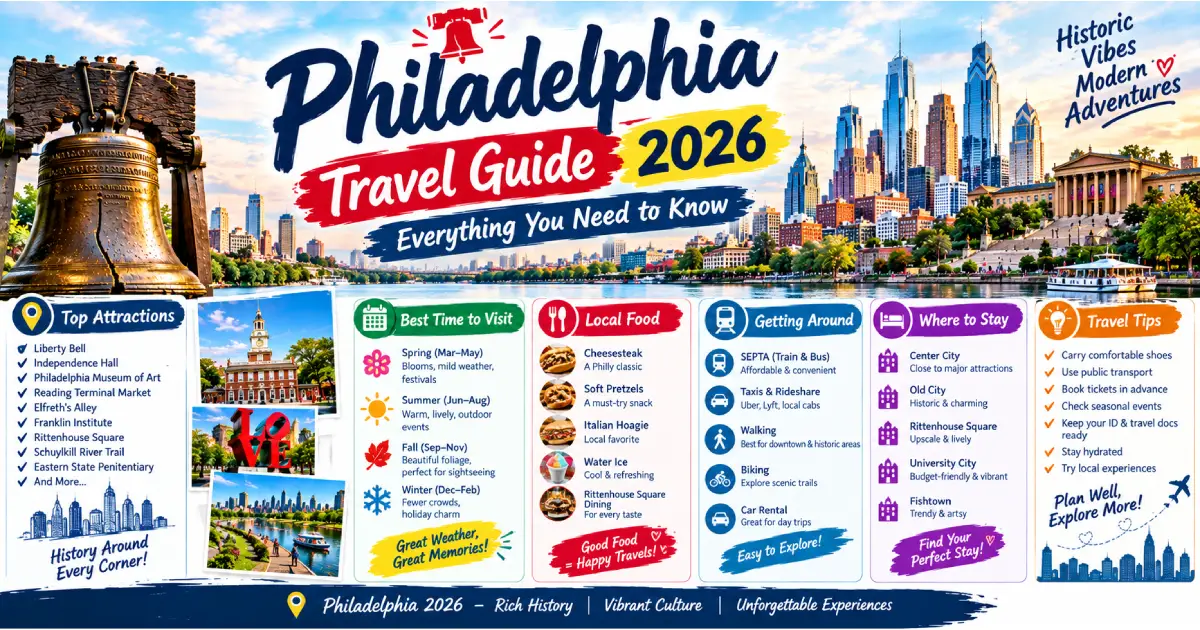
Philadelphia is the American city that most consistently undercharges for what it delivers — a place where the $2.50 SEPTA transit fare takes you from the most important building in American history (Independence Hall) to the most idiosyncratic great art collection on the continent (the Barnes Foundation) to the most vibrant indoor food market in the United States (Reading Terminal Market) within a single afternoon, where the free Liberty Bell requires no advance booking and the free National Constitution Center produces as much genuine civic emotion as the ticketed monuments in Washington DC, and where the cheesesteak debate (Pat’s vs. Geno’s vs. Jim’s vs. John’s Roast Pork) generates more genuine local passion than any comparable food controversy in any other American city. Philadelphia’s specific value proposition — the most historically significant urban landscape in America, available at the most accessible price point of any comparable American destination — remains the most consistently under-appreciated in the national travel conversation.
Planning a Philadelphia visit in 2026 requires understanding several things that the standard travel resources frequently underemphasize: the walkability (Philadelphia’s Center City is the most specifically walkable single American historic urban core after New York’s Manhattan — the 10-minute walk from the Liberty Bell to the Reading Terminal Market, the 20-minute walk from Independence Hall to the Barnes Foundation via the Benjamin Franklin Parkway, and the specific Old City neighborhood grid’s human scale creating the most naturally pedestrian single American patriotic tourism experience), the neighborhood diversity (the 20+ distinct Philadelphia neighborhoods from the Colonial Old City through the Victorian Rittenhouse Square through the working-class South Philadelphia Italian Market through the industrial-converted Fishtown and Northern Liberties creating a city whose specific neighborhood-to-neighborhood variation most specifically rewards the visitor who explores beyond the Independence Mall tourist zone), and the culinary depth (the Reading Terminal Market alone requires a full morning of appetite to do justice to — and the Italian Market, East Passyunk Avenue, the Fishtown restaurant corridor, and Buford Highway’s equivalent in the specific Philadelphia Vietnamese and Chinese communities of South Philadelphia and the Northeast each individually deserve a dedicated meal visit).
This complete Philadelphia Travel Guide for 2026 covers everything from getting there and getting around through neighborhood orientation, budget planning, the best seasons, transit within the city, and the specific insider knowledge that transforms a Philadelphia visit from a founding-era document-checking exercise into the most genuinely rewarding and most genuinely surprising major American East Coast city experience.
For specific activity, dining, and seasonal guidance, see our Things to Do in Philadelphia 2026, Places to Visit in Philadelphia 2026, and Best Time to Visit Philadelphia 2026.
| Category | Details |
|---|---|
| Nickname | The City of Brotherly Love; Philly; The Birthplace of America |
| Population | 1.6 million (city); 6.2 million (metro) |
| Founded | 1682 (William Penn’s charter) |
| State | Pennsylvania |
| Elevation | 39 feet (12 meters) above sea level |
| Airport | Philadelphia International Airport (PHL) — 7 miles southwest of Center City |
| Amtrak | 30th Street Station — the most visited single Amtrak station outside New York Penn Station |
| Time zone | Eastern Time (ET) — UTC-5 standard; UTC-4 DST |
| Currency | US Dollar (USD) |
| Language | English (primary); Spanish widely spoken in South Philadelphia and North Philadelphia |
| Best neighborhoods | Old City, Rittenhouse Square, Fishtown, South Philadelphia, East Passyunk |
| Best season | April–May and September–October |
| Worst month | July (heat + crowds at historic sites) |
| Mid-range hotel | $150–$250/night |
| Car necessary? | No — Center City and Old City very walkable; SEPTA covers most attractions |
| Transit | SEPTA subway and bus; Market-Frankford El; frequent regional rail |
| Cheesesteak order | “Wiz Wit” = Cheez Whiz with onions; the essential single Philadelphia vocabulary item |
Airport code: PHL | Distance from Center City: 7 miles southwest | Drive time: 20–30 minutes (traffic-dependent) | Website: phl.org
Philadelphia International Airport (PHL) — the primary regional airport for the Philadelphia metro, serving approximately 32 million annual passengers with significant domestic coverage (American Airlines’ secondary hub, the most extensive single PHL carrier network, alongside Southwest, United, Delta, and the various other carriers providing comprehensive domestic coverage) and direct international service (London Heathrow via British Airways and American, Amsterdam via KLM, Cancún, Reykjavik via Icelandair, and the various other international routes that Philadelphia’s position as the most historically significant American city for European cultural tourism generates).
Getting from PHL to Center City:
SEPTA Airport Line (train — most recommended): The most cost-effective and most reliably time-consistent airport transfer — the SEPTA Regional Rail Airport Line running from all five PHL terminal stations (the inter-terminal connector tram providing free transport between terminals to the central station) to Center City’s Jefferson Station (10th and Filbert, 1 block from Reading Terminal Market) and 30th Street Station in 25–30 minutes. Cost: $8 one-way (Compass Card or cash). Frequency: every 30 minutes (peak hours), every hour (off-peak). The specific SEPTA Airport Line advantage: the most dramatically cost-effective single major US East Coast airport-to-city rail transfer (the $8 fare vs. the $35–$55 rideshare representing the most specifically budget-optimized single Philadelphia arrival decision), the reliability (the grade-separated rail providing the most traffic-immune single PHL transfer during the I-95 and I-76 rush-hour congestion that affects all road-based transfers), and the Jefferson Station arrival location (the Center City position placing the arriving visitor within a 5-minute walk of the Reading Terminal Market, a 10-minute walk of the Liberty Bell and Independence Hall, and a 15-minute walk of the Benjamin Franklin Parkway corridor).
Rideshare (Uber/Lyft): $25–$45 to Center City hotels in standard conditions; $40–$65 during surge pricing (the I-95 and I-76 corridor congestion creating the most specifically variable single PHL rideshare pricing of any major American airport given the highway-dependent routing). The rideshare pickup at PHL (the designated rideshare staging area accessible from the terminals via the inter-terminal connector) is clearly organized and typically provides 5–10 minute vehicle availability in standard conditions.
Taxi: $28–$40 fixed-rate estimate to Center City — the taxi stand at PHL’s baggage claim level provides the most consistent single non-surge-susceptible airport transfer for visitors who prefer the predictable fare to the rideshare variability.
Rental car: The PHL rental car center (the on-airport facility accessible via shuttle from the terminals) provides all major rental companies. The specific Philadelphia rental car consideration: Center City, Old City, and the Benjamin Franklin Parkway cultural corridor are the most specifically walkable areas, and SEPTA covers most major Philadelphia neighborhoods — a rental car is most specifically useful for day trips (the Brandywine Valley, Valley Forge, the Lancaster County Amish Country [the most specifically Philadelphia-adjacent single day trip, the Amish community 70 miles west]) rather than for the urban Philadelphia visit itself.
Station: 30th Street Station, 2955 Market St, University City | Amtrak service: Northeast Regional (Boston–New York–Philadelphia–Washington DC — the most frequently scheduled and most specifically Philadelphia-convenient single Amtrak route), Acela (the high-speed rail service on the same corridor — the most expensive but most specifically time-efficient single Northeast Corridor intercity option), and the various other Amtrak routes including the Crescent (to Atlanta and New Orleans) and the Cardinal (to Chicago via Indianapolis)
Philadelphia’s 30th Street Station (the 1933 Beaux-Arts station — the most architecturally magnificent single active American rail station after New York Penn Station [whose specific underground character makes 30th Street Station the most dramatically beautiful single above-ground active American rail station], the specific 30th Street Station character [the 95-foot coffered ceilings, the massive bronze angel war memorial at the main hall’s center, and the specific classical proportions that make the 30th Street Station the most specifically grand single Philadelphia building interior] providing the most dramatically arrival-appropriate single Philadelphia entry experience) is the most specifically recommended Philadelphia arrival mode for visitors from New York (the 1 hour 15 minutes by Acela, the 1 hour 30 minutes by Regional), Washington DC (the 1 hour 30 minutes by Acela, the 2 hours by Regional), and Boston (the 5 hours 30 minutes by Regional, the 4 hours 30 minutes by Acela).
The New York–Philadelphia train: The most specifically practical single American intercity train journey for the Philadelphia day trip or the multi-city East Coast itinerary — the specific Amtrak Regional frequency (the trains running every 30–60 minutes throughout the day between New York Penn Station and Philadelphia 30th Street) providing the most flexible single Philadelphia arrival and departure schedule of any American intercity rail corridor.
30th Street Station to Center City: The SEPTA Regional Rail from 30th Street Station to Jefferson Station (Center City) runs every 15–30 minutes and takes 5 minutes. Walking from 30th Street to the Rittenhouse Square area takes approximately 20 minutes across the Schuylkill River via the Market Street Bridge.
From New York City: I-95 South (New Jersey Turnpike); 1 hour 30 minutes (95 miles) — the single most traffic-variable drive to Philadelphia, the specific NJ Turnpike and the I-95 Philadelphia approach [the I-95 through South Philadelphia] creating the most specifically congestion-prone single Philadelphia highway approach during rush hours From Washington DC: I-95 North; 2 hours (140 miles) in normal traffic From Baltimore: I-95 North; 1 hour (100 miles) From Boston: I-95 South; 5 hours (300 miles) From Pittsburgh: I-76 East (Pennsylvania Turnpike); 5 hours (305 miles) From Atlantic City: AC Expressway West to I-676; 1 hour (60 miles)
The Philadelphia parking reality: The most specifically challenging single Philadelphia driving consideration is parking — the Center City parking garages ($20–$40/day) and the specific Old City street parking (the 2-hour metered parking on most Old City streets, the parking enforcement consistent and the fines specific to Philadelphia’s municipal budget priorities) create a parking landscape that most specifically rewards the visitor who arrives by train or uses SEPTA rather than driving into the historic core. The most specifically recommended parking strategy for driving visitors: the Philadelphia Parking Authority’s electronic ParkPHL app (providing real-time garage availability and advance rate reservations at the most cost-effective single Center City parking option), or the specific South Street garage (the most affordably-priced single Center City-adjacent parking facility for Italian Market and Headhouse Square-focused visits).
SEPTA (Southeastern Pennsylvania Transportation Authority) operates the most comprehensively covering single Philadelphia transit network — the specific SEPTA Philadelphia urban transit (the Market-Frankford Line [the east-west subway/elevated rail [the “El”] running from Upper Darby in the west to Frankford in the northeast, the most specifically visitor-relevant single SEPTA rail line [the specific stations: 30th Street, 34th Street/CHOP, 40th Street/Penn, 46th Street, 52nd Street, 60th Street, 69th Street in the west; Market Street/Old City, 2nd Street, 5th Street, 8th Street, Spring Garden, Girard, Berks, York-Dauphin, Huntingdon, Arrott Street to Frankford in the east] providing the most specifically comprehensive single Philadelphia east-west transit connection] and the Broad Street Line [the north-south subway running from Fern Rock in the north through City Hall/Center City to Pattison Avenue [the sports complex] in the south — the most specifically sports-event-transit single Philadelphia line, the Pattison station providing the most direct single SEPTA connection to Citizens Bank Park and Lincoln Financial Field]) providing the most geographically comprehensive single Philadelphia transit network.
The most visitor-relevant SEPTA stations:
| Station | Line | Nearby Attractions |
|---|---|---|
| 30th Street Station | Regional Rail/MFL | Amtrak arrival; University of Pennsylvania; Penn Museum |
| City Hall | Broad Street/MFL | Center City; LOVE Park; Broad Street corridor |
| 13th Street (MFL) | Market-Frankford | Reading Terminal Market (2 blocks north) |
| 5th Street (MFL) | Market-Frankford | Independence Hall (3 blocks south); Liberty Bell |
| 2nd Street (MFL) | Market-Frankford | Old City galleries; Elfreth’s Alley |
| Spring Garden (MFL) | Market-Frankford | Eastern State Penitentiary (10 min walk) |
| Girard (MFL) | Market-Frankford | Fishtown (northern boundary) |
| Pattison (BSL) | Broad Street | Citizens Bank Park; Lincoln Financial Field |
| Ellsworth-Federal (BSL) | Broad Street | Italian Market (10 min walk east) |
SEPTA fares (2026 approximate):
Philadelphia’s Center City grid (William Penn’s 1682 original plan — the most specifically and most rationally planned single American city grid, the five public squares [Rittenhouse, Logan, Franklin, Washington, and Penn — later renamed — Squares] placed symmetrically at the corners and center of the original city plan, the east-west numbered streets and the north-south named streets [Chestnut, Walnut, Locust, Spruce, Pine in the most specifically Philadelphia-identity single street name sequence] creating the most specifically legible single American historic city street grid) is the most walkable American city core outside of Manhattan: the specific Philadelphia distances (the Liberty Bell to Independence Hall: 3 minutes, the Independence Hall to Reading Terminal Market: 12 minutes, the Reading Terminal Market to the Barnes Foundation: 15 minutes, the Barnes Foundation to the Philadelphia Museum of Art: 10 minutes) making the single most historically and culturally rich American urban walking circuit completable in a single day without any transit.
The specific Philadelphia walking circuit: The most naturally structured single Philadelphia walk — Old City (Independence Hall, Liberty Bell, Elfreth’s Alley, Christ Church) → Reading Terminal Market (lunch) → Benjamin Franklin Parkway (the Barnes Foundation, the Rodin Museum, the Franklin Institute) → Philadelphia Museum of Art (Rocky Steps, collection) → Rittenhouse Square (dinner on Walnut Street) — covering the most comprehensive single Philadelphia cultural circuit in approximately 5 miles of walking.
Rideshare operates throughout Philadelphia with generally good availability:
Character: The most specifically Colonial-era and Federal-era American urban neighborhood; Independence National Historical Park; Elfreth’s Alley; First Friday art scene | Best for: American history enthusiasts, architecture lovers, the most specifically historic Philadelphia experience | Transit: SEPTA MFL to 5th Street or 2nd Street
Old City (the neighborhood bounded by the Delaware River to the east, 6th Street to the west, Vine Street to the north, and Walnut Street to the south — the most historically dense single American urban neighborhood, the specific Independence National Historical Park occupying approximately 20% of the neighborhood’s area while the surrounding streets [the surviving 18th- and early 19th-century commercial and residential buildings on Chestnut, Walnut, and 2nd Streets] provide the most specifically historical architectural context of any American city neighborhood) is the non-negotiable Philadelphia base for first-time visitors and the most specifically history-rewarding single Philadelphia neighborhood for any visitor regardless of the visit number.
The Old City evening character: The most specifically surprising single Old City quality for first-time visitors who expect a historic district to be primarily a daytime tourist zone — the specific Old City evening character (the First Friday art galleries filling from 5–9 PM on the first Friday of every month, the restaurants on 3rd and 4th Streets between Market and Chestnut providing the most specifically history-adjacent single fine dining in any American city, and the specific Old City evening atmosphere [the gaslamp-style lighting on the historic commercial streets, the occasional horse-drawn carriage tours through the historic district, and the specific overlay of contemporary social activity on the most specifically historical American urban street grid] creating the most dramatically contrasting single American neighborhood evening — the 18th-century architecture containing 21st-century restaurants and bars).
Character: The business and hotel core; Reading Terminal Market; City Hall; Rittenhouse Square; Philadelphia’s most walkable commercial district | Best for: Hotel bases for most visitor types; the most transit-connected single Philadelphia neighborhood | Transit: Most SEPTA lines converge at City Hall and Jefferson/Market Street
Center City (the neighborhood between the Delaware and Schuylkill Rivers, from South Street to Vine Street — the most comprehensively programmed single Philadelphia urban neighborhood, the specific Center City character [the Reading Terminal Market at 12th and Arch, the City Hall building [the most specifically architecturally ambitious single 19th-century American municipal building, the 548-foot tower [the tallest single Philadelphia building from its 1901 completion until 1987 and the most specifically ornate single Philadelphia building exterior — the 250 exterior sculptures including the specific William Penn statue at the tower’s apex whose specific “gentleman’s agreement” [the informal understanding among Philadelphia’s builders through the mid-20th century that no building would be taller than Penn’s hat brim on the City Hall tower] was violated in 1987 when One Liberty Place exceeded the Penn statue height], the Rittenhouse Square residential neighborhood, and the Benjamin Franklin Parkway cultural corridor) provides the most comprehensively urban single Philadelphia neighborhood base.
Character: The Italian Market; the cheesesteak establishments; Philadelphia’s Magic Gardens; East Passyunk Avenue’s restaurant corridor; the most specifically authentic working-class Philadelphia character | Best for: Food enthusiasts, the most authentic-Philadelphia single neighborhood experience, the Italian Market | Transit: SEPTA BSL to Ellsworth-Federal (Italian Market); rideshare to East Passyunk
South Philadelphia (the neighborhood south of South Street and Broad Street — the most specifically working-class and most specifically Italian-American single Philadelphia neighborhood [the specific South Philly character {the rowhome culture, the specific SEPTA Broad Street Line corridor, the Italian Market on 9th Street, the cheesesteak establishments at 9th and Passyunk, and the East Passyunk Avenue restaurant corridor} creating the most specifically authentic Philadelphia character available to the visitor who ventures beyond the Independence Mall tourist zone]) is the Philadelphia that the Independence Mall visitor most specifically misses and the Philadelphia that the food-motivated visitor most specifically seeks.
Character: Philadelphia’s most affluent and most European-feeling residential neighborhood; the most walkable upscale commercial district; Walnut Street restaurants | Best for: Upscale hotel base; fine dining; the most specifically European-character Philadelphia urban experience | Transit: SEPTA MFL to 15th Street; walking from Center City
Rittenhouse Square (the neighborhood surrounding the 1820 formal park — the most specifically European-character single Philadelphia neighborhood, the specific Rittenhouse Square character [the formal park, the surrounding high-rise residential buildings, and the Walnut Street restaurant corridor [the most restaurant-dense single Center City commercial street, the specific Walnut Street blocks between Broad and 18th providing the most comprehensive single Philadelphia fine-dining street concentration]) and the specific Rittenhouse hotel cluster (the Rittenhouse Hotel, the Sofitel, and the various other quality hotels in the immediate square vicinity providing the most specifically walkable-to-restaurants single Philadelphia hotel base) together provide the most specifically European-urban-residential single Philadelphia neighborhood experience.
Character: Philadelphia’s most dynamic current neighborhood; the most restaurant-and-bar-dense single Philadelphia corridor outside Center City; the most specifically Brooklyn-equivalent single Philadelphia neighborhood | Best for: Food and nightlife enthusiasts; the most specifically contemporary Philadelphia experience | Transit: SEPTA MFL to Girard (Fishtown) or Spring Garden (Northern Liberties)
Fishtown (the former fishing and industrial neighborhood north of Old City — the most specifically creative-class-transformed single Philadelphia neighborhood, the Frankford Avenue corridor [the most restaurant-and-bar-dense single Philadelphia outside-of-Center-City street] providing the most comprehensively food-and-nightlife single Philadelphia neighborhood experience outside of East Passyunk) and Northern Liberties (the adjacent neighborhood to Fishtown’s south — the second-wave-gentrification companion neighborhood, the 2nd Street corridor providing the most specifically Northern-Liberties-character single restaurant and bar experience) together constitute the most specifically contemporary and most specifically culturally-active single Philadelphia neighborhood cluster.
Character: University of Pennsylvania; Drexel University; Penn Museum; the most specifically academic single Philadelphia neighborhood | Best for: Penn Museum; the Reading Terminal Market-adjacent transit access; budget hotels | Transit: SEPTA MFL to 34th Street or 40th Street
University City (the neighborhood west of the Schuylkill River centered on the University of Pennsylvania campus — the most specifically academically-defined single Philadelphia neighborhood, the specific University City character [the Penn campus’s Georgian Revival buildings, the Penn Museum [the most comprehensively global single Philadelphia museum], and the specific restaurant and café culture that the Penn and Drexel student community generates along Baltimore Avenue and 40th Street]) provides the most specifically academic-Philadelphia single neighborhood experience and the most conveniently Penn-Museum-adjacent single hotel base.
| Type | Cost Per Night | Best Areas |
|---|---|---|
| Budget hostel (dorm) | $35–$60 | Old City; University City options |
| Budget hotel | $90–$140 | Near PHL Airport; University City |
| Mid-range hotel | $150–$250 | Center City; Old City; Rittenhouse |
| Boutique hotel | $180–$320 | Old City (AKA Hotel); Rittenhouse |
| Luxury hotel | $300–$600+ | Rittenhouse Hotel; Four Seasons |
| Vacation rental | $120–$280 | Fishtown; South Philadelphia; Old City |
| Category | Cost Per Person | Examples |
|---|---|---|
| Reading Terminal Market meal | $10–$20 | DiNic’s Roast Pork; Amish baked goods |
| Cheesesteak (Pat’s or Geno’s) | $12–$16 | The essential Philadelphia food ritual |
| Italian Market lunch | $8–$18 | Di Bruno Bros. prepared foods |
| Casual neighborhood restaurant | $20–$40 | Fishtown, South Street options |
| Mid-range dinner | $45–$75 | Zahav, Vedge, High Street on Market |
| Fine dining | $80–$150+ | Laurel, Vernick Food & Drink |
| Activity | Cost |
|---|---|
| Independence Hall (guided tour) | Free (timed-entry ticket) |
| Liberty Bell Center | Free |
| Elfreth’s Alley (walking) | Free |
| Christ Church | Free ($5 suggested donation) |
| Philadelphia Museum of Art | $30 |
| Barnes Foundation | $30 |
| Eastern State Penitentiary | $22 |
| Terror Behind the Walls (Halloween) | $30–$45 |
| Mütter Museum | $25 |
| Penn Museum | $20 |
| Philadelphia’s Magic Gardens | $15 |
| Rodin Museum | $10 (suggested donation) |
| Franklin Institute | $22 |
| Philadelphia Flower Show | ~$40 |
| Fairmount Park / Wissahickon (hiking) | Free |
| Rittenhouse Square | Free |
Budget ($90–$130/day/person):
Mid-Range ($160–$240/day/person):
Luxury ($350–$600+/day/person):
The single most specifically Philadelphia practical knowledge item for first-time visitors — the specific cheesesteak ordering vocabulary (the counter-service shorthand that the most experienced Philadelphia cheesesteak establishments expect and that marks the visitor as either initiated or uninitiated in the most specifically Philadelphia single social test):
The order format: [Quantity] + [Cheese choice] + [Wit or Witout]
| Order | Translation |
|---|---|
| “Wiz Wit” | Cheez Whiz with onions — the most specifically original Philadelphia cheesesteak order |
| “Wiz Witout” | Cheez Whiz without onions |
| “American Wit” | American cheese with onions |
| “Provolone Witout” | Provolone without onions |
| “One Wiz Wit” | One cheesesteak with Cheez Whiz and onions |
The specific counter etiquette: The Pat’s King of Steaks order counter (the most specifically instructional single cheesesteak ordering experience — the specific Pat’s signs explaining the ordering system and the specific counter expectation [that the visitor has their order ready when they reach the counter, the specific South Philadelphia counter-service impatience with visitors who deliberate at the counter being the most specifically Philadelphia single consumer experience]) provides the most comprehensively instructed single cheesesteak ordering introduction.
| Month | Pack | Conditions |
|---|---|---|
| January | Heavy winter coat; hat/gloves/scarf; waterproof boots | Cold (24–40°F); occasional snow; Mummers Parade! |
| February | Same as January | Coldest month; lowest crowds |
| March | Medium coat; packable waterproof layer | Variable; Flower Show month |
| April | Medium jacket; layers | Perfect spring; cherry blossoms; azaleas |
| May | Light jacket for evenings; sunscreen | Warm and pleasant |
| June | Light clothing; compact umbrella; sunscreen | Warm; afternoon storms occasional |
| July | Lightweight breathable clothing; sunscreen; umbrella | Hot and humid; most crowded |
| August | Same as July; lighter crowds late month | Hot; improving late August |
| September | Light jacket for evenings; sunscreen | Excellent; most underrated month |
| October | Medium jacket; layers | Beautiful fall; foliage; Terror at ESP |
| November | Medium-to-heavy coat | Cool; Thanksgiving week crowded |
| December | Heavy coat; layers | Cold; Christmas Village; holiday atmosphere |
Philadelphia is a safe destination for tourists in the neighborhoods covered in this guide — the Independence National Historical Park, Old City, Center City, Rittenhouse Square, South Philadelphia, and Fishtown all maintain safe visitor environments throughout standard tourism hours. Philadelphia has some neighborhoods with higher crime rates that are outside the tourist areas — the specific visitor-relevant safety consideration is staying aware of the neighborhood transitions (the specific Philadelphia neighborhood geography where a safe tourist area can transition abruptly to a less safe residential area within a few blocks) rather than avoiding the city’s most rewarding destinations.
Practical safety notes:
The most specifically well-traveled single American intercity corridor — the Philadelphia–New York connection:
Amtrak (most recommended):
Bus (most affordable):
Driving:
Day 1 — The Historic Core: 8:30 AM: Liberty Bell Center (no tickets required; arrive before the 9 AM crowd builds) 9:00 AM: Independence Hall (9 AM timed-entry — book in advance at recreation.gov) 10:30 AM: Elfreth’s Alley + Old City walk (Christ Church, Carpenters’ Hall) 12:30 PM: Reading Terminal Market lunch (DiNic’s Roast Pork — arrive by 12:15 for the pre-peak queue) 2:00 PM: National Constitution Center (1 hour) 3:30 PM: Eastern State Penitentiary OR Philadelphia’s Magic Gardens (choose one) 7:00 PM: Dinner on East Passyunk Avenue
Day 2 — The Cultural Corridor: 9:00 AM: Barnes Foundation (book in advance; 11 AM opening) 12:00 PM: Rodin Museum (The Thinker; The Gates of Hell) 1:00 PM: Benjamin Franklin Parkway walk to PMA 1:30 PM: Philadelphia Museum of Art (Rocky Steps + 2 hours collection) 5:00 PM: Rittenhouse Square evening walk 7:00 PM: Walnut Street or Rittenhouse Square restaurant dinner
Days 1–2 as above, plus:
Day 3 — South Philadelphia: Morning: Italian Market (9th Street) — arrive by 9 AM for the full stall activity Late morning: Pat’s vs. Geno’s cheesesteak comparison at 9th and Passyunk Afternoon: Philadelphia’s Magic Gardens (if not visited Day 1) + South Street walk Evening: East Passyunk Avenue dinner (Laurel if booked ahead; various walk-in options)
Day 4 — Museums and University City: Morning: Penn Museum (the Sphinx; the Ur collections) at University of Pennsylvania Afternoon: Mütter Museum (advance tickets required — 1 hour) Late afternoon: Wissahickon Valley Park (Forbidden Drive — 1.5 hours before sunset) Evening: Fishtown dinner (Suraya or Laser Wolf for the most specifically current Philadelphia restaurant)
About Travel Tourister Travel Tourister’s destination specialists have navigated Philadelphia from every arrival mode and every visitor perspective — arriving by Amtrak Regional from New York into the 30th Street Station’s magnificent coffered-ceiling main hall, by SEPTA Airport Line from PHL arriving at Jefferson Station 1 block from the Reading Terminal Market for a first-afternoon DiNic’s roast pork orientation, by car into the Philadelphia Parking Authority’s ParkPHL-reserved Center City garage for the specific South Philadelphia cheesesteak circuit that required the parking location, navigating the Market-Frankford El from Old City’s 2nd Street station to the Girard stop for Fishtown’s Frankford Avenue restaurant corridor, ordering “One Wiz Wit” at Pat’s and a “One American Wit” at Geno’s in the same 20-minute cross-intersection comparison session, explaining the Barnes Foundation’s ensemble arrangement system to first-time visitors experiencing the specific confusion-then-revelation trajectory, climbing the Rocky Steps at 6 AM before the first tourists arrive, and walking the Wissahickon Forbidden Drive in October’s specific hemlock-canopy golden light — to deliver the most practically honest and most completely experienced Philadelphia planning guide for every type of 2026 visitor.
Posted By : Vinay
Latest Article
2nd Floor, 39, Above Kirti Club, DLF Industrial Area, Kirti Nagar, New Delhi, Delhi 110015



Travel Tourister is a leading Travel portal where we introduce travellers to trusted travel agents to make their journey hasselfree, memorable And happy. Travel Tourister is a platform where travellers get Tour packages ,Hotel packages deals through trusted travel companies And hoteliers who are working with us across the world. We always try to find new and more travel agents and hoteliers from every nook and corners across the world so that you could compare the deals with different travel agents and hoteliers and book your tour or hotel with the one you have chosen according to your taste and budget.
Copyright © Travel Tourister, India. All Rights Reserved

 Call
Call Enquiry