Published on : 17 Oct 2026
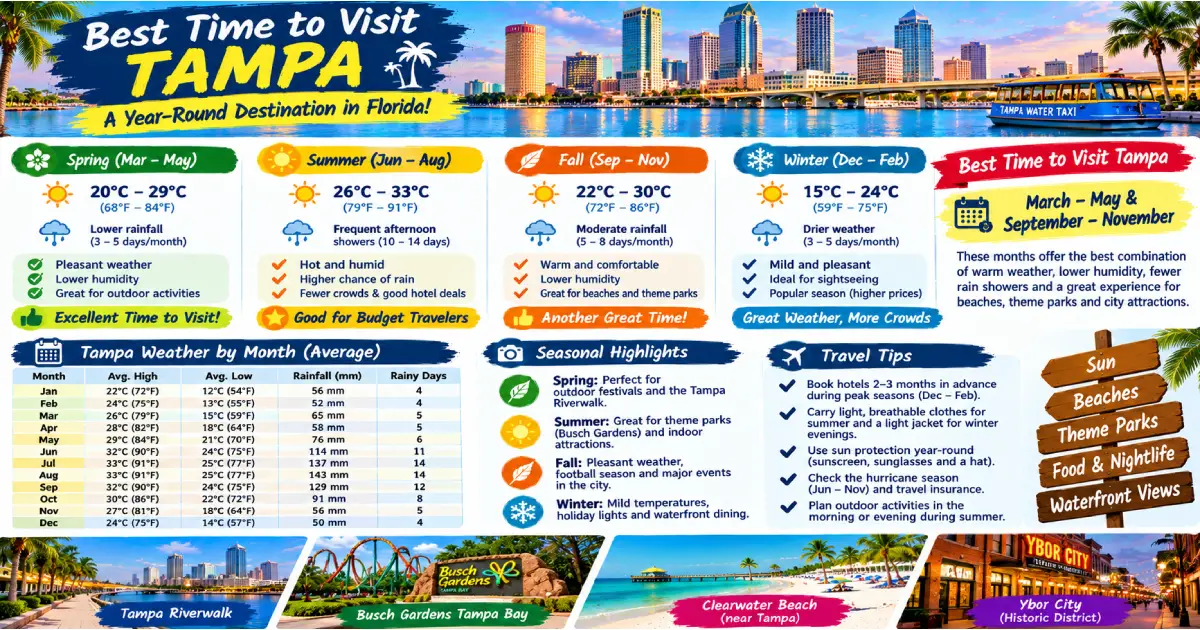
Tampa rewards visitors year-round, but the city’s subtropical climate means timing your trip wisely can be the difference between a perfect beach day and an afternoon thunderstorm that sends everyone scrambling indoors. With roughly 246 sunny days per year, Tampa ranks among Florida’s most appealing destinations — yet its two very distinct seasons (a mild, dry winter and a hot, wet summer) demand some planning. The dry season from November through April delivers blue skies, pleasant temperatures in the 70s°F, and the lowest humidity of the year, making it peak tourist season for good reason. If you’re dreaming of watching the Super Bowl or Gasparilla Pirate Fest, budget season runs January through March, and you’ll want to book hotels months ahead.
Summer in Tampa (June through September) is hot, steamy, and frequently punctuated by afternoon thunderstorms rolling in off the Gulf of Mexico — Tampa is actually the lightning capital of the United States, earning that nickname honestly. But summer isn’t without its merits: hotel rates drop dramatically, theme parks like Busch Gardens are less crowded on weekday mornings, and the Gulf water temperature reaches a bath-like 85°F. If you don’t mind building your day around the afternoon storm window (roughly 2–6 PM daily), summer can be a genuinely good budget option. Spring and fall serve as excellent shoulder seasons, balancing comfortable weather with moderate crowds and reasonable prices.
The single best months to visit Tampa are October and November — the summer storms have tapered off, temperatures hover in the mid-70s°F, humidity has dropped noticeably, and events like Clearwater Jazz Holiday and Gasparilla Arts fill the calendar before the peak winter crowd arrives. Second place goes to February and March, which bring the MLB Spring Training scene (Yankees, Blue Jays, and Phillies all train near Tampa), the city’s famous Gasparilla Pirate Fest, and reliably gorgeous weather without the scorching heat.
| Factor | Details |
|---|---|
| Best Months | October, November, February, March |
| Peak Season | January – April |
| Shoulder Season | October – November, May |
| Budget Season | June – September |
| Wettest Months | June, July, August |
| Driest Months | November, December, March |
| Hottest Month | July (avg high 91°F) |
| Coolest Month | January (avg high 71°F) |
| Hurricane Season | June 1 – November 30 |
| Annual Sunshine | ~246 sunny days per year |
| Month | Avg High °F | Avg Low °F | Sunny Days | Rainfall (in) | Humidity | Crowds |
|---|---|---|---|---|---|---|
| January | 71 | 52 | 22 | 2.3 | Low | High |
| February | 73 | 54 | 22 | 2.8 | Low | High |
| March | 78 | 58 | 24 | 3.5 | Low-Med | High |
| April | 83 | 63 | 25 | 2.2 | Medium | Medium |
| May | 88 | 69 | 24 | 3.0 | Med-High | Medium |
| June | 91 | 74 | 18 | 6.5 | High | Low |
| July | 92 | 76 | 16 | 7.8 | High | Low |
| August | 92 | 76 | 16 | 8.3 | High | Low |
| September | 89 | 74 | 17 | 6.7 | High | Low |
| October | 83 | 66 | 22 | 2.4 | Medium | Medium |
| November | 77 | 58 | 23 | 1.8 | Low | Medium |
| December | 72 | 53 | 22 | 2.2 | Low | Medium-High |
Best for: First-time visitors, beach lovers, sports fans, families with school-age children
Tampa’s dry season is its showpiece period. Temperatures range from a cool 52°F overnight in January to a pleasant 83°F afternoon high in April, with humidity at its annual low. Rain is rare — you might go 10 or 12 days in a row without a drop in January or February. The Gulf of Mexico water temperature dips to around 65–68°F in January and February, which is too cool for most swimmers but perfectly fine for surfers and watersports enthusiasts in wetsuits. By April, the Gulf has warmed back to a comfortable 74°F.
Peak season means higher hotel rates (expect to pay 30–50% more than summer rates at the same property) and larger crowds at Busch Gardens and Clearwater Beach. But the weather payoff is enormous. Spring Training baseball (February–March) draws visitors from across the country: the Yankees train at George M. Steinbrenner Field in Tampa, the Blue Jays at TD Ballpark in Dunedin, and the Phillies at BayCare Ballpark in Clearwater. Tickets are affordable ($15–$35) and the casual atmosphere makes Spring Training games a highlight of any February or March trip.
January brings Gasparilla Pirate Fest — Tampa’s beloved city-wide celebration where a flotilla of “pirates” invades the downtown waterfront — along with the Gasparilla Distance Classic running race. February delivers the Gasparilla International Film Festival and some of the year’s best weather. March and April see the Strawberry Festival in nearby Plant City (one of the largest in the country) and the launch of the outdoor concert season at Amalie Arena.
Best for: Budget-conscious travelers who want good weather, photographers, foodies
October is arguably Tampa’s best-kept secret. The summer storms have moved on, temperatures are back in the low-to-mid 80s°F during the day and dip into the mid-60s at night — perfect for exploring Ybor City on foot or cycling the Bayshore Boulevard. The Gulf water is still warm from summer, hovering around 80°F in October, making it ideal for swimming and paddleboarding. Hotel rates haven’t yet climbed to peak-season levels. Clearwater Jazz Holiday typically runs in mid-October, bringing four days of free outdoor jazz concerts to Coachman Park in Clearwater.
November is similarly excellent. The Gulf cools slightly (around 74°F), but the weather on land is near-perfect: sunny, dry, mid-70s°F highs. Thanksgiving week marks the beginning of the true peak-season rush, with hotel rates climbing and holiday travelers filling the airports, but the first two weeks of November remain a sweet spot. The Gasparilla Music Festival typically returns to downtown Tampa in early November, featuring local and national acts across multiple stages.
May is the other shoulder month. Early May still has dry-season characteristics, with comfortable temperatures in the mid-80s°F and relatively low humidity. By late May, the first summer showers begin appearing in the afternoons. If you can travel in the first two weeks of May, you’ll catch good weather at shoulder-season prices before the summer humidity kicks in.
Best for: Budget travelers, theme park fans (weekday mornings), watersports enthusiasts
Summer in Tampa is an experience unto itself. The heat index regularly exceeds 100°F in July and August, the humidity is oppressive, and afternoon thunderstorms arrive with remarkable predictability between roughly 2 PM and 6 PM. These aren’t gentle showers — Tampa’s summer storms are dramatic affairs with lightning, thunder, and heavy downpours lasting 30 to 90 minutes. Because Tampa is the lightning capital of the US, all outdoor activities (including Busch Gardens roller coasters) halt during storms.
The savvy summer strategy: start your day early, hit outdoor attractions before noon, enjoy a long lunch, wait out the afternoon storm indoors, then return outside for the evening hours when temperatures drop a few degrees and the city comes alive with al fresco dining and outdoor bars. With this approach, summer can genuinely work.
The financial case for summer is strong. Busch Gardens often runs summer promotions where a second day is free. Hotel rates drop 30–50% from peak-season prices. The beaches are still beautiful in the morning hours, and the Gulf water at 85°F is as warm as a bathtub. Tampa’s food scene — Seminole Heights restaurants, Ybor City’s nightlife, Hyde Park’s dining strip — doesn’t slow down at all in summer.
Hurricane season runs June 1 through November 30, with peak activity from mid-August through mid-October. The Tampa Bay area has actually been relatively protected from direct hurricane landfalls historically (the last major direct hit was in 1921), but it remains in the risk zone. If you travel in August, September, or October, monitor the National Hurricane Center (nhc.noaa.gov) and consider travel insurance.
Best: June–August (summer vacation), February, March Summer makes logistical sense for families bound by the school calendar. Busch Gardens and the Florida Aquarium are at their best in morning hours before the afternoon storms; plan to be at the theme park gate when it opens at 10 AM and wrap up outdoor rides by 1 PM. The Gulf beaches at Clearwater and St. Pete Beach are stunning in the early morning. February and March (Presidents’ Day week, Spring Break) are also popular family travel windows with better weather, but book well in advance and expect higher prices.
Best: October, November, May The Gulf of Mexico’s white-sand beaches at Clearwater Beach, St. Pete Beach, and Caladesi Island are at their finest in October and November: warm water (75–80°F), far fewer crowds than summer, and gorgeous light for photography. May is a close second. Avoid January and February if swimming is the priority — the Gulf water drops to 65–68°F, which is bracing for most people.
Best: February–March (Spring Training), September–January (NFL/NHL season) Spring Training fever grips the Tampa Bay area from mid-February through late March. The Tampa Bay Buccaneers NFL season runs September through January at Raymond James Stadium; the Tampa Bay Lightning NHL season runs October through April at Amalie Arena. The Tampa Bay Rays play at Tropicana Field in St. Petersburg (20 minutes from downtown Tampa) April through September.
Best: October–April Tampa’s restaurant scene doesn’t thin out in summer, but the most pleasant time to explore it — particularly Ybor City’s open-air 7th Avenue scene, Seminole Heights’ eclectic strip, and Hyde Park Village’s outdoor patios — is October through April when the evening air is comfortable. The Gasparilla International Film Festival (February/March), various food festivals, and the Riverwalk Art Festival (November) add cultural programming to the calendar.
Best: June–September (with caveats) Hotel rates are at their lowest June through early August. If you can tolerate the heat and humidity and you’re willing to structure your days around the afternoon storms, summer delivers genuine value. Busch Gardens summer promotions and off-peak weekday pricing make the theme parks more accessible. The beaches are still beautiful in early morning hours.
Best: October–November, February The fall light in Tampa is extraordinary — lower in the sky than summer, producing golden-hour shots of the Hillsborough River, the Bayshore Boulevard, and the Ybor City brick streetscapes that simply aren’t achievable in the flat overhead light of a July afternoon. February’s clear skies and blooming landscaping make it a close second. The morning light on Clearwater Beach in October is among the best beach photography conditions in Florida.
Best: November, February, March Tampa’s waterfront dining scene — Oystercatchers on Old Tampa Bay, Ulele in Water Works Park, Armature Works overlooking the Hillsborough River — is at its most romantic in the mild evenings of November through March. Sunset cruises on Tampa Bay are comfortable year-round but most pleasant November through April. Caladesi Island (accessible only by ferry), consistently rated one of Florida’s top beaches, is at its quietest and most romantic in November.
Afternoon storm strategy: From June through September, plan all outdoor activities for the morning (8 AM–1 PM). Book a long lunch or indoor attraction for 1–4 PM, then return outside in the evening. This rhythm — once you accept it — actually works beautifully.
Hurricane preparedness: If traveling June through November, monitor the National Hurricane Center (nhc.noaa.gov) from about a week before your trip. Consider travel insurance with trip cancellation coverage. Tampa Bay’s last direct major hurricane hit was in 1921, but the risk exists.
Sun protection: Year-round, Tampa’s UV index is high. Apply SPF 30+ sunscreen before outdoor activities, even in December. The subtropical sun is stronger than visitors from northern states typically expect.
Gulf water temperatures: January–February: 65–68°F (cold for swimming); March–April: 70–74°F (cool but manageable); May–June: 78–82°F (comfortable); July–September: 84–86°F (bathwater); October: 80°F (excellent); November: 74°F (comfortable); December: 68–70°F (cool).
Dress code: Tampa is casual year-round. Even upscale restaurants like Bern’s Steak House request “resort casual” — collared shirts for men, no flip-flops — rather than formal dress. Pack light clothing for warm months and one light jacket for winter evenings when temperatures occasionally dip into the upper 40s°F.
Posted By : Vinay
Latest Article
2nd Floor, 39, Above Kirti Club, DLF Industrial Area, Kirti Nagar, New Delhi, Delhi 110015



Travel Tourister is a leading Travel portal where we introduce travellers to trusted travel agents to make their journey hasselfree, memorable And happy. Travel Tourister is a platform where travellers get Tour packages ,Hotel packages deals through trusted travel companies And hoteliers who are working with us across the world. We always try to find new and more travel agents and hoteliers from every nook and corners across the world so that you could compare the deals with different travel agents and hoteliers and book your tour or hotel with the one you have chosen according to your taste and budget.
Copyright © Travel Tourister, India. All Rights Reserved

 Call
Call Enquiry