Published on : 16 Oct 2026
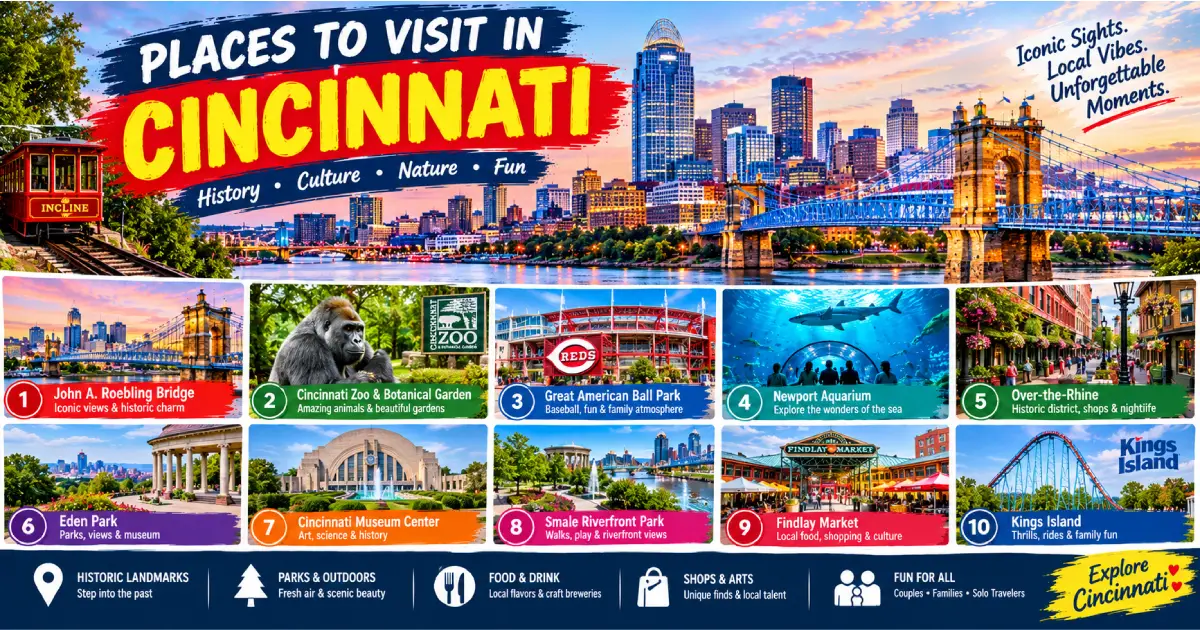
Cincinnati rewards the traveler who looks past the obvious. Yes, there is a famous hippo at the zoo and a chili parlor on every corner — but the city’s deeper pleasures reveal themselves slowly: in the gilded rotunda of a 1933 Art Deco train station turned museum complex, in the view from a Kentucky hilltop at blue hour as the Cincinnati skyline lights up across the Ohio River, in the Saturday morning energy of a 174-year-old public market in a neighborhood that nearly collapsed and instead became one of America’s great urban revival stories. Cincinnati sits at the intersection of the Midwest and the Upper South, and the Ohio River it straddles has shaped everything about it — its history as a Civil War border city, its role in the Underground Railroad, its German immigrant neighborhoods, and its identity as a place that has always looked both north and south at once.
The 20 places on this list span the full range of what Cincinnati offers in 2026: the world-class institutions, the historic districts, the natural escapes, the cross-river Kentucky attractions, and the neighborhood gems that only regulars know. Whether you have two days or a full week, this guide tells you exactly where to go, what to see, and what to expect when you get there.
| Place | Type | Cost | Highlight |
|---|---|---|---|
| Cincinnati Zoo & Botanical Garden | Zoo | $25 | Fiona the hippo, 500+ species |
| Over-the-Rhine (OTR) | Historic District | Free | Best preserved 19th-century neighborhood |
| Cincinnati Art Museum | Museum | Free | 67,000 works, Eden Park setting |
| Cincinnati Museum Center | Museum Complex | $16.50 | Art Deco Union Terminal |
| National Underground Railroad Freedom Center | Museum | $15 | Historic riverfront, slave pen exhibit |
| Eden Park | Park | Free | Mirror Lake, hilltop views |
| Findlay Market | Public Market | Free entry | Ohio’s oldest market, since 1852 |
| Great American Ball Park | Stadium | $12–$120 | Baseball on the Ohio River |
| Newport Aquarium | Aquarium | $30 | Shark Bridge, Kentucky side |
| Music Hall | Concert Hall | Tours $15 | National Historic Landmark |
| John A. Roebling Suspension Bridge | Landmark | Free | Brooklyn Bridge precursor, 1866 |
| Smale Riverfront Park | Park | Free | 45-acre Ohio River park |
| Mt. Adams | Neighborhood | Free | Hilltop views, Victorian streets |
| Devou Park | Park/Viewpoint | Free | Best Cincinnati skyline panorama |
| American Sign Museum | Museum | $15 | World’s only sign museum |
| Taft Museum of Art | Museum | $12 | Old Masters in an 1820 mansion |
| Kings Island | Theme Park | $75–$110 | The Beast wooden coaster |
| Cincinnati Observatory | Observatory | Free/$10 | Historic 1843 telescope |
| Covington, Kentucky | Neighborhood | Free | MainStrasse, riverfront views |
| Purple People Bridge | Landmark | Free | Pedestrian crossing, skyline views |
Admission: $25 adults / $20 children | Hours: Daily 9am–6pm (seasonal variation) | Address: 3400 Vine St, Avondale
Founded in 1875, the Cincinnati Zoo is the second oldest zoo in the United States and consistently ranks among the top ten in the country for animal care, conservation work, and visitor experience. Its global fame rests largely on one resident: Fiona, the Nile hippopotamus born prematurely in January 2017 who became an international celebrity when the zoo live-streamed her fight for survival. Today Fiona — and her younger sibling Fritz — can be seen at the spectacular Hippo Cove exhibit, which features a 400,000-gallon pool with massive underwater viewing windows that put visitors within feet of these enormous animals. Beyond the hippos, the zoo’s Wildlife Canyon showcases African savanna species, the Wings of the World aviary is extraordinary, and the botanical garden component weaves 3,000+ plant species throughout the grounds. In 2026, the Zoo Blooms spring festival (April–May) and the Zoo Lights winter display (November–January) add seasonal spectacle to an already excellent year-round destination. Tip: Fiona feeding times (usually 9:30am and 2:30pm) draw the largest crowds; arrive 15 minutes early for a front-row spot at Hippo Cove.
Cost: Free to explore | Hours: Always open | Best Area: Vine St, Main St, Findlay Market
Over-the-Rhine is the most compelling urban district in Cincinnati and one of the most remarkable neighborhood revival stories in 21st-century America. The neighborhood takes its name from the Miami & Erie Canal that 19th-century German immigrants — finding the water a symbolic substitute for the Rhine — used to mark the boundary between their community and downtown Cincinnati. The result was a dense grid of Italianate and Romanesque Revival brick buildings that survived the 20th century largely intact, if severely deteriorated, before a sustained revitalization effort beginning in the 2000s transformed it into a destination of craft breweries, acclaimed restaurants, art galleries, boutique shops, and one of the country’s finest live music venues (Music Hall). The neighborhood’s National Historic Landmark designation protects its extraordinary architectural fabric — over 900 buildings, the largest contiguous collection of Italianate architecture in the United States. Walk Vine Street from downtown north to Findlay Market, detour onto Main and Pleasant streets, and allow at least three hours to do it justice. Tip: First Fridays (first Friday of each month) bring gallery openings, street performers, and the liveliest pedestrian atmosphere in the city.
Admission: Free permanent collection (special exhibitions $) | Hours: Tue–Sun 11am–5pm, Fri until 9pm | Address: 953 Eden Park Dr
The Cincinnati Art Museum’s permanent collection admission is free — a civic gift that has made high-quality art accessible to generations of Cincinnatians and visitors. The collection spans 67,000 objects across 6,000 years and multiple civilizations: ancient Egyptian artifacts, Greek and Roman antiquities, European Old Masters (Rembrandt, Rubens, Gainsborough), French Impressionists, American modernists, African art, pre-Columbian pieces, and one of the Midwest’s finest collections of decorative arts. The building itself is worth the visit — an elegant 1886 Richardsonian Romanesque structure expanded thoughtfully over the decades, sitting on a hilltop in Eden Park with views over the Ohio River valley. The Friday Art After Dark events (5–9pm) pair gallery access with live music and themed cocktails. The permanent collection’s Rookwood Pottery room is a particularly Cincinnati experience — Rookwood, founded here in 1880, defined American art pottery. Tip: The museum’s cafe and gift shop are both well above the institutional average; budget time for both.
Admission: $16.50 adults / $14.50 children | Hours: Mon–Sat 10am–5pm, Sun 11am–6pm | Address: 1301 Western Ave, Queensgate
Union Terminal is one of the finest Art Deco buildings in the United States — full stop. Completed in 1933 as Cincinnati’s grand central railroad station, its half-dome facade (180 feet in diameter, the largest half-dome in the Western Hemisphere at its completion), soaring interior rotunda, and extraordinary mosaic murals by Winold Reiss represent the apex of the Art Deco movement. After decades as a railroad station, a shopping mall, and various interim uses, it was restored between 2016 and 2018 in a $212 million project and now houses three museums under one spectacular roof: the Cincinnati History Museum, the Museum of Natural History & Science (with remarkable Ice Age Cincinnati exhibits), and the Children’s Discovery Museum. The building alone — particularly the rotunda with its dual mosaic panels depicting Cincinnati’s industrial and cultural heritage — justifies a visit. Tip: Arrive 20–30 minutes early and spend time in the rotunda before entering any museum; the Reiss mosaics deserve unhurried attention.
Admission: $15 adults / $10.50 children | Hours: Tue–Sat 11am–5pm | Address: 50 E Freedom Way, Riverfront
No museum in Cincinnati carries more historical weight than the National Underground Railroad Freedom Center, and its location is itself a statement: on the north bank of the Ohio River, the literal boundary between the slave state of Kentucky and the free state of Ohio. For thousands of enslaved people in the antebellum period, crossing this river meant freedom — and Cincinnati was a critical node in the Underground Railroad network that made those crossings possible. The museum tells that history with extraordinary depth and unflinching honesty. The centerpiece physical artifact is a two-story wooden slave pen from a Kentucky farm, reassembled inside the museum — a haunting, silent object that stops visitors cold. Interactive exhibits, personal narratives, and connections to contemporary human rights issues extend the museum’s reach into the present. Tip: Allow a minimum of 2.5 hours; the emotional and intellectual demands of the museum reward unhurried engagement.
Cost: Free | Hours: Daily dawn to dusk | Address: Eden Park Dr, Mt. Lookout
Eden Park is 186 acres of hilltop green space that serves simultaneously as Cincinnati’s finest urban park and the setting for some of its greatest cultural institutions. The Cincinnati Art Museum anchors the southern edge; the Cincinnati Observatory sits at the apex of neighboring Mt. Ida; Mirror Lake reflects trees and sky in near-perfect stillness; the Twin Lakes offer a quieter retreat from the main paths; and the Hinkle Magnolia Garden erupts in spectacular bloom each April. But the park’s greatest gift may be its overlooks: from multiple points along Eden Park Drive, views extend across the Ohio River valley, over the Kentucky hills, and back toward the Cincinnati skyline — some of the finest urban vistas in the Midwest. The park’s network of paths includes the staircase connections down to the Ohio River and up to Mt. Adams that are quintessentially Cincinnati. Tip: The overlook at the reservoir on Eden Park Drive at sunset is one of the most beautiful spots in Ohio; the Mirror Lake reflection is best on still mornings before 8am.
Cost: Free entry | Hours: Wed & Fri 9am–6pm, Sat 8am–6pm, Sun 10am–4pm | Address: 1801 Race St, OTR
Findlay Market has anchored the community life of Over-the-Rhine since 1852, making it the oldest continuously operating public market in Ohio — a living artifact of the city’s German immigrant heritage that has survived the neighborhood’s decline and emerged through its revival as one of Cincinnati’s most beloved institutions. On Saturday mornings, the market achieves something rare: it’s a genuine civic gathering space where the full range of Cincinnati comes together around food. Farmers sell Ohio-grown produce, Eckerlin Meats offers freshly made goetta (the pork-and-oat sausage that is the other great Cincinnati food tradition alongside chili), bakers display artisan loaves, cheesemakers bring Ohio varieties, and specialty food vendors ring the outdoor stalls. The indoor market house holds permanent vendors; the surrounding streets fill with restaurants and shops that have grown up around the market’s gravitational pull. Tip: Saturday 8–10am is the prime window — the best vendors sell out of their freshest items, and the energy is at its peak before the tourist wave arrives at midday.
Tickets: $12–$120 | Season: April–September 2026 | Address: 100 Joe Nuxhall Way, Riverfront
Great American Ball Park, home of the Cincinnati Reds since 2003, offers something most MLB stadiums cannot: a natural backdrop of genuine beauty. The right-field wall opens to views of the Ohio River and the rolling Kentucky hills beyond — a pastoral scene that softens even the hardest loss. The Reds are the oldest professional baseball franchise in the country (est. 1869), and the ballpark honors that history throughout, including the Reds Hall of Fame and Museum (adjacent, $12 add-on) with artifacts from the team’s 150+ year history. Opening Day in Cincinnati is a civic holiday observed with genuine enthusiasm — the Reds traditionally open their home schedule, and the city parades, closes schools, and turns out in force. The riverfront location means the ballpark is walkable from downtown hotels and Smale Riverfront Park. Tip: The SunDeck in left field offers the most relaxed experience and best views; mid-week day games allow walk-up tickets and the most authentic ballpark atmosphere.
Admission: $30 adults / $22 children | Hours: Daily 10am–7pm | Address: 1 Aquarium Way, Newport, KY
Just across the Ohio River in Newport, Kentucky — a 10-minute walk from downtown Cincinnati via the Purple People Bridge — the Newport Aquarium houses over 1 million gallons of water and 15,000+ animals across 70 exhibits. It’s one of the finest inland aquariums in the United States, and its signature experience is genuinely unlike anything else in the region: the Shark Bridge, a suspended rope crossing over a 385,000-gallon shark tank, puts visitors on a swaying rope bridge inches above sharks and rays with only net netting between the two. The penguin exhibit, sea turtle rehabilitation program, alligator and crocodilian galleries, and touch pools round out an experience that easily fills three hours. Combo tickets with the Cincinnati Zoo are available at a discount. Tip: Walk across via the Purple People Bridge rather than driving; the pedestrian crossing is free, scenic, and puts you at the aquarium’s front door.
Tours: $15 | Address: 1241 Elm St, OTR | Performance Tickets: Vary
Cincinnati Music Hall is, by most architectural assessments, the finest Victorian concert hall in the United States. Completed in 1878 in High Victorian Gothic style — turrets, pointed arches, ornate terracotta detailing, a soaring central tower — and meticulously restored between 2014 and 2017 in a $143 million project that revealed and preserved every original detail, the building is a National Historic Landmark of the first order. It houses the Cincinnati Symphony Orchestra, Cincinnati Pops, and Cincinnati Opera in three halls of varying scale, all contained within a building whose exterior stops pedestrians mid-stride. The main Springer Hall, seating 3,400 under a vaulted ceiling of gilded plasterwork, is the crown jewel. Even visitors with no interest in classical music should take the guided tour ($15) to access the backstage areas, the restored organ, and the building’s extraordinary history. Tip: The CSO season runs September through May; summer Pops concerts are more casual and easier for first-time visitors; check cincinnatiarts.org for 2026 programming.
Cost: Free | Hours: Open 24 hours | Location: Connecting Cincinnati, OH to Covington, KY
The John A. Roebling Suspension Bridge is one of the most historically significant engineering structures in the United States, and most visitors drive across it without knowing what they’re looking at. Completed in 1866 — 17 years before the Brooklyn Bridge — this crossing of the Ohio River was engineer John Roebling’s proof-of-concept for long-span wire suspension bridge construction. When New York needed a bridge across the East River, they hired the man who built Cincinnati’s crossing. The visual similarity between the two bridges is no coincidence: the same engineer, the same system, the same Gothic tower design. The Roebling Bridge is still in active use as a two-lane automobile crossing, and walking its span (about 10 minutes) is free. The view back toward Cincinnati from the Kentucky side — with the bridge’s blue towers framing the skyline — is one of the best photographs in the city. Tip: The best view of the bridge itself is from Smale Riverfront Park at ground level looking south.
Cost: Free | Hours: Daily dawn to 11pm | Address: Ohio River waterfront, Downtown
Completed in stages since 2012, Smale Riverfront Park is Cincinnati’s finest contemporary public space — 45 acres of riverfront parkland stretching from the baseball and football stadiums west to the Purple People Bridge. The park is a genuine civic achievement: the Carroll Chimes Bell Tower, custom children’s play areas, a wetland garden, the Taft’s Ale House in a restored historic building, interactive water features, the Reds Heritage Museum, and direct river access for kayaking and paddleboarding. The Great Lawn hosts free summer concerts, outdoor movies, and festivals. On evenings and weekends it fills with families, runners, cyclists, and kayakers. The views from the riverfront promenade take in the Ohio River, the Kentucky hills, and the Roebling Bridge simultaneously. Tip: Rent a kayak from Riverside Kayak at the park’s eastern end; paddling under the Roebling Bridge is an experience unique to Cincinnati.
Cost: Free to explore | Best Time: Evenings and weekends | Access: From Eden Park or downtown
Mt. Adams is the neighborhood that most captures Cincinnati’s particular character: steep, impractical, beautiful, and fiercely itself. Clinging to a hilltop directly above Eden Park, it’s a six-block cluster of Victorian row houses, neighborhood bars, galleries, and restaurants connected to lower ground by staircase streets and winding lanes that defeat GPS navigation. The hilltop park at the apex offers sweeping views of downtown Cincinnati, the Ohio River, and the Kentucky hills — some of the best unobstructed urban views in the city. Celestial Street and the steps leading up from Eden Park are quintessentially Cincinnati. The bar scene on Pavilion Street comes alive on weekend evenings. Holy Cross Immaculata Church, at the hilltop summit, has hosted an Easter Sunday pilgrimage up its steps since 1860. Tip: Walk up from Eden Park via the art museum stairs rather than driving — the climb is part of the experience, and parking on Mt. Adams is genuinely difficult.
Cost: Free | Hours: Daily dawn to dusk | Address: Devou Park, Covington, KY
Devou Park sits on the Kentucky bluffs above Covington — a 10-minute drive or a 25-minute walk from downtown Cincinnati — and offers what many consider the single best panoramic view of the Cincinnati skyline available anywhere. From the western overlooks, the entire Cincinnati skyline spreads across the Ohio River in a wide sweep that takes in the Roebling Bridge, the downtown towers, Great American Ball Park, and the hills of Northern Kentucky simultaneously. The view is especially spectacular at blue hour (30–45 minutes after sunset) when the skyline illuminates and the river reflects it. The park also contains the Behringer-Crawford Museum of Northern Kentucky natural history and culture ($7), tennis courts, a disc golf course, and a small lake. Tip: Use Google Maps to navigate directly to the “Devou Park Overlook” — the park is large and the overlook is not immediately obvious from the main entrance.
Admission: $15 adults / $10 children | Hours: Tue–Sat 10am–4pm | Address: 1330 Monmouth Ave, Camp Washington
The American Sign Museum in Camp Washington is the most uniquely Cincinnati museum experience available — because there is no other museum like it anywhere on earth. Four centuries of American commercial signage fill a converted factory space: hand-painted colonial trade signs, massive 19th-century painted wall advertisements, rooftop spectaculars from the early 20th century, neon masterworks of the 1940s and ’50s (a darkened gallery of glowing vintage neon is among the most visually stunning rooms in Cincinnati), backlit plastic from the 1960s, and contemporary digital displays. The collection traces the visual history of American commerce, identity, and aspiration through the medium most people walk past without noticing. The docents are extraordinarily knowledgeable. Tip: Budget 90 minutes minimum; the neon gallery alone deserves 20 minutes of slow, attentive looking.
Admission: $12 adults / free under 18 | Hours: Wed–Sun 11am–5pm | Address: 316 Pike St, East End
The Taft Museum of Art occupies a graceful 1820 Federal-style mansion — one of the finest examples of the style in Ohio — and houses a private art collection of extraordinary quality assembled by Charles Phelps Taft (brother of President William Howard Taft) and donated to Cincinnati in 1927. The collection’s highlights include Dutch Old Masters (Rembrandt, Hals), English portraits (Gainsborough, Lawrence), French Barbizon paintings (Corot, Millet), and Chinese porcelain of museum quality. What distinguishes the Taft from larger institutions is the intimacy of experiencing these works in their original residential setting — you’re not in a gallery wing but in the rooms where the Tafts actually lived with these paintings. The garden behind the house is lovely in spring. Tip: The museum is small enough to see thoroughly in 90 minutes and rarely crowded; it offers one of Cincinnati’s best cultural experiences for a modest entry fee.
Admission: $75–$110 advance / more at gate | Hours: Seasonal; check kingsislandpark.com | Location: Mason, OH (25 miles north)
Kings Island in Mason, Ohio is a 25-mile drive from downtown Cincinnati and one of the finest regional amusement parks in the United States. The roller coaster collection alone justifies the drive: The Beast (7,359 feet of wooden track, the longest wooden coaster in the world since 1979), Orion (a 300-foot giga-coaster), Banshee (the world’s longest inverted coaster at 4,124 feet), Diamondback (a hypercoaster with a 230-foot drop), and Mystic Timbers (a newer wooden coaster that has quickly become a fan favorite). Soak City water park is included with admission. The Halloween Haunt event (September–October evenings) is one of the Midwest’s premier Halloween experiences. Tip: Purchase tickets at least one day in advance online for meaningful savings; the first two hours after opening have the shortest lines on any coaster.
Cost: Free grounds; public nights $5–$10 | Address: 3489 Observatory Pl, Hyde Park | Public nights: Select evenings year-round
The Cincinnati Observatory on Mt. Ida in Hyde Park houses a working 11-inch Merz und Mahler refractor telescope completed in 1843 — when it was the largest telescope in the western hemisphere. That same telescope still operates today, offering public observing nights where visitors can look through 183-year-old glass at planets, star clusters, and nebulae. The second telescope, an 1904 16-inch refractor, is equally impressive in its own right. The hilltop park surrounding the domes is beautiful for walking at any time of day, and the views over Hyde Park and toward downtown Cincinnati reward a visit even when the telescopes aren’t open. Tip: Public observing nights (check cinci-observatory.org for the 2026 schedule) are weather-dependent and book up quickly; spring and fall offer the clearest skies and the most comfortable temperatures.
Cost: Free to explore | Access: Roebling Bridge (drive/walk) or Purple People Bridge (walk) | Highlights: MainStrasse Village, riverfront, Mother of God Church
Covington, Kentucky sits directly across the Ohio River from Cincinnati and is close enough to explore as part of a Cincinnati day — close enough that many Cincinnati residents consider it part of the same metro culture. The MainStrasse Village neighborhood is the draw: a German immigrant district of Victorian buildings now occupied by antique shops, restaurants, craft bars, and the Carroll Chimes Bell Tower (a working Flemish carillon). The riverfront blocks offer the clearest views of the Cincinnati skyline available from ground level. Mother of God Church (1871) contains some of the most extraordinary ecclesiastical art in the Midwest — murals, mosaics, and stained glass of exceptional quality that are almost entirely unknown outside the region. The Devou Park overlook is a short drive uphill. Tip: Walk to Covington via the Roebling Bridge (drive your car across and park in Covington) or the Purple People Bridge (pedestrian only); the walk takes 10 minutes and the river views in both directions are spectacular.
Cost: Free | Hours: Open daily | Access: Enter from Sawyer Point Park, Cincinnati, or Newport on the Levee, KY
The Purple People Bridge — officially the Newport Southbank Bridge — is a converted 1872 railroad bridge painted a distinctive purple and repurposed as a pedestrian and bicycle crossing between Cincinnati’s Sawyer Point Park and Newport on the Levee in Kentucky. The bridge’s 1,057-foot span offers continuous views of the downtown Cincinnati skyline, the Ohio River, the Roebling Suspension Bridge, Great American Ball Park, and the Kentucky hills — a panoramic sweep that is among the most photographed views in the Cincinnati metro. On the Kentucky end, Newport on the Levee is a riverfront entertainment complex housing the Newport Aquarium, restaurants, bars, and an IMAX theater. The crossing takes about 10 minutes and is flat, accessible, and stroller-friendly. Tip: Walk at golden hour (one hour before sunset) for the best skyline photographs; the light on the Cincinnati skyline from the bridge is exceptional.
Posted By : Vinay
Latest Article
2nd Floor, 39, Above Kirti Club, DLF Industrial Area, Kirti Nagar, New Delhi, Delhi 110015



Travel Tourister is a leading Travel portal where we introduce travellers to trusted travel agents to make their journey hasselfree, memorable And happy. Travel Tourister is a platform where travellers get Tour packages ,Hotel packages deals through trusted travel companies And hoteliers who are working with us across the world. We always try to find new and more travel agents and hoteliers from every nook and corners across the world so that you could compare the deals with different travel agents and hoteliers and book your tour or hotel with the one you have chosen according to your taste and budget.
Copyright © Travel Tourister, India. All Rights Reserved

 Call
Call Enquiry