Published on : 06 Oct 2026
By Travel Tourister | Updated Oct 2026
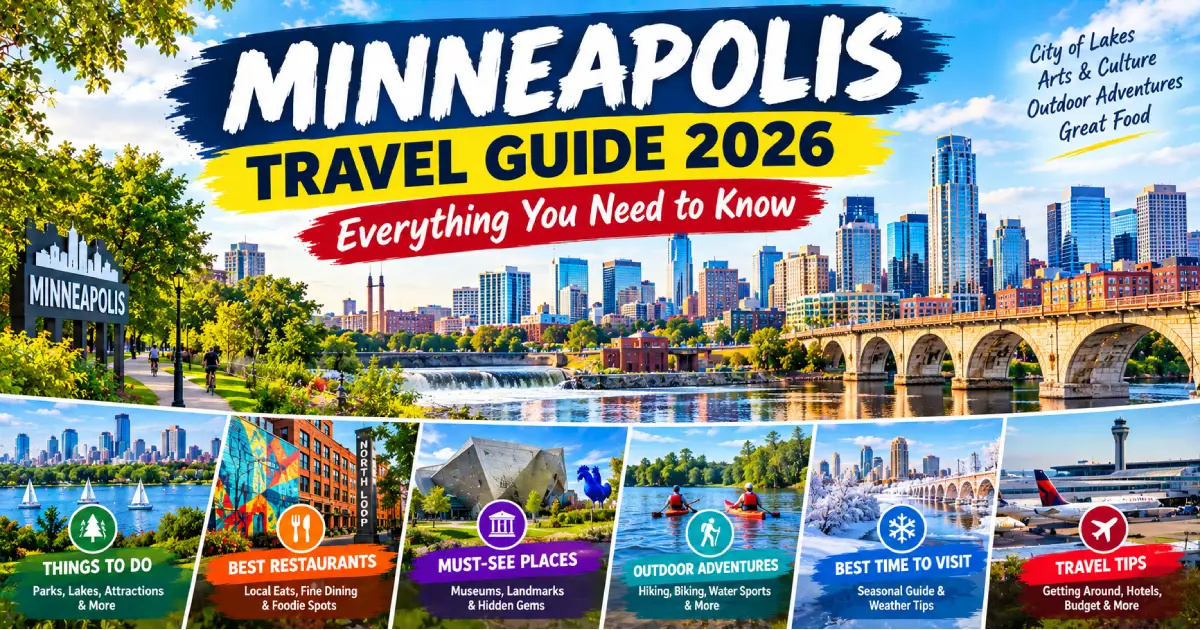
Minneapolis is the American city that most specifically rewards the visitor who arrives with calibrated expectations rather than preconceptions — neither the frozen wasteland of popular mythology nor the secret paradise that its most enthusiastic civic boosters occasionally oversell, but something more specifically interesting: the most park-rich major American city (6,700+ acres of parkland, the Chain of Lakes system, and the Grand Rounds Scenic Byway forming the most comprehensively connected single urban outdoor recreation network in any American city), the most vibrant arts scene between Chicago and the Pacific Coast (more theater seats per capita than any US city except New York, the Walker Art Center’s international contemporary art reputation, and the First Avenue music club’s Prince legacy), and the most genuinely extraordinary winter city in America (the Skyway System’s 9.5-mile enclosed pedestrian bridge network, the frozen-lake skating culture, and the specific Minneapolis winter indoor arts season whose quality and attendance reflects a population that has developed the most comprehensively winter-adapted single American urban culture).
Planning a Minneapolis visit in 2026 requires understanding several things that standard travel resources frequently underemphasize: the neighborhood dispersal (Minneapolis’s most rewarding places — the Walker Art Center, the Chain of Lakes, the Northeast arts district, the North Loop restaurants — are distributed across a city whose light rail system covers some but not all visitor-relevant corridors, requiring a specific combination of the METRO Blue and Green Lines, the free Nicollet Mall shuttle, and rideshare for the most comprehensive single Minneapolis visitor navigation), the seasonal planning imperative (the July–September summer and the January–February winter are both genuinely excellent in different ways, but the winter visitor who arrives without proper cold-weather gear in January faces the most specifically challenging single American major city weather condition), and the specific Minneapolis-St. Paul Twin Cities dynamic (the two cities 10 miles apart sharing the MSP airport, the light rail connection, and the regional cultural calendar — the visitor who treats both cities as a single destination doubles the specific rewarding places available within a 30-minute drive or light rail ride).
This complete Minneapolis Travel Guide for 2026 covers everything from getting there and getting around through neighborhood orientation, budget planning, and the specific insider knowledge that transforms a Minneapolis visit from a Mall of America checkbox into the most genuinely surprising and most specifically rewarding major American northern city experience.
For specific guides, see our Things to Do in Minneapolis 2026, Places to Visit in Minneapolis 2026, Best Restaurants in Minneapolis 2026, and Best Time to Visit Minneapolis 2026.
| Category | Details |
|---|---|
| Nickname | City of Lakes; Mill City; Mini-Apple |
| Population | 430,000 (city); 3.7 million (metro) |
| Founded | 1867 (incorporated) |
| State | Minnesota |
| Elevation | 830 feet (253 meters) |
| Airport | Minneapolis-St. Paul International (MSP) — 12 miles south |
| Time zone | Central Time (CT) — UTC-6 standard; UTC-5 DST |
| Currency | US Dollar (USD) |
| Language | English (primary); significant Somali, Spanish, Hmong, Vietnamese communities |
| Best neighborhoods | North Loop, Northeast, Uptown, Linden Hills, Midtown |
| Best season | June–September (summer outdoor culture); Jan–Feb (winter culture) |
| Worst season | March (variable, late snow) |
| Mid-range hotel | $130–$210/night |
| Car necessary? | Not for Uptown/Downtown; METRO light rail useful; car for suburbs |
| Transit | METRO Blue and Green Lines; bus; Skyway System (downtown, free) |
| Winter temperature | January avg low -10°F/-23°C — the coldest major US city |
| Summer temperature | July avg high 83°F/28°C — comfortable, low humidity |
| Parks | 6,700+ acres — most parkland per capita of any major US city |
Airport code: MSP | Distance: 12 miles south of downtown Minneapolis | Drive time: 20–35 minutes | Website: mspairport.com
Minneapolis-St. Paul International Airport (MSP) serves as a major Delta Air Lines hub — the most extensively Delta-networked single Upper Midwest airport, the specific MSP Delta connection providing the most comprehensively domestic and international single Minneapolis flight network. Additional major carriers include American, United, Southwest, and Sun Country (the Minneapolis-based budget carrier with the most specifically Minnesota-routes-focused single budget airline network). International service includes Air France, British Airways, Icelandair, KLM, and Lufthansa among the most significant MSP international routes.
Getting from MSP to Minneapolis:
METRO Blue Line (most recommended): The light rail service from the MSP airport (the Lindbergh Terminal station directly accessible from the baggage claim level via the tram connection) to downtown Minneapolis (Target Field Station, the most central single downtown Minneapolis light rail terminus) in approximately 25 minutes. Cost: $2.50 one-way. Frequency: every 10 minutes during peak hours. The MSP Blue Line is the most cost-effective, most reliable, and most specifically Minneapolis-character single airport transfer — the 25-minute ride through South Minneapolis providing the most comprehensive single introduction to the city’s residential character.
Rideshare (Uber/Lyft): $25–$40 to downtown Minneapolis in standard conditions; $35–$55 during surge (the I-35W and I-94 interchange congestion creating variable rideshare pricing). The rideshare pickup area at MSP (the designated staging area on the ground transport level) is well-organized with typical 5–8 minute availability.
Taxi: $35–$50 to downtown Minneapolis (metered, with airport surcharge). The most consistent non-surge MSP transfer option.
Rental car: The MSP rental car facility (the consolidated Rental Car Center accessible via shuttle) houses all major companies. A rental car is most specifically useful for the Paisley Park tour (Chanhassen, 20 miles west), Travail Kitchen (Robbinsdale, 10 miles northwest), the Minnesota State Fair (St. Paul Falcon Heights), and the various Twin Cities suburban destinations not served by light rail.
The METRO system (the Metropolitan Council’s light rail network) provides the most visitor-relevant Minneapolis transit connection:
Blue Line: MSP Airport → Mall of America → downtown Minneapolis (Government Plaza, Nicollet Mall, Warehouse District) → North Minneapolis. The most visitor-relevant single METRO line — the airport connection, the downtown corridor, and the Warehouse District (North Loop adjacent) all served.
Green Line: Minneapolis (Target Field Station) → University of Minnesota → downtown St. Paul. The most specifically Twin Cities-connecting single transit option — the 25-minute Green Line ride from Target Field to St. Paul’s Union Depot providing the most accessible single Minneapolis-to-St. Paul transit connection.
METRO fares (2026 approximate):
Key visitor stations:
| Station | Line | Nearby |
|---|---|---|
| MSP Airport (Lindbergh) | Blue | Airport arrivals/departures |
| Mall of America | Blue | America’s largest mall |
| Target Field | Blue/Green | North Loop; Twins games |
| Warehouse District/Hennepin | Blue | Warehouse District; First Avenue |
| Nicollet Mall | Blue | Downtown shopping; hotels |
| Government Plaza | Blue | City Hall; downtown |
| U of M | Green | Weisman Art Museum; campus |
| Raymond Ave | Green | St. Paul’s Grand Avenue area |
| Union Depot | Green | Downtown St. Paul |
The most specifically Minneapolis-identity single downtown infrastructure — the 9.5-mile network of enclosed glass bridges connecting 80 downtown city blocks at the second-floor level. The Skyway (free to use, open during business hours — typically 6 AM–2 AM on weekdays, shorter hours on weekends) allows completely weather-immune downtown Minneapolis pedestrian navigation, the most specifically practical single Minneapolis winter visitor infrastructure. The Skyway connects the most specifically downtown-Minneapolis hotels, the major downtown restaurants, Target Center (Timberwolves and Lynx games), and the Nicollet Mall retail corridor.
The Skyway map: Available at most downtown Minneapolis hotels and at the Minneapolis Visitor Information Center (505 Nicollet Mall) — the Skyway map is the single most essential downtown Minneapolis winter navigation tool.
Cost: $3/30-minute ride; $15/day pass | Season: April–November | Stations: Throughout Minneapolis neighborhoods | Character: The most specifically Minneapolis-summer-identity single visitor transport
Nice Ride Minnesota (the Minneapolis bikeshare system) provides the most specifically Minneapolis-character single visitor transport during the summer season — the Chain of Lakes circuit (13 miles), the Grand Rounds Scenic Byway, and the inter-neighborhood navigation (Uptown to Northeast, North Loop to Midtown) most specifically rewarding and most specifically practical on the Nice Ride bikes. The Nice Ride stations are concentrated throughout the most visitor-relevant Minneapolis neighborhoods (the North Loop, Uptown, Northeast, Midtown, and the University area) and are within 2–3 blocks of the most frequently visited Minneapolis attractions.
Uber and Lyft operate throughout Minneapolis with the most reliable single inter-neighborhood transport — the most practical single Minneapolis transport for the Northeast-to-North-Loop and the Uptown-to-downtown connections not directly served by the METRO light rail.
Typical Minneapolis rideshare costs:
Character: The most upscale-casual and most specifically nationally-food-recognized single Minneapolis neighborhood; converted warehouse district | Best for: Spoon and Stable, Young Joni, the Bachelor Farmer, boutique hotels, the Hewing Hotel | Transit: METRO Blue Line to Target Field or Warehouse District/Hennepin
The North Loop (the former warehouse district north of downtown — the most specifically restaurant-ambitious and most specifically design-forward single Minneapolis neighborhood) is the natural base for the food-motivated Minneapolis visitor: the Spoon and Stable (the most acclaimed Minneapolis restaurant), the Bar La Grassa (the most specifically Italian-American single North Loop restaurant), the Hewing Hotel (the most specifically warehouse-conversion-character single Minneapolis boutique hotel), and the Target Field (the Minnesota Twins ballpark whose specific North Loop position makes it the most specifically walkable single Major League Baseball park from any Minneapolis neighborhood) together make the North Loop the most comprehensively programmed and most specifically nationally-food-recognized single Minneapolis neighborhood.
Character: The most comprehensively studio-artist-populated single American urban arts district; the most specifically craft-brewery-concentrated outside of South End Charlotte | Best for: Art-A-Whirl (May); First Thursday gallery openings; Hai Hai; Young Joni; Indeed Brewing; Northeast bars | Transit: Rideshare from downtown (15 min); walkable within Northeast
Northeast Minneapolis (the neighborhood east of the Mississippi River from downtown — the most comprehensively studio-artist-populated single Minneapolis neighborhood, the specific Northeast character [the 600+ working artists in the converted industrial buildings, the Art-A-Whirl annual studio open house, and the specific Northeast craft brewery concentration [the Indeed Brewing Company, the 612Brew, and the various other Northeast taprooms creating the most specifically brewery-dense single Minneapolis neighborhood] alongside the most nationally-celebrated single Northeast restaurants [the Hai Hai, the Young Joni, and the specific Northeast dining scene]) is the most specifically arts-and-creative-community and most specifically craft-beer-concentrated single Minneapolis neighborhood.
Character: The most eclectic and most specifically bohemian single Minneapolis commercial neighborhood; the Chain of Lakes access | Best for: The Chain of Lakes (cycling, kayaking); Bde Maka Ska; independent shopping; the Lagoon Cinema | Transit: Bus 17 on Hennepin Ave; Nice Ride bikeshare throughout
Uptown (the SW Minneapolis neighborhood centered on Hennepin and Lake — the most eclectic and most specifically bohemian single Minneapolis commercial area) provides the most specifically neighborhood-personality and most specifically Chain-of-Lakes-adjacent single Minneapolis commercial experience. The specific Uptown character (the vintage shops, the independent record stores, the Calhoun Square, the Lagoon Cinema [the most specifically arthouse single Minneapolis movie theater, the 1926 building’s specific single-screen character], and the proximity to the Chain of Lakes [Bde Maka Ska 3 blocks west of Hennepin Avenue]) makes Uptown the most specifically residential-neighborhood-feeling and most specifically locally-used single Minneapolis commercial corridor.
Character: The most globally diverse single Minneapolis dining corridor; the most specifically immigrant-food-accessible single Minneapolis neighborhood | Best for: Midtown Global Market; Hola Arepa; Pimento Jamaican Kitchen; the most globally diverse single Minneapolis casual lunch | Transit: METRO Blue Line to Lake Street/Midtown; bus along Nicollet
Eat Street (the Nicollet Avenue corridor from Grant Street to 29th Street — the “Eat Street” designation earned by the most comprehensively international-food single Minneapolis commercial street) and the Midtown Global Market (the enclosed market in the former Sears building at Lake and Chicago) together provide the most globally diverse single Minneapolis dining experience: the Vietnamese, the Ethiopian, the Somali, the Mexican, the Jamaican, and the various other immigrant community restaurants whose specific quality and specific cultural authenticity makes Eat Street the most specifically globally-curious single Minneapolis neighborhood dining experience.
Character: The most specifically residential and most specifically family-character single Minneapolis neighborhood; the Chain of Lakes’ most beautiful section; Tilia and Pizzeria Lola | Best for: The Chain of Lakes (Lake Harriet, Lake of the Isles); Tilia restaurant; the most specifically neighborhood-residential single Minneapolis experience | Transit: Bus; Nice Ride bikeshare from Uptown
Linden Hills (the SW Minneapolis neighborhood adjacent to Lake Harriet — the most specifically beautiful and most specifically residential-character single Minneapolis neighborhood, the specific Linden Hills character [the craftsman bungalows and the Tudor Revival houses of the most specifically architecturally-consistent single Minneapolis residential neighborhood, the Lake Harriet Bandshell [the most beloved single Minneapolis summer outdoor concert venue at the neighborhood’s eastern edge], and the Tilia restaurant [the most specifically neighborhood-character single Minneapolis fine-casual restaurant] alongside the Pizzeria Lola [the Ann Kim neighborhood pizza restaurant whose specific warmth and most specifically welcoming single Minneapolis restaurant character makes it the most consistently neighborhood-gathering-place single Minneapolis pizza destination]) provides the most specifically residential-Minneapolis-character single neighborhood experience.
| Type | Cost Per Night | Notes |
|---|---|---|
| Budget hostel | $35–$60 | Limited options; check Minneapolis Hostel |
| Budget hotel | $80–$130 | Airport corridor; outer neighborhoods |
| Mid-range hotel | $130–$210 | Downtown; Uptown; North Loop |
| Boutique hotel | $180–$300 | Hewing Hotel; Kimpton Hotel Ivy; The Elliot Park |
| Luxury hotel | $250–$450+ | Four Seasons Minneapolis; W Minneapolis |
| Vacation rental | $100–$200 | Most value in Northeast and Uptown neighborhoods |
The summer premium: Minneapolis hotel rates peak in July–August (the most specifically event-driven and most specifically weather-excellent single Minneapolis hotel demand period) — the same downtown hotel that costs $130/night in January costs $195/night in July. The September shoulder season provides the most specifically value-optimized single Minneapolis hotel window: the summer weather maintained at 15–20% below July hotel rates.
| Category | Cost Per Person | Examples |
|---|---|---|
| Midtown Global Market stall | $8–$15 | Holy Land, Safari, Manny’s Tortas |
| Eat Street casual | $12–$22 | Hola Arepa, Pimento, various |
| Neighborhood casual | $20–$38 | Tilia, Pizzeria Lola, Sandcastle |
| Mid-range dinner | $40–$65 | Hai Hai, Young Joni, Bar La Grassa |
| Fine dining | $75–$130+ | Spoon and Stable, Owamni, Bachelor Farmer |
| Tasting menu (Travail) | $100–$150 | Most ambitious Twin Cities experience |
| Activity | Cost |
|---|---|
| Walker Art Center | $20 (museum); Free (Sculpture Garden) |
| Minneapolis Institute of Art | Free (permanent collection) |
| Weisman Art Museum | Free |
| Guthrie Theater Endless Bridge | Free |
| Chain of Lakes cycling (Nice Ride) | $15 day pass |
| Kayak/SUP rental at Bde Maka Ska | $15–$20/hour |
| Minnehaha Falls | Free |
| Stone Arch Bridge | Free |
| Mill City Museum | $15 |
| First Avenue concert | $15–$60 |
| Paisley Park tour | $45–$75 |
| Guthrie Theater production | $30–$100 |
| Minnesota Twins game | $20–$80 |
| Minnesota Vikings game | $50–$300 |
| Minnesota Timberwolves game | $30–$200 |
| Minnesota State Fair | $17 (admission) |
Budget ($75–$110/day/person):
Mid-Range ($160–$230/day/person):
Luxury ($350–$550+/day/person):
| Season | Months | Temperature Range | Character |
|---|---|---|---|
| Winter | Dec–Feb | -10°F to 28°F (-23°C to -2°C) | Extreme cold; snow; Skyway; frozen lakes |
| Spring | Mar–May | 18°F to 68°F (-8°C to 20°C) | Variable; late snow possible; warming |
| Summer | Jun–Sep | 57°F to 83°F (14°C to 28°C) | Warm; low humidity; outdoor culture peak |
| Fall | Oct–Nov | 21°F to 55°F (-6°C to 13°C) | Crisp; fall color; cooling rapidly |
For any November–March Minneapolis visit, the following are non-negotiable:
Day 1 — Arts and Downtown: Morning: Minneapolis Institute of Art (free; arrive at 10 AM opening for the most uncrowded rooms) Lunch: Midtown Global Market (the most globally diverse single Minneapolis midday meal) Afternoon: Walker Art Center + Minneapolis Sculpture Garden (Spoonbridge and Cherry, the 40+ permanent sculptures) Evening: First Avenue (check calendar for 2026 concert schedule); or North Loop dinner (Spoon and Stable if reserved; Bar La Grassa walk-in)
Day 2 — The Chain of Lakes and Neighborhoods: Morning: Chain of Lakes bicycle circuit (rent Nice Ride at the Bde Maka Ska station; 13-mile full circuit or lake segments) Lunch: Sandcastle at Lake Harriet (the most specifically lakeside single Minneapolis lunch) Afternoon: Lake Harriet Bandshell (check concert schedule — free Wednesday and weekend evenings June–September); Linden Hills walk Evening: Hai Hai (Northeast Minneapolis; reserve in advance) or Young Joni
Day 3 — Riverfront and Northeast: Morning: Stone Arch Bridge + St. Anthony Falls (the most historically significant single free Minneapolis experience) Mill City Museum (the most site-specific Minneapolis museum) Guthrie Theater Endless Bridge (free; the most dramatically positioned Minneapolis overlook) Lunch: Northeast Minneapolis — Holy Land Deli or Northeast neighborhood café Afternoon: Northeast Minneapolis arts district walk; Indeed Brewing taproom Evening: Owamni (reserve well in advance — James Beard Best New Restaurant 2022)
Days 1–3 as above, plus:
Day 4 — Paisley Park and St. Paul: Morning: Paisley Park tour in Chanhassen (book in advance at paisleypark.com; rideshare 20 min west) Afternoon: Return via METRO Green Line; Minnesota History Center in St. Paul (the most comprehensively Minnesota-history single museum) Grand Avenue St. Paul walk (the most specifically St. Paul character single commercial street) Evening: St. Paul dinner on Grand Avenue
Day 5 — Minnesota State Fair (late Aug–Labor Day) or Local Day: State Fair season: Minnesota State Fair (the Great Minnesota Get-Together — free shuttles from Minneapolis; $17 admission) Non-State-Fair: Minnehaha Falls + Surly Brewing destination brewery + Weisman Art Museum
Minneapolis and St. Paul are separate cities 10 miles apart sharing the MSP airport, the METRO Green Line, and the regional cultural calendar. The visitor who treats both cities as a single destination adds the Minnesota History Center, the St. Paul Cathedral, the Cathedral Hill restaurant scene, the Como Park Zoo (free admission suggested), the historic Summit Avenue (the most specifically Victorian-architecture-concentrated single Twin Cities residential street), and the specific St. Paul character (the most specifically historically-European-immigrant-character single Twin Cities city, the specific Irish, Italian, and Eastern European heritage visible in the Cathedral Hill neighborhood and the Lowertown arts district) to the Minneapolis experience within 25 minutes on the Green Line.
The Mall of America (the most specifically American single cultural phenomenon — the largest mall in America by total area, located in Bloomington 15 minutes south of Minneapolis via the METRO Blue Line) is most specifically worth visiting for the Nickelodeon Universe indoor theme park (the 7-acre indoor amusement park in the mall’s atrium, the most dramatically large-scale single American indoor theme park) rather than for the shopping (which is available at most American malls at lower prices). The specific Mall of America Blue Line station (the most convenient single MOA transit access, no driving or parking required) makes the MOA the most accessible single Minneapolis suburb destination.
Posted By : Vinay
Latest Article
2nd Floor, 39, Above Kirti Club, DLF Industrial Area, Kirti Nagar, New Delhi, Delhi 110015



Travel Tourister is a leading Travel portal where we introduce travellers to trusted travel agents to make their journey hasselfree, memorable And happy. Travel Tourister is a platform where travellers get Tour packages ,Hotel packages deals through trusted travel companies And hoteliers who are working with us across the world. We always try to find new and more travel agents and hoteliers from every nook and corners across the world so that you could compare the deals with different travel agents and hoteliers and book your tour or hotel with the one you have chosen according to your taste and budget.
Copyright © Travel Tourister, India. All Rights Reserved

 Call
Call Enquiry