Published on : 06 Oct 2026
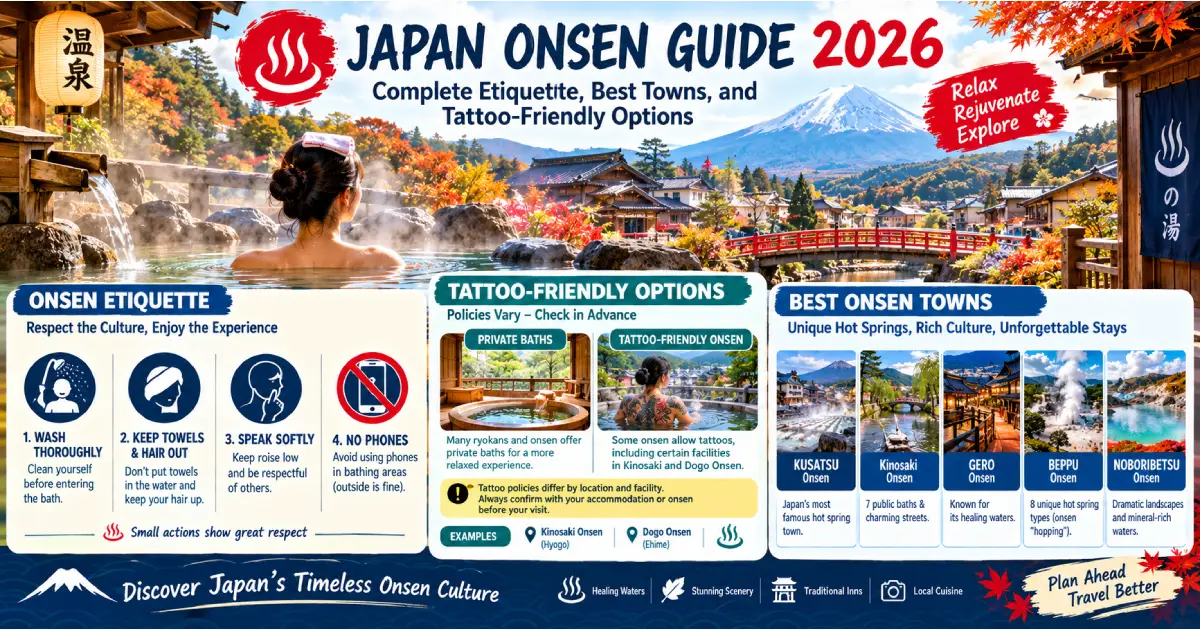
Japan sits atop one of the most volcanically active landscapes on Earth, and the country has turned that geology into a defining cultural institution: over 27,000 registered onsen (natural hot spring) sources nationwide, feeding everything from humble neighborhood bathhouses to elaborate mountain ryokan with private outdoor pools overlooking a forest or coastline. For a first-time tier-1 visitor, onsen culture is simultaneously one of the most rewarding and most anxiety-inducing parts of a Japan trip — rewarding because there’s genuinely nothing comparable in most Western wellness culture, anxiety-inducing because the etiquette (full nudity, strict pre-wash requirements, and still-unresolved tattoo restrictions at many traditional establishments) catches first-timers off guard in specific, avoidable ways. This guide covers the full etiquette walkthrough, the best onsen towns in Japan beyond the obvious Hakone recommendation, and the practical tattoo-friendly options available in 2026.
| Legal Definition | Water heated geothermally to 25°C+ containing at least one of 19 designated minerals |
| Onsen vs. Sento | Onsen uses natural hot spring water; sento uses regular heated tap water |
| Clothing | None — bathing is done fully nude; swimsuits are not permitted in traditional baths |
| Tattoos | Still restricted at many traditional establishments; tattoo-friendly options are growing |
| Typical Cost (public bathhouse) | ¥500–¥1,000 for a day visit |
| Typical Cost (ryokan with onsen, per person) | ¥15,000–¥50,000+, usually including dinner and breakfast |
Under Japanese law, water qualifies as onsen specifically if it emerges from the ground at 25°C (77°F) or above, or contains at least one of 19 officially designated mineral substances — sulfur, iron, sodium chloride, and carbon dioxide among the most common. Different mineral compositions are traditionally associated with different benefits in Japanese bathing culture: sulfur springs (recognizable by their distinct smell) for skin conditions, iron-rich springs for their reddish-brown water and warming properties, and sodium chloride springs for retaining heat longer after bathing — while modern medical evidence for these specific claims varies, the mineral variety is a genuine, noticeable part of what makes visiting different onsen regions a distinct experience rather than a repeat of the same bath.
Onsen uses naturally heated, mineral-rich groundwater sourced directly from a geothermal spring — the bathing format most associated with ryokan stays and dedicated hot spring towns. Sento are public bathhouses using regular heated tap water, historically serving urban residents without private bathing facilities at home — a specifically neighborhood, everyday institution rather than a destination experience, though sento follow largely the same washing and nudity etiquette as onsen and remain a worthwhile, genuinely local experience in any Japanese city.
The datsuijo (changing room) is where all clothing comes off before entering the bathing area — baskets or lockers are provided for your belongings, and a small modesty towel can be carried into the bathing area itself (though never into the water).
This is the single most important rule in onsen etiquette. The washing stations lining the bathing room’s walls — a low stool, a handheld showerhead, soap, and shampoo — exist because the communal bath itself is for soaking, not washing; sit at a station and wash your entire body thoroughly, rinsing all soap off completely, before approaching the bath.
The communal water is shared by every bather that day, sometimes for the bath’s entire operating hours before being drained and refreshed — nothing beyond your clean, rinsed body should enter the water itself.
Hair must be kept fully out of the water — tie it up or use a hair clip before entering the bath.
A small towel can be carried to and from the bath for modesty while walking, and is typically folded and placed on top of your head or set aside at the water’s edge while actually bathing — never submerged or used to cover yourself while in the water.
Onsen baths are for quiet soaking, not swimming or play — a calm, low-volume atmosphere is the expected norm throughout.
Some bathers give themselves a light rinse after soaking, before returning to the changing room, though this step is more personal preference than strict etiquette.
For the broader cultural context behind these specific rules, see our Japan Etiquette Guide.
Traditional Japanese inns (ryokan) frequently include their own onsen facilities — shared gender-segregated baths included in the room rate, and increasingly, private in-room or reservable baths (kashikiri-buro) for an additional fee, which sidestep both the communal nudity and the tattoo restriction many traditional shared baths maintain.
Standalone onsen facilities open to day visitors without requiring a ryokan stay — typically ¥500–¥1,000 for entry, found throughout Japan’s dedicated onsen towns and increasingly within major cities as well (see Spa World in Osaka, covered in our Things to Do in Osaka guide).
Open-air onsen baths, often the specific highlight of a ryokan stay — soaking outdoors while surrounded by forest, mountain, or coastal scenery (and, at some of Japan’s more famous rotenburo, falling snow in winter) is considered by many repeat visitors to be the single best version of the onsen experience.
Free or low-cost public foot baths, common in onsen towns’ main streets — a genuinely accessible, clothing-optional-free way to sample hot spring water without the full undressing and washing process, popular as a casual rest stop while exploring a town.
Covered in detail in our Day Trips from Tokyo and Mount Fuji Travel Guide, Hakone remains the most accessible onsen destination from Tokyo, combining hot spring ryokan with Mount Fuji views on clear days.
Widely considered among Japan’s top three onsen towns, Kusatsu’s central feature is the Yubatake (“hot water field”) — a dramatic, steaming wooden collection point where the town’s naturally acidic, high-volume spring water is channeled and cooled before distribution to the town’s many bathhouses and ryokan, illuminated at night and the visual centerpiece of the entire town.
Japan’s single highest-volume onsen source by output, Beppu is famous for its “Hells” (Jigoku) — a collection of dramatically colored, scalding-hot springs too hot for bathing but spectacular to view, including a vivid cobalt-blue pond and a boiling red “blood pond” — alongside dozens of bathable onsen facilities throughout the town, including sand baths where visitors are buried up to the neck in naturally heated volcanic sand.
A specifically atmospheric onsen town built along a willow-lined canal, Kinosaki is known for its seven distinct public bathhouses, each with different architecture and water characteristics — visitors traditionally stroll between them in yukata (light cotton robes) and wooden geta sandals provided by their ryokan, making bathhouse-hopping itself a core part of the town’s experience rather than a single destination bath.
Hokkaido’s premier onsen town, centered on Jigokudani (“Hell Valley”) — a volcanic crater with steaming vents and bubbling pools feeding the town’s mineral-diverse hot springs, considered among the widest variety of water types available in a single Japanese onsen town.
One of Japan’s oldest recorded onsen towns, with a documented history stretching back over a millennium, Arima is known specifically for two distinct water types found side by side: kinsen (“gold spring,” iron-rich and reddish-brown) and ginsen (“silver spring,” clear and carbonated) — easily combined with an Osaka or Kobe-based itinerary given its short train connection.
A small, remarkably preserved onsen town built along a narrow river gorge, Ginzan’s wooden, multi-story ryokan buildings — lit by gas lamps in the evening — create one of Japan’s most photogenic single streetscapes, particularly atmospheric under winter snowfall; genuinely remote and worth the extra travel effort for visitors seeking the most visually striking onsen town in the country.
Tattoos remain historically associated in Japan with organized crime (yakuza), and a meaningful number of traditional public onsen and bathhouses still refuse entry to visibly tattooed guests outright, though attitudes are gradually shifting, particularly at hotel-affiliated and more internationally oriented facilities. Practical options for tattooed visitors:
Most ryokan and dedicated onsen facilities provide a small modesty towel and yukata robe as part of the stay or entry fee, but it’s worth confirming in advance — some budget public bathhouses charge a small rental fee or expect visitors to bring their own towel. A hair tie (for anyone with longer hair) and any waterproof tattoo cover patches, if needed, are the two items worth packing specifically for an onsen visit beyond what’s typically provided.
About Travel Tourister Travel Tourister’s destination specialists have soaked across Japan’s onsen regions — Hakone’s Fuji-view rotenburo, Kusatsu’s steaming Yubatake, Kinosaki’s seven-bathhouse canal walk, and Ginzan’s snow-lit wooden streetscape — to put together a complete, practical onsen guide for 2026 first-time visitors.
Posted By : Vinay
Latest Article
2nd Floor, 39, Above Kirti Club, DLF Industrial Area, Kirti Nagar, New Delhi, Delhi 110015



Travel Tourister is a leading Travel portal where we introduce travellers to trusted travel agents to make their journey hasselfree, memorable And happy. Travel Tourister is a platform where travellers get Tour packages ,Hotel packages deals through trusted travel companies And hoteliers who are working with us across the world. We always try to find new and more travel agents and hoteliers from every nook and corners across the world so that you could compare the deals with different travel agents and hoteliers and book your tour or hotel with the one you have chosen according to your taste and budget.
Copyright © Travel Tourister, India. All Rights Reserved

 Call
Call Enquiry