Published on : 12 Oct 2026
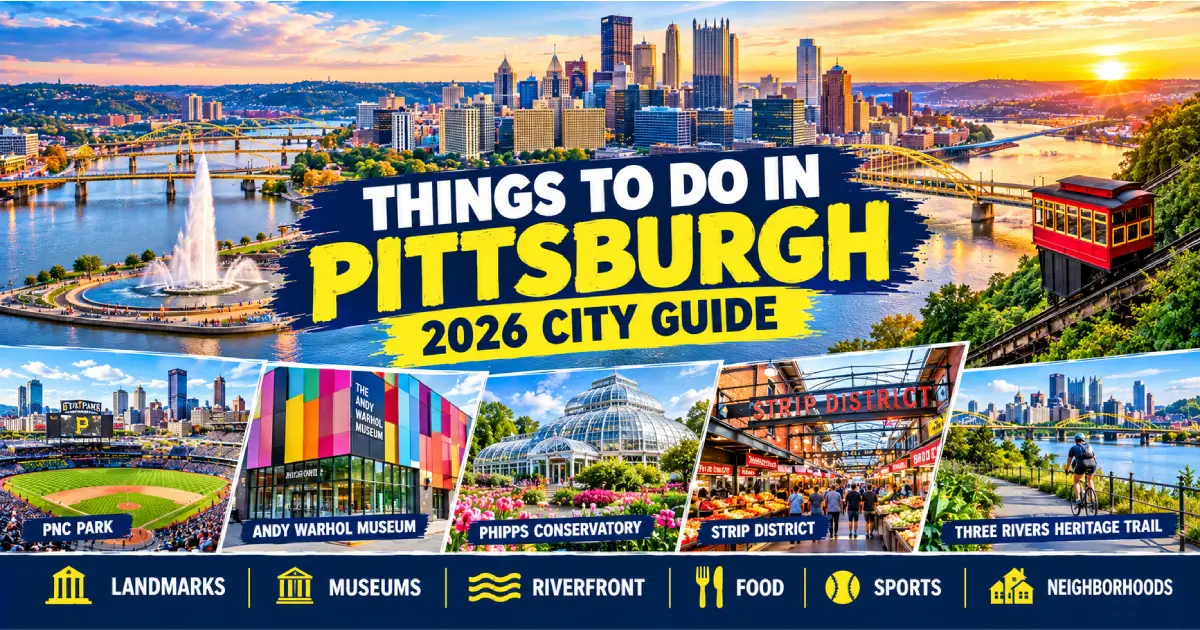
Pittsburgh is one of America’s great surprise cities — a place that visitors consistently leave raving about, usually having arrived with lower expectations than any city of its quality deserves. Built at the confluence of the Allegheny, Monongahela, and Ohio Rivers, Pittsburgh’s topography is dramatic and unusual: a city of hills, bridges (446 of them — more per capita than any city on earth), and neighborhoods perched on ridgelines that offer panoramic views in every direction. The skyline that appears when you emerge from the Fort Pitt Tunnel — the Golden Triangle framed by three rivers, with downtown towers rising behind it — is one of the most breathtaking urban vistas in America, and it sets the tone for everything that follows.
The former Steel City has undergone one of the most remarkable urban reinventions in American history. Where the steel mills once stood along the rivers, you now find world-class museums, thriving neighborhoods, parks, and bike trails. Carnegie Mellon University and the University of Pittsburgh have seeded a technology and biomedical research economy that draws young talent from across the country. Neighborhoods like Lawrenceville, East Liberty, and the South Side have developed vibrant restaurant and bar scenes without losing the working-class authenticity that makes Pittsburgh so immediately likeable. The city’s people — famously warm, fiercely loyal to the Steelers, and proud of their city in a way that is more joy than boast — are a significant part of the appeal.
From the world-class Carnegie Museums complex and the Andy Warhol Museum to Primanti Brothers sandwiches and Phipps Conservatory, from riding the historic Duquesne Incline to watching the Steelers at Acrisure Stadium, Pittsburgh offers a range of experiences that most visitors don’t expect — and the relatively modest size of the city means you can cover an extraordinary amount in a long weekend. This guide covers the best things to do in Pittsburgh in 2026, from the iconic to the wonderfully obscure.
| Category | Top Pick | Neighborhood |
|---|---|---|
| Best Museum | Carnegie Museum of Natural History | Oakland |
| Best Art | Andy Warhol Museum | North Shore |
| Best Views | Mount Washington Inclines | South Side |
| Best Market | Strip District | Strip District |
| Best Stadium Experience | Acrisure Stadium (Steelers) | North Shore |
| Best Park | Schenley Park | Oakland |
| Best Neighborhood Walk | Lawrenceville | East End |
| Best Garden | Phipps Conservatory | Oakland |
| Best Free Activity | Point State Park | Downtown |
| Best Day Trip | Fallingwater | Mill Run, PA |
The most iconic Pittsburgh experience — funiculars to the sky
Pittsburgh’s two surviving inclines — the Monongahela (1870) and the Duquesne (1877) — are among the oldest continuously operating funicular railways in the United States, and riding them to the top of Mount Washington is the single most essential Pittsburgh experience for any first-time visitor. The views from Grandview Avenue at the top are extraordinary: the entire Golden Triangle, the confluence of the three rivers, the bridges, the stadiums, and the downtown skyline laid out beneath you like a map.
The Monongahela Incline, the older of the two, departs from Station Square on the South Side and is the more popular choice for tourists. The Duquesne Incline, two blocks away, is slightly less crowded and has a small museum of Pittsburgh history at its upper station. At the top, Grandview Avenue offers arguably the finest urban panorama in Pennsylvania. Many visitors take one incline up, walk the Grandview Overlook, and return via the other. Sunset is the best time; the way the light catches the bridges and the river is genuinely spectacular.
The world’s largest museum dedicated to a single artist
The Andy Warhol Museum on Pittsburgh’s North Shore is the most important cultural institution the city has produced — a seven-story, 88,000-square-foot celebration of the life and work of Pittsburgh’s most famous native son. Warhol was born and raised in Pittsburgh (the son of Carpatho-Rusyn immigrant parents in the Oakland neighborhood), and the museum’s collection of over 9,000 works traces his extraordinary career from commercial illustrator to pop art icon.
Seven floors of galleries move chronologically through Warhol’s output: the early commercial work, the Campbell’s Soup Cans, the Marilyn silkscreens, the Death and Disaster series, the films, the Silver Factory era, and the late religious works. The time capsules — cardboard boxes Warhol packed with the ephemera of his daily life — are endlessly fascinating windows into his mind. The museum doesn’t merely celebrate Warhol; it contextualizes him within Pittsburgh, American consumer culture, and the 20th century in ways that make the work richer. Allow three hours minimum.
World-class science and art under one roof in Oakland
The Carnegie Museums complex in Pittsburgh’s Oakland neighborhood houses two of the finest museums in Pennsylvania: the Carnegie Museum of Natural History and the Carnegie Museum of Art, connected by a grand Beaux-Arts hall that itself feels like an attraction. Andrew Carnegie founded both in 1895 with the stated goal of bringing culture and knowledge to working people, and the results are extraordinary — collections that rival the great East Coast institutions at a fraction of the crowds.
Carnegie Museum of Natural History is most famous for its Dinosaur Hall — one of the finest in North America, with mounted Apatosaurus, Diplodocus, and Tyrannosaurus rex specimens that tower over visitors in a vast vaulted gallery. The Hillman Hall of Minerals and Gems, the Egyptian mummies, and the Hall of North American Wildlife are equally impressive. Allow 2–3 hours.
Carnegie Museum of Art holds a distinguished permanent collection spanning ancient Egypt through the 20th century, with particular strengths in Impressionism, decorative arts, and American painting. The Scaife Galleries are the finest modern art spaces in western Pennsylvania. Allow 1.5–2 hours.
Pittsburgh’s most vibrant market district — food, culture, and street life
The Strip District is a narrow neighborhood running along the Allegheny River north of downtown that has been Pittsburgh’s wholesale market district since the 1800s. Today it’s the city’s most dynamic food destination — a mile-long stretch of produce markets, specialty food importers, fishmongers, bakeries, spice merchants, and restaurant supply stores that serves the professional kitchen trade but welcomes anyone who loves good food.
Saturday morning is the time to visit: the sidewalks fill with the weekly farmers market, vendors set up carts of pierogies (Pittsburgh’s unofficial food), and the permanent stalls of Wholey’s Fish Market, Pennsylvania Macaroni Company, and Lotus Food Company are doing peak business. The breakfast sandwich from Smallman Galley or the Italian market food at Penn Mac are essential stops. The Strip also now has excellent coffee (La Prima Espresso, Pittsburgh’s finest Italian-style espresso), whiskey bars (Wigle Whiskey, Pittsburgh’s first distillery since Prohibition), and evening restaurants that have transformed it into an all-day destination.
Where three rivers meet — Pittsburgh’s geographic and symbolic heart
Point State Park occupies the tip of the Golden Triangle at the confluence of the Allegheny, Monongahela, and Ohio Rivers — the most historically significant location in Pittsburgh, the site of Fort Duquesne (French, 1754) and Fort Pitt (British, 1758), and the strategic pivot point of the French and Indian War. Today it’s a 36-acre park with a 150-foot fountain (one of the largest in the US), river access, sweeping views of the North Shore stadiums and bridges, and the Fort Pitt Museum in a reconstructed bastion.
The park is beautiful at all hours, but particularly so in the golden hour before sunset when the fountain catches the light. The Roberto Clemente Bridge (6th Street Bridge) connecting downtown to the North Shore is closed to vehicles on Pirates game days and becomes a pedestrian promenade, one of the most pleasant game-day rituals in American professional sports. The Fort Pitt Museum ($8) traces the colonial history of the confluence with excellent exhibits.
The finest Victorian greenhouse in America
The Phipps Conservatory in Schenley Park is one of the most beautiful public buildings in Pittsburgh — a stunning Victorian glass greenhouse built in 1893 by Andrew Carnegie’s business partner Henry Phipps, and subsequently expanded to include 23 distinct garden rooms under glass. The permanent collection spans tropical forests, orchid rooms, a fern room, a Japanese courtyard, and a butterfly forest; the seasonal shows (Holiday Magic, Spring Flower Show, Summer Orchid Show) are among the most attended events in Pittsburgh.
The conservatory has undergone significant sustainability upgrades and is now one of the greenest public gardens in the US — a LEED platinum facility powered partly by solar and geothermal energy. The outdoor gardens are free to enter and beautifully maintained. The indoor experience, especially in winter when it’s warm, humid, and fragrant with tropical plants while snow falls outside, is genuinely magical.
America’s most storied franchise on the banks of the Ohio
Acrisure Stadium (formerly Heinz Field) sits on the North Shore of the Ohio River with extraordinary views of the Pittsburgh skyline from the stands — one of the most scenic NFL venues in America. The Steelers are the most successful franchise in NFL history (six Super Bowl championships), and the passion of Pittsburgh’s fans — who bring their Terrible Towels to games worldwide — is legendary. A Steelers home game is one of the great American sports experiences.
Single-game tickets are available through StubHub and secondary markets for most games (expect $80–$250 for regular season depending on opponent; playoff games are nearly impossible without season ticket holder connections). The pre-game atmosphere on the North Shore — the strip of bars and restaurants along the riverfront, the Roberto Clemente Bridge walkway, the statue of Art Rooney outside the stadium — is worth experiencing even if you can’t get a ticket to the game itself.
The most beautiful ballpark in America
PNC Park, opened in 2001 on the North Shore adjacent to Acrisure Stadium, is consistently ranked the most beautiful baseball stadium in America — and the argument is hard to dispute. The Roberto Clemente Bridge frames right field; the Pittsburgh skyline rises beyond center field; and the stadium sits right on the Allegheny River with a pedestrian promenade running the perimeter. On a clear day, watching baseball here with the city glittering behind the outfield is a genuinely transcendent experience.
The Pirates have been rebuilding in recent years, but baseball at PNC Park hardly requires a pennant race to be worthwhile — the stadium itself is the attraction. Seats are affordable (as low as $12 for outfield bleachers) and the atmosphere on summer evenings, particularly for Friday night fireworks games, is festive and family-friendly. The Clemente Bridge pedestrian walkway closes to traffic for home games and becomes one of the great pre-game gathering places in American baseball.
Pittsburgh’s most vibrant neighborhood for art, food, and nightlife
Lawrenceville, stretching along Butler Street about two miles northeast of downtown, has been Pittsburgh’s most exciting neighborhood for over a decade — a place where former steel-worker rowhouses now host some of the best restaurants, bars, galleries, and boutiques in western Pennsylvania. The neighborhood has a genuine creative energy without yet feeling like it’s been polished smooth; the grit and the glamour exist side by side in a way that gives it authenticity.
Butler Street is the artery: a mile-long stretch of independent restaurants (Cure, Piccolo Forno, Spirit), coffee shops (Espresso a Mano, the city’s finest espresso), design boutiques, vintage shops, and nightlife venues. The Arsenal building on Penn Avenue has been converted into studios and galleries. The Lawrenceville Farmers Market runs on Sundays. Saturday and Sunday afternoons are ideal for a long neighborhood walk with stops for coffee, food, and browsing.
Pittsburgh’s Central Park — 456 acres of trails and landscape
Schenley Park is Pittsburgh’s magnificent answer to Central Park — 456 acres of wooded hills, meadows, trails, and recreational facilities given to the city by Mary Schenley in 1889, located adjacent to the University of Pittsburgh and Carnegie Mellon University in the Oakland neighborhood. The park contains Phipps Conservatory, the Schenley Park Café, tennis courts, a golf course, cross-country ski and running trails, and the Panther Hollow Lake.
The park is at its most spectacular in spring (dogwood and redbud blooming), autumn (deciduous foliage across the hillsides), and winter (cross-country skiing on groomed trails after snow). The Flagstaff Hill outdoor cinema — an annual summer film series showing classic movies on a hillside meadow — is one of Pittsburgh’s most beloved traditions, drawing crowds of thousands on warm summer nights.
The world’s second-tallest educational building — a Pittsburgh icon
The Cathedral of Learning at the University of Pittsburgh is one of America’s most remarkable academic buildings — a 42-story, 535-foot Gothic tower built between 1926 and 1937 that dominates the Oakland skyline and serves as the administrative and instructional center of Pitt’s campus. The building is extraordinary from the outside, but the interior is where it truly astonishes: the Commons Room, a vaulted Gothic hall four stories high, is one of the most dramatic interior spaces in Pennsylvania.
The Nationality Rooms on the building’s lower floors are a unique feature: 31 classrooms designed and furnished by Pittsburgh’s ethnic communities to reflect their cultural heritage, ranging from a Syrian classroom with Damascus tilework to an Early American room, a Chinese room, and a Lithuanian classroom. The rooms are in active educational use but offer tours on weekends. The 36th-floor Observatory provides a 360-degree panoramic view of Pittsburgh that rivals the Inclines.
The legendary Pittsburgh sandwich that defines the city’s food culture
Primanti Brothers is to Pittsburgh what deep-dish pizza is to Chicago — a local food institution that divides its fanbase into those who consider it a genuine culinary treasure and those who see it as beloved tourist kitsch, but that everyone agrees you have to try. The Original sandwich (invented in the Strip District in 1933) is a feat of working-class genius: meat of your choice (capicola, kielbasa, or grilled fish) layered with coleslaw and thick-cut french fries all between two slices of Italian bread, designed so steelworkers could eat a full meal with one hand.
The original Strip District location is still the most atmospheric, though Primanti Brothers now has locations across western Pennsylvania. The experience is part of the city’s DNA — the décor is vintage Pittsburgh (black and gold, Steelers memorabilia, old newspaper front pages), the service is brusque and cheerful, and the sandwiches are enormous. Order the Pittsburgher (double egg and cheese with capicola) and the Iron City beer for the full effect.
Hands-on science, a real submarine, and a planetarium
The Carnegie Science Center on the North Shore, steps from PNC Park and Acrisure Stadium, is one of the best science museums in Pennsylvania — a hands-on facility with over 250 interactive exhibits on robotics, sports science, space, and natural phenomena that appeal equally to children and adults. The USS Requin, a WWII-era submarine docked outside the museum, is one of only a few preserved fleet submarines open to the public in the US.
The Buhl Planetarium shows are the finest in the region; the Omnimax Theater offers the full dome experience; and the SportsWorks section uses physics demonstrations applied to Pittsburgh’s beloved sports (testing reaction time, throwing accuracy, and sports biomechanics) in ways that are genuinely entertaining. On weekends and school holidays, the museum fills with families — plan 3–4 hours.
The most radical contemporary art museum you’ve never heard of
The Mattress Factory is one of the most distinctive contemporary art museums in America — a former warehouse complex in the Mexican War Streets neighborhood of the North Side that specializes in large-scale, site-specific installations by artists who come to Pittsburgh to conceive and build works directly in the space. The permanent collection includes work by Yayoi Kusama (her Infinity Mirror Rooms, installed at the Mattress Factory before she became globally famous), James Turrell (whose light installations here are among the best on the East Coast), and a rotating roster of temporary commissions.
The experience of moving through rooms that have been transformed by artists working at full scale is unlike anything available in a conventional gallery setting. The Mattress Factory’s modest size (two buildings on a quiet residential block) and unpretentious presentation make the work feel immediate and personal rather than institutional. Allow 2–3 hours.
24 miles of riverside trail connecting Pittsburgh’s neighborhoods
The Three Rivers Heritage Trail is a paved, flat multi-use trail running 24 miles along the three Pittsburgh rivers — connecting the North Shore, the Strip District, the South Side, and the Point in a continuous loop. It’s one of the finest urban cycling routes in America, offering close river access, bridge crossings, views of the city’s industrial waterfront, and connections to Lawrenceville, the South Side Works, and the Waterfront retail district in Homestead.
Bike rentals are available from the Point at Healthy Ride (Pittsburgh’s bike-share system) or from shops in the Strip District. A full circuit takes 2–3 hours at a casual pace; most visitors ride a segment rather than the full loop. The trail passes under several of Pittsburgh’s famous bridges (the historic South Side has six bridges in quick succession) and through the former steel mill zones that have been converted to parks and retail.
One of only four accredited combined zoo and aquarium facilities in the US
The Pittsburgh Zoo and Aquarium in Highland Park is one of the finest combined facilities of its kind in the country — 77 acres of naturalistic animal habitats housing over 4,000 animals from 475 species, including a PPG Aquarium that is one of the best freshwater and marine facilities in the mid-Atlantic region. The African Savanna exhibit (lions, giraffes, zebras in a large, naturalistic environment), the Kids Kingdom (giraffe feeding, kangaroo walkthrough), and the sea lion and shark exhibits are all outstanding.
The zoo is particularly good in spring and early fall, when the animals are most active and the grounds are beautiful. Summer heat sends many animals indoors during peak afternoon hours; arrive at opening time for the best viewing. The aquarium section is excellent year-round and a good option during inclement weather.
The greatest house in America — 90 minutes from downtown Pittsburgh
Fallingwater in Mill Run, Pennsylvania, 90 minutes southeast of Pittsburgh, is one of the most important buildings in architectural history — Frank Lloyd Wright’s 1937 house for the Kaufmann family, built over a waterfall in the Laurel Highlands. It is consistently ranked among the finest works of architecture in America and draws visitors from around the world who come to see how Wright achieved his vision of a house growing organically from its landscape.
Tours are the only way to see the interior, and they range from a basic hour-long tour ($34–$42) to extended experiences that include the guest house and special architect-led tours. The grounds around the house — walking trails along Bear Run Creek, views of the waterfall from below and above — are extraordinary in all seasons. Combine with a stop at Kentuck Knob (another Wright house, 8 miles away, $26) for a full day of architectural pilgrimage.
Pittsburgh’s most energetic nightlife strip — and much more
East Carson Street on Pittsburgh’s South Side is the city’s most famous entertainment strip — a mile-long stretch of bars, restaurants, live music venues, and clubs that has been the center of Pittsburgh nightlife since the 1970s. It’s also more than that: the surrounding neighborhood is one of the most architecturally intact working-class streetcar neighborhoods in America, with Victorian brick rowhouses, corner stores, and neighborhood institutions that give it a texture that distinguishes it from generic entertainment districts.
During the day, East Carson Street offers independent boutiques (ModCloth started here), excellent coffee (Commonplace Coffee), and brunch spots that draw long weekend queues. The Porch at Schenley is a famous bar. At night, the street transforms — live music at Club Café and the Rex Theater, dozens of bars serving Pittsburgh’s beloved Iron City and Penn Brewery beers, and a general sense of festivity that continues until well past midnight. The South Side Slopes — a neighborhood of Victorian houses ascending the hillside above the Flats — offer extraordinary views and some of Pittsburgh’s best neighborhood walking.
A hidden gem in the Allegheny foothills west of Pittsburgh
The Pittsburgh Botanic Garden in Settler’s Ridge, opened in 2015, is a 460-acre botanical garden and natural landscape preserve on the western edge of the Pittsburgh metro — one of the largest botanical garden sites in Pennsylvania. Still developing its plantings and infrastructure, the garden already offers excellent woodland trails, a Japanese woodland garden, a historic oak grove, and seasonal wildflower meadows that are extraordinary in late April and May.
Less crowded than Phipps Conservatory and offering a more naturalistic experience, the Pittsburgh Botanic Garden is the ideal choice for visitors who want extended trail time in a botanical setting. The fall color here — particularly in the native woodland sections — is excellent in October. Admission is modestly priced and parking is free.
31 countries, one building — Pittsburgh’s most underrated experience
Beyond the Cathedral of Learning, the University of Pittsburgh campus in Oakland is one of the finest early 20th-century institutional landscapes in America — a collection of Gothic and Romanesque buildings centered on the Cathedral that includes the Heinz Memorial Chapel (arguably the finest collegiate Gothic chapel in the US, with remarkable stained glass), the Soldiers and Sailors Memorial Hall and Museum, and the Stephen Foster Memorial.
The Nationality Rooms tour ($4) is among the best-value experiences in Pittsburgh: 31 classrooms decorated by Pittsburgh’s ethnic communities — Syrian, early American, Chinese, Lithuanian, African, Korean, and 25 others — that together constitute a global journey through design traditions. The rooms are actively used for teaching (Pitt students have class in the room that resembles a Damascus merchant’s hall), which gives them a vitality that museum displays rarely achieve.
Western Pennsylvania’s most comprehensive history museum
The Heinz History Center in the Strip District is the largest history museum in Pennsylvania and a Smithsonian affiliate — a six-floor institution housed in a former ice warehouse that covers western Pennsylvania’s history from the pre-contact era through the 20th century. The Great Hall’s exhibits on Pittsburgh’s steel industry are the finest of their kind, with actual mill equipment, oral history recordings, and documentary photography that capture the scale and human cost of the industrial era.
The Western Pennsylvania Sports Museum (floors 5 and 6) is a nationally ranked sports museum covering Pittsburgh’s extraordinary sports heritage: the Steelers’ six Super Bowls, Roberto Clemente and the Pirates, the Penguins’ Stanley Cups, and Pittsburgh’s broader contribution to American sports culture. The French and Indian War gallery, covering the 1754–1763 conflict that began at Pittsburgh’s confluence, is among the finest in the US.
446 bridges — more per capita than any city on earth
Pittsburgh’s claim to 446 bridges is not marketing hyperbole — it is a consequence of the city’s topography (three rivers, 90 distinct neighborhoods on hills divided by river valleys) and its industrial heritage as a steel-producing city that had the material to build. The bridges range from the extraordinary to the functional, but several are architectural masterpieces worth seeking out specifically.
The Three Sisters Bridges (Roberto Clemente, Andy Warhol, and Rachel Carson) are three nearly identical self-anchored suspension bridges — the only set of three such bridges in the world — connecting downtown to the North Shore. The Smithfield Street Bridge (1883, the oldest surviving Lenticular truss bridge in the US) connects downtown to the South Side. The Birmingham Bridge offers extraordinary views of the river and downtown. A walking or cycling bridge tour, crossing three or four of these structures in an afternoon, is one of the most distinctive things you can do in Pittsburgh.
The National Historic Landmark roller coaster park
Kennywood in West Mifflin, 10 miles from downtown Pittsburgh, is one of the oldest and most beloved regional amusement parks in the United States — a National Historic Landmark that has operated continuously since 1898 and preserves three of its original wooden roller coasters (the Jack Rabbit, the Racer, and the Thunderbolt). Pittsburgh families have been coming here for generations, and the park’s combination of historic attractions and modern thrill rides creates a nostalgic atmosphere unlike any corporate theme park.
The Thunderbolt, ranked among the finest wooden coasters in America, was built in 1924 and modified in 1968 to add a dramatic blind drop at the start. The Steel Curtain, opened in 2019 (named after the famous Steelers defensive line), is a steel coaster with nine inversions and a 220-foot-tall first hill. The Potato Patch fries — hand-cut, served with a variety of toppings — are a Kennywood tradition that predates most of the rides.
The most concentrated arts district between New York and Chicago
Pittsburgh’s Cultural District in downtown is a 14-block neighborhood of historic theaters, performance venues, and arts spaces managed by the Pittsburgh Cultural Trust that together make Pittsburgh one of the most significant performing arts cities in the mid-Atlantic. The Benedum Center for the Performing Arts (a restored 1928 movie palace, home of the Pittsburgh Ballet Theatre and Pittsburgh Opera), the Heinz Hall (home of the Pittsburgh Symphony Orchestra), the August Wilson African American Cultural Center, and the O’Reilly Theater are all within walking distance.
The Pittsburgh Symphony Orchestra, under Music Director Manfred Honeck, is one of the finest in America — a subscription season running October through May and a summer Pops series that draws excellent programming. Single-ticket sales are available through the Cultural Trust box office or the individual venues. Broadway touring productions stop at the Benedum regularly.
Roberto Clemente, Honus Wagner, Willie Stargell — Pittsburgh’s heroes in bronze
The North Shore Riverfront between PNC Park and Acrisure Stadium is one of the most pleasant urban waterfront walks in America — a landscaped promenade along the Ohio River connecting the two stadiums and offering views of the downtown Golden Triangle, the bridges, and the Point. Along the walk, bronze statues of Pittsburgh’s greatest sports icons create an outdoor gallery of heroes.
Roberto Clemente (outside PNC Park), Honus Wagner (the famous original 1955 statue moved from Forbes Field), Willie Stargell, and Ralph Kiner represent the Pirates’ immortals. Art Rooney (the beloved Steelers founder) and other franchise legends are near Acrisure Stadium. The walk is free, open at all hours, and beautiful at sunset or at night when the stadium lights reflect on the river.
Getting Around: Pittsburgh is a driving city — the hill topography makes walking between neighborhoods challenging. Uber and Lyft are widely available. The Port Authority bus network is extensive but routes are complex for first-time visitors. The Pittsburgh Inclines are the most scenic way to cross between Mount Washington and the South Side.
When to Visit: May–June and September–October offer the best combination of weather, events, and outdoor access. Steelers games (September–January) sell out; Pirates games (April–September) are usually available.
Pittsburgh Accent: Pittsburghers speak a recognizable regional dialect — “yinz” (you + ones = second person plural), “dahntahn” (downtown), and “Stillers” (Steelers). It’s beloved by locals and charming to visitors.
Food Must-Haves: Primanti Brothers sandwich, pierogies (anywhere in the Strip District), Klavon’s ice cream (Strip District, since 1923), Conflict Kitchen (rotating global cuisine from countries the US is in conflict with — a genuinely unique Pittsburgh institution).
Posted By : Vinay
Latest Article
2nd Floor, 39, Above Kirti Club, DLF Industrial Area, Kirti Nagar, New Delhi, Delhi 110015



Travel Tourister is a leading Travel portal where we introduce travellers to trusted travel agents to make their journey hasselfree, memorable And happy. Travel Tourister is a platform where travellers get Tour packages ,Hotel packages deals through trusted travel companies And hoteliers who are working with us across the world. We always try to find new and more travel agents and hoteliers from every nook and corners across the world so that you could compare the deals with different travel agents and hoteliers and book your tour or hotel with the one you have chosen according to your taste and budget.
Copyright © Travel Tourister, India. All Rights Reserved

 Call
 Enquiry