Published on : 15 Oct 2026
Published: October 15, 2026 — Thursday (Announcement date: August 18, 2026 · Source: American Airlines official press release)
American Airlines is reversing one of the most criticised decisions in its recent history.
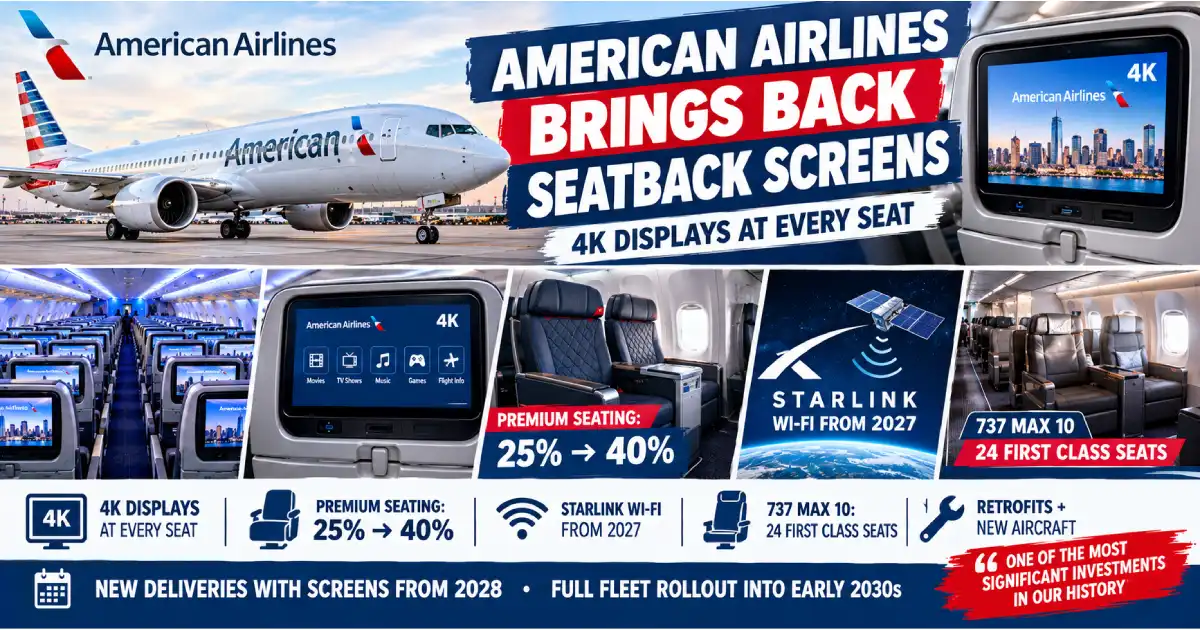
Nine years after stripping seatback entertainment screens from its narrowbody aircraft — a move made in 2017 on the bet that passengers preferred streaming content to their own devices — American Airlines announced on August 18, 2026 that individual seatback screens will return to every seat across its entire narrowbody fleet.
The announcement, made from Fort Worth, Texas, is the most significant domestic product investment American Airlines has made in over a decade. It covers not just the screen reversal — which would be news enough on its own — but a comprehensive cabin transformation that includes a 40 percent premium seating target, 24 First Class seats on new Boeing 737 MAX 10 deliveries, Starlink satellite Wi-Fi from 2027, Bluetooth audio support, USB-C fast charging at every seat, premium dining partnerships with Champagne Bollinger and Lavazza, and a lounge expansion programme.
Chief Customer Officer Heather Garboden confirmed the scale: “From next-generation seatback entertainment at every seat to substantially more premium seating options, these enhancements will give our customers more ways to relax, stay connected and enjoy their journey.”
If you fly American Airlines domestically — on any of the dozens of city pairs the carrier operates across the US — this announcement directly affects what your experience looks like from 2027 onwards.
Published: October 15, 2026 Announcement date: August 18, 2026 Announced by: American Airlines, Fort Worth, Texas Chief Customer Officer quote: “From next-generation seatback entertainment at every seat to substantially more premium seating options, these enhancements will give our customers more ways to relax, stay connected and enjoy their journey.” — Heather Garboden, American Airlines Chief Customer Officer American called it: “One of the most significant investments in onboard experience in our history”
SEATBACK SCREENS:
PREMIUM SEATING EXPANSION:
WI-FI:
PREMIUM DINING:
CONTEXT — why the reversal:
American Airlines app: aa.com → Flight amenities section updated Flight search showing screen availability: aa.com → Seat Map → look for IFE icon
In 2017, American Airlines made a bet that turned out to be wrong.
The airline decided to remove seatback entertainment screens from its single-aisle — narrowbody — aircraft on the basis that personal devices had made them redundant. Why spend money installing and maintaining screens, the argument went, when every passenger has a smartphone, tablet, or laptop? American rolled out an app-based streaming service called American Airlines Entertainment and told its fleet of A319s, A320s, A321s, Boeing 737s, and 737 MAX aircraft they would fly without individual screens.
Delta Air Lines never followed. United Airlines followed briefly and then reversed. Both of those carriers spent the years between 2017 and 2026 offering a more complete product on domestic routes while American remained the only major full-service US carrier with essentially no embedded entertainment across its standard narrowbody fleet.
The practical reality of American’s approach was visible to anyone who flew a domestic American route: passengers frantically downloading content before boarding because in-flight Wi-Fi was unreliable, screens on economy seats blank or absent, and the experience sitting measurably below what Delta or United offered on the same route for the same fare. For a carrier positioning itself as the premium domestic airline — with higher Business Select fares, an expanded premium cabin strategy, and a revamped Admirals Club lounge programme — the absence of seatback screens was an increasingly visible contradiction.
August 18, 2026 is the day that contradiction ended. American announced it as part of a broader press release describing a “sweeping transformation” of its narrowbody fleet. The corporate language was unusually direct about the competitive gap that had opened: the move is designed to “bring the onboard product of its narrowbody fleet closer to the level traditionally associated with long-haul aircraft.”
American is not simply reinstalling the screens it removed in 2017. It is installing a next-generation entertainment platform that will offer, according to the airline, some of the largest displays available on any narrowbody aircraft in North America.
The technology confirmed:
The new seatback screens will offer 4K ultra-high-definition resolution — the same picture quality standard now common on long-haul widebody aircraft including American’s own Boeing 787 and Airbus A321XLR fleet. On a narrowbody aircraft flying a domestic two or three-hour route, 4K resolution is a meaningful upgrade over the standard HD screens that competed carriers offer.
Bluetooth wireless audio connectivity allows passengers to connect their own earbuds or headphones directly to the screen — eliminating the adapter requirement and the audio quality degradation that wired connections through older seat-mounted audio jacks produce. This is a detail that frequent flyers specifically will notice: being able to use your AirPods Pro or Sony WH-1000XM5 directly with the seatback screen without any adapter.
USB-C fast charging at every seat ensures that passengers emerge from domestic flights with more battery life than when they boarded — a practical benefit that has become a baseline expectation rather than a luxury, and one that American has historically been inconsistent at delivering on narrowbody aircraft.
When the screens arrive:
New narrowbody aircraft deliveries from 2028 onwards — both Airbus and Boeing — will feature screens from the factory. The retrofit programme for American’s existing narrowbody fleet begins now (2026) and will complete across the majority of the fleet by the early 2030s.
This timeline means passengers on American’s domestic network will experience an inconsistent product for several years. Some aircraft will have the new screens. Others will not. American’s seat map and booking tools are being updated to show which specific aircraft has which configuration, allowing passengers to choose flights with the new IFE installed where it matters to them.
What aircraft are included and excluded:
Included: All Airbus narrowbodies (A319, A320, A321, A321neo) and all Boeing narrowbodies (737 MAX 8, 737 MAX 10) — both new deliveries and existing retrofit candidates.
Already equipped: Wide-body aircraft (Boeing 777, 787-8, 787-9) — more than 140 aircraft already have seatback screens — plus the A321XLR.
Not included: Regional aircraft operated under the American Eagle brand (Embraer ERJ-175, ERJ-145, Bombardier CRJ-900) — these are not part of this announcement.
The premium seating expansion announcement is, in commercial terms, potentially the larger story of the two.
American is targeting a premium seating share of approximately 40 percent of narrowbody departures — up from approximately 25 percent today. That is a 60 percent increase in the proportion of premium seats on American’s domestic narrowbody flights. It means that on a typical 150-seat narrowbody American flight, approximately 60 seats will be in a premium category, versus approximately 37-38 today.
What counts as “premium seating” in American’s framework:
First Class: The front cabin with wider seats, more pitch, full meal service, dedicated overhead bin space, and priority boarding/deplaning. American offers this on virtually all narrowbody routes.
Main Cabin Extra: American’s extra-legroom economy product — positioned behind First Class — with several additional inches of legroom compared to standard Main Cabin, complimentary beverages, and priority boarding.
Preferred seats: Window and aisle seats in the first several rows of the Main Cabin, offered at a modest premium for the convenience of the location rather than the physical product.
What is changing specifically:
On new Boeing 737 MAX 10 deliveries, American is configuring the aircraft with 24 First Class seats — a meaningfully expanded business class section versus the standard narrowbody First Class configuration. The 737 MAX 10 is the largest single-aisle aircraft in Boeing’s current production lineup, seating up to 230 passengers in a standard two-class configuration, and 24 First Class seats represents a proportionally generous business cabin.
On the Airbus A321neo fleet, additional premium seating will be added — specific reconfiguration details will follow later.
On the A319/A320 retrofit programme — which is already underway — an extra First Class row is being added to existing aircraft. This is happening now, ahead of the wider screen rollout.
Main Cabin Extra is also expanding across the majority of the narrowbody fleet, meaning more passengers will have access to the extra-legroom economy product.
The commercial logic:
Premium seats generate significantly more revenue per seat than standard economy — typically three to five times more per available seat mile on domestic routes. Increasing premium capacity from 25% to 40% of the narrowbody fleet is a meaningful revenue strategy, not just a passenger experience one. It reflects American’s broader 2026 commercial strategy to compete more directly with Delta’s premium domestic product, which has consistently outperformed American on ancillary revenue and customer satisfaction scores.
The Starlink announcement may arrive sooner than the screens and deliver a more immediate practical benefit to regular American Airlines passengers.
American will begin installing high-speed Starlink satellite Wi-Fi on its narrowbody fleet in 2027 — ahead of the 2028 new delivery date for the seatback screens. Starlink, SpaceX’s low-Earth orbit satellite internet constellation, has established a track record across multiple airlines — including Hawaiian Airlines, JSX, and United Airlines — of delivering materially faster and more reliable in-flight connectivity than the previous generation of satellite and air-to-ground Wi-Fi systems.
Why Starlink is a meaningful upgrade:
American’s current narrowbody Wi-Fi — primarily Viasat-based — has been a consistent source of passenger complaints, particularly on domestic routes where the aircraft spends relatively little time at cruise altitude before beginning its descent. Slow speeds, connection drops, and paid tiers that delivered disappointing performance have been recurring themes in passenger feedback.
Starlink’s low-Earth orbit positioning means lower latency and higher bandwidth compared to geostationary satellite systems. On flights where Starlink is installed, passengers can realistically expect to video call, stream, and work in the way they do on the ground — at whatever speed tier the airline chooses to offer.
American has not yet confirmed whether Starlink Wi-Fi on narrowbody aircraft will be free, tiered, or subscription-based. Given that the announcement paired Starlink with the premium product push, a free-for-premium, paid-for-economy model seems the most likely initial structure — consistent with the approach that United Airlines has taken with its own Starlink rollout.
Delta Air Lines:
Delta never removed seatback screens from its narrowbody aircraft. While American and United were betting on personal devices, Delta was installing upgraded screens — including seatback entertainment on its A220 fleet and retrofitting Bluetooth audio support across its domestic narrowbodies. Delta’s domestic product has consistently outscored American’s in J.D. Power US Airline Satisfaction surveys, and aviation analysts have attributed much of that gap to the entertainment experience.
With American’s August 18 announcement, Delta’s screen advantage begins to close — but only on paper until 2028 at the earliest. For the next two to three years, Delta will still offer a more consistent domestic IFE experience on more aircraft.
United Airlines:
United took a similar device-first approach to American in the mid-2010s but reversed course earlier and more aggressively. Under its United Next programme announced in 2021, United committed to installing seatback screens across its entire narrowbody fleet — a programme that is well advanced by 2026. United’s Boeing 737 MAX 10 aircraft already feature 22 First Class seats and large seatback screens.
American’s announcement mirrors United’s strategy closely — 24 First Class on 737 MAX 10 versus United’s 22, 4K screens versus United’s screens — and positions American to match United’s domestic product eventually, though the retrofit timelines mean United maintains an advantage in the near term.
The competitive conclusion:
For the first time in nearly a decade, American Airlines is making a credible claim to be competitive with Delta and United on domestic narrowbody product. It will take until the early 2030s to fully realise — but the direction, the investment commitment, and the specific product targets are now public and confirmed.
If you are flying American Airlines domestically today (October 2026):
Existing aircraft do not yet have the new screens. The retrofit is underway but will take years. Check the seat map when booking — American is updating its booking tools to reflect which aircraft have been retrofitted and which have not.
If you are flying American Airlines in 2027:
Starlink Wi-Fi will begin appearing on retrofitted narrowbody aircraft from 2027. The first aircraft to receive Starlink will likely be the most-travelled routes and highest-yielding markets. Check aa.com for the most current Starlink rollout information.
If you are flying American Airlines on new aircraft from 2028:
New A319, A320, A321neo, A321XLR, and Boeing 737 MAX deliveries from 2028 will have the full new screen platform installed from delivery. These will be distinguishable by the larger screens in premium cabins.
If you want an A319/A320 with the extra First Class row:
The A319/A320 retrofit adding an extra First Class row is underway now. Check the seat map on your specific booking — aircraft that have undergone this retrofit will show more First Class seats on the seat map. These retrofits are being completed progressively through 2026–2027.
Which routes get the new aircraft first:
American typically deploys new narrowbody deliveries on its highest-demand routes first — Dallas-Fort Worth, Los Angeles, Miami, Chicago O’Hare, New York JFK and LaGuardia, Charlotte Douglas, and Phoenix Sky Harbor. If you fly those routes regularly, the new 737 MAX 10 with 24 First Class seats and 4K screens will appear in your booking options before lower-frequency routes.
The loyalty programme impact:
American AAdvantage status members at Platinum, Platinum Pro, and Executive Platinum levels receive complimentary upgrade access to First Class on eligible domestic flights. With 24 First Class seats on 737 MAX 10 aircraft versus the standard configuration, there will be more upgrade availability on those aircraft — which is a direct material benefit for AAdvantage elite members who rely on domestic upgrades as part of their travel experience.
| Upgrade | Status | When |
|---|---|---|
| Extra First Class row (A319/A320 retrofit) | ✅ UNDERWAY NOW | 2026–2027 |
| Starlink Wi-Fi narrowbody fleet | 🔜 CONFIRMED | From 2027 |
| 4K seatback screens — new deliveries | 🔜 CONFIRMED | From 2028 |
| 4K seatback screens — fleet retrofit | 🔜 UNDERWAY | 2026 → early 2030s |
| 24 First Class seats — 737 MAX 10 | 🔜 CONFIRMED | From 2028 deliveries |
| A321neo premium reconfiguration | 🔜 CONFIRMED | Later — TBC |
| Premium seating 25% → 40% target | 🔜 IN PROGRESS | “Coming years” |
| Champagne Bollinger + Lavazza premium dining | ✅ CONFIRMED | Select cabins — underway |
| Resource | Website | What For |
|---|---|---|
| American Airlines newsroom | news.aa.com | Official announcement + press release |
| American Airlines fleet map | aa.com/flightinfo | Check which aircraft has which amenities |
| Manage booking + seat map | aa.com → Manage Trip | View seat configuration for your flight |
| AAdvantage loyalty programme | aa.com/aadvantage | Upgrade eligibility + status benefits |
| American Airlines customer care | aa.com/contact | 1-800-433-7300 |
Related Articles:
Posted By : Vinay
This article is provided for general informational purposes only and is based on information available at the time of publication. Travel advisories, airline schedules, airport operations, visa requirements, government regulations, and other travel-related information are subject to change without prior notice. While Travel Tourister makes reasonable efforts to verify information using official announcements, government publications, airline and airport communications, and other reliable sources, we cannot guarantee that all information remains complete, accurate, or up to date at all times. Readers should independently verify any information that may affect their travel plans with the relevant airline, airport authority, government agency, embassy, or other official source before making travel, financial, or other decisions. Travel Tourister shall not be liable for any direct or indirect loss, inconvenience, or damages arising from the use of or reliance on the information contained in this article. Nothing in this publication constitutes legal, immigration, financial, or professional travel advice. If you believe any information in this article is inaccurate or outdated, please contact our editorial team. We review all credible correction requests promptly and update our content whenever appropriate.
Lastest News
2nd Floor, 39, Above Kirti Club, DLF Industrial Area, Kirti Nagar, New Delhi, Delhi 110015



Travel Tourister is a leading Travel portal where we introduce travellers to trusted travel agents to make their journey hasselfree, memorable And happy. Travel Tourister is a platform where travellers get Tour packages ,Hotel packages deals through trusted travel companies And hoteliers who are working with us across the world. We always try to find new and more travel agents and hoteliers from every nook and corners across the world so that you could compare the deals with different travel agents and hoteliers and book your tour or hotel with the one you have chosen according to your taste and budget.
Copyright © Travel Tourister, India. All Rights Reserved

 Call
Call Enquiry