Published on : 07 Feb 2026
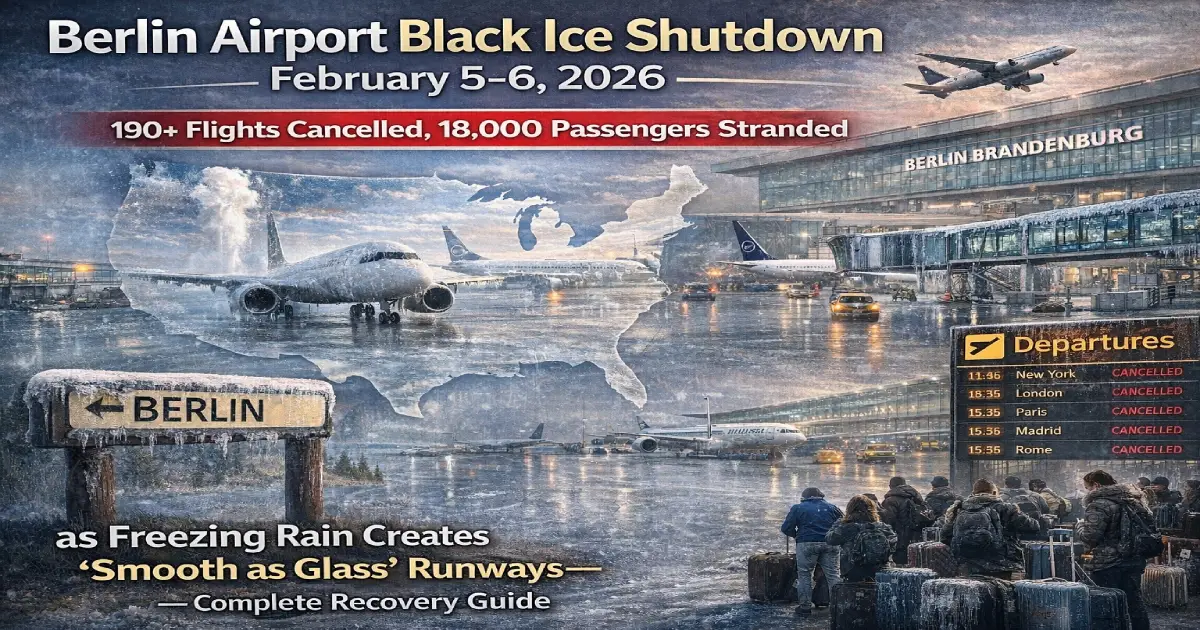
Breaking: Berlin Brandenburg Airport (BER) completely shut down for 48 hours as black ice turned runways “smooth as glass,” forcing airlines to cancel 190+ flights and strand 18,000 passengers on February 5-6, 2026. The unprecedented closure at Germany’s third-busiest airport sent shockwaves through European air networks as freezing rain made de-icing impossible. Here’s everything affected travelers need to know now.
Published: February 7, 2026 Closure Began: February 5, 2026, 6:00 PM CET Operations Resume: February 6, 2026, 3:30 PM (limited) Flights Cancelled: 190+ in 48 hours Passengers Affected: 18,000+ Recovery Timeline: Full operations expected Monday, February 9
Starting February 5, 2026 at 6:00 PM CET, every flight at Berlin Brandenburg Airport ground to a halt when black ice coated runways and taxiways. De-icing crews worked through Thursday night spraying glycol, but the chemical froze instantly—rendering standard winter operations completely useless.
“Currently, we have freezing rain and black ice, and we cannot yet predict when takeoffs and landings will be possible,” the airport stated on its website, a message that remained posted for nearly 20 hours straight.
Timeline of the Crisis:
🕐 Thursday, Feb 5, 6:00 PM – Airport suspends all departures, most arrivals 🕘 Thursday, Feb 5, 9:00 PM – Over 120 flights cancelled within first 3 hours 🕐 Friday, Feb 6, 1:00 AM – Airport confirms closure extends through Friday 🕞 Friday, Feb 6, 3:30 PM – Limited operations resume with major delays 🕘 Saturday, Feb 7 – Fog and ice warnings, potential renewed disruptions 🕘 Sunday, Feb 8 – More freezing rain forecast overnight 🕘 Monday, Feb 9 – Full recovery targeted
Unlike snow—which can be plowed—black ice forms when freezing rain hits surfaces at or below 0°C (32°F), creating a transparent layer airport crews described as “smooth as glass.”
Winter service teams treated the airfield throughout Thursday night with de-icing agents, but without success. The surfaces remained dangerously slippery as of Friday morning at 7:30 AM. Clearing machines were deployed on the airfield, but the airport confirmed restarting operations would not be possible.
Why De-Icing Failed:
“Due to weather conditions, no take-offs or landings are currently possible,” the airport posted repeatedly on X (formerly Twitter) and its official website.
According to FlightAware data, more than 190 flights were cancelled at Berlin Brandenburg Airport during the 48-hour disruption period—affecting both domestic and international routes critical to US, UK, and Canadian travelers.
Major Airlines Hit:
✈️ Lufthansa – Germany’s flagship carrier diverted multiple inbound services to Leipzig/Halle and Dresden airports ✈️ easyJet – BER’s second-largest operator cancelled dozens of short-haul European flights ✈️ Qatar Airways – Long-haul Doha service delayed 18+ hours ✈️ United Airlines – Newark and JFK-bound flights pushed back 12-24 hours ✈️ Ryanair – Multiple cancellations to UK, Ireland, Mediterranean ✈️ Eurowings – Domestic connections to Munich, Hamburg, Cologne affected
Friday’s Breakdown (as of 8:30 AM EST):
Approximately 18,000 passengers were directly impacted by the cancellations, with thousands more experiencing cascading delays as the airport worked through the backlog.
American, British, and Canadian travelers were among those hardest hit—particularly those with connecting flights or cruise ship embarkations.
Affected Transatlantic Routes:
🇺🇸 Berlin → New York JFK (United, Lufthansa) 🇺🇸 Berlin → Newark (United) 🇬🇧 Berlin → London Heathrow (British Airways, easyJet) 🇬🇧 Berlin → Edinburgh, Manchester (Ryanair, easyJet) 🇨🇦 Berlin → Toronto via Frankfurt/Munich (Air Canada, Lufthansa) 🇮🇪 Berlin → Dublin (Ryanair, Aer Lingus)
Many North American travelers heading to or from Berlin for February half-term break found themselves stranded or forced to rebook through alternative European hubs including Frankfurt, Amsterdam, Paris—all of which experienced their own winter weather challenges simultaneously.
Black ice is a thin, transparent layer of ice that forms when freezing rain falls on surfaces with temperatures at or below 0°C (32°F). It’s “black” because it’s nearly invisible—and extremely slippery.
Unlike snow:
❌ Can’t be plowed ❌ Salt doesn’t work on aircraft surfaces ❌ Forms instantly with freezing rain ❌ Creates hidden dangers ❌ Standard de-icing chemicals freeze before working
Berlin’s Specific Problem:
Airport operators explained the conditions at BER were particularly treacherous because glycol de-icing spray was freezing on contact rather than melting the ice. With continuous freezing rain, no treatment could work effectively.
Aircraft braking distances increased dramatically. Steering during taxiing became more complicated. Black ice created hidden dangers for ground crews working around aircraft.
“In such weather conditions, the risk to flight safety increases dramatically,” Berlin Brandenburg Airport officials stated. “The braking distance of aircraft increases and steering during taxiing and landing becomes more complicated.”
Berlin Brandenburg Airport began a phased reopening on Friday afternoon, February 6, 2026 after temperatures rose slightly and crews completed extensive ice removal operations.
Current Recovery Timeline:
Friday Afternoon (Feb 6): First departures resume with delays Saturday (Feb 7): Fog and ice expected overnight—potential renewed disruptions Sunday (Feb 8): Full operations targeted pending weather Monday (Feb 9): Normal schedule expected to resume
Airport officials warned travelers to expect continued disruptions through Sunday, February 8 as the German Weather Service (DWD) forecast more freezing rain Saturday night.
Airlines are working to reaccommodate affected passengers, but limited aircraft availability and crew scheduling restrictions mean some travelers may face delays of 24-48 hours or longer.
Under EU Regulation 261/2004, passengers affected by the Berlin airport shutdown have specific rights—though weather-related cancellations are considered “extraordinary circumstances” that typically exempt airlines from paying monetary compensation.
✅ Free rebooking on next available flight to your destination ✅ Full refund if you choose not to travel ✅ Meals and refreshments during delays:
❌ Monetary compensation (€250-€600) for weather-related delays ❌ Reimbursement for separately booked connecting flights ❌ Compensation for missed cruise departures
Important Exception: If the airline failed to have adequate de-icing equipment or proper winter preparation, passengers MAY be able to claim compensation under EU261. Experts note that winter ice in Germany during February is NOT considered “extraordinary,” meaning airlines could be liable if they were unprepared.
“Flight delays or cancellations due to snow can be extremely frustrating, but airlines still have a duty of care to passengers, and must provide clear information about their rights to assistance or a refund,” explains Rory Boland, Editor of Which? Travel.
Immediate Steps for Affected Passengers:
1️⃣ Check flight status on your airline’s app or website before heading to airport 2️⃣ Contact airline directly via phone, app, or customer service desk 3️⃣ Request rebooking to next available flight at no additional charge 4️⃣ Request refund if you no longer wish to travel (airline must process within 7 days) 5️⃣ Keep all receipts for meals, accommodation, transport for insurance claims
Alternative Routing Options:
✈️ Reroute through Frankfurt (FRA), Munich (MUC), or Düsseldorf (DUS) 🚄 Consider Deutsche Bahn high-speed rail to nearby cities ✈️ Check alternative airports: Leipzig/Halle (LEJ) or Dresden (DRS)
Deutsche Bahn waived exchange fees for passengers holding BER rail-fly combination tickets, though train services also experienced speed reductions on high-speed lines due to ice.
Travelers with comprehensive travel insurance may be covered for additional expenses incurred during the Berlin airport shutdown.
Typical Coverage Includes:
💰 Trip delay benefit – Reimbursement for meals, accommodation after 3+ hour delay 💰 Missed connection coverage – Additional costs if you missed a separately-booked connection 💰 Trip interruption – Costs to continue journey or return home 💰 Cancel for any reason (CFAR) – May allow partial refund even for weather (if purchased within 14-21 days of initial trip payment)
What Travel Insurance Does NOT Cover:
❌ Compensation if airline already provided meals/hotel ❌ Delays under 3 hours ❌ Expenses without receipts/documentation ❌ Pre-existing conditions that prevented travel
“Keep all documentation that can help with filing a claim, including receipts for meals and accommodations, proof from your airline of the delay and the reason, and an updated itinerary showing the length of the delay,” advises Lauren McCormick of Squaremouth insurance comparison site.
The black ice crisis extended far beyond Berlin Brandenburg Airport, creating transportation chaos across northern and eastern Germany.
Other Systems Affected:
🚗 Roads – Multiple accidents reported, 19 people injured on Autobahn 10 near Potsdam 🚄 Rail – Deutsche Bahn reduced speeds on high-speed line to Hannover, delays on Berlin-Hamburg route 🚇 Public Transit – Berlin’s S-Bahn, U2, U3 lines experienced significant delays and suspensions 🏥 Hospitals – Between 30-40 people per day admitted to Berlin emergency departments with slip injuries including broken wrists and concussions
On Monday alone, police reported 201 accidents across the Berlin region.
Environmental Controversy:
Environmental regulations ban salt use on footpaths in Berlin, worsening conditions. The city relies on less-effective alternatives that couldn’t combat the persistent ice.
Local lawmakers attempted to temporarily suspend the salt ban law, but the Berlin Administrative Court intervened, saying Berlin authorities had no legal right to suspend a nationwide law.
The German Weather Service (DWD) issued its highest ice warning (level 3) for the capital region, cautioning that conditions posed a danger to life and limb.
The Berlin airport shutdown is part of a broader pattern of winter disruption across Europe in early 2026:
January-February 2026 European Chaos:
🇳🇱 Amsterdam Schiphol – Over 3,200 flights cancelled in January due to de-icing fluid shortage 🇫🇷 Paris CDG – 900km traffic jams in early January as vacationers departed during snowfall 🇬🇧 London Gatwick, Heathrow, Manchester – 1,805 flight delays and 98 cancellations on January 3 🇬🇧 Birmingham Airport – Closed entirely during Storm Goretti with 99 mph winds 🇨🇦 Toronto Pearson – 984 flights grounded by 40cm snowstorm on January 16
Weather experts note European airports are experiencing an unusually prolonged winter with multiple severe weather events creating cascading disruptions across the continent’s interconnected air network.
1️⃣ Contact your airline immediately for rebooking options 2️⃣ Join airline’s social media channels for real-time updates 3️⃣ Save all receipts for out-of-pocket expenses 4️⃣ Check if your credit card offers trip delay protection 5️⃣ File travel insurance claim within required timeframe (typically 20-30 days)
1️⃣ Monitor Berlin airport status at www.ber.berlin-airport.de 2️⃣ Check weather forecasts for your travel dates 3️⃣ Consider purchasing trip protection insurance if not already covered 4️⃣ Allow extra time for connections through European hubs 5️⃣ Download airline apps for push notifications on flight changes 6️⃣ Sign up for flight status alerts via text/email
1️⃣ Book refundable fares or tickets with flexible change policies 2️⃣ Buy comprehensive travel insurance within 14 days of initial trip deposit 3️⃣ Build extra buffer days into itineraries for weather delays 4️⃣ Keep emergency contact info for airlines and travel insurance providers 5️⃣ Pack essentials in carry-on in case checked bags are delayed
Aviation experts note European airports face unique challenges during winter weather compared to North American hubs:
Key Challenges:
📉 Compact airport layouts leave less room for snow storage and equipment 📉 Environmental regulations restrict salt and chemical use 📉 Aging infrastructure at some major hubs not designed for extreme weather 📉 De-icing fluid logistics complicated by Brexit and supply chain issues 📉 Hub-and-spoke networks mean one airport’s problems cascade across continent
The Berlin incident highlighted ongoing vulnerability in European aviation infrastructure, particularly as climate change creates more unpredictable winter weather patterns.
The German Weather Service (DWD) predicts conditions may improve slightly during Saturday daytime hours, but drizzling rain could return in the evening, potentially turning to ice overnight.
Fog and ice are forecast for Saturday night into Sunday morning—which could complicate airport operations again.
Travelers with weekend flights through Berlin Brandenburg Airport should remain flexible and prepare for potential additional disruptions.
Last Updated: February 7, 2026, 10:00 AM CET Current Status: Airport operating with delays, full recovery expected Monday, February 9 Official Updates: www.ber.berlin-airport.de
For More Resources:
Related Articles:
Posted By : Vinay
This article is provided for general informational purposes only and is based on information available at the time of publication. Travel advisories, airline schedules, airport operations, visa requirements, government regulations, and other travel-related information are subject to change without prior notice. While Travel Tourister makes reasonable efforts to verify information using official announcements, government publications, airline and airport communications, and other reliable sources, we cannot guarantee that all information remains complete, accurate, or up to date at all times. Readers should independently verify any information that may affect their travel plans with the relevant airline, airport authority, government agency, embassy, or other official source before making travel, financial, or other decisions. Travel Tourister shall not be liable for any direct or indirect loss, inconvenience, or damages arising from the use of or reliance on the information contained in this article. Nothing in this publication constitutes legal, immigration, financial, or professional travel advice. If you believe any information in this article is inaccurate or outdated, please contact our editorial team. We review all credible correction requests promptly and update our content whenever appropriate.
Lastest News
2nd Floor, 39, Above Kirti Club, DLF Industrial Area, Kirti Nagar, New Delhi, Delhi 110015



Travel Tourister is a leading Travel portal where we introduce travellers to trusted travel agents to make their journey hasselfree, memorable And happy. Travel Tourister is a platform where travellers get Tour packages ,Hotel packages deals through trusted travel companies And hoteliers who are working with us across the world. We always try to find new and more travel agents and hoteliers from every nook and corners across the world so that you could compare the deals with different travel agents and hoteliers and book your tour or hotel with the one you have chosen according to your taste and budget.
Copyright © Travel Tourister, India. All Rights Reserved

 Call
Call Enquiry