Published on : 08 Apr 2026
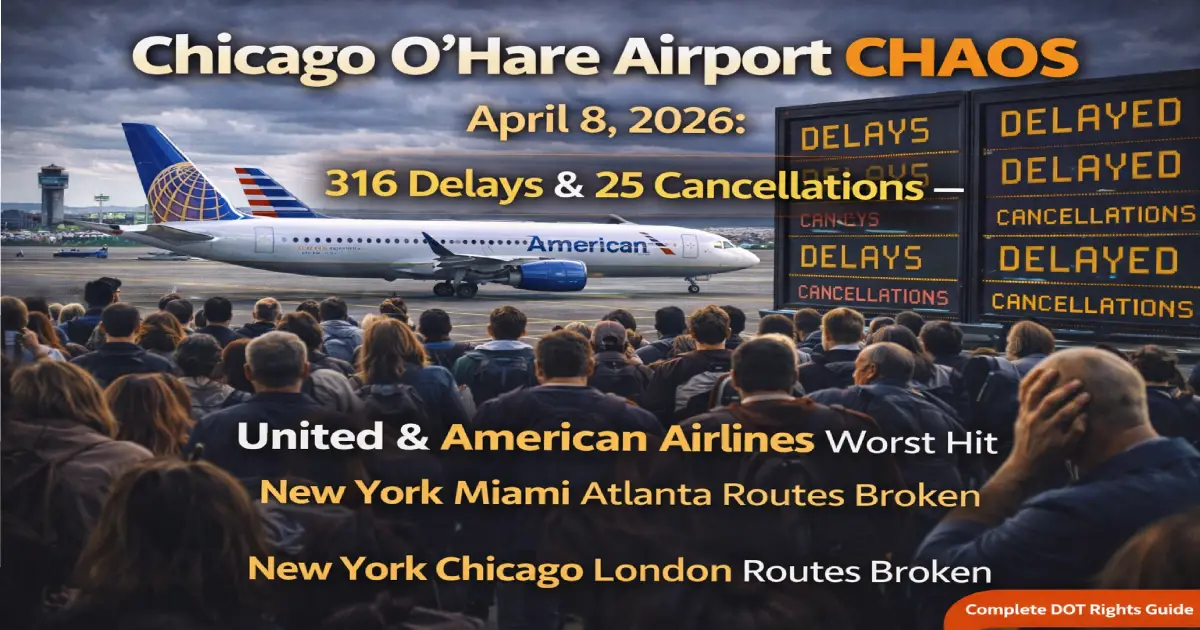
Breaking: Chicago O’Hare International Airport is recording its sixth consecutive day of significant disruption on Wednesday, April 8, 2026. A total of 341 flight disruptions — 316 delays and 25 cancellations — are tearing through one of the world’s most congested aviation hubs as the post-Easter network cascade collides with a new spring weather system pushing across the Midwest. United Airlines — which operates O’Hare as its second-largest global hub after Houston — is absorbing the dominant share of today’s disruption. American Airlines, which dramatically expanded its Chicago footprint with 100 new daily departures this spring, is the second worst-hit carrier. SkyWest, as the dominant regional carrier feeding both United and American at ORD, is amplifying every mainline disruption into cascading passenger impact. Routes to New York, Miami, Atlanta, Los Angeles, London, Toronto, and Frankfurt are all fractured. Nationally, 3,963 delays and 415 cancellations have been confirmed across all US airports today — and Chicago O’Hare, as a primary transmission node for disruption across the entire North American network, is both a victim and a vector of that national pain. If you are flying through ORD today, here is every number, every carrier, and exactly what you are owed.
Published: April 8, 2026 — Wednesday Airport: Chicago O’Hare International Airport (ORD) Total Disruptions: 341 (316 delays + 25 cancellations) Worst Carrier: United Airlines — dominant share of disruptions at its second-largest global hub Second Worst Carrier: American Airlines — 100 new daily ORD departures added spring 2026, all now exposed to the cascade Regional Cascade Amplifier: SkyWest Airlines — 96 cancellations + 332 delays nationally, feeding both United and American at ORD National Context (USA): 3,963 delays + 415 cancellations across all airports today Routes Broken: New York (EWR/JFK/LGA), Miami, Atlanta, Los Angeles, San Francisco, London Heathrow, Toronto, Frankfurt Passengers Affected at ORD: Est. 40,000–55,000 Primary Causes: Post-Easter aircraft and crew positioning cascade + new Midwest spring weather system + FAA traffic management programs + TSA structural understaffing + ATC staffing constraints at Chicago ARTCC ORD Annual Passengers: 80 million — world’s #4 busiest airport by passenger volume Consecutive Disruption Days at ORD: Day 6 — O’Hare has not had a normal operating day since Good Friday April 3
Chicago O’Hare International Airport is absorbing 341 total disruptions today — 316 delays and 25 cancellations — across an airport that handles 900+ daily flights and processes 80 million passengers annually. ORD is the world’s fourth-busiest airport by passenger volume, the second-largest hub for United Airlines globally, and the airport that American Airlines dramatically expanded in spring 2026 with 100 additional daily departures. When O’Hare is disrupted at this scale, the cascade does not stay in Illinois. It reaches New York within an hour. It reaches London overnight. It is felt in Miami, Atlanta, Los Angeles, Toronto, and Frankfurt simultaneously.
Today marks the sixth consecutive day that Chicago O’Hare has recorded significant disruption. The airport has not had a normal operating day since Good Friday, April 3 — the day a severe thunderstorm system triggered 1,247 delays and 419 cancellations, the worst single-day total in ORD’s recorded history. Each subsequent day has seen a smaller but still severe disruption count as the cascade slowly works through the system: 314 disruptions April 4, 727 disruptions April 5, 458 disruptions April 6, elevated disruptions April 7, and now 341 today. The system has not recovered. It is still running.
Four forces are sustaining today’s disruption at Chicago O’Hare:
🔴 Post-Easter aircraft and crew positioning cascade — Day 6 — every aircraft and every flight crew that was displaced during the Easter chaos of April 3–6 is still working its way back to its scheduled base position. United’s ORD rotation involves hundreds of individual aircraft legs per day. A single aircraft that ended Easter Sunday in the wrong city needs multiple completed legs before it is back in the right position — and with each leg running slightly late, the positioning deficit compounds rather than clears
🔴 New Midwest spring weather system — a fresh spring convective weather system is moving across Illinois today, bringing the threat of thunderstorms, gusty winds, and reduced visibility that force FAA traffic management programs at ORD. The Chicago Air Route Traffic Control Center — which manages high-altitude traffic throughout the entire Midwest region — is implementing ground delay programs that hold aircraft at origin airports before they can depart for O’Hare. Every aircraft held on the ground in New York, Miami, or Atlanta for a Chicago ground delay program is an aircraft that will arrive at ORD late, depart ORD late, and cascade its delay into the next city
🔴 ATC staffing constraints at Chicago ARTCC — the Chicago Air Route Traffic Control Center has operated below optimal controller staffing levels throughout spring 2026. In late March, a 90-minute ground delay occurred not from weather but purely from staffing limitations — a direct signal of systemic fragility. During severe weather, when controllers must implement traffic management programs and coordinate frequent re-routes, understaffed facilities extend recovery timelines significantly. Today, with weather and staffing pressure combining, the ARTCC is running at the edge of its operational capacity
🔴 TSA structural understaffing at ORD — TSA has lost nearly 500 workers nationally during the ongoing partial government shutdown. At O’Hare — which processes 80 million annual passengers across four terminals — checkpoint congestion is compressing departure windows for every flight. Passengers arriving at security lanes running 30–45 minutes slow are reaching gates during final boarding, forcing airlines to hold aircraft (delays) or close doors without them (missed connections)
The ripple from Chicago today is moving in every direction simultaneously. New York area airports are receiving delayed inbound aircraft from ORD. Miami, Atlanta, and Dallas are all both sending and receiving disrupted flights through Chicago’s hub structure. London Heathrow and Frankfurt are receiving late departures on United’s transatlantic services. Toronto is seeing its Air Canada and United transborder connections disrupted. Every city O’Hare touches today has an ORD disruption inside its own schedule.
| Metric | Number |
|---|---|
| Total Disruptions at ORD | 341 |
| Total Delays at ORD | 316 |
| Total Cancellations at ORD | 25 |
| Consecutive Disruption Days at ORD | 6 — unbroken since Good Friday April 3 |
| National Context (USA total) | 3,963 delays + 415 cancellations |
| Passengers Affected at ORD Today | Est. 40,000–55,000 |
| United Airlines Market Share at ORD | ~45% — dominant single carrier |
| American Airlines ORD Expansion (Spring 2026) | +100 daily departures — now ORD’s second-largest operator |
| ORD Daily Flight Operations | 900+ — world’s #4 airport by passenger volume |
| ORD Annual Passenger Volume | 80 million |
| United Global Ranking for ORD | #2 hub worldwide after Houston IAH |
| ORD Worst Day This Crisis (April 3) | 1,247 delays + 419 cancellations = 1,666 total disruptions |
Chicago O’Hare today is a two-carrier crisis concentrated at United and American, amplified by SkyWest’s national regional collapse, and felt across every carrier operating even a minor presence at the airport.
United Airlines is the story at Chicago O’Hare on April 8, 2026. With the dominant share of today’s 341 disruptions, United is absorbing the largest absolute volume of delays and cancellations at its second-largest global hub — numbers that reflect both the carrier’s commanding ORD presence and the still-unresolved crew and aircraft positioning failures from six days of consecutive disruption.
United Airlines operates Chicago O’Hare as its second-largest hub globally after Houston George Bush Intercontinental. With approximately 400 daily departures from ORD connecting 165+ destinations across North America, Latin America, Europe, Asia, and the Pacific, United’s ORD footprint is so large that its disruptions at O’Hare today are creating cascading effects at every other United hub simultaneously — Newark, Denver, San Francisco, Houston, and Los Angeles are all receiving late inbound aircraft from ORD.
United’s O’Hare operation is built around a banked hub schedule — concentrated waves of arrivals followed by rapid turnarounds and coordinated departure banks. This model delivers maximum connectivity but carries a catastrophic vulnerability: when the first arrival bank of the day runs late, every subsequent departure bank runs late. There is no mechanism to recover within the operating day. Today’s six-day positioning deficit means United’s first arrival bank at ORD was already running behind before the first aircraft pushed back from any gate anywhere in the country.
United has also delayed the launch of several new regional routes from O’Hare in response to FAA-imposed limits on hourly flight movements at ORD — a structural acknowledgment that the airport is operating at or above its demonstrated manageable capacity even on normal days. Today is not a normal day.
Most disrupted United Airlines routes from ORD today:
What United Airlines passengers at ORD must do right now: ✅ Open the United app immediately — self-service rebooking is your fastest tool; ORD customer service desks are overwhelmed today ✅ If delayed 3+ hours on a domestic flight, you are entitled to a full cash refund under DOT rules — you do not have to accept a rebooking or a travel credit ✅ Check united.com for active travel waivers — United has issued weather waivers for Chicago-affected routes that may permit free same-day changes ✅ Connecting to London, Frankfurt, or Tokyo through ORD today? Do not wait at the gate — rebook proactively on the United app before your connection window closes ✅ United Club locations at ORD: Terminal 1 (Concourse B and C), Terminal 2 (Concourse E) — open for members and Star Alliance Gold. United Polaris Lounge: Terminal 1 Concourse B — open for eligible Business Class passengers
American Airlines is today’s second-worst carrier at Chicago O’Hare — and the story of how it got there is one of the defining aviation decisions of spring 2026. American dramatically expanded its Chicago footprint this spring, adding 100 new daily departures from ORD in a strategic push to compete more aggressively with United on the airport’s most valuable domestic and connecting routes. That expansion means American now has approximately 200+ daily departures from ORD — every one of which is today exposed to the post-Easter cascade, the new Midwest weather system, and the FAA traffic management programs affecting inbound flow from across American’s entire network.
American’s Dallas Fort Worth super-hub — the origin city for many of its ORD inbound flights — is itself recording 454 delays and 77 cancellations today as the single most disrupted airport in the United States. That means the aircraft scheduled to arrive into ORD from DFW this morning and afternoon are arriving late from the worst-disrupted hub in the country. American’s ORD delays today are, in part, a direct downstream consequence of American’s DFW meltdown.
Most disrupted American Airlines routes from ORD today:
What American Airlines passengers at ORD must do: ✅ Use the American Airlines app — self-service rebooking is faster than any ORD queue today ✅ If delayed 3+ hours, demand a full cash refund under DOT rules — or accept a rebooking; the choice is yours ✅ Check aa.com/travelinfo for active travel waivers covering Chicago or your origin city ✅ Call American: 1-800-433-7300; be prepared for extended hold times nationally today ✅ Admirals Club at ORD: Terminal 3 Concourse K and Terminal 3 Concourse H — open for members
SkyWest Airlines is today’s hidden crisis at Chicago O’Hare — and its impact at ORD is far larger than its local gate count suggests. SkyWest operates as both United Express and American Eagle at O’Hare, feeding passengers from smaller US cities into United’s and American’s mainline connecting banks. With 96 cancellations and 332 delays nationally — the highest cancellation count of any carrier in the United States today — SkyWest’s collapse is simultaneously stranding thousands of feeder passengers across the country and flooding ORD’s United and American rebooking infrastructure with displaced connecting passengers.
When a SkyWest regional feeder is cancelled from Rockford, Madison, or a Midwest regional city, those passengers miss their United or American mainline connection at ORD. They then arrive at the United or American customer service desk at O’Hare needing a complete itinerary rebuild — adding to the queue for every other stranded passenger at the airport and compounding the service collapse at the gate agent level.
What SkyWest passengers at ORD must do: ✅ Contact United (1-800-864-8331) or American (1-800-433-7300) directly depending on which mainline carrier your itinerary is booked through — SkyWest operates under both systems at ORD ✅ If your SkyWest feeder is cancelled and your connection is missed, the mainline carrier is responsible for your rebooking ✅ DOT refund rights apply in full — a SkyWest cancellation within airline control entitles you to a full cash refund if you choose not to travel
Delta Air Lines is recording delays and cancellations at O’Hare today consistent with its ORD presence, which is substantially smaller than United’s or American’s but still significant on key domestic routes. Delta’s primary ORD connections serve Atlanta, Detroit, Minneapolis, and New York JFK — all cities that are themselves experiencing significant disruption today. Delta’s Atlanta hub is recording 114 delays and 15 cancellations; its Detroit hub is under strain nationally with 293 delays and 49 cancellations across the Delta system.
Most disrupted Delta routes from ORD today:
What Delta passengers at ORD must do: ✅ Use the Fly Delta app — self-service rebooking is faster than any ORD agent queue ✅ ORD → ATL today? Atlanta itself is recording 15 cancellations — allow 90-minute minimum connection buffer ✅ Call Delta: 1-800-221-1212 for rebooking assistance
Southwest Airlines does not operate from O’Hare — its Chicago base is Chicago Midway International Airport (MDW), 10 miles southwest of ORD. However, Southwest’s Midway operation is recording delays today consistent with the broader Midwest weather system. For ORD passengers who need same-day alternative routing, Midway is worth checking.
What Southwest passengers should know: ✅ If you need a same-day Chicago alternative: Chicago Midway (MDW) is 25–30 minutes from ORD by taxi or rideshare; check southwest.com for availability ✅ No change fees on Southwest — rebook free if your delay exceeds 3 hours ✅ Call Southwest: 1-800-435-9792
Chicago O’Hare is not merely a Midwest hub. It is one of the most important aviation transmission nodes on earth — the airport through which the disruption of one coast reaches the other, through which transatlantic services link the American interior to Europe, and through which every major US carrier’s connecting bank is tested daily. When ORD disrupts at this scale, every city it touches is inside the cascade.
| City | Airport | Impact Today |
|---|---|---|
| New York/Newark | EWR | United’s primary Northeast corridor from Chicago — under heavy strain |
| New York JFK | JFK | American and Delta corridors — JFK post-Easter pressure |
| New York LaGuardia | LGA | American East Coast shuttle — LGA recorded 341 disruptions April 7 |
| Miami | MIA | United and American Southeast connectors — MIA recording 384 delays today |
| Atlanta | ATL | Delta and American hub connectors — ATL recording 114 delays + 15 cancellations |
| Dallas/Fort Worth | DFW | American super-hub connector — DFW recording 531 disruptions today — worst in US |
| Houston IAH | IAH | United inter-hub connection — IAH recording 116 delays + 7 cancellations |
| Los Angeles | LAX | United and American West Coast corridors — LAX recording 71 delays today |
| San Francisco | SFO | United West Coast hub — SFO recording 58 delays + 5 cancellations |
| Denver | DEN | United Rockies hub connector |
| Washington Dulles | IAD | United primary DC hub connection |
| Philadelphia | PHL | American Northeast hub |
| Toronto | YYZ | United and Air Canada transborder — Toronto also disrupted independently |
| London Heathrow | LHR | United and American transatlantic — UK261 exposure for British passengers |
| Frankfurt | FRA | United primary ORD–Europe corridor — EU261 exposure |
| Madrid | MAD | Iberia/American codeshare — EU261 exposure |
| Tokyo Narita | NRT | United Pacific route — premium cabin affected |
| Cancún | CUN | United leisure Mexico route — peak spring season demand |
| Mexico City | MEX | United Mexico City hub connector |
O’Hare’s disruption cascade began on Good Friday, April 3, when a severe thunderstorm system triggered what was at that point the worst single-day disruption total in the airport’s recorded history — 1,247 delays and 419 cancellations. That single day displaced hundreds of aircraft and thousands of flight crew members from their scheduled base positions across the entire United and American networks. Recovering from that scale of displacement requires each affected aircraft to complete multiple on-time legs in sequence to return to its correct rotation. Six days later, that recovery is still in progress — because each subsequent day has brought additional weather events or residual scheduling pressure that has prevented the full completion of the positioning recovery cycle.
United and American both operate massive hub-and-spoke networks from O’Hare simultaneously — United with ~400 daily departures and American with ~200+ following its spring expansion. Unlike Dallas Fort Worth (where American holds ~80% market share and effectively owns the recovery timeline) or Atlanta (where Delta similarly dominates), Chicago O’Hare has two full competing hub operations trying to recover from the same disruption simultaneously. United’s recovery needs conflict with American’s recovery needs for the same limited runway slots, gate positions, and air traffic control resources. Neither carrier can optimise its own recovery without being constrained by the other’s simultaneous demand.
The Chicago Air Route Traffic Control Center manages high-altitude traffic for a region stretching from the Great Plains to the Atlantic seaboard. When ARTCC is understaffed — as it demonstrably was in late March 2026, when a 90-minute ground delay was triggered by staffing alone — the ripple from any Chicago weather or congestion event reaches every airport in the eastern half of the United States. The ARTCC is not just managing O’Hare; it is managing the airspace through which aircraft travel between the East Coast and the Midwest, between the Southeast and the Pacific Northwest. When that facility is under strain, the cascade is national — not local.
American Airlines’ strategic decision to add 100 daily departures from Chicago O’Hare in spring 2026 was driven by competitive logic — United had long dominated ORD, and American saw an opportunity to capture market share during a period of high spring travel demand. But the expansion created 100 new daily departure slots that are now all exposed to the post-Easter cascade simultaneously. These are not legacy American flights with years of crew and aircraft positioning optimised for Chicago — they are new additions, many operating with repositioned aircraft and crew that have less scheduling buffer built into their rotations. In a normal spring week, the expansion would have been a competitive success. In week six of the worst aviation disruption crisis since COVID, it is 100 additional points of failure at the worst-hit hub in the Midwest.
A departure board at O’Hare reading “On-Time” today is particularly dangerous information. Chicago’s hub structure — especially United’s banked schedule model — means that departure status at ORD is updated conservatively throughout the morning as airlines wait to confirm inbound aircraft positions before formally declaring a delay. By the time an ORD departure is officially marked “Delayed” on the board, the cascade that will affect the next three departures of that aircraft is already mathematically locked in.
How to verify your inbound aircraft right now:
Do this before you leave your hotel. At O’Hare today, the FlightAware inbound check is the only reliable piece of real-time information available to you. The departure board will tell you the truth eventually — FlightAware will tell you 2–3 hours earlier.
✅ Full cash refund to your original payment method — not a voucher, not a travel credit, not an airline eVoucher — if you choose not to travel ✅ Rebooking on the next available flight at no additional cost — the choice between refund and rebooking is yours, not the airline’s ✅ Meal vouchers during the wait — ask at the gate desk or airline kiosk immediately; do not wait for the airline to offer ✅ Hotel accommodation + transport if you are stranded overnight due to a cancellation within the airline’s control (mechanical, crew, staffing — not weather)
The exact words to say at the desk: “My flight has been cancelled. I am requesting a full cash refund to my original payment method under DOT rules.”
| Delay Duration | What Airlines Must Provide |
|---|---|
| 2+ hours | Meal vouchers — ask at the gate desk immediately |
| 3+ hours domestic | Right to full cash refund OR rebooking — your choice |
| Overnight stranding | Hotel accommodation + transport (controllable causes only) |
| 6+ hours international departure | Right to full refund regardless of cause |
Passengers on United Airlines, American Airlines, Lufthansa, or British Airways codeshare flights departing ORD for EU or UK destinations that are delayed 3+ hours at the final destination may be entitled to:
❌ Weather-caused delays and cancellations are classified as extraordinary circumstances — airlines are not required to provide hotel accommodation for weather cancellations ❌ The Trump administration cancelled the Biden-era mandatory delay payment rule — no automatic cash compensation for delays under current US DOT regulations ❌ Travel insurance purchased after the disruption has already begun does not cover today’s event ❌ Accepting a rebooking waives your cash refund right — decide which you want before speaking to an agent
Step 1 — Track your inbound aircraft before you leave for the airport Go to flightaware.com. Search your United or American flight number. Find where your specific aircraft is right now. If it has not yet departed New York, Miami, Dallas, or Los Angeles, your O’Hare departure will be late. Do this before you leave home — it is the only truly reliable piece of operational data available to you today.
Step 2 — Start rebooking on your carrier’s app before you arrive If your United or American flight is already delayed 2+ hours, begin rebooking before you reach ORD. The self-service apps process rebooking in minutes. Agent desk queues at O’Hare today are measured in hours. Every minute spent in a queue is a seat on an alternative flight gone.
Step 3 — Arrive 3 hours early minimum TSA checkpoint wait times at ORD are elevated across all four terminals today. Use the MyTSA app for live checkpoint wait times. United passengers: primary security at Terminals 1 and 2. American passengers: primary security at Terminal 3. International departures: Terminal 5. Know your terminal before you leave home.
Step 4 — Know your terminal — ORD has five terminals and they are not all physically connected Chicago O’Hare operates across five terminals connected by the Airport Transit System (ATS) train:
Within the secure area, use the ATS train (Airport Transit System) to move between terminals. It runs continuously. Do not exit security if connecting between United and American terminals — you would need to re-clear security, which is not advisable today given checkpoint wait times.
Step 5 — Ask for meal vouchers immediately if delayed 2+ hours Do not wait for the airline to offer. Walk to any gate agent desk and say: “My flight is delayed over two hours. I would like meal vouchers.” Airlines are legally required to provide them for controllable delays. Keep all food receipts from the moment of disruption — required for any travel insurance or DOT complaint.
Step 6 — If stranded overnight, demand hotel accommodation Ask at the United or American desk: “My flight has been cancelled due to [cause stated by the airline]. I need hotel accommodation tonight.” If the stated cause is mechanical or crew-related, hotel accommodation is legally required. ORD-area hotels with airport connections: Hilton Chicago O’Hare Airport (connected to Terminal 2 by walkway), Marriott O’Hare, Hyatt Rosemont, Westin O’Hare, Crowne Plaza Chicago O’Hare.
Step 7 — Consider Chicago Midway (MDW) as a Southwest alternative for domestic routes If you must travel domestically today and your ORD flight is cancelled, Chicago Midway International Airport is 25–30 minutes from O’Hare by taxi or rideshare. Southwest operates an extensive point-to-point domestic network from Midway that is structurally independent of O’Hare’s hub cascade — its disruptions today, while present, are substantially less severe than ORD’s. Check southwest.com for same-day availability before accepting a 24-hour ORD rebooking that may itself be at risk.
| Carrier | Phone | App | Status Page |
|---|---|---|---|
| United Airlines | 1-800-864-8331 | United app | united.com/flightstatus |
| United Express (SkyWest via United) | 1-800-864-8331 | United app | united.com/flightstatus |
| American Airlines | 1-800-433-7300 | AA app | aa.com/flightStatus |
| American Eagle (SkyWest via American) | 1-800-433-7300 | AA app | aa.com/flightStatus |
| Delta Air Lines | 1-800-221-1212 | Fly Delta | delta.com/flight-search/flight-status |
| Southwest (Midway) | 1-800-435-9792 | Southwest app | southwest.com/flight/retrieve |
| ORD Live Status | — | — | flychicago.com |
| FAA Live Delays | — | — | fly.faa.gov |
| FlightAware | — | FlightAware app | flightaware.com |
| DOT Complaints | — | — | airconsumer.dot.gov |
Wednesday April 8, 2026 at Chicago O’Hare International Airport means 341 total disruptions — 316 delays and 25 cancellations — on the sixth consecutive day of significant disruption since the Good Friday collapse of April 3. United Airlines is the worst carrier, absorbing the dominant share of disruption at its second-largest global hub. American Airlines — whose spring 2026 ORD expansion added 100 new daily departures, all now inside the cascade — is the second-worst carrier. SkyWest’s 96 national cancellations are amplifying the passenger impact at every United and American gate. New York, Miami, Atlanta, Dallas, London, Frankfurt, and Toronto are all in the ripple. Nationally, 3,963 delays and 415 cancellations have been confirmed. Chicago O’Hare has not had a normal operating day since April 3 — and today confirms that the cascade is still running.
If you are at ORD right now:
For More Resources:
Related Articles:
Sources: FlightAware, US Department of Transportation, Federal Aviation Administration, airport operations data, United Airlines Newsroom (hub.united.com), American Airlines Newsroom (news.aa.com), Chicago Department of Aviation (flychicago.com), — April 8, 2026
Posted By : Vinay
This article is provided for general informational purposes only and is based on information available at the time of publication. Travel advisories, airline schedules, airport operations, visa requirements, government regulations, and other travel-related information are subject to change without prior notice. While Travel Tourister makes reasonable efforts to verify information using official announcements, government publications, airline and airport communications, and other reliable sources, we cannot guarantee that all information remains complete, accurate, or up to date at all times. Readers should independently verify any information that may affect their travel plans with the relevant airline, airport authority, government agency, embassy, or other official source before making travel, financial, or other decisions. Travel Tourister shall not be liable for any direct or indirect loss, inconvenience, or damages arising from the use of or reliance on the information contained in this article. Nothing in this publication constitutes legal, immigration, financial, or professional travel advice. If you believe any information in this article is inaccurate or outdated, please contact our editorial team. We review all credible correction requests promptly and update our content whenever appropriate.
Lastest News
2nd Floor, 39, Above Kirti Club, DLF Industrial Area, Kirti Nagar, New Delhi, Delhi 110015



Travel Tourister is a leading Travel portal where we introduce travellers to trusted travel agents to make their journey hasselfree, memorable And happy. Travel Tourister is a platform where travellers get Tour packages ,Hotel packages deals through trusted travel companies And hoteliers who are working with us across the world. We always try to find new and more travel agents and hoteliers from every nook and corners across the world so that you could compare the deals with different travel agents and hoteliers and book your tour or hotel with the one you have chosen according to your taste and budget.
Copyright © Travel Tourister, India. All Rights Reserved

 Call
Call Enquiry