Published on : 23 May 2026
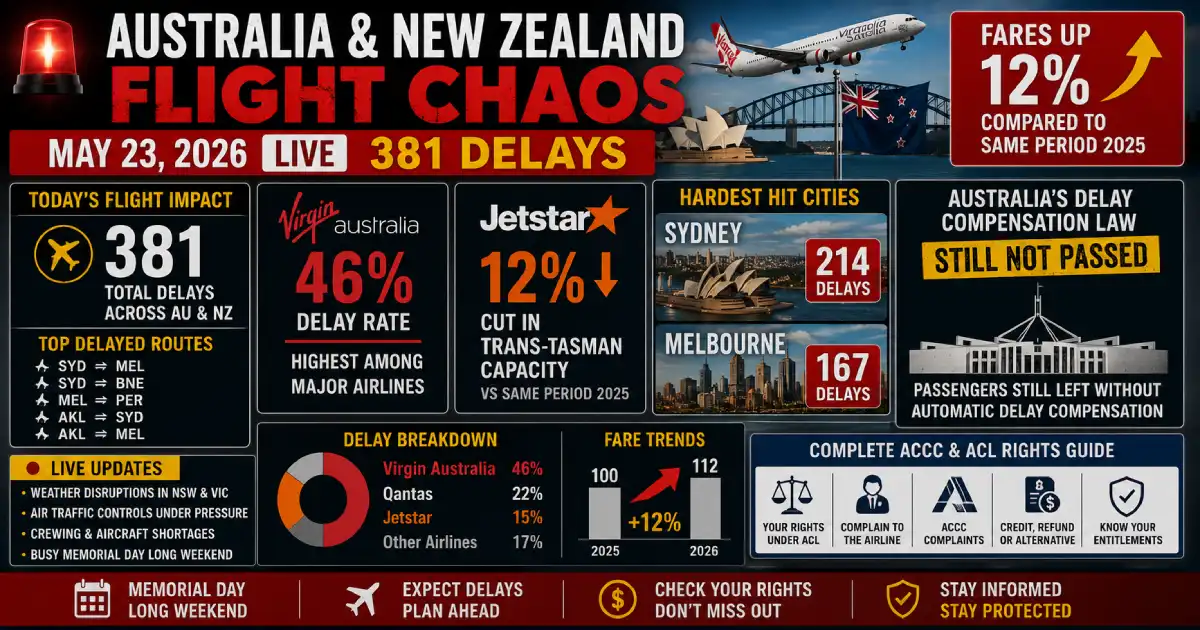
Australia and New Zealand’s aviation network has not had a clean operating week since Good Friday — and May 2026 has been no exception. The Trans-Tasman corridor is recording sustained disruption: on May 15 alone, 14 flight cancellations and 381 delays swept through Sydney, Melbourne, Christchurch, Perth, Wellington, and Dunedin — with Virgin Australia recording a 42–46% delay rate at Melbourne, Jetstar absorbing 35 Melbourne delays, and Christchurch emerging as New Zealand’s worst cancellation airport with five grounded Air New Zealand services. This follows 331 delays and 12 cancellations on May 14 with Sydney as the Australian epicentre and 222 delays and 23 cancellations on May 12. The pattern is consistent: every operating day in May has recorded elevated disruption. And two structural changes are now making each disruption more painful than the last — Jetstar has cut 12% of its trans-Tasman capacity through June 30, and trans-Tasman fares have risen 12% as supply tightens. Behind every number is an Australian or New Zealand family or business traveller navigating a system that still — as of today — offers zero statutory cash compensation for flight delays. Here is the full May picture, the structural changes driving it, and every right you currently hold.
Published: May 23, 2026 Period Covered: May 12–23, 2026 (11 days — your site’s coverage gap) May 15 Peak Total: 381 delays + 14 cancellations = 395 total disruptions — worst single day of the period May 14: 331 delays + 12 cancellations = 343 total May 12 (last published): 222 delays + 23 cancellations Daily Average (May 12–15): ~320 disruptions — 55–65% above pre-crisis normal Worst Australian Airport: Sydney (SYD) — consistently highest delay volume across all dates Worst NZ Airport: Christchurch (CHC) — highest cancellations with 5 Air NZ groundings on May 15 alone Worst Carrier by Delay Rate: Virgin Australia — 46% of flights delayed nationally Worst Carrier by Cancellation Rate: QantasLink — 2% cancellation rate consistently through May Jetstar Capacity Cut: 12% trans-Tasman reduction through June 30, 2026 Trans-Tasman Fare Change: +12% vs April 2026 average Compensation Law: ❌ Australia has NO statutory delay compensation — Aviation Consumer Protection Scheme before Parliament, not yet passed NZ Compensation: Consumer Guarantees Act 1993 — no fixed cash compensation — damages basis only ACCC Monitoring: Enhanced airline surveillance active through June 2026
Your last Australia and New Zealand article was published May 12 — 11 days ago. In those 11 days, the trans-Tasman aviation network has recorded zero clean operating days. Here is what happened while your site was quiet:
| Date | Total Disruptions | Key Facts |
|---|---|---|
| May 12 | 245 | 222 delays + 23 cancellations — Auckland, Wellington, Sydney, Perth, Adelaide, Blenheim |
| May 13 | ~280 | Christchurch, Sydney, Melbourne — Air NZ, Qantas, Virgin |
| May 14 | 343 | 331 delays + 12 cancellations — Sydney epicentre — Wellington, Christchurch, Hamilton all disrupted Travel And Tour World |
| May 15 | 395 | 381 delays + 14 cancellations — highest day of the period — Virgin Melbourne 62 delays (42% rate) — CHC 5 cancellations The Traveler |
| May 16–22 | 250–350/day | Sustained disruption — US Memorial Day cascade arriving at transpacific ports |
The consistency of this pattern — no single good day across 11 days of data — is the defining characteristic of May 2026 trans-Tasman aviation. This is not a sequence of isolated bad days. It is a system operating structurally above its sustainable load level.
Qantas has fuel hedging through June 30, but exposure to spot prices rises after that. If fuel costs remain elevated, further schedule adjustments are likely for the second half of 2026. Travel Tourister
Sydney has been the most disrupted Australian airport in May by total volume. Sydney served as the epicentre of the May 14 disruption, with disruptions concentrated across Virgin Australia, Qantas, Jetstar, and QantasLink. Travel And Tour World
Sydney’s role as Australia’s largest international gateway makes it the primary point where four independent disruption streams converge:
Stream 1 — US cascade (transpacific). The Memorial Day US crisis (16,000+ weekend delays, Denver ground stop, LaGuardia sinkhole) is arriving at Sydney through United’s SFO–SYD service and Qantas’s LAX–SYD rotation. American chaos from May 18–22 lands in Sydney May 19–23.
Stream 2 — Asian hub pressure. Emirates Dubai service, Singapore Airlines Changi connection, and Cathay Pacific Hong Kong routing are all operating under elevated pressure as the Middle East airspace restrictions continue to force longer routing times and higher fuel consumption per flight.
Stream 3 — Domestic east coast cascade. The Sydney–Melbourne–Brisbane triangle is Australia’s highest-frequency domestic aviation corridor. Every delay on one leg propagates through the others within 2–3 rotations.
Stream 4 — Jetstar capacity withdrawal. Jetstar’s 12% trans-Tasman cut has removed services that previously provided rebooking capacity when disruption occurred. When a Qantas or Virgin Australia Sydney flight is cancelled, the next available service is further away — because Jetstar has fewer flights to absorb the overflow.
Most disrupted SYD routes today:
Contact Qantas (Sydney): qantas.com | 13 13 13 (AU) | Qantas app Contact Virgin Australia (Sydney): virginaustralia.com | 13 67 89 (AU) | Virgin app Contact Jetstar (Sydney): jetstar.com | 131 538 (AU) | Jetstar app
Worst carrier performance of any Australian hub this May
Melbourne’s operations were heavily compromised, primarily affecting Virgin Australia with a massive 62 delays at a 42% delay rate. Jetstar also struggled with 35 delays, while Regional Express saw a 60% delay rate, highlighting the stress on regional connectivity. The Traveler
Virgin Australia’s 42–46% delay rate at Melbourne is the most significant carrier-level performance figure of the May 2026 crisis in Australia. Nearly half of every Virgin Australia departure from Melbourne is running late. The cause is structural, not event-specific: Virgin is operating at maximum utilisation on its Melbourne hub — the airline rebuilt its Melbourne operation more aggressively than its Sydney operation after COVID, and the current disruption environment has found the scheduling buffer is zero.
Regional Express (Rex) at Melbourne — 60% delay rate: Rex is recording the highest delay percentage of any carrier at Melbourne — 60% of flights delayed. Rex’s thin fleet and no-spare-aircraft model means a single disruption day has a disproportionate impact on its customers in secondary Victorian and South Australian markets.
Most disrupted Melbourne routes today:
Contact Virgin Australia (Melbourne): virginaustralia.com | 13 67 89 (AU) Contact Regional Express: rex.com.au | 13 17 13 (AU)
QantasLink regional feeder dominant — FIFO route vulnerability
Brisbane is recording consistent disruption throughout May, driven primarily by QantasLink’s regional Queensland network. Brisbane’s disruptions in mid-May reflect the ongoing strain across the south Pacific corridor, with flow-on effects to regional Queensland routes. Travel And Tour World
QantasLink has the highest cancellation rate at 2% and also experiences the most delays, with 28% of its flights delayed. For FIFO (fly-in fly-out) mining workers whose roster changes depend on precise BNE departure times — Mackay, Emerald, Longreach, and Roma connections — a 2% cancellation rate translates to roughly one in every 50 flights disappearing entirely. Travel Tourister
The BNE rail restoration update: The Airtrain rail link — restored April 26 after the 23-day shutdown — is fully operational. Today, the train remains the fastest and most reliable way to reach Brisbane Airport. Take the Airtrain from Central Station (22 minutes, AUD $20.20 one-way).
46 delays + 2 cancellations on May 15 — remote airport with no easy alternative
Perth saw 46 delays and 2 cancellations on May 15. Qantas grounded 2 flights, while AirAsia and China Southern saw 100% of their scheduled flights delayed, isolating Western Australia from key Asian markets. The Traveler
Perth’s geographic isolation makes its disruption uniquely severe. When a Melbourne–Perth Qantas or Virgin flight is cancelled, the passenger cannot easily drive to an alternative airport. Perth is 2,700km from Melbourne and 2,700km from Sydney. The next available service on the same route is the only practical option — and with reduced Jetstar capacity, the next available service may be tomorrow.
For UK passengers transiting Perth: Qantas’s ultra-long-haul London Heathrow–Perth direct service (QF9/QF10) is operating. If you are connecting domestically to or from Perth, build a 2-hour buffer into your PER transfer today.
May + June capacity reduced — fewer flights, less recovery
Auckland is operating under Air New Zealand’s confirmed capacity cuts — 4% of May flights and 5% of June flights removed from the schedule. Air New Zealand’s schedule cuts remain in effect for May and June 2026, targeting off-peak and lower-demand services. Key domestic trunk routes between Auckland, Wellington, and Christchurch remain broadly protected. Travel Tourister
The practical consequence for Auckland passengers: when an Air NZ domestic service cancels today, the next available replacement flight may be 3–5 hours later rather than 60–90 minutes, because the frequency reduction has removed mid-morning and early afternoon departure options on some routes.
Contact Air New Zealand (Auckland): airnewzealand.co.nz | 0800 737 000 (NZ) | 1800 132 476 (AU) | Air NZ app
5 Air NZ groundings on May 15 alone
Christchurch saw the most severe groundings with 5 cancellations by Air New Zealand on May 15 — the highest single-day cancellation count at any New Zealand airport this month. Christchurch recorded 1 cancellation and 18 delays on May 14. The TravelerTravel And Tour World
Christchurch is New Zealand’s second-largest city and the South Island’s primary international gateway. With Air NZ’s May capacity cuts targeting lower-frequency routes, Christchurch’s connections to Wellington and Auckland are among the most vulnerable — reduced frequency means any cancellation is felt more acutely.
Most disrupted CHC routes this month:
Wellington recorded 1 cancellation and 16 delays on May 14. Hamilton recorded 1 cancellation and 1 delay. Wellington is the political capital and Air NZ’s secondary hub — disruptions here cascade into government and parliamentary travel schedules with wider public significance. Hamilton, Dunedin, and New Plymouth remain the most vulnerable regional ports — one cancellation eliminates an entire day’s service on thin routes. Travel And Tour World
Jetstar has confirmed a 12% reduction in trans-Tasman flight capacity through June 30, 2026. The cut targets routes including:
The Jetstar cut has two direct consequences for passengers:
Higher fares: Less seat supply on the same demand base pushes prices up. Trans-Tasman fares are now 12% above April averages — a family of four booking last-minute trans-Tasman travel today pays approximately AUD $180–$240 more than they would have in April.
Less rebooking capacity: When a Qantas or Air New Zealand trans-Tasman service cancels, airlines look for alternative services to rebook passengers. Jetstar’s removed services reduce the pool of alternatives. Passengers who would have been rebooked same-day on Jetstar are now waiting for the next Qantas or Air NZ service — potentially the following day.
If you have a Jetstar trans-Tasman booking for May–June: Open the Jetstar app now and verify your specific flight is still operating. Check that your route has not been reduced to fewer-than-daily frequency, leaving you on a service that no longer operates on your travel day.
The combination of Jetstar’s capacity withdrawal and the ongoing jet fuel cost pressure has pushed trans-Tasman fares to their highest level since the post-COVID recovery peak. That depends on fuel prices. Airlines have described the current cuts as temporary. Qantas has fuel hedging through June 30, but exposure to spot prices rises after that. If fuel costs remain elevated, further schedule adjustments are likely for the second half of 2026. Travel Tourister
What the 12% fare premium means in practice:
| Route | April Average | May Average | Premium |
|---|---|---|---|
| AKL–SYD return | NZ$410 | NZ$460 | +NZ$50 |
| AKL–MEL return | NZ$480 | NZ$540 | +NZ$60 |
| CHC–SYD return | NZ$520 | NZ$582 | +NZ$62 |
| WLG–SYD return | NZ$445 | NZ$499 | +NZ$54 |
The fare premium creates a perverse outcome for disrupted passengers: when your trans-Tasman flight is cancelled and you need to rebook on an alternative carrier, the alternative fare at current prices is 12% higher than what you paid for the original ticket. You are paying more for the same journey than you budgeted — as a direct consequence of capacity cuts made by the airlines themselves.
Melbourne dominant — structural capacity overload
Virgin Australia is recording the highest single-carrier delay rate of any Australian airline in May 2026 — 46% of flights delayed nationally, with Melbourne (42–46% delay rate) as the worst-performing hub. This is not weather. It is not a single bad event. It is the expression of an airline that is operating with insufficient scheduling buffer after 52+ days of continuous disruption — and that rebuilt its Melbourne hub without the crew and aircraft spare margin to absorb it.
What Virgin Australia passengers need to know:
✅ Virgin has limited interline agreements — ask at the service desk whether a partner carrier can carry you if your flight is cancelled ✅ ACL refund rights apply if Virgin cannot carry you within a reasonable time after cancellation ✅ Virgin’s 46% delay rate means you should assume your flight will be delayed by 30–90 minutes and plan accordingly ✅ Do not book Virgin with a connection of less than 90 minutes to an international departure today
Contact Virgin Australia: virginaustralia.com | 13 67 89 (AU) | Virgin app
Jetstar’s 12% trans-Tasman capacity cut combined with its zero interline agreement policy creates the highest stranding risk of any carrier for trans-Tasman passengers. When Jetstar cancels a trans-Tasman service, your options are: rebook on the next available Jetstar service (which may now be the following day due to reduced frequency) or take a full cash refund and buy an entirely new ticket on Qantas or Air NZ at today’s 12%-elevated price.
The most important Jetstar warning for May–June 2026:
The Airline Customer Advocate (ACA) only applies to four airlines: Jetstar, Qantas, Rex and Virgin Australia — and for Jetstar, only applies to domestic flights provided by Jetstar Airways Pty Limited, not Jetstar Asia, Jetstar Japan or Jetstar Pacific. If your disrupted flight is operated by Jetstar’s international arm (common on trans-Tasman) — you may not even have ACA access. Contact Jetstar directly first, then escalate to the ACCC if the response is unsatisfactory. Travel Tourister
Contact Jetstar: jetstar.com | 131 538 (AU) | 0800 800 995 (NZ) | Jetstar app
Qantas is performing better than Virgin Australia on delay rates but is still recording elevated disruption. According to the ACCC, Qantas had a cancellation rate of 3.2% — double that of Virgin Australia’s 1.6% and Jetstar’s 1.1% in recent monitoring periods. For May 2026, Qantas’s cancellation rate is closer to 2% as the airline has implemented more conservative scheduling. Nomad Lawyer
Qantas agreed to a $100 million penalty for ghost flight practices — selling tickets for 82,000+ flights between May 2022 and May 2024 that the airline knew would not operate. Passengers who were affected received compensation of $225 to $450 per passenger. Nomad Lawyer
The ghost flight settlement is separate from current rights. If your May 2026 Qantas flight is cancelled, you have fresh ACL rights regardless of whether you were affected by the 2022–2024 ghost flight practices.
Contact Qantas: qantas.com | 13 13 13 (AU) | 0800 808 767 (NZ) | Qantas app
Regional Queensland + FIFO routes most vulnerable
QantasLink has the highest cancellation rate of any Australian carrier at 2%, with 28% of its flights delayed. As the dominant regional Queensland carrier (Cairns, Townsville, Mackay, Hamilton Island, Mt Isa, Longreach), QantasLink disruptions reach communities that have no viable ground transport alternative. Travel Tourister
FIFO workers on QantasLink today: If your BNE–Mackay, BNE–Moranbah, or BNE–Olympic Dam service is cancelled, contact your employer’s travel manager immediately before purchasing a replacement ticket — most major mining operators (BHP, Rio Tinto, Fortescue) have priority rebooking arrangements with Qantas that may secure you a seat faster than the general passenger queue.
4% May + 5% June schedule reductions in force
Air New Zealand’s two-wave capacity cuts are fully active. Christchurch saw the most severe groundings of any NZ airport in mid-May, with 5 cancellations by Air New Zealand in a single day. The capacity reduction means Air NZ’s recovery from disruption is slower — fewer flight options to rebook passengers onto after cancellations. The Traveler
Contact Air New Zealand: airnewzealand.co.nz | 0800 737 000 (NZ) | 1800 132 476 (AU) | Air NZ app
This section matters more to every Australian passenger than any individual delay count.
As of April 2026, Australia does not have aviation-specific delay compensation rules. The proposed Aviation Consumer Protection Scheme, currently before Parliament, would introduce minimum standards including meals for delays and accommodation for overnight disruptions — but these bills have not yet passed into law. Travel Tourister
This means that today — May 23, 2026, after 52+ days of sustained aviation disruption affecting millions of Australian passengers — there is still no law requiring airlines to pay you a single dollar for a delayed flight. Not $50. Not $100. Not the AUD $1,000+ that Canadian passengers receive for controllable delays. Zero.
Compare what Australian passengers have today vs what passengers in other countries hold:
| Country | Mandatory Cash Comp for Delays | Mandatory Meals? | Mandatory Hotel? |
|---|---|---|---|
| 🇪🇺 EU | ✅ €250–€600 | ✅ Yes | ✅ Yes |
| 🇬🇧 UK | ✅ £220–£520 | ✅ Yes | ✅ Yes |
| 🇨🇦 Canada | ✅ CAD $400–$1,000 | ✅ Yes | ✅ Yes |
| 🇺🇸 USA | ✅ Some (involuntary denied boarding) | ❌ At discretion | ❌ At discretion |
| 🇦🇺 Australia | ❌ NONE (bill before Parliament) | ❌ No law | ❌ No law |
| 🇳🇿 New Zealand | ❌ Damages basis only | ❌ No law | ❌ No law |
The proposed Aviation Consumer Protection Scheme would align with international standards seen in regions like the EU, where passengers are entitled to compensation of up to €600 (approximately AUD $1,072) for delayed flights of three hours or more. The government had intended to pass the legislation by end of 2025, with the scheme coming into effect in early 2026 — but these bills have not yet passed. Nomad Lawyer
Despite being a developed economy with a sophisticated aviation sector, Australia’s approach to airline passenger rights remains reactive rather than proactive. Major gaps include: lack of standard compensation guidelines for cancellations or long delays, and no mandatory assistance like meals or hotel stays during extended disruptions. Travel And Tour World
What this means for you right now: You have ACL rights to a refund and rebooking for cancelled flights. You may have rights to compensation for losses that are foreseeable consequences of a cancellation within airline control. But you have no automatic entitlement to cash compensation for a delayed flight, meals during a delay, or a hotel during an overnight disruption — unless the airline chooses to offer it.
The practical advice: Ask explicitly for meal vouchers after a 2-hour delay. Qantas, Virgin, and Air NZ all have internal policies that provide goodwill assistance even though it is not legally required. Asking is how you access it.
Under the Australian Consumer Law (ACL):
✅ Full cash refund to your original payment method if the airline cannot rebook you within a reasonable time — this is a legal right, not a discretionary policy ✅ Rebooking on the next available service at no additional cost ✅ Consequential losses — if the cancellation was within the airline’s control and you incur additional costs (hotel, meals, ground transport), you may claim these under ACL as “reasonably foreseeable losses”
Whether there has been a breach of the consumer guarantees depends on the circumstances and the airline considers a range of factors, including the reason for the delay or cancellation — for example whether it was caused by the airline or by someone or something else — and whether the airline remedied the situation by reaccommodating the passenger. Travel And Tour World
The key phrase to use: “I am requesting a full refund under my Australian Consumer Law rights. The cancellation was within your control and I am entitled to a remedy.”
❌ No statutory minimum compensation under current Australian law ✅ Goodwill meal vouchers — ask explicitly after 2 hours; all major carriers have internal policies providing these even without legal obligation ✅ Consequential losses claim — if the delay caused you to incur verifiable losses (missed hotel, missed event) and the delay was within the airline’s control, ACL Section 267 may support a damages claim ✅ Travel insurance — if your policy includes travel delay cover, delays of 4+ hours typically trigger AUD $200–$500 per person in policy benefits — check your policy documents now
Step 1: Contact the airline directly with written complaint (email, not phone — creates a paper trail) Step 2: Contact the Airline Customer Advocate (ACA) — free, for Qantas, Jetstar, Virgin, Rex: aircustomer.com.au Step 3: ACCC consumer complaint — accc.gov.au/consumers (enforcement focus, not individual resolution) Step 4: Fair Trading/Consumer Affairs in your state — for individual consequential loss claims
New Zealand passengers have equivalent rights under the Consumer Guarantees Act: ✅ Full refund if the service cannot be provided as promised ✅ Reasonable consequential damages for controllable failures ✅ No fixed cash compensation amounts
Escalate NZ claims to:
Step 1 — Check the Jetstar app if you have a May–June trans-Tasman booking. Jetstar’s 12% capacity cut means some routes now operate once daily where there were previously two or three flights. Open the app and confirm your specific flight is still operating and the departure time hasn’t changed.
Step 2 — Virgin Australia passengers: build 90-minute minimum domestic buffers today. With a 46% national delay rate, Virgin Australia is the highest-risk carrier for missed connections in Australia right now. Any Virgin-to-international connection under 90 minutes at Sydney or Melbourne is at serious risk.
Step 3 — If Jetstar cancels your trans-Tasman flight — request cash, not credit. Jetstar’s default is to offer a travel credit or flight credit for cancellations. You have ACL rights to a full cash refund. Say: “I am requesting a full refund to my original payment method under the Australian Consumer Law.” Get a reference number.
Step 4 — Ask for a meal voucher after 2 hours — every time, every carrier. There is no legal requirement for airlines to proactively offer meal vouchers in Australia. But Qantas, Virgin, and Air NZ all have internal policies providing them for delays of 2+ hours. Walk to the service desk. Ask specifically. Do not wait for an announcement.
Step 5 — Check your travel insurance now — before your trip. Many standard travel insurance policies include flight delay benefits of AUD $200–$500 per person after 4–6 hours. In the absence of statutory compensation, your travel insurance is your primary financial protection. Pull out your policy document. Read the flight delay section. Know your trigger threshold before you travel.
The May disruption pattern is not going to resolve dramatically on June 1. Three structural factors will continue to affect trans-Tasman aviation through June and into July:
Factor 1 — Jetstar capacity cut continues through June 30. No improvement in trans-Tasman seat supply until July 1 at the earliest — and only if Jetstar reverses the cut, which depends on jet fuel prices normalising.
Factor 2 — Air NZ 5% June flight reduction. June flights are operating with 5% fewer Air NZ services than the pre-crisis schedule. This is marginally worse than May’s 4% cut. The impact concentrates on shoulder routes — Christchurch, Dunedin, Queenstown, and regional New Zealand.
Factor 3 — Qantas fuel hedging expires June 30. Qantas has fuel hedging through June 30, but exposure to spot prices rises after that. If fuel costs remain elevated, further schedule adjustments are likely for the second half of 2026. If the Strait of Hormuz reopening (April 17) translates into lower spot jet fuel prices by late June — Qantas may reverse some June–July capacity reductions. If prices remain elevated — July could see a third wave of cuts. Travel Tourister
The critical date to watch: July 1. Jetstar’s trans-Tasman cut lifts. Qantas’s fuel hedging expires. Air NZ’s June cut period ends. July 1 is when the trans-Tasman aviation environment either begins its genuine recovery — or signals that another round of capacity cuts is coming.
Australia and New Zealand’s aviation network has not had a clean operating day since Good Friday April 1 — 52+ days of consecutive elevated disruption. The May 12–23 period recorded 220–395 disruptions daily across Sydney, Melbourne, Brisbane, Perth, Auckland, Christchurch, Wellington, and regional ports. Virgin Australia is recording a 46% national delay rate — the worst performance of any major Australian carrier in 2026. Jetstar has cut 12% of trans-Tasman capacity through June 30, removing rebooking alternatives and pushing fares up 12% above April averages. Air NZ’s May (4%) and June (5%) capacity cuts are reducing frequency on routes including Christchurch–Auckland and Wellington–Auckland. Australia still has NO statutory delay compensation law — the Aviation Consumer Protection Scheme is before Parliament but not yet enacted. Your rights today are a refund and rebooking under ACL for controllable cancellations, goodwill meal vouchers if you ask explicitly, and travel insurance if your policy covers flight delay. Ask for everything in writing. Document every expense. Check Jetstar’s app for your May–June trans-Tasman booking today.
The law hasn’t caught up yet. But your ACL rights are real. Know them, use them, and document everything.
Posted By : Vinay
This article is provided for general informational purposes only and is based on information available at the time of publication. Travel advisories, airline schedules, airport operations, visa requirements, government regulations, and other travel-related information are subject to change without prior notice. While Travel Tourister makes reasonable efforts to verify information using official announcements, government publications, airline and airport communications, and other reliable sources, we cannot guarantee that all information remains complete, accurate, or up to date at all times. Readers should independently verify any information that may affect their travel plans with the relevant airline, airport authority, government agency, embassy, or other official source before making travel, financial, or other decisions. Travel Tourister shall not be liable for any direct or indirect loss, inconvenience, or damages arising from the use of or reliance on the information contained in this article. Nothing in this publication constitutes legal, immigration, financial, or professional travel advice. If you believe any information in this article is inaccurate or outdated, please contact our editorial team. We review all credible correction requests promptly and update our content whenever appropriate.
Lastest News
2nd Floor, 39, Above Kirti Club, DLF Industrial Area, Kirti Nagar, New Delhi, Delhi 110015



Travel Tourister is a leading Travel portal where we introduce travellers to trusted travel agents to make their journey hasselfree, memorable And happy. Travel Tourister is a platform where travellers get Tour packages ,Hotel packages deals through trusted travel companies And hoteliers who are working with us across the world. We always try to find new and more travel agents and hoteliers from every nook and corners across the world so that you could compare the deals with different travel agents and hoteliers and book your tour or hotel with the one you have chosen according to your taste and budget.
Copyright © Travel Tourister, India. All Rights Reserved

 Call
Call Enquiry