Published on : 04 Jun 2026
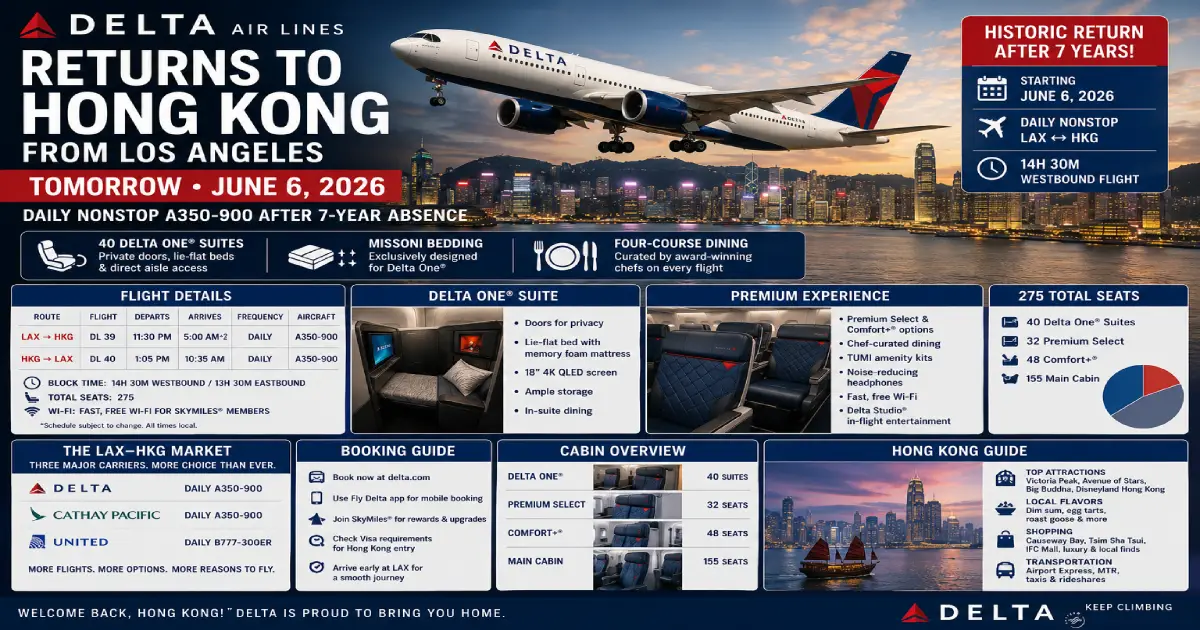
In 48 hours, Delta Air Lines takes off from Los Angeles International Airport on a route it has not operated for seven years. The destination: Hong Kong. The aircraft: the Airbus A350-900, Delta’s flagship widebody. The significance: the largest transpacific route addition at LAX in years.
Daily nonstop flights to Hong Kong International Airport will begin on June 6, marking Delta’s return to the city after a seven-year absence. The airline last served Hong Kong from Seattle until October 2018. The new route will operate using Airbus A350-900 aircraft configured with four cabin classes.
The move will see Delta compete directly with Cathay Pacific and United Airlines, which operate up to three and two daily flights respectively between LAX and HKG. According to OAG Schedules Analyser data, Cathay holds a 63% capacity share on the route, while United accounts for 37%. Delta’s entry will contribute an additional 4,300 weekly seats, increasing overall nonstop capacity by more than 20%.
For passengers who have been flying LAX–Hong Kong on Cathay Pacific or United, Delta’s arrival tomorrow creates genuine competition on a route that has had none since American Airlines exited in 2020. For the 150,000-plus Hong Kong diaspora community in Los Angeles and the millions of Southern California travellers seeking Asia access, tomorrow’s first departure marks a significant expansion of choice.
Published: June 4, 2026 — Wednesday (2 days to launch) Route: Los Angeles International (LAX) ↔ Hong Kong International (HKG) Launch date: Saturday, June 6, 2026 Frequency: Daily — year-round Aircraft: Airbus A350-900 — 275 seats Flight number (outbound): DL5 — LAX → HKG Flight number (inbound): DL6 — HKG → LAX Departure LAX: 23:30 (11:30 PM) Arrival HKG: 05:00 (+2 days) Departure HKG: 09:25 Arrival LAX: 08:00 Flight time (westbound): 14 hours 30 minutes Flight time (eastbound): 13 hours 35 minutes Route distance: 7,260 miles (6,309 nautical miles / 11,684 km) Delta One suites: 40 seats — 1-2-1 layout, full sliding doors Delta Premium Select: 40 seats — 2-4-2 layout Delta Comfort+: 36 seats Delta Main Cabin: 159 seats Delta’s history at HKG: Previously served 1991–1995 (via Anchorage, then nonstop from LAX) and 2010–2018 (via Tokyo Narita, then Seattle nonstop) Competitors at LAX–HKG: Cathay Pacific (up to 3 daily) · United Airlines (2 daily) Book at: delta.com
Delta Air Lines is not new to Hong Kong. The airline’s relationship with the city stretches back to 1991 — but it has been punctuated by exits and returns that reflect the turbulent history of the LAX–HKG route itself.
In the 1990s, Delta operated the Los Angeles–Hong Kong route between May 1991 and November 1995, initially via Anchorage, later switching to nonstop flight. Delta last operated service to Hong Kong until October 2018, when it offered Seattle–Hong Kong nonstop service.
Between 2010 and 2018, Delta offered Hong Kong service via its Tokyo Narita hub, then as a nonstop from Seattle. The October 2018 withdrawal was driven by a combination of factors: relatively weak demand on the Seattle–Hong Kong corridor, competitive pressure from Cathay Pacific’s dominant position at Hong Kong International, and Delta’s redeployment of transpacific capacity toward higher-yielding routes through its Seoul Incheon hub.
The LAX choice for the 2026 return is strategically different from the 2018 Seattle service. Delta operates a big hub at LAX as the largest global carrier at the airport by seats and departures. The Hong Kong service from LAX provides access to a significantly larger pool of Southern California and connecting passengers than the Seattle base ever did.
Joining Cathay Pacific and United from Los Angeles, it will be the first time three carriers have operated simultaneously on the LAX–HKG route since American Airlines pulled out in 2020.
Delta’s choice of the A350-900 for this route is the best possible aircraft selection for a 14h30m transpacific flight, and it matters significantly for passenger experience.
Delta uses its expanding A350 fleet as its long-haul flagship, fielding 41 aircraft with 15 more on order, deployed primarily on transoceanic and hub-to-hub missions. On June 6, Delta will launch daily year-round service from Los Angeles to Hong Kong, a 6,309-nautical-mile sector scheduled at up to 15 hours 45 minutes each way, using the 275-seat high-premium A350-900.
The A350-900’s passenger comfort advantages over older widebodies are well-documented and genuinely felt on a flight of this length:
Cabin pressure: The A350 maintains cabin pressure at the equivalent of 6,000 feet altitude, compared to 8,000 feet on older aircraft types. Over a 14.5-hour flight, this translates to meaningfully less dehydration and fatigue on arrival.
Humidity: The A350’s composite fuselage permits higher cabin humidity than aluminium aircraft — approximately 20% versus 5–10% on older metal-fuselage planes. On a transpacific overnight flight, the difference is perceptible in skin condition and throat comfort.
Noise: The A350’s Rolls-Royce Trent XWB engines produce significantly less cabin noise than the GE90s and PW4000s of older aircraft. For the 8-hour sleep window that most DL5 passengers will attempt, lower ambient noise is a genuine quality-of-life improvement.
Cabin design: The A350’s wider fuselage (18.5-inch width in Main Cabin, versus 17 inches on the 777) gives every passenger more shoulder room. At 14.5 hours, this is not a marginal comfort factor — it is a meaningful difference.
The A350-900 features 40 business class seats in Delta One, 40 premium economy seats, 36 extra legroom economy seats and 159 economy seats.
Delta One on the A350-900 is one of the strongest business class products currently operating in the transpacific market — and its door-equipped suite configuration places it alongside the premium end of competitive offerings from Cathay Pacific’s business class and United’s Polaris product.
Delta’s A350 features 40 VantageXL suites in a staggered 1-2-1 layout, offering direct aisle access. Thirty-two suites occupy the forward cabin between doors L1 and L2, with an additional eight in a smaller, more private mini cabin situated ahead of Premium Select. The 20.5-inch-wide seat converts into a fully flat 76-inch bed and includes a sliding door, ensuring a cocoon-like level of seclusion.
The 1-2-1 configuration is the defining advantage of the Delta One suite over competing products on this route. Every passenger — window and centre alike — has direct aisle access without disturbing a neighbouring passenger. On a 14.5-hour flight with at least one meal service and multiple hours of sleep, not being forced to climb over a seatmate to use the lavatory is a genuine quality-of-life advantage.
The sliding door provides near-complete visual privacy from the aisle and from adjacent centre seats. When closed, the suite creates a genuinely private sleeping environment — a meaningful step above the open business class products that still dominate many Asian carriers.
Suite dimensions:
Best seats in Delta One (DL5 LAX→HKG):
Window suites (A and K seats) are the most private — tucked against the fuselage with maximum separation from the centre pairs. Row 1 and Row 2 window seats are particularly desirable for passengers who want to eat and immediately sleep, as the forward position means meal service reaches them first. The mini cabin (rows 9–10, approximately) offers the quietest Delta One environment — fewer galleys, fewer passenger movements, more separation from the main forward cabin.
Reach new levels of comfort with Missoni — from collectible amenity kits to exclusive bedding sets. Each 180-degree lie-flat seat adjusts easily and is paired with luxury bedding from Missoni, including a lumbar pillow that doubles as a mattress pad. Enjoy chef-curated meals served with elegant appetizers, warm nuts, and a curated selection of complimentary beer, spirits, and fine wine.
Amenities included a Missoni-branded amenity kit, slippers, Delta-branded headphones and a bottle of water. Bedding was also by Missoni: a soft duvet, mattress pad and large pillow, plus a smaller throw pillow.
Missoni’s signature zig-zag pattern runs through everything in the Delta One cabin — the amenity kit exterior, the bedding, the pillow cases. The collaboration is unusual for an airline — Missoni is a genuine luxury fashion house, not an amenity kit manufacturer — and it gives Delta One a distinctive aesthetic that competes credibly with Cathay Pacific’s ACBD-partnered soft product and United’s Saks Fifth Avenue bedding.
Delta One offers four-course meals and lie-flat seats with plush bedding and amenities by Missoni.
The four-course meal structure on DL5 westbound follows a standard long-haul Delta One sequence: warm nuts and appetiser on departure from LAX, a full main course with two starters and dessert service approximately 90 minutes after departure, a light snack approximately 4 hours before Hong Kong arrival, and a pre-arrival breakfast. Wine service throughout is sommelier-curated — Delta has invested in its wine program across Delta One routes, partnering with wine consultants to select wines appropriate for high-altitude consumption (higher tannin and lower alcohol wines tend to perform better in pressurised cabins).
In front of each seat is the Delta Studio entertainment system. The screen measures 18 inches across and offers hours of entertainment. You can access movies across several genres and watch newly released films. There’s also a variety of TV shows, live television, and Spotify-curated audio playlists to choose from.
Delta Studio on the A350 offers one of the largest content libraries of any US carrier, including same-day releases on selected new films and a Spotify integration that allows passengers to connect their own Spotify playlists through the IFE system without needing to use Bluetooth headphones.
Delta One access benefits at LAX:
Enjoy dedicated Delta One check-in and security at all Delta hubs, access to the Delta One lounge at LAX, and priority boarding.
Delta One Lounge at LAX Terminal 3 is one of Delta’s four dedicated Delta One Lounge locations (alongside JFK, Boston, and Seattle). It offers hot food service, a full bar, shower suites, and lounge seating with airfield views. Given DL5’s 23:30 departure, Delta One passengers arriving at LAX from early evening can spend several hours in the lounge before boarding.
The A350-900 features 40 Delta Premium Select seats in a 2-4-2 layout.
Delta Premium Select (DPS) is Delta’s premium economy offering — positioned between Main Cabin and Delta One in price, seat size, and service. On a 14.5-hour transpacific flight, DPS represents a significant upgrade from standard economy at a fraction of the Delta One price premium.
Delta Premium Select key specs:
For passengers who want meaningful additional comfort on a nearly 15-hour flight without paying full Delta One fares, DPS is the rational choice. The 2-4-2 configuration means window DPS passengers sit in pairs — a consideration for solo travellers who prefer maximum separation from neighbours.
The A350-900 features 36 Delta Comfort+ seats.
Delta Comfort+ (C+) is Delta’s economy upgrade cabin — extra legroom economy seats, typically located in the first several rows of the main economy cabin and over the wing exits. C+ passengers on DL5 receive:
On a 14.5-hour flight, the additional legroom in C+ is a meaningful comfort improvement. The seat width remains standard economy, but the ability to extend legs more fully during sleeping periods makes a measurable difference to arrival condition.
The A350-900 features 159 Main Cabin seats in a 3-3-3 configuration.
Delta’s Main Cabin 3-3-3 configuration on the A350-900 gives each economy passenger 18.5 inches of width — wider than the 17-inch standard on older aircraft types. On a flight of this length, the additional shoulder room reduces the physical fatigue associated with close contact with neighbouring passengers over many hours.
Main Cabin meals on DL5 will include a full dinner service shortly after departure (approximately 1–2 hours post-takeoff), a snack midway, and a light breakfast before arrival in Hong Kong.
Delta Studio IFE is available to all cabin classes on this aircraft — the 10-inch touchscreen in Main Cabin gives economy passengers access to the same content library as Delta One, including the Spotify integration.
Delta’s entry will be the first time three carriers have operated simultaneously on the LAX–HKG route since American Airlines pulled out in 2020.
For passengers choosing between the three carriers from June 6, here is a straightforward comparison:
| Factor | Delta (DL5/6) | Cathay Pacific | United |
|---|---|---|---|
| Frequency | 1 daily | Up to 3 daily | 2 daily |
| Aircraft | A350-900 | A350-1000 / 777-300ER | 787-9 |
| Business class | Delta One Suite — door, 1-2-1 | Cathay Business — door, 1-2-1 | Polaris — door, 1-2-1 |
| Capacity added | 4,300 seats/week | 63% of previous capacity | 37% of previous capacity |
| Alliance | SkyTeam | Oneworld | Star Alliance |
| FF programme | SkyMiles | Asia Miles | MileagePlus |
| LAX departure (outbound) | 23:30 | Multiple | Multiple |
| HKG arrival | 05:00 (+2 days) | Multiple | Multiple |
| HKG departure (inbound) | 09:25 | Multiple | Multiple |
| LAX arrival | 08:00 | Multiple | Multiple |
According to OAG data, Cathay holds a 63% capacity share on the LAX–HKG route, while United accounts for 37%. Delta’s entry will increase overall nonstop capacity by more than 20%.
The 20% capacity increase is the most significant market-level consequence of Delta’s June 6 launch. On the LAX–Hong Kong route, which has operated as a two-carrier market for four years, Cathay Pacific has had limited incentive to compete aggressively on fares. Delta’s entry creates genuine competition — particularly in business class, where all three carriers now offer door-equipped suite products.
For SkyTeam frequent flyers, Delta’s LAX–HKG service enables mileage earning on Air France/KLM Flying Blue, Korean Air SKYPASS, and other SkyTeam partners — none of which has had a direct LAX–HKG vehicle until now.
The new nonstop service between Los Angeles and Hong Kong provides direct access to this global city, while also unlocking more than 30 convenient one-stop connections to and from LAX.
This is the feature of the Delta LAX–HKG launch that receives the least coverage but matters most for a significant portion of the route’s passengers — those not originating or terminating in Los Angeles.
Delta operates 30+ domestic US routes into LAX daily — from Atlanta, Salt Lake City, Seattle, Portland, Las Vegas, Phoenix, Denver, Minneapolis, Detroit, New York JFK, Boston, Washington Reagan National, and more. Every one of these cities now has a one-stop connection to Hong Kong via Delta, without the need to connect through a third-party hub or transship to a partner carrier.
Practical example: A Delta SkyMiles member in Salt Lake City (Delta’s western hub) can now fly SLC–LAX–HKG on a single Delta ticket, earning SkyMiles and Medallion Qualifying Miles on the complete itinerary, with seamless checked bag transfer and Delta customer service accountability for the full journey.
Previously, that same passenger would have needed to either connect through United’s San Francisco hub (losing SkyTeam mileage accumulation) or route through Tokyo Narita (longer journey time).
US citizens enjoy visa-free access to Hong Kong for stays up to 90 days. Entry processing includes additional security screening. Hotels mandate passport registration within 24 hours of arrival.
By passport nationality:
| Passport | Entry requirement | Maximum stay |
|---|---|---|
| US passport | No visa required | 90 days |
| UK passport | No visa required | 180 days |
| Australian passport | No visa required | 90 days |
| Canadian passport | No visa required | 90 days |
| New Zealand passport | No visa required | 90 days |
| EU passports (most) | No visa required | 90 days |
All passengers must hold a passport valid for at least 6 months beyond their intended departure from Hong Kong. Return or onward travel ticket required at immigration.
UK BN(O) passport holders: The BN(O) passport cannot be used for immigration clearance in Hong Kong. Hong Kong residents with BN(O) passports may continue to use their HKSAR Passports or Hong Kong Permanent Identity Cards for entering or departing. Passengers travelling to Hong Kong from the UK on a BN(O) passport (not a full UK passport) should check their specific status before booking.
Hong Kong International Airport is located on Lantau Island, approximately 34km from Hong Kong’s urban centre on Hong Kong Island. DL5 arrives at 05:00 — which is early enough to clear immigration and reach your hotel before the business day begins, but requires awareness of connection timings.
From HKG to the city:
| Mode | Journey | Time | Cost (approx.) |
|---|---|---|---|
| Airport Express (MTR) | HKG → Hong Kong Station | 24 min | HKD 115 (£11 / $15) |
| Airport Express (MTR) | HKG → Kowloon Station | 19 min | HKD 105 |
| Taxi (Hong Kong Island) | HKG → Central | 35–45 min | HKD 380–420 |
| Taxi (Kowloon) | HKG → TST | 30–35 min | HKD 280–320 |
| Bus (A11) | HKG → Hong Kong Island major stops | 70–80 min | HKD 40 |
The Airport Express is definitively the best option for DL5 passengers arriving at 05:00. The MTR opens at approximately 06:00, meaning passengers will need to wait in the terminal for approximately an hour post-arrival before the Express is available — or take a taxi at the additional cost. The Airport Express also offers In-Town Check-in at Hong Kong Station and Kowloon Station, allowing passengers to check baggage for DL6 up to one day before departure from the city centre.
Transit passengers: Hong Kong International Airport is one of Asia’s premier transit hubs. Cathay Pacific alone offers connections to over 100 destinations within 4–6 hours of a DL5 arrival. The immigration-free transit facility at HKG allows passengers connecting within 24 hours to remain airside without Hong Kong entry.
Victoria Harbour & Central: The skyline that defines Hong Kong — a vertical forest of glass and steel rising from the harbour’s edge. The Peak Tram from Garden Road ascends to Victoria Peak in approximately 8 minutes, delivering the iconic harbour view that remains one of the most spectacular urban panoramas in Asia. Star Ferry from Central Pier to Tsim Sha Tsui across the harbour: 12 minutes, HKD 4.
Kowloon — Temple Street & Mong Kok: Temple Street Night Market operates from approximately 18:00 daily. Ladies’ Market in Mong Kok is the city’s densest street market experience. Mong Kok is also home to Sneaker Street, Goldfish Market, and Bird Garden — distinctly Hong Kong micro-retail environments that persist despite the surrounding urban density.
Sham Shui Po: Hong Kong’s authentic electronics and fabric market district — now also emerging as a food destination. Cheap, excellent Cantonese roast meats, congee, and dim sum at street level alongside jade and antique stalls.
Lantau Island & Po Lin Monastery: Tian Tan Buddha — the world’s largest seated outdoor bronze Buddha — is reachable by cable car (Ngong Ping 360) from Tung Chung MTR station. The Ngong Ping village and Po Lin Monastery compound is a half-day excursion from the city. Lantau also contains the pre-handover fishing village of Tai O, accessible by bus from Tung Chung.
Wan Chai & Causeway Bay: Hong Kong’s most diverse restaurant corridor — everything from traditional Cantonese dim sum at Fook Lam Moon to Michelin-starred contemporary Chinese to the city’s best Vietnamese, Japanese, and Southeast Asian restaurants. Hong Kong’s restaurant density and quality-to-cost ratio in this area is among the highest in the world.
Outlying Islands: Cheung Chau and Lamma Island are both ferry-accessible from Central Pier in 30–55 minutes and offer a completely different pace — fishing villages, hiking trails, seafood restaurants, and beaches without high-rise development.
Direct booking: delta.com → Book a Trip → Enter LAX and HKG with your travel dates. All four cabin classes are bookable directly.
SkyMiles awards: Delta One award bookings on the LAX–HKG route are available through delta.com → Award Travel. Delta has moved to a dynamic award pricing model — award prices vary by demand, season, and departure date. Generally speaking, off-peak periods (February–April, September–November, excluding holidays) offer significantly better award rates than peak summer and Chinese New Year periods.
Partner awards: Korean Air SKYPASS miles can be used to book Delta flights (SkyTeam reciprocity). Korean Air miles are generally bookable on Delta at fixed rates and can represent strong value on Delta One, particularly on routes launched after Korean Air’s award chart was last updated.
Connecting itinerary booking: delta.com allows seamless booking of domestic US connections onto the LAX–HKG service. Enter your originating US city and Hong Kong as the final destination — Delta will display one-stop options through LAX.
Cargo note: The A350-900 can carry more than 20 tons of cargo per flight, creating a vital new freight corridor between two of the world’s most robust cargo markets. The service expands Delta’s ability to support global supply chains and deliver seamless, reliable logistics solutions between Asia and North America. Delta Cargo bookings on LAX–HKG: deltacargo.com.
Delta is the largest global carrier at LAX by seats and departures. Launching service to Hong Kong and Chicago from LAX strengthens our presence in two of the world’s most dynamic markets, said Paul Baldoni, SVP of Network Planning.
The Hong Kong launch is not an isolated route decision — it is part of a systematic LAX investment strategy that includes the new LAX–Chicago O’Hare domestic route (3 daily flights from June 7), the forthcoming LAX–Melbourne service (December 2026), and continued expansion of Delta’s Asia-Pacific network from the West Coast.
The Hong Kong relaunch places Delta back into a competitive three-carrier market from Los Angeles, alongside Cathay Pacific and United, giving flyers more choice on timings, fares and onward connections. Delta already operates from LAX to Tokyo Haneda, Sydney, Shanghai Pudong, and with the upcoming Melbourne route beginning in December, LAX becomes Delta’s most comprehensive Asia-Pacific gateway.
For SkyMiles members and travel agents in the western United States, Delta’s LAX–HKG launch completes a long-missing transpacific connection from the carrier’s West Coast operations — one that gives Delta a genuine answer to United’s San Francisco transpacific dominance and positions LAX as a credible alternative hub for Asia-bound passengers from across the western US.
| Detail | Information |
|---|---|
| First departure | June 6, 2026 (Saturday) |
| Route | LAX (Los Angeles) ↔ HKG (Hong Kong) |
| Frequency | Daily — year-round |
| Flight numbers | DL5 (LAX→HKG) · DL6 (HKG→LAX) |
| Aircraft | Airbus A350-900 — 275 seats |
| Delta One | 40 suites · 1-2-1 · sliding doors · Missoni bedding |
| Premium Select | 40 seats · 2-4-2 · enhanced dining |
| Comfort+ | 36 seats · extra legroom |
| Main Cabin | 159 seats · 3-3-3 |
| LAX departure | 23:30 |
| HKG arrival | 05:00 (+2 days) |
| HKG departure | 09:25 |
| LAX arrival | 08:00 |
| Westbound flight time | 14h 30m |
| Eastbound flight time | 13h 35m |
| US passport entry HKG | Visa-free · 90 days |
| UK passport entry HKG | Visa-free · 180 days |
| AU/CA/NZ passports | Visa-free · 90 days |
| Book at | delta.com |
| Delta One Lounge LAX | Terminal 3 — opens 4 hours pre-departure |
| Delta cargo | deltacargo.com — 20 tons/flight capacity |
Related Articles:
Posted By : Vinay
This article is provided for general informational purposes only and is based on information available at the time of publication. Travel advisories, airline schedules, airport operations, visa requirements, government regulations, and other travel-related information are subject to change without prior notice. While Travel Tourister makes reasonable efforts to verify information using official announcements, government publications, airline and airport communications, and other reliable sources, we cannot guarantee that all information remains complete, accurate, or up to date at all times. Readers should independently verify any information that may affect their travel plans with the relevant airline, airport authority, government agency, embassy, or other official source before making travel, financial, or other decisions. Travel Tourister shall not be liable for any direct or indirect loss, inconvenience, or damages arising from the use of or reliance on the information contained in this article. Nothing in this publication constitutes legal, immigration, financial, or professional travel advice. If you believe any information in this article is inaccurate or outdated, please contact our editorial team. We review all credible correction requests promptly and update our content whenever appropriate.
Lastest News
2nd Floor, 39, Above Kirti Club, DLF Industrial Area, Kirti Nagar, New Delhi, Delhi 110015



Travel Tourister is a leading Travel portal where we introduce travellers to trusted travel agents to make their journey hasselfree, memorable And happy. Travel Tourister is a platform where travellers get Tour packages ,Hotel packages deals through trusted travel companies And hoteliers who are working with us across the world. We always try to find new and more travel agents and hoteliers from every nook and corners across the world so that you could compare the deals with different travel agents and hoteliers and book your tour or hotel with the one you have chosen according to your taste and budget.
Copyright © Travel Tourister, India. All Rights Reserved

 Call
Call Enquiry